US FED, OSFI
AND ECB


TEAM 6 – DUL, LUONG, RAMEEZ, RIANDE, AND SHAAR
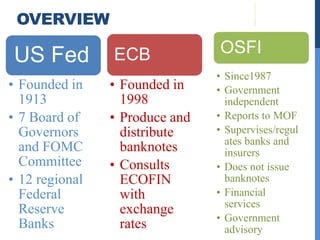
OVERVIEW
                                OSFI
US Fed          ECB
                                • Since1987
• Founded in    • Founded in    • Government
  1913            1998            independent
• 7 Board of    • Produce and   • Reports to MOF
  Governors       distribute    • Supervises/regul
                                  ates banks and
  and FOMC        banknotes       insurers
  Committee     • Consults      • Does not issue
• 12 regional     ECOFIN          banknotes
  Federal         with          • Financial
                                  services
  Reserve         exchange
                                • Government
  Banks           rates           advisory
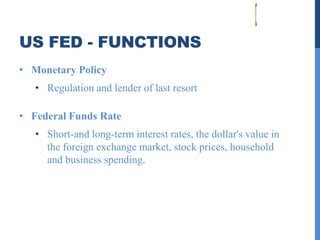
US FED - FUNCTIONS
• Monetary Policy
   • Regulation and lender of last resort

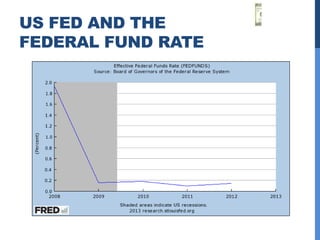
• Federal Funds Rate
   • Short-and long-term interest rates, the dollar's value in
     the foreign exchange market, stock prices, household
     and business spending.
US FED AND THE LENDER OF
LAST RESORT
Lender of Last Resort – Quantitative Easing (QE)
• A government monetary policy OCCASINALLY used to increase the
  money supply by buying government securities or other securities
  from the market
Cost:
• $2.3tn the Fed had already put into QE since 2008
• QE3, entails buying $40 billion in mortgage-backed securities each
  month
US FED AND THE
FEDERAL FUND RATE
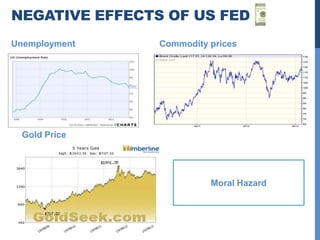
NEGATIVE EFFECTS OF US FED
Unemployment    Commodity prices


 Gold Price


                          Moral Hazard
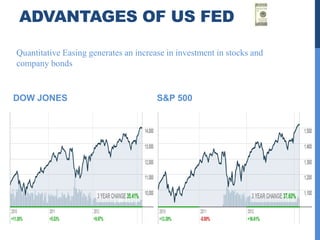
ADVANTAGES OF US FED

Quantitative Easing generates an increase in investment in stocks and
company bonds


DOW JONES                              S&P 500
NO DIRECT ROLE IN
BANKING SUPERVISION,
WHY?
• There are 3 main political and economic reasons why this 2
  agents system was created
   • Countries would not have accepted one single
     establishment to become, the central bank, for all euro
     area.
   • The Euro system approach is build upon the different
     experiences of all NCBs, therefore each member maintains
     their institutional set up, infrastructure and operational
     Capabilities and expertise;
         •   Moreover, NCB continue to perform some non-Euro system-
             related tasks (Internal affairs).
   • In order to maintain a credit institution as an access point
     to central banking in each participating Member State
WHAT IS ECB?
• Lets remember now!

• ECB has legal personality and is fully independent of
  other national and European institutions.
• The ECB manages the Economic and Monetary Union by
  handling the European System of Central Banks (ESCB)
  requirements.
   •   Its primary objective is to maintain price stability; by
       defining their monetary policy of “the Union”
        • Price stability by steadying the general level of prices in the
          economy; thus the avoidance of prolonged inflation and
          deflation will be achieved (Monetary Transparency)
ECB OBJECTIVES AND
RESULTS
•   By maintaining price stability it will be possible to achieve the following
    objectives regarding Community
     •   Enables firms and consumers to make better-informed decisions on
         consumption and investment,
            •   Thus allocating resources more efficiently
     •   Their will be no investors’ risk premium, on stocks or bonds (Smaller
         Interest rate)
            •   An "inflation risk premium" is used to compensate investors for the risks
                associated with holding nominal assets over the longer term.
     •   Price stability makes it less likely that individuals and firms will divert
         resources from productive uses; thus hedging against inflation
     •   In order to make more transparent the Tax and welfare systems

•   Benefits of price stability regarding community
            •   High level of employment  Has this been achieved???
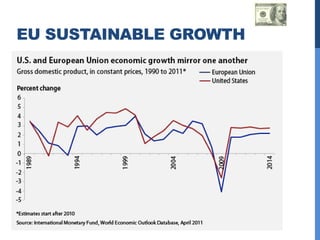
            •   Sustainable growth  Our goal was met?
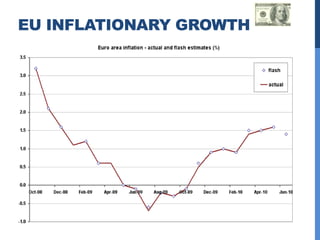
            •   Non-inflationary growth  Did we made the right call???
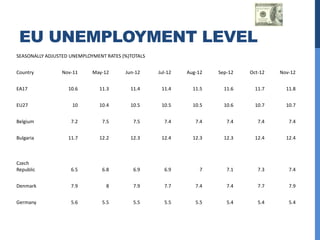
EU UNEMPLOYMENT LEVEL
SEASONALLY ADJUSTED UNEMPLOYMENT RATES (%)TOTALS


Country          Nov-11     May-12      Jun-12     Jul-12   Aug-12   Sep-12   Oct-12   Nov-12


EA17               10.6       11.3        11.4      11.4      11.5     11.6     11.7     11.8


EU27                10        10.4        10.5      10.5      10.5     10.6     10.7     10.7


Belgium             7.2        7.5         7.5       7.4       7.4      7.4      7.4      7.4


Bulgaria           11.7       12.2        12.3      12.4      12.3     12.3     12.4     12.4


Czech
Republic            6.5        6.8         6.9       6.9        7       7.1      7.3      7.4


Denmark             7.9          8         7.9       7.7       7.4      7.4      7.7      7.9


Germany             5.6        5.5         5.5       5.5       5.5      5.4      5.4      5.4
EU SUSTAINABLE GROWTH
EU INFLATIONARY GROWTH
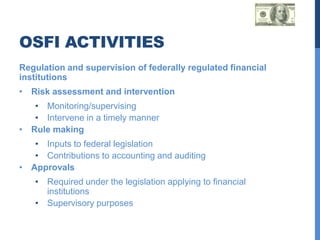
OSFI ACTIVITIES
Regulation and supervision of federally regulated financial
institutions
• Risk assessment and intervention
   • Monitoring/supervising
   • Intervene in a timely manner
• Rule making
   • Inputs to federal legislation
   • Contributions to accounting and auditing
• Approvals
   • Required under the legislation applying to financial
     institutions
   • Supervisory purposes
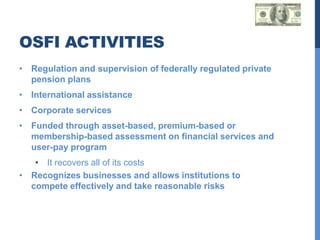
OSFI ACTIVITIES
• Regulation and supervision of federally regulated private
  pension plans
• International assistance
• Corporate services
• Funded through asset-based, premium-based or
  membership-based assessment on financial services and
  user-pay program
   • It recovers all of its costs
• Recognizes businesses and allows institutions to
  compete effectively and take reasonable risks
IMPORTANCE OF OSFI
• Ensures the safety and the soundness of the financial
  system
   • Set the minimum standards
   • Point the deficiencies
   • Set appropriate corrective measures
• Maintain a balance
   • Competition VS stability
   • International rules VS Local market reality
• Creates public confidence in the financial system
EFFECTS OF OSFI
• Treats all members equally
   • Implementing similar regulations and policies
• Direct effects
• Indirect effects to businesses and consumers
   • Businesses taking loans from banks
   • Consumers for private pension plans
• Banks and insurers have a trusted reference
   • OSFI related to governments
   • Reports to MOF
Q&A
THANK
 YOU

Tutorial Presentation

  • 1.
    US FED, OSFI ANDECB TEAM 6 – DUL, LUONG, RAMEEZ, RIANDE, AND SHAAR
  • 2.
    OVERVIEW OSFI US Fed ECB • Since1987 • Founded in • Founded in • Government 1913 1998 independent • 7 Board of • Produce and • Reports to MOF Governors distribute • Supervises/regul ates banks and and FOMC banknotes insurers Committee • Consults • Does not issue • 12 regional ECOFIN banknotes Federal with • Financial services Reserve exchange • Government Banks rates advisory
  • 3.
    US FED -FUNCTIONS • Monetary Policy • Regulation and lender of last resort • Federal Funds Rate • Short-and long-term interest rates, the dollar's value in the foreign exchange market, stock prices, household and business spending.
  • 4.
    US FED ANDTHE LENDER OF LAST RESORT Lender of Last Resort – Quantitative Easing (QE) • A government monetary policy OCCASINALLY used to increase the money supply by buying government securities or other securities from the market Cost: • $2.3tn the Fed had already put into QE since 2008 • QE3, entails buying $40 billion in mortgage-backed securities each month
  • 5.
    US FED ANDTHE FEDERAL FUND RATE
  • 6.
    NEGATIVE EFFECTS OFUS FED Unemployment Commodity prices Gold Price Moral Hazard
  • 7.
    ADVANTAGES OF USFED Quantitative Easing generates an increase in investment in stocks and company bonds DOW JONES S&P 500
  • 8.
    NO DIRECT ROLEIN BANKING SUPERVISION, WHY? • There are 3 main political and economic reasons why this 2 agents system was created • Countries would not have accepted one single establishment to become, the central bank, for all euro area. • The Euro system approach is build upon the different experiences of all NCBs, therefore each member maintains their institutional set up, infrastructure and operational Capabilities and expertise; • Moreover, NCB continue to perform some non-Euro system- related tasks (Internal affairs). • In order to maintain a credit institution as an access point to central banking in each participating Member State
  • 9.
    WHAT IS ECB? •Lets remember now! • ECB has legal personality and is fully independent of other national and European institutions. • The ECB manages the Economic and Monetary Union by handling the European System of Central Banks (ESCB) requirements. • Its primary objective is to maintain price stability; by defining their monetary policy of “the Union” • Price stability by steadying the general level of prices in the economy; thus the avoidance of prolonged inflation and deflation will be achieved (Monetary Transparency)
  • 10.
    ECB OBJECTIVES AND RESULTS • By maintaining price stability it will be possible to achieve the following objectives regarding Community • Enables firms and consumers to make better-informed decisions on consumption and investment, • Thus allocating resources more efficiently • Their will be no investors’ risk premium, on stocks or bonds (Smaller Interest rate) • An "inflation risk premium" is used to compensate investors for the risks associated with holding nominal assets over the longer term. • Price stability makes it less likely that individuals and firms will divert resources from productive uses; thus hedging against inflation • In order to make more transparent the Tax and welfare systems • Benefits of price stability regarding community • High level of employment  Has this been achieved??? • Sustainable growth  Our goal was met? • Non-inflationary growth  Did we made the right call???
  • 11.
    EU UNEMPLOYMENT LEVEL SEASONALLYADJUSTED UNEMPLOYMENT RATES (%)TOTALS Country Nov-11 May-12 Jun-12 Jul-12 Aug-12 Sep-12 Oct-12 Nov-12 EA17 10.6 11.3 11.4 11.4 11.5 11.6 11.7 11.8 EU27 10 10.4 10.5 10.5 10.5 10.6 10.7 10.7 Belgium 7.2 7.5 7.5 7.4 7.4 7.4 7.4 7.4 Bulgaria 11.7 12.2 12.3 12.4 12.3 12.3 12.4 12.4 Czech Republic 6.5 6.8 6.9 6.9 7 7.1 7.3 7.4 Denmark 7.9 8 7.9 7.7 7.4 7.4 7.7 7.9 Germany 5.6 5.5 5.5 5.5 5.5 5.4 5.4 5.4
  • 12.
  • 13.
  • 14.
    OSFI ACTIVITIES Regulation andsupervision of federally regulated financial institutions • Risk assessment and intervention • Monitoring/supervising • Intervene in a timely manner • Rule making • Inputs to federal legislation • Contributions to accounting and auditing • Approvals • Required under the legislation applying to financial institutions • Supervisory purposes
  • 15.
    OSFI ACTIVITIES • Regulationand supervision of federally regulated private pension plans • International assistance • Corporate services • Funded through asset-based, premium-based or membership-based assessment on financial services and user-pay program • It recovers all of its costs • Recognizes businesses and allows institutions to compete effectively and take reasonable risks
  • 16.
    IMPORTANCE OF OSFI •Ensures the safety and the soundness of the financial system • Set the minimum standards • Point the deficiencies • Set appropriate corrective measures • Maintain a balance • Competition VS stability • International rules VS Local market reality • Creates public confidence in the financial system
  • 17.
    EFFECTS OF OSFI •Treats all members equally • Implementing similar regulations and policies • Direct effects • Indirect effects to businesses and consumers • Businesses taking loans from banks • Consumers for private pension plans • Banks and insurers have a trusted reference • OSFI related to governments • Reports to MOF
  • 18.
  • 19.