
Monetary
policy
Jérémy Morvan
Assistant professor
Université de Bretagne Occidentale
Introduction
• To manage a bond portfolio, a fund manager has to anticipate changes in
interest rates
• The credit market is the largest financial market (money market + sovereign &
corporate bond market)
• To anticipate interest rates, it is necessary to capture the main variables involved
in the formation of interest rates
• Expected inflation (𝐶𝑃𝐼)
• Expected growth (𝑌)
• …
• Central banks are major players on money markets
• How do central banks act?
• What are the goals of central banks?
• What is quantitative easing?
Monetary policy
Monetary policy
in normal market conditions
Monetary policy
• Definition
4
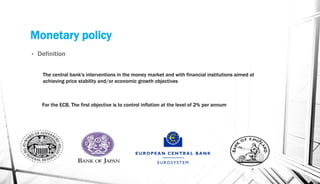
The central bank's interventions in the money market and with financial institutions aimed at
achieving price stability and/or economic growth objectives
For the ECB, The first objective is to control inflation at the level of 2% per annum
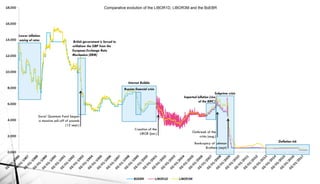
Monetary policy
• Definition
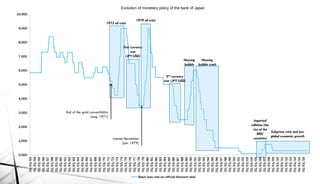
5
Higher
interest rates
Lower demand
Lower inflationary
pressures
Lower
interest rates
Higher demand
Higher inflationary
pressures
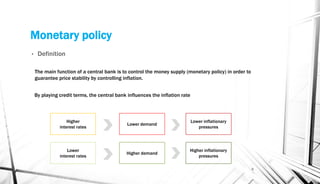
The main function of a central bank is to control the money supply (monetary policy) in order to
guarantee price stability by controlling inflation.
By playing credit terms, the central bank influences the inflation rate
Monetary policy
• Definition
6
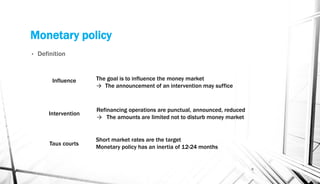
The goal is to influence the money market
→ The announcement of an intervention may suffice
Refinancing operations are punctual, announced, reduced
→ The amounts are limited not to disturb money market
Influence
Intervention
Taux courts
Short market rates are the target
Monetary policy has an inertia of 12-24 months
Monetary policy
• Three pillars of the ECB monetary policy
7
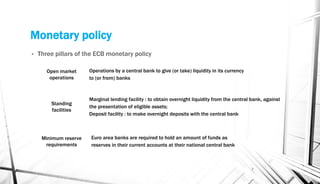
Operations by a central bank to give (or take) liquidity in its currency
to (or from) banks
Open market
operations
Marginal lending facility : to obtain overnight liquidity from the central bank, against
the presentation of eligible assets;
Deposit facility : to make overnight deposits with the central bank
Standing
facilities
Euro area banks are required to hold an amount of funds as
reserves in their current accounts at their national central bank
Minimum reserve
requirements
Monetary policy
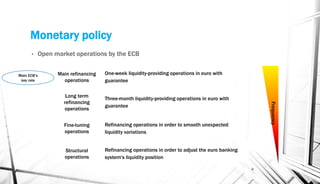
• Open market operations by the ECB
8
One-week liquidity-providing operations in euro with
guarantee
Main refinancing
operations
Main ECB’s
key rate
Three-month liquidity-providing operations in euro with
guarantee
Long term
refinancing
operations
Refinancing operations in order to smooth unexpected
liquidity variations
Fine-tuning
operations
Refinancing operations in order to adjust the euro banking
system's liquidity position
Structural
operations
Frequency
Monetary policy
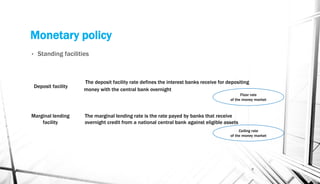
• Standing facilities
9
The deposit facility rate defines the interest banks receive for depositing
money with the central bank overnight
Floor rate
of the money market
Marginal lending
facility
The marginal lending rate is the rate payed by banks that receive
overnight credit from a national central bank against eligible assets
Ceiling rate
of the money market
Deposit facility
Monetary policy
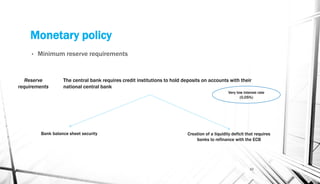
• Minimum reserve requirements
10
The central bank requires credit institutions to hold deposits on accounts with their
national central bank
Very low interest rate
(0,05%)
Bank balance sheet security Creation of a liquidity deficit that requires
banks to refinance with the ECB
Reserve
requirements
Monetary policy
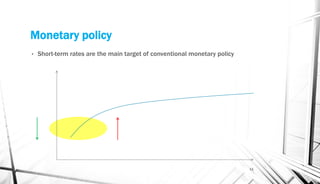
• Short-term rates are the main target of conventional monetary policy
11
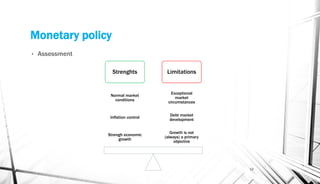
Monetary policy
• Assessment
12
Strenghts Limitations
Growth is not
(always) a primary
objective
Debt market
development
Exceptional
market
circumstances
Strengh economic
growth
Inflation control
Normal market
conditions
Unconventional monetary
policy
Monetary policy
in the event of a major financial crisis
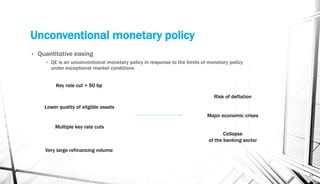
Unconventional monetary policy
• Quantitative easing
• QE is an unconventional monetary policy in response to the limits of monetary policy
under exceptional market conditions
14
Key rate cut > 50 bp
Multiple key rate cuts
Very large refinancing volume
Lower quality of eligible assets
Risk of deflation
Major economic crises
Collapse
of the banking sector
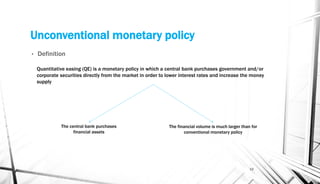
Unconventional monetary policy
• Definition
15
Quantitative easing (QE) is a monetary policy in which a central bank purchases government and/or
corporate securities directly from the market in order to lower interest rates and increase the money
supply
The central bank purchases
financial assets
The financial volume is much larger than for
conventional monetary policy
Unconventional monetary policy
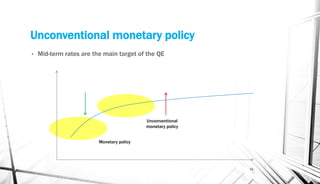
• Mid-term rates are the main target of the QE
16
Monetary policy
Unconventional
monetary policy
Unconventional monetary policy
17
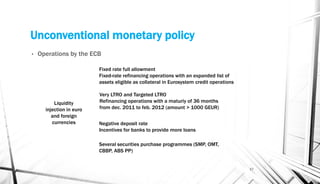
• Operations by the ECB
Fixed rate full allowment
Fixed-rate refinancing operations with an expanded list of
assets eligible as collateral in Eurosystem credit operations
Liquidity
injection in euro
and foreign
currencies
Several securities purchase programmes (SMP, OMT,
CBBP, ABS PP)
Negative deposit rate
Incentives for banks to provide more loans
Very LTRO and Targeted LTRO
Refinancing operations with a maturiy of 36 months
from dec. 2011 to feb. 2012 (amount > 1000 GEUR)
Unconventional monetary policy
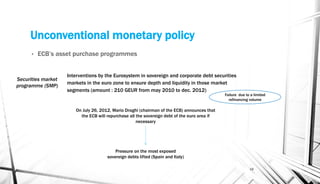
• ECB’s asset purchase programmes
18
Interventions by the Eurosystem in sovereign and corporate debt securities
markets in the euro zone to ensure depth and liquidity in those market
segments (amount : 210 GEUR from may 2010 to dec. 2012)
Securities market
programme (SMP)
Failure due to a limited
refinancing volume
On July 26, 2012, Mario Draghi (chairman of the ECB) announces that
the ECB will repurchase all the sovereign debt of the euro area if
necessary
Pressure on the most exposed
sovereign debts lifted (Spain and Italy)
Unconventional monetary policy
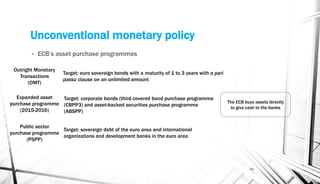
• ECB’s asset purchase programmes
19
The ECB buys assets directly
to give cash to the banks
Outright Monetary
Transactions
(OMT)
Target: euro sovereign bonds with a maturity of 1 to 3 years with a pari
passu clause on an unlimited amount
Expanded asset
purchase programme
(2015-2016)
Target: corporate bonds (third covered bond purchase programme
(CBPP3) and asset-backed securities purchase programme
(ABSPP)
Public sector
purchase programme
(PSPP)
Target: sovereign debt of the euro area and international
organizations and development banks in the euro area
Unconventional monetary policy
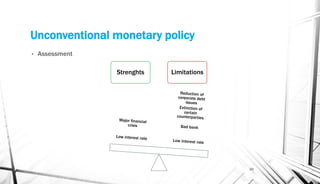
• Assessment
20
Strenghts Limitations
Unconventional monetary policy
• The growth does not only depend on low interest rates
• Unemployment, optimism, international trade…
• Deflationary context
• Lower global growth (BRIC)
• Lower oil prices (BRIC...)
• The QE does not create inflation because the cash does not circulate in the
economy
• Banks have few opportunities in a depressed economic environment and prefer
to put money at negative rates
• The ECB tries to lower the euro
• Toward a currency war?
21
Money market rates
and key rates
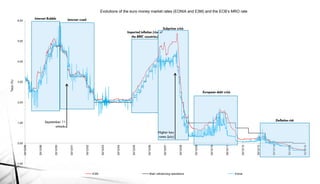
Money market rates
• In the euro area
• The Main Refinancing Operations (MRO) rate is the main ECB’s key rate
• Two money market indices
• Euro Overnight Index Average (EONIA) is the weighted average of all overnight unsecured
lending transactions in the euro interbank market
• Euro Interbank offered rate (E3M) is the averaged interest rates at which Eurozone banks
offer to lend unsecured funds to other banks with a maturity of 3 months
• A money market with a low exposure to the currency risk
• Non-European operators testing the institutional resistance of the ECB
-1,00
0,00
1,00
2,00
3,00
4,00
5,00
6,00
30/12/98
30/12/99
30/12/00
30/12/01
30/12/02
30/12/03
30/12/04
30/12/05
30/12/06
30/12/07
30/12/08
30/12/09
30/12/10
30/12/11
30/12/12
30/12/13
30/12/14
30/12/15
30/12/16
Taux(%) Evolutions of the euro money market rates (EONIA and E3M) and the ECB’s MRO rate
E3M Main refinancing operations Eonia
Internet Bubble
Imported inflation (rise of
the BRIC countries)
Internet crash
Higher key
rates (july)
European debt crisis
Subprime crisis
Deflation riskSeptember 11
attacks
Money market rates
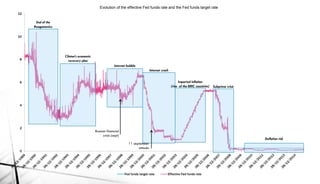
• In the United States
• The effective federal funds rate (EFFR) is calculated as a volume-weighted
median of overnight domestic unsecured borrowings in U.S. dollars by depository
banks
• The Fed conducts open market operations so that the EFFR reaches more or less
that Fed funds target rate
• A major money market is the US
• First political power
• First economic power
• USD is the main currency
0
2
4
6
8
10
12
Evolution of the effective Fed funds rate and the Fed funds target rate
Fed funds target rate Effective Fed funds rate
End of the
Reaganomics
Clinton’s economic
recovery plan
Internet bubble
Russian financial
crisis (sept)
11 september
attacks
Imported inflation
(rise of the BRIC countries) Subprime crisis
Internet crash
Deflation risk
0,000
1,000
2,000
3,000
4,000
5,000
6,000
7,000
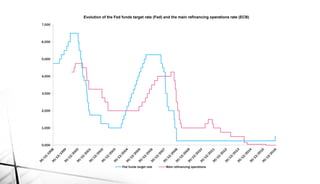
Evolution of the Fed funds target rate (Fed) and the main refinancing operations rate (ECB)
Fed funds target rate Main refinancing operations
Money market rates
• In Great Britain
• The base rate is the rate that the Bank of England charges banks and financial
institutions for overnight credit
• Two interbank rates
• As the EURIBOR for the euro, the LIBOR are interbank offered rates in GBP
• LIBOR1D is an overnight rate
• LIBOR3M is a rate for interbank loans in GBP with a maturity of three months
• A specific history due to an evolution strongly bound to the global banking sector
0,000
2,000
4,000
6,000
8,000
10,000
12,000
14,000
16,000
18,000 Comparative evolution of the LIBOR1D, LIBOR3M and the BoEBR
BOEBR LIBOR1D LIBOR3M
Lower inflation:
easing of rates British government is forced to
withdraw the GBP from the
European Exchange Rate
Mechanism (ERM)
Soros' Quantum Fund began
a massive sell-off of pounds
(15 sept.)
Creation of the
LIBOR (jan.)
Imported inflation (rise
of the BRIC)
Subprime crisis
Outbreak of the
crisis (aug.)
Bankruptcy of Lehman
Brothers (sept)
Internet Bubble
Russian financial crisis
Deflation risk
Money market rates
• In Japan
• The basic loan rate is the standing facility rate for refinancing operations with
the Bank of Japan in JPY with a maturity of 1 day (no collateral is needed for
these overnight loans)
• The call rate is an overnight interbank rate
• A money market with a string link with
• The yen/US-dollar exchange rate
• The oil price (imports) and the global economic growth (exports)
• A market with low rates since the bursting of the housing bubble in 1993
0,000
1,000
2,000
3,000
4,000
5,000
6,000
7,000
8,000
9,000
10,000
01/01/53
01/01/54
01/01/55
01/01/56
01/01/57
01/01/58
01/01/59
01/01/60
01/01/61
01/01/62
01/01/63
01/01/64
01/01/65
01/01/66
01/01/67
01/01/68
01/01/69
01/01/70
01/01/71
01/01/72
01/01/73
01/01/74
01/01/75
01/01/76
01/01/77
01/01/78
01/01/79
01/01/80
01/01/81
01/01/82
01/01/83
01/01/84
01/01/85
01/01/86
01/01/87
01/01/88
01/01/89
01/01/90
01/01/91
01/01/92
01/01/93
01/01/94
01/01/95
01/01/96
01/01/97
01/01/98
01/01/99
01/01/00
01/01/01
01/01/02
01/01/03
01/01/04
01/01/05
01/01/06
01/01/07
01/01/08
01/01/09
01/01/10
01/01/11
01/01/12
01/01/13
01/01/14
01/01/15
01/01/16
Evolution of monetary policy of the bank of Japan
Basic loan rate (ex official discount rate)
Iranian Revolution
(jan. 1979)
1973 oil crisis
End of the gold convertibility
(aug. 1971)
1979 oil crisis
First currency
war
(JPY/USD)
2nd currency
war (JPY/USD)
Housing
bubble
Housing
bubble crash
Imported
inflation (the
rise of the
BRIC
countries)
Subprime crisis and low
global economic growth
Conclusion
“If I turn out to be particularly clear, you've probably
misunderstood what I've said.” (Alan Greenspan)
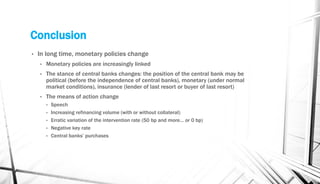
Conclusion
• In long time, monetary policies change
• Monetary policies are increasingly linked
• The stance of central banks changes: the position of the central bank may be
political (before the independence of central banks), monetary (under normal
market conditions), insurance (lender of last resort or buyer of last resort)
• The means of action change
• Speech
• Increasing refinancing volume (with or without collateral)
• Erratic variation of the intervention rate (50 bp and more… or 0 bp)
• Negative key rate
• Central banks’ purchases
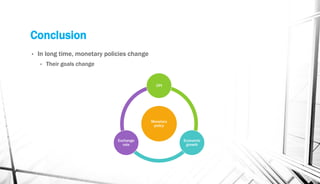
Conclusion
• In long time, monetary policies change
• Their goals change
Monetary
policy
CPI
Economic
growth
Exchange
rate
References
Books & papers
Bernanke Ben S. (2015), The Courage to Act, W.W. Norton & Company, 610 pp.
Clarida Richard, Gali Jordi, Gertler Mark (2000), "Monetary Policy Rules and Macroeconomics Stability: Evidence
and Some Theory", Quarterly Journal of Economics, (115)1, 147-180
Greenspan Alan (2007), The Age of Turbulence, Penguin, London, 531 pp.
Hetzel Robert L. (2002), "German Monetary History in the Second Half of the Twentieth Century: From the Deutsche
Mark to the Euro", Federal Reserve Bank of Richmond Economic Quarterly, (88)2, 29-64
Reinhart, Carmen M., Rogoff Kenneth S. (2013), "Shifting mandates: The Federal Reserve’s first centennial ",
American Economic Review, 103(3), 48-54
Reischauer Edwin O. (1970), Japan, the story of a nation, Knopf, New York, 448 pp.
Web sites
www.bankofengland.co.uk
www.boj.or.jp
www.ecb.europa.eu
www.federalreserve.gov

Monetary policy: monetary orthodoxy or quantitative easing?

  • 1.
  • 2.
    Introduction • To managea bond portfolio, a fund manager has to anticipate changes in interest rates • The credit market is the largest financial market (money market + sovereign & corporate bond market) • To anticipate interest rates, it is necessary to capture the main variables involved in the formation of interest rates • Expected inflation (𝐶𝑃𝐼) • Expected growth (𝑌) • … • Central banks are major players on money markets • How do central banks act? • What are the goals of central banks? • What is quantitative easing?
  • 3.
    Monetary policy Monetary policy innormal market conditions
  • 4.
    Monetary policy • Definition 4 Thecentral bank's interventions in the money market and with financial institutions aimed at achieving price stability and/or economic growth objectives For the ECB, The first objective is to control inflation at the level of 2% per annum
  • 5.
    Monetary policy • Definition 5 Higher interestrates Lower demand Lower inflationary pressures Lower interest rates Higher demand Higher inflationary pressures The main function of a central bank is to control the money supply (monetary policy) in order to guarantee price stability by controlling inflation. By playing credit terms, the central bank influences the inflation rate
  • 6.
    Monetary policy • Definition 6 Thegoal is to influence the money market → The announcement of an intervention may suffice Refinancing operations are punctual, announced, reduced → The amounts are limited not to disturb money market Influence Intervention Taux courts Short market rates are the target Monetary policy has an inertia of 12-24 months
  • 7.
    Monetary policy • Threepillars of the ECB monetary policy 7 Operations by a central bank to give (or take) liquidity in its currency to (or from) banks Open market operations Marginal lending facility : to obtain overnight liquidity from the central bank, against the presentation of eligible assets; Deposit facility : to make overnight deposits with the central bank Standing facilities Euro area banks are required to hold an amount of funds as reserves in their current accounts at their national central bank Minimum reserve requirements
  • 8.
    Monetary policy • Openmarket operations by the ECB 8 One-week liquidity-providing operations in euro with guarantee Main refinancing operations Main ECB’s key rate Three-month liquidity-providing operations in euro with guarantee Long term refinancing operations Refinancing operations in order to smooth unexpected liquidity variations Fine-tuning operations Refinancing operations in order to adjust the euro banking system's liquidity position Structural operations Frequency
  • 9.
    Monetary policy • Standingfacilities 9 The deposit facility rate defines the interest banks receive for depositing money with the central bank overnight Floor rate of the money market Marginal lending facility The marginal lending rate is the rate payed by banks that receive overnight credit from a national central bank against eligible assets Ceiling rate of the money market Deposit facility
  • 10.
    Monetary policy • Minimumreserve requirements 10 The central bank requires credit institutions to hold deposits on accounts with their national central bank Very low interest rate (0,05%) Bank balance sheet security Creation of a liquidity deficit that requires banks to refinance with the ECB Reserve requirements
  • 11.
    Monetary policy • Short-termrates are the main target of conventional monetary policy 11
  • 12.
    Monetary policy • Assessment 12 StrenghtsLimitations Growth is not (always) a primary objective Debt market development Exceptional market circumstances Strengh economic growth Inflation control Normal market conditions
  • 13.
    Unconventional monetary policy Monetary policy inthe event of a major financial crisis
  • 14.
    Unconventional monetary policy •Quantitative easing • QE is an unconventional monetary policy in response to the limits of monetary policy under exceptional market conditions 14 Key rate cut > 50 bp Multiple key rate cuts Very large refinancing volume Lower quality of eligible assets Risk of deflation Major economic crises Collapse of the banking sector
  • 15.
    Unconventional monetary policy •Definition 15 Quantitative easing (QE) is a monetary policy in which a central bank purchases government and/or corporate securities directly from the market in order to lower interest rates and increase the money supply The central bank purchases financial assets The financial volume is much larger than for conventional monetary policy
  • 16.
    Unconventional monetary policy •Mid-term rates are the main target of the QE 16 Monetary policy Unconventional monetary policy
  • 17.
    Unconventional monetary policy 17 •Operations by the ECB Fixed rate full allowment Fixed-rate refinancing operations with an expanded list of assets eligible as collateral in Eurosystem credit operations Liquidity injection in euro and foreign currencies Several securities purchase programmes (SMP, OMT, CBBP, ABS PP) Negative deposit rate Incentives for banks to provide more loans Very LTRO and Targeted LTRO Refinancing operations with a maturiy of 36 months from dec. 2011 to feb. 2012 (amount > 1000 GEUR)
  • 18.
    Unconventional monetary policy •ECB’s asset purchase programmes 18 Interventions by the Eurosystem in sovereign and corporate debt securities markets in the euro zone to ensure depth and liquidity in those market segments (amount : 210 GEUR from may 2010 to dec. 2012) Securities market programme (SMP) Failure due to a limited refinancing volume On July 26, 2012, Mario Draghi (chairman of the ECB) announces that the ECB will repurchase all the sovereign debt of the euro area if necessary Pressure on the most exposed sovereign debts lifted (Spain and Italy)
  • 19.
    Unconventional monetary policy •ECB’s asset purchase programmes 19 The ECB buys assets directly to give cash to the banks Outright Monetary Transactions (OMT) Target: euro sovereign bonds with a maturity of 1 to 3 years with a pari passu clause on an unlimited amount Expanded asset purchase programme (2015-2016) Target: corporate bonds (third covered bond purchase programme (CBPP3) and asset-backed securities purchase programme (ABSPP) Public sector purchase programme (PSPP) Target: sovereign debt of the euro area and international organizations and development banks in the euro area
  • 20.
    Unconventional monetary policy •Assessment 20 Strenghts Limitations
  • 21.
    Unconventional monetary policy •The growth does not only depend on low interest rates • Unemployment, optimism, international trade… • Deflationary context • Lower global growth (BRIC) • Lower oil prices (BRIC...) • The QE does not create inflation because the cash does not circulate in the economy • Banks have few opportunities in a depressed economic environment and prefer to put money at negative rates • The ECB tries to lower the euro • Toward a currency war? 21
  • 22.
  • 23.
    Money market rates •In the euro area • The Main Refinancing Operations (MRO) rate is the main ECB’s key rate • Two money market indices • Euro Overnight Index Average (EONIA) is the weighted average of all overnight unsecured lending transactions in the euro interbank market • Euro Interbank offered rate (E3M) is the averaged interest rates at which Eurozone banks offer to lend unsecured funds to other banks with a maturity of 3 months • A money market with a low exposure to the currency risk • Non-European operators testing the institutional resistance of the ECB
  • 24.
    -1,00 0,00 1,00 2,00 3,00 4,00 5,00 6,00 30/12/98 30/12/99 30/12/00 30/12/01 30/12/02 30/12/03 30/12/04 30/12/05 30/12/06 30/12/07 30/12/08 30/12/09 30/12/10 30/12/11 30/12/12 30/12/13 30/12/14 30/12/15 30/12/16 Taux(%) Evolutions ofthe euro money market rates (EONIA and E3M) and the ECB’s MRO rate E3M Main refinancing operations Eonia Internet Bubble Imported inflation (rise of the BRIC countries) Internet crash Higher key rates (july) European debt crisis Subprime crisis Deflation riskSeptember 11 attacks
  • 25.
    Money market rates •In the United States • The effective federal funds rate (EFFR) is calculated as a volume-weighted median of overnight domestic unsecured borrowings in U.S. dollars by depository banks • The Fed conducts open market operations so that the EFFR reaches more or less that Fed funds target rate • A major money market is the US • First political power • First economic power • USD is the main currency
  • 26.
    0 2 4 6 8 10 12 Evolution of theeffective Fed funds rate and the Fed funds target rate Fed funds target rate Effective Fed funds rate End of the Reaganomics Clinton’s economic recovery plan Internet bubble Russian financial crisis (sept) 11 september attacks Imported inflation (rise of the BRIC countries) Subprime crisis Internet crash Deflation risk
  • 27.
    0,000 1,000 2,000 3,000 4,000 5,000 6,000 7,000 Evolution of theFed funds target rate (Fed) and the main refinancing operations rate (ECB) Fed funds target rate Main refinancing operations
  • 28.
    Money market rates •In Great Britain • The base rate is the rate that the Bank of England charges banks and financial institutions for overnight credit • Two interbank rates • As the EURIBOR for the euro, the LIBOR are interbank offered rates in GBP • LIBOR1D is an overnight rate • LIBOR3M is a rate for interbank loans in GBP with a maturity of three months • A specific history due to an evolution strongly bound to the global banking sector
  • 29.
    0,000 2,000 4,000 6,000 8,000 10,000 12,000 14,000 16,000 18,000 Comparative evolutionof the LIBOR1D, LIBOR3M and the BoEBR BOEBR LIBOR1D LIBOR3M Lower inflation: easing of rates British government is forced to withdraw the GBP from the European Exchange Rate Mechanism (ERM) Soros' Quantum Fund began a massive sell-off of pounds (15 sept.) Creation of the LIBOR (jan.) Imported inflation (rise of the BRIC) Subprime crisis Outbreak of the crisis (aug.) Bankruptcy of Lehman Brothers (sept) Internet Bubble Russian financial crisis Deflation risk
  • 30.
    Money market rates •In Japan • The basic loan rate is the standing facility rate for refinancing operations with the Bank of Japan in JPY with a maturity of 1 day (no collateral is needed for these overnight loans) • The call rate is an overnight interbank rate • A money market with a string link with • The yen/US-dollar exchange rate • The oil price (imports) and the global economic growth (exports) • A market with low rates since the bursting of the housing bubble in 1993
  • 31.
    0,000 1,000 2,000 3,000 4,000 5,000 6,000 7,000 8,000 9,000 10,000 01/01/53 01/01/54 01/01/55 01/01/56 01/01/57 01/01/58 01/01/59 01/01/60 01/01/61 01/01/62 01/01/63 01/01/64 01/01/65 01/01/66 01/01/67 01/01/68 01/01/69 01/01/70 01/01/71 01/01/72 01/01/73 01/01/74 01/01/75 01/01/76 01/01/77 01/01/78 01/01/79 01/01/80 01/01/81 01/01/82 01/01/83 01/01/84 01/01/85 01/01/86 01/01/87 01/01/88 01/01/89 01/01/90 01/01/91 01/01/92 01/01/93 01/01/94 01/01/95 01/01/96 01/01/97 01/01/98 01/01/99 01/01/00 01/01/01 01/01/02 01/01/03 01/01/04 01/01/05 01/01/06 01/01/07 01/01/08 01/01/09 01/01/10 01/01/11 01/01/12 01/01/13 01/01/14 01/01/15 01/01/16 Evolution of monetarypolicy of the bank of Japan Basic loan rate (ex official discount rate) Iranian Revolution (jan. 1979) 1973 oil crisis End of the gold convertibility (aug. 1971) 1979 oil crisis First currency war (JPY/USD) 2nd currency war (JPY/USD) Housing bubble Housing bubble crash Imported inflation (the rise of the BRIC countries) Subprime crisis and low global economic growth
  • 32.
    Conclusion “If I turnout to be particularly clear, you've probably misunderstood what I've said.” (Alan Greenspan)
  • 33.
    Conclusion • In longtime, monetary policies change • Monetary policies are increasingly linked • The stance of central banks changes: the position of the central bank may be political (before the independence of central banks), monetary (under normal market conditions), insurance (lender of last resort or buyer of last resort) • The means of action change • Speech • Increasing refinancing volume (with or without collateral) • Erratic variation of the intervention rate (50 bp and more… or 0 bp) • Negative key rate • Central banks’ purchases
  • 34.
    Conclusion • In longtime, monetary policies change • Their goals change Monetary policy CPI Economic growth Exchange rate
  • 35.
    References Books & papers BernankeBen S. (2015), The Courage to Act, W.W. Norton & Company, 610 pp. Clarida Richard, Gali Jordi, Gertler Mark (2000), "Monetary Policy Rules and Macroeconomics Stability: Evidence and Some Theory", Quarterly Journal of Economics, (115)1, 147-180 Greenspan Alan (2007), The Age of Turbulence, Penguin, London, 531 pp. Hetzel Robert L. (2002), "German Monetary History in the Second Half of the Twentieth Century: From the Deutsche Mark to the Euro", Federal Reserve Bank of Richmond Economic Quarterly, (88)2, 29-64 Reinhart, Carmen M., Rogoff Kenneth S. (2013), "Shifting mandates: The Federal Reserve’s first centennial ", American Economic Review, 103(3), 48-54 Reischauer Edwin O. (1970), Japan, the story of a nation, Knopf, New York, 448 pp. Web sites www.bankofengland.co.uk www.boj.or.jp www.ecb.europa.eu www.federalreserve.gov