Hello!
We are,
Aman Kumar
Deepak Kumar
Himanshu Anand
Jayati Chaube
Yash Paunikar
Rachit Vohra
2
Monetary
Policy
3
“
○ Monetary policy consists of the process of
drafting, announcing and implementing the
plan of actions taken by the central bank,
currency board or other competent regulatory
authority of a country that determines the
scope and impact of the key drivers of the
economic activity in that country.
○ Activities which are integral to monetary
policy consists of management of money
supply and interest rates which are aimed at
achieving macroeconomic objectives like
controlling inflation, consumption, growth
and liquidity.
4
What is Monetary Policy
European
Monetary
Policy
5
The Treaty did three things to further
monetary integration in Europe.
1. It set out a timetable for the
establishment of monetary union.
2. It laid down the criteria by which the
fitness of countries to join in monetary
union would be determined.
3. It established the institutional framework
for the conduct of monetary policy under
EMU.
6
The Road to EMU
The European Central Bank
○ Ensuring that EU prices are stable, that is below
2% but also close to 2% to avoid the danger of
deflation
○ Managing EU interest rates and money supply
○ Providing liquidity to the system when needed
7
Activities of the ECB
When a European country joins the euro-area its
central bank cedes much of its power to the
ECB.
The European Central Bank (ECB) oversees EU
monetary policy.
8
The ECB’s monetary policy strategy
○ Overview
○ Price stability
○ The first pillar of the monetary policy
strategy: Economic analysis
○ The second pillar of the monetary policy
strategy: Monetary analysis
9
The guiding principles of ECB action
○ The independence of the ECB
○ The principles of accountability and
transparency of the ECB
○ Voting rules in the ECB Governing
Council
Stage One: July 1, 1990.
○ The complete elimination of capital controls
among the Member States and increased
cooperation between their central banks.
10
The three stages of monetary union
Stage Two: January 1, 1994.
○ The real beginning of the transition to EMU with the
establishment of the European Monetary Institute
(EMI).
○ EMI = precursor of the European Central Bank,
charged with co-ordinating monetary policy and
preparation for the single currency.
11
The three stages of monetary union
Stage Three: January 1, 1999.
○ Eleven countries fixed their exchange
rates.
○ The national currencies of the eleven were
replaced by the euro.
○ The ECB took over responsibility for
monetary policy in the euro area.
12
The three stages of monetary union
13
The European System of Central Banks (ESCB)
comprises the ECB and the national central banks of all
the EU Member States. The primary objective of the
ESCB is to maintain price stability. In order to achieve its
primary objective, the Governing Council of the ECB
bases its decisions on a two-pillar monetary policy
strategy and implements them using both standard and
non-standard monetary policy measures. The main
instruments of ECB standard monetary policy are open
market operations, standing facilities and the holding of
minimum reserves. As a response to the financial crisis,
the ECB has also changed its communication strategy by
providing forward guidance on the future path of the
ECB’s interest rate policy conditional on the outlook for
price stability and has taken a number of non-standard
monetary policy measures. These include the purchases
of assets and sovereign bonds on the secondary market,
with the aim of safeguarding price stability and the
effectiveness of the monetary policy transmission
mechanism.
European System of Central Banks
14
Long run neutrality of money
○ The underlying economic philosophy of the ECB is
that, in the long run, real income and the level of
employment - that is, the real economy - is not
determined by the money supply. The main objective
of monetary policy is to achieve short term price
stability as this is seen as the way to provide an
economic framework for supply side growth.
○ The policy instrument used is short term interest
rates.
The ECB meets on a monthly basis to determine
two things:
○ The level of interest rates across the euro
area - the 19 countries that share the euro
○ The quantity of money in circulation
The primary purpose of the ECB is to control euro-
area inflation so that the value of the euro remains
constant and strong. It also provides liquidity into
the system when needed. If an EU country joins
the euro area, its central bank cedes most of its
power to the ECB.
15
Monetary Policy in Europe
16
EU monetary institutions are fundamentally anti-
fiscal, and greatly influenced by the monetarist
view.
Europe’s view can be summarized as:
• Fiscal policy is less useful than monetary
policy to help stabilize the macro-economy.
• Too much borrowing will harm the stability of
the Euro, hence the Stability Pact.
• Fiscal policy is less useful than supply-side
policy to help create long-term growth.
○ Unlike the Bank of England's inflation target, which is
symmetrical, the ECB target is asymmetrical. This
means that while inflation cannot rise above 2%, there
is no figure which it is must not fall below. Critics
argue that this creates an in-built recessionary bias,
with no specific policy intervention required if deflation
occurs. In the UK, the target is 2% +/- 1, so that an
inflation rate of less than 1% triggers a monetary
stimulus.
17
Asymmetric inflation target
18
Euro area interest rates
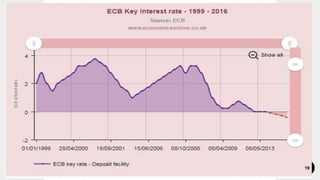
• Euro-area interest rates remained fairly stable
from 1999 until 2009, but rates on the main
deposit facility began to fall from 2009, moving
into negative territory from 2014, reflecting
deflationary conditions across the euro-area.
•
Even before the financial crisis, the one-size-fits-
all approach had been running into difficulty.
This was largely because of increasing
differences in the performance of the various
euro area countries, including differences in
growth rates, fiscal deficits, trade balances, and
house prices.
19
20
The poor macro-economic
performance of the Euro area
In recent years growth rates in the EU have
lagged behind those of the USA and the UK.
The poor growth record of the euro area
may be down to the inflexible economies of
its member countries, rather than monetary
policy. In other words, the underlying
problems of Europe are more to do with
poor supply-side performance than
ineffective demand-side policy. The ECB
itself recognizes that growth problems are
more down to national governments failing
to come to terms with globalization, that with
ineffective monetary policy.
21
In addition, the ECB has been generally
reluctant to reduce interest rates to deal with
sluggish growth, mainly due to fears about
raising inflationary expectations. However,
the financial crisis of 2008-09 has forced the
ECB to reduce interest rates to a historically
low level, at 1.5%, and continued to reduce
them in response to the deepening economic
downturn.
Critics argue that, unless the economy is
flexible, a fiscal or monetary stimulus to help
the financial crisis may simply drive up prices.
22
In addition, a fiscal stimulus could also lead
to balance of payments problems, and if
funded by borrowing, could crowd-out the
private sector.
The Stability Pact was established to provides
a constraint against a fiscal stimulus, although
the depth of the financial crisis has caused
debt levels to rise well above those set down
in the pact. The ongoing sovereign debt crisis
has put the whole Euro-system at risk as it
battles to form a fiscal union which would give
power to the EU itself to control national
budgets.
The European Financial Stability Facility
○ The European Financial Stability Facility (EFSF) was
established in May 2010 to manage the €780b of
financial aid guarantees made necessary as debt-
laden Euro members try to cope with the fall-out
from the financial crisis. The Luxembourg based
EFSF is part of the wider European Financial
Stabilization Mechanism (EFSM).
○ The fund, which provides temporary financial
assistance, is supported by the 19 Euro members to
the tune of €500b, with the remainder provided by
the IMF. Germany is the single biggest guarantor,
followed by France and Italy. Together, Germany
and France provide 50% of the total guarantees.
23
24
Thanks!
Any questions?

Monetary policy of EU

  • 2.
    Hello! We are, Aman Kumar DeepakKumar Himanshu Anand Jayati Chaube Yash Paunikar Rachit Vohra 2
  • 3.
  • 4.
    “ ○ Monetary policyconsists of the process of drafting, announcing and implementing the plan of actions taken by the central bank, currency board or other competent regulatory authority of a country that determines the scope and impact of the key drivers of the economic activity in that country. ○ Activities which are integral to monetary policy consists of management of money supply and interest rates which are aimed at achieving macroeconomic objectives like controlling inflation, consumption, growth and liquidity. 4 What is Monetary Policy
  • 5.
  • 6.
    The Treaty didthree things to further monetary integration in Europe. 1. It set out a timetable for the establishment of monetary union. 2. It laid down the criteria by which the fitness of countries to join in monetary union would be determined. 3. It established the institutional framework for the conduct of monetary policy under EMU. 6 The Road to EMU
  • 7.
    The European CentralBank ○ Ensuring that EU prices are stable, that is below 2% but also close to 2% to avoid the danger of deflation ○ Managing EU interest rates and money supply ○ Providing liquidity to the system when needed 7 Activities of the ECB When a European country joins the euro-area its central bank cedes much of its power to the ECB. The European Central Bank (ECB) oversees EU monetary policy.
  • 8.
    8 The ECB’s monetarypolicy strategy ○ Overview ○ Price stability ○ The first pillar of the monetary policy strategy: Economic analysis ○ The second pillar of the monetary policy strategy: Monetary analysis
  • 9.
    9 The guiding principlesof ECB action ○ The independence of the ECB ○ The principles of accountability and transparency of the ECB ○ Voting rules in the ECB Governing Council
  • 10.
    Stage One: July1, 1990. ○ The complete elimination of capital controls among the Member States and increased cooperation between their central banks. 10 The three stages of monetary union
  • 11.
    Stage Two: January1, 1994. ○ The real beginning of the transition to EMU with the establishment of the European Monetary Institute (EMI). ○ EMI = precursor of the European Central Bank, charged with co-ordinating monetary policy and preparation for the single currency. 11 The three stages of monetary union
  • 12.
    Stage Three: January1, 1999. ○ Eleven countries fixed their exchange rates. ○ The national currencies of the eleven were replaced by the euro. ○ The ECB took over responsibility for monetary policy in the euro area. 12 The three stages of monetary union
  • 13.
    13 The European Systemof Central Banks (ESCB) comprises the ECB and the national central banks of all the EU Member States. The primary objective of the ESCB is to maintain price stability. In order to achieve its primary objective, the Governing Council of the ECB bases its decisions on a two-pillar monetary policy strategy and implements them using both standard and non-standard monetary policy measures. The main instruments of ECB standard monetary policy are open market operations, standing facilities and the holding of minimum reserves. As a response to the financial crisis, the ECB has also changed its communication strategy by providing forward guidance on the future path of the ECB’s interest rate policy conditional on the outlook for price stability and has taken a number of non-standard monetary policy measures. These include the purchases of assets and sovereign bonds on the secondary market, with the aim of safeguarding price stability and the effectiveness of the monetary policy transmission mechanism. European System of Central Banks
  • 14.
    14 Long run neutralityof money ○ The underlying economic philosophy of the ECB is that, in the long run, real income and the level of employment - that is, the real economy - is not determined by the money supply. The main objective of monetary policy is to achieve short term price stability as this is seen as the way to provide an economic framework for supply side growth. ○ The policy instrument used is short term interest rates.
  • 15.
    The ECB meetson a monthly basis to determine two things: ○ The level of interest rates across the euro area - the 19 countries that share the euro ○ The quantity of money in circulation The primary purpose of the ECB is to control euro- area inflation so that the value of the euro remains constant and strong. It also provides liquidity into the system when needed. If an EU country joins the euro area, its central bank cedes most of its power to the ECB. 15 Monetary Policy in Europe
  • 16.
    16 EU monetary institutionsare fundamentally anti- fiscal, and greatly influenced by the monetarist view. Europe’s view can be summarized as: • Fiscal policy is less useful than monetary policy to help stabilize the macro-economy. • Too much borrowing will harm the stability of the Euro, hence the Stability Pact. • Fiscal policy is less useful than supply-side policy to help create long-term growth.
  • 17.
    ○ Unlike theBank of England's inflation target, which is symmetrical, the ECB target is asymmetrical. This means that while inflation cannot rise above 2%, there is no figure which it is must not fall below. Critics argue that this creates an in-built recessionary bias, with no specific policy intervention required if deflation occurs. In the UK, the target is 2% +/- 1, so that an inflation rate of less than 1% triggers a monetary stimulus. 17 Asymmetric inflation target
  • 18.
    18 Euro area interestrates • Euro-area interest rates remained fairly stable from 1999 until 2009, but rates on the main deposit facility began to fall from 2009, moving into negative territory from 2014, reflecting deflationary conditions across the euro-area. • Even before the financial crisis, the one-size-fits- all approach had been running into difficulty. This was largely because of increasing differences in the performance of the various euro area countries, including differences in growth rates, fiscal deficits, trade balances, and house prices.
  • 19.
  • 20.
    20 The poor macro-economic performanceof the Euro area In recent years growth rates in the EU have lagged behind those of the USA and the UK. The poor growth record of the euro area may be down to the inflexible economies of its member countries, rather than monetary policy. In other words, the underlying problems of Europe are more to do with poor supply-side performance than ineffective demand-side policy. The ECB itself recognizes that growth problems are more down to national governments failing to come to terms with globalization, that with ineffective monetary policy.
  • 21.
    21 In addition, theECB has been generally reluctant to reduce interest rates to deal with sluggish growth, mainly due to fears about raising inflationary expectations. However, the financial crisis of 2008-09 has forced the ECB to reduce interest rates to a historically low level, at 1.5%, and continued to reduce them in response to the deepening economic downturn. Critics argue that, unless the economy is flexible, a fiscal or monetary stimulus to help the financial crisis may simply drive up prices.
  • 22.
    22 In addition, afiscal stimulus could also lead to balance of payments problems, and if funded by borrowing, could crowd-out the private sector. The Stability Pact was established to provides a constraint against a fiscal stimulus, although the depth of the financial crisis has caused debt levels to rise well above those set down in the pact. The ongoing sovereign debt crisis has put the whole Euro-system at risk as it battles to form a fiscal union which would give power to the EU itself to control national budgets.
  • 23.
    The European FinancialStability Facility ○ The European Financial Stability Facility (EFSF) was established in May 2010 to manage the €780b of financial aid guarantees made necessary as debt- laden Euro members try to cope with the fall-out from the financial crisis. The Luxembourg based EFSF is part of the wider European Financial Stabilization Mechanism (EFSM). ○ The fund, which provides temporary financial assistance, is supported by the 19 Euro members to the tune of €500b, with the remainder provided by the IMF. Germany is the single biggest guarantor, followed by France and Italy. Together, Germany and France provide 50% of the total guarantees. 23
  • 24.