Federal Reserve
By: Brit Malner, Shenna Xiong, Jeffrey Graves.
Brianna Worster, and Ana M. Adams-Wiley
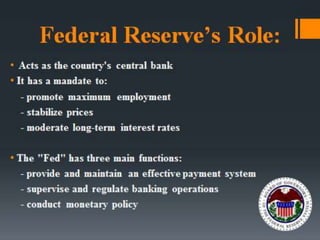
Federal Reserve’s Role:
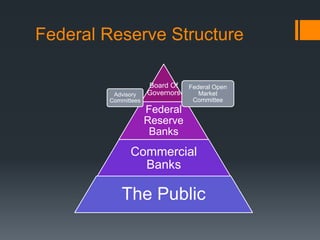
Board Of
Governors
Federal
Reserve
Banks
Commercial
Banks
The Public
Federal Open
Market
Committee
Advisory
Committees
Federal Reserve Structure
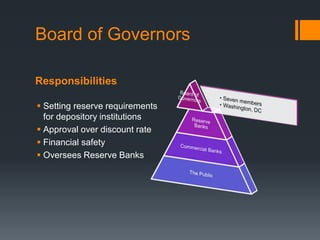
Board of Governors
Responsibilities
 Setting reserve requirements
for depository institutions
 Approval over discount rate
 Financial safety
 Oversees Reserve Banks
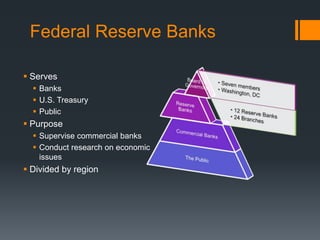
Federal Reserve Banks
 Serves
 Banks
 U.S. Treasury
 Public
 Purpose
 Supervise commercial banks
 Conduct research on economic
issues
 Divided by region
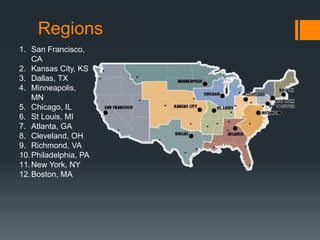
Regions
1. San Francisco,
CA
2. Kansas City, KS
3. Dallas, TX
4. Minneapolis,
MN
5. Chicago, IL
6. St Louis, MI
7. Atlanta, GA
8. Cleveland, OH
9. Richmond, VA
10.Philadelphia, PA
11.New York, NY
12.Boston, MA
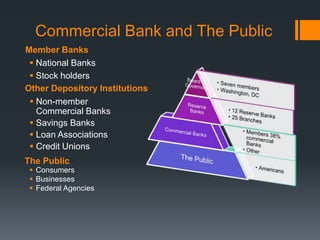
Commercial Bank and The Public
 Consumers
 Businesses
 Federal Agencies
Member Banks
 National Banks
 Stock holders
Other Depository Institutions
 Non-member
Commercial Banks
 Savings Banks
 Loan Associations
 Credit Unions
The Public
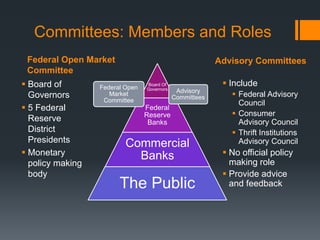
Committees: Members and Roles
Federal Open Market
Committee
 Board of
Governors
 5 Federal
Reserve
District
Presidents
 Monetary
policy making
body
Advisory Committees
 Include
 Federal Advisory
Council
 Consumer
Advisory Council
 Thrift Institutions
Advisory Council
 No official policy
making role
 Provide advice
and feedback
Board Of
Governors
Federal
Reserve
Banks
Commercial
Banks
The Public
Federal Open
Market
Committee
Advisory
Committees
Monetary Policy
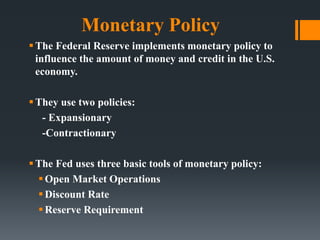
The Federal Reserve implements monetary policy to
influence the amount of money and credit in the U.S.
economy.
They use two policies:
- Expansionary
-Contractionary
The Fed uses three basic tools of monetary policy:
Open Market Operations
Discount Rate
Reserve Requirement
Policies and Tools Used:
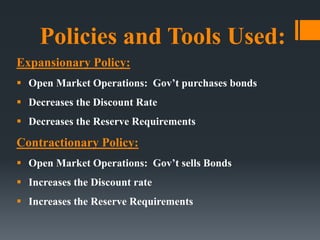
Expansionary Policy:
 Open Market Operations: Gov’t purchases bonds
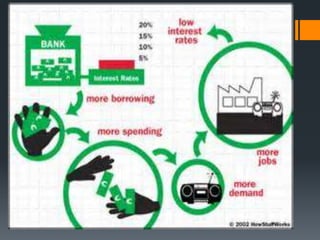
 Decreases the Discount Rate
 Decreases the Reserve Requirements
Contractionary Policy:
 Open Market Operations: Gov’t sells Bonds
 Increases the Discount rate
 Increases the Reserve Requirements
Open Market Operations
When the Fed wants to influence the money
supply, they will buy or sell government bonds.
This is called open market operations.
When the Fed wants to increase the money supply
they will buy bonds. When the Fed wants to
decrease the money supply the will sell bonds.
Open market operations is the most important tool
of monetary policy because it’s subtle, and can be
implemented quickly and cheaply.
Reserve Requirement
The reserve requirement is the percent of deposits
a bank must keep as reserves.
A higher reserve requirement lowers the money
supply.
A lower reserve requirement raises the money
supply.
Though it’s hardly ever used, the reserve
requirement affects the amount of money a bank
can lend.
Monetary Measures Used:
 Provides payment services to keep a stable system
 During the financial crisis: liquidity was provided
because loans were undesirable due to credit markets
being seized.
 Currently there are several temporary lending programs
to nonbank financial institutions:
- commercial paper issuers
- money market mutual fund
- primary securities dealer
 In 2010 the Dodd- Frank Act restricted the Federal
Reserve to lend money without the approval from U.S
Treasury Department.
 Contractionary Monetary Policy : This lowers,
- inflation rates
- creates employment
- stabilizes prices
Works Cited
 "AmosWEB Is Economics: Encyclonomic WEB*pedia." AmosWEB Is
Economics: Encyclonomic WEB*pedia. Web. 12 Nov. 2015.
 Smale, Pauline. "Structure and Functions of the Federal Reserve System."
Structure and Functions of the Federal Reserve System. US Department of
State, 2010. Print.
 "The Fed's Structure - Federal Reserve Structure and Functions." Federal
Reserve Bank of Atlanta. Web. 10 Nov. 2015.
 "The Structure and Functions of the Federal Reserve System." The Structure
and Functions of the Federal Reserve System. Web. 12 Nov. 2015.
 "The Structure of the Federal Reserve System." The Structure of the Federal
Reserve System. Web. 16 Nov. 2015.
 "National Fed Resources." Federal Reserve System. Web. 16 Nov. 2015.
 https://www.youtube.com/watch?v=MRUITSOw6Ek
 "What Is the Fed: Financial Stability." Education. Federal Reserve Bank of
San Francisco, n.d. Web. 19 Nov. 2015.
 http://blog-imfdirect.imf.org/2013/07/30/u-s-fiscal-policy-a-tough-balancing-
act/

Federal Reserve

  • 1.
    Federal Reserve By: BritMalner, Shenna Xiong, Jeffrey Graves. Brianna Worster, and Ana M. Adams-Wiley
  • 2.
  • 3.
    Board Of Governors Federal Reserve Banks Commercial Banks The Public FederalOpen Market Committee Advisory Committees Federal Reserve Structure
  • 4.
    Board of Governors Responsibilities Setting reserve requirements for depository institutions  Approval over discount rate  Financial safety  Oversees Reserve Banks
  • 5.
    Federal Reserve Banks Serves  Banks  U.S. Treasury  Public  Purpose  Supervise commercial banks  Conduct research on economic issues  Divided by region
  • 6.
    Regions 1. San Francisco, CA 2.Kansas City, KS 3. Dallas, TX 4. Minneapolis, MN 5. Chicago, IL 6. St Louis, MI 7. Atlanta, GA 8. Cleveland, OH 9. Richmond, VA 10.Philadelphia, PA 11.New York, NY 12.Boston, MA
  • 7.
    Commercial Bank andThe Public  Consumers  Businesses  Federal Agencies Member Banks  National Banks  Stock holders Other Depository Institutions  Non-member Commercial Banks  Savings Banks  Loan Associations  Credit Unions The Public
  • 8.
    Committees: Members andRoles Federal Open Market Committee  Board of Governors  5 Federal Reserve District Presidents  Monetary policy making body Advisory Committees  Include  Federal Advisory Council  Consumer Advisory Council  Thrift Institutions Advisory Council  No official policy making role  Provide advice and feedback Board Of Governors Federal Reserve Banks Commercial Banks The Public Federal Open Market Committee Advisory Committees
  • 9.
    Monetary Policy The FederalReserve implements monetary policy to influence the amount of money and credit in the U.S. economy. They use two policies: - Expansionary -Contractionary The Fed uses three basic tools of monetary policy: Open Market Operations Discount Rate Reserve Requirement
  • 10.
    Policies and ToolsUsed: Expansionary Policy:  Open Market Operations: Gov’t purchases bonds  Decreases the Discount Rate  Decreases the Reserve Requirements Contractionary Policy:  Open Market Operations: Gov’t sells Bonds  Increases the Discount rate  Increases the Reserve Requirements
  • 11.
    Open Market Operations Whenthe Fed wants to influence the money supply, they will buy or sell government bonds. This is called open market operations. When the Fed wants to increase the money supply they will buy bonds. When the Fed wants to decrease the money supply the will sell bonds. Open market operations is the most important tool of monetary policy because it’s subtle, and can be implemented quickly and cheaply.
  • 12.
    Reserve Requirement The reserverequirement is the percent of deposits a bank must keep as reserves. A higher reserve requirement lowers the money supply. A lower reserve requirement raises the money supply. Though it’s hardly ever used, the reserve requirement affects the amount of money a bank can lend.
  • 13.
    Monetary Measures Used: Provides payment services to keep a stable system  During the financial crisis: liquidity was provided because loans were undesirable due to credit markets being seized.  Currently there are several temporary lending programs to nonbank financial institutions: - commercial paper issuers - money market mutual fund - primary securities dealer  In 2010 the Dodd- Frank Act restricted the Federal Reserve to lend money without the approval from U.S Treasury Department.  Contractionary Monetary Policy : This lowers, - inflation rates - creates employment - stabilizes prices
  • 16.
    Works Cited  "AmosWEBIs Economics: Encyclonomic WEB*pedia." AmosWEB Is Economics: Encyclonomic WEB*pedia. Web. 12 Nov. 2015.  Smale, Pauline. "Structure and Functions of the Federal Reserve System." Structure and Functions of the Federal Reserve System. US Department of State, 2010. Print.  "The Fed's Structure - Federal Reserve Structure and Functions." Federal Reserve Bank of Atlanta. Web. 10 Nov. 2015.  "The Structure and Functions of the Federal Reserve System." The Structure and Functions of the Federal Reserve System. Web. 12 Nov. 2015.  "The Structure of the Federal Reserve System." The Structure of the Federal Reserve System. Web. 16 Nov. 2015.  "National Fed Resources." Federal Reserve System. Web. 16 Nov. 2015.  https://www.youtube.com/watch?v=MRUITSOw6Ek  "What Is the Fed: Financial Stability." Education. Federal Reserve Bank of San Francisco, n.d. Web. 19 Nov. 2015.  http://blog-imfdirect.imf.org/2013/07/30/u-s-fiscal-policy-a-tough-balancing- act/