TURNAROUND STRATEGY FOR A VULNERABLE ORGANISATION FOCUS
ON LONG TERM GROWTH STRATEGY AND SUPPORT MEASURES
Department of Management Studies
Indian Institute of Technology Roorkee
B M N 6 0 5 – S T R AT E G I C M A N A G E M E N T
PRESENTED BY
GROUP - 12
ANKITA SHUKLA | ANOOP TS | BABY CHANDRA | BHAVYA SIHMAR | MOHD. SUFIYAN | RAKESH G NAIR | SUCHI AERON
Design:
anoopts.com
Source : Thompson, A. A., Strickland, A. J., Gamble, J., & Thompson, A. A. (2005). Crafting and executing strategy: The quest for competitive advantage : concepts and cases. New York, N.Y: McGraw-Hill/Irwin.
2
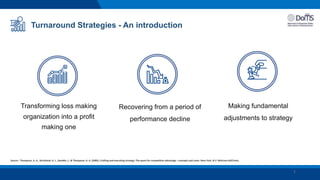
Recovering from a period of
performance decline
Turnaround Strategies - An introduction
Making fundamental
adjustments to strategy
Transforming loss making
organization into a profit
making one
Source : Thompson, A. A., Strickland, A. J., Gamble, J., & Thompson, A. A. (2005). Crafting and executing strategy: The quest for competitive advantage : concepts and cases. New York, N.Y: McGraw-Hill/Irwin.
3
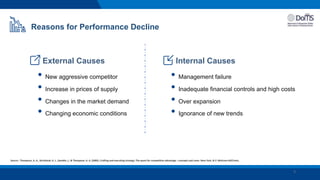
Reasons for Performance Decline
External Causes
• New aggressive competitor
• Increase in prices of supply
• Changes in the market demand
• Changing economic conditions
Internal Causes
• Management failure
• Inadequate financial controls and high costs
• Over expansion
• Ignorance of new trends
Adapted from: Dikshit, J. R. (2015). Turnaround strategy in Indian Textile Industry (Doctoral dissertation, Indira Gandhi National Open University IGNOU) | Source: http://hdl.handle.net/10603/249801 | License: CC BY-NC-SA 4.0
4
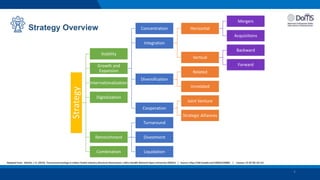
Strategy Overview
Strategy
Stability
Growth and
Expansion
Concentration
Integration
Horizontal
Mergers
Acquisitions
Vertical
Backward
Forward
Diversification
Related
Unrelated
Cooperation
Joint Venture
Strategic Alliances
Internationalization
Digitalization
Retrenchment
Turnaround
Divestment
Liquidation
Combination
Source : Thompson, A. A., Strickland, A. J., Gamble, J., & Thompson, A. A. (2005). Crafting and executing strategy: The quest for competitive advantage : concepts and cases. New York, N.Y: McGraw-Hill/Irwin.
5
Generic Turnaround Strategies
• Restructure leadership and organizational culture
• Cost Reduction
• Asset redeployment
• Selective product and market strategy
• Repositioning
INDUSTRY
OVERVIEW & ANALYSIS
6
Source: IBEF Report 2019 | Accessed at : https://www.ibef.org/industry/textiles.aspx.
7
Indian Textile Industry: Before COVID 19
• Indian textile and apparel is the second largest sector serving employment.
• 15% of total industrial production and contributes to 30% of exports.
• Cotton exports remained at US $ 38.70 billion in Financial Year 2019 .
• Highly endorsed to gain an increment to US $ 82 billion by Financial Year 2021.
• It has a large variety of sectors like the hand-spun and hand-woven materials areas.
• Textile industry in India has 1200 small, medium and large-scale textile mills operating in India.
• The material and dress exports represent 33% of the all out estimation of fares from the nation.
• This industry needs to upgrade the technology as 80% of the exported yarn comes from coarser yarn.
• Indian textile industry constitutes 4% of global market.
Image Source: http://www.businessworld.in/article/Covid-19-And-Textile-Industry/09-05-2020-191637/
8
Indian Textile Industry: Impact of COVID 19
• Factory closures
• The collapse of garment trade
• Cash flow constraints
• Labour force and employment
• Order cancellations have been common
• Import & Exports of raw material & readymade garment
• Factories are operating at reduced capacity..
• Handling cargo from affected countries
• Women have been disproportionally affected
Source: Ashok, P., et al. 2020 Impact of coronavirus outbreak on Indian textile sector. Journal of Management Research and Analysis, April-June, 2020;7(2):76-83
9
Indian Textile Industry: Impact of COVID 19
• Textile industry found the new opportunity in production of PPE kits, masks, disposable
towels, disposable bed sheets etc.
• India has become the second largest manufacturer for PPE kits with more than 600 certified
companies for its manufacturing.
• Government has allowed 100% FDI by automatic route in the textile sector.
• Integrated Textile Parks (SITP) and Technology Upgradation Fund (TUF).
• Twenty one readymade garments manufacturing units in 7 states were announced for modernization.
• India has potential to reach ~USD 70 Billion in export by 2024.
Current position
Source: Ashok, P., et al. 2020 Impact of coronavirus outbreak on Indian textile sector. Journal of Management Research and Analysis, April-June, 2020;7(2):76-83
10
Indian Textile Industry: Strategic Standpoint
Marketplace forces out of the control of the business may force business to make strategic changes
relevant to current and future business potential.
Such turbulences need carefully assessment of:
Expected future state
How market will change
Financial aspects ( looking for a long-term or a
short-term change),Operations, and Resources
Source: Cosentino, M. (2007). Case in point: Complete case interview preparation (p. 266). Burgee Press.
11
Indian Textile Industry: Strategic Standpoint
• Increasing sales
o Product development : based on new needs and wants
o Marketing your company : core values (communication)
o Redeveloping : converting capabilities into new possibilities
• Reducing costs cutting down on loss making units or product lines (cost analysis)
• Acquire and merge with competitors- for products, distribution channel, finance
• Innovation to adapt to new normal process, capabilities and competencies
What and how ?
Source: Cosentino, M. (2007). Case in point: Complete case interview preparation (p. 266). Burgee Press.
12
Indian Textile Industry: Strategic Standpoint
• Satiate contemporary market demands
o Prioritize short term successes to gain some momentum
o Decrease Volume of unsolicited products
• Realign supply chain
• High demand markets
• Acquisitions
o Joint venture/strategic alliance
o Acquire existing players
o Divesting Parts of business
What and how ?
AN
EXAMPLE
FROM TEXTILE INDUSTRY
13
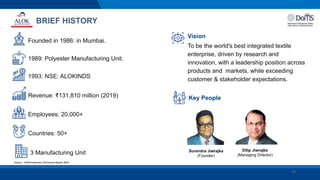
BRIEF HISTORY
Founded in 1986: in Mumbai.
1989: Polyester Manufacturing Unit.
1993: NSE: ALOKINDS
Revenue: ₹131,810 million (2019)
Employees: 20,000+
Countries: 50+
3 Manufacturing Unit
Vision
To be the world's best integrated textile
enterprise, driven by research and
innovation, with a leadership position across
products and markets, while exceeding
customer & stakeholder expectations.
Dilip Jiwrajka
(Managing Director)
Surendra Jiwrajka
(Founder)
Key People
Source : ALOK Industries LTD Annual Report 2019
14
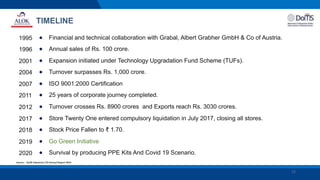
TIMELINE
Source : ALOK Industries LTD Annual Report 2019
15
Financial and technical collaboration with Grabal, Albert Grabher GmbH & Co of Austria.
Annual sales of Rs. 100 crore.
Expansion initiated under Technology Upgradation Fund Scheme (TUFs).
Turnover surpasses Rs. 1,000 crore.
ISO 9001:2000 Certification
25 years of corporate journey completed.
Turnover crosses Rs. 8900 crores and Exports reach Rs. 3030 crores.
Store Twenty One entered compulsory liquidation in July 2017, closing all stores.
Stock Price Fallen to ₹ 1.70.
Go Green Initiative
Survival by producing PPE Kits And Covid 19 Scenario.
1995
1996
2001
2004
2007
2011
2012
2017
2018
2019
2020
●
●
●
●
●
●
●
●
●
●
●
PRODUCTS
Source : ALOK Industries LTD Annual Report 2019
16
Cotton and Blended Yarn
SIlvassa India,13500 ton per annum
Apparel Fabrics - WOVENS
SIlvassa India,105 Million Meters per annum
Apparel Fabrics - KNITS
SIlvassa India, 67200 tons per annum
Embroidery
Navi Mumbai India, 34 billion stitches per annum
Garments- WOVEN & KNITTED
SIlvassa India, 22 Million pieces per annum
Home Textiles- BED LINEN
Vapi, India, 82.50 Million Mt. per annum
Home Textiles- TERRY TOWELS
Vapi, India, 6700 tons per annum
Polyester Texturised Yarn
SIlvassa, India,114000 tons per annum
MANAGING TURNAROUND : Life Cycle Perspective
Source : ALOK Industries LTD Annual Report 2019 and Yahoo Finance CLC Adapted FromDikshit, J. R. (2015). Turnaround strategy in Indian Textile Industry (Doctoral dissertation, Indira Gandhi National Open University IGNOU). Turnaround Strategy in Indian Textile Industry
17
Bankruptcy
In 2019, About to get bankrupt
Share Price
Share Value Went up to ` 1.76 (May 2018)
Start Up
Dynamic
Growth
Maturity
Transformation Future growth
Renewal
Liquidation
Entrepreneurial Management Turnaround Management
1986
1992
2016
2017
2020
2019
Mere Recovery
Short term
Survival but
eventual failure
MANAGING TURNAROUND
Source : ALOK Industries LTD Annual Report 2019 and Yahoo Finance
18
Worker Wear Fabrics
Vapi, India, 20 Million Mtr. per annum
Product & Design Development
Vapi, India.R & D Facility
50.599998
0
10
20
30
40
50
60
11/22/2019 12/22/2019 1/22/2020 2/22/2020 3/22/2020 4/22/2020 5/22/2020 6/22/2020 7/22/2020 8/22/2020 9/22/2020 10/22/2020
STOCK PRICES - NSE: ALOKINDS
19
Scan QR for More
Detailed Information
20
CONCLUSION
• Textiles demand had plummeted in past months as retails were completely shut due to
Covid-19 induced lockdown globally.
• Manufacturers operating from readymade complex in making shirts, pants and other apparel
switched production to PPE kits, masks, disposable towels, disposable bed sheets etc.
• Turnaround strategy means to change a loss-making company into a profit-making company
• It helps to sick company to stand once again in the market.
THANK YOU

Turnaround Strategy

  • 1.
    TURNAROUND STRATEGY FORA VULNERABLE ORGANISATION FOCUS ON LONG TERM GROWTH STRATEGY AND SUPPORT MEASURES Department of Management Studies Indian Institute of Technology Roorkee B M N 6 0 5 – S T R AT E G I C M A N A G E M E N T PRESENTED BY GROUP - 12 ANKITA SHUKLA | ANOOP TS | BABY CHANDRA | BHAVYA SIHMAR | MOHD. SUFIYAN | RAKESH G NAIR | SUCHI AERON Design: anoopts.com
  • 2.
    Source : Thompson,A. A., Strickland, A. J., Gamble, J., & Thompson, A. A. (2005). Crafting and executing strategy: The quest for competitive advantage : concepts and cases. New York, N.Y: McGraw-Hill/Irwin. 2 Recovering from a period of performance decline Turnaround Strategies - An introduction Making fundamental adjustments to strategy Transforming loss making organization into a profit making one
  • 3.
    Source : Thompson,A. A., Strickland, A. J., Gamble, J., & Thompson, A. A. (2005). Crafting and executing strategy: The quest for competitive advantage : concepts and cases. New York, N.Y: McGraw-Hill/Irwin. 3 Reasons for Performance Decline External Causes • New aggressive competitor • Increase in prices of supply • Changes in the market demand • Changing economic conditions Internal Causes • Management failure • Inadequate financial controls and high costs • Over expansion • Ignorance of new trends
  • 4.
    Adapted from: Dikshit,J. R. (2015). Turnaround strategy in Indian Textile Industry (Doctoral dissertation, Indira Gandhi National Open University IGNOU) | Source: http://hdl.handle.net/10603/249801 | License: CC BY-NC-SA 4.0 4 Strategy Overview Strategy Stability Growth and Expansion Concentration Integration Horizontal Mergers Acquisitions Vertical Backward Forward Diversification Related Unrelated Cooperation Joint Venture Strategic Alliances Internationalization Digitalization Retrenchment Turnaround Divestment Liquidation Combination
  • 5.
    Source : Thompson,A. A., Strickland, A. J., Gamble, J., & Thompson, A. A. (2005). Crafting and executing strategy: The quest for competitive advantage : concepts and cases. New York, N.Y: McGraw-Hill/Irwin. 5 Generic Turnaround Strategies • Restructure leadership and organizational culture • Cost Reduction • Asset redeployment • Selective product and market strategy • Repositioning
  • 6.
  • 7.
    Source: IBEF Report2019 | Accessed at : https://www.ibef.org/industry/textiles.aspx. 7 Indian Textile Industry: Before COVID 19 • Indian textile and apparel is the second largest sector serving employment. • 15% of total industrial production and contributes to 30% of exports. • Cotton exports remained at US $ 38.70 billion in Financial Year 2019 . • Highly endorsed to gain an increment to US $ 82 billion by Financial Year 2021. • It has a large variety of sectors like the hand-spun and hand-woven materials areas. • Textile industry in India has 1200 small, medium and large-scale textile mills operating in India. • The material and dress exports represent 33% of the all out estimation of fares from the nation. • This industry needs to upgrade the technology as 80% of the exported yarn comes from coarser yarn. • Indian textile industry constitutes 4% of global market.
  • 8.
    Image Source: http://www.businessworld.in/article/Covid-19-And-Textile-Industry/09-05-2020-191637/ 8 IndianTextile Industry: Impact of COVID 19 • Factory closures • The collapse of garment trade • Cash flow constraints • Labour force and employment • Order cancellations have been common • Import & Exports of raw material & readymade garment • Factories are operating at reduced capacity.. • Handling cargo from affected countries • Women have been disproportionally affected
  • 9.
    Source: Ashok, P.,et al. 2020 Impact of coronavirus outbreak on Indian textile sector. Journal of Management Research and Analysis, April-June, 2020;7(2):76-83 9 Indian Textile Industry: Impact of COVID 19 • Textile industry found the new opportunity in production of PPE kits, masks, disposable towels, disposable bed sheets etc. • India has become the second largest manufacturer for PPE kits with more than 600 certified companies for its manufacturing. • Government has allowed 100% FDI by automatic route in the textile sector. • Integrated Textile Parks (SITP) and Technology Upgradation Fund (TUF). • Twenty one readymade garments manufacturing units in 7 states were announced for modernization. • India has potential to reach ~USD 70 Billion in export by 2024.
  • 10.
    Current position Source: Ashok,P., et al. 2020 Impact of coronavirus outbreak on Indian textile sector. Journal of Management Research and Analysis, April-June, 2020;7(2):76-83 10 Indian Textile Industry: Strategic Standpoint Marketplace forces out of the control of the business may force business to make strategic changes relevant to current and future business potential. Such turbulences need carefully assessment of: Expected future state How market will change Financial aspects ( looking for a long-term or a short-term change),Operations, and Resources
  • 11.
    Source: Cosentino, M.(2007). Case in point: Complete case interview preparation (p. 266). Burgee Press. 11 Indian Textile Industry: Strategic Standpoint • Increasing sales o Product development : based on new needs and wants o Marketing your company : core values (communication) o Redeveloping : converting capabilities into new possibilities • Reducing costs cutting down on loss making units or product lines (cost analysis) • Acquire and merge with competitors- for products, distribution channel, finance • Innovation to adapt to new normal process, capabilities and competencies What and how ?
  • 12.
    Source: Cosentino, M.(2007). Case in point: Complete case interview preparation (p. 266). Burgee Press. 12 Indian Textile Industry: Strategic Standpoint • Satiate contemporary market demands o Prioritize short term successes to gain some momentum o Decrease Volume of unsolicited products • Realign supply chain • High demand markets • Acquisitions o Joint venture/strategic alliance o Acquire existing players o Divesting Parts of business What and how ?
  • 13.
  • 14.
    BRIEF HISTORY Founded in1986: in Mumbai. 1989: Polyester Manufacturing Unit. 1993: NSE: ALOKINDS Revenue: ₹131,810 million (2019) Employees: 20,000+ Countries: 50+ 3 Manufacturing Unit Vision To be the world's best integrated textile enterprise, driven by research and innovation, with a leadership position across products and markets, while exceeding customer & stakeholder expectations. Dilip Jiwrajka (Managing Director) Surendra Jiwrajka (Founder) Key People Source : ALOK Industries LTD Annual Report 2019 14
  • 15.
    TIMELINE Source : ALOKIndustries LTD Annual Report 2019 15 Financial and technical collaboration with Grabal, Albert Grabher GmbH & Co of Austria. Annual sales of Rs. 100 crore. Expansion initiated under Technology Upgradation Fund Scheme (TUFs). Turnover surpasses Rs. 1,000 crore. ISO 9001:2000 Certification 25 years of corporate journey completed. Turnover crosses Rs. 8900 crores and Exports reach Rs. 3030 crores. Store Twenty One entered compulsory liquidation in July 2017, closing all stores. Stock Price Fallen to ₹ 1.70. Go Green Initiative Survival by producing PPE Kits And Covid 19 Scenario. 1995 1996 2001 2004 2007 2011 2012 2017 2018 2019 2020 ● ● ● ● ● ● ● ● ● ● ●
  • 16.
    PRODUCTS Source : ALOKIndustries LTD Annual Report 2019 16 Cotton and Blended Yarn SIlvassa India,13500 ton per annum Apparel Fabrics - WOVENS SIlvassa India,105 Million Meters per annum Apparel Fabrics - KNITS SIlvassa India, 67200 tons per annum Embroidery Navi Mumbai India, 34 billion stitches per annum Garments- WOVEN & KNITTED SIlvassa India, 22 Million pieces per annum Home Textiles- BED LINEN Vapi, India, 82.50 Million Mt. per annum Home Textiles- TERRY TOWELS Vapi, India, 6700 tons per annum Polyester Texturised Yarn SIlvassa, India,114000 tons per annum
  • 17.
    MANAGING TURNAROUND :Life Cycle Perspective Source : ALOK Industries LTD Annual Report 2019 and Yahoo Finance CLC Adapted FromDikshit, J. R. (2015). Turnaround strategy in Indian Textile Industry (Doctoral dissertation, Indira Gandhi National Open University IGNOU). Turnaround Strategy in Indian Textile Industry 17 Bankruptcy In 2019, About to get bankrupt Share Price Share Value Went up to ` 1.76 (May 2018) Start Up Dynamic Growth Maturity Transformation Future growth Renewal Liquidation Entrepreneurial Management Turnaround Management 1986 1992 2016 2017 2020 2019 Mere Recovery Short term Survival but eventual failure
  • 18.
    MANAGING TURNAROUND Source :ALOK Industries LTD Annual Report 2019 and Yahoo Finance 18 Worker Wear Fabrics Vapi, India, 20 Million Mtr. per annum Product & Design Development Vapi, India.R & D Facility 50.599998 0 10 20 30 40 50 60 11/22/2019 12/22/2019 1/22/2020 2/22/2020 3/22/2020 4/22/2020 5/22/2020 6/22/2020 7/22/2020 8/22/2020 9/22/2020 10/22/2020 STOCK PRICES - NSE: ALOKINDS
  • 19.
    19 Scan QR forMore Detailed Information
  • 20.
    20 CONCLUSION • Textiles demandhad plummeted in past months as retails were completely shut due to Covid-19 induced lockdown globally. • Manufacturers operating from readymade complex in making shirts, pants and other apparel switched production to PPE kits, masks, disposable towels, disposable bed sheets etc. • Turnaround strategy means to change a loss-making company into a profit-making company • It helps to sick company to stand once again in the market.
  • 21.