

ARGUS
EVENT SCREEN
01/29/17
Katalyst Healthcares & Life Sciences
1
 CODING
Standardisation of terminology by using a dictionary (MedDRA)
 GROUPING
Presentation of the available diagnostic information by
appropriately grouping the terms reported
FOR A PROPER MEDICAL ASSESSMENT AND
FOR MEANINGFUL SEARCHES WE REQUIRE
Coding & Grouping:
01/29/17Katalyst Healthcares & Life Sciences
2
GROUPING permits COMMON ASSESSMENT of DIAGNOSES
mentioned in the REPORT RECEIVED
USE ONLY DIAGNOSES MADE BY REPORTER
ONE COMMON ASSESSMENT FOR ALL SYMPTOMS RELATED TO A
GIVEN DIAGNOSIS
Grouping:
01/29/17Katalyst Healthcares & Life Sciences
3
 Grouping of symptoms belonging to a given diagnosis provides
better structured reports
 Assessment of clinical entities reported and not of each single
symptom
 Permits better searches
 Facilitates reconciliation with clinical database (all symptoms
coded)
Coding & Grouping:
01/29/17Katalyst Healthcares & Life Sciences
4
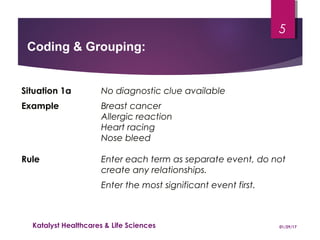
Situation 1a No diagnostic clue available
Example Breast cancer
Allergic reaction
Heart racing
Nose bleed
Rule Enter each term as separate event, do not
create any relationships.
Enter the most significant event first.
Coding & Grouping:
01/29/17Katalyst Healthcares & Life Sciences
5
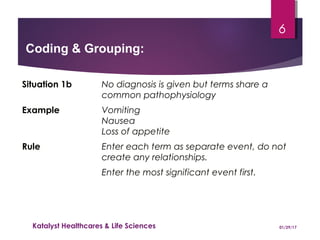
Situation 1b No diagnosis is given but terms share a
common pathophysiology
Example Vomiting
Nausea
Loss of appetite
Rule Enter each term as separate event, do not
create any relationships.
Enter the most significant event first.
Coding & Grouping:
01/29/17Katalyst Healthcares & Life Sciences
6
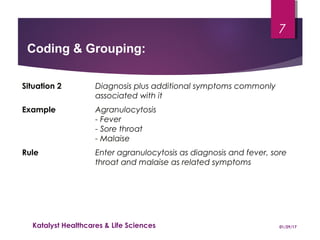
Situation 2 Diagnosis plus additional symptoms commonly
associated with it
Example Agranulocytosis
- Fever
- Sore throat
- Malaise
Rule Enter agranulocytosis as diagnosis and fever, sore
throat and malaise as related symptoms
Coding & Grouping:
01/29/17Katalyst Healthcares & Life Sciences
7
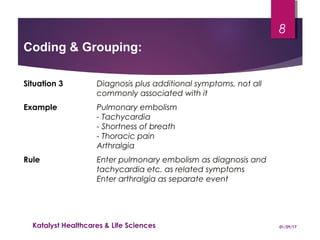
Situation 3 Diagnosis plus additional symptoms, not all
commonly associated with it
Example Pulmonary embolism
- Tachycardia
- Shortness of breath
- Thoracic pain
Arthralgia
Rule Enter pulmonary embolism as diagnosis and
tachycardia etc. as related symptoms
Enter arthralgia as separate event
Coding & Grouping:
01/29/17Katalyst Healthcares & Life Sciences
8
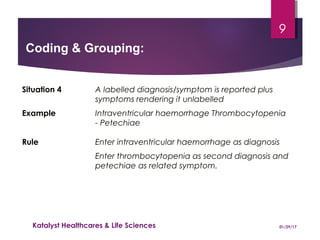
Situation 4 A labelled diagnosis/symptom is reported plus
symptoms rendering it unlabelled
Example Intraventricular haemorrhage Thrombocytopenia
- Petechiae
Rule Enter intraventricular haemorrhage as diagnosis
Enter thrombocytopenia as second diagnosis and
petechiae as related symptom.
Coding & Grouping:
01/29/17Katalyst Healthcares & Life Sciences
9
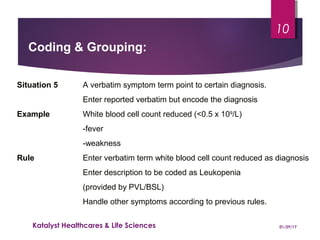
Situation 5 A verbatim symptom term point to certain diagnosis.
Enter reported verbatim but encode the diagnosis
Example White blood cell count reduced (<0.5 x 10⁹
/L)
-fever
-weakness
Rule Enter verbatim term white blood cell count reduced as diagnosis
Enter description to be coded as Leukopenia
(provided by PVL/BSL)
Handle other symptoms according to previous rules.
Coding & Grouping:
01/29/17Katalyst Healthcares & Life Sciences
10
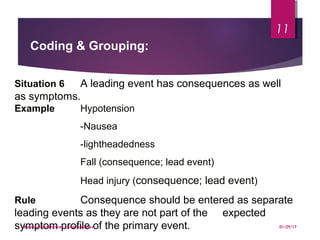
Situation 6 A leading event has consequences as well
as symptoms.
Example Hypotension
-Nausea
-lightheadedness
Fall (consequence; lead event)
Head injury (consequence; lead event)
Rule Consequence should be entered as separate
leading events as they are not part of the expected
symptom profile of the primary event.
Coding & Grouping:
01/29/17Katalyst Healthcares & Life Sciences
11
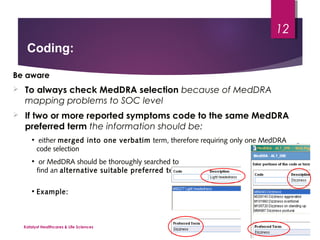
Be aware
 To always check MedDRA selection because of MedDRA
mapping problems to SOC level
 If two or more reported symptoms code to the same MedDRA
preferred term the information should be:
• either merged into one verbatim term, therefore requiring only one MedDRA
code selection
• or MedDRA should be thoroughly searched to
find an alternative suitable preferred term
• Example:
Coding:
Katalyst Healthcares & Life Sciences
12
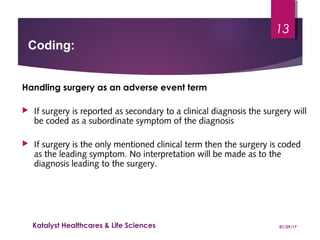
Handling surgery as an adverse event term
 If surgery is reported as secondary to a clinical diagnosis the surgery will
be coded as a subordinate symptom of the diagnosis
 If surgery is the only mentioned clinical term then the surgery is coded
as the leading symptom. No interpretation will be made as to the
diagnosis leading to the surgery.
Coding:
01/29/17Katalyst Healthcares & Life Sciences
13
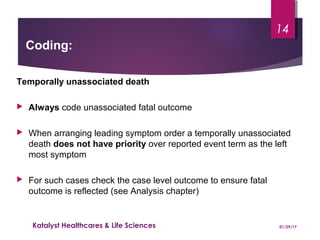
Temporally unassociated death
 Always code unassociated fatal outcome
 When arranging leading symptom order a temporally unassociated
death does not have priority over reported event term as the left
most symptom
 For such cases check the case level outcome to ensure fatal
outcome is reflected (see Analysis chapter)
Coding:
01/29/17Katalyst Healthcares & Life Sciences
14
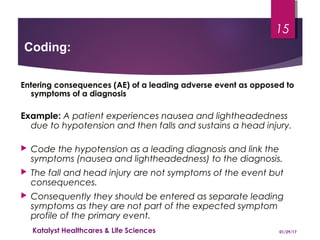
Entering consequences (AE) of a leading adverse event as opposed to
symptoms of a diagnosis
Example: A patient experiences nausea and lightheadedness
due to hypotension and then falls and sustains a head injury.
 Code the hypotension as a leading diagnosis and link the
symptoms (nausea and lightheadedness) to the diagnosis.
 The fall and head injury are not symptoms of the event but
consequences.
 Consequently they should be entered as separate leading
symptoms as they are not part of the expected symptom
profile of the primary event.
Coding:
01/29/17Katalyst Healthcares & Life Sciences
15
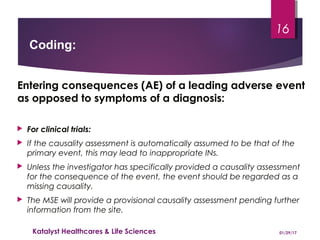
Entering consequences (AE) of a leading adverse event
as opposed to symptoms of a diagnosis:
 For clinical trials:
 If the causality assessment is automatically assumed to be that of the
primary event, this may lead to inappropriate INs.
 Unless the investigator has specifically provided a causality assessment
for the consequence of the event, the event should be regarded as a
missing causality.
 The MSE will provide a provisional causality assessment pending further
information from the site.
Coding:
01/29/17Katalyst Healthcares & Life Sciences
16
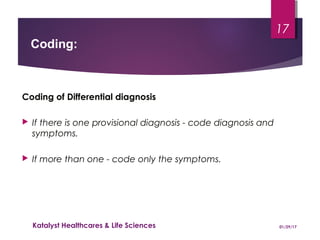
Coding of Differential diagnosis
 If there is one provisional diagnosis - code diagnosis and
symptoms.
 If more than one - code only the symptoms.
Coding:
01/29/17Katalyst Healthcares & Life Sciences
17
 Reported Serious drop down list should be selected as appropriate for each
coded term.
 Where the reporter is a HCP and has reported the event as serious, select
Yes.
 Where the HCP has indicated that the event is non serious, select No.
 Where no indication has been made or the reporter is a consumer, select
unk.
Reported Serious:
01/29/17Katalyst Healthcares & Life Sciences
18
 All cancers must be assigned a ‘medically significant’ seriousness
criterion unless another, more appropriate criterion is valid, e.g.
‘hospitalisation’, ‘life-threatening’.
 The seriousness criterion “Intervention Required” is not used by
Novartis
 If there is more than one serious leading symptom any
unlisted/unexpected term should be the left most symptom.
 For PMS: If there is more than one serious leading symptom any
suspected term should be the left most symptom (has priority over not
suspected).
Seriousness:
01/29/17Katalyst Healthcares & Life Sciences
19
Event Outcome:
 Whilst causality and labelling must be consistent, the outcome can
be different for the symptoms associated with a diagnosis.
E.g. Pneumonia (improving)
Cough (improving)
Wheezing (recovered)
Rales(recovered)
 For SRs: If no information on the outcome of the event is provided
by the reporter select ‘not reported’ if the outcome of the event is
reported as unknown to the reporter select ‘unknown’
01/29/17Katalyst Healthcares & Life Sciences
20
 Coding events is not automatic the moment you click into another
field.
 Click into the description to be coded and then tab to onset for auto-
encoding to run.
Caution
 Soundex is not working correctly on MedDRA searching
 DO NOT check the Complete Search (Like, Soundex box)
 Use wild card searching with the % sign before (not required after a
word)
Coding Events:
01/29/17Katalyst Healthcares & Life Sciences
21
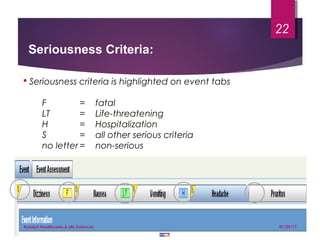
 Seriousness criteria is highlighted on event tabs
F = fatal
LT = Life-threatening
H = Hospitalization
S = all other serious criteria
no letter = non-serious
Seriousness Criteria:
01/29/17Katalyst Healthcares & Life Sciences
22
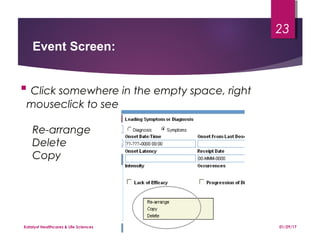
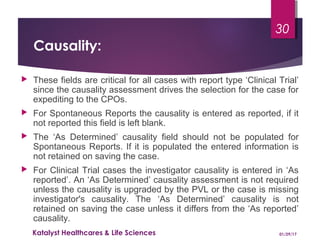
 Click somewhere in the empty space, right
mouseclick to see
Re-arrange
Delete
Copy
Event Screen:
01/29/17Katalyst Healthcares & Life Sciences
23
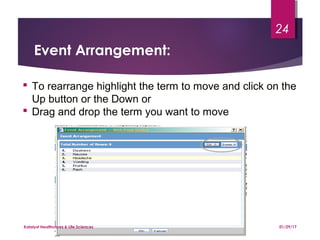
Event Arrangement:
 To rearrange highlight the term to move and click on the
Up button or the Down or
 Drag and drop the term you want to move
01/29/17Katalyst Healthcares & Life Sciences
24
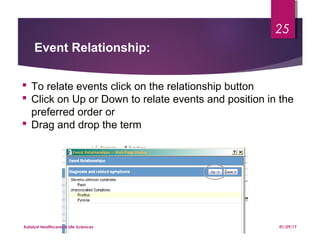
Event Relationship:
 To relate events click on the relationship button
 Click on Up or Down to relate events and position in the
preferred order or
 Drag and drop the term
01/29/17Katalyst Healthcares & Life Sciences
25
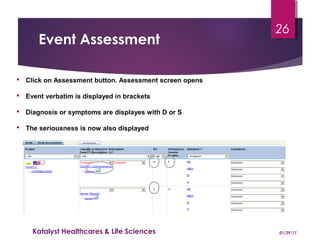
Event Assessment
 Click on Assessment button. Assessment screen opens
 Event verbatim is displayed in brackets
 Diagnosis or symptoms are displayes with D or S
 The seriousness is now also displayed
01/29/17Katalyst Healthcares & Life Sciences
26
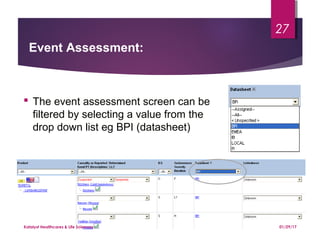
Event Assessment:
 The event assessment screen can be
filtered by selecting a value from the
drop down list eg BPI (datasheet)
01/29/17Katalyst Healthcares & Life Sciences
27
Event Assessment – Labeling:
SRs, Literature and PMS Reports:
 To view any justification comment right mouse click on the green
button
 For SRs where no CDS exists no labelling assessment should be
added and no Novartis comment is entered, unless a particular
national data sheet has been identified as equivalent to CDS
 Causality and labelling must be consistent between Diagnoses and
linked symptoms
01/29/17Katalyst Healthcares & Life Sciences
28
Event Assessment – Causality:
For PMS report (report type Clinical Trial)
 The investigator causality is entered in ‘as reported’
 Ensure that each event has a causality and if suspected,
the labelling is entered
 Causality and labelling must be consistent between
Diagnoses and linked symptoms
01/29/17Katalyst Healthcares & Life Sciences
29
Causality:
 These fields are critical for all cases with report type ‘Clinical Trial’
since the causality assessment drives the selection for the case for
expediting to the CPOs.
 For Spontaneous Reports the causality is entered as reported, if it
not reported this field is left blank.
 The ‘As Determined’ causality field should not be populated for
Spontaneous Reports. If it is populated the entered information is
not retained on saving the case.
 For Clinical Trial cases the investigator causality is entered in ‘As
reported’. An ‘As Determined’ causality assessment is not required
unless the causality is upgraded by the PVL or the case is missing
investigator's causality. The ‘As Determined’ causality is not
retained on saving the case unless it differs from the ‘As reported’
causality.
01/29/17Katalyst Healthcares & Life Sciences
30
Causality cont.
 For Clinical Trials cases and PMS/registry cases provided without
reporter causality the PVL must make an assessment of causality.
‘Unknown’ should be entered in the ‘As Reported’ causality field
until the reporter causality is determined by follow-up. If the
(previously missing) reporter’s causality has been received in a
follow-up report, the ‘As Determined’ causality assessment must be
removed.
 If the ‘As Determined’ causality assessment is in any way different
from that provided by the reporter the selection of a different term
autogenerates the ‘Action Justification’ screen where a reason
justifying the different assessment has to be provided.
 For clinical trial cases where the patient has not yet received study
medication, the case should be assessed as not suspected unless
the investigator has specifically indicated that the event is due to
the study conduct. 01/29/17
Katalyst Healthcares & Life Sciences
31
Event Assessment:
Be aware
 The recalculate button should be pressed for every time a
case is updated with any information which requires re-
expediting
Why ?
 So that any newly configured licences will be updated to the
case and the case is distributed accordingly. This prevents
missed submissions
01/29/17Katalyst Healthcares & Life Sciences
32
Thank YouThank You
&&
QuestionsQuestions
33
Contact:
Katalyst Healthcare’s & Life Sciences
South Plainfield, NJ, USA 07080.
E-Mail: info@KatalystHLS.com
01/29/17Katalyst Healthcares & Life Sciences

Argus Event Tab Screen - Katalyst HLS

  • 1.
  • 2.
     CODING Standardisation ofterminology by using a dictionary (MedDRA)  GROUPING Presentation of the available diagnostic information by appropriately grouping the terms reported FOR A PROPER MEDICAL ASSESSMENT AND FOR MEANINGFUL SEARCHES WE REQUIRE Coding & Grouping: 01/29/17Katalyst Healthcares & Life Sciences 2
  • 3.
    GROUPING permits COMMONASSESSMENT of DIAGNOSES mentioned in the REPORT RECEIVED USE ONLY DIAGNOSES MADE BY REPORTER ONE COMMON ASSESSMENT FOR ALL SYMPTOMS RELATED TO A GIVEN DIAGNOSIS Grouping: 01/29/17Katalyst Healthcares & Life Sciences 3
  • 4.
     Grouping ofsymptoms belonging to a given diagnosis provides better structured reports  Assessment of clinical entities reported and not of each single symptom  Permits better searches  Facilitates reconciliation with clinical database (all symptoms coded) Coding & Grouping: 01/29/17Katalyst Healthcares & Life Sciences 4
  • 5.
    Situation 1a Nodiagnostic clue available Example Breast cancer Allergic reaction Heart racing Nose bleed Rule Enter each term as separate event, do not create any relationships. Enter the most significant event first. Coding & Grouping: 01/29/17Katalyst Healthcares & Life Sciences 5
  • 6.
    Situation 1b Nodiagnosis is given but terms share a common pathophysiology Example Vomiting Nausea Loss of appetite Rule Enter each term as separate event, do not create any relationships. Enter the most significant event first. Coding & Grouping: 01/29/17Katalyst Healthcares & Life Sciences 6
  • 7.
    Situation 2 Diagnosisplus additional symptoms commonly associated with it Example Agranulocytosis - Fever - Sore throat - Malaise Rule Enter agranulocytosis as diagnosis and fever, sore throat and malaise as related symptoms Coding & Grouping: 01/29/17Katalyst Healthcares & Life Sciences 7
  • 8.
    Situation 3 Diagnosisplus additional symptoms, not all commonly associated with it Example Pulmonary embolism - Tachycardia - Shortness of breath - Thoracic pain Arthralgia Rule Enter pulmonary embolism as diagnosis and tachycardia etc. as related symptoms Enter arthralgia as separate event Coding & Grouping: 01/29/17Katalyst Healthcares & Life Sciences 8
  • 9.
    Situation 4 Alabelled diagnosis/symptom is reported plus symptoms rendering it unlabelled Example Intraventricular haemorrhage Thrombocytopenia - Petechiae Rule Enter intraventricular haemorrhage as diagnosis Enter thrombocytopenia as second diagnosis and petechiae as related symptom. Coding & Grouping: 01/29/17Katalyst Healthcares & Life Sciences 9
  • 10.
    Situation 5 Averbatim symptom term point to certain diagnosis. Enter reported verbatim but encode the diagnosis Example White blood cell count reduced (<0.5 x 10⁹ /L) -fever -weakness Rule Enter verbatim term white blood cell count reduced as diagnosis Enter description to be coded as Leukopenia (provided by PVL/BSL) Handle other symptoms according to previous rules. Coding & Grouping: 01/29/17Katalyst Healthcares & Life Sciences 10
  • 11.
    Situation 6 Aleading event has consequences as well as symptoms. Example Hypotension -Nausea -lightheadedness Fall (consequence; lead event) Head injury (consequence; lead event) Rule Consequence should be entered as separate leading events as they are not part of the expected symptom profile of the primary event. Coding & Grouping: 01/29/17Katalyst Healthcares & Life Sciences 11
  • 12.
    Be aware  Toalways check MedDRA selection because of MedDRA mapping problems to SOC level  If two or more reported symptoms code to the same MedDRA preferred term the information should be: • either merged into one verbatim term, therefore requiring only one MedDRA code selection • or MedDRA should be thoroughly searched to find an alternative suitable preferred term • Example: Coding: Katalyst Healthcares & Life Sciences 12
  • 13.
    Handling surgery asan adverse event term  If surgery is reported as secondary to a clinical diagnosis the surgery will be coded as a subordinate symptom of the diagnosis  If surgery is the only mentioned clinical term then the surgery is coded as the leading symptom. No interpretation will be made as to the diagnosis leading to the surgery. Coding: 01/29/17Katalyst Healthcares & Life Sciences 13
  • 14.
    Temporally unassociated death Always code unassociated fatal outcome  When arranging leading symptom order a temporally unassociated death does not have priority over reported event term as the left most symptom  For such cases check the case level outcome to ensure fatal outcome is reflected (see Analysis chapter) Coding: 01/29/17Katalyst Healthcares & Life Sciences 14
  • 15.
    Entering consequences (AE)of a leading adverse event as opposed to symptoms of a diagnosis Example: A patient experiences nausea and lightheadedness due to hypotension and then falls and sustains a head injury.  Code the hypotension as a leading diagnosis and link the symptoms (nausea and lightheadedness) to the diagnosis.  The fall and head injury are not symptoms of the event but consequences.  Consequently they should be entered as separate leading symptoms as they are not part of the expected symptom profile of the primary event. Coding: 01/29/17Katalyst Healthcares & Life Sciences 15
  • 16.
    Entering consequences (AE)of a leading adverse event as opposed to symptoms of a diagnosis:  For clinical trials:  If the causality assessment is automatically assumed to be that of the primary event, this may lead to inappropriate INs.  Unless the investigator has specifically provided a causality assessment for the consequence of the event, the event should be regarded as a missing causality.  The MSE will provide a provisional causality assessment pending further information from the site. Coding: 01/29/17Katalyst Healthcares & Life Sciences 16
  • 17.
    Coding of Differentialdiagnosis  If there is one provisional diagnosis - code diagnosis and symptoms.  If more than one - code only the symptoms. Coding: 01/29/17Katalyst Healthcares & Life Sciences 17
  • 18.
     Reported Seriousdrop down list should be selected as appropriate for each coded term.  Where the reporter is a HCP and has reported the event as serious, select Yes.  Where the HCP has indicated that the event is non serious, select No.  Where no indication has been made or the reporter is a consumer, select unk. Reported Serious: 01/29/17Katalyst Healthcares & Life Sciences 18
  • 19.
     All cancersmust be assigned a ‘medically significant’ seriousness criterion unless another, more appropriate criterion is valid, e.g. ‘hospitalisation’, ‘life-threatening’.  The seriousness criterion “Intervention Required” is not used by Novartis  If there is more than one serious leading symptom any unlisted/unexpected term should be the left most symptom.  For PMS: If there is more than one serious leading symptom any suspected term should be the left most symptom (has priority over not suspected). Seriousness: 01/29/17Katalyst Healthcares & Life Sciences 19
  • 20.
    Event Outcome:  Whilstcausality and labelling must be consistent, the outcome can be different for the symptoms associated with a diagnosis. E.g. Pneumonia (improving) Cough (improving) Wheezing (recovered) Rales(recovered)  For SRs: If no information on the outcome of the event is provided by the reporter select ‘not reported’ if the outcome of the event is reported as unknown to the reporter select ‘unknown’ 01/29/17Katalyst Healthcares & Life Sciences 20
  • 21.
     Coding eventsis not automatic the moment you click into another field.  Click into the description to be coded and then tab to onset for auto- encoding to run. Caution  Soundex is not working correctly on MedDRA searching  DO NOT check the Complete Search (Like, Soundex box)  Use wild card searching with the % sign before (not required after a word) Coding Events: 01/29/17Katalyst Healthcares & Life Sciences 21
  • 22.
     Seriousness criteriais highlighted on event tabs F = fatal LT = Life-threatening H = Hospitalization S = all other serious criteria no letter = non-serious Seriousness Criteria: 01/29/17Katalyst Healthcares & Life Sciences 22
  • 23.
     Click somewherein the empty space, right mouseclick to see Re-arrange Delete Copy Event Screen: 01/29/17Katalyst Healthcares & Life Sciences 23
  • 24.
    Event Arrangement:  Torearrange highlight the term to move and click on the Up button or the Down or  Drag and drop the term you want to move 01/29/17Katalyst Healthcares & Life Sciences 24
  • 25.
    Event Relationship:  Torelate events click on the relationship button  Click on Up or Down to relate events and position in the preferred order or  Drag and drop the term 01/29/17Katalyst Healthcares & Life Sciences 25
  • 26.
    Event Assessment  Clickon Assessment button. Assessment screen opens  Event verbatim is displayed in brackets  Diagnosis or symptoms are displayes with D or S  The seriousness is now also displayed 01/29/17Katalyst Healthcares & Life Sciences 26
  • 27.
    Event Assessment:  Theevent assessment screen can be filtered by selecting a value from the drop down list eg BPI (datasheet) 01/29/17Katalyst Healthcares & Life Sciences 27
  • 28.
    Event Assessment –Labeling: SRs, Literature and PMS Reports:  To view any justification comment right mouse click on the green button  For SRs where no CDS exists no labelling assessment should be added and no Novartis comment is entered, unless a particular national data sheet has been identified as equivalent to CDS  Causality and labelling must be consistent between Diagnoses and linked symptoms 01/29/17Katalyst Healthcares & Life Sciences 28
  • 29.
    Event Assessment –Causality: For PMS report (report type Clinical Trial)  The investigator causality is entered in ‘as reported’  Ensure that each event has a causality and if suspected, the labelling is entered  Causality and labelling must be consistent between Diagnoses and linked symptoms 01/29/17Katalyst Healthcares & Life Sciences 29
  • 30.
    Causality:  These fieldsare critical for all cases with report type ‘Clinical Trial’ since the causality assessment drives the selection for the case for expediting to the CPOs.  For Spontaneous Reports the causality is entered as reported, if it not reported this field is left blank.  The ‘As Determined’ causality field should not be populated for Spontaneous Reports. If it is populated the entered information is not retained on saving the case.  For Clinical Trial cases the investigator causality is entered in ‘As reported’. An ‘As Determined’ causality assessment is not required unless the causality is upgraded by the PVL or the case is missing investigator's causality. The ‘As Determined’ causality is not retained on saving the case unless it differs from the ‘As reported’ causality. 01/29/17Katalyst Healthcares & Life Sciences 30
  • 31.
    Causality cont.  ForClinical Trials cases and PMS/registry cases provided without reporter causality the PVL must make an assessment of causality. ‘Unknown’ should be entered in the ‘As Reported’ causality field until the reporter causality is determined by follow-up. If the (previously missing) reporter’s causality has been received in a follow-up report, the ‘As Determined’ causality assessment must be removed.  If the ‘As Determined’ causality assessment is in any way different from that provided by the reporter the selection of a different term autogenerates the ‘Action Justification’ screen where a reason justifying the different assessment has to be provided.  For clinical trial cases where the patient has not yet received study medication, the case should be assessed as not suspected unless the investigator has specifically indicated that the event is due to the study conduct. 01/29/17 Katalyst Healthcares & Life Sciences 31
  • 32.
    Event Assessment: Be aware The recalculate button should be pressed for every time a case is updated with any information which requires re- expediting Why ?  So that any newly configured licences will be updated to the case and the case is distributed accordingly. This prevents missed submissions 01/29/17Katalyst Healthcares & Life Sciences 32
  • 33.
    Thank YouThank You && QuestionsQuestions 33 Contact: KatalystHealthcare’s & Life Sciences South Plainfield, NJ, USA 07080. E-Mail: info@KatalystHLS.com 01/29/17Katalyst Healthcares & Life Sciences

Editor's Notes

  • #3 Coding = MEDDRA session Grouping = topic of this session
  • #5 Everybody is aware that the grouping of adverse events and symptoms produces an additional workload: Grouping requires also an additional mental effort. The points listed in this slide, in particular the common understanding of the adverse event by the CSS and the MSE, are of very high benefit. As a certain subjectivity is always included in the grouping of events, therefore it may happen that the grouping is wrong in rare cases when follow-up is received.
  • #6 Each of these symptoms is a leading symptom, since there is no obvious association. Breast cancer is a diagnosis, but none of the other verbatim terms is a common symptom for this disease. In analysing groups of patients the symptoms “Nosebleed” and “Heart Racing” must be treated individually. Make sure each event is ticked as a diagnosis in the adverse events screen
  • #7 The first symptom should be the most descriptive one. The organ system the first term points to should be the desired one for listings and statistics by organ system. In this example the case will appear under the heading gastrointestinal disorders. If loss of appetite would be entered as first symptom the case would appear under the heading ‘disorders of metabolism and nutrition’. Make sure each event is ticked as a diagnosis in the adverse events screen
  • #8 All symptoms are commonly observed with agranulocytosis. Labelling assessment for agranulocytosis covers all of these symptoms. There is no need to analyse this malaise with others where malaise occurred with liver failure or related to gastrointestinal side effects. Only Agranulocytosis will be ticked as a diagnosis all other events will not be.
  • #9 This case does not need consideration for grouping with other cases of arrhythmia, but arthralgia is not adequately explained by the diagnosis provided. This situation is common with SAE reporting, where all adverse events occurring are solicited. Pulmonary embolism as medically more significant entity is put first. Arthalgia and Pulmonary embolism will be ticked as diagnoses.
  • #10 If a symptom entered under a diagnosis which as such is labelled for a drug, renders it unlabelled due to increased severity, an additional group shall be created, intraventricular haemorrhage in this case. Thrombocytopenia and intraventricular haemorrhage would be ticked as diagnoses.