Financial Management
Tunnel Farming Project Report
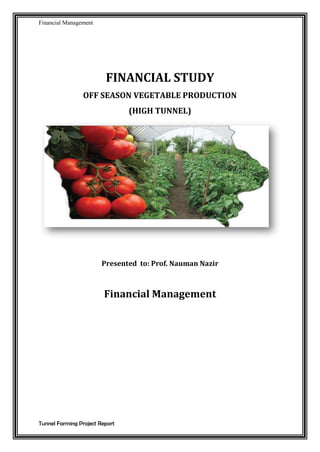
FINANCIAL STUDY
OFF SEASON VEGETABLE PRODUCTION
(HIGH TUNNEL)
Presented to: Prof. Nauman Nazir
Financial Management
Tunnel Farming Project Report
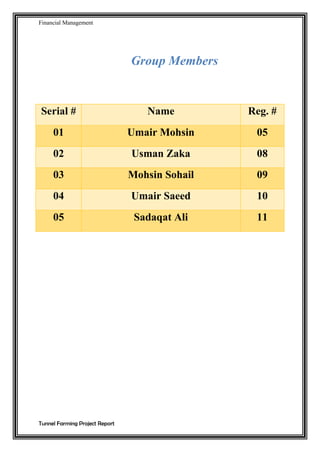
Group Members
Serial # Name Reg. #
01 Umair Mohsin 05
02 Usman Zaka 08
03 Mohsin Sohail 09
04 Umair Saeed 10
05 Sadaqat Ali 11
Financial Management
Tunnel Farming Project Report
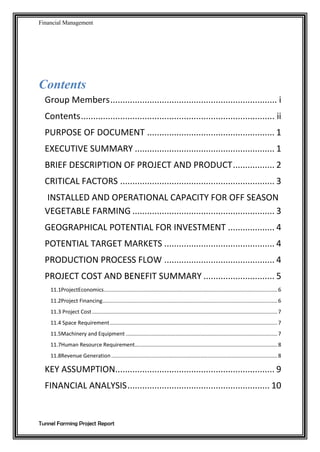
Contents
Group Members.................................................................... i
Contents............................................................................... ii
PURPOSE OF DOCUMENT .................................................... 1
EXECUTIVE SUMMARY ......................................................... 1
BRIEF DESCRIPTION OF PROJECT AND PRODUCT................. 2
CRITICAL FACTORS ............................................................... 3
INSTALLED AND OPERATIONAL CAPACITY FOR OFF SEASON
VEGETABLE FARMING .......................................................... 3
GEOGRAPHICAL POTENTIAL FOR INVESTMENT ................... 4
POTENTIAL TARGET MARKETS ............................................. 4
PRODUCTION PROCESS FLOW ............................................. 4
PROJECT COST AND BENEFIT SUMMARY ............................. 5
11.1ProjectEconomics.....................................................................................................................6
11.2Project Financing......................................................................................................................6
11.3 Project Cost.............................................................................................................................7
11.4 Space Requirement.................................................................................................................7
11.5Machinery and Equipment ......................................................................................................7
11.7Human Resource Requirement................................................................................................8
11.8Revenue Generation................................................................................................................8
KEY ASSUMPTION................................................................. 9
FINANCIAL ANALYSIS.......................................................... 10
Financial Management
Tunnel Farming Project Report
PURPOSE OF DOCUMENT
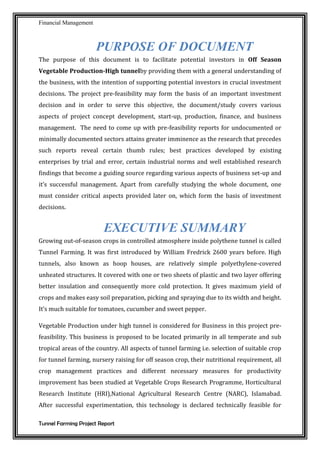
The purpose of this document is to facilitate potential investors in Off Season
Vegetable Production-High tunnelby providing them with a general understanding of
the business, with the intention of supporting potential investors in crucial investment
decisions. The project pre-feasibility may form the basis of an important investment
decision and in order to serve this objective, the document/study covers various
aspects of project concept development, start-up, production, finance, and business
management. The need to come up with pre-feasibility reports for undocumented or
minimally documented sectors attains greater imminence as the research that precedes
such reports reveal certain thumb rules; best practices developed by existing
enterprises by trial and error, certain industrial norms and well established research
findings that become a guiding source regarding various aspects of business set-up and
it’s successful management. Apart from carefully studying the whole document, one
must consider critical aspects provided later on, which form the basis of investment
decisions.
EXECUTIVE SUMMARY
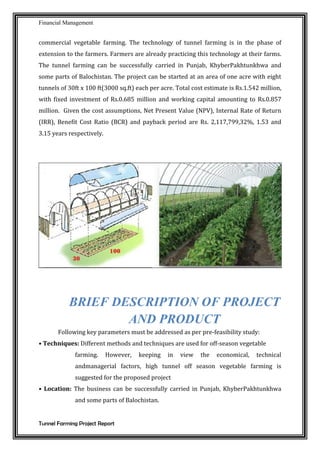
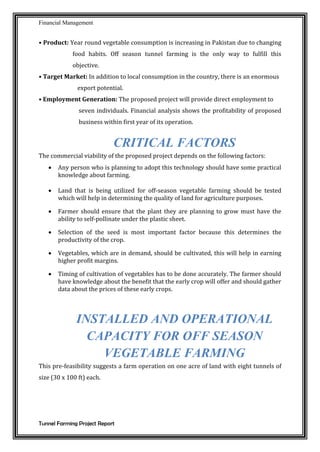
Growing out-of-season crops in controlled atmosphere inside polythene tunnel is called
Tunnel Farming. It was first introduced by William Fredrick 2600 years before. High
tunnels, also known as hoop houses, are relatively simple polyethylene-covered
unheated structures. It covered with one or two sheets of plastic and two layer offering
better insulation and consequently more cold protection. It gives maximum yield of
crops and makes easy soil preparation, picking and spraying due to its width and height.
It’s much suitable for tomatoes, cucumber and sweet pepper.
Vegetable Production under high tunnel is considered for Business in this project pre-
feasibility. This business is proposed to be located primarily in all temperate and sub
tropical areas of the country. All aspects of tunnel farming i.e. selection of suitable crop
for tunnel farming, nursery raising for off season crop, their nutritional requirement, all
crop management practices and different necessary measures for productivity
improvement has been studied at Vegetable Crops Research Programme, Horticultural
Research Institute (HRI),National Agricultural Research Centre (NARC), Islamabad.
After successful experimentation, this technology is declared technically feasible for
Financial Management
Tunnel Farming Project Report
commercial vegetable farming. The technology of tunnel farming is in the phase of
extension to the farmers. Farmers are already practicing this technology at their farms.
The tunnel farming can be successfully carried in Punjab, KhyberPakhtunkhwa and
some parts of Balochistan. The project can be started at an area of one acre with eight
tunnels of 30ft x 100 ft(3000 sq.ft) each per acre. Total cost estimate is Rs.1.542 million,
with fixed investment of Rs.0.685 million and working capital amounting to Rs.0.857
million. Given the cost assumptions, Net Present Value (NPV), Internal Rate of Return
(IRR), Benefit Cost Ratio (BCR) and payback period are Rs. 2,117,799,32%, 1.53 and
3.15 years respectively.
BRIEF DESCRIPTION OF PROJECT
AND PRODUCT
Following key parameters must be addressed as per pre-feasibility study:
• Techniques: Different methods and techniques are used for off-season vegetable
farming. However, keeping in view the economical, technical
andmanagerial factors, high tunnel off season vegetable farming is
suggested for the proposed project
• Location: The business can be successfully carried in Punjab, KhyberPakhtunkhwa
and some parts of Balochistan.
Financial Management
Tunnel Farming Project Report
• Product: Year round vegetable consumption is increasing in Pakistan due to changing
food habits. Off season tunnel farming is the only way to fulfill this
objective.
• Target Market: In addition to local consumption in the country, there is an enormous
export potential.
• Employment Generation: The proposed project will provide direct employment to
seven individuals. Financial analysis shows the profitability of proposed
business within first year of its operation.
CRITICAL FACTORS
The commercial viability of the proposed project depends on the following factors:
ď‚· Any person who is planning to adopt this technology should have some practical
knowledge about farming.
ď‚· Land that is being utilized for off-season vegetable farming should be tested
which will help in determining the quality of land for agriculture purposes.
ď‚· Farmer should ensure that the plant they are planning to grow must have the
ability to self-pollinate under the plastic sheet.
ď‚· Selection of the seed is most important factor because this determines the
productivity of the crop.
ď‚· Vegetables, which are in demand, should be cultivated, this will help in earning
higher profit margins.
ď‚· Timing of cultivation of vegetables has to be done accurately. The farmer should
have knowledge about the benefit that the early crop will offer and should gather
data about the prices of these early crops.
INSTALLED AND OPERATIONAL
CAPACITY FOR OFF SEASON
VEGETABLE FARMING
This pre-feasibility suggests a farm operation on one acre of land with eight tunnels of
size (30 x 100 ft) each.
Financial Management
Tunnel Farming Project Report
GEOGRAPHICAL POTENTIAL FOR
INVESTMENT
The proposed location for establishment of the tunnel farming will primarily be
temperate and sub tropical areas.
POTENTIAL TARGET MARKETS
The marketing of off season vegetables follows the traditional marketing channel,
through middlemen or wholesalers at farm who identifies potential buyers and
negotiate price, or directly to retailers in urban markets. The time spent in
transportation, from farm to the retail shop, varies from area to area. Over the years,
transportation of vegetables has improved with the use of better and refrigerated
vehicles. However, greater the distance between farm and consumer, more complicated
will be the marketing or distribution system, due to the perishable nature of the
vegetables. The key factors in marketing are availability of current market information,
quality of vegetables and supply & demand which will determine the selling price.
PRODUCTION PROCESS FLOW
The overall production cycle for the off season vegetable farming comprises of 4-8
months, depending upon the crop. In case of tomato, the production cycle will take eight
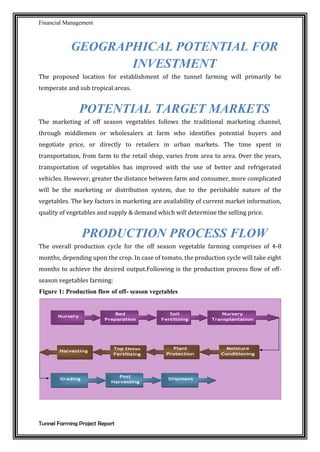
months to achieve the desired output.Following is the production process flow of off-
season vegetables farming:
Figure 1: Production flow of off- season vegetables
Nursery
Bed
Preparation
Soil
Fertilizing
Nursery
Transplantation
Top Dress
Fertilizing
Harvesting
Plant
Protection
Moisture
Conditioning
Shipment
Post
Harvesting
Aspects
Grading
Financial Management
Tunnel Farming Project Report
Sowing& Picking Period Of Off -Season Vegetables
Following are sowing and picking periods of selected off-season vegetables in their
respective normal growing seasons:
Table 1: Sowing and picking period for the selected off--season vegetables
vegetables Sowing period Picking period
Tomato October (Nursery)
November (Transplantation)
February-May
Cucumber End of October to end of
December (direct seeding)
Mid January to May
Sweet peppers Mid of September to 1st week of October
End of October to 1st week of November
(Transplantation)
End of January toSeptember
Temperature Requirements for Best Growth of Vegetables
Temperature is much important in off-season vegetables.Following are the temperature
requirement for the off-season vegetables
Table 2:Temperature Requirements for Vegetables
Vegetables Temperature Requirements
Tomato 29-21
Cucumber 24-18
Sweet pepper 24-21
PROJECT COST AND BENEFIT
SUMMARY
A detailed financial model has been developed to analyze the commercial viability of off-
season vegetable farming under the Prime Minister’s Small Business Loan Scheme.
Various cost and revenue related assumptions, along with results of the analysis, are
outlined in this section.
Financial Management
Tunnel Farming Project Report
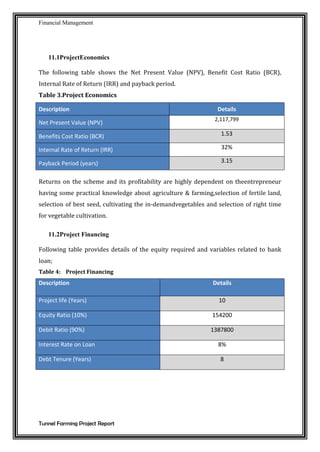
11.1ProjectEconomics
The following table shows the Net Present Value (NPV), Benefit Cost Ratio (BCR),
Internal Rate of Return (IRR) and payback period.
Table 3.Project Economics
Description Details
Net Present Value (NPV)
2,117,799
Benefits Cost Ratio (BCR) 1.53
Internal Rate of Return (IRR) 32%
Payback Period (years) 3.15
Returns on the scheme and its profitability are highly dependent on theentrepreneur
having some practical knowledge about agriculture & farming,selection of fertile land,
selection of best seed, cultivating the in-demandvegetables and selection of right time
for vegetable cultivation.
11.2Project Financing
Following table provides details of the equity required and variables related to bank
loan;
Table 4: Project Financing
Description Details
Project life (Years) 10
Equity Ratio (10%) 154200
Debit Ratio (90%) 1387800
Interest Rate on Loan 8%
Debt Tenure (Years) 8
Financial Management
Tunnel Farming Project Report
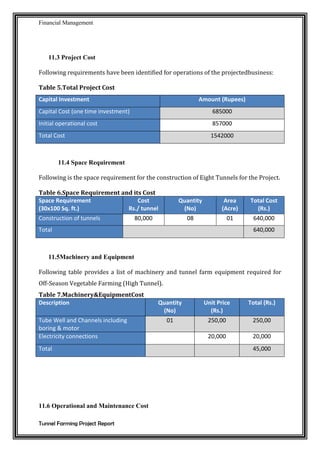
11.3 Project Cost
Following requirements have been identified for operations of the projectedbusiness:
Table 5.Total Project Cost
Capital Investment Amount (Rupees)
Capital Cost (one time investment) 685000
Initial operational cost 857000
Total Cost 1542000
11.4 Space Requirement
Following is the space requirement for the construction of Eight Tunnels for the Project.
Table 6.Space Requirement and its Cost
Space Requirement
(30x100 Sq. ft.)
Cost
Rs./ tunnel
Quantity
(No)
Area
(Acre)
Total Cost
(Rs.)
Construction of tunnels 80,000 08 01 640,000
Total 640,000
11.5Machinery and Equipment
Following table provides a list of machinery and tunnel farm equipment required for
Off-Season Vegetable Farming (High Tunnel).
Table 7.Machinery&EquipmentCost
Description Quantity
(No)
Unit Price
(Rs.)
Total (Rs.)
Tube Well and Channels including
boring & motor
01 250,00 250,00
Electricity connections 20,000 20,000
Total 45,000
11.6 Operational and Maintenance Cost
Financial Management
Tunnel Farming Project Report
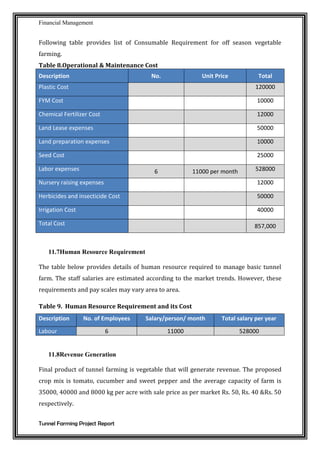
Following table provides list of Consumable Requirement for off season vegetable
farming.
Table 8.Operational & Maintenance Cost
Description No. Unit Price Total
Plastic Cost 120000
FYM Cost 10000
Chemical Fertilizer Cost 12000
Land Lease expenses 50000
Land preparation expenses 10000
Seed Cost 25000
Labor expenses 6 11000 per month 528000
Nursery raising expenses 12000
Herbicides and insecticide Cost 50000
Irrigation Cost 40000
Total Cost 857,000
11.7Human Resource Requirement
The table below provides details of human resource required to manage basic tunnel
farm. The staff salaries are estimated according to the market trends. However, these
requirements and pay scales may vary area to area.
Table 9. Human Resource Requirement and its Cost
Description No. of Employees Salary/person/ month Total salary per year
Labour 6 11000 528000
11.8Revenue Generation
Final product of tunnel farming is vegetable that will generate revenue. The proposed
crop mix is tomato, cucumber and sweet pepper and the average capacity of farm is
35000, 40000 and 8000 kg per acre with sale price as per market Rs. 50, Rs. 40 &Rs. 50
respectively.
Financial Management
Tunnel Farming Project Report
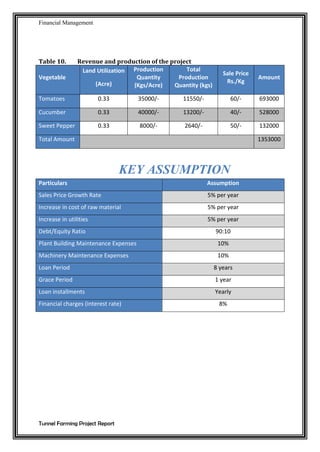
Table 10. Revenue and production of the project
Vegetable
Land Utilization
(Acre)
Production
Quantity
(Kgs/Acre)
Total
Production
Quantity (kgs)
Sale Price
Rs./Kg
Amount
Tomatoes 0.33 35000/- 11550/- 60/- 693000
Cucumber 0.33 40000/- 13200/- 40/- 528000
Sweet Pepper 0.33 8000/- 2640/- 50/- 132000
Total Amount 1353000
KEY ASSUMPTION
Particulars Assumption
Sales Price Growth Rate 5% per year
Increase in cost of raw material 5% per year
Increase in utilities 5% per year
Debt/Equity Ratio 90:10
Plant Building Maintenance Expenses 10%
Machinery Maintenance Expenses 10%
Loan Period 8 years
Grace Period 1 year
Loan installments Yearly
Financial charges (interest rate) 8%
Financial Management
Tunnel Farming Project Report
10
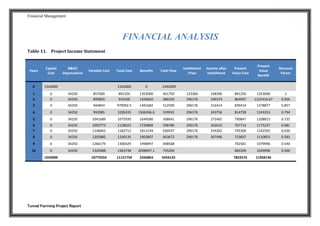
FINANCIAL ANALYSIS
Table 11. Project Income Statement
Years
Capital
Cost
R&M/
Depreciation
Variable Cost Total Cost Benefits Cash Flow
Installment
/Year
Income after
Installment
Present
Value Cost
Present
Value
Benefit
Discount
Factor
0 1542000 1542000 0 -1542000
1 0 34250 857000 891250 1353000 461750 123360 338390 891250 1353000 1
2 0 34250 899850 934100 1420650 486550 296176 190374 864907 1315416.67 0.926
3 0 34250 944843 979092.5 1491682 512590 296176 216414 839414 1278877 0.857
4 0 34250 992085 1026335 1566266.6 539932 296176 243756 814738 1243353 0.794
5 0 34250 1041689 1075939 1644580 568641 296176 272465 790847 1208815 0.735
6 0 34250 1093773 1128023 1726809 598786 296176 302610 767714 1175237 0.681
7 0 34250 1148462 1182712 1813149 630437 296176 334262 745309 1142592 0.630
8 0 34250 1205885 1240135 1903807 663672 296176 367496 723607 1110853 0.583
9 0 34250 1266179 1300429 1998997 698568 702581 1079996 0.540
10 0 34250 1329488 1363738 2098947.1 735209 682209 1049996 0.500
1542000 10779254 11121754 2266863 4354135 7822576 11958136

tunnel farming project

  • 1.
    Financial Management Tunnel FarmingProject Report FINANCIAL STUDY OFF SEASON VEGETABLE PRODUCTION (HIGH TUNNEL) Presented to: Prof. Nauman Nazir Financial Management
  • 2.
    Financial Management Tunnel FarmingProject Report Group Members Serial # Name Reg. # 01 Umair Mohsin 05 02 Usman Zaka 08 03 Mohsin Sohail 09 04 Umair Saeed 10 05 Sadaqat Ali 11
  • 3.
    Financial Management Tunnel FarmingProject Report Contents Group Members.................................................................... i Contents............................................................................... ii PURPOSE OF DOCUMENT .................................................... 1 EXECUTIVE SUMMARY ......................................................... 1 BRIEF DESCRIPTION OF PROJECT AND PRODUCT................. 2 CRITICAL FACTORS ............................................................... 3 INSTALLED AND OPERATIONAL CAPACITY FOR OFF SEASON VEGETABLE FARMING .......................................................... 3 GEOGRAPHICAL POTENTIAL FOR INVESTMENT ................... 4 POTENTIAL TARGET MARKETS ............................................. 4 PRODUCTION PROCESS FLOW ............................................. 4 PROJECT COST AND BENEFIT SUMMARY ............................. 5 11.1ProjectEconomics.....................................................................................................................6 11.2Project Financing......................................................................................................................6 11.3 Project Cost.............................................................................................................................7 11.4 Space Requirement.................................................................................................................7 11.5Machinery and Equipment ......................................................................................................7 11.7Human Resource Requirement................................................................................................8 11.8Revenue Generation................................................................................................................8 KEY ASSUMPTION................................................................. 9 FINANCIAL ANALYSIS.......................................................... 10
  • 4.
    Financial Management Tunnel FarmingProject Report PURPOSE OF DOCUMENT The purpose of this document is to facilitate potential investors in Off Season Vegetable Production-High tunnelby providing them with a general understanding of the business, with the intention of supporting potential investors in crucial investment decisions. The project pre-feasibility may form the basis of an important investment decision and in order to serve this objective, the document/study covers various aspects of project concept development, start-up, production, finance, and business management. The need to come up with pre-feasibility reports for undocumented or minimally documented sectors attains greater imminence as the research that precedes such reports reveal certain thumb rules; best practices developed by existing enterprises by trial and error, certain industrial norms and well established research findings that become a guiding source regarding various aspects of business set-up and it’s successful management. Apart from carefully studying the whole document, one must consider critical aspects provided later on, which form the basis of investment decisions. EXECUTIVE SUMMARY Growing out-of-season crops in controlled atmosphere inside polythene tunnel is called Tunnel Farming. It was first introduced by William Fredrick 2600 years before. High tunnels, also known as hoop houses, are relatively simple polyethylene-covered unheated structures. It covered with one or two sheets of plastic and two layer offering better insulation and consequently more cold protection. It gives maximum yield of crops and makes easy soil preparation, picking and spraying due to its width and height. It’s much suitable for tomatoes, cucumber and sweet pepper. Vegetable Production under high tunnel is considered for Business in this project pre- feasibility. This business is proposed to be located primarily in all temperate and sub tropical areas of the country. All aspects of tunnel farming i.e. selection of suitable crop for tunnel farming, nursery raising for off season crop, their nutritional requirement, all crop management practices and different necessary measures for productivity improvement has been studied at Vegetable Crops Research Programme, Horticultural Research Institute (HRI),National Agricultural Research Centre (NARC), Islamabad. After successful experimentation, this technology is declared technically feasible for
  • 5.
    Financial Management Tunnel FarmingProject Report commercial vegetable farming. The technology of tunnel farming is in the phase of extension to the farmers. Farmers are already practicing this technology at their farms. The tunnel farming can be successfully carried in Punjab, KhyberPakhtunkhwa and some parts of Balochistan. The project can be started at an area of one acre with eight tunnels of 30ft x 100 ft(3000 sq.ft) each per acre. Total cost estimate is Rs.1.542 million, with fixed investment of Rs.0.685 million and working capital amounting to Rs.0.857 million. Given the cost assumptions, Net Present Value (NPV), Internal Rate of Return (IRR), Benefit Cost Ratio (BCR) and payback period are Rs. 2,117,799,32%, 1.53 and 3.15 years respectively. BRIEF DESCRIPTION OF PROJECT AND PRODUCT Following key parameters must be addressed as per pre-feasibility study: • Techniques: Different methods and techniques are used for off-season vegetable farming. However, keeping in view the economical, technical andmanagerial factors, high tunnel off season vegetable farming is suggested for the proposed project • Location: The business can be successfully carried in Punjab, KhyberPakhtunkhwa and some parts of Balochistan.
  • 6.
    Financial Management Tunnel FarmingProject Report • Product: Year round vegetable consumption is increasing in Pakistan due to changing food habits. Off season tunnel farming is the only way to fulfill this objective. • Target Market: In addition to local consumption in the country, there is an enormous export potential. • Employment Generation: The proposed project will provide direct employment to seven individuals. Financial analysis shows the profitability of proposed business within first year of its operation. CRITICAL FACTORS The commercial viability of the proposed project depends on the following factors:  Any person who is planning to adopt this technology should have some practical knowledge about farming.  Land that is being utilized for off-season vegetable farming should be tested which will help in determining the quality of land for agriculture purposes.  Farmer should ensure that the plant they are planning to grow must have the ability to self-pollinate under the plastic sheet.  Selection of the seed is most important factor because this determines the productivity of the crop.  Vegetables, which are in demand, should be cultivated, this will help in earning higher profit margins.  Timing of cultivation of vegetables has to be done accurately. The farmer should have knowledge about the benefit that the early crop will offer and should gather data about the prices of these early crops. INSTALLED AND OPERATIONAL CAPACITY FOR OFF SEASON VEGETABLE FARMING This pre-feasibility suggests a farm operation on one acre of land with eight tunnels of size (30 x 100 ft) each.
  • 7.
    Financial Management Tunnel FarmingProject Report GEOGRAPHICAL POTENTIAL FOR INVESTMENT The proposed location for establishment of the tunnel farming will primarily be temperate and sub tropical areas. POTENTIAL TARGET MARKETS The marketing of off season vegetables follows the traditional marketing channel, through middlemen or wholesalers at farm who identifies potential buyers and negotiate price, or directly to retailers in urban markets. The time spent in transportation, from farm to the retail shop, varies from area to area. Over the years, transportation of vegetables has improved with the use of better and refrigerated vehicles. However, greater the distance between farm and consumer, more complicated will be the marketing or distribution system, due to the perishable nature of the vegetables. The key factors in marketing are availability of current market information, quality of vegetables and supply & demand which will determine the selling price. PRODUCTION PROCESS FLOW The overall production cycle for the off season vegetable farming comprises of 4-8 months, depending upon the crop. In case of tomato, the production cycle will take eight months to achieve the desired output.Following is the production process flow of off- season vegetables farming: Figure 1: Production flow of off- season vegetables Nursery Bed Preparation Soil Fertilizing Nursery Transplantation Top Dress Fertilizing Harvesting Plant Protection Moisture Conditioning Shipment Post Harvesting Aspects Grading
  • 8.
    Financial Management Tunnel FarmingProject Report Sowing& Picking Period Of Off -Season Vegetables Following are sowing and picking periods of selected off-season vegetables in their respective normal growing seasons: Table 1: Sowing and picking period for the selected off--season vegetables vegetables Sowing period Picking period Tomato October (Nursery) November (Transplantation) February-May Cucumber End of October to end of December (direct seeding) Mid January to May Sweet peppers Mid of September to 1st week of October End of October to 1st week of November (Transplantation) End of January toSeptember Temperature Requirements for Best Growth of Vegetables Temperature is much important in off-season vegetables.Following are the temperature requirement for the off-season vegetables Table 2:Temperature Requirements for Vegetables Vegetables Temperature Requirements Tomato 29-21 Cucumber 24-18 Sweet pepper 24-21 PROJECT COST AND BENEFIT SUMMARY A detailed financial model has been developed to analyze the commercial viability of off- season vegetable farming under the Prime Minister’s Small Business Loan Scheme. Various cost and revenue related assumptions, along with results of the analysis, are outlined in this section.
  • 9.
    Financial Management Tunnel FarmingProject Report 11.1ProjectEconomics The following table shows the Net Present Value (NPV), Benefit Cost Ratio (BCR), Internal Rate of Return (IRR) and payback period. Table 3.Project Economics Description Details Net Present Value (NPV) 2,117,799 Benefits Cost Ratio (BCR) 1.53 Internal Rate of Return (IRR) 32% Payback Period (years) 3.15 Returns on the scheme and its profitability are highly dependent on theentrepreneur having some practical knowledge about agriculture & farming,selection of fertile land, selection of best seed, cultivating the in-demandvegetables and selection of right time for vegetable cultivation. 11.2Project Financing Following table provides details of the equity required and variables related to bank loan; Table 4: Project Financing Description Details Project life (Years) 10 Equity Ratio (10%) 154200 Debit Ratio (90%) 1387800 Interest Rate on Loan 8% Debt Tenure (Years) 8
  • 10.
    Financial Management Tunnel FarmingProject Report 11.3 Project Cost Following requirements have been identified for operations of the projectedbusiness: Table 5.Total Project Cost Capital Investment Amount (Rupees) Capital Cost (one time investment) 685000 Initial operational cost 857000 Total Cost 1542000 11.4 Space Requirement Following is the space requirement for the construction of Eight Tunnels for the Project. Table 6.Space Requirement and its Cost Space Requirement (30x100 Sq. ft.) Cost Rs./ tunnel Quantity (No) Area (Acre) Total Cost (Rs.) Construction of tunnels 80,000 08 01 640,000 Total 640,000 11.5Machinery and Equipment Following table provides a list of machinery and tunnel farm equipment required for Off-Season Vegetable Farming (High Tunnel). Table 7.Machinery&EquipmentCost Description Quantity (No) Unit Price (Rs.) Total (Rs.) Tube Well and Channels including boring & motor 01 250,00 250,00 Electricity connections 20,000 20,000 Total 45,000 11.6 Operational and Maintenance Cost
  • 11.
    Financial Management Tunnel FarmingProject Report Following table provides list of Consumable Requirement for off season vegetable farming. Table 8.Operational & Maintenance Cost Description No. Unit Price Total Plastic Cost 120000 FYM Cost 10000 Chemical Fertilizer Cost 12000 Land Lease expenses 50000 Land preparation expenses 10000 Seed Cost 25000 Labor expenses 6 11000 per month 528000 Nursery raising expenses 12000 Herbicides and insecticide Cost 50000 Irrigation Cost 40000 Total Cost 857,000 11.7Human Resource Requirement The table below provides details of human resource required to manage basic tunnel farm. The staff salaries are estimated according to the market trends. However, these requirements and pay scales may vary area to area. Table 9. Human Resource Requirement and its Cost Description No. of Employees Salary/person/ month Total salary per year Labour 6 11000 528000 11.8Revenue Generation Final product of tunnel farming is vegetable that will generate revenue. The proposed crop mix is tomato, cucumber and sweet pepper and the average capacity of farm is 35000, 40000 and 8000 kg per acre with sale price as per market Rs. 50, Rs. 40 &Rs. 50 respectively.
  • 12.
    Financial Management Tunnel FarmingProject Report Table 10. Revenue and production of the project Vegetable Land Utilization (Acre) Production Quantity (Kgs/Acre) Total Production Quantity (kgs) Sale Price Rs./Kg Amount Tomatoes 0.33 35000/- 11550/- 60/- 693000 Cucumber 0.33 40000/- 13200/- 40/- 528000 Sweet Pepper 0.33 8000/- 2640/- 50/- 132000 Total Amount 1353000 KEY ASSUMPTION Particulars Assumption Sales Price Growth Rate 5% per year Increase in cost of raw material 5% per year Increase in utilities 5% per year Debt/Equity Ratio 90:10 Plant Building Maintenance Expenses 10% Machinery Maintenance Expenses 10% Loan Period 8 years Grace Period 1 year Loan installments Yearly Financial charges (interest rate) 8%
  • 13.
    Financial Management Tunnel FarmingProject Report 10 FINANCIAL ANALYSIS Table 11. Project Income Statement Years Capital Cost R&M/ Depreciation Variable Cost Total Cost Benefits Cash Flow Installment /Year Income after Installment Present Value Cost Present Value Benefit Discount Factor 0 1542000 1542000 0 -1542000 1 0 34250 857000 891250 1353000 461750 123360 338390 891250 1353000 1 2 0 34250 899850 934100 1420650 486550 296176 190374 864907 1315416.67 0.926 3 0 34250 944843 979092.5 1491682 512590 296176 216414 839414 1278877 0.857 4 0 34250 992085 1026335 1566266.6 539932 296176 243756 814738 1243353 0.794 5 0 34250 1041689 1075939 1644580 568641 296176 272465 790847 1208815 0.735 6 0 34250 1093773 1128023 1726809 598786 296176 302610 767714 1175237 0.681 7 0 34250 1148462 1182712 1813149 630437 296176 334262 745309 1142592 0.630 8 0 34250 1205885 1240135 1903807 663672 296176 367496 723607 1110853 0.583 9 0 34250 1266179 1300429 1998997 698568 702581 1079996 0.540 10 0 34250 1329488 1363738 2098947.1 735209 682209 1049996 0.500 1542000 10779254 11121754 2266863 4354135 7822576 11958136