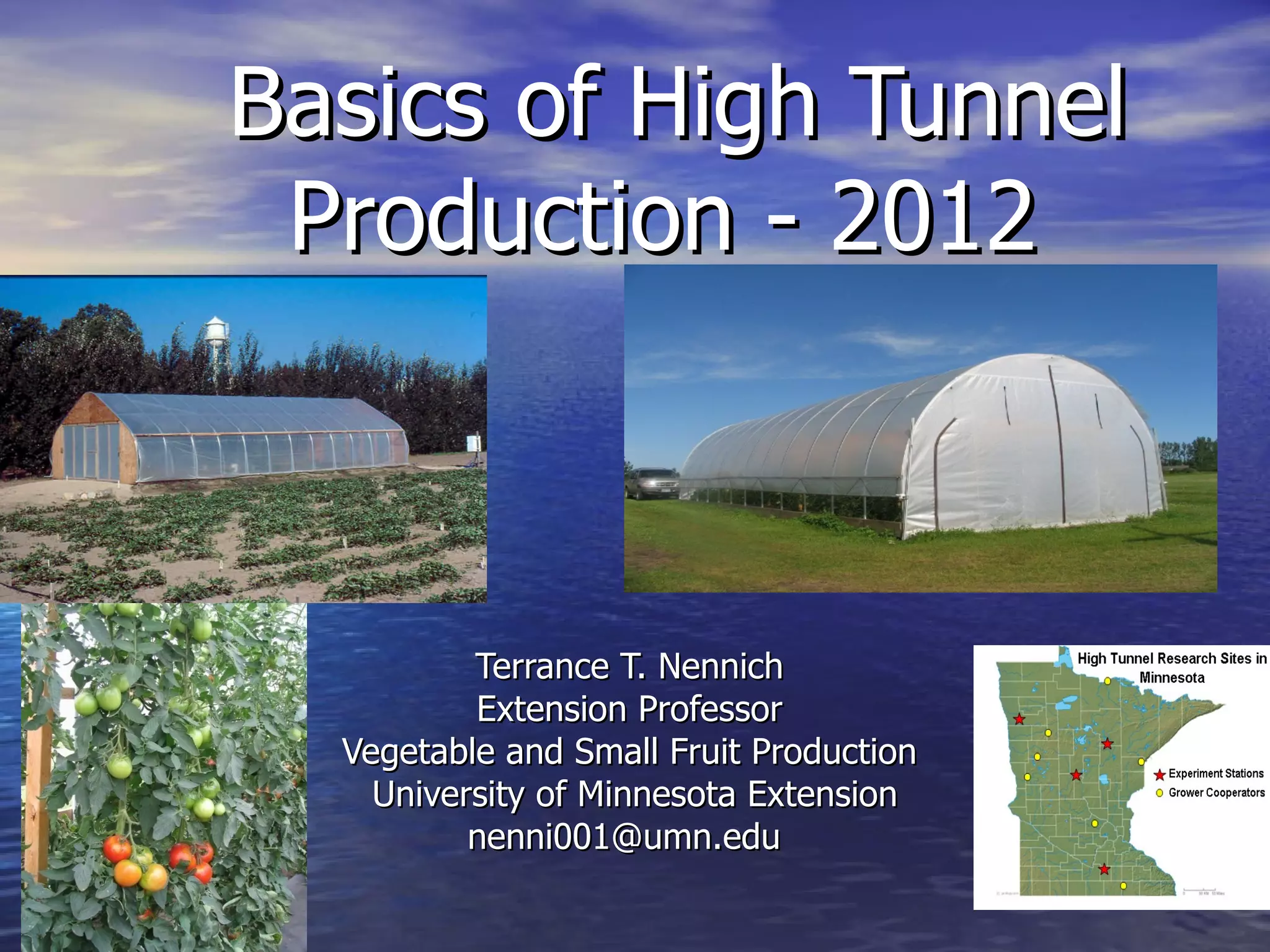















Basics of High Tunnel
 Production - 2012


          Terrance T. Nennich
          Extension Professor
  Vegetable and Small Fruit Production
    University of Minnesota Extension
          nenni001@umn.edu
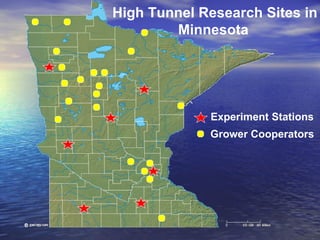
High Tunnel Research Sites in
        Minnesota


             Experiment Stations
             Grower Cooperators
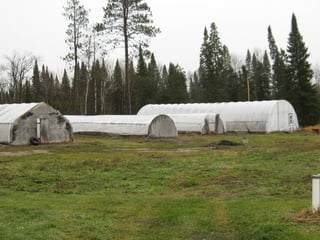
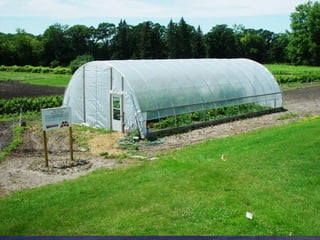
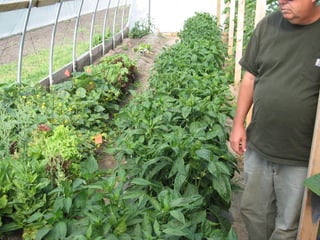
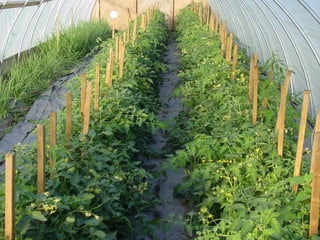
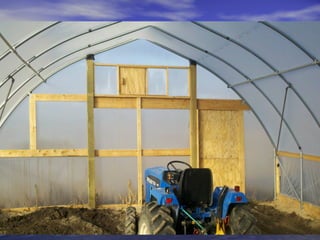
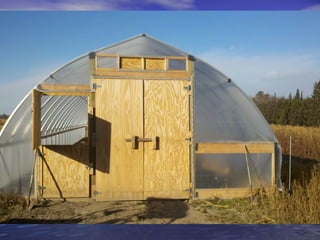
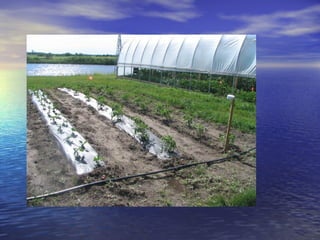
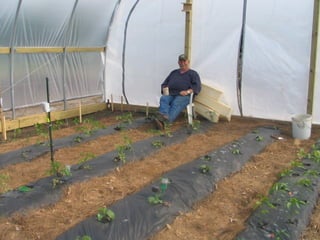
What are High Tunnels

• High tunnels are not a poor persons
 greenhouse

• High tunnels are a separate intense
 technology which allows crops to be
 grown up to three zones earlier and later
 and eliminate considerable risk.
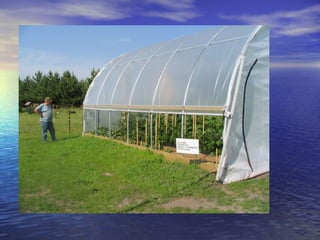
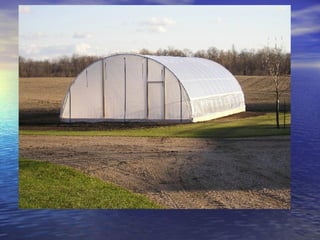
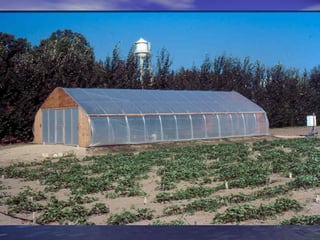
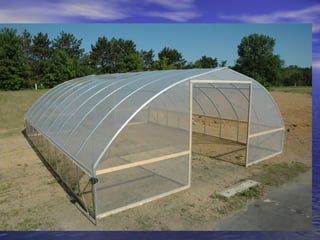
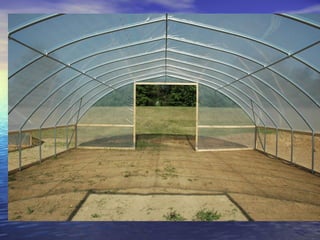
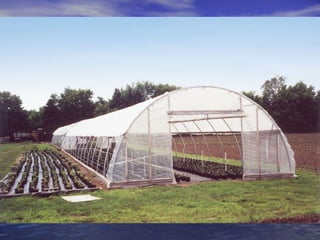
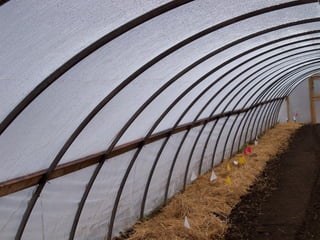
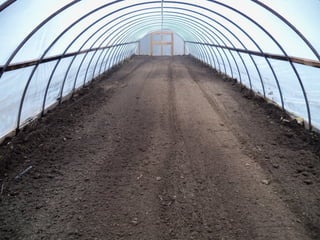
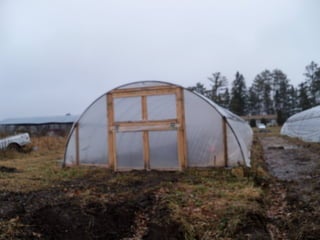
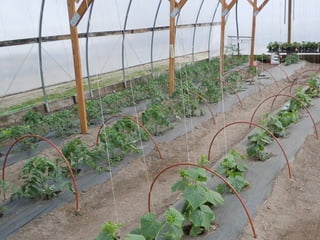
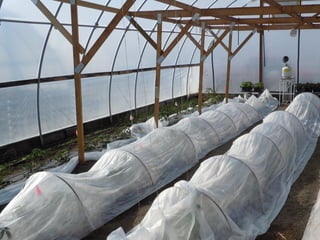
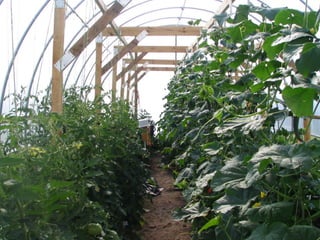
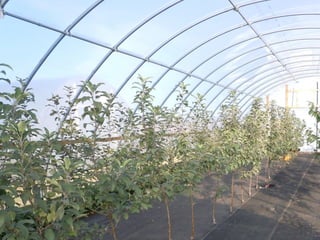
What are High Tunnels?

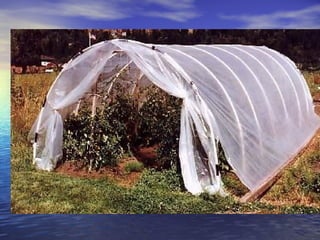
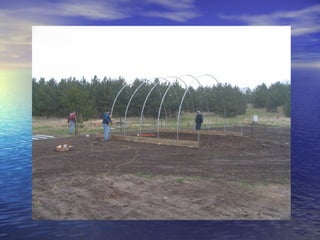
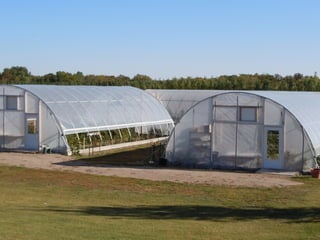
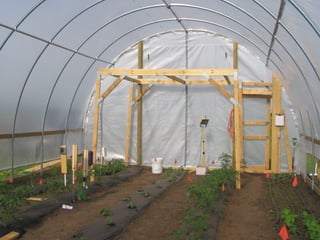
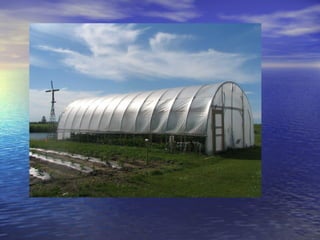
• Structures that resemble some
  greenhouses - in appearances only
• Use no artificial heat (except for
  emergencies)
• Use no artificial ventilation such as fans,
  tubes or forced air
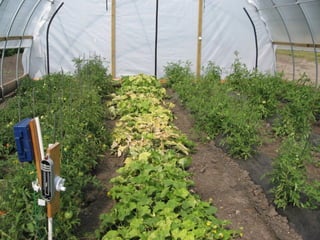
• Plants are grown in the ground.
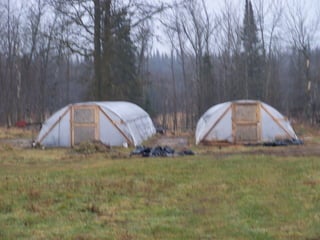
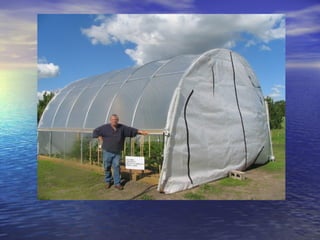
• Many shapes and sizes
What Can be Grown in High
    Tunnels in Zones 2 and 3.
• Any crop that can normally be grown in
 the area

• Most crops in zones 4 through 5.

• Some in zone 6 and be on.
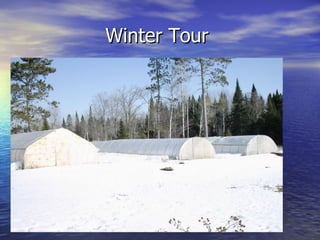
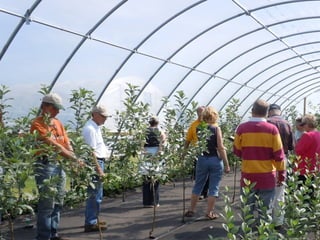
Winter Tour
Advantages of High Tunnels

• 4-8 weeks earlier production in the spring
• 2-5 weeks later possible production in the
  fall
• Grow crops not usually grown in the area
• Very high yield per plant
• Crop mix
• Very cost effective
• Usually no pesticides needed
• Organic production
Advantages of High Tunnels

• Natural disease control
• Insect control
• Control water
• Guarantee a crop
• Reduce cull fruit.
Advantages of High Tunnels

• Natural disease control
• Insect control
• Control water
• Guarantee a crop
• Reduce cull fruit.
Concerns of High Tunnels

• Cost involved
• Education
• Planning
• Management
• Time
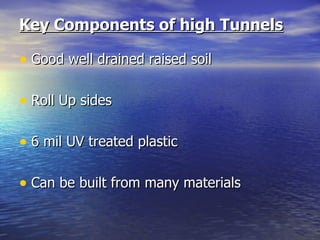
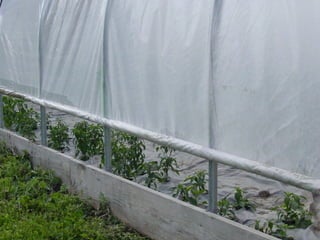
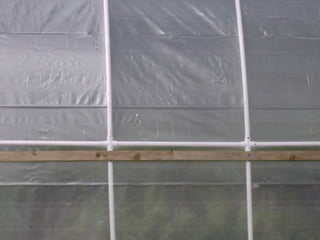
Key Components of high Tunnels

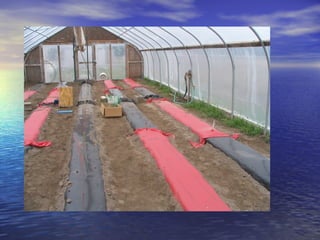
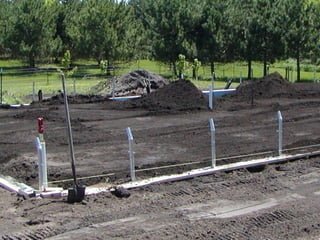
• Good well drained raised soil

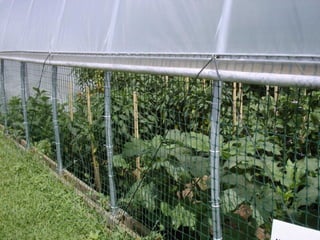
• Roll Up sides

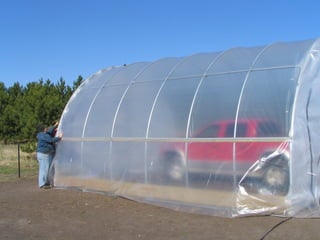
• 6 mil UV treated plastic

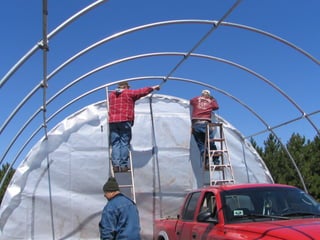
• Can be built from many materials
Why High Tunnels Work

• Lets review the principles of plant growth
     Time
     Heat
     Light
     Stress
Time
• All plants need time to advance in growth and
    mature
•   How much growth that occurs in a given length
    of time depends on how ideal the environmental
    growth factors are.
•   In northern climates heat is the one factor that
    we need to be concerned about.
•   Seed catalogs use maximum conditions in
    deciding growing days.
Heat

• Plants are classified by there ideal heat
  requirements.
• Tomatoes , peppers, 80-90 degrees
• Cucumber , melons , 85-95 degrees
• Heat is measured in growing degree days
• Duration of Temperature is Critical
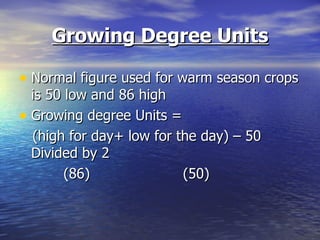
Growing Degree Units

• Normal figure used for warm season crops
  is 50 low and 86 high
• Growing degree Units =
  (high for day+ low for the day) – 50
  Divided by 2
        (86)              (50)
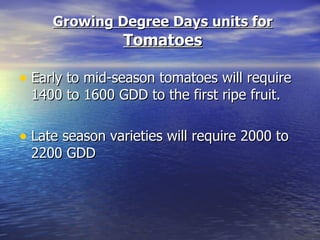
Growing Degree Days units for
                Tomatoes

• Early to mid-season tomatoes will require
 1400 to 1600 GDD to the first ripe fruit.

• Late season varieties will require 2000 to
 2200 GDD
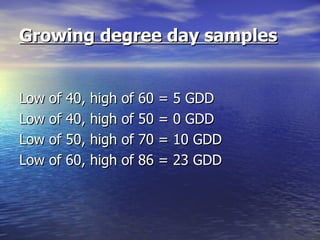
Growing degree day samples


Low of 40, high of 60 = 5 GDD
Low of 40, high of 50 = 0 GDD
Low of 50, high of 70 = 10 GDD
Low of 60, high of 86 = 23 GDD
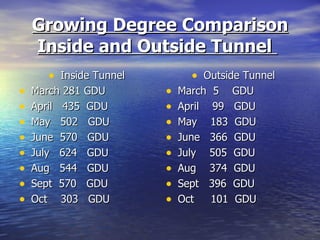
Growing Degree Comparison
    Inside and Outside Tunnel
      • Inside Tunnel         • Outside Tunnel
•   March 281 GDU       •   March 5     GDU
•   April 435 GDU       •   April 99    GDU
•   May 502 GDU         •   May 183     GDU
•   June 570 GDU        •   June 366    GDU
•   July 624 GDU        •   July 505    GDU
•   Aug 544 GDU         •   Aug 374     GDU
•   Sept 570 GDU        •   Sept 396    GDU
•   Oct 303 GDU         •   Oct   101   GDU
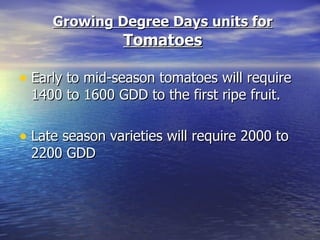
Growing Degree Days units for
                Tomatoes

• Early to mid-season tomatoes will require
 1400 to 1600 GDD to the first ripe fruit.

• Late season varieties will require 2000 to
 2200 GDD
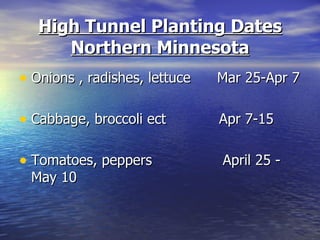
High Tunnel Planting Dates
      Northern Minnesota
• Onions , radishes, lettuce   Mar 25-Apr 7

• Cabbage, broccoli ect        Apr 7-15

• Tomatoes, peppers            April 25 -
 May 10
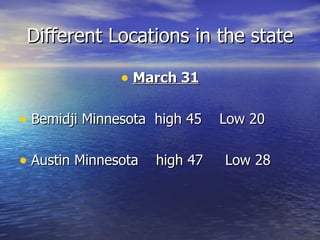
Different Locations in the state

              • March 31

• Bemidji Minnesota high 45 Low 20

• Austin Minnesota high 47   Low 28
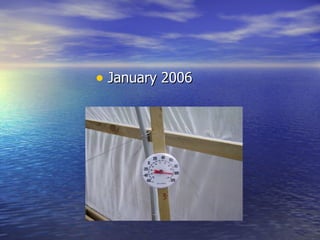
• January 2006
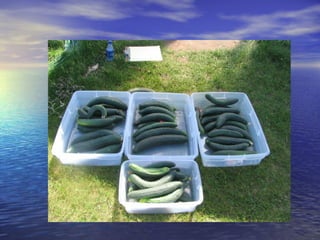
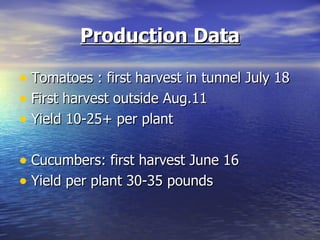
Production Data

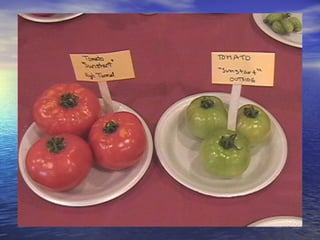
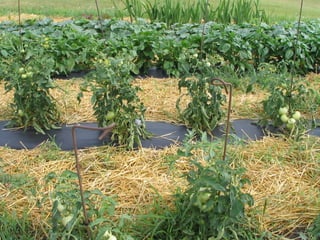
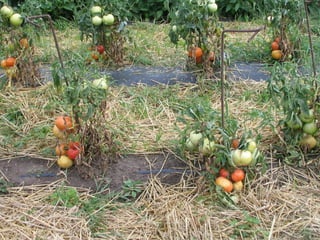
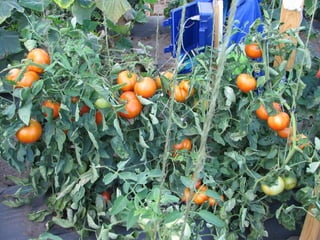
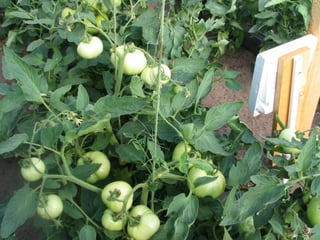
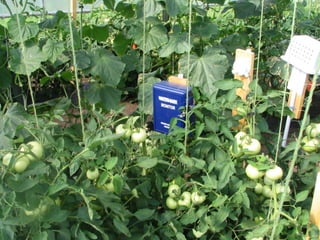
• Tomatoes : first harvest in tunnel July 18
• First harvest outside Aug.11
• Yield 10-25+ per plant

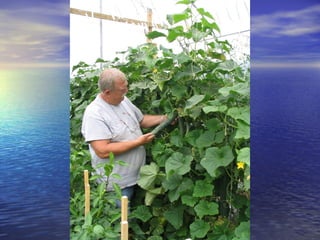
• Cucumbers: first harvest June 16
• Yield per plant 30-35 pounds
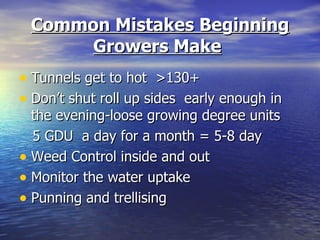
Common Mistakes Beginning
      Growers Make
• Tunnels get to hot >130+
• Don’t shut roll up sides early enough in
  the evening-loose growing degree units
  5 GDU a day for a month = 5-8 day
• Weed Control inside and out
• Monitor the water uptake
• Punning and trellising
Tunnel Direction

• Narrow end against prevailing high winds

• The outside air direction has little to do
  with the cooling of the tunnel

• Recommend tunnel construction for 100
  MPH winds
Yield Potential & Nutrient Needs


 • Yields in a high tunnel can be 3 to 4 times the
   yield obtained in the field

 • Higher yields will required more nutrients, but
   knowing how much to apply is a challenge
   –   Lack of nutrients – deficiencies
   –   Excessive nutrients – salt build up
   –   Both situations affect yield and quality
Cucumber Results
                         Cucumbers
  All the fruit from all 26 cucumber plants were weighed
  and evaluated for quality. All data is in pounds per plant.

Sweet Success
  First Harvest       June 8
  Total Yield/Plant    65.12
  Culls                8.0
  MKT/sq/ft            9,52
  Total sq/ft         10.85

  Total Yield Acre    =        472,628 or 236 tons.
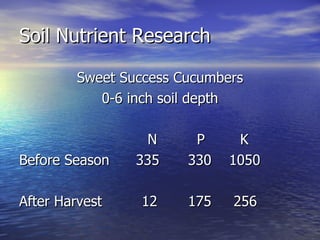
Soil Nutrient Research

        Sweet Success Cucumbers
           0-6 inch soil depth

                 N      P     K
Before Season   335    330   1050

After Harvest   12     175   256
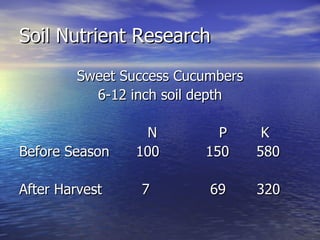
Soil Nutrient Research
        Sweet Success Cucumbers
          6-12 inch soil depth

                 N         P       K
Before Season   100      150      580

After Harvest   7         69      320
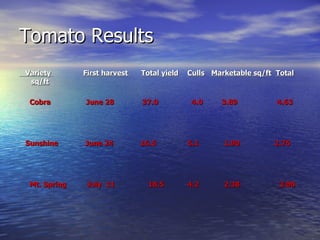
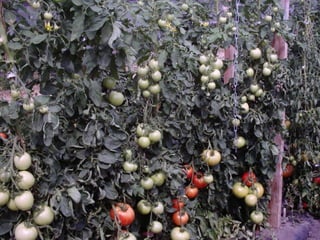
Tomato Results
Variety       First harvest   Total yield   Culls Marketable sq/ft Total
 sq/ft

 Cobra        June 28         37.0           4.0    3.89           4.63


Sunshine      June 24         16.5          5.1      1.90         2.75


 Mt. Spring    July 11          18.5        4.2      2.38           3.08
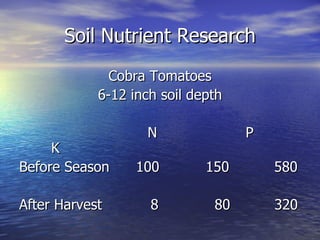
Soil Nutrient Research
              Cobra Tomatoes
            6-12 inch soil depth

                   N               P
     K
Before Season     100        150       580

After Harvest       8         80       320
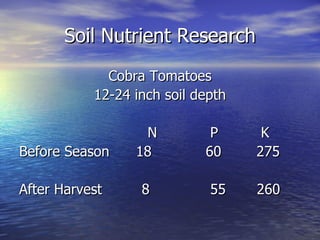
Soil Nutrient Research
             Cobra Tomatoes
           12-24 inch soil depth

                  N          P      K
Before Season    18         60     275

After Harvest     8          55    260
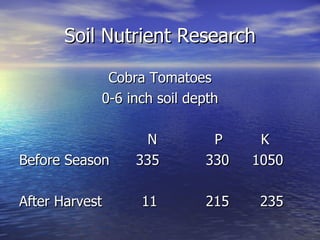
Soil Nutrient Research

             Cobra Tomatoes
            0-6 inch soil depth

                  N          P     K
Before Season    335        330   1050

After Harvest     11        215    235
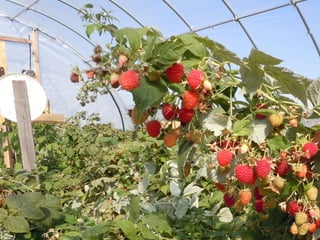
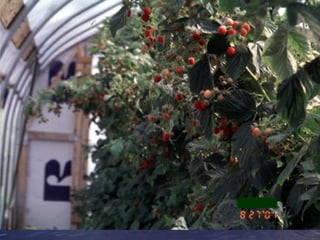
Berry quality
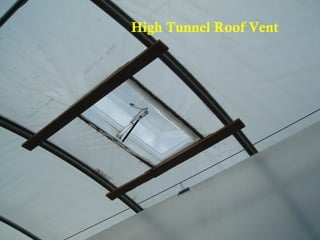
High Tunnel Roof Vent
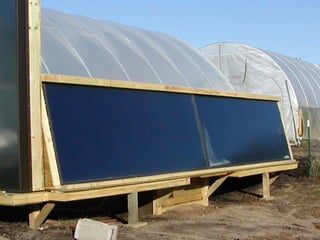
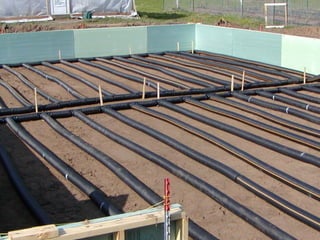
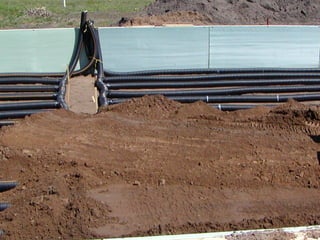
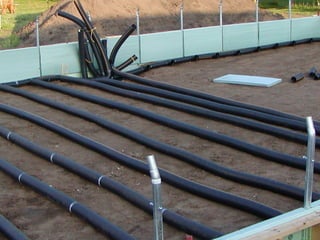
• Air leaves the solar panels at about
 125-175 degrees depending on the
 amount of sun

• Air leaves the soil at 50 – 75 degrees to
 be recirculated through the solar panels
 (this is a closed system )
Solar Heating of the Soil

• Cucumbers – May 15

• Tomatoes – June 5
Results to Date


• Soil temperatures have been kept at
 minimum of 52 degrees even though
 outside temperature have been well below
 10 degrees.

• At this temperature, cool season crops are
 doing very well
Local High Tunnel List Serve

• Be sure to sign up for the Minnesota/North
 Dakota List Serve.

• Talk to local producers, be informed of
 upcoming events.
On line at:

www.hightunnels.cfans.umn.edu


Minnesota Fruit and Vegetable
Growers Association – (763) 434-0400
Minnesota High Tunnel Web
Site
•http://hightunnels.cfans.umn.edu/
Upcoming Research
• Plant density studies

• Fertility studies

• Variety Studies

• Irrigation Studies

• Raspberries, Perennial crops , Overwintering
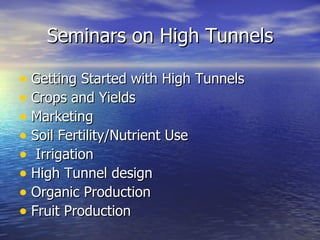
Seminars on High Tunnels

• Getting Started with High Tunnels
• Crops and Yields
• Marketing
• Soil Fertility/Nutrient Use
• Irrigation
• High Tunnel design
• Organic Production
• Fruit Production
QUESTIONS
???????????

High tunnel basic state conference 2012

  • 1.
    Basics of HighTunnel Production - 2012 Terrance T. Nennich Extension Professor Vegetable and Small Fruit Production University of Minnesota Extension nenni001@umn.edu
  • 2.
    High Tunnel ResearchSites in Minnesota Experiment Stations Grower Cooperators
  • 3.
    What are HighTunnels • High tunnels are not a poor persons greenhouse • High tunnels are a separate intense technology which allows crops to be grown up to three zones earlier and later and eliminate considerable risk.
  • 5.
    What are HighTunnels? • Structures that resemble some greenhouses - in appearances only • Use no artificial heat (except for emergencies) • Use no artificial ventilation such as fans, tubes or forced air • Plants are grown in the ground. • Many shapes and sizes
  • 7.
    What Can beGrown in High Tunnels in Zones 2 and 3. • Any crop that can normally be grown in the area • Most crops in zones 4 through 5. • Some in zone 6 and be on.
  • 21.
  • 26.
    Advantages of HighTunnels • 4-8 weeks earlier production in the spring • 2-5 weeks later possible production in the fall • Grow crops not usually grown in the area • Very high yield per plant • Crop mix • Very cost effective • Usually no pesticides needed • Organic production
  • 27.
    Advantages of HighTunnels • Natural disease control • Insect control • Control water • Guarantee a crop • Reduce cull fruit.
  • 28.
    Advantages of HighTunnels • Natural disease control • Insect control • Control water • Guarantee a crop • Reduce cull fruit.
  • 29.
    Concerns of HighTunnels • Cost involved • Education • Planning • Management • Time
  • 30.
    Key Components ofhigh Tunnels • Good well drained raised soil • Roll Up sides • 6 mil UV treated plastic • Can be built from many materials
  • 51.
    Why High TunnelsWork • Lets review the principles of plant growth Time Heat Light Stress
  • 52.
    Time • All plantsneed time to advance in growth and mature • How much growth that occurs in a given length of time depends on how ideal the environmental growth factors are. • In northern climates heat is the one factor that we need to be concerned about. • Seed catalogs use maximum conditions in deciding growing days.
  • 53.
    Heat • Plants areclassified by there ideal heat requirements. • Tomatoes , peppers, 80-90 degrees • Cucumber , melons , 85-95 degrees • Heat is measured in growing degree days • Duration of Temperature is Critical
  • 54.
    Growing Degree Units •Normal figure used for warm season crops is 50 low and 86 high • Growing degree Units = (high for day+ low for the day) – 50 Divided by 2 (86) (50)
  • 55.
    Growing Degree Daysunits for Tomatoes • Early to mid-season tomatoes will require 1400 to 1600 GDD to the first ripe fruit. • Late season varieties will require 2000 to 2200 GDD
  • 56.
    Growing degree daysamples Low of 40, high of 60 = 5 GDD Low of 40, high of 50 = 0 GDD Low of 50, high of 70 = 10 GDD Low of 60, high of 86 = 23 GDD
  • 57.
    Growing Degree Comparison Inside and Outside Tunnel • Inside Tunnel • Outside Tunnel • March 281 GDU • March 5 GDU • April 435 GDU • April 99 GDU • May 502 GDU • May 183 GDU • June 570 GDU • June 366 GDU • July 624 GDU • July 505 GDU • Aug 544 GDU • Aug 374 GDU • Sept 570 GDU • Sept 396 GDU • Oct 303 GDU • Oct 101 GDU
  • 58.
    Growing Degree Daysunits for Tomatoes • Early to mid-season tomatoes will require 1400 to 1600 GDD to the first ripe fruit. • Late season varieties will require 2000 to 2200 GDD
  • 59.
    High Tunnel PlantingDates Northern Minnesota • Onions , radishes, lettuce Mar 25-Apr 7 • Cabbage, broccoli ect Apr 7-15 • Tomatoes, peppers April 25 - May 10
  • 60.
    Different Locations inthe state • March 31 • Bemidji Minnesota high 45 Low 20 • Austin Minnesota high 47 Low 28
  • 61.
  • 72.
    Production Data • Tomatoes: first harvest in tunnel July 18 • First harvest outside Aug.11 • Yield 10-25+ per plant • Cucumbers: first harvest June 16 • Yield per plant 30-35 pounds
  • 73.
    Common Mistakes Beginning Growers Make • Tunnels get to hot >130+ • Don’t shut roll up sides early enough in the evening-loose growing degree units 5 GDU a day for a month = 5-8 day • Weed Control inside and out • Monitor the water uptake • Punning and trellising
  • 75.
    Tunnel Direction • Narrowend against prevailing high winds • The outside air direction has little to do with the cooling of the tunnel • Recommend tunnel construction for 100 MPH winds
  • 107.
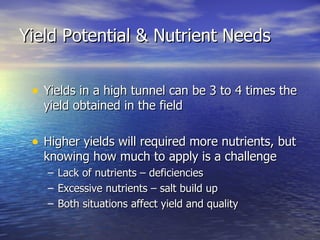
    Yield Potential &Nutrient Needs • Yields in a high tunnel can be 3 to 4 times the yield obtained in the field • Higher yields will required more nutrients, but knowing how much to apply is a challenge – Lack of nutrients – deficiencies – Excessive nutrients – salt build up – Both situations affect yield and quality
  • 108.
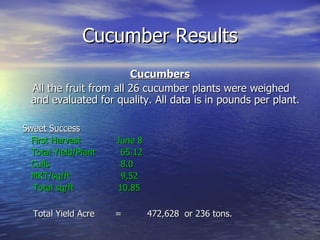
    Cucumber Results Cucumbers All the fruit from all 26 cucumber plants were weighed and evaluated for quality. All data is in pounds per plant. Sweet Success First Harvest June 8 Total Yield/Plant 65.12 Culls 8.0 MKT/sq/ft 9,52 Total sq/ft 10.85 Total Yield Acre = 472,628 or 236 tons.
  • 109.
    Soil Nutrient Research Sweet Success Cucumbers 0-6 inch soil depth N P K Before Season 335 330 1050 After Harvest 12 175 256
  • 110.
    Soil Nutrient Research Sweet Success Cucumbers 6-12 inch soil depth N P K Before Season 100 150 580 After Harvest 7 69 320
  • 111.
    Tomato Results Variety First harvest Total yield Culls Marketable sq/ft Total sq/ft Cobra June 28 37.0 4.0 3.89 4.63 Sunshine June 24 16.5 5.1 1.90 2.75 Mt. Spring July 11 18.5 4.2 2.38 3.08
  • 112.
    Soil Nutrient Research Cobra Tomatoes 6-12 inch soil depth N P K Before Season 100 150 580 After Harvest 8 80 320
  • 113.
    Soil Nutrient Research Cobra Tomatoes 12-24 inch soil depth N P K Before Season 18 60 275 After Harvest 8 55 260
  • 114.
    Soil Nutrient Research Cobra Tomatoes 0-6 inch soil depth N P K Before Season 335 330 1050 After Harvest 11 215 235
  • 125.
  • 134.
  • 142.
    • Air leavesthe solar panels at about 125-175 degrees depending on the amount of sun • Air leaves the soil at 50 – 75 degrees to be recirculated through the solar panels (this is a closed system )
  • 147.
    Solar Heating ofthe Soil • Cucumbers – May 15 • Tomatoes – June 5
  • 148.
    Results to Date •Soil temperatures have been kept at minimum of 52 degrees even though outside temperature have been well below 10 degrees. • At this temperature, cool season crops are doing very well
  • 149.
    Local High TunnelList Serve • Be sure to sign up for the Minnesota/North Dakota List Serve. • Talk to local producers, be informed of upcoming events.
  • 150.
    On line at: www.hightunnels.cfans.umn.edu MinnesotaFruit and Vegetable Growers Association – (763) 434-0400
  • 151.
    Minnesota High TunnelWeb Site •http://hightunnels.cfans.umn.edu/
  • 153.
    Upcoming Research • Plantdensity studies • Fertility studies • Variety Studies • Irrigation Studies • Raspberries, Perennial crops , Overwintering
  • 154.
    Seminars on HighTunnels • Getting Started with High Tunnels • Crops and Yields • Marketing • Soil Fertility/Nutrient Use • Irrigation • High Tunnel design • Organic Production • Fruit Production
  • 155.