Non-insulin glucose-loweringNon-insulin glucose-lowering
therapy in type 2 diabetestherapy in type 2 diabetes
Mohsen Eledrisi, MD, FACE, FACP
Department of Medicine
Hamad Medical Corporation
Doha, Qatar
eledrisi@yahoo.com
CASE 1CASE 1
• A 41-year-old man with no past medical history
• Presents for routine check up
• Fasting plasma glucose 10 mmol (180 mg)
• Kidney and liver function tests: normal
• HbA1c 8.3
• How to approach?
CASE assessmentCASE assessment
• The diagnosis of diabetes can be made
• As fasting plasma glucose is ≥ 7 mmol (126 mg)
• This was confirmed with A1c ≥ 6.5
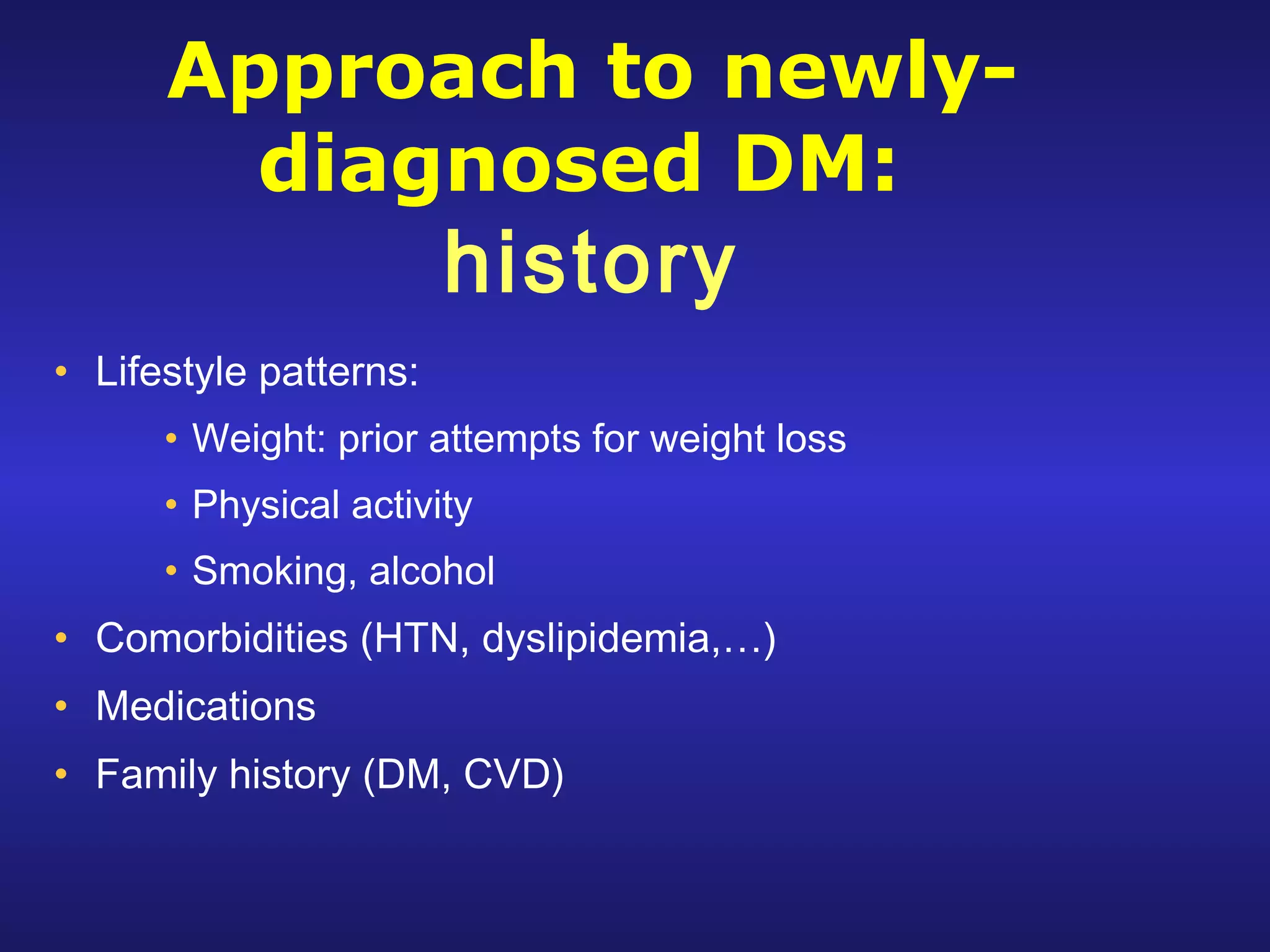
• Lifestyle patterns:
• Weight: prior attempts for weight loss
• Physical activity
• Smoking, alcohol
• Comorbidities (HTN, dyslipidemia,…)
• Medications
• Family history (DM, CVD)
Approach to newly-
diagnosed DM:
history
• Blood pressure
• Weight, height, BMI
• Thyroid
• Skin
• Foot
Approach to DM:
physical exam
American Diabetes Association. Diabetes Care 2019;42 (suppl. 1):S34
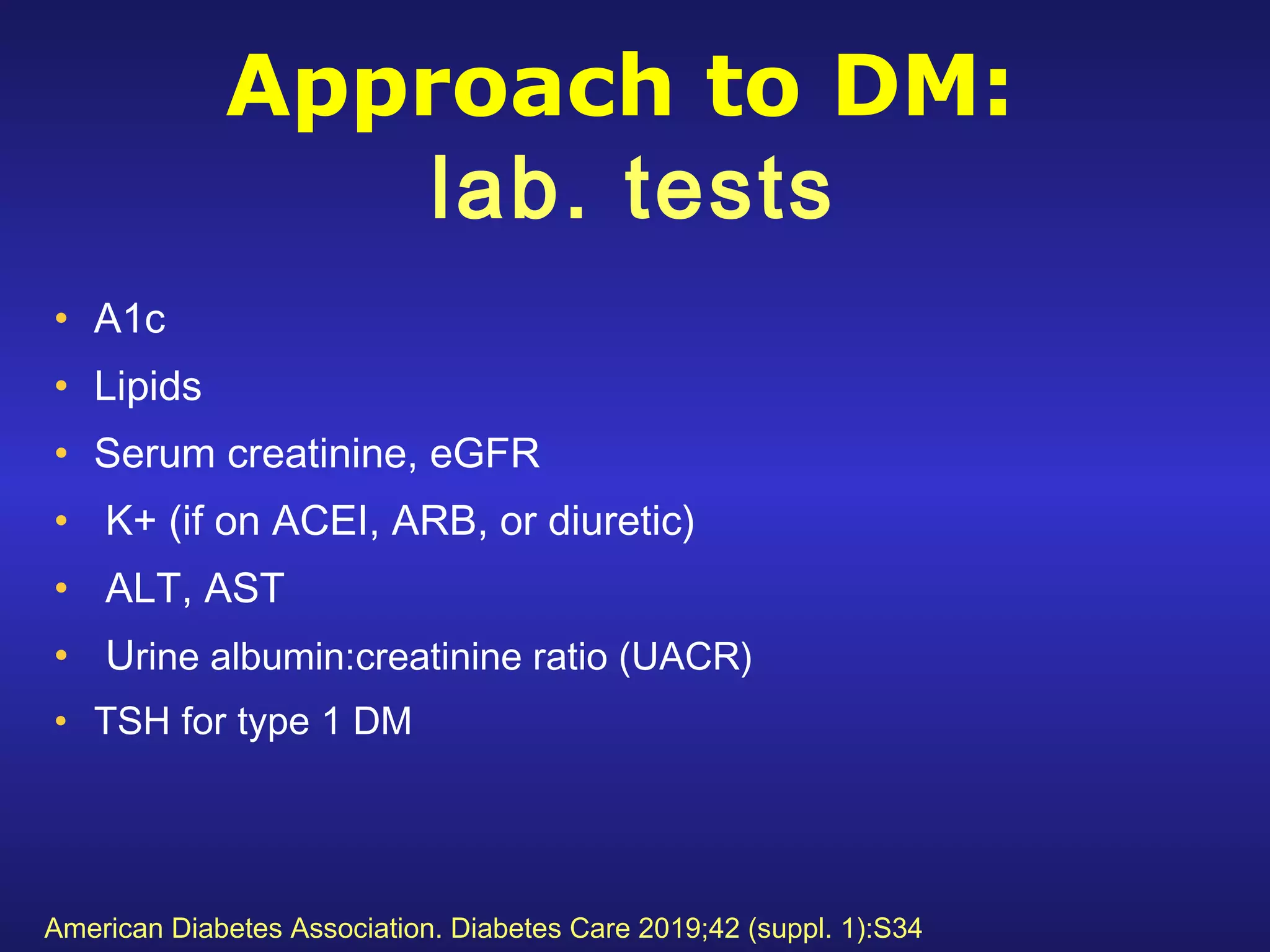
• A1c
• Lipids
• Serum creatinine, eGFR
• K+ (if on ACEI, ARB, or diuretic)
• ALT, AST
• Urine albumin:creatinine ratio (UACR)
• TSH for type 1 DM
Approach to DM:
lab. tests
American Diabetes Association. Diabetes Care 2019;42 (suppl. 1):S34
Glucose targetsGlucose targets
depend on:depend on:
AgeAge
Comorbid conditionsComorbid conditions
Vascular diseaseVascular disease
Disease durationDisease duration
Life expectancyLife expectancy
Risks of treatmentRisks of treatment
American Diabetes Association. Diabetes Care 2019;42 (suppl. 1):S34
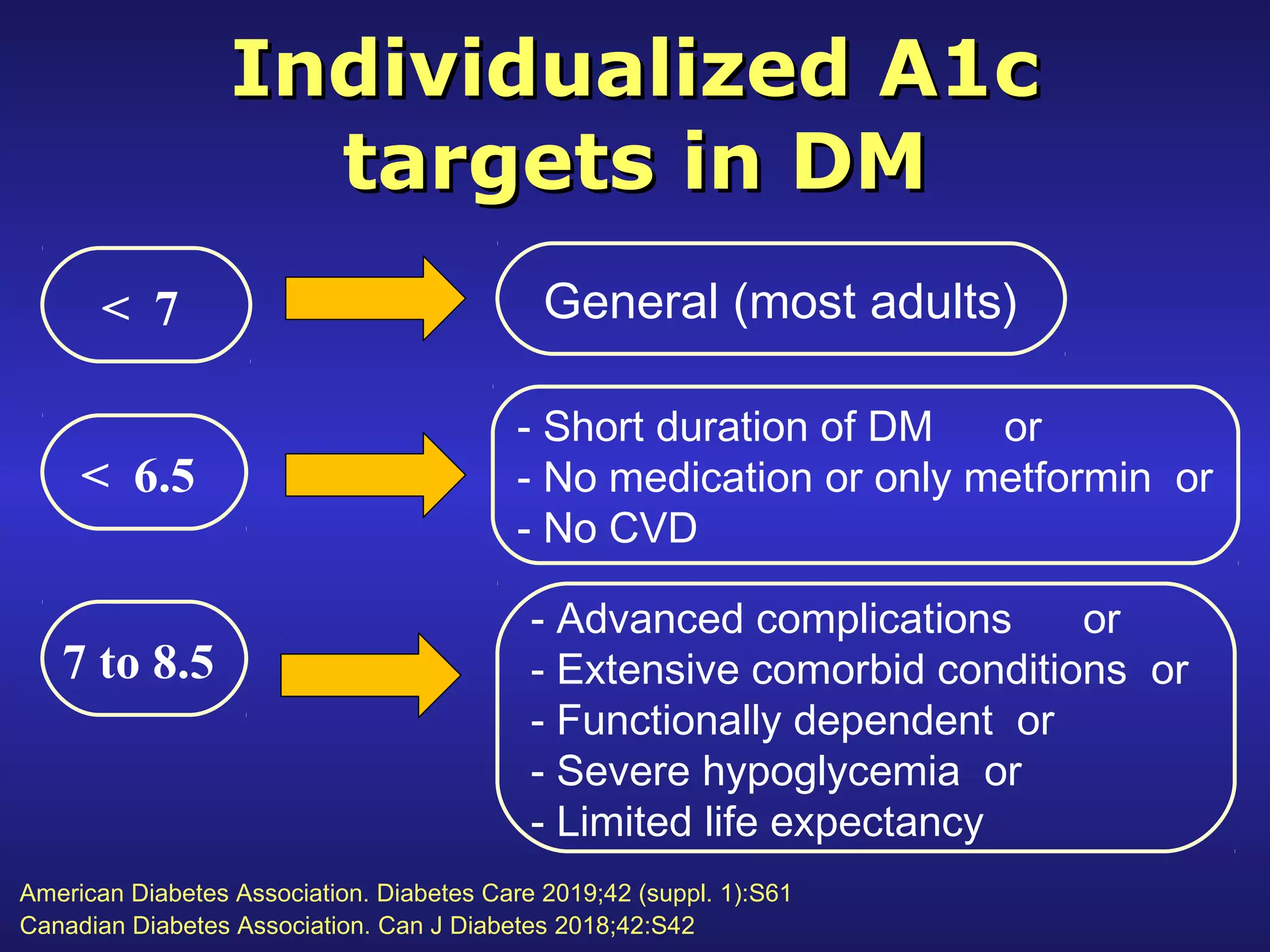
Individualized A1cIndividualized A1c
targets in DMtargets in DM
American Diabetes Association. Diabetes Care 2019;42 (suppl. 1):S61
Canadian Diabetes Association. Can J Diabetes 2018;42:S42
< 7 General (most adults)
- Short duration of DM or
- No medication or only metformin or
- No CVD
< 6.5
7 to 8.5
- Advanced complications or
- Extensive comorbid conditions or
- Functionally dependent or
- Severe hypoglycemia or
- Limited life expectancy
Home glucose targets
Before meals:
80-130 mg
(4.4-7.2 mmol)
2 hours after meals:
< 180 mg
(10 mmol)
American Diabetes Association. Diabetes Care 2019;42 (suppl. 1):S61
Components of lifestyle
changes
1) Self-management education
– Refer to educator
2) Medical nutrition therapy
– Refer to dietitian
3) Physical activity
– Advise 150 minutes/week
– Over 3-5 days/week
American Diabetes Association. Diabetes Care 2019;42 (suppl 1):S46
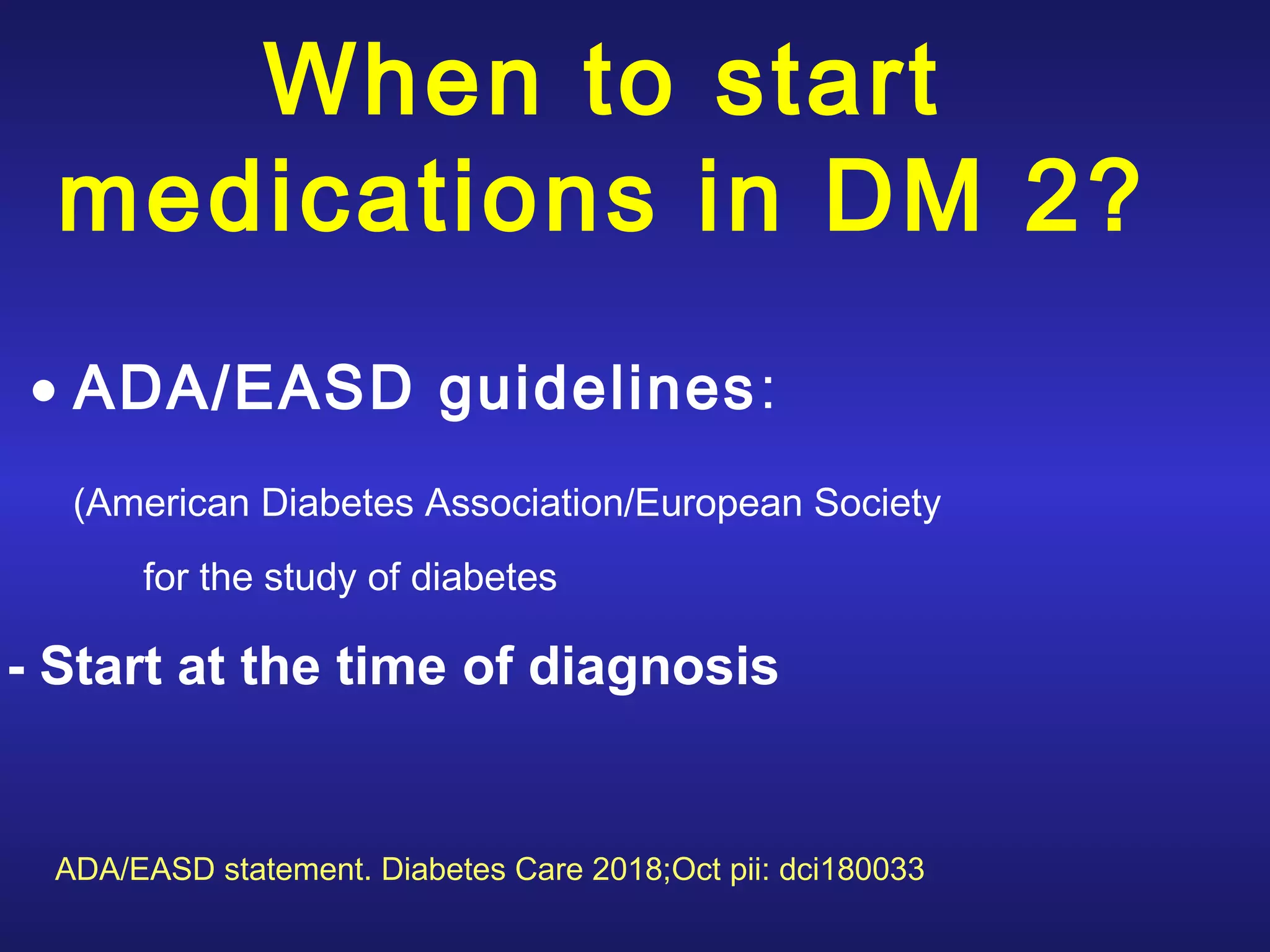
• ADA/EASD guidelines:
(American Diabetes Association/European Society
for the study of diabetes
- Start at the time of diagnosis
ADA/EASD statement. Diabetes Care 2018;Oct pii: dci180033
When to start
medications in DM 2?
11stst
choicechoice
medicationmedicationMetforminMetformin
American Diabetes Association. Diabetes Care 2019;42 (suppl. 1):S90
Benefits of Metformin
American Diabetes Association. Diabetes Care 2019;42 (suppl. 1):S90
• High efficacy:
↓ A1c by 1 to 1.5 %
• Rare hypoglycemia
• Weight loss or weight neutral
• Low cost
• Potential ↓ cardiovascular events & CV mortality
Starting Metformin
American Diabetes Association. Diabetes Care 2019;42 (suppl. 1):S90
• Before starting: kidney function (cr, eGFR), ALT, AST
• Start 500 mg twice/day then increase to 1000 mg bid
• Take with meals
• If GI upset, go back to 500 mg bid
• XR form is more tolerated
• Some are intolerant even to small dose: have to stop
• Maximum effective dose: 1000 mg bid
• Adherence is less with 3 times/day (avoid TID)
Metformin & the kidneys
♦ Obtain eGFR before starting metformin:
• Don’t start if eGFR < 45
• eGFR 30-44 on Metformin:
- Assess the benefits and risks
- Consider reducing the dose
• Stop if eGFR < 30
• Yearly eGFR; more frequent if high risk (low eGFR, elderly)
American Diabetes Association. Diabetes Care 2019;42 (suppl. 1):S90
Inzuchhi S et al. JAMA 2014;312:2668; www.fda.org
Metformin: Side effects
• GI side effects (nausea, vomiting, diarrhea)
• Vitamin B12 deficiency:
- Periodic monitoring is recommended (consider yearly)
(especially if there is anemia or peripheral neuropathy)
• Avoid in unstable or hospitalized patient with
heart failure. Can be used in stable HF
• Hold if contrast procedure when eGFR 30-60.
Resume after 48 hours if serum creatinine is stable
• Lactic acidosis (rare)
American Diabetes Association. Diabetes Care 2019;42 (suppl. 1):S90
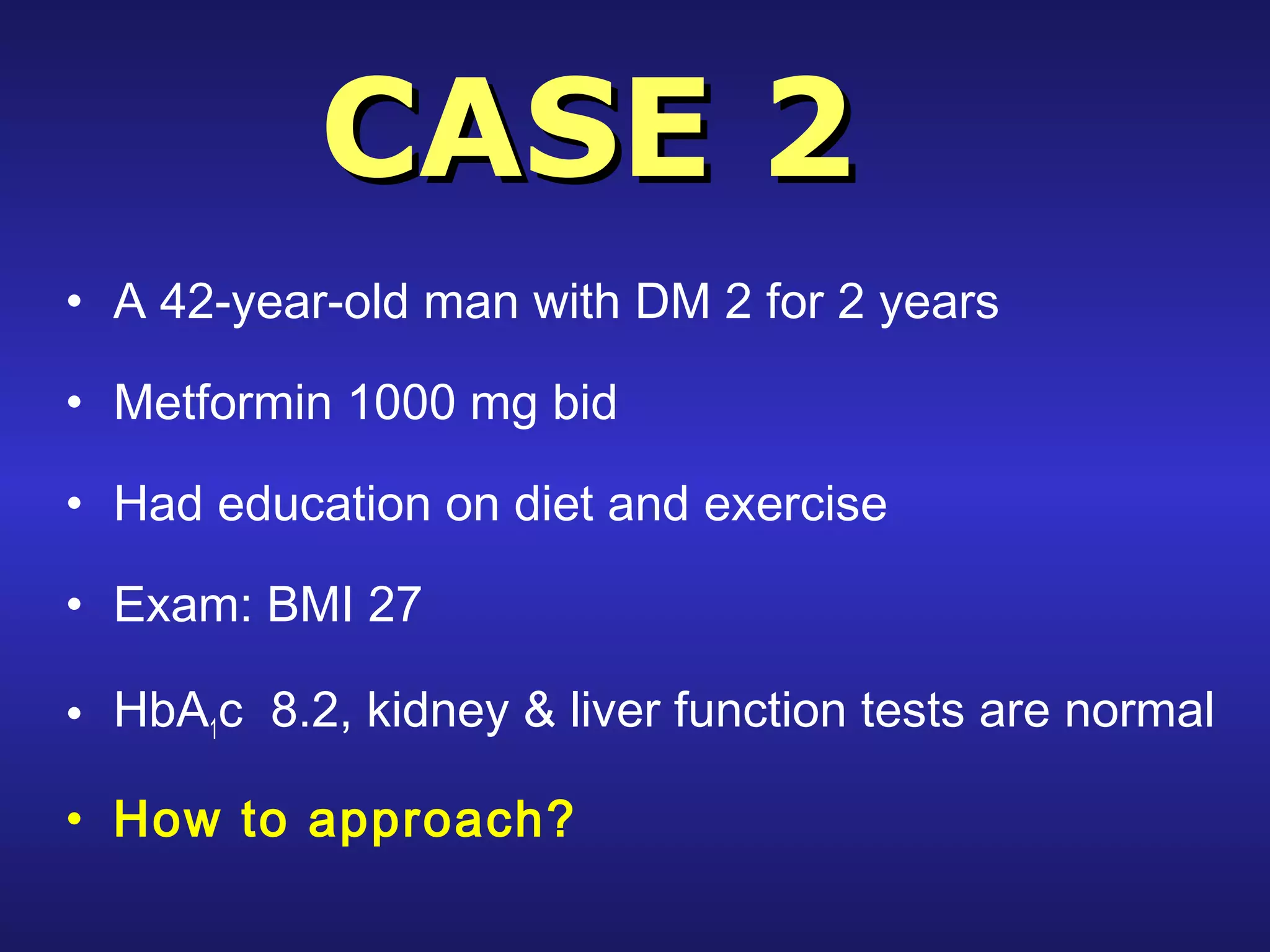
CASE 2CASE 2
• A 42-year-old man with DM 2 for 2 years
• Metformin 1000 mg bid
• Had education on diet and exercise
• Exam: BMI 27
• HbA1c 8.2, kidney & liver function tests are normal
• How to approach?
• Duration of diabetes
• Medications and any side effects
• Presence of complications
• Screening for complications
• Comorbidities (HTN, dyslipidemia,…)
• Social: smoking, work, alcohol, ….
• Prior visits to educator/dietitian
• Family history (DM, HTN, CVD)
Approach to DM:
history
• Blood pressure
• Weight, height, BMI
• Thyroid
• Skin
• Foot
Approach to DM:
physical exam
• A1c
• Lipids (LDL, HDL, TG)
• Serum creatinine, eGFR
• Serum potassium (if on ACEI, ARB, or diuretic)
• ALT, AST
• Urine albumin creatinine ratio (UACR)
Approach to DM:
Labs
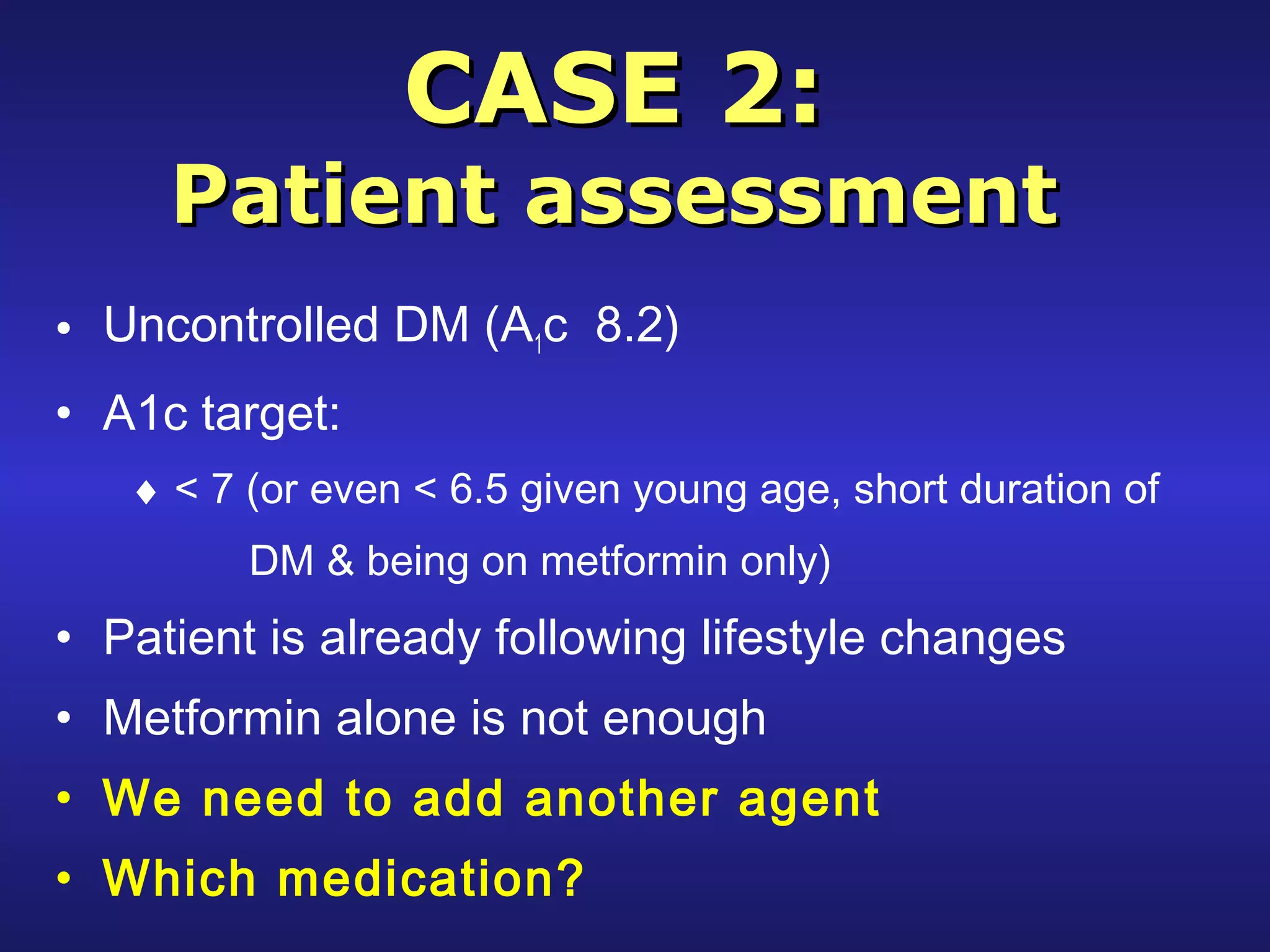
CASE 2:CASE 2:
Patient assessmentPatient assessment
• Uncontrolled DM (A1c 8.2)
• A1c target:
♦ < 7 (or even < 6.5 given young age, short duration of
DM & being on metformin only)
• Patient is already following lifestyle changes
• Metformin alone is not enough
• We need to add another agent
• Which medication?
What’s best afterWhat’s best after
Metformin?Metformin?
American Diabetes Association. Diabetes Care 2019;42 (suppl. 1):S90
• No clear advantage of any medication
• Decision is based on:
- Comorbidities (ASCVD, HF, CKD)
- Risk of hypoglycemia
- Effect on weight
- Side effects
- Cost
- Patient preference
22ndnd
line agentsline agents
• Sulfonylureas
• DPP-4 inhibitors
• Glitazones (TZD)
• GLP-1 receptor agonists
• SGLT-2 inhibitors
• Basal insulin
(Meglitinides & Alpha-glucosidase inhibitors are less
commonly used)
American Diabetes Association. Diabetes Care 2019;42 (suppl. 1):S90
SulfonylureasSulfonylureas
• Stimulate insulin release
• Gliclazide MR (Dimicron MR®
):
- Starting dose: 60 mg daily
- Maximum: 120 mg daily
• Glimepiride (Amaryl®
):
- Starting dose: 1 or 2 mg daily
- Maximum: 8 mg daily (usually 4 mg qd)
• Glibenclamide (Glyburide), Glipizide:
- Starting dose: 2.5 or 5 mg qd
- Maximum: 10 mg bid
Vijan S. In the clinic. Ann Intern Med 2015
Sulfonylureas dosingSulfonylureas dosing
• Glibenclamide, Glyburide, Glipizide, Gliclazide
– 15 to 20 minutes before main meal (breakfast or lunch)
• Gliclazide MR, Glimepiride
- With main meal (breakfast or lunch)
Vijan S. In the clinic. Ann Intern Med 2015
Sulfonylureas:Sulfonylureas:
which one?which one?
• All have same efficacy
• Gilbenclamide is associated with ↑ hypoglycemia
• Most of the benefit is seen with half-maximum dose
• Observational studies: ? adverse cardiac effect
• UKPDS: no increased cardiovascular events
American Diabetes Association. Diabetes Care 2019;42 (suppl. 1):S90
Vijan S. In the clinic. Ann Intern Med 2015
Sulfonylureas: pros & consSulfonylureas: pros & cons
• Advantages:
– Highly effective: lower A1c by 1 to 1.5 %
– Low cost
• Disadvantages:
– Hypoglycemia
– Weight gain
– High rate of secondary failure
American Diabetes Association. Diabetes Care 2019;42 (suppl. 1):S90
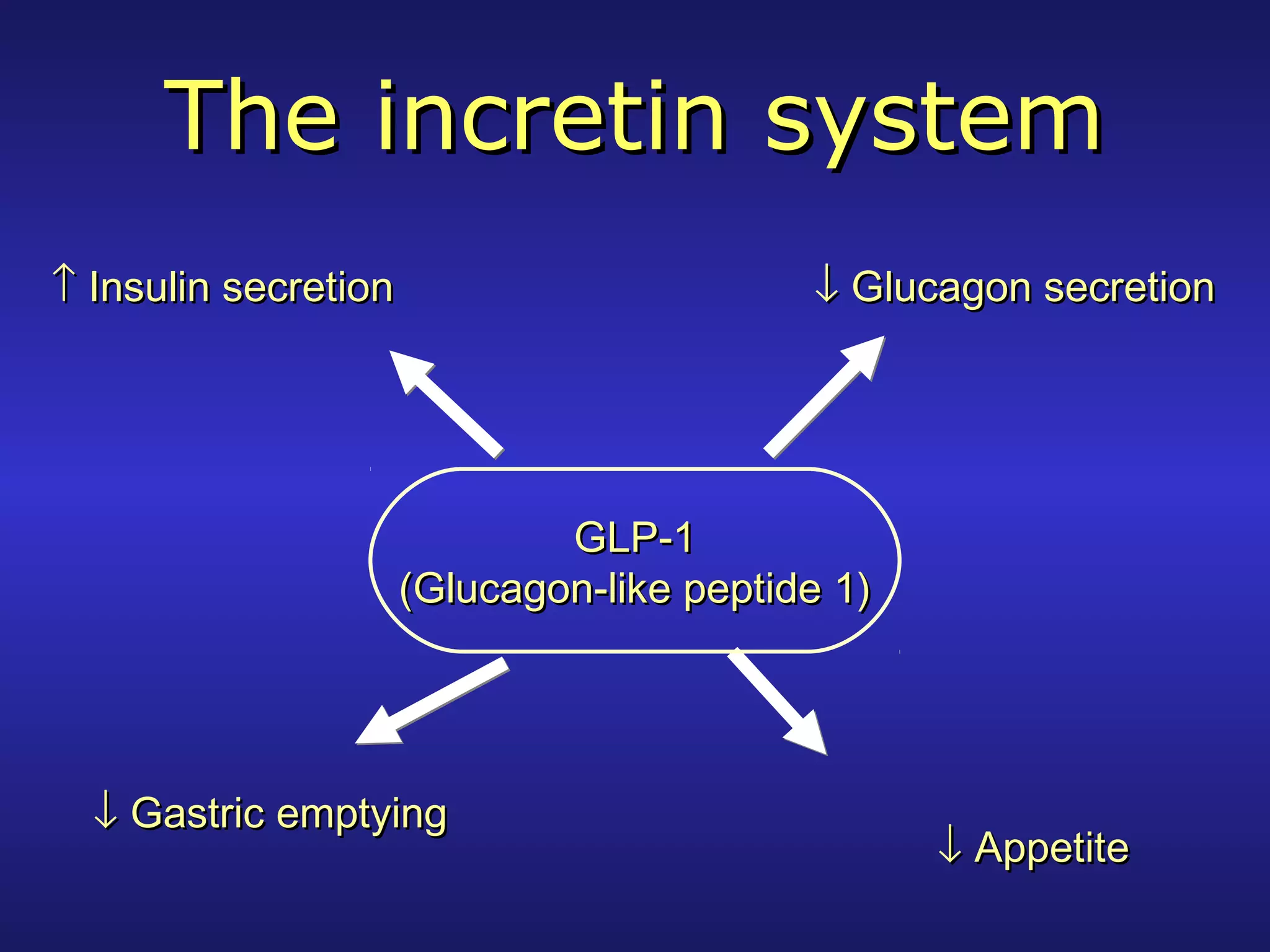
↑↑ Insulin secretionInsulin secretion ↓↓ Glucagon secretionGlucagon secretion
↓↓ Gastric emptyingGastric emptying
↓↓ AppetiteAppetite
GLP-1GLP-1
(Glucagon-like peptide 1)(Glucagon-like peptide 1)
The incretin systemThe incretin system
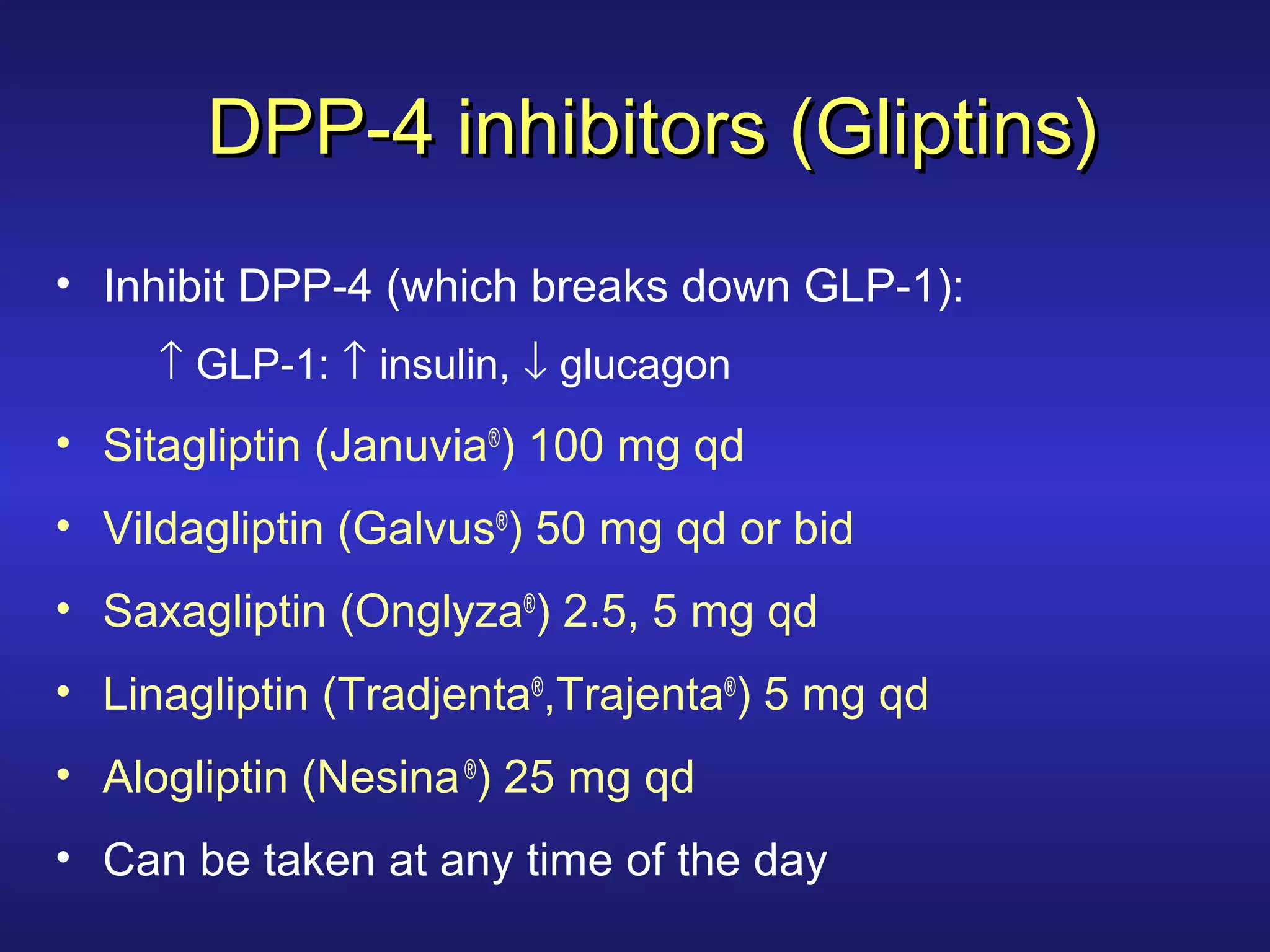
DPP-4 inhibitors (Gliptins)DPP-4 inhibitors (Gliptins)
• Inhibit DPP-4 (which breaks down GLP-1):
↑ GLP-1: ↑ insulin, ↓ glucagon
• Sitagliptin (Januvia®
) 100 mg qd
• Vildagliptin (Galvus®
) 50 mg qd or bid
• Saxagliptin (Onglyza®
) 2.5, 5 mg qd
• Linagliptin (Tradjenta®
,Trajenta®
) 5 mg qd
• Alogliptin (Nesina®
) 25 mg qd
• Can be taken at any time of the day
Gliptins: pros & consGliptins: pros & cons
• Advantages:
– Well tolerated
– No weight gain
– Rare hypoglycemia
• Disadvantages:
– Moderate effect (↓ A1c by 0.6 to 1 %)
– High cost
American Diabetes Association. Diabetes Care 2019;42 (suppl. 1):S90
Gliptins: side effectsGliptins: side effects
• GI upset, upper respiratory tract symptoms, joint/limb pains,
headache, back pain, acute pancreatitis
• Reduce dose in chronic kidney disease (except Linagliptin)
• Vildagliptin:
- Not FDA-approved (approved by European Medicines Agency)
- Can affect liver function
- Monitor liver enzymes every 3 months in 1st
year then
periodically. Stop if ALT > 3 times upper limit of normal
• Saxagliptin ↑ hospitalization for heart failure especially in
patients with cardiovascular or kidney disease
American Diabetes Association. Diabetes Care 2019;42 (suppl. 1):S90;; www.fda.gov; www.ema.europa.eu
EXAMINE trial. N Engl J Med 2013;369:1327
GLP-1 receptor agonistsGLP-1 receptor agonists
∀ ↑ GLP-1: leading to ↑ insulin, ↓ glucagon, ↓ appetite
• Generally effective (↓ A1c by 0.5-1.5 %)
• Associated with weight loss
• Rare hypoglycemia
• Liraglutide ↓ CV events & mortality in patients with
ASCVD
American Diabetes Association. Diabetes Care 2019;42 (suppl. 1):S90
GLP-1 receptor agonistsGLP-1 receptor agonists
• Subcutaneous injection
• GI side effects (nausea, vomiting, diarrhea)
• ? Acute pancreatitis
• Should not be used in
patients with medullary thyroid
cancer
• Very high cost
GLP-1 RA examplesGLP-1 RA examples
Exenatide (Byetta®
)
• 5 micrograms bid (within 1 hour before main meals)
•Maximum dose: 10 micrograms bid
•Long-acting (Bydureon®
) [2 mg once/week]
Liraglutide (Victoza®
)
•Start 0.6 mg daily for 1-2 weeks then if tolerated increase to
1.2 mg qd
•Maximum dose: 1.8 mg qd
•Take at any time of the day
GLP-1 RA examplesGLP-1 RA examples
Dulaglutide (Trulicity®
)
• 0.75 mg once-weekly
• Maximum 1.5 mg once-weekly
• Take at any time of the day
Lixisenatide (Lyxumia®
, Adlyxin®
)
•10 micrograms once-daily
•Maximum 20 micrograms once-daily (within 1 hour before
meal)
SGLT2 inhibitors (Gliflozins)SGLT2 inhibitors (Gliflozins)
• Decrease glucose reabsorption at the kidney by inhibiting
sodium-glucose co-transport 2 (SGLT2) causing glucosuria
• Canagliflozin (Invokana®
) 100, 300 mg qd
• Dapagliflozin (Forxiga®
,Farxiga®
) 5, 10 mg qd
• Empagliflozin (Jardiance®
) 10, 25 mg qd
• Ertugliflozin (Steglatro®
) 5, 15 mg qd
• Take morning, with or without food
American Diabetes Association. Diabetes Care 2019;42 (suppl. 1):S90
Vasilakou D, et al . Ann Intern Med 2013;159; www.fda.gov
SGLT2 inhibitors (Gliflozins)SGLT2 inhibitors (Gliflozins)
• Modest effect: lower A1c by 0.6-0.8 %
∀ ↓ Weight, ↓ blood pressure
• Rare hypoglycemia
• Empagliflozin ↓ CV mortality & events in patients with
ASCVD
• Canagliflozin ↓ CV events in patients with ASCVD
American Diabetes Association. Diabetes Care 2019;42 (suppl. 1):S90
Vasilakou D, et al . Ann Intern Med 2013;159; www.fda.gov
SGLT-2i: disadvantagesSGLT-2i: disadvantages
• UTI, genital infections, AKI, dehydration, ↑ LDL
• High cost
• Diabetic ketoacidosis (rare)
• Canagliflozin ↑ risk of bone fractures
• Canagliflozin ↑ risk of leg and foot amputations
American Diabetes Association. Diabetes Care 2019;42 (suppl. 1):S90
www.fda.gov
TZD (Gitazones)TZD (Gitazones)
∀ ↑ glucose uptake in muscle and fat tissue
• Pioglitazone (Actos®
) 15, 30, 45 mg qd (any time of the day)
• Advantages:
– Effective (but variable: ↓ A1c 0.5 to 1.5 %)
– Rare hypoglycemia
– Low cost
• Disadvantages:
– Edema, weight gain, heart failure
– Bone fractures
– Urinary bladder cancer (FDA & EMA warnings)
American Diabetes Association. Diabetes Care 2019;42 (suppl. 1):S90
MeglitinidesMeglitinides
• Stimulate insulin secretion
• Repaglinide (Novonorm®
) 0.5, 1, 2 mg
• Nateglinide (Starlix®
) 60, 120 mg
• Less effective than Sulfonylurea
• Moderate cost
• Hypoglycemia & weight gain
• Three times/day (skip it if a meal is skipped)
• Less commonly used
American Diabetes Association. Diabetes Care 2019;42 (suppl. 1):S90
Alpha-glucosidase inhibitorsAlpha-glucosidase inhibitors
∀ ↓ digestion/absorption of intestinal carbohydrates
• Acarbose, Miglitol
• Acarbose: 25 mg tid. Maximum 100 mg tid (with meals)
• Rare hypoglycemia, low cost, no weight gain
• GI side effects (gases, diarrhea)
• Modest effect: lower A1cby 0.5 to 0.7 %
• Less commonly used
American Diabetes Association. Diabetes Care 2019;42 (suppl.
1):S90
Back to CASE 2Back to CASE 2
• A 42-year-old man with DM 2 for 2 years
• Metformin 1000 mg bid
• BMI 27
• HbA1c 8.2
• Plan:
– Add a second agent
CASE 2: OptionsCASE 2: Options
• Sulfonylurea:
- Effective, low cost
- He is not obese with relatively short DM duration
- Weight gain, hypoglycemia
• DPP-4i:
- No weight gain, low risk of hypoglycemia
- But high cost
Our patient: optionsOur patient: options
• Pioglitazone:
- Effective, but weight gain & bladder cancer
• GLP-1 RA:
- Weight loss, but injections & expensive
• SGLT-2i:
- Weight loss, but less effective & expensive
CASE 2: finalCASE 2: final
decisiondecision- If cost is an issue, go for Sulfonylurea
- If cost is not an issue, consider DPP4i or SGLT-2i
- DPP-4i is well tolerated, available in combination with
metformin & less expensive than SGLT-2i or GLP-1RA
- SGLT-2i or GLP-1RA are good options to lose weight,
but
more expensive
CASE 3CASE 3
• A 55-year-old man with DM 2 for 5 years
• Metformin 500 mg bid (could not tolerate 1 gm bid)
and Glimepiride 4 mg qd
• He tries his best with lifestyle changes
• BMI 31
• HbA1c 8.0
• How to approach?
CASE 3:CASE 3:
Patient assessmentPatient assessment
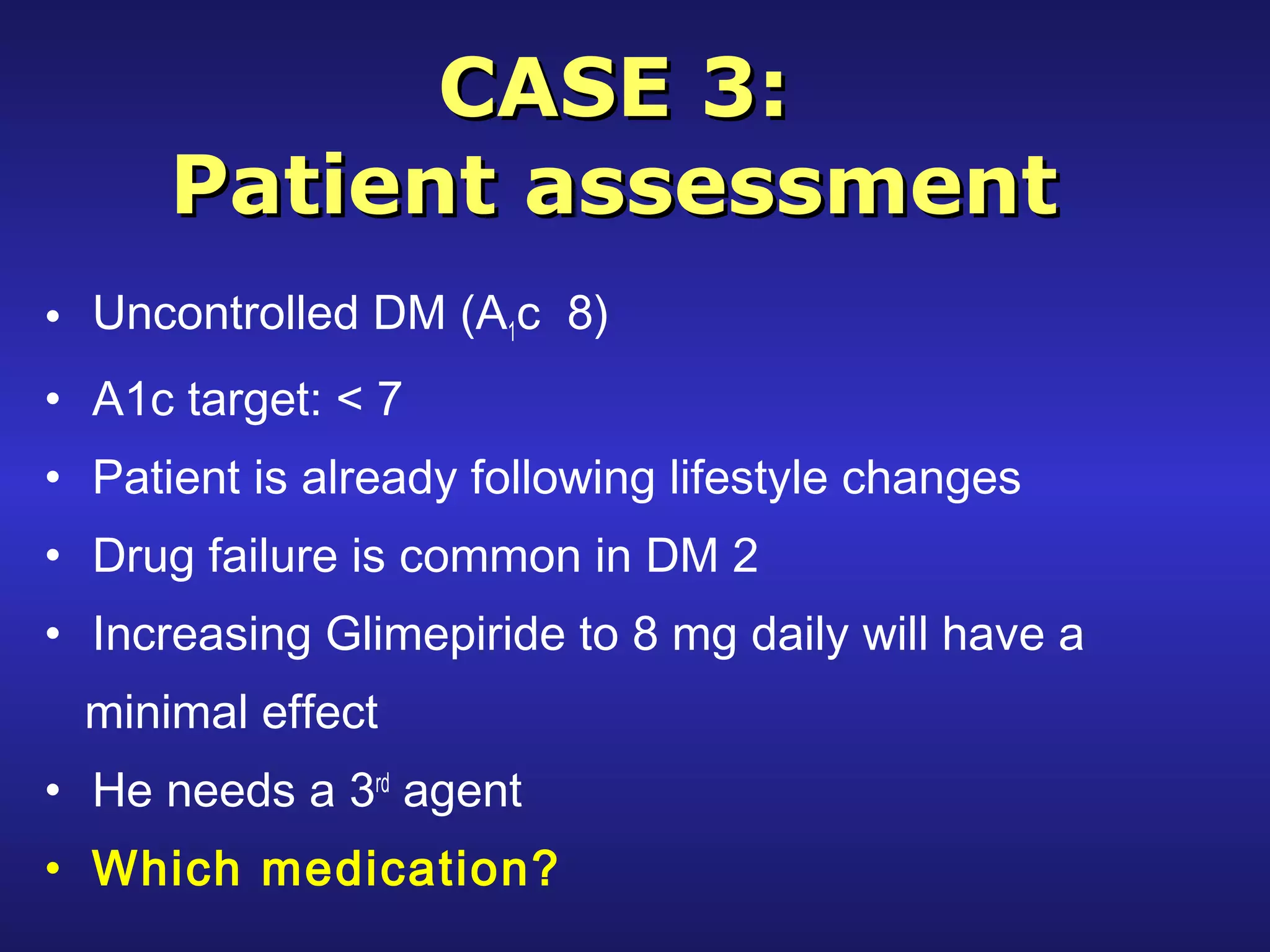
• Uncontrolled DM (A1c 8)
• A1c target: < 7
• Patient is already following lifestyle changes
• Drug failure is common in DM 2
• Increasing Glimepiride to 8 mg daily will have a
minimal effect
• He needs a 3rd
agent
• Which medication?
Drug failure in diabetesDrug failure in diabetes
Turner RC et al. JAMA 1999;281:2005
20
40
60
80
Patients on sulfonylureaPatients on sulfonylurea
6 years6 years
34 %34 %
24 %24 %
50%50%
3 years3 years 9 years9 years
100
% of patients with
HbA1c < 7
β-cell function
(% of normal by
HOMA)
Holman RR. Diab Res Clin Pract 1998;40(suppl):S21
UKPDS. Diabetes. 1995;44:1249
Years
0
20
40
60
80
100
−10 −9 −8 −7 −6 −5 −4 −3 −2 −1 0 1 2 3 4 5 6
Time of diagnosis
?
HOMA=homeostasis model assessment
Diabetes: a progressive disease
Pancreatic function
~ 50% of normal
At diagnosis, ~ 50 % of
insulin production is lost
33rdrd
line agentsline agents
• Sulfonylurea
• DPP-4 inhibitor
• Glitazones (TZD)
• GLP-1 receptor agonist
• SGLT-2 inhibitor
• Insulin (usually basal)
CASE 3: optionsCASE 3: options
• The patient is obese
• GLP-1 agonists: best option given weight loss and
efficacy
But: - Will the patient agree for injections?
- Can he afford its high cost?
• SGLT-2i: Weight loss, but high cost & moderate effect
• DPP-4i: Weight neutral, well-tolerated, high cost (less than
GLP-1 agonists)
CASE 3: FinalCASE 3: Final
decisiondecision• I would go for a GLP-1 agonist
• SGLT-2i is another option if patient refuses injections
• DPP-4i is another reasonable choice
CASE 4CASE 4
• A 52-year-old man with type 2 DM for 6 years
• Coronary artery disease (acute MI with stent)
• Metformin 500 mg bid, Gliclazide MR 60 mg daily
• He tries with lifestyle changes
• Exam: BP 120/70 and BMI 29.3
• Labs: all normal except A1c 8.1
• How to approach?
CASE 4:CASE 4:
Patient assessmentPatient assessment
• Uncontrolled DM (A1c 8.1)
• A1c target:
♦ < 7
• Patient is already following lifestyle changes
• He could not tolerate metformin 1000 mg bid
• Increasing SU will have minimal effect
• We need to add a 3rd
agent
• Which medication?
  ASCVD Heart failure
American Diabetes Association. Diabetes Care 2019;42 (suppl. 1):S103
Metformin Potential benefit Neutral
Neutral Neutral
Neutral
- Neutral (Sita, Lina)
- ↑ risk (Saxagliptin)
- Benefit (Liraglutide)
- Neutral (Exenatide ER, Lixisenatide)
Neutral Neutral
Neutral
Empagliflozin: ↓ mortality & events
Canagliflozin: ↓ events
Dapagliflozin: neutral
Benefit
Potential benefit ↑ risk
Sulfonylurea
DPP-4i
GLP-1RA
SGLT-2i
Pioglitazone
Insulin
Diabetes & ASCVD: guidelinesDiabetes & ASCVD: guidelines
• Start with Metformin & lifestyle changes
• If glucose is not at target:
– Add Empagliflozin or Liraglutide
∀↓ CV mortality & events
– May consider Canagliflozin
∀↓ CV events
* Dapagliflozin did not reduce CV mortality or events
American Diabetes Association. Diabetes Care 2019;42 (suppl. 1):S103
Canadian Diabetes Association. Can J Diabetes 2018;42:S88
Diabetes & other comorbiditiesDiabetes & other comorbidities
• Heart failure:
♦SGLT-2i:
- ↓ Hospitalization for HF
- This was a secondary outcome & mainly in patients
with ASCVD (Level C = weak evidence)
• CKD:
♦SGLT-2i or Liraglutide
- Decreased progression of CKD
- This was a secondary outcome & mainly in
patients with ASCVD (Level C)
American Diabetes Association. Diabetes Care 2019;42 (suppl. 1):S90
Use of SGLT-2i & GLP-RAUse of SGLT-2i & GLP-RA
in chronic kidney diseasein chronic kidney disease
• Empagliflozin: not recommended if GFR < 45
• Canagliflozin : not recommended if GFR < 45
• Dapagliflozin : not recommended if GFR < 60
• Exenatide: not recommended if GFR < 30
• Liraglutide: studied in GFR as low as 15
• Dulaglutide: studied in GFR as low as 15
American Diabetes Association. Diabetes Care 2019;42 (suppl. 1):S90
www.fda.gov
CASE 5CASE 5
• A 68-year-old woman with DM 2 for 12 years
• She also has hypertension, coronary artery disease
• Metformin 1000 mg bid, Glimepiride 4 mg qd
• HbA1c 6.2
• How to approach?
ApproachApproach
• The A1c is very tight (high possibility of hypoglycemia)
• Further history is needed:
– Does the patient have a glucometer?
– Home glucose monitoring? Documented hypoglycemia?
– Patterns of food and timing of medications to food?
– Home conditions, level of independence/ambulation?
AssessmentAssessment
• The patient is 68-year-old with CVD
• Her glucose is tightly controlled
• This may be harmful (ACCORD study)
– The cause is not known. It was not due to hypoglycemia
• ADA recommends looser target for such patients (7 to 8 %)
ACCORD study group. N Engl J Med 2008; 358:2545
American Diabetes Association. Diabetes Care 2019;42 (suppl. 1):S61
PlanPlan
• I would stop sulfonylurea
• Check A1c after 3 months
– Expected to rise by 1-1.5 % (so would still be in target of 7 to 8)
• If A1c rises above target, may consider other agents:
– Empagliflozin or Liraglutide are preferred given ASCVD
CASE 6CASE 6
• A 62-year-old man with DM 2 for 8 years ago
• Metformin 1000 mg bID, Gliclazide MR 60 mg QD,
Pioglitazone 30 mg QD
• About 1 year ago, HbA1c was 10.2.
• So, physician ↑ Metformin to 1000/500/1000 and ↑
Gliclazide MR to 120 mg QD
• Today, HbA1c is 9.8
• Physician added Sitagliptin
• Do you agree with the plan?
Physicians are late in startingPhysicians are late in starting
insulininsulin
Brown JB et al. Diabetes Care 2004;27:1535
7
8
9
MeanA1c
9.19.1
8.88.8
8.68.6
2.5 years2.5 years
10
2.9 years2.9 years
Diet/Exercise
2.2 years2.2 years 2.8 years2.8 years
  Metformin
        Sulfonylurea
3rd
 drug
9.69.6
Diagnosis of DM          Time
Clinical inertiaClinical inertia
• Recognition of a problem with patient’s
management, but failure to act.
Phillips L et al.
Ann Intern Med 2001;135:825
Why do physicians delayWhy do physicians delay
insulin?insulin?
• Lack of time or personnel to teach patients
• Inadequate training/experience with using insulin
• Sense of inadequacy about being unable to manage
without insulin
• Fear of patient non-adherence
• Concerns about hypoglycemia & weight gain
• Belief that insulin will not help or has cardiovascular risk
Peyrot M, et al. Diabetes Care 2005;28:2673
Korytkowksi M. Int J Ob Metab Relat Metab Disord 2002;26(supp 3)S18
CASE 6: lessonsCASE 6: lessons
• Studies on 4-drug combination are limited
• Guidelines do not recommend using 4 drugs
• Physicians (not patients) are sometimes reluctant to
start insulin
• Remember: oral medications or GLP-1 agonists lower
A1c by an average of 1 %
• Do not delay insulin
Diagnosis of type 2 DMDiagnosis of type 2 DM
Lifestyle changes + MetforminLifestyle changes + Metformin
If A1c < 8: add 3If A1c < 8: add 3rdrd
non-insulin agentnon-insulin agent
Start Insulin
UncontrolledUncontrolled
on 3 agentson 3 agents
ASCVDASCVD
Empagliflozin orEmpagliflozin or
LiraglutideLiraglutide
GLP-1RA or GLP-1RA or 
SGLT-2iSGLT-2i
DPP-4i, SGLT-2i,DPP-4i, SGLT-2i,
GLP-1RA, or TZDGLP-1RA, or TZD
HypoglycemiaHypoglycemia
concernconcern
WeightWeight
concernconcern
CostCost
concernconcern
SU or SU or 
TZDTZD
Liraglutide orLiraglutide or
EmpagliflozinEmpagliflozin
SGLT-2i, DPP-4i,SGLT-2i, DPP-4i,
GLP-1RA, or TZDGLP-1RA, or TZD
SGLT-2i orSGLT-2i or
GLP-1RA  GLP-1RA  
TZD or SUTZD or SU
A1cA1c ≥≥ 88
on 2 agentson 2 agents
or

Non insulin glucose-lowering therapy in type 2 DM

  • 1.
    Non-insulin glucose-loweringNon-insulin glucose-lowering therapyin type 2 diabetestherapy in type 2 diabetes Mohsen Eledrisi, MD, FACE, FACP Department of Medicine Hamad Medical Corporation Doha, Qatar eledrisi@yahoo.com
  • 2.
    CASE 1CASE 1 •A 41-year-old man with no past medical history • Presents for routine check up • Fasting plasma glucose 10 mmol (180 mg) • Kidney and liver function tests: normal • HbA1c 8.3 • How to approach?
  • 3.
    CASE assessmentCASE assessment •The diagnosis of diabetes can be made • As fasting plasma glucose is ≥ 7 mmol (126 mg) • This was confirmed with A1c ≥ 6.5
  • 4.
    • Lifestyle patterns: •Weight: prior attempts for weight loss • Physical activity • Smoking, alcohol • Comorbidities (HTN, dyslipidemia,…) • Medications • Family history (DM, CVD) Approach to newly- diagnosed DM: history
  • 5.
    • Blood pressure •Weight, height, BMI • Thyroid • Skin • Foot Approach to DM: physical exam American Diabetes Association. Diabetes Care 2019;42 (suppl. 1):S34
  • 6.
    • A1c • Lipids •Serum creatinine, eGFR • K+ (if on ACEI, ARB, or diuretic) • ALT, AST • Urine albumin:creatinine ratio (UACR) • TSH for type 1 DM Approach to DM: lab. tests American Diabetes Association. Diabetes Care 2019;42 (suppl. 1):S34
  • 7.
    Glucose targetsGlucose targets dependon:depend on: AgeAge Comorbid conditionsComorbid conditions Vascular diseaseVascular disease Disease durationDisease duration Life expectancyLife expectancy Risks of treatmentRisks of treatment American Diabetes Association. Diabetes Care 2019;42 (suppl. 1):S34
  • 8.
    Individualized A1cIndividualized A1c targetsin DMtargets in DM American Diabetes Association. Diabetes Care 2019;42 (suppl. 1):S61 Canadian Diabetes Association. Can J Diabetes 2018;42:S42 < 7 General (most adults) - Short duration of DM or - No medication or only metformin or - No CVD < 6.5 7 to 8.5 - Advanced complications or - Extensive comorbid conditions or - Functionally dependent or - Severe hypoglycemia or - Limited life expectancy
  • 9.
    Home glucose targets Beforemeals: 80-130 mg (4.4-7.2 mmol) 2 hours after meals: < 180 mg (10 mmol) American Diabetes Association. Diabetes Care 2019;42 (suppl. 1):S61
  • 10.
    Components of lifestyle changes 1)Self-management education – Refer to educator 2) Medical nutrition therapy – Refer to dietitian 3) Physical activity – Advise 150 minutes/week – Over 3-5 days/week American Diabetes Association. Diabetes Care 2019;42 (suppl 1):S46
  • 11.
    • ADA/EASD guidelines: (AmericanDiabetes Association/European Society for the study of diabetes - Start at the time of diagnosis ADA/EASD statement. Diabetes Care 2018;Oct pii: dci180033 When to start medications in DM 2?
  • 12.
  • 13.
    Benefits of Metformin AmericanDiabetes Association. Diabetes Care 2019;42 (suppl. 1):S90 • High efficacy: ↓ A1c by 1 to 1.5 % • Rare hypoglycemia • Weight loss or weight neutral • Low cost • Potential ↓ cardiovascular events & CV mortality
  • 14.
    Starting Metformin American DiabetesAssociation. Diabetes Care 2019;42 (suppl. 1):S90 • Before starting: kidney function (cr, eGFR), ALT, AST • Start 500 mg twice/day then increase to 1000 mg bid • Take with meals • If GI upset, go back to 500 mg bid • XR form is more tolerated • Some are intolerant even to small dose: have to stop • Maximum effective dose: 1000 mg bid • Adherence is less with 3 times/day (avoid TID)
  • 15.
    Metformin & thekidneys ♦ Obtain eGFR before starting metformin: • Don’t start if eGFR < 45 • eGFR 30-44 on Metformin: - Assess the benefits and risks - Consider reducing the dose • Stop if eGFR < 30 • Yearly eGFR; more frequent if high risk (low eGFR, elderly) American Diabetes Association. Diabetes Care 2019;42 (suppl. 1):S90 Inzuchhi S et al. JAMA 2014;312:2668; www.fda.org
  • 16.
    Metformin: Side effects •GI side effects (nausea, vomiting, diarrhea) • Vitamin B12 deficiency: - Periodic monitoring is recommended (consider yearly) (especially if there is anemia or peripheral neuropathy) • Avoid in unstable or hospitalized patient with heart failure. Can be used in stable HF • Hold if contrast procedure when eGFR 30-60. Resume after 48 hours if serum creatinine is stable • Lactic acidosis (rare) American Diabetes Association. Diabetes Care 2019;42 (suppl. 1):S90
  • 17.
    CASE 2CASE 2 •A 42-year-old man with DM 2 for 2 years • Metformin 1000 mg bid • Had education on diet and exercise • Exam: BMI 27 • HbA1c 8.2, kidney & liver function tests are normal • How to approach?
  • 18.
    • Duration ofdiabetes • Medications and any side effects • Presence of complications • Screening for complications • Comorbidities (HTN, dyslipidemia,…) • Social: smoking, work, alcohol, …. • Prior visits to educator/dietitian • Family history (DM, HTN, CVD) Approach to DM: history
  • 19.
    • Blood pressure •Weight, height, BMI • Thyroid • Skin • Foot Approach to DM: physical exam
  • 20.
    • A1c • Lipids(LDL, HDL, TG) • Serum creatinine, eGFR • Serum potassium (if on ACEI, ARB, or diuretic) • ALT, AST • Urine albumin creatinine ratio (UACR) Approach to DM: Labs
  • 21.
    CASE 2:CASE 2: PatientassessmentPatient assessment • Uncontrolled DM (A1c 8.2) • A1c target: ♦ < 7 (or even < 6.5 given young age, short duration of DM & being on metformin only) • Patient is already following lifestyle changes • Metformin alone is not enough • We need to add another agent • Which medication?
  • 22.
    What’s best afterWhat’sbest after Metformin?Metformin? American Diabetes Association. Diabetes Care 2019;42 (suppl. 1):S90 • No clear advantage of any medication • Decision is based on: - Comorbidities (ASCVD, HF, CKD) - Risk of hypoglycemia - Effect on weight - Side effects - Cost - Patient preference
  • 23.
    22ndnd line agentsline agents •Sulfonylureas • DPP-4 inhibitors • Glitazones (TZD) • GLP-1 receptor agonists • SGLT-2 inhibitors • Basal insulin (Meglitinides & Alpha-glucosidase inhibitors are less commonly used) American Diabetes Association. Diabetes Care 2019;42 (suppl. 1):S90
  • 24.
    SulfonylureasSulfonylureas • Stimulate insulinrelease • Gliclazide MR (Dimicron MR® ): - Starting dose: 60 mg daily - Maximum: 120 mg daily • Glimepiride (Amaryl® ): - Starting dose: 1 or 2 mg daily - Maximum: 8 mg daily (usually 4 mg qd) • Glibenclamide (Glyburide), Glipizide: - Starting dose: 2.5 or 5 mg qd - Maximum: 10 mg bid Vijan S. In the clinic. Ann Intern Med 2015
  • 25.
    Sulfonylureas dosingSulfonylureas dosing •Glibenclamide, Glyburide, Glipizide, Gliclazide – 15 to 20 minutes before main meal (breakfast or lunch) • Gliclazide MR, Glimepiride - With main meal (breakfast or lunch) Vijan S. In the clinic. Ann Intern Med 2015
  • 26.
    Sulfonylureas:Sulfonylureas: which one?which one? •All have same efficacy • Gilbenclamide is associated with ↑ hypoglycemia • Most of the benefit is seen with half-maximum dose • Observational studies: ? adverse cardiac effect • UKPDS: no increased cardiovascular events American Diabetes Association. Diabetes Care 2019;42 (suppl. 1):S90 Vijan S. In the clinic. Ann Intern Med 2015
  • 27.
    Sulfonylureas: pros &consSulfonylureas: pros & cons • Advantages: – Highly effective: lower A1c by 1 to 1.5 % – Low cost • Disadvantages: – Hypoglycemia – Weight gain – High rate of secondary failure American Diabetes Association. Diabetes Care 2019;42 (suppl. 1):S90
  • 28.
    ↑↑ Insulin secretionInsulinsecretion ↓↓ Glucagon secretionGlucagon secretion ↓↓ Gastric emptyingGastric emptying ↓↓ AppetiteAppetite GLP-1GLP-1 (Glucagon-like peptide 1)(Glucagon-like peptide 1) The incretin systemThe incretin system
  • 29.
    DPP-4 inhibitors (Gliptins)DPP-4inhibitors (Gliptins) • Inhibit DPP-4 (which breaks down GLP-1): ↑ GLP-1: ↑ insulin, ↓ glucagon • Sitagliptin (Januvia® ) 100 mg qd • Vildagliptin (Galvus® ) 50 mg qd or bid • Saxagliptin (Onglyza® ) 2.5, 5 mg qd • Linagliptin (Tradjenta® ,Trajenta® ) 5 mg qd • Alogliptin (Nesina® ) 25 mg qd • Can be taken at any time of the day
  • 30.
    Gliptins: pros &consGliptins: pros & cons • Advantages: – Well tolerated – No weight gain – Rare hypoglycemia • Disadvantages: – Moderate effect (↓ A1c by 0.6 to 1 %) – High cost American Diabetes Association. Diabetes Care 2019;42 (suppl. 1):S90
  • 31.
    Gliptins: side effectsGliptins:side effects • GI upset, upper respiratory tract symptoms, joint/limb pains, headache, back pain, acute pancreatitis • Reduce dose in chronic kidney disease (except Linagliptin) • Vildagliptin: - Not FDA-approved (approved by European Medicines Agency) - Can affect liver function - Monitor liver enzymes every 3 months in 1st year then periodically. Stop if ALT > 3 times upper limit of normal • Saxagliptin ↑ hospitalization for heart failure especially in patients with cardiovascular or kidney disease American Diabetes Association. Diabetes Care 2019;42 (suppl. 1):S90;; www.fda.gov; www.ema.europa.eu EXAMINE trial. N Engl J Med 2013;369:1327
  • 32.
    GLP-1 receptor agonistsGLP-1receptor agonists ∀ ↑ GLP-1: leading to ↑ insulin, ↓ glucagon, ↓ appetite • Generally effective (↓ A1c by 0.5-1.5 %) • Associated with weight loss • Rare hypoglycemia • Liraglutide ↓ CV events & mortality in patients with ASCVD American Diabetes Association. Diabetes Care 2019;42 (suppl. 1):S90
  • 33.
    GLP-1 receptor agonistsGLP-1receptor agonists • Subcutaneous injection • GI side effects (nausea, vomiting, diarrhea) • ? Acute pancreatitis • Should not be used in patients with medullary thyroid cancer • Very high cost
  • 34.
    GLP-1 RA examplesGLP-1RA examples Exenatide (Byetta® ) • 5 micrograms bid (within 1 hour before main meals) •Maximum dose: 10 micrograms bid •Long-acting (Bydureon® ) [2 mg once/week] Liraglutide (Victoza® ) •Start 0.6 mg daily for 1-2 weeks then if tolerated increase to 1.2 mg qd •Maximum dose: 1.8 mg qd •Take at any time of the day
  • 35.
    GLP-1 RA examplesGLP-1RA examples Dulaglutide (Trulicity® ) • 0.75 mg once-weekly • Maximum 1.5 mg once-weekly • Take at any time of the day Lixisenatide (Lyxumia® , Adlyxin® ) •10 micrograms once-daily •Maximum 20 micrograms once-daily (within 1 hour before meal)
  • 36.
    SGLT2 inhibitors (Gliflozins)SGLT2inhibitors (Gliflozins) • Decrease glucose reabsorption at the kidney by inhibiting sodium-glucose co-transport 2 (SGLT2) causing glucosuria • Canagliflozin (Invokana® ) 100, 300 mg qd • Dapagliflozin (Forxiga® ,Farxiga® ) 5, 10 mg qd • Empagliflozin (Jardiance® ) 10, 25 mg qd • Ertugliflozin (Steglatro® ) 5, 15 mg qd • Take morning, with or without food American Diabetes Association. Diabetes Care 2019;42 (suppl. 1):S90 Vasilakou D, et al . Ann Intern Med 2013;159; www.fda.gov
  • 37.
    SGLT2 inhibitors (Gliflozins)SGLT2inhibitors (Gliflozins) • Modest effect: lower A1c by 0.6-0.8 % ∀ ↓ Weight, ↓ blood pressure • Rare hypoglycemia • Empagliflozin ↓ CV mortality & events in patients with ASCVD • Canagliflozin ↓ CV events in patients with ASCVD American Diabetes Association. Diabetes Care 2019;42 (suppl. 1):S90 Vasilakou D, et al . Ann Intern Med 2013;159; www.fda.gov
  • 38.
    SGLT-2i: disadvantagesSGLT-2i: disadvantages •UTI, genital infections, AKI, dehydration, ↑ LDL • High cost • Diabetic ketoacidosis (rare) • Canagliflozin ↑ risk of bone fractures • Canagliflozin ↑ risk of leg and foot amputations American Diabetes Association. Diabetes Care 2019;42 (suppl. 1):S90 www.fda.gov
  • 39.
    TZD (Gitazones)TZD (Gitazones) ∀↑ glucose uptake in muscle and fat tissue • Pioglitazone (Actos® ) 15, 30, 45 mg qd (any time of the day) • Advantages: – Effective (but variable: ↓ A1c 0.5 to 1.5 %) – Rare hypoglycemia – Low cost • Disadvantages: – Edema, weight gain, heart failure – Bone fractures – Urinary bladder cancer (FDA & EMA warnings) American Diabetes Association. Diabetes Care 2019;42 (suppl. 1):S90
  • 40.
    MeglitinidesMeglitinides • Stimulate insulinsecretion • Repaglinide (Novonorm® ) 0.5, 1, 2 mg • Nateglinide (Starlix® ) 60, 120 mg • Less effective than Sulfonylurea • Moderate cost • Hypoglycemia & weight gain • Three times/day (skip it if a meal is skipped) • Less commonly used American Diabetes Association. Diabetes Care 2019;42 (suppl. 1):S90
  • 41.
    Alpha-glucosidase inhibitorsAlpha-glucosidase inhibitors ∀↓ digestion/absorption of intestinal carbohydrates • Acarbose, Miglitol • Acarbose: 25 mg tid. Maximum 100 mg tid (with meals) • Rare hypoglycemia, low cost, no weight gain • GI side effects (gases, diarrhea) • Modest effect: lower A1cby 0.5 to 0.7 % • Less commonly used American Diabetes Association. Diabetes Care 2019;42 (suppl. 1):S90
  • 42.
    Back to CASE2Back to CASE 2 • A 42-year-old man with DM 2 for 2 years • Metformin 1000 mg bid • BMI 27 • HbA1c 8.2 • Plan: – Add a second agent
  • 43.
    CASE 2: OptionsCASE2: Options • Sulfonylurea: - Effective, low cost - He is not obese with relatively short DM duration - Weight gain, hypoglycemia • DPP-4i: - No weight gain, low risk of hypoglycemia - But high cost
  • 44.
    Our patient: optionsOurpatient: options • Pioglitazone: - Effective, but weight gain & bladder cancer • GLP-1 RA: - Weight loss, but injections & expensive • SGLT-2i: - Weight loss, but less effective & expensive
  • 45.
    CASE 2: finalCASE2: final decisiondecision- If cost is an issue, go for Sulfonylurea - If cost is not an issue, consider DPP4i or SGLT-2i - DPP-4i is well tolerated, available in combination with metformin & less expensive than SGLT-2i or GLP-1RA - SGLT-2i or GLP-1RA are good options to lose weight, but more expensive
  • 46.
    CASE 3CASE 3 •A 55-year-old man with DM 2 for 5 years • Metformin 500 mg bid (could not tolerate 1 gm bid) and Glimepiride 4 mg qd • He tries his best with lifestyle changes • BMI 31 • HbA1c 8.0 • How to approach?
  • 47.
    CASE 3:CASE 3: PatientassessmentPatient assessment • Uncontrolled DM (A1c 8) • A1c target: < 7 • Patient is already following lifestyle changes • Drug failure is common in DM 2 • Increasing Glimepiride to 8 mg daily will have a minimal effect • He needs a 3rd agent • Which medication?
  • 48.
    Drug failure indiabetesDrug failure in diabetes Turner RC et al. JAMA 1999;281:2005 20 40 60 80 Patients on sulfonylureaPatients on sulfonylurea 6 years6 years 34 %34 % 24 %24 % 50%50% 3 years3 years 9 years9 years 100 % of patients with HbA1c < 7
  • 49.
    β-cell function (% ofnormal by HOMA) Holman RR. Diab Res Clin Pract 1998;40(suppl):S21 UKPDS. Diabetes. 1995;44:1249 Years 0 20 40 60 80 100 −10 −9 −8 −7 −6 −5 −4 −3 −2 −1 0 1 2 3 4 5 6 Time of diagnosis ? HOMA=homeostasis model assessment Diabetes: a progressive disease Pancreatic function ~ 50% of normal At diagnosis, ~ 50 % of insulin production is lost
  • 50.
    33rdrd line agentsline agents •Sulfonylurea • DPP-4 inhibitor • Glitazones (TZD) • GLP-1 receptor agonist • SGLT-2 inhibitor • Insulin (usually basal)
  • 51.
    CASE 3: optionsCASE3: options • The patient is obese • GLP-1 agonists: best option given weight loss and efficacy But: - Will the patient agree for injections? - Can he afford its high cost? • SGLT-2i: Weight loss, but high cost & moderate effect • DPP-4i: Weight neutral, well-tolerated, high cost (less than GLP-1 agonists)
  • 52.
    CASE 3: FinalCASE3: Final decisiondecision• I would go for a GLP-1 agonist • SGLT-2i is another option if patient refuses injections • DPP-4i is another reasonable choice
  • 53.
    CASE 4CASE 4 •A 52-year-old man with type 2 DM for 6 years • Coronary artery disease (acute MI with stent) • Metformin 500 mg bid, Gliclazide MR 60 mg daily • He tries with lifestyle changes • Exam: BP 120/70 and BMI 29.3 • Labs: all normal except A1c 8.1 • How to approach?
  • 54.
    CASE 4:CASE 4: PatientassessmentPatient assessment • Uncontrolled DM (A1c 8.1) • A1c target: ♦ < 7 • Patient is already following lifestyle changes • He could not tolerate metformin 1000 mg bid • Increasing SU will have minimal effect • We need to add a 3rd agent • Which medication?
  • 55.
      ASCVD Heart failure AmericanDiabetes Association. Diabetes Care 2019;42 (suppl. 1):S103 Metformin Potential benefit Neutral Neutral Neutral Neutral - Neutral (Sita, Lina) - ↑ risk (Saxagliptin) - Benefit (Liraglutide) - Neutral (Exenatide ER, Lixisenatide) Neutral Neutral Neutral Empagliflozin: ↓ mortality & events Canagliflozin: ↓ events Dapagliflozin: neutral Benefit Potential benefit ↑ risk Sulfonylurea DPP-4i GLP-1RA SGLT-2i Pioglitazone Insulin
  • 56.
    Diabetes & ASCVD:guidelinesDiabetes & ASCVD: guidelines • Start with Metformin & lifestyle changes • If glucose is not at target: – Add Empagliflozin or Liraglutide ∀↓ CV mortality & events – May consider Canagliflozin ∀↓ CV events * Dapagliflozin did not reduce CV mortality or events American Diabetes Association. Diabetes Care 2019;42 (suppl. 1):S103 Canadian Diabetes Association. Can J Diabetes 2018;42:S88
  • 57.
    Diabetes & othercomorbiditiesDiabetes & other comorbidities • Heart failure: ♦SGLT-2i: - ↓ Hospitalization for HF - This was a secondary outcome & mainly in patients with ASCVD (Level C = weak evidence) • CKD: ♦SGLT-2i or Liraglutide - Decreased progression of CKD - This was a secondary outcome & mainly in patients with ASCVD (Level C) American Diabetes Association. Diabetes Care 2019;42 (suppl. 1):S90
  • 58.
    Use of SGLT-2i& GLP-RAUse of SGLT-2i & GLP-RA in chronic kidney diseasein chronic kidney disease • Empagliflozin: not recommended if GFR < 45 • Canagliflozin : not recommended if GFR < 45 • Dapagliflozin : not recommended if GFR < 60 • Exenatide: not recommended if GFR < 30 • Liraglutide: studied in GFR as low as 15 • Dulaglutide: studied in GFR as low as 15 American Diabetes Association. Diabetes Care 2019;42 (suppl. 1):S90 www.fda.gov
  • 59.
    CASE 5CASE 5 •A 68-year-old woman with DM 2 for 12 years • She also has hypertension, coronary artery disease • Metformin 1000 mg bid, Glimepiride 4 mg qd • HbA1c 6.2 • How to approach?
  • 60.
    ApproachApproach • The A1cis very tight (high possibility of hypoglycemia) • Further history is needed: – Does the patient have a glucometer? – Home glucose monitoring? Documented hypoglycemia? – Patterns of food and timing of medications to food? – Home conditions, level of independence/ambulation?
  • 61.
    AssessmentAssessment • The patientis 68-year-old with CVD • Her glucose is tightly controlled • This may be harmful (ACCORD study) – The cause is not known. It was not due to hypoglycemia • ADA recommends looser target for such patients (7 to 8 %) ACCORD study group. N Engl J Med 2008; 358:2545 American Diabetes Association. Diabetes Care 2019;42 (suppl. 1):S61
  • 62.
    PlanPlan • I wouldstop sulfonylurea • Check A1c after 3 months – Expected to rise by 1-1.5 % (so would still be in target of 7 to 8) • If A1c rises above target, may consider other agents: – Empagliflozin or Liraglutide are preferred given ASCVD
  • 63.
    CASE 6CASE 6 •A 62-year-old man with DM 2 for 8 years ago • Metformin 1000 mg bID, Gliclazide MR 60 mg QD, Pioglitazone 30 mg QD • About 1 year ago, HbA1c was 10.2. • So, physician ↑ Metformin to 1000/500/1000 and ↑ Gliclazide MR to 120 mg QD • Today, HbA1c is 9.8 • Physician added Sitagliptin • Do you agree with the plan?
  • 64.
    Physicians are latein startingPhysicians are late in starting insulininsulin Brown JB et al. Diabetes Care 2004;27:1535 7 8 9 MeanA1c 9.19.1 8.88.8 8.68.6 2.5 years2.5 years 10 2.9 years2.9 years Diet/Exercise 2.2 years2.2 years 2.8 years2.8 years   Metformin         Sulfonylurea 3rd  drug 9.69.6 Diagnosis of DM          Time
  • 65.
    Clinical inertiaClinical inertia •Recognition of a problem with patient’s management, but failure to act. Phillips L et al. Ann Intern Med 2001;135:825
  • 66.
    Why do physiciansdelayWhy do physicians delay insulin?insulin? • Lack of time or personnel to teach patients • Inadequate training/experience with using insulin • Sense of inadequacy about being unable to manage without insulin • Fear of patient non-adherence • Concerns about hypoglycemia & weight gain • Belief that insulin will not help or has cardiovascular risk Peyrot M, et al. Diabetes Care 2005;28:2673 Korytkowksi M. Int J Ob Metab Relat Metab Disord 2002;26(supp 3)S18
  • 67.
    CASE 6: lessonsCASE6: lessons • Studies on 4-drug combination are limited • Guidelines do not recommend using 4 drugs • Physicians (not patients) are sometimes reluctant to start insulin • Remember: oral medications or GLP-1 agonists lower A1c by an average of 1 % • Do not delay insulin
  • 68.
    Diagnosis of type2 DMDiagnosis of type 2 DM Lifestyle changes + MetforminLifestyle changes + Metformin If A1c < 8: add 3If A1c < 8: add 3rdrd non-insulin agentnon-insulin agent Start Insulin UncontrolledUncontrolled on 3 agentson 3 agents ASCVDASCVD Empagliflozin orEmpagliflozin or LiraglutideLiraglutide GLP-1RA or GLP-1RA or  SGLT-2iSGLT-2i DPP-4i, SGLT-2i,DPP-4i, SGLT-2i, GLP-1RA, or TZDGLP-1RA, or TZD HypoglycemiaHypoglycemia concernconcern WeightWeight concernconcern CostCost concernconcern SU or SU or  TZDTZD Liraglutide orLiraglutide or EmpagliflozinEmpagliflozin SGLT-2i, DPP-4i,SGLT-2i, DPP-4i, GLP-1RA, or TZDGLP-1RA, or TZD SGLT-2i orSGLT-2i or GLP-1RA  GLP-1RA   TZD or SUTZD or SU A1cA1c ≥≥ 88 on 2 agentson 2 agents or