Copyright © 2008 Russell Pannone – rpannone@WeBeAgile.com. All rights reserved.
                                                                                  2
Copyright © 2008 Russell Pannone – rpannone@WeBeAgile.com. All rights reserved.
                                                                                  3
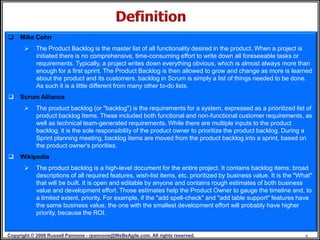
    Mike Cohn
           The Product Backlog is the master list of all functionality desired in the product. When a project is
            initiated there is no comprehensive, time-consuming effort to write down all foreseeable tasks or
            requirements. Typically, a project writes down everything obvious, which is almost always more than
            enough for a first sprint. The Product Backlog is then allowed to grow and change as more is learned
            about the product and its customers. backlog in Scrum is simply a list of things needed to be done.
            As such it is a little different from many other to-do lists.
    Scrum Alliance
           The product backlog (or "backlog") is the requirements for a system, expressed as a prioritized list of
            product backlog Items. These included both functional and non-functional customer requirements, as
            well as technical team-generated requirements. While there are multiple inputs to the product
            backlog, it is the sole responsibility of the product owner to prioritize the product backlog. During a
            Sprint planning meeting, backlog items are moved from the product backlog into a sprint, based on
            the product owner's priorities.
    Wikipedia
           The product backlog is a high-level document for the entire project. It contains backlog items: broad
            descriptions of all required features, wish-list items, etc. prioritized by business value. It is the "What"
            that will be built. It is open and editable by anyone and contains rough estimates of both business
            value and development effort. Those estimates help the Product Owner to gauge the timeline and, to
            a limited extent, priority. For example, if the "add spell-check" and "add table support" features have
            the same business value, the one with the smallest development effort will probably have higher
            priority, because the ROI.


Copyright © 2008 Russell Pannone - rpannone@WeBeAgile.com. All rights reserved.                                      4
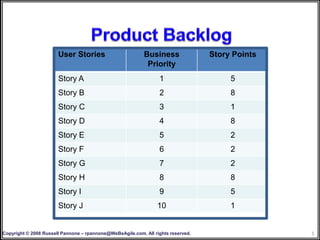
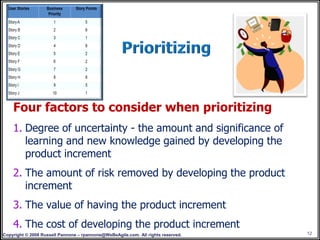
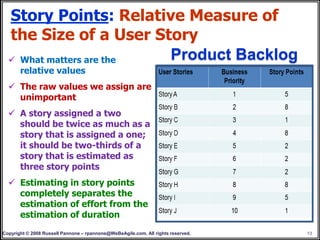
User Stories                        Business               Story Points
                                                            Priority
                       Story A                                   1                     5
                       Story B                                   2                     8
                       Story C                                   3                     1
                       Story D                                   4                     8
                       Story E                                   5                     2
                       Story F                                   6                     2
                       Story G                                   7                     2
                       Story H                                   8                     8
                       Story I                                   9                     5
                       Story J                                  10                     1


Copyright © 2008 Russell Pannone – rpannone@WeBeAgile.com. All rights reserved.                  5
Copyright © 2008 Russell Pannone – rpannone@WeBeAgile.com. All rights reserved.
                                                                                  6
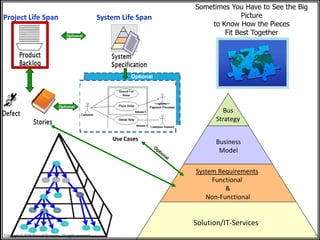
Sometimes You Have to See the Big
Project Life Span                                        System Life Span                  Picture
                                                                                  to Know How the Pieces
                                      Optional
                                                                                      Fit Best Together


                                                                   Optional


                                 Optional
                                                                                       Bus
                                                                                     Strategy

                                                             Use Cases
                                                                                    Business
                                                                                     Model

                                                                              System Requirements
                                                                                   Functional
                                                                                       &
                                                                                 Non-Functional


                                                                              Solution/IT-Services
Copyright © 2008 Russell Pannone. All rights reserved.                                                            7
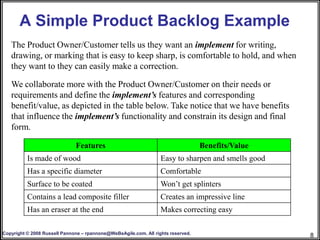
A Simple Product Backlog Example
   The Product Owner/Customer tells us they want an implement for writing,
   drawing, or marking that is easy to keep sharp, is comfortable to hold, and when
   they want to they can easily make a correction.

   We collaborate more with the Product Owner/Customer on their needs or
   requirements and define the implement’s features and corresponding
   benefit/value, as depicted in the table below. Take notice that we have benefits
   that influence the implement’s functionality and constrain its design and final
   form.

                              Features                                            Benefits/Value
          Is made of wood                                         Easy to sharpen and smells good
          Has a specific diameter                                 Comfortable
          Surface to be coated                                    Won’t get splinters
          Contains a lead composite filler                        Creates an impressive line
          Has an eraser at the end                                Makes correcting easy

Copyright © 2008 Russell Pannone – rpannone@WeBeAgile.com. All rights reserved.
                                                                                                    8
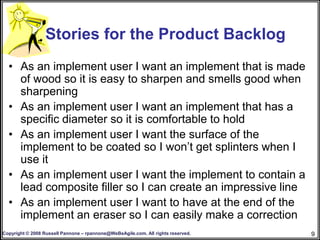
Stories for the Product Backlog
  • As an implement user I want an implement that is made
    of wood so it is easy to sharpen and smells good when
    sharpening
  • As an implement user I want an implement that has a
    specific diameter so it is comfortable to hold
  • As an implement user I want the surface of the
    implement to be coated so I won’t get splinters when I
    use it
  • As an implement user I want the implement to contain a
    lead composite filler so I can create an impressive line
  • As an implement user I want to have at the end of the
    implement an eraser so I can easily make a correction
Copyright © 2008 Russell Pannone – rpannone@WeBeAgile.com. All rights reserved.   9
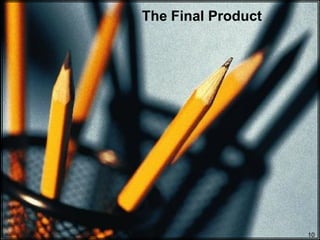
The Final Product


Russell Pannone (805-910-6481)                       10
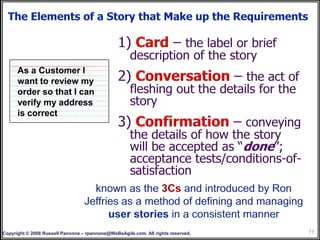
As a Customer I
      want to review my
      order so that I can
      verify my address
      is correct


Copyright © 2008 Russell Pannone – rpannone@WeBeAgile.com. All rights reserved.   11
Four factors to consider when prioritizing
    1. Degree of uncertainty - the amount and significance of
       learning and new knowledge gained by developing the
       product increment
    2. The amount of risk removed by developing the product
       increment
    3. The value of having the product increment
    4. The cost of developing the product increment
Copyright © 2008 Russell Pannone – rpannone@WeBeAgile.com. All rights reserved.   12
Story Points: Relative Measure of
  the Size of a User Story
   What matters are the Product Backlog
       relative values
   The raw values we assign are
    unimportant
   A story assigned a two
    should be twice as much as a
    story that is assigned a one;
    it should be two-thirds of a
    story that is estimated as
    three story points
   Estimating in story points
    completely separates the
    estimation of effort from the
    estimation of duration
Copyright © 2008 Russell Pannone – rpannone@WeBeAgile.com. All rights reserved.   13
 The Product Owner is responsible for creating and
      maintaining the Product Backlog
            The Product Backlog is not static it is dynamic; marked by
             usually continuous and productive activity or change
     The items or stories that make up the Product Backlog come
      from various sources
            Inspection and discussion specific to the Product Roadmap
             and Release Planning
            As a result of the stories being identified in the first place
             (see How Do I Create User Stories for more information)
     The Product Development and Delivery Team are held
      accountable for delivering the stories based on the priority of
      the story, the team velocity and meeting the conditions-of-
      satisfaction for the value-added

Copyright © 2008 Russell Pannone – rpannone@WeBeAgile.com. All rights reserved.   14
Copyright © 2008 Russell Pannone – rpannone@WeBeAgile.com. All rights reserved.
                                                                                  15
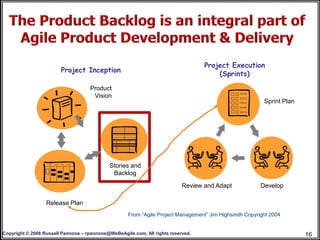
Project Execution
                        Project Inception
                                                                                      (Sprints)
                                    Product
                                     Vision
                                                                                                         Sprint Plan


                                            Stories and
                                             Backlog

                                                                           Review and Adapt             Develop

                  Release Plan
                                                    From “Agile Project Management” Jim Highsmith Copyright 2004


Copyright © 2008 Russell Pannone – rpannone@WeBeAgile.com. All rights reserved.                                        16
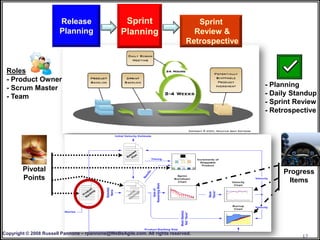
Release                    Sprint                       Sprint
                       Planning                  Planning                     Review &
                                                                            Retrospective


 Roles
 - Product Owner
 - Scrum Master                                                                             - Planning
 - Team                                                                                     - Daily Standup
                                                                                            - Sprint Review
                                                                                            - Retrospective


        Pivotal                                                                                  Progress
        Points                                                                                     Items


Copyright © 2008 Russell Pannone – rpannone@WeBeAgile.com. All rights reserved.
                                                                                                      17
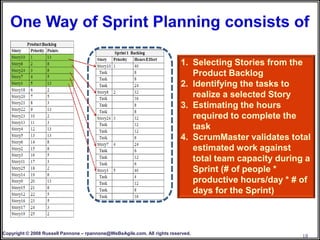
1. Selecting Stories from the
                                                                             Product Backlog
                                                                          2. Identifying the tasks to
                                                                             realize a selected Story
                                                                          3. Estimating the hours
                                                                             required to complete the
                                                                             task
                                                                          4. ScrumMaster validates total
                                                                             estimated work against
                                                                             total team capacity during a
                                                                             Sprint (# of people *
                                                                             productive hours/day * # of
                                                                             days for the Sprint)


Copyright © 2008 Russell Pannone – rpannone@WeBeAgile.com. All rights reserved.
                                                                                                       18
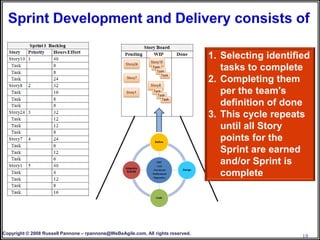
1. Selecting identified
                                                                                     tasks to complete
                                                                                  2. Completing them
                                                                                     per the team's
                                                                                     definition of done
                                                                                  3. This cycle repeats
                                                                                     until all Story
                                                                                     points for the
                                                                                     Sprint are earned
                                                                                     and/or Sprint is
                                                                                     complete


Copyright © 2008 Russell Pannone – rpannone@WeBeAgile.com. All rights reserved.
                                                                                                       19

Creating A Product Backlog

  • 1.
    Copyright © 2008Russell Pannone – rpannone@WeBeAgile.com. All rights reserved.
  • 2.
    Copyright © 2008Russell Pannone – rpannone@WeBeAgile.com. All rights reserved. 2
  • 3.
    Copyright © 2008Russell Pannone – rpannone@WeBeAgile.com. All rights reserved. 3
  • 4.
    Mike Cohn  The Product Backlog is the master list of all functionality desired in the product. When a project is initiated there is no comprehensive, time-consuming effort to write down all foreseeable tasks or requirements. Typically, a project writes down everything obvious, which is almost always more than enough for a first sprint. The Product Backlog is then allowed to grow and change as more is learned about the product and its customers. backlog in Scrum is simply a list of things needed to be done. As such it is a little different from many other to-do lists.  Scrum Alliance  The product backlog (or "backlog") is the requirements for a system, expressed as a prioritized list of product backlog Items. These included both functional and non-functional customer requirements, as well as technical team-generated requirements. While there are multiple inputs to the product backlog, it is the sole responsibility of the product owner to prioritize the product backlog. During a Sprint planning meeting, backlog items are moved from the product backlog into a sprint, based on the product owner's priorities.  Wikipedia  The product backlog is a high-level document for the entire project. It contains backlog items: broad descriptions of all required features, wish-list items, etc. prioritized by business value. It is the "What" that will be built. It is open and editable by anyone and contains rough estimates of both business value and development effort. Those estimates help the Product Owner to gauge the timeline and, to a limited extent, priority. For example, if the "add spell-check" and "add table support" features have the same business value, the one with the smallest development effort will probably have higher priority, because the ROI. Copyright © 2008 Russell Pannone - rpannone@WeBeAgile.com. All rights reserved. 4
  • 5.
    User Stories Business Story Points Priority Story A 1 5 Story B 2 8 Story C 3 1 Story D 4 8 Story E 5 2 Story F 6 2 Story G 7 2 Story H 8 8 Story I 9 5 Story J 10 1 Copyright © 2008 Russell Pannone – rpannone@WeBeAgile.com. All rights reserved. 5
  • 6.
    Copyright © 2008Russell Pannone – rpannone@WeBeAgile.com. All rights reserved. 6
  • 7.
    Sometimes You Haveto See the Big Project Life Span System Life Span Picture to Know How the Pieces Optional Fit Best Together Optional Optional Bus Strategy Use Cases Business Model System Requirements Functional & Non-Functional Solution/IT-Services Copyright © 2008 Russell Pannone. All rights reserved. 7
  • 8.
    A Simple ProductBacklog Example The Product Owner/Customer tells us they want an implement for writing, drawing, or marking that is easy to keep sharp, is comfortable to hold, and when they want to they can easily make a correction. We collaborate more with the Product Owner/Customer on their needs or requirements and define the implement’s features and corresponding benefit/value, as depicted in the table below. Take notice that we have benefits that influence the implement’s functionality and constrain its design and final form. Features Benefits/Value Is made of wood Easy to sharpen and smells good Has a specific diameter Comfortable Surface to be coated Won’t get splinters Contains a lead composite filler Creates an impressive line Has an eraser at the end Makes correcting easy Copyright © 2008 Russell Pannone – rpannone@WeBeAgile.com. All rights reserved. 8
  • 9.
    Stories for theProduct Backlog • As an implement user I want an implement that is made of wood so it is easy to sharpen and smells good when sharpening • As an implement user I want an implement that has a specific diameter so it is comfortable to hold • As an implement user I want the surface of the implement to be coated so I won’t get splinters when I use it • As an implement user I want the implement to contain a lead composite filler so I can create an impressive line • As an implement user I want to have at the end of the implement an eraser so I can easily make a correction Copyright © 2008 Russell Pannone – rpannone@WeBeAgile.com. All rights reserved. 9
  • 10.
    The Final Product RussellPannone (805-910-6481) 10
  • 11.
    As a CustomerI want to review my order so that I can verify my address is correct Copyright © 2008 Russell Pannone – rpannone@WeBeAgile.com. All rights reserved. 11
  • 12.
    Four factors toconsider when prioritizing 1. Degree of uncertainty - the amount and significance of learning and new knowledge gained by developing the product increment 2. The amount of risk removed by developing the product increment 3. The value of having the product increment 4. The cost of developing the product increment Copyright © 2008 Russell Pannone – rpannone@WeBeAgile.com. All rights reserved. 12
  • 13.
    Story Points: RelativeMeasure of the Size of a User Story  What matters are the Product Backlog relative values  The raw values we assign are unimportant  A story assigned a two should be twice as much as a story that is assigned a one; it should be two-thirds of a story that is estimated as three story points  Estimating in story points completely separates the estimation of effort from the estimation of duration Copyright © 2008 Russell Pannone – rpannone@WeBeAgile.com. All rights reserved. 13
  • 14.
     The ProductOwner is responsible for creating and maintaining the Product Backlog  The Product Backlog is not static it is dynamic; marked by usually continuous and productive activity or change  The items or stories that make up the Product Backlog come from various sources  Inspection and discussion specific to the Product Roadmap and Release Planning  As a result of the stories being identified in the first place (see How Do I Create User Stories for more information)  The Product Development and Delivery Team are held accountable for delivering the stories based on the priority of the story, the team velocity and meeting the conditions-of- satisfaction for the value-added Copyright © 2008 Russell Pannone – rpannone@WeBeAgile.com. All rights reserved. 14
  • 15.
    Copyright © 2008Russell Pannone – rpannone@WeBeAgile.com. All rights reserved. 15
  • 16.
    Project Execution Project Inception (Sprints) Product Vision Sprint Plan Stories and Backlog Review and Adapt Develop Release Plan From “Agile Project Management” Jim Highsmith Copyright 2004 Copyright © 2008 Russell Pannone – rpannone@WeBeAgile.com. All rights reserved. 16
  • 17.
    Release Sprint Sprint Planning Planning Review & Retrospective Roles - Product Owner - Scrum Master - Planning - Team - Daily Standup - Sprint Review - Retrospective Pivotal Progress Points Items Copyright © 2008 Russell Pannone – rpannone@WeBeAgile.com. All rights reserved. 17
  • 18.
    1. Selecting Storiesfrom the Product Backlog 2. Identifying the tasks to realize a selected Story 3. Estimating the hours required to complete the task 4. ScrumMaster validates total estimated work against total team capacity during a Sprint (# of people * productive hours/day * # of days for the Sprint) Copyright © 2008 Russell Pannone – rpannone@WeBeAgile.com. All rights reserved. 18
  • 19.
    1. Selecting identified tasks to complete 2. Completing them per the team's definition of done 3. This cycle repeats until all Story points for the Sprint are earned and/or Sprint is complete Copyright © 2008 Russell Pannone – rpannone@WeBeAgile.com. All rights reserved. 19