this place matters
re-thinking local leadership
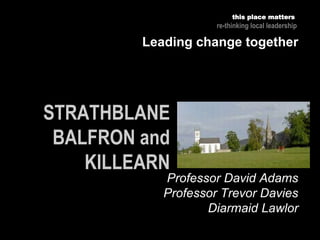
Leading change together
Professor David Adams
Professor Trevor Davies
Diarmaid Lawlor
Diarmaid Lawlor
this place matters
re-thinking local leadership
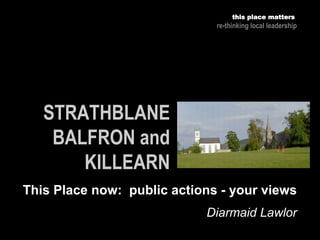
This Place now: public actions - your views
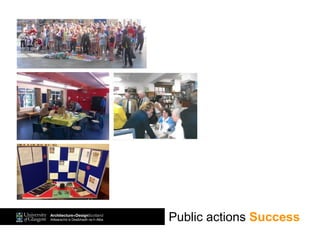
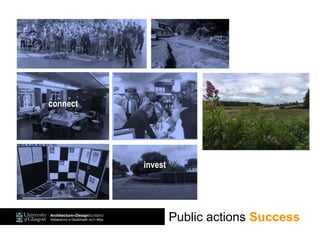
Public actions Success
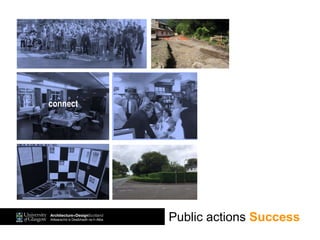
connect
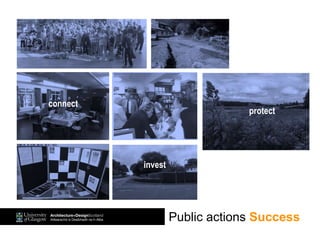
Public actions Success
connect
invest
Public actions Success
connect
invest
protect
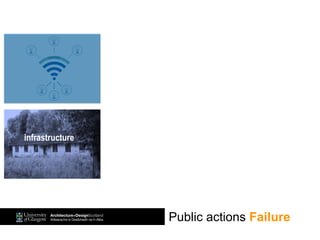
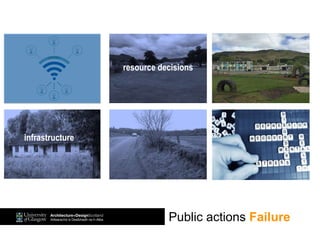
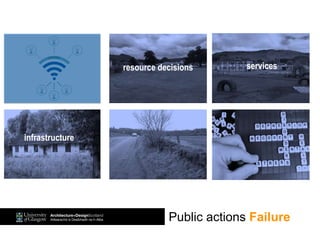
Public actions Failure
infrastructure
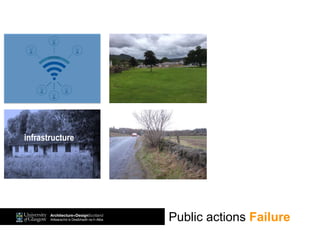
Public actions Failure
infrastructure
Public actions Failure
infrastructure
resource decisions
Public actions Failure
infrastructure
resource decisions services
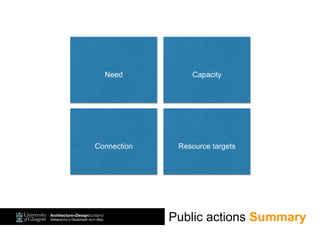
Public actions Summary
Need
Resource targetsConnection
Capacity
this place matters
re-thinking local leadership
Looking forward: plans, priorities and pilots
Gillian Gillian Taylor
Stirling Council
Stirling Council
Community Pilot Projects
• This is a Stirling Council and Community Planning Partners
project
• We want to support our communities to be thriving, well
connected and proud places to live and work
• We want to work in new ways so that we can collectively
identify local needs and priorities
• We want to test community led solutions to local
issues (tangible projects)
Why are we doing this?
• Nobody knows a community better than the people living and
working there – need community focussed solutions
• To move away from ‘one size fits all’ method of providing
services and recognise the difference between our rural
communities and the city
• Challenging economic times - need to be more collaborative
and innovative
• This is a way of testing unique and forward thinking solutions
to local issues
Stirling Council
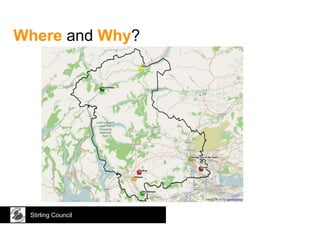
Where and Why?
Stirling Council
• Scenic rural west area of Stirling Council
• Combined population of 6,642 (Balfron 2061, Killearn
2194, Strathblane 2387)
• Strathblane has more residents in the 85+ age group (2.7%
of population)
• Health outcomes are better than the Stirling average
• Economically active area with higher than average levels of
self employment
Community Profile
Stirling Council
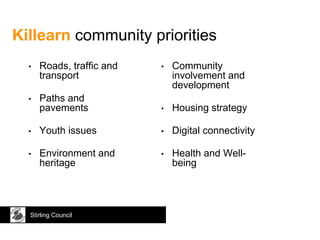
Killearn community priorities
Stirling Council
• Roads, traffic and
transport
• Paths and
pavements
• Youth issues
• Environment and
heritage
• Community
involvement and
development
• Housing strategy
• Digital connectivity
• Health and Well-
being
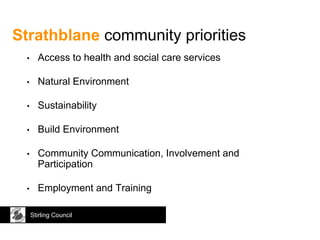
• Access to health and social care services
• Natural Environment
• Sustainability
• Build Environment
• Community Communication, Involvement and
Participation
• Employment and Training
Strathblane community priorities
Stirling Council
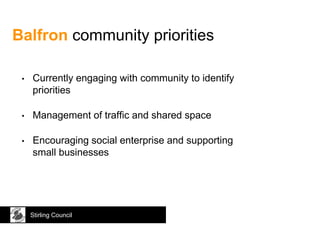
Balfron community priorities
Stirling Council
• Currently engaging with community to identify
priorities
• Management of traffic and shared space
• Encouraging social enterprise and supporting
small businesses
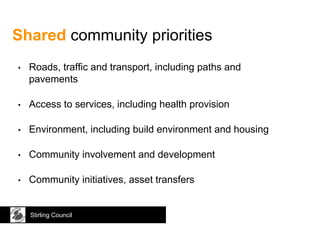
Shared community priorities
Stirling Council
• Roads, traffic and transport, including paths and
pavements
• Access to services, including health provision
• Environment, including build environment and housing
• Community involvement and development
• Community initiatives, asset transfers
Professor David Adams
this place matters
re-thinking local leadership
Barriers to change
What’s getting in the way?
What are the BARRIERS to achieving change?
Diarmaid Lawlor
this place matters
re-thinking local leadership
Looking forward : Shared priorities
What priorities do you share?
What are the priorities you SHARE?
What’s the BIG idea?
What are the big PRIORITIES in this place?
What BENEFITS come from working on them together?
What are the priorities you SHARE?
Professor David Adams
this place matters
re-thinking local leadership
Leading Change Together:
Understanding PLACE
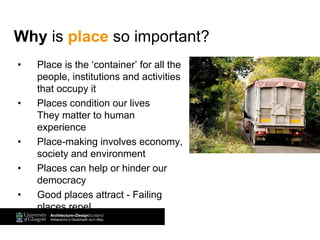
• Place is the ‘container’ for all the
people, institutions and activities
that occupy it
• Places condition our lives
They matter to human
experience
• Place-making involves economy,
society and environment
• Places can help or hinder our
democracy
• Good places attract - Failing
places repel
Why is place so important?
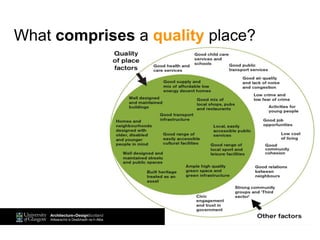
What comprises a quality place?
What makes a quality place?
• Good supply and mix of affordable, low energy homes
• Well-designed and maintained public buildings
• Good mix of local shops and pubs etc
• Good transport infrastructure
• Range of accessible cultural facilities
• Easily available public services
• Ample high quality green space
• Built heritage treated as an asset
• Well-designed and maintained streets & public spaces
• Homes and neighbourhoods for everyone - young & old
What supports a quality place?
• Good health and care services
• Good schools and child care
• Good public transport services
• Low pollution, noise and congestion
• Activities for young people
• Job opportunities
• Low cost of living
• Community cohesion
• Good relations between neighbours
• Strong community and voluntary groups
• Civic engagement and trust
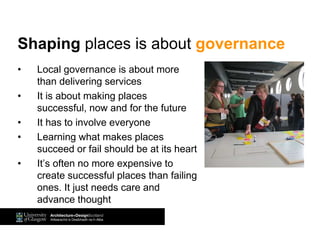
• Local governance is about more
than delivering services
• It is about making places
successful, now and for the future
• It has to involve everyone
• Learning what makes places
succeed or fail should be at its heart
• It’s often no more expensive to
create successful places than failing
ones. It just needs care and
advance thought
Shaping places is about governance
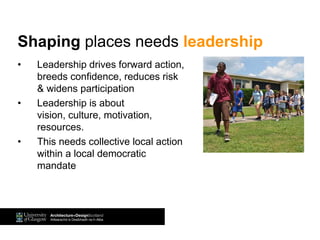
• Leadership drives forward action,
breeds confidence, reduces risk
& widens participation
• Leadership is about
vision, culture, motivation,
resources.
• This needs collective local action
within a local democratic
mandate
Shaping places needs leadership
Professor Trevor Davies
this place matters
re-thinking local leadership
Leading Change Together: Values
Leading change together: values
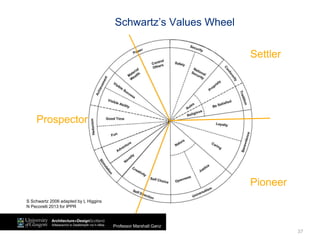
Shalom Schwartz: (2006)
“values are the desirable goals we set for ourselves, which
transcend specific situations and motivate our actions”
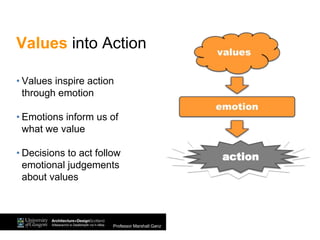
action
• Values inspire action
through emotion
• Emotions inform us of
what we value
• Decisions to act follow
emotional judgements
about values
Values into Action
Professor Marshall Ganz
Leading change together: values
George Lakoff: (2009)
Our first social experience is the family. Family metaphors
frame our social values.
Based in the brain’s neural maps “metaphors are mental
structures independent of language”. “Metaphorical thought is
ordinary, mostly unconscious and automatic.”
37
S Schwartz 2006 adapted by L Higgins
N Pecorelli 2013 for IPPR
Schwartz’s Values Wheel
Prospector
Settler
Pioneer
Professor Marshall Ganz
What personal values led you to public action?SELF: What personal values led you to public action?What personal values led you to public action?
Leading change together: values
What personal values led you to public action?
Can you define common ground in your values?
SELF: What personal values led you to public action?What personal values led you to public action?
Leading change together: values
this place matters
re-thinking local leadership
BREAK!
Professor David Adams
this place matters
re-thinking local leadership
Leading change together :
in each others shoes
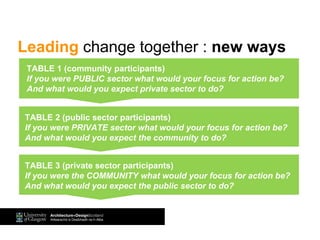
Leading change together : new ways
TABLE 1 (community participants)
If you were PUBLIC sector what would your focus for action be?
And what would you expect private sector to do?
TABLE 2 (public sector participants)
If you were PRIVATE sector what would your focus for action be?
And what would you expect the community to do?
TABLE 3 (private sector participants)
If you were the COMMUNITY what would your focus for action be?
And what would you expect the public sector to do?
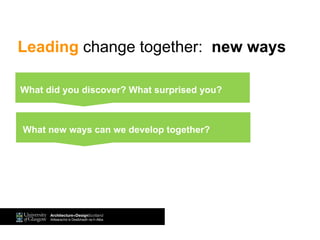
What did you discover? What surprised you?
Leading change together: new ways
What new ways can we develop together?
this place matters
re-thinking local leadership
Leading change together : strategic thinking
Professor Trevor Davies
Leading change together - strategic thinking
Chris Carter: (2014)
“The setting and accomplishment of long-term objectives
recognising the emergent, paradoxical and unintended
nature of organisational life.
“Positioning the organisation and bringing together a
compelling narrative with the people, resources and
techniques to realise the objectives.”
➢ long term objectives
Leading change together - strategic thinking
• ambitious and achievable
• relevant and credible
• eloquent and compelling
• unifying and identity-building
➢ identity
• Who are we - this team in this place?
• Who we are is shaped by our values.
Our values shape our common purpose
• What makes us different from what was done before or by
others?
• And what is it about us that will endure over time?
Leading change together - strategic thinking
➢ techniques
Small things can make a big difference:
• - by changing how people see things
• - by showing how it’s done
• - by making an easy set of steps to follow
• - by tapping into positive beliefs and values
Leading change together - strategic thinking
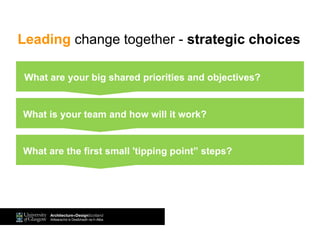
What are your big shared priorities and objectives?
What are the first small 'tipping point” steps?
What is your team and how will it work?
Leading change together - strategic choices
this place matters
re-thinking local leadership
Leading change together : narrative
Professor Trevor Davies
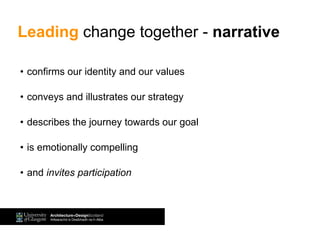
• confirms our identity and our values
• conveys and illustrates our strategy
• describes the journey towards our goal
• is emotionally compelling
• and invites participation
Leading change together - narrative
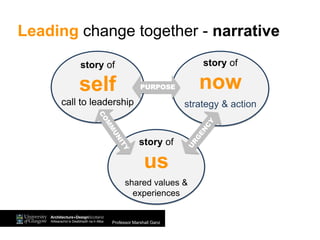
story of
self
call to leadership
story of
now
strategy & action
story of
us
shared values &
experiences
PURPOSE
Professor Marshall Ganz
Leading change together - narrative
Leading change together : Story of Us
Who were the partners? What values did they share?
What assets or services from 2015 were re-configured?
Looking back from 2020:
What project was central to creating collaboration?
this place matters
re-thinking local leadership
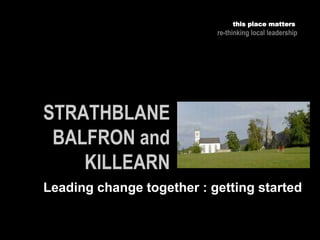
Leading change together : getting started
Leading change together : First steps
Tell the story of getting from now till then …….
So what happens now?
this place matters
re-thinking local leadership
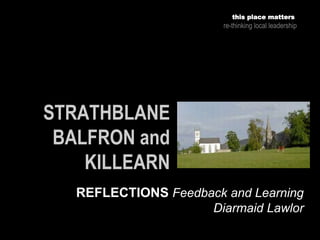
REFLECTIONS Feedback and Learning
Diarmaid Lawlor
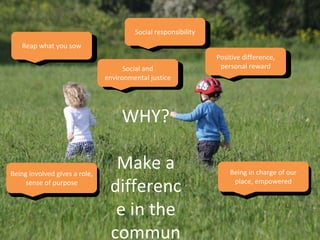
Being involved gives a role,
sense of purpose
Being charge of our place,
empowered
Reap what you sow
Social and
environmental justice
Social responsibility
Positive difference,
personal reward
Reap what you sow
Social and
environmental justice
Social responsibility
Positive difference,
personal reward
Being involved gives a role,
sense of purpose
Being in charge of our
place, empowered
WHY?
Make a
differenc
e in the
commun
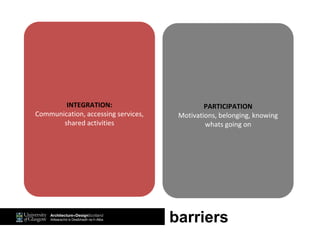
barriers
INTEGRATION:
Communication, accessing services,
shared activities
PARTICIPATION
Motivations, belonging, knowing
whats going on
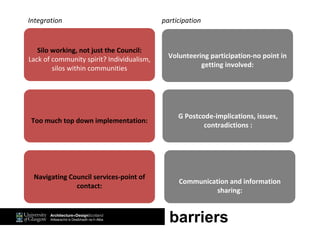
barriers
Communication and information
sharing:
Volunteering participation-no point in
getting involved:
Too much top down implementation:
G Postcode-implications, issues,
contradictions :
Navigating Council services-point of
contact:
Silo working, not just the Council:
Lack of community spirit? Individualism,
silos within communities
Integration participation
PILOT
PROJECT BRIEFS
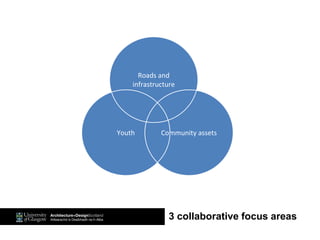
3 collaborative focus areas
Roads and
infrastructure
Community assetsYouth
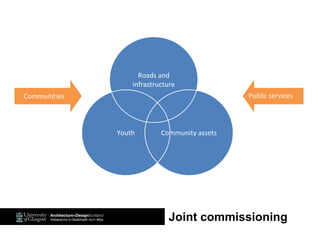
Joint commissioning
Communities Public services
Roads and
infrastructure
Community assetsYouth
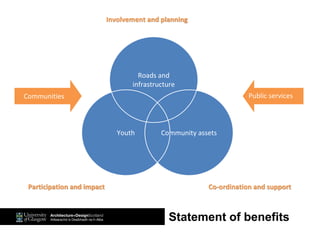
Statement of benefits
Involvement and planning
Participation and impact Co-ordination and support
Communities Public services
Roads and
infrastructure
Community assetsYouth
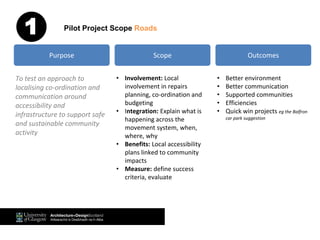
Purpose
To test an approach to
localising co-ordination and
communication around
accessibility and
infrastructure to support safe
and sustainable community
activity
Scope
• Involvement: Local
involvement in repairs
planning, co-ordination and
budgeting
• Integration: Explain what is
happening across the
movement system, when,
where, why
• Benefits: Local accessibility
plans linked to community
impacts
• Measure: define success
criteria, evaluate
Outcomes
• Better environment
• Better communication
• Supported communities
• Efficiencies
• Quick win projects eg the Balfron
car park suggestion
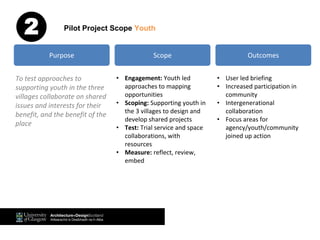
Pilot Project Scope Roads1
Purpose
To test approaches to
supporting youth in the three
villages collaborate on shared
issues and interests for their
benefit, and the benefit of the
place
Scope
• Engagement: Youth led
approaches to mapping
opportunities
• Scoping: Supporting youth in
the 3 villages to design and
develop shared projects
• Test: Trial service and space
collaborations, with
resources
• Measure: reflect, review,
embed
Outcomes
• User led briefing
• Increased participation in
community
• Intergenerational
collaboration
• Focus areas for
agency/youth/community
joined up action
Pilot Project Scope Youth2
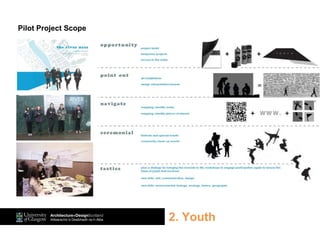
2. Youth
Pilot Project Scope
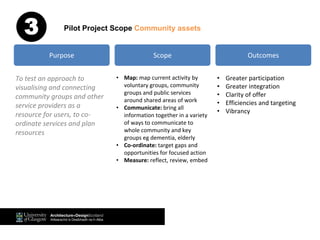
Purpose
To test an approach to
visualising and connecting
community groups and other
service providers as a
resource for users, to co-
ordinate services and plan
resources
Scope
• Map: map current activity by
voluntary groups, community
groups and public services
around shared areas of work
• Communicate: bring all
information together in a variety
of ways to communicate to
whole community and key
groups eg dementia, elderly
• Co-ordinate: target gaps and
opportunities for focused action
• Measure: reflect, review, embed
Outcomes
• Greater participation
• Greater integration
• Clarity of offer
• Efficiencies and targeting
• Vibrancy
Pilot Project Scope Community assets3
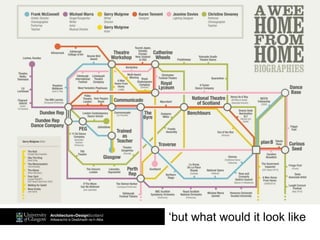
‘but what would it look like
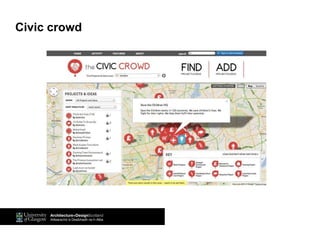
Civic crowd
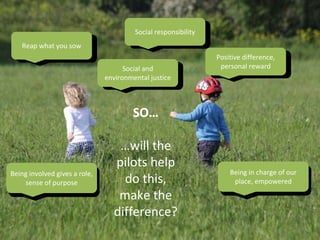
Being involved gives a role,
sense of purpose
Being charge of our place,
empowered
Reap what you sow
Social and
environmental justice
Social responsibility
Positive difference,
personal reward
Reap what you sow
Social and
environmental justice
Social responsibility
Positive difference,
personal reward
Being involved gives a role,
sense of purpose
Being in charge of our
place, empowered
SO…
…will the
pilots help
do this,
make the
difference?
SUSTAINING
THE EFFECTS
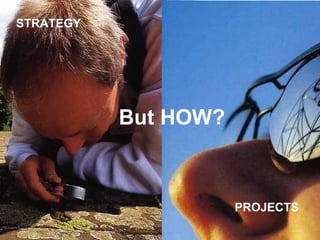
STRATEGY
PROJECTS
But HOW?
Culture of decisions
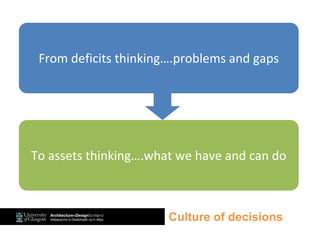
From deficits thinking….problems and gaps
To assets thinking….what we have and can do
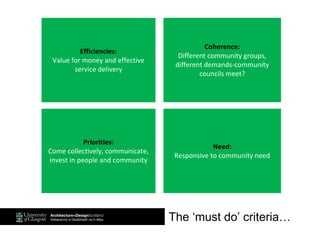
The ‘must do’ criteria…
Efficiencies:
Value for money and effective
service delivery
Coherence:
Different community groups,
different demands-community
councils meet?
Priorities:
Come collectively, communicate,
invest in people and community
Need:
Responsive to community need
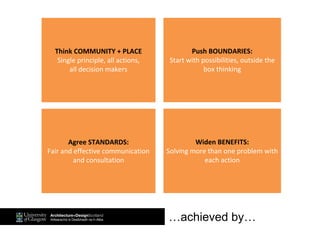
…achieved by…
Think COMMUNITY + PLACE
Single principle, all actions,
all decision makers
Push BOUNDARIES:
Start with possibilities, outside the
box thinking
Agree STANDARDS:
Fair and effective communication
and consultation
Widen BENEFITS:
Solving more than one problem with
each action
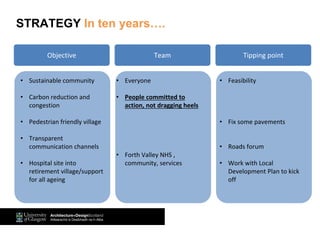
Objective Team Tipping point
• Sustainable community
• Carbon reduction and
congestion
• Pedestrian friendly village
• Transparent
communication channels
• Hospital site into
retirement village/support
for all ageing
• Feasibility
• Carbon reduction and
congestion
• Fix some pavements
• Roads forum
• Work with Local
Development Plan to kick
off
• Everyone
• People committed to
action, not dragging heels
• Forth Valley NHS ,
community, services
STRATEGY In ten years….
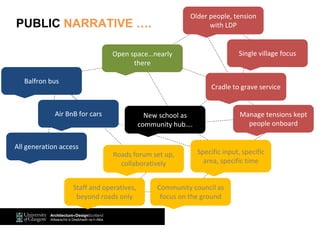
PUBLIC NARRATIVE ….
Balfron bus
Air BnB for cars
All generation access
Open space…nearly
there
New school as
community hub….
Roads forum set up,
collaboratively
Staff and operatives,
beyond roads only
Community council as
focus on the ground
Specific input, specific
area, specific time
Older people, tension
with LDP
Single village focus
Cradle to grave service
Manage tensions kept
people onboard
this place matters
re-thinking local leadership
INFORMATION
www.thisplacematters.org.uk

Strathblane, Balfron and Killearn

  • 1.
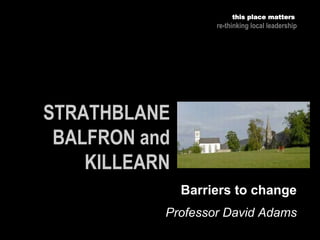
    this place matters re-thinkinglocal leadership Leading change together Professor David Adams Professor Trevor Davies Diarmaid Lawlor
  • 2.
    Diarmaid Lawlor this placematters re-thinking local leadership This Place now: public actions - your views
  • 3.
  • 4.
  • 5.
  • 6.
  • 7.
  • 8.
  • 9.
  • 10.
  • 11.
    Public actions Summary Need ResourcetargetsConnection Capacity
  • 12.
    this place matters re-thinkinglocal leadership Looking forward: plans, priorities and pilots Gillian Gillian Taylor Stirling Council
  • 13.
    Stirling Council Community PilotProjects • This is a Stirling Council and Community Planning Partners project • We want to support our communities to be thriving, well connected and proud places to live and work • We want to work in new ways so that we can collectively identify local needs and priorities • We want to test community led solutions to local issues (tangible projects)
  • 14.
    Why are wedoing this? • Nobody knows a community better than the people living and working there – need community focussed solutions • To move away from ‘one size fits all’ method of providing services and recognise the difference between our rural communities and the city • Challenging economic times - need to be more collaborative and innovative • This is a way of testing unique and forward thinking solutions to local issues Stirling Council
  • 15.
  • 16.
    • Scenic ruralwest area of Stirling Council • Combined population of 6,642 (Balfron 2061, Killearn 2194, Strathblane 2387) • Strathblane has more residents in the 85+ age group (2.7% of population) • Health outcomes are better than the Stirling average • Economically active area with higher than average levels of self employment Community Profile Stirling Council
  • 17.
    Killearn community priorities StirlingCouncil • Roads, traffic and transport • Paths and pavements • Youth issues • Environment and heritage • Community involvement and development • Housing strategy • Digital connectivity • Health and Well- being
  • 18.
    • Access tohealth and social care services • Natural Environment • Sustainability • Build Environment • Community Communication, Involvement and Participation • Employment and Training Strathblane community priorities Stirling Council
  • 19.
    Balfron community priorities StirlingCouncil • Currently engaging with community to identify priorities • Management of traffic and shared space • Encouraging social enterprise and supporting small businesses
  • 20.
    Shared community priorities StirlingCouncil • Roads, traffic and transport, including paths and pavements • Access to services, including health provision • Environment, including build environment and housing • Community involvement and development • Community initiatives, asset transfers
  • 21.
    Professor David Adams thisplace matters re-thinking local leadership Barriers to change
  • 22.
    What’s getting inthe way? What are the BARRIERS to achieving change?
  • 23.
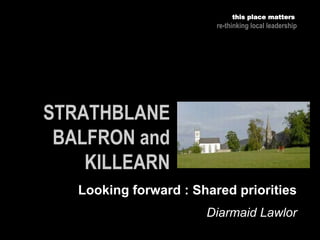
    Diarmaid Lawlor this placematters re-thinking local leadership Looking forward : Shared priorities
  • 24.
    What priorities doyou share? What are the priorities you SHARE?
  • 25.
    What’s the BIGidea? What are the big PRIORITIES in this place? What BENEFITS come from working on them together? What are the priorities you SHARE?
  • 26.
    Professor David Adams thisplace matters re-thinking local leadership Leading Change Together: Understanding PLACE
  • 27.
    • Place isthe ‘container’ for all the people, institutions and activities that occupy it • Places condition our lives They matter to human experience • Place-making involves economy, society and environment • Places can help or hinder our democracy • Good places attract - Failing places repel Why is place so important?
  • 28.
    What comprises aquality place?
  • 29.
    What makes aquality place? • Good supply and mix of affordable, low energy homes • Well-designed and maintained public buildings • Good mix of local shops and pubs etc • Good transport infrastructure • Range of accessible cultural facilities • Easily available public services • Ample high quality green space • Built heritage treated as an asset • Well-designed and maintained streets & public spaces • Homes and neighbourhoods for everyone - young & old
  • 30.
    What supports aquality place? • Good health and care services • Good schools and child care • Good public transport services • Low pollution, noise and congestion • Activities for young people • Job opportunities • Low cost of living • Community cohesion • Good relations between neighbours • Strong community and voluntary groups • Civic engagement and trust
  • 31.
    • Local governanceis about more than delivering services • It is about making places successful, now and for the future • It has to involve everyone • Learning what makes places succeed or fail should be at its heart • It’s often no more expensive to create successful places than failing ones. It just needs care and advance thought Shaping places is about governance
  • 32.
    • Leadership drivesforward action, breeds confidence, reduces risk & widens participation • Leadership is about vision, culture, motivation, resources. • This needs collective local action within a local democratic mandate Shaping places needs leadership
  • 33.
    Professor Trevor Davies thisplace matters re-thinking local leadership Leading Change Together: Values
  • 34.
    Leading change together:values Shalom Schwartz: (2006) “values are the desirable goals we set for ourselves, which transcend specific situations and motivate our actions”
  • 35.
    action • Values inspireaction through emotion • Emotions inform us of what we value • Decisions to act follow emotional judgements about values Values into Action Professor Marshall Ganz
  • 36.
    Leading change together:values George Lakoff: (2009) Our first social experience is the family. Family metaphors frame our social values. Based in the brain’s neural maps “metaphors are mental structures independent of language”. “Metaphorical thought is ordinary, mostly unconscious and automatic.”
  • 37.
    37 S Schwartz 2006adapted by L Higgins N Pecorelli 2013 for IPPR Schwartz’s Values Wheel Prospector Settler Pioneer Professor Marshall Ganz
  • 38.
    What personal valuesled you to public action?SELF: What personal values led you to public action?What personal values led you to public action? Leading change together: values
  • 39.
    What personal valuesled you to public action? Can you define common ground in your values? SELF: What personal values led you to public action?What personal values led you to public action? Leading change together: values
  • 40.
    this place matters re-thinkinglocal leadership BREAK!
  • 41.
    Professor David Adams thisplace matters re-thinking local leadership Leading change together : in each others shoes
  • 42.
    Leading change together: new ways TABLE 1 (community participants) If you were PUBLIC sector what would your focus for action be? And what would you expect private sector to do? TABLE 2 (public sector participants) If you were PRIVATE sector what would your focus for action be? And what would you expect the community to do? TABLE 3 (private sector participants) If you were the COMMUNITY what would your focus for action be? And what would you expect the public sector to do?
  • 43.
    What did youdiscover? What surprised you? Leading change together: new ways What new ways can we develop together?
  • 44.
    this place matters re-thinkinglocal leadership Leading change together : strategic thinking Professor Trevor Davies
  • 45.
    Leading change together- strategic thinking Chris Carter: (2014) “The setting and accomplishment of long-term objectives recognising the emergent, paradoxical and unintended nature of organisational life. “Positioning the organisation and bringing together a compelling narrative with the people, resources and techniques to realise the objectives.”
  • 46.
    ➢ long termobjectives Leading change together - strategic thinking • ambitious and achievable • relevant and credible • eloquent and compelling • unifying and identity-building
  • 47.
    ➢ identity • Whoare we - this team in this place? • Who we are is shaped by our values. Our values shape our common purpose • What makes us different from what was done before or by others? • And what is it about us that will endure over time? Leading change together - strategic thinking
  • 48.
    ➢ techniques Small thingscan make a big difference: • - by changing how people see things • - by showing how it’s done • - by making an easy set of steps to follow • - by tapping into positive beliefs and values Leading change together - strategic thinking
  • 49.
    What are yourbig shared priorities and objectives? What are the first small 'tipping point” steps? What is your team and how will it work? Leading change together - strategic choices
  • 50.
    this place matters re-thinkinglocal leadership Leading change together : narrative Professor Trevor Davies
  • 51.
    • confirms ouridentity and our values • conveys and illustrates our strategy • describes the journey towards our goal • is emotionally compelling • and invites participation Leading change together - narrative
  • 52.
    story of self call toleadership story of now strategy & action story of us shared values & experiences PURPOSE Professor Marshall Ganz Leading change together - narrative
  • 53.
    Leading change together: Story of Us Who were the partners? What values did they share? What assets or services from 2015 were re-configured? Looking back from 2020: What project was central to creating collaboration?
  • 54.
    this place matters re-thinkinglocal leadership Leading change together : getting started
  • 55.
    Leading change together: First steps Tell the story of getting from now till then ……. So what happens now?
  • 56.
    this place matters re-thinkinglocal leadership REFLECTIONS Feedback and Learning Diarmaid Lawlor
  • 57.
    Being involved givesa role, sense of purpose Being charge of our place, empowered Reap what you sow Social and environmental justice Social responsibility Positive difference, personal reward Reap what you sow Social and environmental justice Social responsibility Positive difference, personal reward Being involved gives a role, sense of purpose Being in charge of our place, empowered WHY? Make a differenc e in the commun
  • 58.
    barriers INTEGRATION: Communication, accessing services, sharedactivities PARTICIPATION Motivations, belonging, knowing whats going on
  • 59.
    barriers Communication and information sharing: Volunteeringparticipation-no point in getting involved: Too much top down implementation: G Postcode-implications, issues, contradictions : Navigating Council services-point of contact: Silo working, not just the Council: Lack of community spirit? Individualism, silos within communities Integration participation
  • 60.
  • 61.
    3 collaborative focusareas Roads and infrastructure Community assetsYouth
  • 62.
    Joint commissioning Communities Publicservices Roads and infrastructure Community assetsYouth
  • 63.
    Statement of benefits Involvementand planning Participation and impact Co-ordination and support Communities Public services Roads and infrastructure Community assetsYouth
  • 64.
    Purpose To test anapproach to localising co-ordination and communication around accessibility and infrastructure to support safe and sustainable community activity Scope • Involvement: Local involvement in repairs planning, co-ordination and budgeting • Integration: Explain what is happening across the movement system, when, where, why • Benefits: Local accessibility plans linked to community impacts • Measure: define success criteria, evaluate Outcomes • Better environment • Better communication • Supported communities • Efficiencies • Quick win projects eg the Balfron car park suggestion Pilot Project Scope Roads1
  • 65.
    Purpose To test approachesto supporting youth in the three villages collaborate on shared issues and interests for their benefit, and the benefit of the place Scope • Engagement: Youth led approaches to mapping opportunities • Scoping: Supporting youth in the 3 villages to design and develop shared projects • Test: Trial service and space collaborations, with resources • Measure: reflect, review, embed Outcomes • User led briefing • Increased participation in community • Intergenerational collaboration • Focus areas for agency/youth/community joined up action Pilot Project Scope Youth2
  • 66.
  • 67.
    Purpose To test anapproach to visualising and connecting community groups and other service providers as a resource for users, to co- ordinate services and plan resources Scope • Map: map current activity by voluntary groups, community groups and public services around shared areas of work • Communicate: bring all information together in a variety of ways to communicate to whole community and key groups eg dementia, elderly • Co-ordinate: target gaps and opportunities for focused action • Measure: reflect, review, embed Outcomes • Greater participation • Greater integration • Clarity of offer • Efficiencies and targeting • Vibrancy Pilot Project Scope Community assets3
  • 68.
    ‘but what wouldit look like
  • 69.
  • 70.
    Being involved givesa role, sense of purpose Being charge of our place, empowered Reap what you sow Social and environmental justice Social responsibility Positive difference, personal reward Reap what you sow Social and environmental justice Social responsibility Positive difference, personal reward Being involved gives a role, sense of purpose Being in charge of our place, empowered SO… …will the pilots help do this, make the difference?
  • 71.
  • 72.
  • 73.
    Culture of decisions Fromdeficits thinking….problems and gaps To assets thinking….what we have and can do
  • 74.
    The ‘must do’criteria… Efficiencies: Value for money and effective service delivery Coherence: Different community groups, different demands-community councils meet? Priorities: Come collectively, communicate, invest in people and community Need: Responsive to community need
  • 75.
    …achieved by… Think COMMUNITY+ PLACE Single principle, all actions, all decision makers Push BOUNDARIES: Start with possibilities, outside the box thinking Agree STANDARDS: Fair and effective communication and consultation Widen BENEFITS: Solving more than one problem with each action
  • 77.
    Objective Team Tippingpoint • Sustainable community • Carbon reduction and congestion • Pedestrian friendly village • Transparent communication channels • Hospital site into retirement village/support for all ageing • Feasibility • Carbon reduction and congestion • Fix some pavements • Roads forum • Work with Local Development Plan to kick off • Everyone • People committed to action, not dragging heels • Forth Valley NHS , community, services STRATEGY In ten years….
  • 78.
    PUBLIC NARRATIVE …. Balfronbus Air BnB for cars All generation access Open space…nearly there New school as community hub…. Roads forum set up, collaboratively Staff and operatives, beyond roads only Community council as focus on the ground Specific input, specific area, specific time Older people, tension with LDP Single village focus Cradle to grave service Manage tensions kept people onboard
  • 79.
    this place matters re-thinkinglocal leadership INFORMATION www.thisplacematters.org.uk

Editor's Notes

  • #36 Understanding the link between values, emotion and action is central to public narrative. The argument that I am making is that values inspire action through emotion. Let me say that again – values inspire action through emotion. Let’s think about that for a moment. Call to mind an injustice that you see in the world. What is it? How does it make you feel? Why do you feel that way? Because of the values that you hold. Our emotions provide a kind of information about what it is that we value. It turns out that people who are unable to feel emotion are also unable to make choices. This is especially important in public narrative because ultimately you will be asking people to MAKE A CHOICE to join you in action. Unless you can provide them with the emotional information they need they are unlikely to do so.
  • #53 This is the basic framework of public narrative – as you can see it has three elements. During this workshop you will learn to tell and link three distinct stories. Your story of self: a story of why you are called to leadership right here and now Your story of us: a story about your community and why they are called to take action with you Your story of now: a story about the action that needs to be taken now and the consequences of taking or not taking it