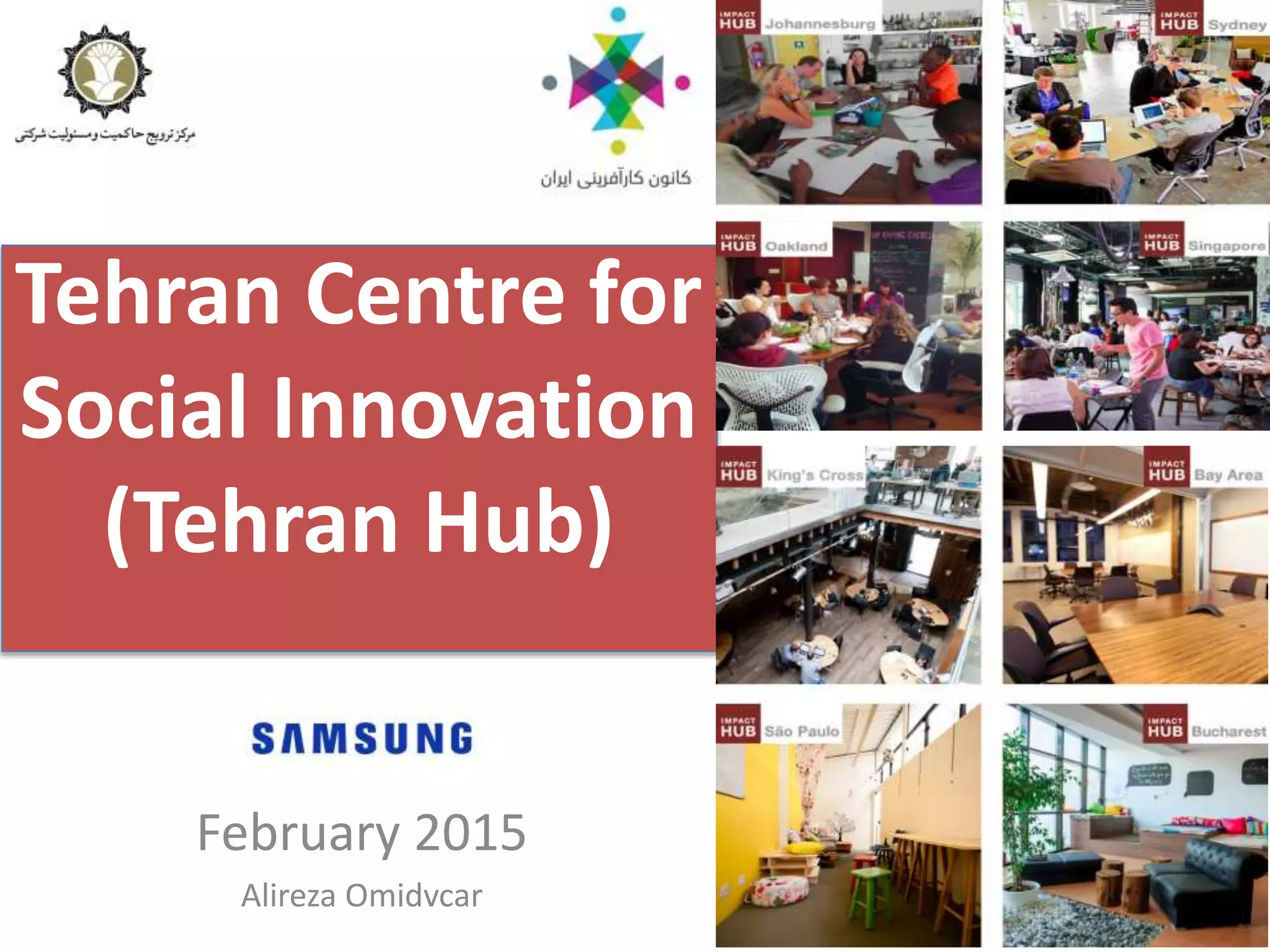
Tehran Centre for
Social Innovation
(Tehran Hub)
February 2015
Alireza Omidvcar
Table of content
• Presentation Objectives
• Current Situation
• What is Social Innovation?
• What is TCSI?
• How does TCSI work?
• What is needed from
partners?
• Examples
Part TwoPart One
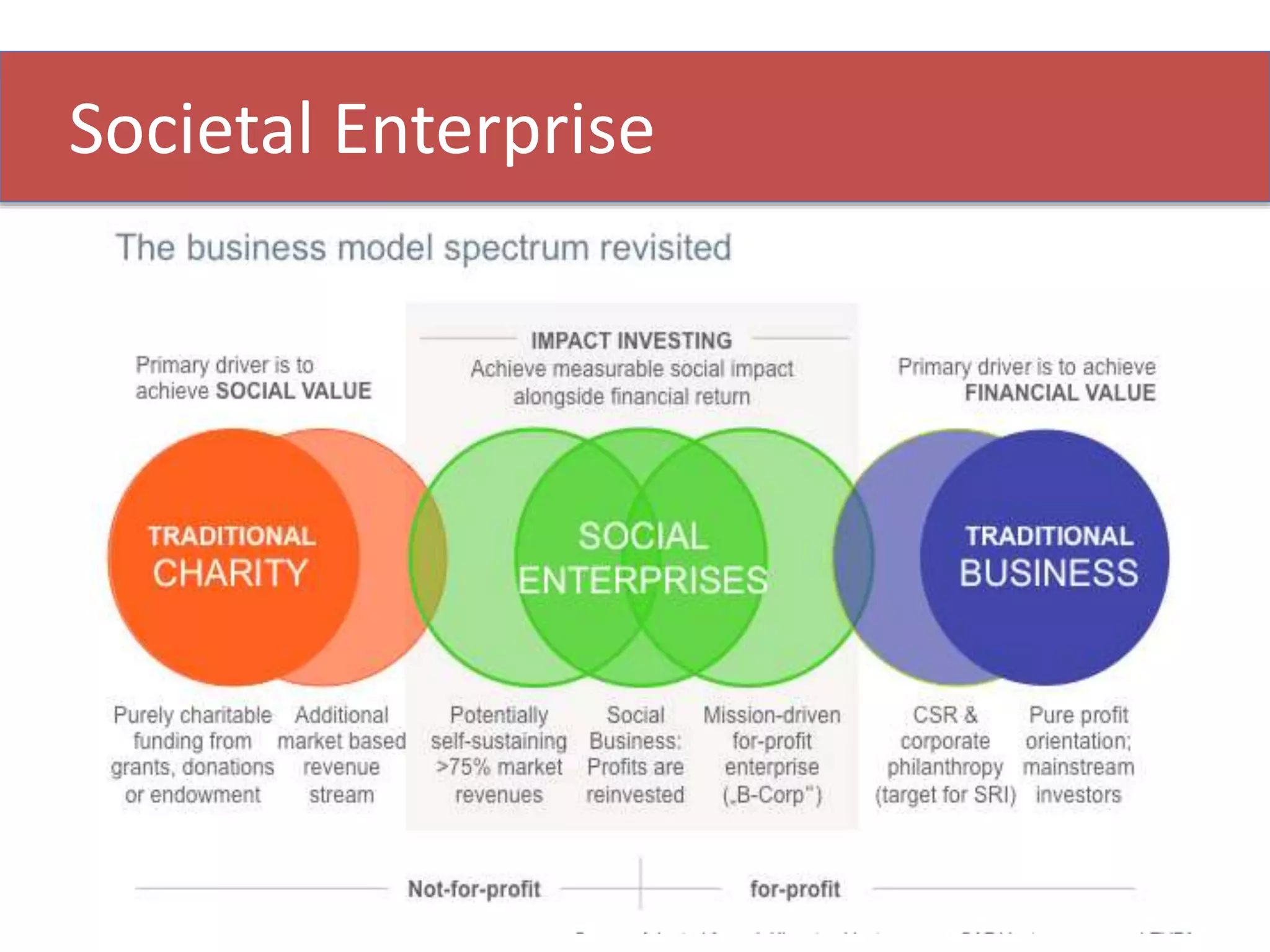
Societal Enterprise
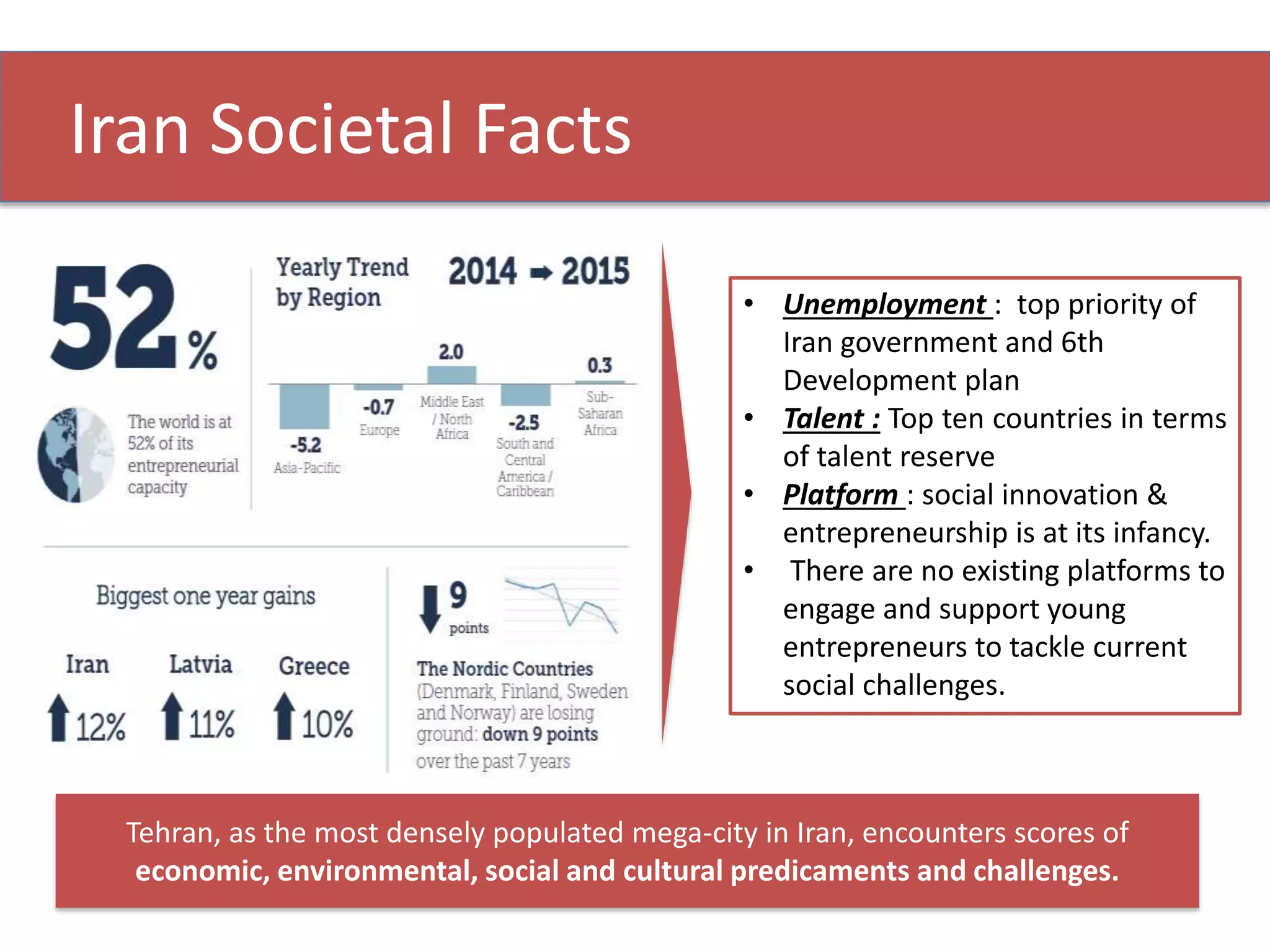
• Unemployment : top priority of
Iran government and 6th
Development plan
• Talent : Top ten countries in terms
of talent reserve
• Platform : social innovation &
entrepreneurship is at its infancy.
• There are no existing platforms to
engage and support young
entrepreneurs to tackle current
social challenges.
Iran Societal Facts
Tehran, as the most densely populated mega-city in Iran, encounters scores of
economic, environmental, social and cultural predicaments and challenges.
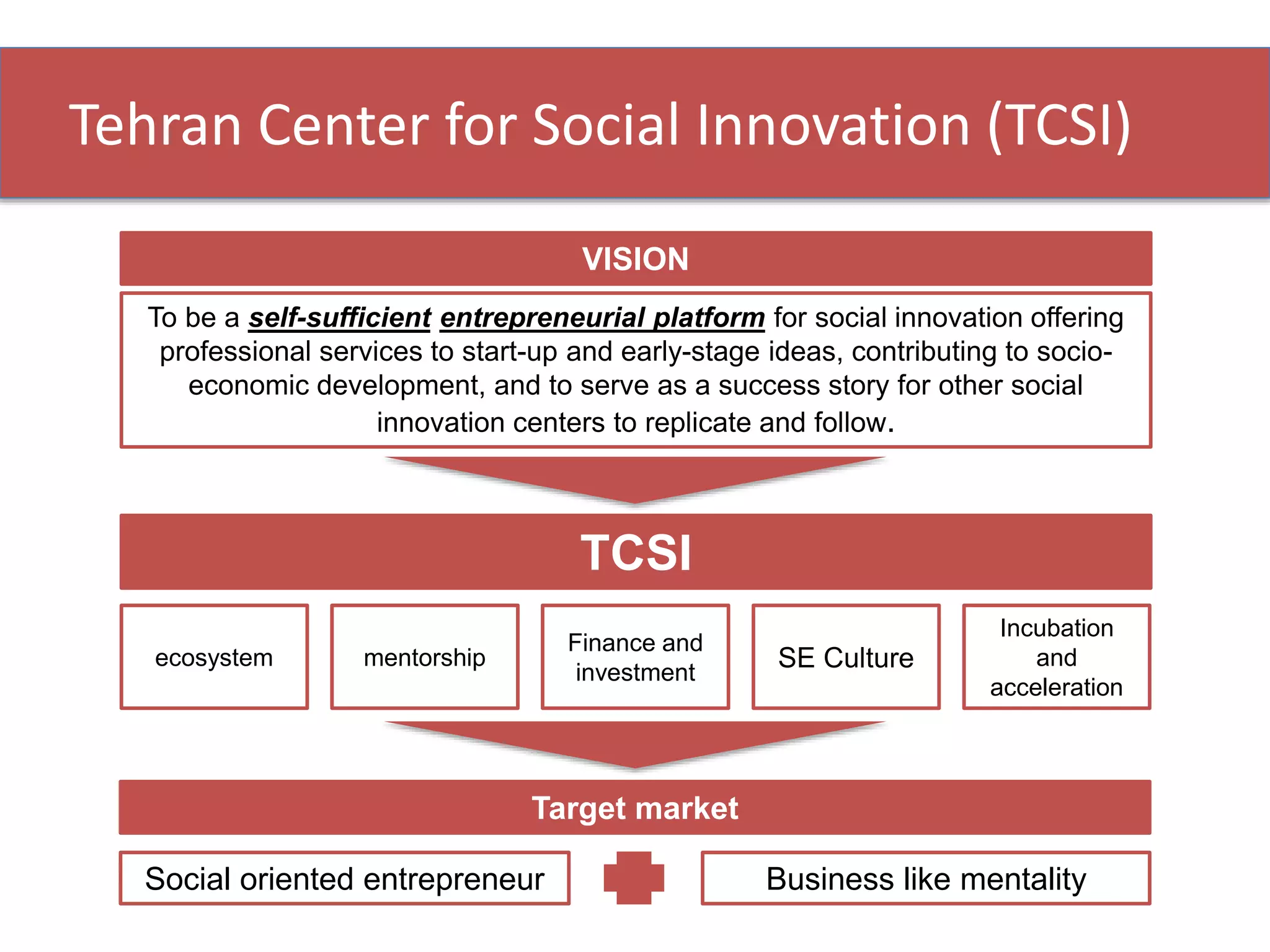
Tehran Center for Social Innovation (TCSI)
To be a self-sufficient entrepreneurial platform for social innovation offering
professional services to start-up and early-stage ideas, contributing to socio-
economic development, and to serve as a success story for other social
innovation centers to replicate and follow.
VISION
TCSI
ecosystem mentorship
Finance and
investment
Incubation
and
acceleration
SE Culture
Social oriented entrepreneur
Target market
Business like mentality
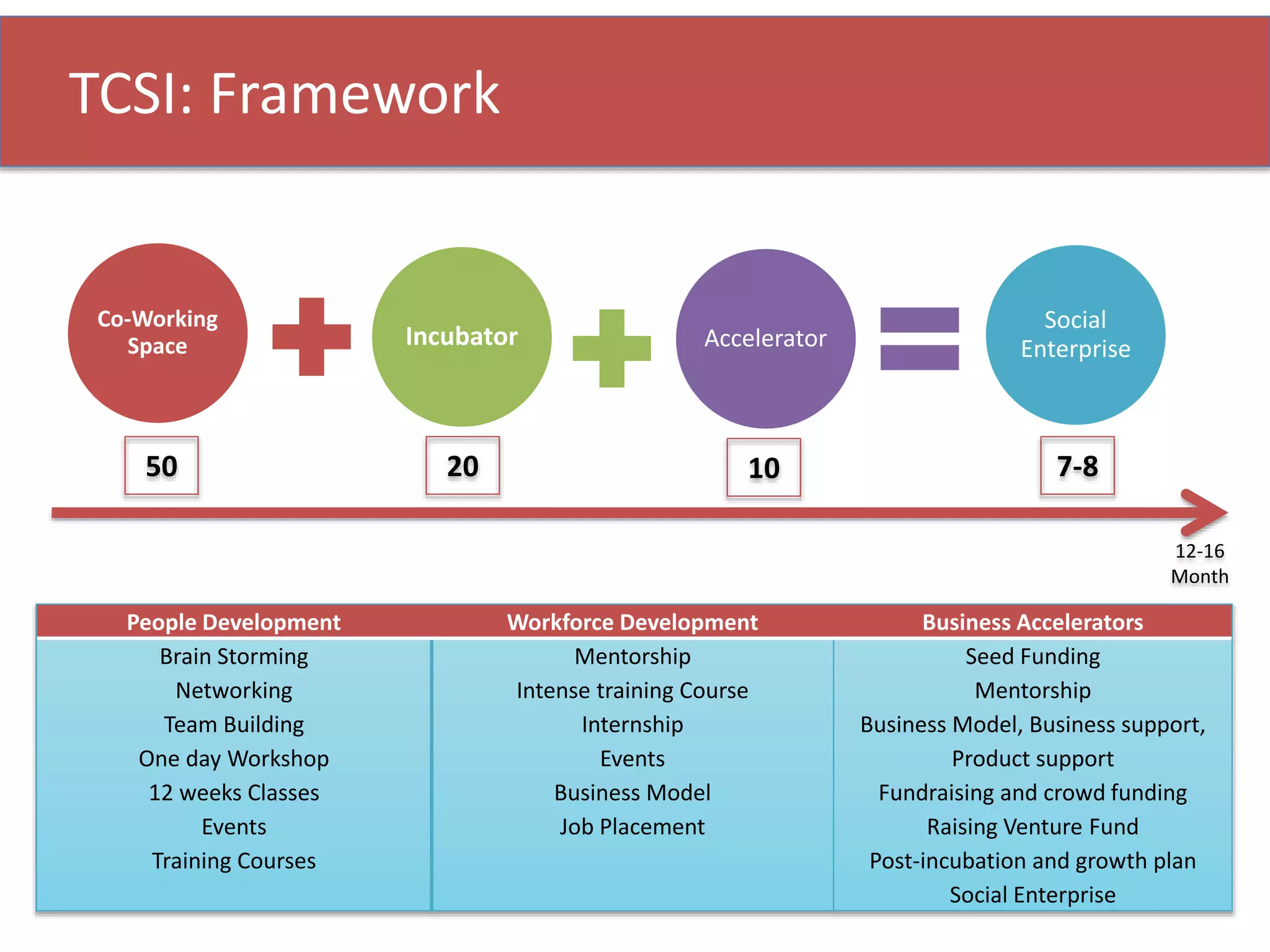
TCSI: Framework
Co-Working
Space Incubator Accelerator
Social
Enterprise
People Development Workforce Development Business Accelerators
Brain Storming
Networking
Team Building
One day Workshop
12 weeks Classes
Events
Training Courses
Mentorship
Intense training Course
Internship
Events
Business Model
Job Placement
Seed Funding
Mentorship
Business Model, Business support,
Product support
Fundraising and crowd funding
Raising Venture Fund
Post-incubation and growth plan
Social Enterprise
1020 7-850
12-16
Month
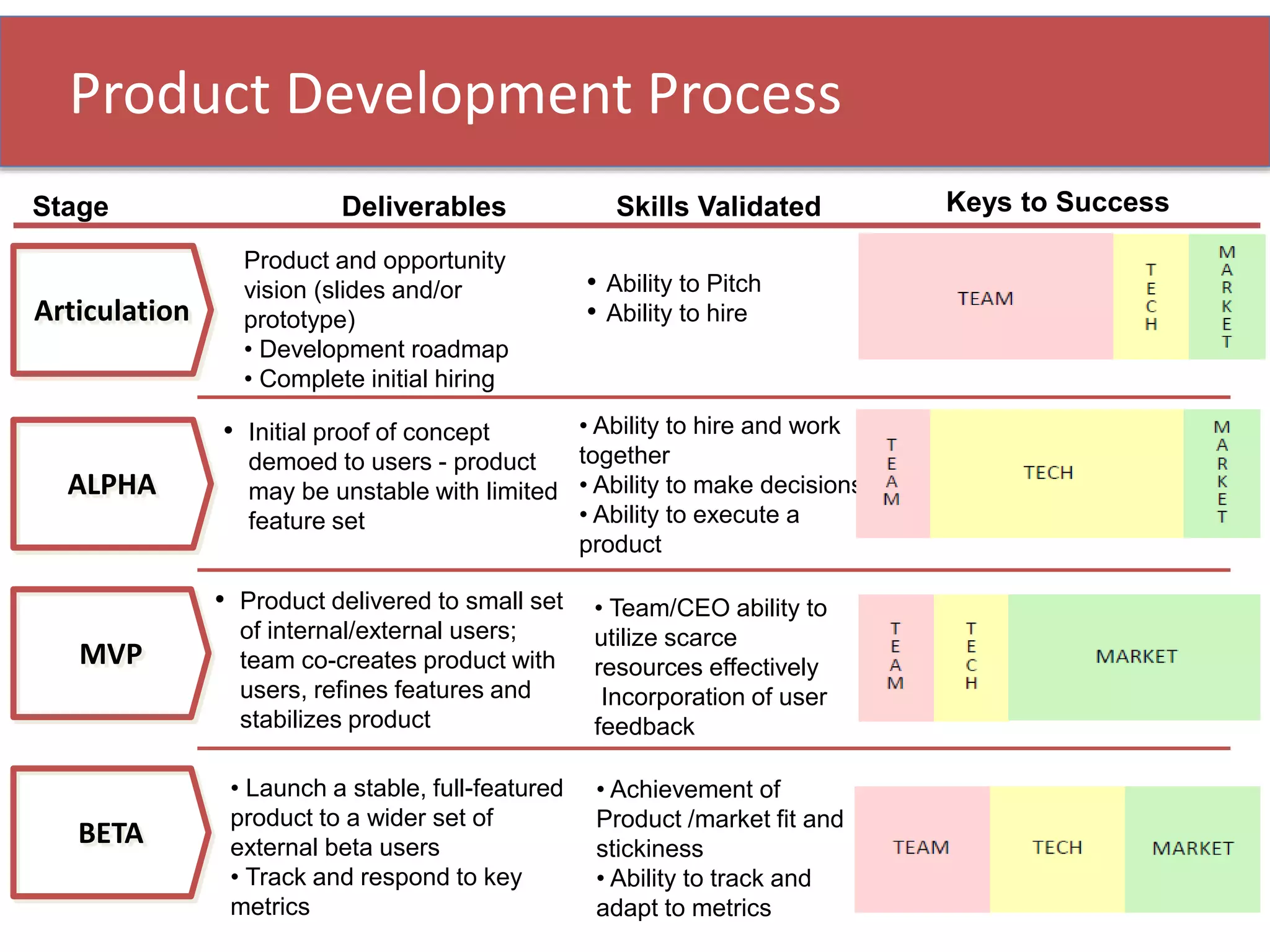
Articulation
Product and opportunity
vision (slides and/or
prototype)
• Development roadmap
• Complete initial hiring
ALPHA
• Initial proof of concept
demoed to users - product
may be unstable with limited
feature set
MVP
• Launch a stable, full-featured
product to a wider set of
external beta users
• Track and respond to key
metrics
Stage Deliverables Skills Validated Keys to Success
BETA
• Product delivered to small set
of internal/external users;
team co-creates product with
users, refines features and
stabilizes product
• Team/CEO ability to
utilize scarce
resources effectively
Incorporation of user
feedback
• Ability to hire and work
together
• Ability to make decisions
• Ability to execute a
product
• Ability to Pitch
• Ability to hire
• Achievement of
Product /market fit and
stickiness
• Ability to track and
adapt to metrics
Product Development Process
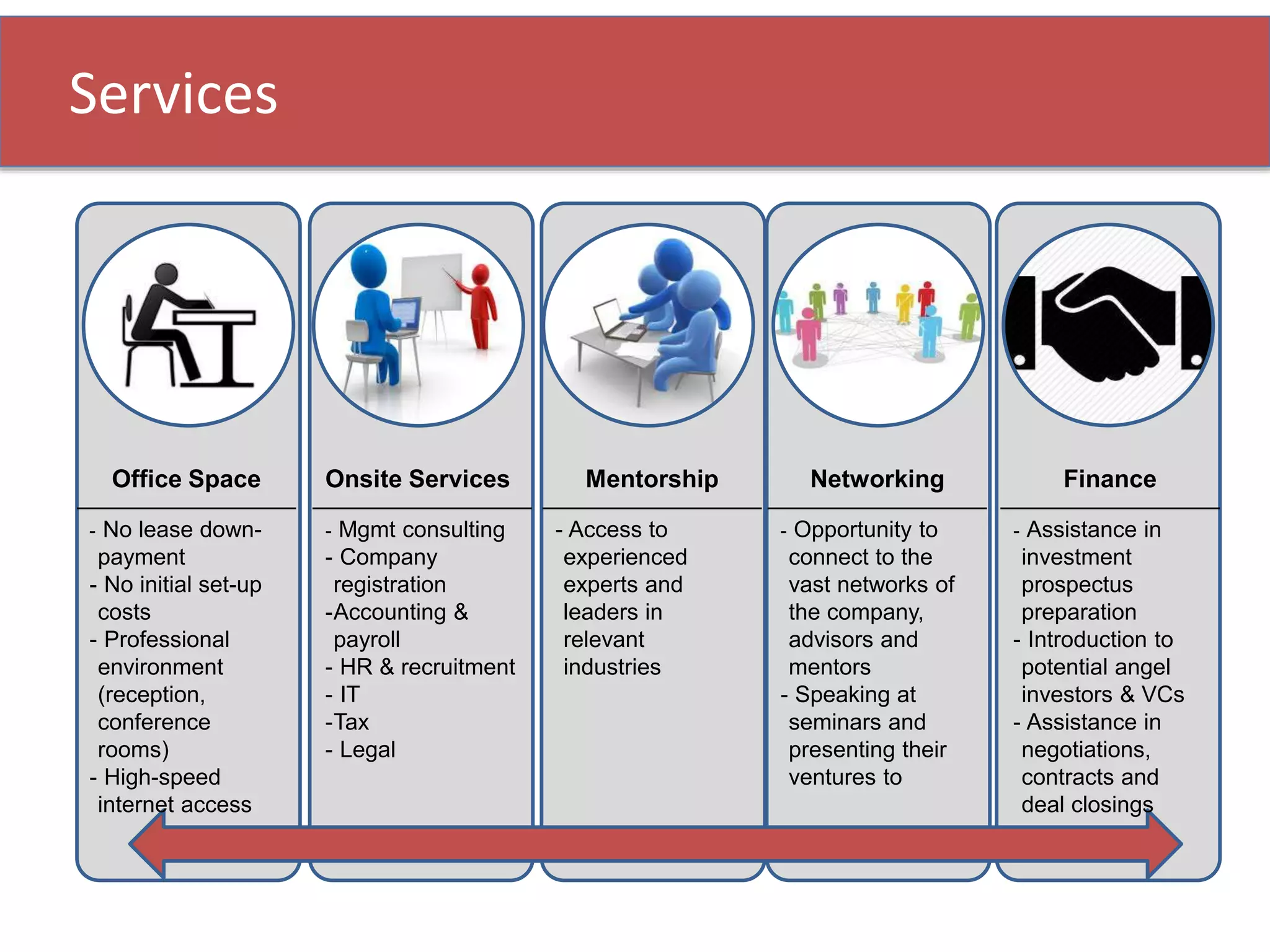
Onsite Services
- Mgmt consulting
- Company
registration
-Accounting &
payroll
- HR & recruitment
- IT
-Tax
- Legal
Office Space
- No lease down-
payment
- No initial set-up
costs
- Professional
environment
(reception,
conference
rooms)
- High-speed
internet access
Mentorship
- Access to
experienced
experts and
leaders in
relevant
industries
Networking
- Opportunity to
connect to the
vast networks of
the company,
advisors and
mentors
- Speaking at
seminars and
presenting their
ventures to
Finance
- Assistance in
investment
prospectus
preparation
- Introduction to
potential angel
investors & VCs
- Assistance in
negotiations,
contracts and
deal closings
Services
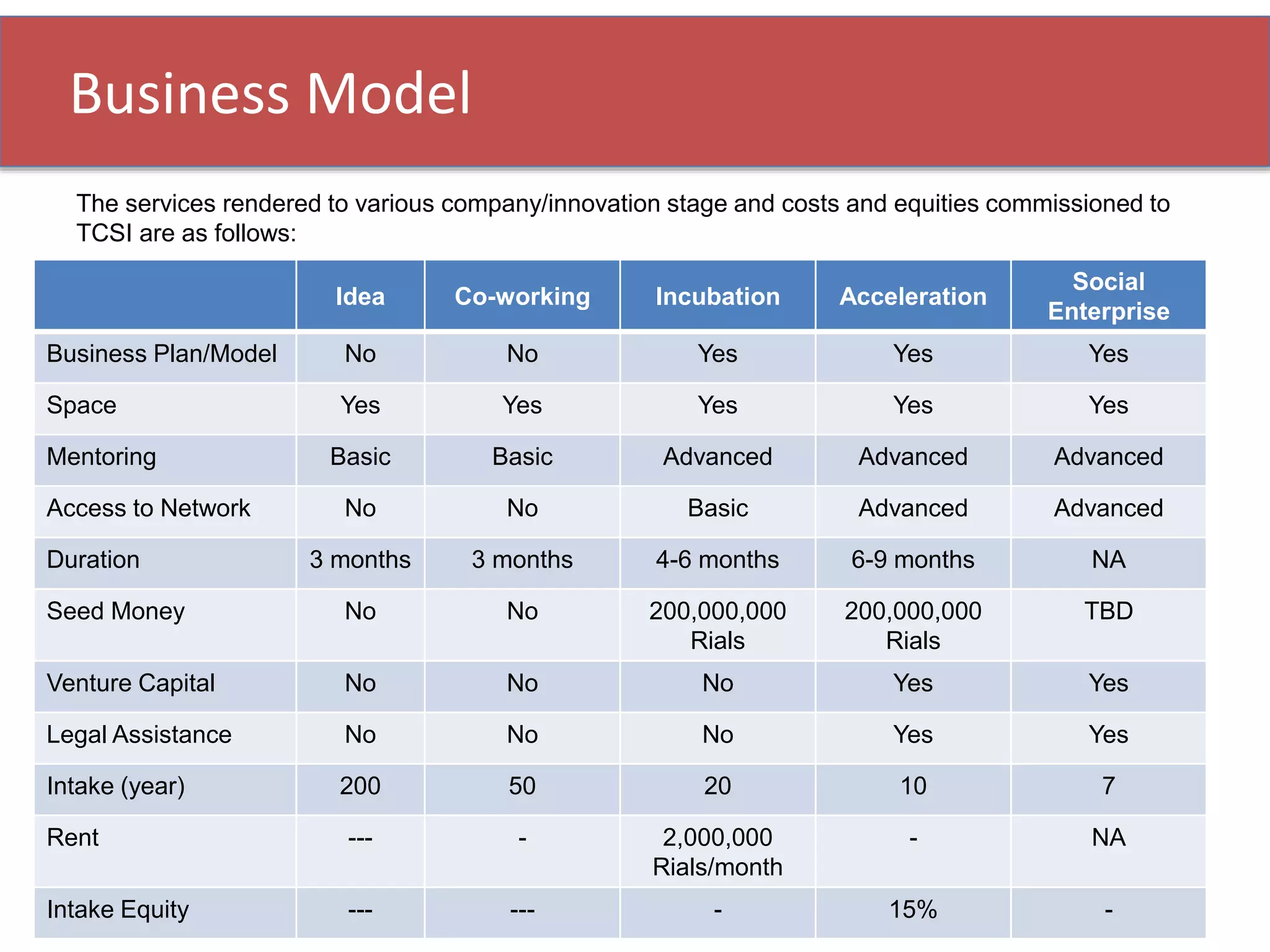
The services rendered to various company/innovation stage and costs and equities commissioned to
TCSI are as follows:
Idea Co-working Incubation Acceleration
Social
Enterprise
Business Plan/Model No No Yes Yes Yes
Space Yes Yes Yes Yes Yes
Mentoring Basic Basic Advanced Advanced Advanced
Access to Network No No Basic Advanced Advanced
Duration 3 months 3 months 4-6 months 6-9 months NA
Seed Money No No 200,000,000
Rials
200,000,000
Rials
TBD
Venture Capital No No No Yes Yes
Legal Assistance No No No Yes Yes
Intake (year) 200 50 20 10 7
Rent --- - 2,000,000
Rials/month
- NA
Intake Equity --- --- - 15% -
Business Model
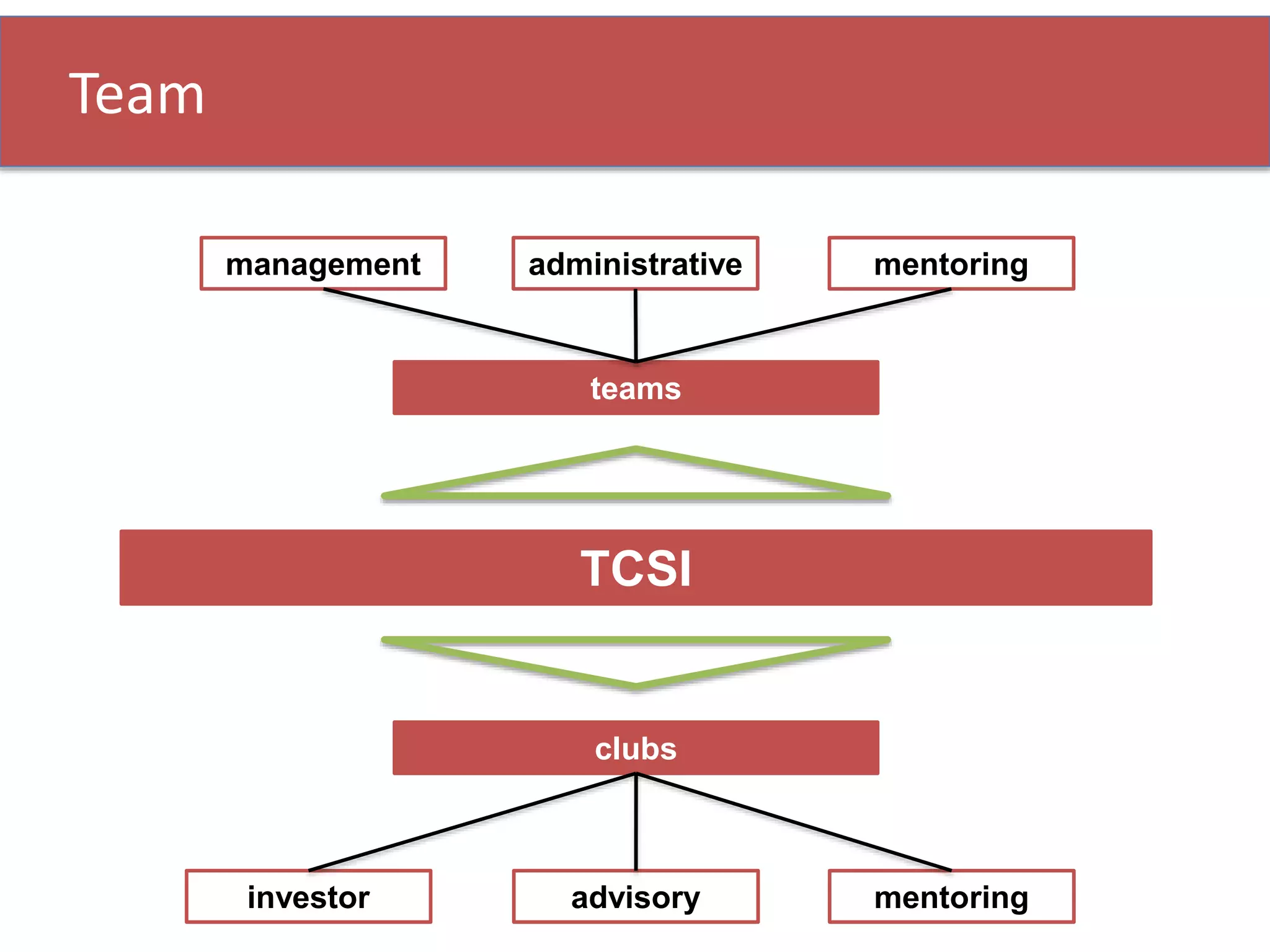
Team
teams
TCSI
clubs
management administrative mentoring
investor advisory mentoring
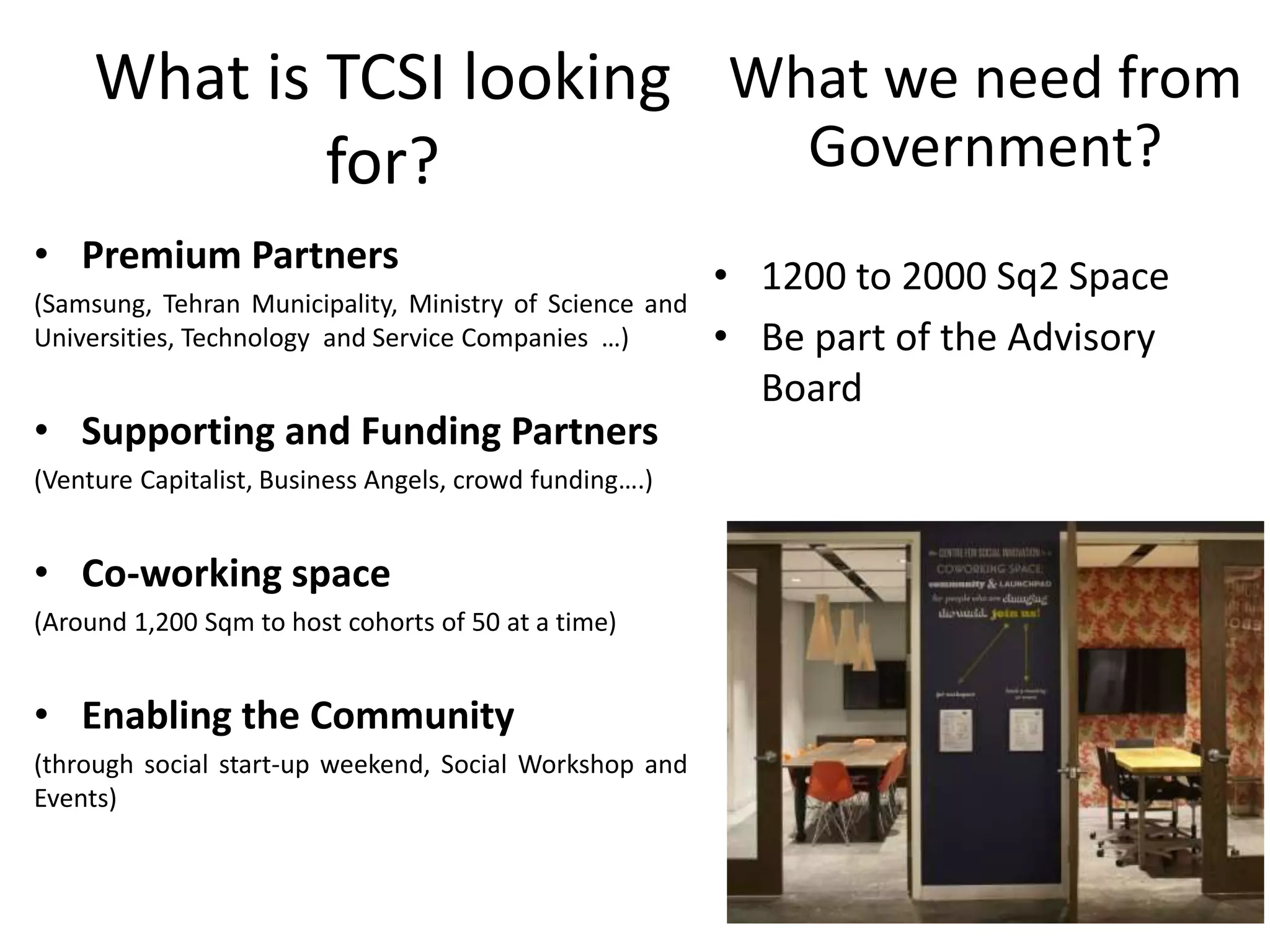
What is TCSI looking
for?
• Premium Partners
(Samsung, Tehran Municipality, Ministry of Science and
Universities, Technology and Service Companies …)
• Supporting and Funding Partners
(Venture Capitalist, Business Angels, crowd funding….)
• Co-working space
(Around 1,200 Sqm to host cohorts of 50 at a time)
• Enabling the Community
(through social start-up weekend, Social Workshop and
Events)
What we need from
Government?
• 1200 to 2000 Sq2 Space
• Be part of the Advisory
Board
Marketing
- Targeted marketing and advertising in venues and publications such as “Tadbir”
- Strong social media presence
Events
- Organizing events and seminars to promote and encourage social entrepreneurship
- Shark Tank panel for entrepreneurs to showcase their ideas in front of prospective investors
Workshops
- Inviting first rate organizations in social innovation to share their experience and progress with:
- Idea and business holders
- Policy –making authorities
- Financial Institutions and Investment clubs
- Government organizations
International Cooperation
- Cooperation and collaboration with international institutions such as Center for Social Enterprises,
Lab Brilliant and Impact Hub
Lab Events
- To dissect various social dilemmas and to brainstorm on how to make a sustainable business
while fighting them
Community Enablers
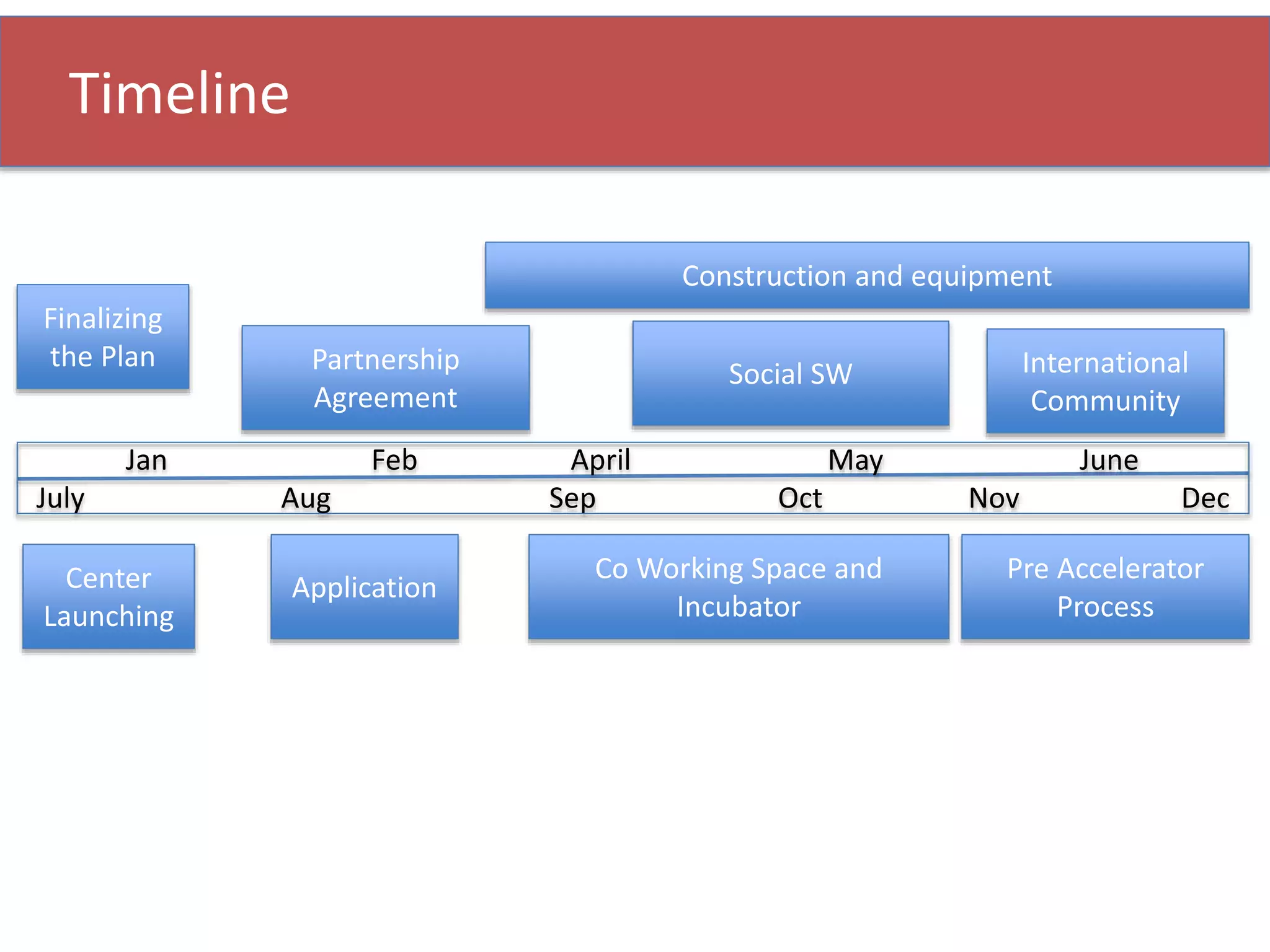
Finalizing
the Plan
Center
Launching
Co Working Space and
Incubator
Social SW International
Community
Pre Accelerator
Process
Construction and equipment
Partnership
Agreement
Application
Jan Feb April May June
July Aug Sep Oct Nov Dec
Timeline
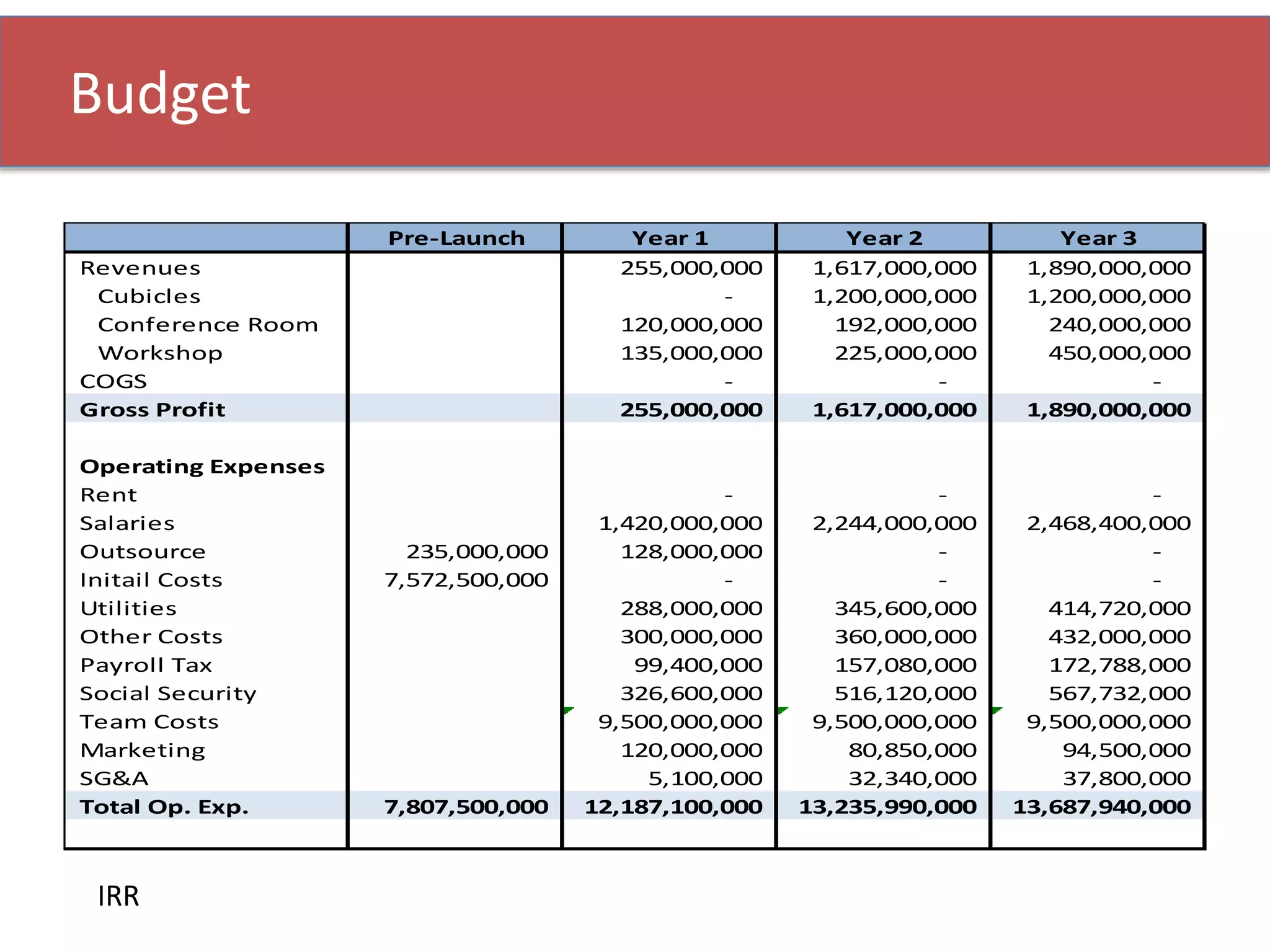
Pre-Launch Year 1 Year 2 Year 3
Revenues 255,000,000 1,617,000,000 1,890,000,000
Cubicles - 1,200,000,000 1,200,000,000
Conference Room 120,000,000 192,000,000 240,000,000
Workshop 135,000,000 225,000,000 450,000,000
COGS - - -
Gross Profit 255,000,000 1,617,000,000 1,890,000,000
Operating Expenses
Rent - - -
Salaries 1,420,000,000 2,244,000,000 2,468,400,000
Outsource 235,000,000 128,000,000 - -
Initail Costs 7,572,500,000 - - -
Utilities 288,000,000 345,600,000 414,720,000
Other Costs 300,000,000 360,000,000 432,000,000
Payroll Tax 99,400,000 157,080,000 172,788,000
Social Security 326,600,000 516,120,000 567,732,000
Team Costs 9,500,000,000 9,500,000,000 9,500,000,000
Marketing 120,000,000 80,850,000 94,500,000
SG&A 5,100,000 32,340,000 37,800,000
Total Op. Exp. 7,807,500,000 12,187,100,000 13,235,990,000 13,687,940,000
IRR
Budget
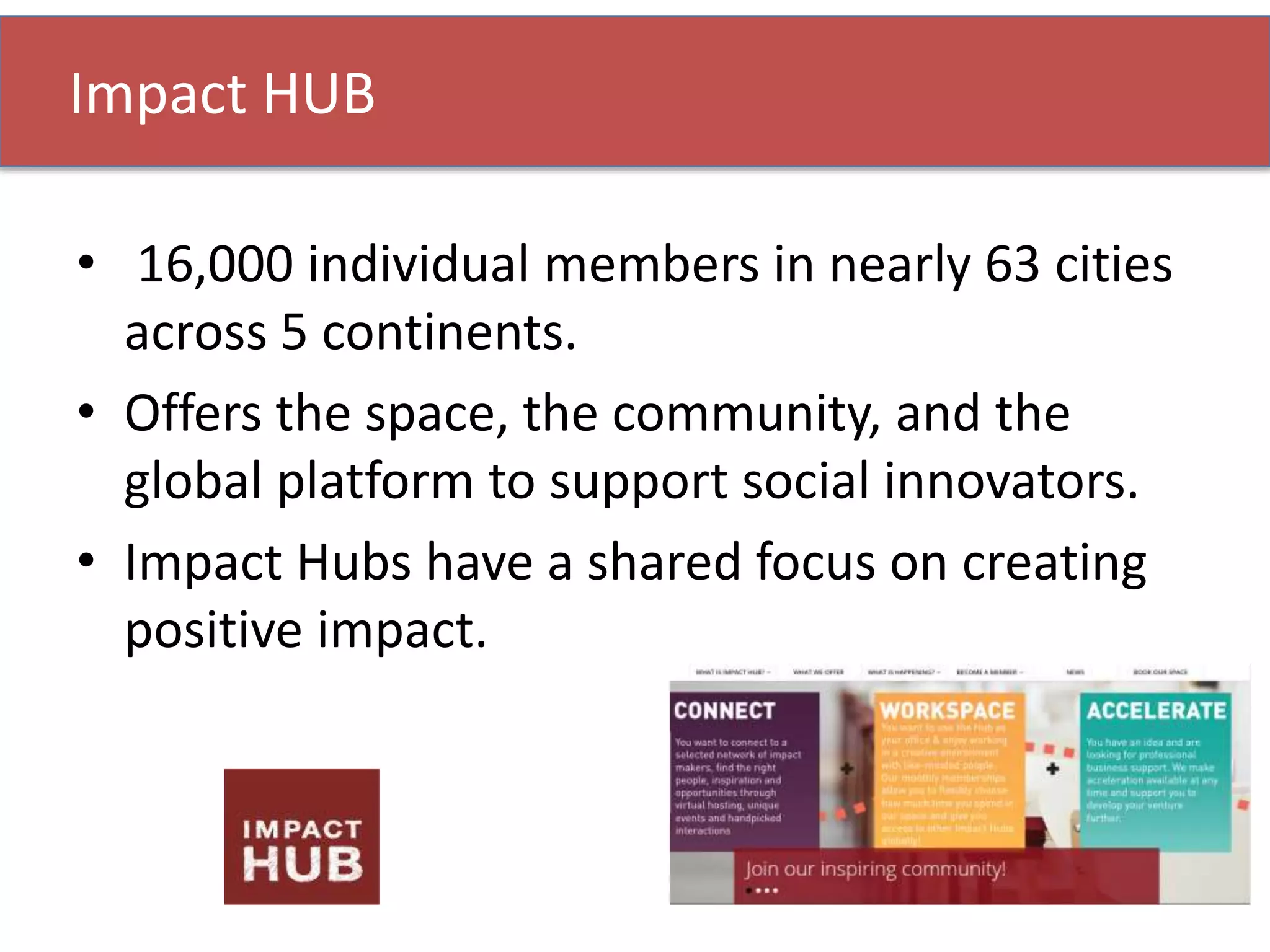
• 16,000 individual members in nearly 63 cities
across 5 continents.
• Offers the space, the community, and the
global platform to support social innovators.
• Impact Hubs have a shared focus on creating
positive impact.
Impact HUB
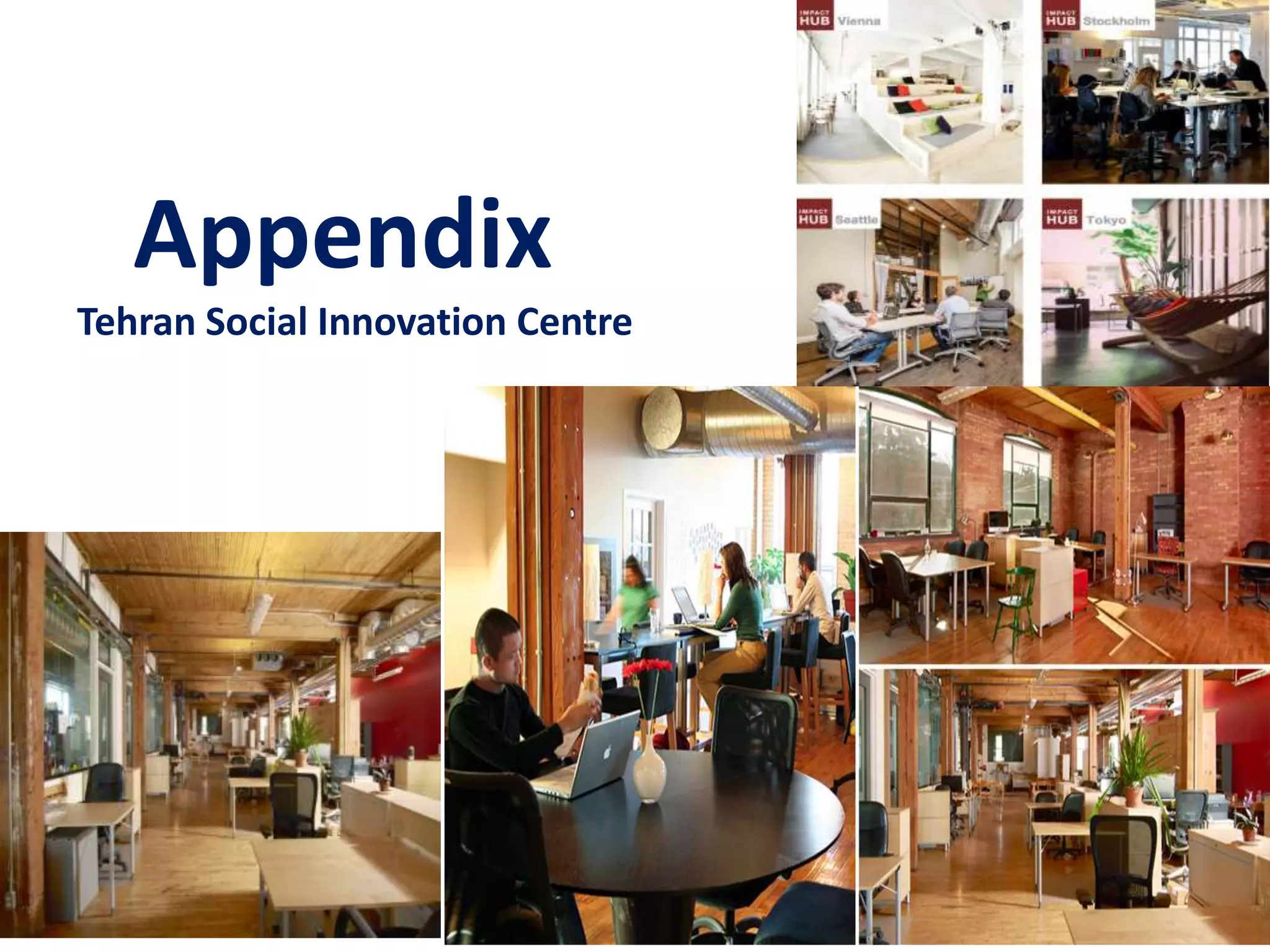
Appendix
Tehran Social Innovation Centre
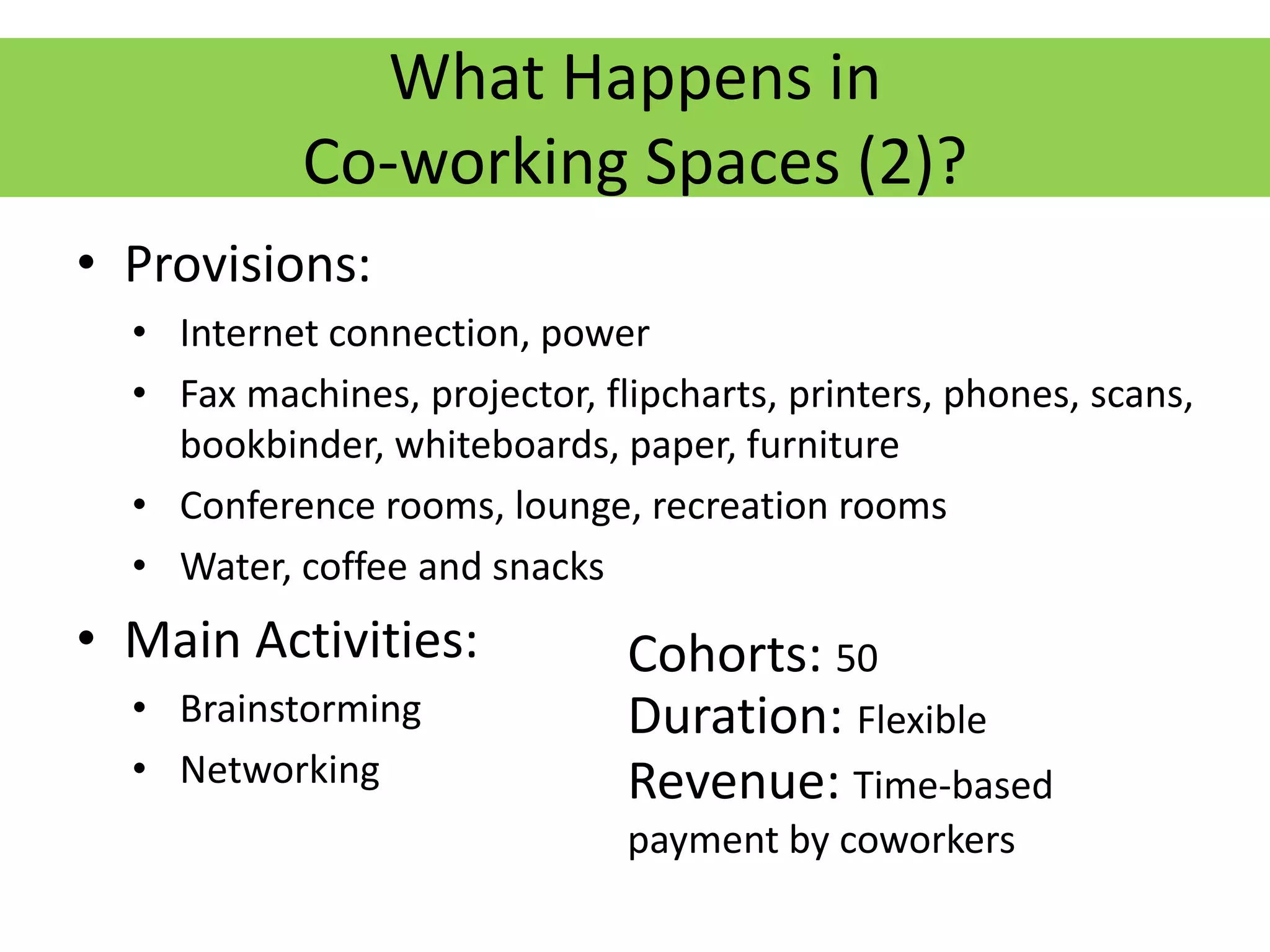
What Happens in
Co-working Spaces (2)?
• Provisions:
• Internet connection, power
• Fax machines, projector, flipcharts, printers, phones, scans,
bookbinder, whiteboards, paper, furniture
• Conference rooms, lounge, recreation rooms
• Water, coffee and snacks
• Main Activities:
• Brainstorming
• Networking
Cohorts: 50
Duration: Flexible
Revenue: Time-based
payment by coworkers
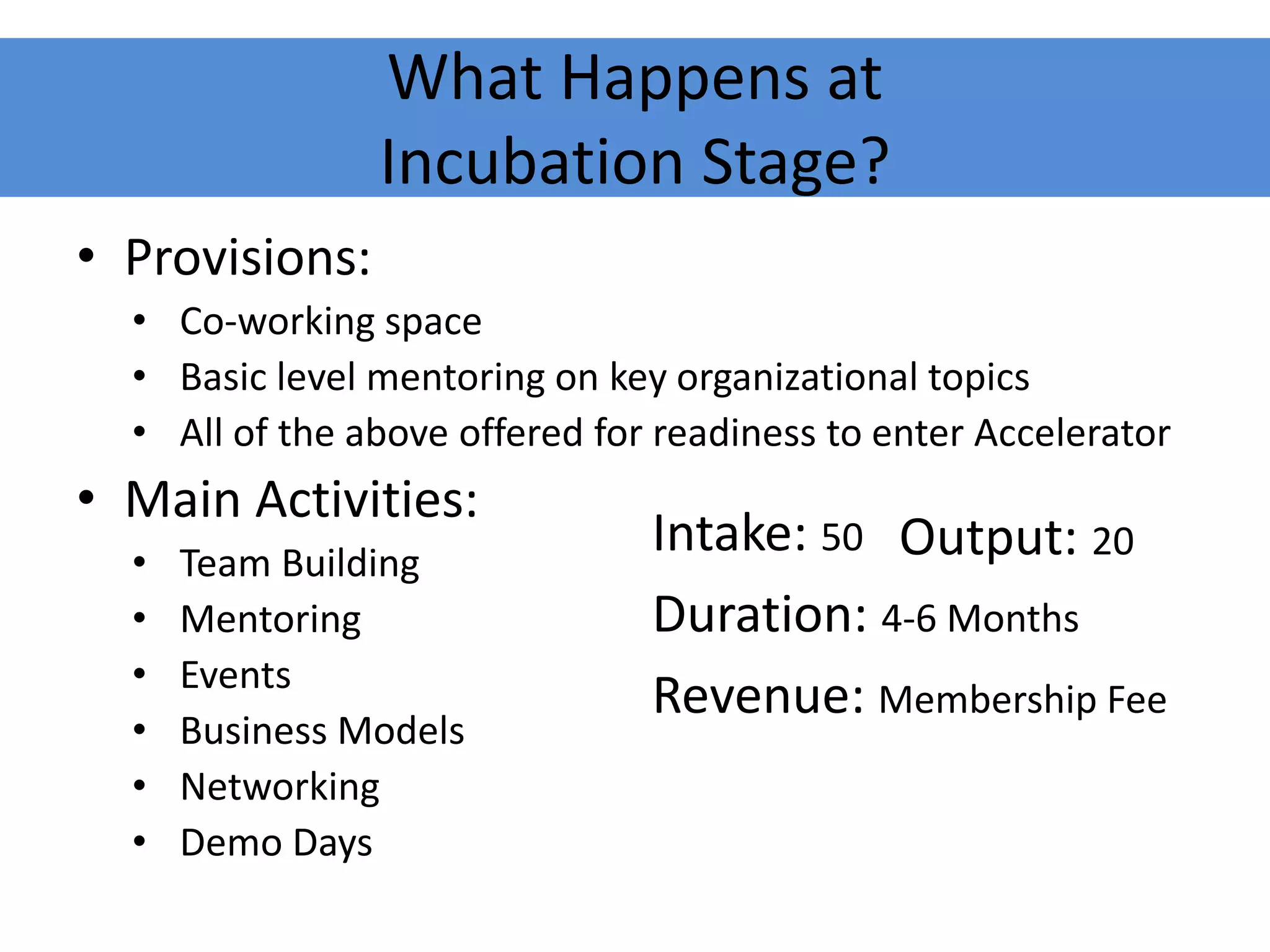
What Happens at
Incubation Stage?
• Provisions:
• Co-working space
• Basic level mentoring on key organizational topics
• All of the above offered for readiness to enter Accelerator
• Main Activities:
• Team Building
• Mentoring
• Events
• Business Models
• Networking
• Demo Days
Intake: 50
Duration: 4-6 Months
Revenue: Membership Fee
Output: 20
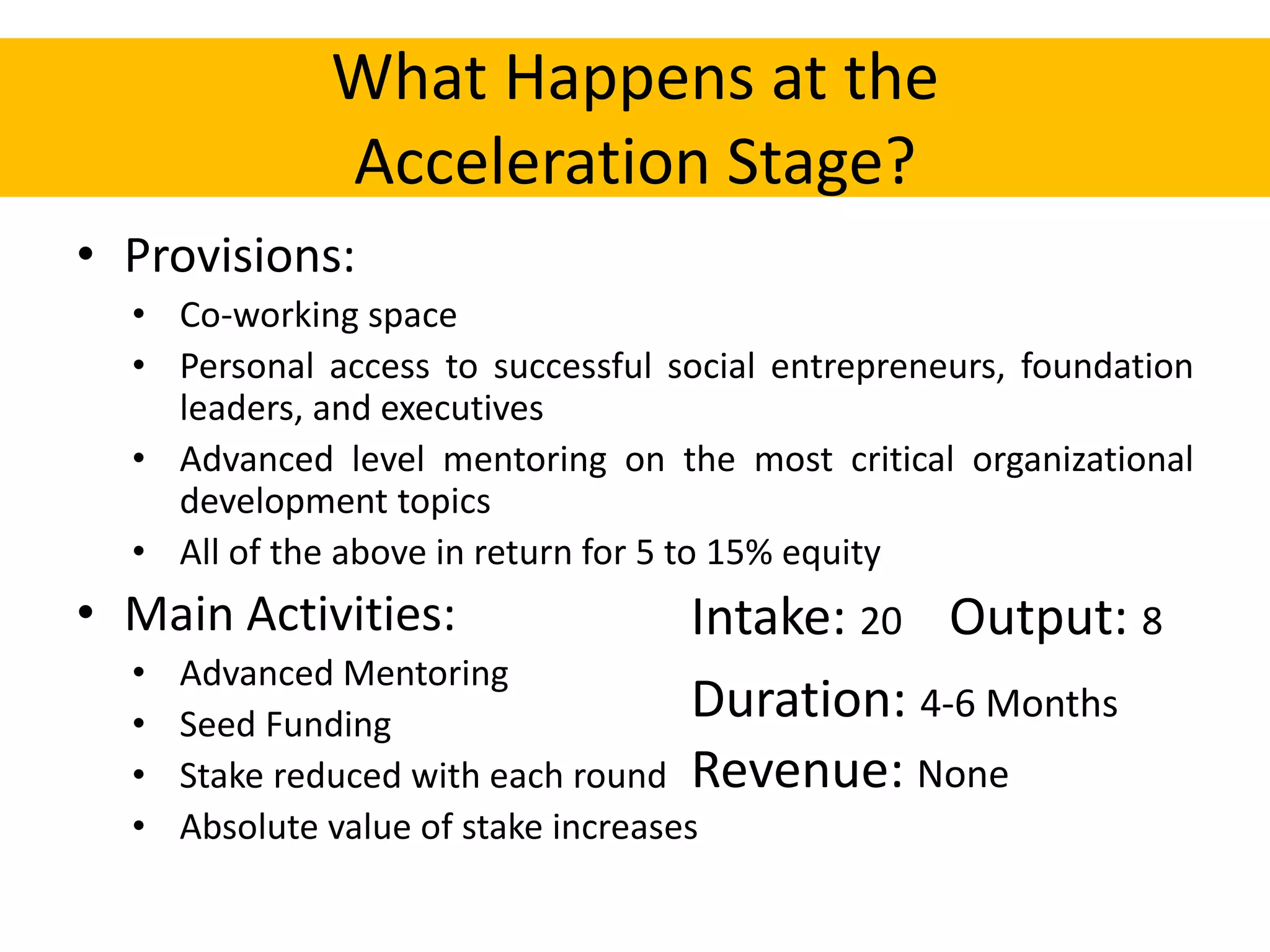
What Happens at the
Acceleration Stage?
• Provisions:
• Co-working space
• Personal access to successful social entrepreneurs, foundation
leaders, and executives
• Advanced level mentoring on the most critical organizational
development topics
• All of the above in return for 5 to 15% equity
• Main Activities:
• Advanced Mentoring
• Seed Funding
• Stake reduced with each round
• Absolute value of stake increases
Intake: 20 Output: 8
Duration: 4-6 Months
Revenue: None
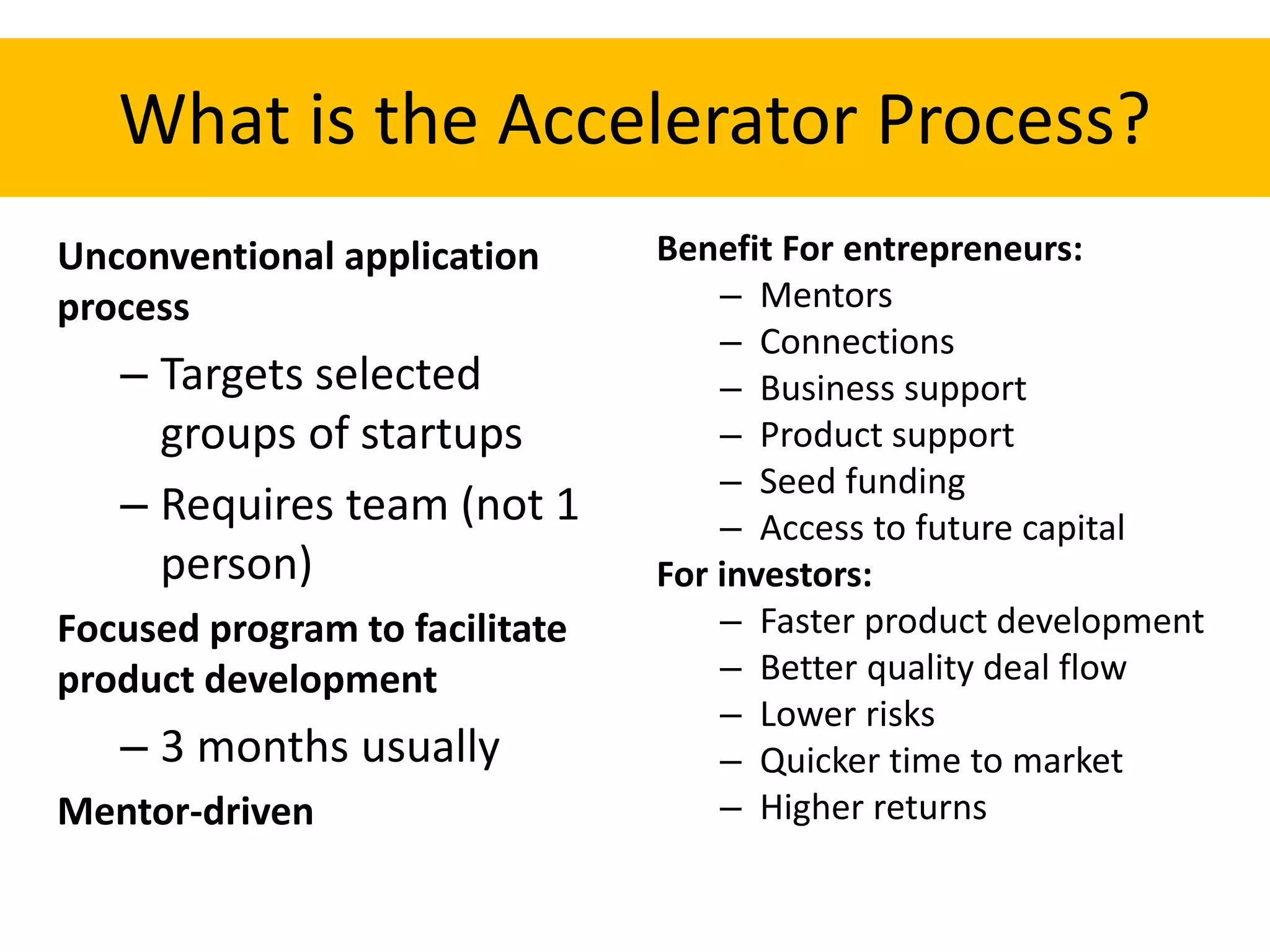
What is the Accelerator Process?
Unconventional application
process
– Targets selected
groups of startups
– Requires team (not 1
person)
Focused program to facilitate
product development
– 3 months usually
Mentor-driven
Benefit For entrepreneurs:
– Mentors
– Connections
– Business support
– Product support
– Seed funding
– Access to future capital
For investors:
– Faster product development
– Better quality deal flow
– Lower risks
– Quicker time to market
– Higher returns
Legal Concept of Social Enterprise
Legal concept of a social enterprise (Article 2 of the Law
on the Promotion of Social Enterprises)
• A company which does business activities of producing
and selling products and services while pursuing such
social purposes as providing vulnerable social groups
with social services or jobs to improve the quality of
life of the local residents.
• A company which reinvests profits in the business or
the local community putting priority on pursuing social
purposes rather than on maximizing profits for
shareholders or owner of the company.
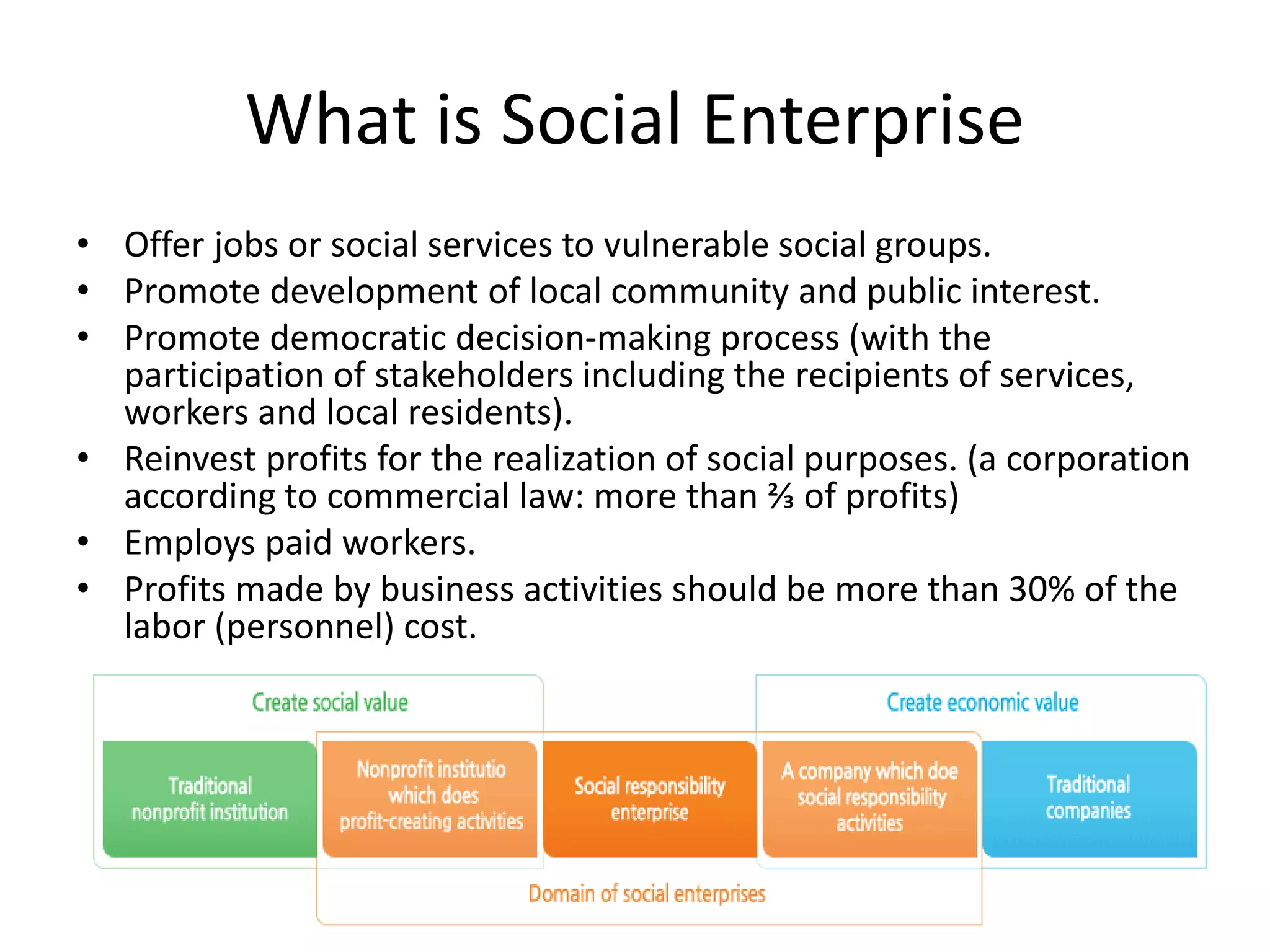
What is Social Enterprise
• Offer jobs or social services to vulnerable social groups.
• Promote development of local community and public interest.
• Promote democratic decision-making process (with the
participation of stakeholders including the recipients of services,
workers and local residents).
• Reinvest profits for the realization of social purposes. (a corporation
according to commercial law: more than ⅔ of profits)
• Employs paid workers.
• Profits made by business activities should be more than 30% of the
labor (personnel) cost.
Types of social enterprise
Social enterprises are classified into 5 types in Korea according to their
social purposes.
• 1. Job-creation Type: The main purpose of the enterprise is to offer
jobs to vulnerable social groups.
• 2. Social Service Provision Type: The main purpose of the enterprise
is to provide vulnerable social groups with social services.
• 3. Mixed Type: Job-creation Type + Social Service Provision Type
• 4. Other Types: A social enterprise of which realization of social
purposes is difficult to judge on the basis of the ratio of
employment or provision of social service.
• 5. Local Community Contribution Type: An enterprise which
contribute to the improvement in the quality of life of the local
community. (newly defined in 2011)
Thank You

Tcsi presentation january 10th 2015 v4

  • 1.
    Tehran Centre for SocialInnovation (Tehran Hub) February 2015 Alireza Omidvcar
  • 2.
    Table of content •Presentation Objectives • Current Situation • What is Social Innovation? • What is TCSI? • How does TCSI work? • What is needed from partners? • Examples Part TwoPart One
  • 3.
  • 4.
    • Unemployment :top priority of Iran government and 6th Development plan • Talent : Top ten countries in terms of talent reserve • Platform : social innovation & entrepreneurship is at its infancy. • There are no existing platforms to engage and support young entrepreneurs to tackle current social challenges. Iran Societal Facts Tehran, as the most densely populated mega-city in Iran, encounters scores of economic, environmental, social and cultural predicaments and challenges.
  • 5.
    Tehran Center forSocial Innovation (TCSI) To be a self-sufficient entrepreneurial platform for social innovation offering professional services to start-up and early-stage ideas, contributing to socio- economic development, and to serve as a success story for other social innovation centers to replicate and follow. VISION TCSI ecosystem mentorship Finance and investment Incubation and acceleration SE Culture Social oriented entrepreneur Target market Business like mentality
  • 6.
    TCSI: Framework Co-Working Space IncubatorAccelerator Social Enterprise People Development Workforce Development Business Accelerators Brain Storming Networking Team Building One day Workshop 12 weeks Classes Events Training Courses Mentorship Intense training Course Internship Events Business Model Job Placement Seed Funding Mentorship Business Model, Business support, Product support Fundraising and crowd funding Raising Venture Fund Post-incubation and growth plan Social Enterprise 1020 7-850 12-16 Month
  • 7.
    Articulation Product and opportunity vision(slides and/or prototype) • Development roadmap • Complete initial hiring ALPHA • Initial proof of concept demoed to users - product may be unstable with limited feature set MVP • Launch a stable, full-featured product to a wider set of external beta users • Track and respond to key metrics Stage Deliverables Skills Validated Keys to Success BETA • Product delivered to small set of internal/external users; team co-creates product with users, refines features and stabilizes product • Team/CEO ability to utilize scarce resources effectively Incorporation of user feedback • Ability to hire and work together • Ability to make decisions • Ability to execute a product • Ability to Pitch • Ability to hire • Achievement of Product /market fit and stickiness • Ability to track and adapt to metrics Product Development Process
  • 8.
    Onsite Services - Mgmtconsulting - Company registration -Accounting & payroll - HR & recruitment - IT -Tax - Legal Office Space - No lease down- payment - No initial set-up costs - Professional environment (reception, conference rooms) - High-speed internet access Mentorship - Access to experienced experts and leaders in relevant industries Networking - Opportunity to connect to the vast networks of the company, advisors and mentors - Speaking at seminars and presenting their ventures to Finance - Assistance in investment prospectus preparation - Introduction to potential angel investors & VCs - Assistance in negotiations, contracts and deal closings Services
  • 9.
    The services renderedto various company/innovation stage and costs and equities commissioned to TCSI are as follows: Idea Co-working Incubation Acceleration Social Enterprise Business Plan/Model No No Yes Yes Yes Space Yes Yes Yes Yes Yes Mentoring Basic Basic Advanced Advanced Advanced Access to Network No No Basic Advanced Advanced Duration 3 months 3 months 4-6 months 6-9 months NA Seed Money No No 200,000,000 Rials 200,000,000 Rials TBD Venture Capital No No No Yes Yes Legal Assistance No No No Yes Yes Intake (year) 200 50 20 10 7 Rent --- - 2,000,000 Rials/month - NA Intake Equity --- --- - 15% - Business Model
  • 10.
  • 11.
    What is TCSIlooking for? • Premium Partners (Samsung, Tehran Municipality, Ministry of Science and Universities, Technology and Service Companies …) • Supporting and Funding Partners (Venture Capitalist, Business Angels, crowd funding….) • Co-working space (Around 1,200 Sqm to host cohorts of 50 at a time) • Enabling the Community (through social start-up weekend, Social Workshop and Events) What we need from Government? • 1200 to 2000 Sq2 Space • Be part of the Advisory Board
  • 12.
    Marketing - Targeted marketingand advertising in venues and publications such as “Tadbir” - Strong social media presence Events - Organizing events and seminars to promote and encourage social entrepreneurship - Shark Tank panel for entrepreneurs to showcase their ideas in front of prospective investors Workshops - Inviting first rate organizations in social innovation to share their experience and progress with: - Idea and business holders - Policy –making authorities - Financial Institutions and Investment clubs - Government organizations International Cooperation - Cooperation and collaboration with international institutions such as Center for Social Enterprises, Lab Brilliant and Impact Hub Lab Events - To dissect various social dilemmas and to brainstorm on how to make a sustainable business while fighting them Community Enablers
  • 13.
    Finalizing the Plan Center Launching Co WorkingSpace and Incubator Social SW International Community Pre Accelerator Process Construction and equipment Partnership Agreement Application Jan Feb April May June July Aug Sep Oct Nov Dec Timeline
  • 14.
    Pre-Launch Year 1Year 2 Year 3 Revenues 255,000,000 1,617,000,000 1,890,000,000 Cubicles - 1,200,000,000 1,200,000,000 Conference Room 120,000,000 192,000,000 240,000,000 Workshop 135,000,000 225,000,000 450,000,000 COGS - - - Gross Profit 255,000,000 1,617,000,000 1,890,000,000 Operating Expenses Rent - - - Salaries 1,420,000,000 2,244,000,000 2,468,400,000 Outsource 235,000,000 128,000,000 - - Initail Costs 7,572,500,000 - - - Utilities 288,000,000 345,600,000 414,720,000 Other Costs 300,000,000 360,000,000 432,000,000 Payroll Tax 99,400,000 157,080,000 172,788,000 Social Security 326,600,000 516,120,000 567,732,000 Team Costs 9,500,000,000 9,500,000,000 9,500,000,000 Marketing 120,000,000 80,850,000 94,500,000 SG&A 5,100,000 32,340,000 37,800,000 Total Op. Exp. 7,807,500,000 12,187,100,000 13,235,990,000 13,687,940,000 IRR Budget
  • 15.
    • 16,000 individualmembers in nearly 63 cities across 5 continents. • Offers the space, the community, and the global platform to support social innovators. • Impact Hubs have a shared focus on creating positive impact. Impact HUB
  • 16.
  • 17.
    What Happens in Co-workingSpaces (2)? • Provisions: • Internet connection, power • Fax machines, projector, flipcharts, printers, phones, scans, bookbinder, whiteboards, paper, furniture • Conference rooms, lounge, recreation rooms • Water, coffee and snacks • Main Activities: • Brainstorming • Networking Cohorts: 50 Duration: Flexible Revenue: Time-based payment by coworkers
  • 18.
    What Happens at IncubationStage? • Provisions: • Co-working space • Basic level mentoring on key organizational topics • All of the above offered for readiness to enter Accelerator • Main Activities: • Team Building • Mentoring • Events • Business Models • Networking • Demo Days Intake: 50 Duration: 4-6 Months Revenue: Membership Fee Output: 20
  • 19.
    What Happens atthe Acceleration Stage? • Provisions: • Co-working space • Personal access to successful social entrepreneurs, foundation leaders, and executives • Advanced level mentoring on the most critical organizational development topics • All of the above in return for 5 to 15% equity • Main Activities: • Advanced Mentoring • Seed Funding • Stake reduced with each round • Absolute value of stake increases Intake: 20 Output: 8 Duration: 4-6 Months Revenue: None
  • 20.
    What is theAccelerator Process? Unconventional application process – Targets selected groups of startups – Requires team (not 1 person) Focused program to facilitate product development – 3 months usually Mentor-driven Benefit For entrepreneurs: – Mentors – Connections – Business support – Product support – Seed funding – Access to future capital For investors: – Faster product development – Better quality deal flow – Lower risks – Quicker time to market – Higher returns
  • 21.
    Legal Concept ofSocial Enterprise Legal concept of a social enterprise (Article 2 of the Law on the Promotion of Social Enterprises) • A company which does business activities of producing and selling products and services while pursuing such social purposes as providing vulnerable social groups with social services or jobs to improve the quality of life of the local residents. • A company which reinvests profits in the business or the local community putting priority on pursuing social purposes rather than on maximizing profits for shareholders or owner of the company.
  • 22.
    What is SocialEnterprise • Offer jobs or social services to vulnerable social groups. • Promote development of local community and public interest. • Promote democratic decision-making process (with the participation of stakeholders including the recipients of services, workers and local residents). • Reinvest profits for the realization of social purposes. (a corporation according to commercial law: more than ⅔ of profits) • Employs paid workers. • Profits made by business activities should be more than 30% of the labor (personnel) cost.
  • 23.
    Types of socialenterprise Types of social enterprise Social enterprises are classified into 5 types in Korea according to their social purposes. • 1. Job-creation Type: The main purpose of the enterprise is to offer jobs to vulnerable social groups. • 2. Social Service Provision Type: The main purpose of the enterprise is to provide vulnerable social groups with social services. • 3. Mixed Type: Job-creation Type + Social Service Provision Type • 4. Other Types: A social enterprise of which realization of social purposes is difficult to judge on the basis of the ratio of employment or provision of social service. • 5. Local Community Contribution Type: An enterprise which contribute to the improvement in the quality of life of the local community. (newly defined in 2011)
  • 24.