LEADERSHIP STYLES
ACROSS DIFFERENT
CULTURES
Presented By
Manas Pandey
Aditi Rai
Ayushi Tripathi
Leadership Styles
• A leadership style is a leader’s style of providing direction, implementing plans,
and motivating people. Various authors have proposed identifying many different
leadership styles as exhibited by leaders in the political, business or other fields.
• Studies on leadership style are conducted in the military field, expressing an
approach that stresses a holistic view of leadership , including how a leader's
physical presence determines how others perceive that leader. The factors of
physical presence in this context include military bearing , physical fitness,
confidence, and resilience.
• The leader's intellectual capacity helps to conceptualize solutions and to acquire
knowledge to do the job. A leader's conceptual abilities apply agility, judgment,
innovation, interpersonal tact, and domain knowledge.
• Domain knowledge encompasses tactical and technical knowledge as well as
cultural and geopolitical awareness.
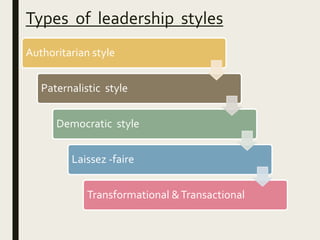
Types of leadership styles
Authoritarian style
Paternalistic style
Democratic style
Laissez -faire
Transformational &Transactional
Different cultures & Leadership
styles
■ Different cultures can have radically different leadership
styles. British linguist Richard D. Lewis charted these
differences in his book “When cultures Collide”.
■ From structured individualism in the U.S. to ringi-sho
consensus in Japan, the charts seem intuitively correct, if not
unilaterally true across a country and they won’t change any
time soon according to Lewis.
■ “Even in countries where political & economic change is
currently rapid or sweeping, deeply rooted attitudes &
beliefs will resist a sudden transformation of values when
pressured by reformists, government or conglomerates,” he
writes.
• British managers
- They are diplomatic, casual, helpful, willing to compromise and
seeking to be fair.
- They can be ruthless when necessary.
- Unfortunately, their adherence to tradition endows them with an
insular obstinacy resulting in a failure to comprehend differing
values in others.
• American managers
- They are assertive, aggressive, goal & action oriented, confident,
vigorous, optimistic, and ready for change.
- They are capable of teamwork and corporate spirit but they value
individual freedom and their first interest is furthering their own
career.
• French managers
- They tend to be autocratic and paternalistic, with an impressive
grasp of the many issues facing their company.
- Opinions of experienced middle managers and technical staff may
be dismissed.
• Swedish managers
- Management is decentralized and democratic.
- The rationale is that better informed employees are more
motivated and perform better.
- The drawback is that decisions can be delayed.
• German managers
- They strive to create a perfect system.
- There is a clear chain of command in each department and
information and instructions are passed down from the top.
- Nonetheless, considerable value is placed on consensus.
• Indonesian managers
- Under the auspices of an autocratic government, Indonesia's
business leadership is often entrusted to a resident Chinese
professional class.
• Netherland managers
- Leadership in the Netherlands is based on merit, competence,
and achievement.
- Managers are vigorous and decisive, but consensus is
mandatory, as there are many key players in the decision-
making process.
• Japanese managers
- The top executives have great power in conformity with
Confucian hierarchy but actually have little involvement in the
everyday affairs of the company.
• Russian managers
- They make efforts to promote business through official
channels may founder on the rocks of bureaucracy and Russian
apathy.
- Using key people and personal alliances, the "system" is often
bypassed and a good result achieved.
• Australian managers
- They must sit in the ring with the "mates."
- From this position, once it is accepted that they will not pull
rank, they actually exert much more influence than their
Swedish counterparts.
- As the semi-Americanized nature of Australian business
requires quick thinking and rapid decision making.
• Norway managers
- In democratic Norway, the boss is very much in the center of
things, and staff enjoy access to him or her most of the time.
- Middle managers' opinions are heard and acted upon in
egalitarian fashion, but top executives rarely abandon
responsibility and accountability.
• Finland managers
- They exercise control from a position just outside and above the
ring of middle managers, who are allowed to make day-today
decisions.
- Finnish top executives have the reputation of being decisive at
crunch time and do not hesitate to stand shoulder to shoulder with
staff and help out in crises.
• Spanish leaders
- They are autocratic and charismatic.
- Unlike the French, they work less from logic than from intuition, and
pride themselves on their personal influence on all their staff
members.
• Indian managers
- Nepotism is rife in traditional Indian companies.
- Family members hold key positions and work in close unison.
- Policy is also dictated by the trade group, e.g. fruit merchants,
jewelers, etc. These groups work in concert, often develop close
personal relations and come to each other's support in difficult
times.
• Lithuanian managers
- The older generation of Lithuanian managers has not completely
freed themselves of bureaucratic habits from Soviet times,.
- But young leadership is developing a more dynamic style, with
Nordic encouragement.
• Poland managers
- Despite pressure from Nazis and communists, the Polish still retain
many traditional romantic values.
- However, meritocracy increasingly dominates advancement in place
of aristocracy.
• Chinese managers
- Consensus is generally highly valued in China. In companies
controlled by the state, a leadership group will decide policy.
- In the developing expansion of capitalist-style companies, leaders
are emerging with reputations of competence; also, locally elected
officials are becoming influential in the business sphere and may
have only loose ties with Beijing.
• Israeli managers:
- Lacking an aristocracy, Israeli society attaches importance to
achievement and dynamism when looking for leadership.
• South African Managers:
- Traditionally, many Black South African societies were based on clans
and lineages.
- This type of leadership still exists, but economic change, when South
Africa became part of the total worldwide system of economic
production and exchange, has weakened clan and tribal influence.
• Turkish managers:
- They are still influenced by the tenets of Kemal Ataturk.
- A democratic republic is partially supported by the army, in a delicate
balance with Islamic Fundamentalists.
• Estonian managers:
- Estonians are very individualistic. Status is gained by achievement,
decisiveness, and energy.
• Latvian managers:
- Similar to Estonians, Latvians are individualistic. Everybody wants
to be not so much a leader, but a manager in his or her own right.
- However, there is a tendency to respect firm, confident,
knowledgeable leadership.
• Arab managers
- The authority is concentrated in the chief executive, and family
relations are very important, with ubiquitous nepotism.
Cim ppt

Cim ppt

  • 1.
    LEADERSHIP STYLES ACROSS DIFFERENT CULTURES PresentedBy Manas Pandey Aditi Rai Ayushi Tripathi
  • 2.
    Leadership Styles • Aleadership style is a leader’s style of providing direction, implementing plans, and motivating people. Various authors have proposed identifying many different leadership styles as exhibited by leaders in the political, business or other fields. • Studies on leadership style are conducted in the military field, expressing an approach that stresses a holistic view of leadership , including how a leader's physical presence determines how others perceive that leader. The factors of physical presence in this context include military bearing , physical fitness, confidence, and resilience. • The leader's intellectual capacity helps to conceptualize solutions and to acquire knowledge to do the job. A leader's conceptual abilities apply agility, judgment, innovation, interpersonal tact, and domain knowledge. • Domain knowledge encompasses tactical and technical knowledge as well as cultural and geopolitical awareness.
  • 3.
    Types of leadershipstyles Authoritarian style Paternalistic style Democratic style Laissez -faire Transformational &Transactional
  • 4.
    Different cultures &Leadership styles ■ Different cultures can have radically different leadership styles. British linguist Richard D. Lewis charted these differences in his book “When cultures Collide”. ■ From structured individualism in the U.S. to ringi-sho consensus in Japan, the charts seem intuitively correct, if not unilaterally true across a country and they won’t change any time soon according to Lewis. ■ “Even in countries where political & economic change is currently rapid or sweeping, deeply rooted attitudes & beliefs will resist a sudden transformation of values when pressured by reformists, government or conglomerates,” he writes.
  • 5.
    • British managers -They are diplomatic, casual, helpful, willing to compromise and seeking to be fair. - They can be ruthless when necessary. - Unfortunately, their adherence to tradition endows them with an insular obstinacy resulting in a failure to comprehend differing values in others. • American managers - They are assertive, aggressive, goal & action oriented, confident, vigorous, optimistic, and ready for change. - They are capable of teamwork and corporate spirit but they value individual freedom and their first interest is furthering their own career.
  • 6.
    • French managers -They tend to be autocratic and paternalistic, with an impressive grasp of the many issues facing their company. - Opinions of experienced middle managers and technical staff may be dismissed. • Swedish managers - Management is decentralized and democratic. - The rationale is that better informed employees are more motivated and perform better. - The drawback is that decisions can be delayed. • German managers - They strive to create a perfect system. - There is a clear chain of command in each department and information and instructions are passed down from the top. - Nonetheless, considerable value is placed on consensus.
  • 7.
    • Indonesian managers -Under the auspices of an autocratic government, Indonesia's business leadership is often entrusted to a resident Chinese professional class. • Netherland managers - Leadership in the Netherlands is based on merit, competence, and achievement. - Managers are vigorous and decisive, but consensus is mandatory, as there are many key players in the decision- making process. • Japanese managers - The top executives have great power in conformity with Confucian hierarchy but actually have little involvement in the everyday affairs of the company.
  • 8.
    • Russian managers -They make efforts to promote business through official channels may founder on the rocks of bureaucracy and Russian apathy. - Using key people and personal alliances, the "system" is often bypassed and a good result achieved. • Australian managers - They must sit in the ring with the "mates." - From this position, once it is accepted that they will not pull rank, they actually exert much more influence than their Swedish counterparts. - As the semi-Americanized nature of Australian business requires quick thinking and rapid decision making. • Norway managers - In democratic Norway, the boss is very much in the center of things, and staff enjoy access to him or her most of the time. - Middle managers' opinions are heard and acted upon in egalitarian fashion, but top executives rarely abandon responsibility and accountability.
  • 9.
    • Finland managers -They exercise control from a position just outside and above the ring of middle managers, who are allowed to make day-today decisions. - Finnish top executives have the reputation of being decisive at crunch time and do not hesitate to stand shoulder to shoulder with staff and help out in crises. • Spanish leaders - They are autocratic and charismatic. - Unlike the French, they work less from logic than from intuition, and pride themselves on their personal influence on all their staff members. • Indian managers - Nepotism is rife in traditional Indian companies. - Family members hold key positions and work in close unison. - Policy is also dictated by the trade group, e.g. fruit merchants, jewelers, etc. These groups work in concert, often develop close personal relations and come to each other's support in difficult times.
  • 10.
    • Lithuanian managers -The older generation of Lithuanian managers has not completely freed themselves of bureaucratic habits from Soviet times,. - But young leadership is developing a more dynamic style, with Nordic encouragement. • Poland managers - Despite pressure from Nazis and communists, the Polish still retain many traditional romantic values. - However, meritocracy increasingly dominates advancement in place of aristocracy. • Chinese managers - Consensus is generally highly valued in China. In companies controlled by the state, a leadership group will decide policy. - In the developing expansion of capitalist-style companies, leaders are emerging with reputations of competence; also, locally elected officials are becoming influential in the business sphere and may have only loose ties with Beijing.
  • 11.
    • Israeli managers: -Lacking an aristocracy, Israeli society attaches importance to achievement and dynamism when looking for leadership. • South African Managers: - Traditionally, many Black South African societies were based on clans and lineages. - This type of leadership still exists, but economic change, when South Africa became part of the total worldwide system of economic production and exchange, has weakened clan and tribal influence. • Turkish managers: - They are still influenced by the tenets of Kemal Ataturk. - A democratic republic is partially supported by the army, in a delicate balance with Islamic Fundamentalists.
  • 12.
    • Estonian managers: -Estonians are very individualistic. Status is gained by achievement, decisiveness, and energy. • Latvian managers: - Similar to Estonians, Latvians are individualistic. Everybody wants to be not so much a leader, but a manager in his or her own right. - However, there is a tendency to respect firm, confident, knowledgeable leadership. • Arab managers - The authority is concentrated in the chief executive, and family relations are very important, with ubiquitous nepotism.