TOURISM
SECTORS
Part II
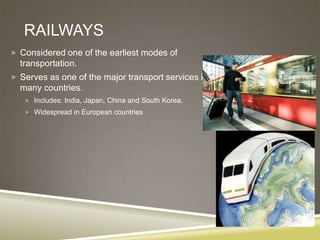
RAILWAYS
 Considered one of the earliest modes of
  transportation.
 Serves as one of the major transport services in
  many countries.
    Includes: India, Japan, China and South Korea.
    Widespread in European countries
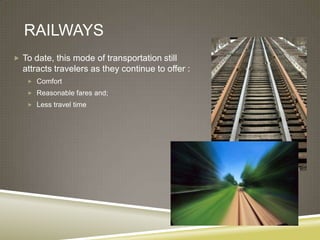
RAILWAYS
 To date, this mode of transportation still
  attracts travelers as they continue to offer :
    Comfort
    Reasonable fares and;
    Less travel time
EUROPEAN RAILWAY SYSTEM
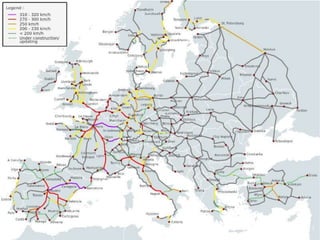
 Europe is home to one of the most extensive railway systems.
 The main international trains operating in Europe are:
    InterCityExpress (Germany, The
      Netherlands, Belgium, France, Denmark, Switzerland and Austria)
    Thalys (France, Germany, Belgium, The Netherlands)
    Enterprise (Republic of Ireland & Northern Ireland/UK)
    Eurostar (Great Britain, France, Belgium)
    EuroCity (conventional trains operated by nearly all Western and Central
      European operators, with the notable exception of the United Kingdom and
      Ireland)
    TGV (France, Belgium, Italy, Switzerland, Germany, Luxembourg)
    Oresundtrain (Denmark, Sweden)
    SJ 2000 (Sweden, Denmark)
THE EURAIL
 The Eurail also known as the Eurorail
 One of the most exstensive railway systems in the world.
 Its major product, offers rail passes for train travel all across
  Europe
        The Eurail passes (Eurorail Passes)

        A passenger has largely unlimited ability to travel on nearly all European railroads
          and some shipping lines at a fixed price per day of travel or travel within a certain
          number of days.
THE EURAIL
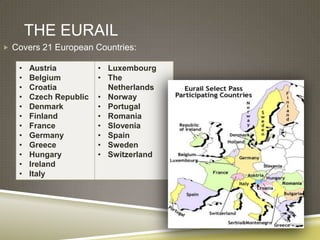
 Covers 21 European Countries:

   •   Austria          • Luxembourg
   •   Belgium          • The
   •   Croatia            Netherlands
   •   Czech Republic   • Norway
   •   Denmark          • Portugal
   •   Finland          • Romania
   •   France           • Slovenia
   •   Germany          • Spain
   •   Greece           • Sweden
   •   Hungary          • Switzerland
   •   Ireland
   •   Italy
THE EURAIL PASSES
Types
 Global Pass:
    The Eurail Global Pass lets you visit 23 countries throughout Europe, and see
        them in any order you like.
 Select Pass:
    Gives you flexibility to plan your trip, and also comes with the most options.
    Can choose from 3, 4 or 5 bordering countries and 5 up to 15 travel days.
THE EURAIL PASSES
 Regional Pass:
    Combine two bordering countries.
    Offer the ability to concentrate your European adventure within a specific
       region.
 One Country Pass:
      The Eurail One Country Pass is for if you want to spend your time exploring
       one country or area.
    Valid for one month, and the number of travel days available varies per
       country.
THE EURAIL PASSES
 Unfortunately this service not available for everyone.
    Not available for residents of Europe, the UK, Morocco, Turkey, or any of the
       countries of the former Soviet Union.
       If you are a citizen of any of these countries, but are a resident of the United
       States, Caribbean, Mexico, Central America or Canada, Eurorail are able to
       sell the rail pass or tickets to you.
    Passes are based on residency not citizenship, and the country of your
       residence will be printed on the rail pass as well as the names on the pass
       and on the passport have to match.
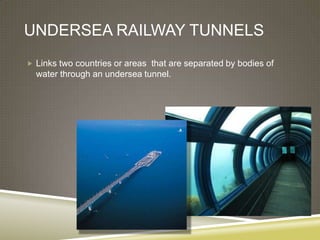
UNDERSEA RAILWAY TUNNELS
 Links two countries or areas that are separated by bodies of
  water through an undersea tunnel.
UNDERSEA RAILWAY TUNNELS
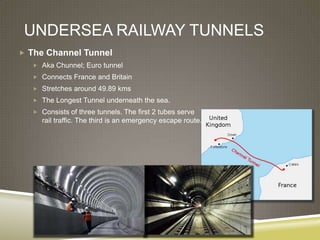
 The Channel Tunnel
   Aka Chunnel; Euro tunnel
   Connects France and Britain
   Stretches around 49.89 kms
   The Longest Tunnel underneath the sea.
   Consists of three tunnels. The first 2 tubes serve
     rail traffic. The third is an emergency escape route.
UNDERSEA RAILWAY TUNNELS
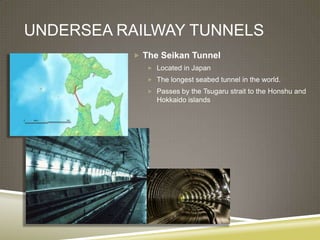
           The Seikan Tunnel
              Located in Japan
              The longest seabed tunnel in the world.
              Passes by the Tsugaru strait to the Honshu and
               Hokkaido islands
MOTOR COACHES
 The bus is the most reasonable and practical mode of
  transportation.
 Dominated by two major players:
    Trailways Transportation Systems
    Greyhound lines
MOTOR COACHES
 Trailways Transportation Systems
    Composed of 80 small independent motor coaches that have merged to
     provide competitive markets.
    Operates over 2,000 luxury-styled motor coaches serving more than 1,00
     destinations throughout north America and parts of Europe.
MOTOR COACHES
 Greyhound Lines
    Founded in 1914
    The largest provider of intercity bus transportation serving more than 2,000
      destinations across north America.
    They also operate with independent buslines to provide links from small towns
      to the national routes of the country.
RAILWAYS AND
MOTOR COACHES:
An examination of the Philippine
Setting
HISTORY
 June 25, 1875, a general plan to establish the railroad line in
  Luzon was declared by King Alfonso XII of Spain.
 November 24, 1982: First 195km railway line from manila to
  Dagupan was opened. This was extended to reach Legaspi in the
  south and La Union in the north in 1940.
HISTORY
 June 20, 1946: RA 4156, a new charter that renamed the Railway
  system to the Philippine National Railways (PNR).
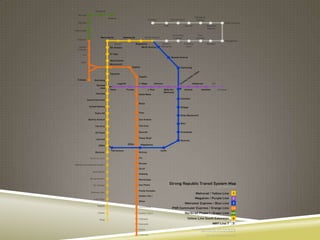
 The Strong Republic Transit System was born. Aims to provide an
  integrated mass transit system.
 The mass transit trains of the Philippines were created through
  E.O. 603, as amended by E.O. 830.
HISTORY
 The creation of the Light Rail Transit Authority (LRTA) aimed to
  create fast and efficient mas transit for the growing population in
  the Philippines.
THE TRAIN LINES IN THE
PHILIPPINES
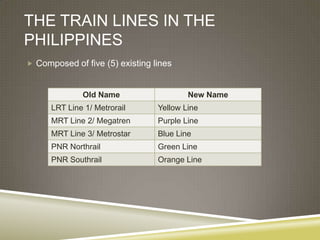
 Composed of five (5) existing lines


              Old Name                   New Name
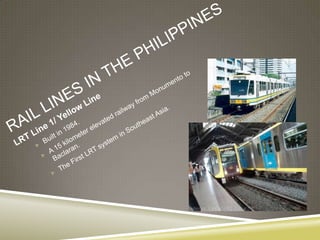
      LRT Line 1/ Metrorail      Yellow Line
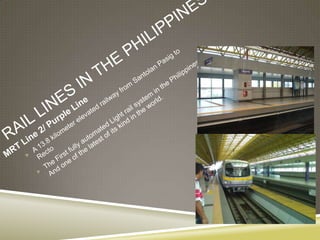
      MRT Line 2/ Megatren       Purple Line
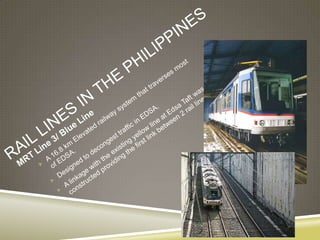
      MRT Line 3/ Metrostar      Blue Line
      PNR Northrail              Green Line
      PNR Southrail              Orange Line
THE TRAIN LINES IN THE
 PHILIPPINES
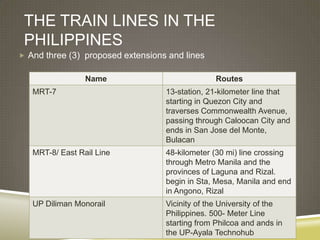
 And three (3) proposed extensions and lines


                 Name                            Routes
   MRT-7                           13-station, 21-kilometer line that
                                   starting in Quezon City and
                                   traverses Commonwealth Avenue,
                                   passing through Caloocan City and
                                   ends in San Jose del Monte,
                                   Bulacan
   MRT-8/ East Rail Line           48-kilometer (30 mi) line crossing
                                   through Metro Manila and the
                                   provinces of Laguna and Rizal.
                                   begin in Sta, Mesa, Manila and end
                                   in Angono, Rizal
   UP Diliman Monorail             Vicinity of the University of the
                                   Philippines. 500- Meter Line
                                   starting from Philcoa and ands in
                                   the UP-Ayala Technohub
Passenger Transportation

THE CRUISING INDUSTRY
SEA TRANSPORTATION AND
CRUISING
 Sea Transportation:
    Watercraft carrying people or goods. Sea transport
     has been the largest carrier of freight throughout
     recorded history.
    Can be over any distance by boat, ship, sailboat or
     barge, over oceans and lakes, through canals or
     along rivers.
    May be for commerce, recreation or the Military.
     Virtually any material that can be moved, can be
     moved by water
SEA TRANSPORTATION AND CRUISING

Cruise
   Vacation trip by ship.
   Travelling by water for purely recreational
   purposes. This is a leisure vacation experience
   with the ships staff doing all the work.
SEA TRANSPORTATION AND CRUISING

History of Cruising
   Ancient Times
     Ships sailed for practical reasons across the
      Mediterranean. However, there were a few
      who came on board in order to experience
      the far flung ports visited by these ships.
     Herodotus was one of those people. He
      compiled the list of interesting things he saw
      on his travels.
SEA TRANSPORTATION AND CRUISING

History of Cruising
   500AD
      “Leisure” travel disappeared. Sea travel was
       mostly for exploration, trade and to conquer new
       lands.
   The 1800’s
      Shipping companies rediscovered that they
       could increase their profits by booking
       passengers.
      Shipping companies began building vessels
       (steamships as they were called before) to
       transport people.
SEA TRANSPORTATION AND CRUISING

History of Cruising
   The 1900’s:
     Ocean liners were among the most astonishing
      creations to appear during this period.
     The purpose of this was to carry immigrants and
      not the wealthy. There was two or three classes
      of service.
SEA TRANSPORTATION AND CRUISING

History of Cursing
     The First World War:
       Most ocean crossing vessels were converted
        into troop transport.
       During the 1920’s and 1930’s ocean liners
        began to provide more entertainment and
        tried to attract more of the middle class.
       Being seen inside ocean liners was the “in”
        thing.
SEA TRANSPORTATION AND CRUISING

History of Cursing
   The birth of contemporary cruising
      During the 1900’s a few smaller steamship lines
      created a product that is close to what we now
      call a cruise.
     During winter, these lines would switch routes
      from the transatlantic route to routes going to
      warmer places.
     1958 marked the emergence of commercial jet
      service across the Atlantic ocean.
SEA TRANSPORTATION AND CRUISING

History of Cursing
   Development of modern cruising
     The smaller ships cruising the Caribbean became the
      model of nearly every company that pursued this
      product.
     Ships became floating resorts offering pleasurable
      activities.
     During the 1970’s cruising became a major
      phenomenon. Cruise companies were building ships
      designed primarily for cruising.
     The 1980’s and 1990’s saw the emergence of
      “megaships”.
SEA TRANSPORTATION AND CRUISING

Cruising today:
   Cruises today have itineraries that range from a
    three-day, four-day (short itineraries)
   The more popular ones are the five- to twelve-
    day cruises. The seven-day cruise is the most
    common.
   A ships agenda can be a round trip or circle
    itinerary. The agenda can also be a one-way
    itinerary.
SEA TRANSPORTATION AND CRUISING

Cruising Today:
   During the cruise, the passengers experience a
    plethora of different activities. The activities
    usually take place on at-sea days.
   When the ship is on port days, passengers
    have the option to go ashore or say on the ship.
THE PASSENGERS
AND MOTIVATION
FOR CRUISING
THE PASSENGERS AND MOTIVATION
FOR CRUISING
Who Cruises?
    All age groups
    There are different cruises being offered for different demographics
THE PASSENGERS AND MOTIVATION
FOR CRUISING
Why do people cruise?
    A cruise is a hassle-free vacation
    A cruise takes you away from it all
    Your pampered like nowhere else
    You can do it all- or nothing at all
    You can sample a broad geographic area
    A cruise is something new
    Cruises offere a huge variety of events, activities and meals
THE PASSENGERS AND MOTIVATION
FOR CRUISING
Why do people cruise?
    A cruise facilitates shopping
    A cruise lend themselves to groups
    It’s easy to make friends on a cruise
    Cruises lend themselves to groups
    Cruise is a romantic experience
    A cruise is a learning experience
    There’s a cruise that can satisisfy virtually anyone
THE PASSENGERS AND MOTIVATION
FOR CRUISING
Why do people cruise?
    It’s a great way to celebrate a special event
    Everybody’s talking about how wonderful cruises are
    Cruises represent a safe travel experience
    Value for money
    You know what your paying for in advance.
THE PASSENGERS AND MOTIVATION
FOR CRUISING
Why do some people not go on cruises?
    Cruises are too expensive
    Cruises are boring
    Cruises are too stuffy and formal
    Cruises are for older people
    Cruises are too regimented
    There is not enough time in ports
    Ship environment is too confining
THE PASSENGERS AND MOTIVATION
FOR CRUISING
Why do some people not go on cruises?
    Being forced to socialize with people
    I’ll eat too much and put on weight.
    Ship safety
    Worried about getting sick
    I don’t know that much about cruises
THE PASSENGERS AND MOTIVATION
FOR CRUISING
Pricing Patterns for Cruises:
    The price of cruises is based on basis two or double occupancy
    The higher the deck, the stateroom is on the higher the price
    Outside staterooms (has windows) are more expensive than interior
      staterooms
    Larger staterooms are usually more epxensive
    Outside staterooms with obstructive that are obstructed are cheaper
      compared to those with unobstructed views
THE PASSENGERS AND MOTIVATION
FOR CRUISING
Pricing Patterns for Cruises:
    Booking six to nine months or more in advance usually yields savings
    Last minute sales when a ship is not yet fully booked results in cheaper prices
    Repositioned cruises are almost always cheaper
THE PASSENGERS AND MOTIVATION
FOR CRUISING
Seasonality in Cruises
    Summer is high season
    Spring and Fall is shoulder seasons
    Winter is low season.
THE ANATOMY
OF A CRUISE
SHIP
STYLES OF SHIPS
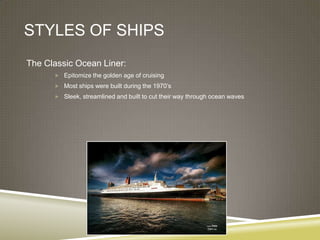
The Classic Ocean Liner:
       Epitomize the golden age of cruising

       Most ships were built during the 1970’s
       Sleek, streamlined and built to cut their way through ocean waves
STYLES OF SHIPS
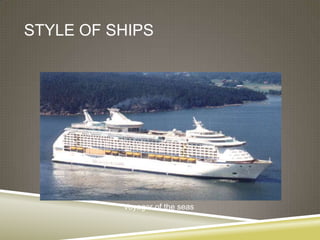
Contemporary Cruise Ship
       These are broader, boxier vessels built to accommodate uniformly sized staterooms
         and numerous activity venues
       These are usually called “Megaships”


      *Megaships are ships that can accommodate 2,000 or more passengers and have 12 or
         more decks.
STYLE OF SHIPS


          Voyager of the seas
STYLES OF SHIPS
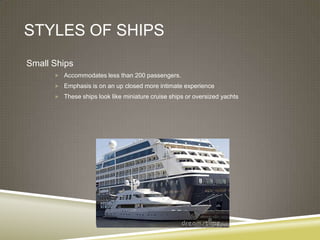
Small Ships
       Accommodates less than 200 passengers.

       Emphasis is on an up closed more intimate experience
       These ships look like miniature cruise ships or oversized yachts
STYLES OF SHIPS
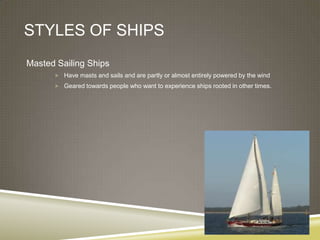
Masted Sailing Ships
       Have masts and sails and are partly or almost entirely powered by the wind

       Geared towards people who want to experience ships rooted in other times.
STYLE OF SHIPS
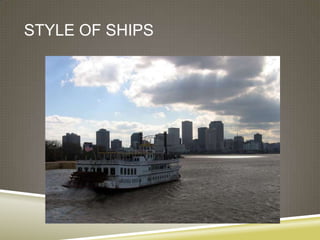
River Boats
       Also called the paddle wheeler

       Modeled after great steamboats of the 19th century.
       These ships permit passengers to experience America’s great rivers in the style
         immortalized by the works of Mark Twain.
STYLE OF SHIPS
STYLE OF SHIPS
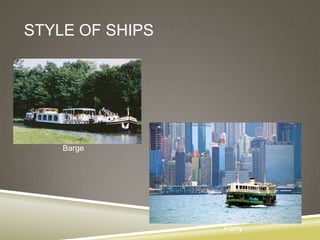
Barges
           A twelve-passenger sea craft

Ferries
Multi-Purpose Ships
           Carry Cargo, Transport Passengers between two points and serve as cruise ships
STYLE OF SHIPS


    Barge


                 Ferry
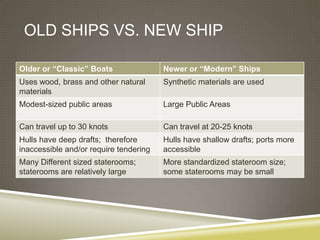
OLD SHIPS VS. NEW SHIP

Older or “Classic” Boats                Newer or “Modern” Ships
Uses wood, brass and other natural      Synthetic materials are used
materials
Modest-sized public areas               Large Public Areas

Can travel up to 30 knots               Can travel at 20-25 knots
Hulls have deep drafts; therefore       Hulls have shallow drafts; ports more
inaccessible and/or require tendering   accessible
Many Different sized staterooms;        More standardized stateroom size;
staterooms are relatively large         some staterooms may be small
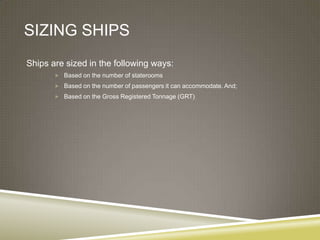
SIZING SHIPS
Ships are sized in the following ways:
        Based on the number of staterooms

        Based on the number of passengers it can accommodate. And;
        Based on the Gross Registered Tonnage (GRT)
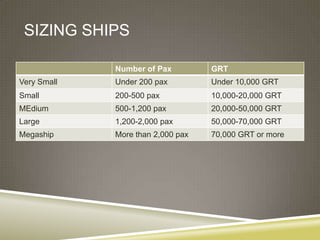
SIZING SHIPS

             Number of Pax         GRT
Very Small   Under 200 pax         Under 10,000 GRT
Small        200-500 pax           10,000-20,000 GRT
MEdium       500-1,200 pax         20,000-50,000 GRT
Large        1,200-2,000 pax       50,000-70,000 GRT
Megaship     More than 2,000 pax   70,000 GRT or more
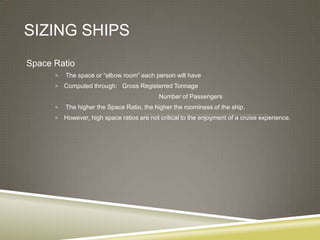
SIZING SHIPS
Space Ratio
         The space or “elbow room” each person will have
       Computed through: Gross Registerred Tonnage
                                            Number of Passengers
         The higher the Space Ratio, the higher the roominess of the ship.
       However, high space ratios are not critical to the enjoyment of a cruise experience.
SIZING SHIPS

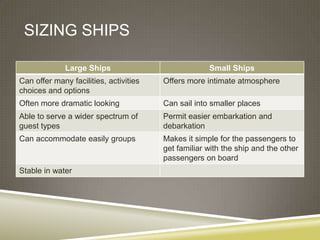
              Large Ships                            Small Ships
Can offer many facilities, activities   Offers more intimate atmosphere
choices and options
Often more dramatic looking             Can sail into smaller places
Able to serve a wider spectrum of       Permit easier embarkation and
guest types                             debarkation
Can accommodate easily groups           Makes it simple for the passengers to
                                        get familiar with the ship and the other
                                        passengers on board
Stable in water
SHIPS FACILITIES
 There are three types of Facilities:
        Stateroom space

        Private Space
        Public Space
SHIPS FACILITIES
 Stateroom Space
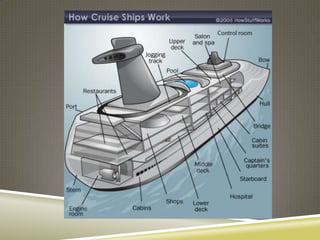
    The cabin
    The ships equivalent to the guest room in a hotel.
    Has three types:
        Outside Staterooms:
             Rooms that have windows.
             Ideal for clients who worry about feeling cramped

        Inside Staterooms:
             Inside the ships interior

             They usually have no windows

             The least expensive room on the ship
SHIPS FACILITIES
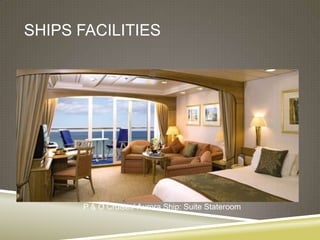
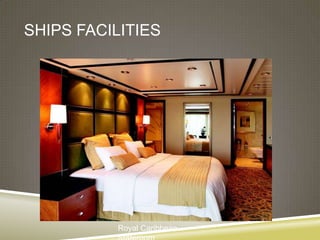
    Suites

        The most expensive accommodation facilities on a ship

        Some vessels have only a few suite rooms but some boast entire decks for it.

        The suite consists of a sitting area and sleeping area which is usually divided
          by a curtain
        Ideal room for families
SHIPS FACILITIES


      P & O Cruises’ Aurora Ship: Suite Stateroom
SHIPS FACILITIES


          Royal Caribbean
SHIPS FACILITIES
 Private Space
    This includes the Bridge, the galley or kitchen and the mechanical areas.
    Mostly employees areas only.
SHIPS FACILITIES
 Public Areas
    Where the passengers/guests mingle
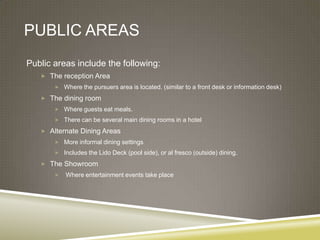
PUBLIC AREAS
Public areas include the following:
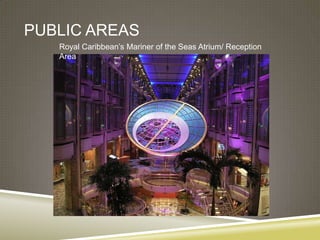
    The reception Area
        Where the pursuers area is located. (similar to a front desk or information desk)

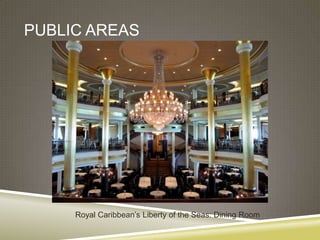
    The dining room
        Where guests eat meals.
        There can be several main dining rooms in a hotel

    Alternate Dining Areas
        More informal dining settings
        Includes the Lido Deck (pool side), or al fresco (outside) dining.

    The Showroom
          Where entertainment events take place
PUBLIC AREAS
   Royal Caribbean’s Mariner of the Seas Atrium/ Reception
   Area
PUBLIC AREAS


     Royal Caribbean’s Liberty of the Seas: Dining Room
PUBLIC AREAS
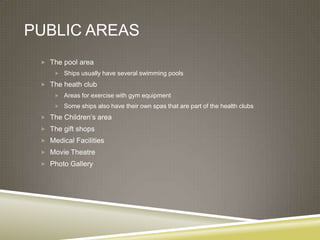
  The pool area
      Ships usually have several swimming pools

  The heath club
      Areas for exercise with gym equipment

      Some ships also have their own spas that are part of the health clubs

  The Children’s area
  The gift shops
  Medical Facilities
  Movie Theatre
  Photo Gallery
PUBLIC AREAS


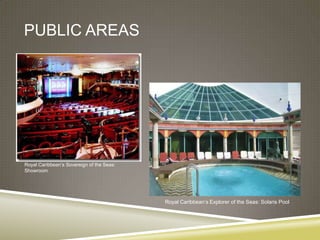
Royal Caribbean’s Sovereign of the Seas:
Showroom


                                           Royal Caribbean’s Explorer of the Seas: Solaris Pool

TSM 101 tourism sectors- hotels

  • 1.
  • 2.
    RAILWAYS  Considered oneof the earliest modes of transportation.  Serves as one of the major transport services in many countries.  Includes: India, Japan, China and South Korea.  Widespread in European countries
  • 3.
    RAILWAYS  To date,this mode of transportation still attracts travelers as they continue to offer :  Comfort  Reasonable fares and;  Less travel time
  • 4.
    EUROPEAN RAILWAY SYSTEM Europe is home to one of the most extensive railway systems.  The main international trains operating in Europe are:  InterCityExpress (Germany, The Netherlands, Belgium, France, Denmark, Switzerland and Austria)  Thalys (France, Germany, Belgium, The Netherlands)  Enterprise (Republic of Ireland & Northern Ireland/UK)  Eurostar (Great Britain, France, Belgium)  EuroCity (conventional trains operated by nearly all Western and Central European operators, with the notable exception of the United Kingdom and Ireland)  TGV (France, Belgium, Italy, Switzerland, Germany, Luxembourg)  Oresundtrain (Denmark, Sweden)  SJ 2000 (Sweden, Denmark)
  • 6.
    THE EURAIL  TheEurail also known as the Eurorail  One of the most exstensive railway systems in the world.  Its major product, offers rail passes for train travel all across Europe  The Eurail passes (Eurorail Passes)  A passenger has largely unlimited ability to travel on nearly all European railroads and some shipping lines at a fixed price per day of travel or travel within a certain number of days.
  • 7.
    THE EURAIL  Covers21 European Countries: • Austria • Luxembourg • Belgium • The • Croatia Netherlands • Czech Republic • Norway • Denmark • Portugal • Finland • Romania • France • Slovenia • Germany • Spain • Greece • Sweden • Hungary • Switzerland • Ireland • Italy
  • 8.
    THE EURAIL PASSES Types Global Pass:  The Eurail Global Pass lets you visit 23 countries throughout Europe, and see them in any order you like.  Select Pass:  Gives you flexibility to plan your trip, and also comes with the most options.  Can choose from 3, 4 or 5 bordering countries and 5 up to 15 travel days.
  • 9.
    THE EURAIL PASSES Regional Pass:  Combine two bordering countries.  Offer the ability to concentrate your European adventure within a specific region.  One Country Pass:  The Eurail One Country Pass is for if you want to spend your time exploring one country or area.  Valid for one month, and the number of travel days available varies per country.
  • 10.
    THE EURAIL PASSES Unfortunately this service not available for everyone.  Not available for residents of Europe, the UK, Morocco, Turkey, or any of the countries of the former Soviet Union.  If you are a citizen of any of these countries, but are a resident of the United States, Caribbean, Mexico, Central America or Canada, Eurorail are able to sell the rail pass or tickets to you.  Passes are based on residency not citizenship, and the country of your residence will be printed on the rail pass as well as the names on the pass and on the passport have to match.
  • 11.
    UNDERSEA RAILWAY TUNNELS Links two countries or areas that are separated by bodies of water through an undersea tunnel.
  • 12.
    UNDERSEA RAILWAY TUNNELS The Channel Tunnel  Aka Chunnel; Euro tunnel  Connects France and Britain  Stretches around 49.89 kms  The Longest Tunnel underneath the sea.  Consists of three tunnels. The first 2 tubes serve rail traffic. The third is an emergency escape route.
  • 13.
    UNDERSEA RAILWAY TUNNELS  The Seikan Tunnel  Located in Japan  The longest seabed tunnel in the world.  Passes by the Tsugaru strait to the Honshu and Hokkaido islands
  • 14.
    MOTOR COACHES  Thebus is the most reasonable and practical mode of transportation.  Dominated by two major players:  Trailways Transportation Systems  Greyhound lines
  • 15.
    MOTOR COACHES  TrailwaysTransportation Systems  Composed of 80 small independent motor coaches that have merged to provide competitive markets.  Operates over 2,000 luxury-styled motor coaches serving more than 1,00 destinations throughout north America and parts of Europe.
  • 16.
    MOTOR COACHES  GreyhoundLines  Founded in 1914  The largest provider of intercity bus transportation serving more than 2,000 destinations across north America.  They also operate with independent buslines to provide links from small towns to the national routes of the country.
  • 17.
    RAILWAYS AND MOTOR COACHES: Anexamination of the Philippine Setting
  • 18.
    HISTORY  June 25,1875, a general plan to establish the railroad line in Luzon was declared by King Alfonso XII of Spain.  November 24, 1982: First 195km railway line from manila to Dagupan was opened. This was extended to reach Legaspi in the south and La Union in the north in 1940.
  • 19.
    HISTORY  June 20,1946: RA 4156, a new charter that renamed the Railway system to the Philippine National Railways (PNR).  The Strong Republic Transit System was born. Aims to provide an integrated mass transit system.  The mass transit trains of the Philippines were created through E.O. 603, as amended by E.O. 830.
  • 20.
    HISTORY  The creationof the Light Rail Transit Authority (LRTA) aimed to create fast and efficient mas transit for the growing population in the Philippines.
  • 21.
    THE TRAIN LINESIN THE PHILIPPINES  Composed of five (5) existing lines Old Name New Name LRT Line 1/ Metrorail Yellow Line MRT Line 2/ Megatren Purple Line MRT Line 3/ Metrostar Blue Line PNR Northrail Green Line PNR Southrail Orange Line
  • 22.
    THE TRAIN LINESIN THE PHILIPPINES  And three (3) proposed extensions and lines Name Routes MRT-7 13-station, 21-kilometer line that starting in Quezon City and traverses Commonwealth Avenue, passing through Caloocan City and ends in San Jose del Monte, Bulacan MRT-8/ East Rail Line 48-kilometer (30 mi) line crossing through Metro Manila and the provinces of Laguna and Rizal. begin in Sta, Mesa, Manila and end in Angono, Rizal UP Diliman Monorail Vicinity of the University of the Philippines. 500- Meter Line starting from Philcoa and ands in the UP-Ayala Technohub
  • 28.
  • 29.
    SEA TRANSPORTATION AND CRUISING Sea Transportation:  Watercraft carrying people or goods. Sea transport has been the largest carrier of freight throughout recorded history.  Can be over any distance by boat, ship, sailboat or barge, over oceans and lakes, through canals or along rivers.  May be for commerce, recreation or the Military. Virtually any material that can be moved, can be moved by water
  • 30.
    SEA TRANSPORTATION ANDCRUISING Cruise  Vacation trip by ship.  Travelling by water for purely recreational purposes. This is a leisure vacation experience with the ships staff doing all the work.
  • 31.
    SEA TRANSPORTATION ANDCRUISING History of Cruising  Ancient Times  Ships sailed for practical reasons across the Mediterranean. However, there were a few who came on board in order to experience the far flung ports visited by these ships.  Herodotus was one of those people. He compiled the list of interesting things he saw on his travels.
  • 32.
    SEA TRANSPORTATION ANDCRUISING History of Cruising  500AD  “Leisure” travel disappeared. Sea travel was mostly for exploration, trade and to conquer new lands.  The 1800’s  Shipping companies rediscovered that they could increase their profits by booking passengers.  Shipping companies began building vessels (steamships as they were called before) to transport people.
  • 33.
    SEA TRANSPORTATION ANDCRUISING History of Cruising  The 1900’s:  Ocean liners were among the most astonishing creations to appear during this period.  The purpose of this was to carry immigrants and not the wealthy. There was two or three classes of service.
  • 34.
    SEA TRANSPORTATION ANDCRUISING History of Cursing  The First World War:  Most ocean crossing vessels were converted into troop transport.  During the 1920’s and 1930’s ocean liners began to provide more entertainment and tried to attract more of the middle class.  Being seen inside ocean liners was the “in” thing.
  • 35.
    SEA TRANSPORTATION ANDCRUISING History of Cursing  The birth of contemporary cruising  During the 1900’s a few smaller steamship lines created a product that is close to what we now call a cruise.  During winter, these lines would switch routes from the transatlantic route to routes going to warmer places.  1958 marked the emergence of commercial jet service across the Atlantic ocean.
  • 36.
    SEA TRANSPORTATION ANDCRUISING History of Cursing  Development of modern cruising  The smaller ships cruising the Caribbean became the model of nearly every company that pursued this product.  Ships became floating resorts offering pleasurable activities.  During the 1970’s cruising became a major phenomenon. Cruise companies were building ships designed primarily for cruising.  The 1980’s and 1990’s saw the emergence of “megaships”.
  • 37.
    SEA TRANSPORTATION ANDCRUISING Cruising today:  Cruises today have itineraries that range from a three-day, four-day (short itineraries)  The more popular ones are the five- to twelve- day cruises. The seven-day cruise is the most common.  A ships agenda can be a round trip or circle itinerary. The agenda can also be a one-way itinerary.
  • 38.
    SEA TRANSPORTATION ANDCRUISING Cruising Today:  During the cruise, the passengers experience a plethora of different activities. The activities usually take place on at-sea days.  When the ship is on port days, passengers have the option to go ashore or say on the ship.
  • 39.
  • 40.
    THE PASSENGERS ANDMOTIVATION FOR CRUISING Who Cruises?  All age groups  There are different cruises being offered for different demographics
  • 41.
    THE PASSENGERS ANDMOTIVATION FOR CRUISING Why do people cruise?  A cruise is a hassle-free vacation  A cruise takes you away from it all  Your pampered like nowhere else  You can do it all- or nothing at all  You can sample a broad geographic area  A cruise is something new  Cruises offere a huge variety of events, activities and meals
  • 42.
    THE PASSENGERS ANDMOTIVATION FOR CRUISING Why do people cruise?  A cruise facilitates shopping  A cruise lend themselves to groups  It’s easy to make friends on a cruise  Cruises lend themselves to groups  Cruise is a romantic experience  A cruise is a learning experience  There’s a cruise that can satisisfy virtually anyone
  • 43.
    THE PASSENGERS ANDMOTIVATION FOR CRUISING Why do people cruise?  It’s a great way to celebrate a special event  Everybody’s talking about how wonderful cruises are  Cruises represent a safe travel experience  Value for money  You know what your paying for in advance.
  • 44.
    THE PASSENGERS ANDMOTIVATION FOR CRUISING Why do some people not go on cruises?  Cruises are too expensive  Cruises are boring  Cruises are too stuffy and formal  Cruises are for older people  Cruises are too regimented  There is not enough time in ports  Ship environment is too confining
  • 45.
    THE PASSENGERS ANDMOTIVATION FOR CRUISING Why do some people not go on cruises?  Being forced to socialize with people  I’ll eat too much and put on weight.  Ship safety  Worried about getting sick  I don’t know that much about cruises
  • 46.
    THE PASSENGERS ANDMOTIVATION FOR CRUISING Pricing Patterns for Cruises:  The price of cruises is based on basis two or double occupancy  The higher the deck, the stateroom is on the higher the price  Outside staterooms (has windows) are more expensive than interior staterooms  Larger staterooms are usually more epxensive  Outside staterooms with obstructive that are obstructed are cheaper compared to those with unobstructed views
  • 47.
    THE PASSENGERS ANDMOTIVATION FOR CRUISING Pricing Patterns for Cruises:  Booking six to nine months or more in advance usually yields savings  Last minute sales when a ship is not yet fully booked results in cheaper prices  Repositioned cruises are almost always cheaper
  • 48.
    THE PASSENGERS ANDMOTIVATION FOR CRUISING Seasonality in Cruises  Summer is high season  Spring and Fall is shoulder seasons  Winter is low season.
  • 49.
    THE ANATOMY OF ACRUISE SHIP
  • 51.
    STYLES OF SHIPS TheClassic Ocean Liner:  Epitomize the golden age of cruising  Most ships were built during the 1970’s  Sleek, streamlined and built to cut their way through ocean waves
  • 52.
    STYLES OF SHIPS ContemporaryCruise Ship  These are broader, boxier vessels built to accommodate uniformly sized staterooms and numerous activity venues  These are usually called “Megaships” *Megaships are ships that can accommodate 2,000 or more passengers and have 12 or more decks.
  • 53.
    STYLE OF SHIPS Voyager of the seas
  • 54.
    STYLES OF SHIPS SmallShips  Accommodates less than 200 passengers.  Emphasis is on an up closed more intimate experience  These ships look like miniature cruise ships or oversized yachts
  • 55.
    STYLES OF SHIPS MastedSailing Ships  Have masts and sails and are partly or almost entirely powered by the wind  Geared towards people who want to experience ships rooted in other times.
  • 56.
    STYLE OF SHIPS RiverBoats  Also called the paddle wheeler  Modeled after great steamboats of the 19th century.  These ships permit passengers to experience America’s great rivers in the style immortalized by the works of Mark Twain.
  • 57.
  • 58.
    STYLE OF SHIPS Barges  A twelve-passenger sea craft Ferries Multi-Purpose Ships  Carry Cargo, Transport Passengers between two points and serve as cruise ships
  • 59.
    STYLE OF SHIPS Barge Ferry
  • 60.
    OLD SHIPS VS.NEW SHIP Older or “Classic” Boats Newer or “Modern” Ships Uses wood, brass and other natural Synthetic materials are used materials Modest-sized public areas Large Public Areas Can travel up to 30 knots Can travel at 20-25 knots Hulls have deep drafts; therefore Hulls have shallow drafts; ports more inaccessible and/or require tendering accessible Many Different sized staterooms; More standardized stateroom size; staterooms are relatively large some staterooms may be small
  • 61.
    SIZING SHIPS Ships aresized in the following ways:  Based on the number of staterooms  Based on the number of passengers it can accommodate. And;  Based on the Gross Registered Tonnage (GRT)
  • 62.
    SIZING SHIPS Number of Pax GRT Very Small Under 200 pax Under 10,000 GRT Small 200-500 pax 10,000-20,000 GRT MEdium 500-1,200 pax 20,000-50,000 GRT Large 1,200-2,000 pax 50,000-70,000 GRT Megaship More than 2,000 pax 70,000 GRT or more
  • 63.
    SIZING SHIPS Space Ratio  The space or “elbow room” each person will have  Computed through: Gross Registerred Tonnage Number of Passengers  The higher the Space Ratio, the higher the roominess of the ship.  However, high space ratios are not critical to the enjoyment of a cruise experience.
  • 64.
    SIZING SHIPS Large Ships Small Ships Can offer many facilities, activities Offers more intimate atmosphere choices and options Often more dramatic looking Can sail into smaller places Able to serve a wider spectrum of Permit easier embarkation and guest types debarkation Can accommodate easily groups Makes it simple for the passengers to get familiar with the ship and the other passengers on board Stable in water
  • 65.
    SHIPS FACILITIES  Thereare three types of Facilities:  Stateroom space  Private Space  Public Space
  • 66.
    SHIPS FACILITIES  StateroomSpace  The cabin  The ships equivalent to the guest room in a hotel.  Has three types:  Outside Staterooms:  Rooms that have windows.  Ideal for clients who worry about feeling cramped  Inside Staterooms:  Inside the ships interior  They usually have no windows  The least expensive room on the ship
  • 67.
    SHIPS FACILITIES  Suites  The most expensive accommodation facilities on a ship  Some vessels have only a few suite rooms but some boast entire decks for it.  The suite consists of a sitting area and sleeping area which is usually divided by a curtain  Ideal room for families
  • 68.
    SHIPS FACILITIES P & O Cruises’ Aurora Ship: Suite Stateroom
  • 69.
    SHIPS FACILITIES Royal Caribbean
  • 70.
    SHIPS FACILITIES  PrivateSpace  This includes the Bridge, the galley or kitchen and the mechanical areas.  Mostly employees areas only.
  • 71.
    SHIPS FACILITIES  PublicAreas  Where the passengers/guests mingle
  • 72.
    PUBLIC AREAS Public areasinclude the following:  The reception Area  Where the pursuers area is located. (similar to a front desk or information desk)  The dining room  Where guests eat meals.  There can be several main dining rooms in a hotel  Alternate Dining Areas  More informal dining settings  Includes the Lido Deck (pool side), or al fresco (outside) dining.  The Showroom  Where entertainment events take place
  • 73.
    PUBLIC AREAS Royal Caribbean’s Mariner of the Seas Atrium/ Reception Area
  • 74.
    PUBLIC AREAS Royal Caribbean’s Liberty of the Seas: Dining Room
  • 75.
    PUBLIC AREAS The pool area  Ships usually have several swimming pools  The heath club  Areas for exercise with gym equipment  Some ships also have their own spas that are part of the health clubs  The Children’s area  The gift shops  Medical Facilities  Movie Theatre  Photo Gallery
  • 76.
    PUBLIC AREAS Royal Caribbean’sSovereign of the Seas: Showroom Royal Caribbean’s Explorer of the Seas: Solaris Pool