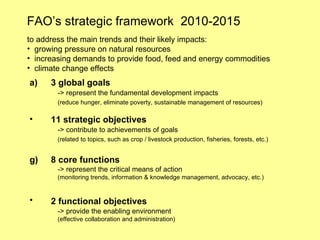
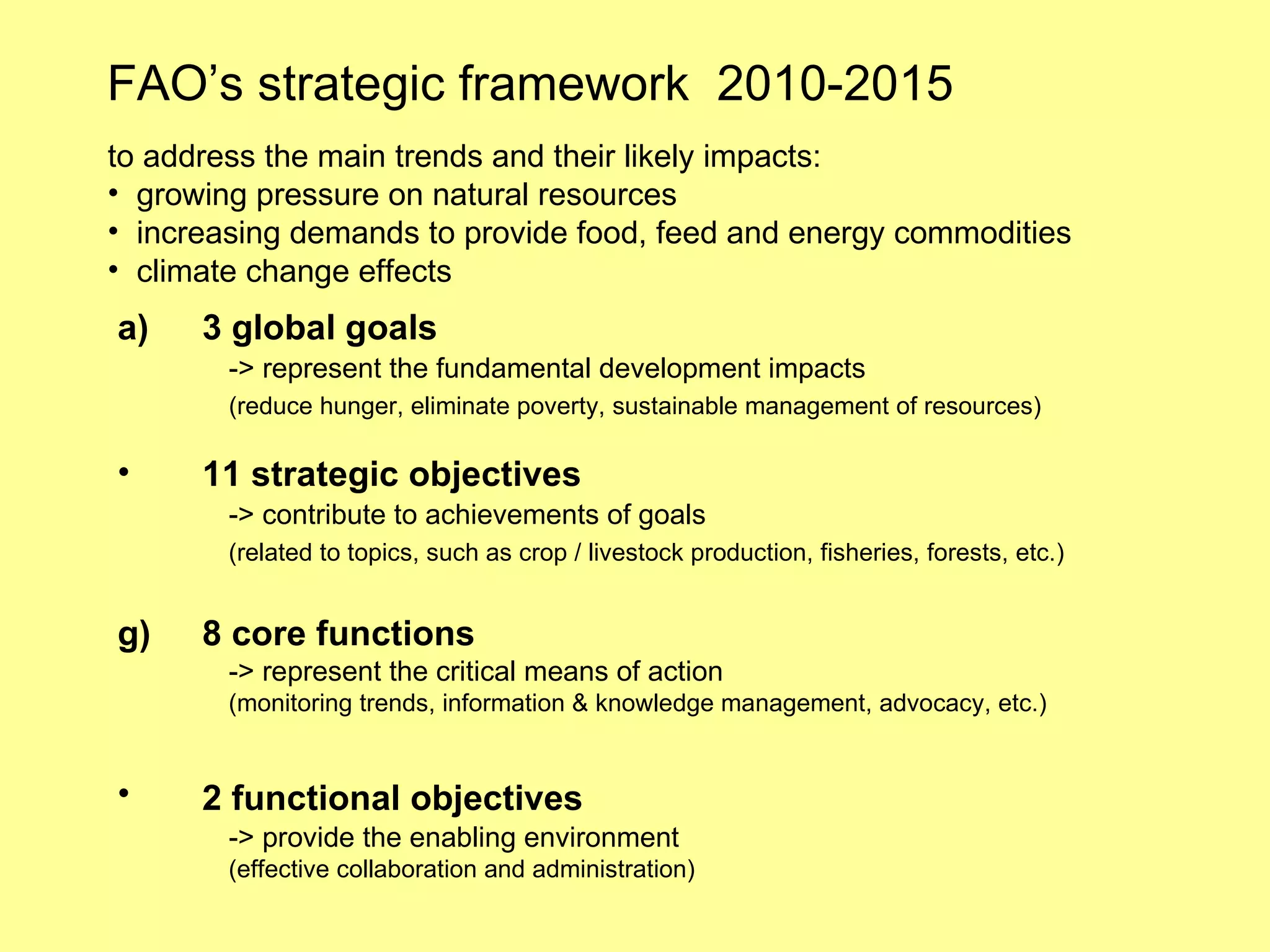
FAO’s strategic framework  2010-2015 3 global goals   -> represent the fundamental development impacts   (reduce hunger, eliminate poverty, sustainable management of resources) 11 strategic objectives   -> contribute to achievements of goals (related to topics, such as crop / livestock production, fisheries, forests, etc.) 8 core functions -> represent the critical means of action (monitoring trends, information & knowledge management, advocacy, etc.) 2 functional objectives   -> provide the enabling environment (effective collaboration and administration) to address the main trends and their likely impacts: growing pressure on natural resources increasing demands to provide food, feed and energy commodities climate change effects
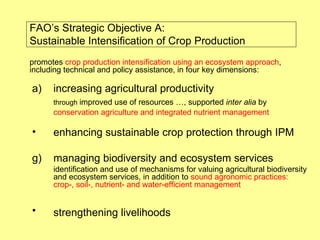
FAO’s Strategic Objective A:  Sustainable Intensification of Crop Production increasing agricultural productivity through  improved use of resources …, supported  inter alia  by  conservation agriculture and integrated nutrient management enhancing sustainable crop protection   through IPM  managing biodiversity and ecosystem services identification and use of mechanisms for valuing agricultural biodiversity and ecosystem services, in addition to  sound agronomic practices: crop-, soil-, nutrient- and water-efficient management strengthening livelihoods   promotes  crop production intensification using an ecosystem approach , including technical and policy assistance, in four key dimensions:
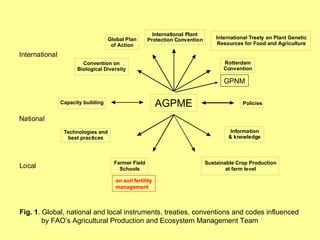
GPNM on soil fertility management Fig. 1 . Global, national and local instruments, treaties, conventions and codes influenced by FAO’s Agricultural Production and Ecosystem Management Team
FAO’s AGPME team is multidisciplinary committed to provide services to member countries. Services focus on enhancing ecological, social and economic resilience of agricultural systems for food security; works on the sustainable intensification of agricultural systems by promoting management practices built on natural ecosystem’s processes and the enhance-ment of knowledge, in order to restore systems and increase efficiencies of resource use (natural/human/economic).  integrates different disciplines (weed management, agronomy, plant nutrition, mechanization, ecology, social science, IPM, climate change, pollination and biodiversity management, crop/livestock interactions). We work in a variety of ecological zones (dry and humid savannah, mountains, drylands and rangelands, humid tropics, temperate) in over 80 countries. Our focus is on farmers and policy makers to help providing increased awareness of the diversity of choices for adapting practices and technologies, through encouraging partnership and capacity building at multiple levels.  contributes by collecting, reviewing and sharing information; supporting networks at national, regional and global level; developing capacity; integrating of scientific, traditional, and local knowledge; mainstreaming use and enhancement of biodiversity and ecosystem services into agricultural policies as well as at the field level;  monitoring trends and developing databases, tools and policy guidelines
Case studies These case studies will provide concrete contributions for further: assessing current or new production systems for SCPI   promoting improved production concepts/systems   Identifying areas for improvement (both policy and technology providing examples of policies and technologies that have worked and the reasons why   should illustrate that the activity is undertaken within the context of sustainable agriculture, emphasizing the management of biodiversity and ecosystem services; should also describe impacts on other aspects of sustainability such as social, political and economic - if appropriate.

Tsbf presentation nairobi 111206

  • 1.
    FAO’s strategic framework 2010-2015 3 global goals -> represent the fundamental development impacts (reduce hunger, eliminate poverty, sustainable management of resources) 11 strategic objectives -> contribute to achievements of goals (related to topics, such as crop / livestock production, fisheries, forests, etc.) 8 core functions -> represent the critical means of action (monitoring trends, information & knowledge management, advocacy, etc.) 2 functional objectives -> provide the enabling environment (effective collaboration and administration) to address the main trends and their likely impacts: growing pressure on natural resources increasing demands to provide food, feed and energy commodities climate change effects
  • 2.
    FAO’s Strategic ObjectiveA: Sustainable Intensification of Crop Production increasing agricultural productivity through improved use of resources …, supported inter alia by conservation agriculture and integrated nutrient management enhancing sustainable crop protection through IPM managing biodiversity and ecosystem services identification and use of mechanisms for valuing agricultural biodiversity and ecosystem services, in addition to sound agronomic practices: crop-, soil-, nutrient- and water-efficient management strengthening livelihoods promotes crop production intensification using an ecosystem approach , including technical and policy assistance, in four key dimensions:
  • 3.
    GPNM on soilfertility management Fig. 1 . Global, national and local instruments, treaties, conventions and codes influenced by FAO’s Agricultural Production and Ecosystem Management Team
  • 4.
    FAO’s AGPME teamis multidisciplinary committed to provide services to member countries. Services focus on enhancing ecological, social and economic resilience of agricultural systems for food security; works on the sustainable intensification of agricultural systems by promoting management practices built on natural ecosystem’s processes and the enhance-ment of knowledge, in order to restore systems and increase efficiencies of resource use (natural/human/economic). integrates different disciplines (weed management, agronomy, plant nutrition, mechanization, ecology, social science, IPM, climate change, pollination and biodiversity management, crop/livestock interactions). We work in a variety of ecological zones (dry and humid savannah, mountains, drylands and rangelands, humid tropics, temperate) in over 80 countries. Our focus is on farmers and policy makers to help providing increased awareness of the diversity of choices for adapting practices and technologies, through encouraging partnership and capacity building at multiple levels. contributes by collecting, reviewing and sharing information; supporting networks at national, regional and global level; developing capacity; integrating of scientific, traditional, and local knowledge; mainstreaming use and enhancement of biodiversity and ecosystem services into agricultural policies as well as at the field level; monitoring trends and developing databases, tools and policy guidelines
  • 5.
    Case studies Thesecase studies will provide concrete contributions for further: assessing current or new production systems for SCPI promoting improved production concepts/systems Identifying areas for improvement (both policy and technology providing examples of policies and technologies that have worked and the reasons why should illustrate that the activity is undertaken within the context of sustainable agriculture, emphasizing the management of biodiversity and ecosystem services; should also describe impacts on other aspects of sustainability such as social, political and economic - if appropriate.

Editor's Notes

  • #4 Here, I pointed out that FAO’s interaction with GPNM goes beyond AGPME and will also include Harinder Makkar’s work on N-use efficiency in animal feeds