100% agroecology will nourish the
world!
Action plan for changing
course in agriculture
Swedish Society for                      Hans R. Herren
Nature Conservation (SSNC)
April 25, 2012           President www.millennium-institute.org
Stockholm                           President www.biovision.ch
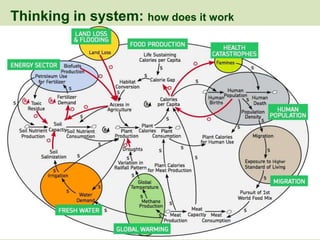
                                 Co-Chair IAASTD www.agassessment.org
                               Coordinator UNEP GER Agriculture Chapter
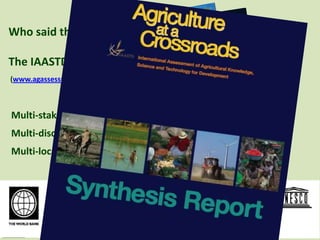
Who said that we need to change course?:

The IAASTD Reports…and then others, in different ways
(www.agassessment.org)


Multi-stakeholder: 400 authors, 52 countries
Multi-disciplinary
Multi-locational: Global / sub-Global Reports
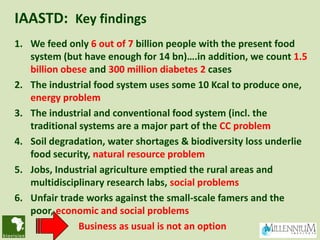
IAASTD: Key findings
1. We feed only 6 out of 7 billion people with the present food
   system (but have enough for 14 bn)….in addition, we count 1.5
   billion obese and 300 million diabetes 2 cases
2. The industrial food system uses some 10 Kcal to produce one,
   energy problem
3. The industrial and conventional food system (incl. the
   traditional systems are a major part of the CC problem
4. Soil degradation, water shortages & biodiversity loss underlie
   food security, natural resource problem
5. Jobs, Industrial agriculture emptied the rural areas and
   multidisciplinary research labs, social problems
6. Unfair trade works against the small-scale famers and the
   poor, economic and social problems
               Business as usual is not an option
What’s the plan forward?
Different intervention levels (all with multistakeholder
approaches) for planning (it’s a system), implementation and
monitoring the new paradigm (multifunctional agriculture)

1. Policies (informed via
   assessments, i.e., IAASTD, implementation via
   policies,.i.e., AU-EOA Initiative; land reforms, etc..)
2. Institutions (reformed to support agroecological
   agriculture, i.e., reassign perverse subsidies)
1. R&D (in support of the new paradigm, with emphasis on
   women, resilience
Actors: Producers, Suppliers /
Buyers, Processors, Consumers, Policy Makers
Food security…..is
“a situation that exists when all people, at all times, have physical,
    social and economic access to sufficient, safe and nutritious
    food that meets their dietary needs and food preferences for
    an active and healthy life” (FAO)
……is built on:
• food availability: sufficient quantities of nutritious food are
    available on a consistent basis
• food access: nutritious food is affordable for all people
• food stability: Not bumper yields, but stable yields as expected
   from resilient system are needed
• food use: knowledge of basic nutrition, access to adequate
    water and sanitation, safe processing and handling

           …….and implies multifunctionality
IAASTD: Showing the right road
1. “a fundamental shift in AKST and the connected
• agri-food system policies; • institutions; • capacity
development; and • investments”
2. Paradigm change: Transition to sustainable /agro-ecological /
organic agri-culture
3. An agriculture that addresses the multifunctionality and
resilience needs of the small-scale and family farmers (social &
economic: equity issue, farmer status, land ownership, empowerment, women),
quality job creation (Edu at all levels);
4. Need to use a systemic and holistic approach (basic ecological
principles); treat cause not symptoms; is part of the solution to
hunger, poverty, health, natural resources conservation, CC
5. Good governance and new Institutions
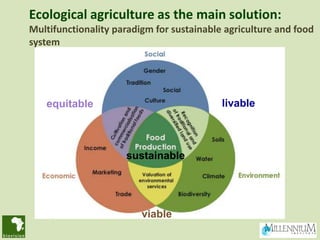
Ecological agriculture as the main solution:
Multifunctionality paradigm for sustainable agriculture and food
system


   equitable                               livable


                     sustainable


                         viable
Thinking in system: how does it work
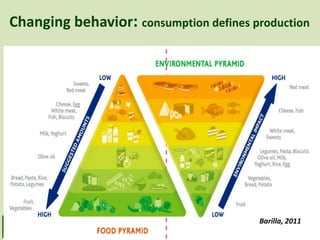
Changing behavior: consumption defines production

  Encouraging a
  wider genetic
  base in
  agriculture…trees
  , fruits, grains,
  vegetables, lost
  crops, animals

  for nutrition and
  health, cultural
  diversity,
  incomes, pest
  control, resilience
  to climate change
                                        Barilla, 2011
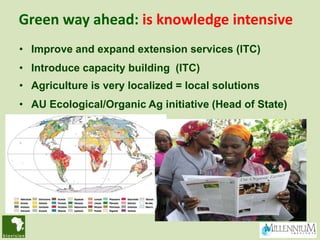
Green way ahead: is knowledge intensive
• Improve and expand extension services (ITC)
• Introduce capacity building (ITC)
• Agriculture is very localized = local solutions
• AU Ecological/Organic Ag initiative (Head of State)
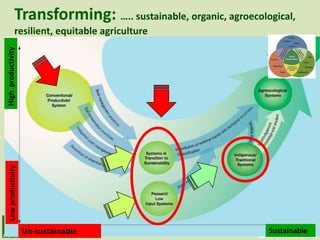
Transforming: ….. sustainable, organic, agroecological,
              resilient, equitable agriculture
High productivity
  Low productivity


                     Un-sustainable                            Sustainable
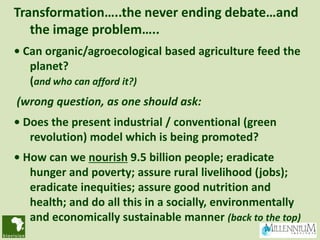
Transformation…..the never ending debate…and
   the image problem…..
• Can organic/agroecological based agriculture feed the
   planet?
   (and who can afford it?)
(wrong question, as one should ask:
• Does the present industrial / conventional (green
   revolution) model which is being promoted?
• How can we nourish 9.5 billion people; eradicate
   hunger and poverty; assure rural livelihood (jobs);
   eradicate inequities; assure good nutrition and
   health; and do all this in a socially, environmentally
   and economically sustainable manner (back to the top)
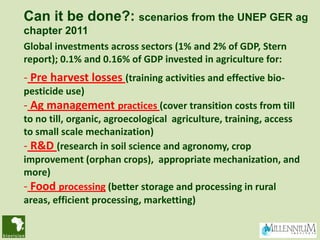
Can it be done?: scenarios from the UNEP GER ag
chapter 2011
Global investments across sectors (1% and 2% of GDP, Stern
report); 0.1% and 0.16% of GDP invested in agriculture for:
- Pre harvest losses (training activities and effective bio-
pesticide use)
- Ag management practices (cover transition costs from till
to no till, organic, agroecological agriculture, training, access
to small scale mechanization)
- R&D (research in soil science and agronomy, crop
improvement (orphan crops), appropriate mechanization, and
more)
- Food processing (better storage and processing in rural
areas, efficient processing, marketting)
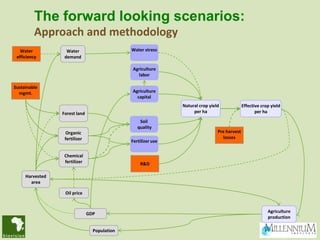
The forward looking scenarios:
         Approach and methodology
   Water           Water                      Water stress
 efficiency       demand

                                              Agriculture
                                                labor

Sustainable
  mgmt.                                       Agriculture
                                                capital
                                                               Natural crop yield             Effective crop yield
                 Forest land                                        per ha                           per ha
                                                  Soil
                                                 quality
                   Organic                                                      Pre harvest
                  fertilizer                                                      losses
                                              Fertilizer use

                  Chemical
                  fertilizer                      R&D

     Harvested
       area

                  Oil price


                               GDP                                                                         Agriculture
                                                                                                           production

                                 Population
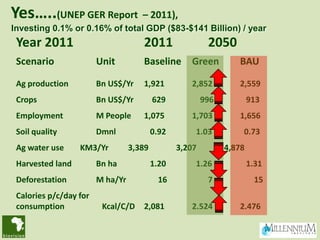
Yes…..(UNEP GER Report – 2011),
Investing 0.1% or 0.16% of total GDP ($83-$141 Billion) / year
 Year 2011                           2011                 2050
 Scenario               Unit         Baseline       Green         BAU

 Ag production          Bn US$/Yr    1,921          2,852         2,559
 Crops                  Bn US$/Yr         629            996           913
 Employment             M People     1,075          1,703         1,656
 Soil quality           Dmnl              0.92       1.03          0.73
 Ag water use     KM3/Yr          3,389          3,207         4,878
 Harvested land         Bn ha             1.20       1.26              1.31
 Deforestation          M ha/Yr             16            7              15
 Calories p/c/day for
 consumption             Kcal/C/D    2,081          2.524         2.476
In conclusion
The change that is needed will first start with each of us…
….then as a group of like minded we need to:
• take a medium and long, holistic, multifunctional and
    systemic view in addressing multiple challenges
• invest more in (agro-ecological -research, -extension, -
education
• focus on the finality of agriculture and food systems: health,
equity and cultural diversity
• support changes in governance (be active in policy design to
end perverse subsidies and favor a true food pricing policy)
• Invest in enabling conditions

……and yes it can be done, so lets do it NOW
From Stockholm 72 to Rio 92 to
   Jo‘burg 02 to Rio 12 (Rio+20)
92: Multilateral Environmental Agreements (MEA)
• (UNFCCC); (CBD); (UNCCD)

02: IAASTD
      11: IPBES
12: Governance, Institutions and Green Economy
      (IAASTD implementation via CFS)
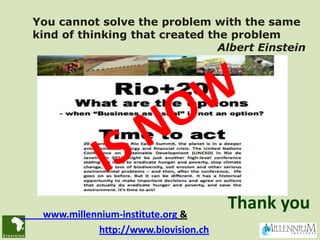
You cannot solve the problem with the same
kind of thinking that created the problem
                                Albert Einstein


 www.millennium-institute.org &
                                     Thank you
           http://www.biovision.ch

Action plan for changing course in agriculture

  • 1.
    100% agroecology willnourish the world! Action plan for changing course in agriculture Swedish Society for Hans R. Herren Nature Conservation (SSNC) April 25, 2012 President www.millennium-institute.org Stockholm President www.biovision.ch Co-Chair IAASTD www.agassessment.org Coordinator UNEP GER Agriculture Chapter
  • 2.
    Who said thatwe need to change course?: The IAASTD Reports…and then others, in different ways (www.agassessment.org) Multi-stakeholder: 400 authors, 52 countries Multi-disciplinary Multi-locational: Global / sub-Global Reports
  • 3.
    IAASTD: Key findings 1.We feed only 6 out of 7 billion people with the present food system (but have enough for 14 bn)….in addition, we count 1.5 billion obese and 300 million diabetes 2 cases 2. The industrial food system uses some 10 Kcal to produce one, energy problem 3. The industrial and conventional food system (incl. the traditional systems are a major part of the CC problem 4. Soil degradation, water shortages & biodiversity loss underlie food security, natural resource problem 5. Jobs, Industrial agriculture emptied the rural areas and multidisciplinary research labs, social problems 6. Unfair trade works against the small-scale famers and the poor, economic and social problems Business as usual is not an option
  • 4.
    What’s the planforward? Different intervention levels (all with multistakeholder approaches) for planning (it’s a system), implementation and monitoring the new paradigm (multifunctional agriculture) 1. Policies (informed via assessments, i.e., IAASTD, implementation via policies,.i.e., AU-EOA Initiative; land reforms, etc..) 2. Institutions (reformed to support agroecological agriculture, i.e., reassign perverse subsidies) 1. R&D (in support of the new paradigm, with emphasis on women, resilience Actors: Producers, Suppliers / Buyers, Processors, Consumers, Policy Makers
  • 5.
    Food security…..is “a situationthat exists when all people, at all times, have physical, social and economic access to sufficient, safe and nutritious food that meets their dietary needs and food preferences for an active and healthy life” (FAO) ……is built on: • food availability: sufficient quantities of nutritious food are available on a consistent basis • food access: nutritious food is affordable for all people • food stability: Not bumper yields, but stable yields as expected from resilient system are needed • food use: knowledge of basic nutrition, access to adequate water and sanitation, safe processing and handling …….and implies multifunctionality
  • 6.
    IAASTD: Showing theright road 1. “a fundamental shift in AKST and the connected • agri-food system policies; • institutions; • capacity development; and • investments” 2. Paradigm change: Transition to sustainable /agro-ecological / organic agri-culture 3. An agriculture that addresses the multifunctionality and resilience needs of the small-scale and family farmers (social & economic: equity issue, farmer status, land ownership, empowerment, women), quality job creation (Edu at all levels); 4. Need to use a systemic and holistic approach (basic ecological principles); treat cause not symptoms; is part of the solution to hunger, poverty, health, natural resources conservation, CC 5. Good governance and new Institutions
  • 7.
    Ecological agriculture asthe main solution: Multifunctionality paradigm for sustainable agriculture and food system equitable livable sustainable viable
  • 8.
    Thinking in system:how does it work
  • 9.
    Changing behavior: consumptiondefines production Encouraging a wider genetic base in agriculture…trees , fruits, grains, vegetables, lost crops, animals for nutrition and health, cultural diversity, incomes, pest control, resilience to climate change Barilla, 2011
  • 10.
    Green way ahead:is knowledge intensive • Improve and expand extension services (ITC) • Introduce capacity building (ITC) • Agriculture is very localized = local solutions • AU Ecological/Organic Ag initiative (Head of State)
  • 11.
    Transforming: ….. sustainable,organic, agroecological, resilient, equitable agriculture High productivity Low productivity Un-sustainable Sustainable
  • 12.
    Transformation…..the never endingdebate…and the image problem….. • Can organic/agroecological based agriculture feed the planet? (and who can afford it?) (wrong question, as one should ask: • Does the present industrial / conventional (green revolution) model which is being promoted? • How can we nourish 9.5 billion people; eradicate hunger and poverty; assure rural livelihood (jobs); eradicate inequities; assure good nutrition and health; and do all this in a socially, environmentally and economically sustainable manner (back to the top)
  • 13.
    Can it bedone?: scenarios from the UNEP GER ag chapter 2011 Global investments across sectors (1% and 2% of GDP, Stern report); 0.1% and 0.16% of GDP invested in agriculture for: - Pre harvest losses (training activities and effective bio- pesticide use) - Ag management practices (cover transition costs from till to no till, organic, agroecological agriculture, training, access to small scale mechanization) - R&D (research in soil science and agronomy, crop improvement (orphan crops), appropriate mechanization, and more) - Food processing (better storage and processing in rural areas, efficient processing, marketting)
  • 14.
    The forward lookingscenarios: Approach and methodology Water Water Water stress efficiency demand Agriculture labor Sustainable mgmt. Agriculture capital Natural crop yield Effective crop yield Forest land per ha per ha Soil quality Organic Pre harvest fertilizer losses Fertilizer use Chemical fertilizer R&D Harvested area Oil price GDP Agriculture production Population
  • 15.
    Yes…..(UNEP GER Report– 2011), Investing 0.1% or 0.16% of total GDP ($83-$141 Billion) / year Year 2011 2011 2050 Scenario Unit Baseline Green BAU Ag production Bn US$/Yr 1,921 2,852 2,559 Crops Bn US$/Yr 629 996 913 Employment M People 1,075 1,703 1,656 Soil quality Dmnl 0.92 1.03 0.73 Ag water use KM3/Yr 3,389 3,207 4,878 Harvested land Bn ha 1.20 1.26 1.31 Deforestation M ha/Yr 16 7 15 Calories p/c/day for consumption Kcal/C/D 2,081 2.524 2.476
  • 16.
    In conclusion The changethat is needed will first start with each of us… ….then as a group of like minded we need to: • take a medium and long, holistic, multifunctional and systemic view in addressing multiple challenges • invest more in (agro-ecological -research, -extension, - education • focus on the finality of agriculture and food systems: health, equity and cultural diversity • support changes in governance (be active in policy design to end perverse subsidies and favor a true food pricing policy) • Invest in enabling conditions ……and yes it can be done, so lets do it NOW
  • 17.
    From Stockholm 72to Rio 92 to Jo‘burg 02 to Rio 12 (Rio+20) 92: Multilateral Environmental Agreements (MEA) • (UNFCCC); (CBD); (UNCCD) 02: IAASTD 11: IPBES 12: Governance, Institutions and Green Economy (IAASTD implementation via CFS)
  • 18.
    You cannot solvethe problem with the same kind of thinking that created the problem Albert Einstein www.millennium-institute.org & Thank you http://www.biovision.ch

Editor's Notes

  • #2 13.00 Welcome and SSNCs new agriculture report SvanteAxelsson, Secretary General,Swedish Society for Nature Conservation (SSNC) 13.20 Sweden towards Rio +20 Magnus Kindbom, State Secretary, Ministry of Rural Development 13.40 Agriculture in the Green Economy Achim Steiner, UNEP Executive Directorand Under-Secretary-General of the United Nations 14.00 Africa can feed it self Sue Edwards, Director,Institute for Sustainable Development (ISD) 14.20 How to produce food, protect the environment and generate income for farmers André Goncalves, Technical Coordinator, Centro Ecologico and Professor Agroecology, Instituto Federal Catarinense14.35 Coffee 15.05 The potential of a productive, fossil fuel free agriculture based on ecosystem services Johanna Björklund, Teaching Professor Agroecology, Örebro University 15.20 Case, the Philippines Chito Medina, Director, MASIPAG 15.35 Action plan for changing course in agriculture Hans Herren, Director, Millenium Institute 15.55 The way forward – discussion 17.00 End
  • #4 The prevalence of diabetes has reached epidemic proportions.WHO predicts that developing countries will bear the brunt of this epidemic in the 21st century. Currently, more than 70% of people with diabetes live in low- and middle income countries.An estimated 285 million people, corresponding to 6.4% of the world's adult population, will live with diabetes in 2010. The number is expected to grow to 438 million by 2030, corresponding to 7.8% of the adult population.While the global prevalence of diabetes is 6.4%, the prevalence varies from 10.2% in the Western Pacific to 3.8% in the African region. However, the African region is expected to experience the highest increase.70% of the current cases of diabetes occur in low- and middle income countries. With an estimated 50.8 million people living with diabetes, India has the world's largest diabetes population, followed by China with 43.2 million.
  • #12 Conventional system:Best ngnt practicesSoil conservation practicesIPMReduction of chemical inputsSystem in Transition to sustainability: substitution of external inputs with biological processesPeasant low input: state support to reach “substitutions etc…Indigenous traditional systems: state support to reach the substitutions….