See discussions, stats, and author profiles for this publication at: https://www.researchgate.net/publication/28684337
A Comparative Profitability Analysis of Organic and Conventional Farms in
Emilia-Romagna and in Minnesota
Article · January 2007
DOI: 10.1007/978-0-387-39582-1_3 · Source: OAI
CITATIONS
10
READS
1,314
4 authors, including:
Some of the authors of this publication are also working on these related projects:
SISACER View project
ANGELYS - A development of a new pear variety Angelys between sensory and marketing View project
Maurizio Canavari
University of Bologna
234 PUBLICATIONS   2,486 CITATIONS   
SEE PROFILE
Rino Ghelfi
University of Bologna
34 PUBLICATIONS   92 CITATIONS   
SEE PROFILE
Sergio Rivaroli
University of Bologna
40 PUBLICATIONS   139 CITATIONS   
SEE PROFILE
All content following this page was uploaded by Maurizio Canavari on 01 June 2014.
The user has requested enhancement of the downloaded file.
1
M. Canavari, R. Ghelfi, K. Olson, S. Rivaroli*
A COMPARATIVE PROFITABILITY ANALYSIS OF
ORGANIC AND CONVENTIONAL FARMS IN
EMILIA-ROMAGNA AND IN MINNESOTA
1 Summary
Recent discussion surrounding organic agriculture (also referred to as organic
farming) has turned from just whether it represents a viable alternative to
conventional agriculture to whether it would be adopted by a significant
percentage of farmers. After a beginning phase in which the adoption was
mainly due to an ethically based choice of the farmer, the success in the
market and the increasing demand for organic products are increasing the
number of farmers converting their farming system. Despite a still high
relevance of non-economic factors and the uncertainty given by short-term
and mid-term fluctuations of prices, a decisive point is whether the conversion
to organic farming may be worthwhile from an economic perspective. The
question remains as to how many farmers would convert to organic farming
systems. The aim of the paper is to compare the actual and potential
profitability of farms using organic production methods to those farms using
conventional production methods. The analysis will be based on several data-
sets, provided on the Italian side by Emilia-Romagna Region, Italian National
Institute of Agricultural Economics (INEA), Italian National Institute of
Statistics (Istat), and on the US side by the Department of Applied
Economics, University of Minnesota.
Keywords: farm accountancy, organic farming, innovation, profitability,
comparative analysis, logistic regression
2 Introduction
The advent (or return) of organic agriculture has been listed as one of the
many innovations affecting and transforming the food industry today
(Santucci, 2002a; Santucci and Chiorri, 1996). To the proponents of organic
agriculture, it represents an alternative to conventional cultivation system.
2
The adoption of an innovation (such as organic farming) may be interpreted as
a mental process leading the agricultural entrepreneur to form an opinion on
the opportunity to make or not to make a certain choice (Rogers, 1983).
According to Prochaska et al. (1992) this mental evolution develops through
phases, characterizing the decision path of the entrepreneur. Figure 1 shows a
typical decision path leading to acceptance or refusal of innovation and the
influences of endogenous and exogenous factors. The endogenous factors are
linked to changes in structural, managerial, socio-economic characteristics of
the entrepreneur and of his or her family. The exogenous factors are linked to
changes in institutions, infrastructures, socio-economic characteristics of the
business environment and changes in demand and supply conditions within
the market.
Figure 1: the innovation-adoption decision process
After a beginning phase in which the adoption of organic farming was mainly
due to an ethically based choice of the farmer, the number of farmers
converting to an organic farming system is increasing due to the early success
in the market and the increasing demand for organic products. However, due
to the continuing presence and importance of non-economic factors and the
uncertainty given by short-term and mid-term fluctuations of prices, farmers
are still debating whether the conversion to organic farming may be
FASE di
PREPARAZIONE
Communication: information e way
of diffusion, opinioni leaders
ENDOGENOUS
FACTORS
Institutional: norms, regulations (local, national, and
international)
Motivational: Ethical,
religious
Social: Age, gender,
household's composition,
education
EXOGENOUS
FACTORS
Managerial:
Structural: Assets, farm size, type of
activities, location , altimetria, forma di
conduzione
Market:,organization and supply-chain integration models
DECISION
Economical: Incentives, prices,
profitability, costs of production,
certification costs
KNOWLEDGE
FASE
CONTEMPLATIVA
FASE
PRE-CONTEMPLATIVA
AWARENESS
3
worthwhile from an economic perspective. Thus, the question remains as to
how many farmers would convert to organic farming systems.
After the analysis of the influence of structural factors into the farmer’s
decision process, the aim of the paper is to compare the actual and potential
profitability of farms using organic production methods to those farms using
conventional production methods.
3 Objectives and hypotheses
The conceptual framework just described highlights the fact that the
conversion to organic agriculture may be influenced by a set of factors of
various nature. While it would be more desirable to jointly consider many
elements that may influence a farmer's choice, the information available only
allows us to test the influence of structural factors on the decision path
followed by a group of agricultural enterprises in the Emilia-Romagna region.
Based on the conceptual framework and the available data, the following
hypotheses are tested.
H1: structural characteristics of the farm are related to the adoption of
organic farming;
H2: a direct relationship exists between income level and organic
farming adoption.
A third objective is to compare the profitability of organic and conventional
farms in Emilia-Romagna and in Minnesota.
4 Materials and methods
The first part of this analysis was carried out using administrative and
accounting data for Emilia-Romagna farms from 2000 through 2003. This
database consists of the bookkeeping data from a sample of farms within of
the European Union Network of Farm Accountancy Data (FADN). The
information can be considered as representative of an average situation for the
2000-2003 period.
A sub-group was selected from the whole sample consisting of those farms
using organic farming methods and receiving EU subsidies for sustaining this
practice. While homogeneous in terms of organic farming practices, these
farms are different in terms of size, type of farmers, and so on. The
4
accountancy data have been standardized, so the economic parameters are
consistent and comparable across the sample and also with the group of US
farms being used for comparison.
In Minnesota, the data for this report was obtained from the University of
Minnesota’s Center for Farm Financial Management’s (CFFM’s) FINBIN©
database system.1
However, since we did not have access to individual
observations, comparable farms were obtained by selecting and deselecting
size and other characteristics of the organic farms (within FINBIN’s reporting
system) to obtain as homogeneous a group of farms as possible given the
limits in the absolute number of farms classified as organic and the reporting
mechanisms within FINBIN. A balance had to be made between having a
sufficient number of reporting farms and the breadth of the characteristics. In
the four years from 2000 through 2003, there were 42 observations of organic
farms: 10 from 2000, 11 from 2001, 10 from 2002, and 11 from 2003. These
42 farms were specified as being predominately crop; dairy; crop and dairy;
crop and hog; crop and beef; and other more diversified farms. The
conventional farm observations were 2,897; 397 from 2000, 439 from 2001,
996 from 2002, and 1,065 from 2003.
The analysis used to test the H1 and H2 hypotheses and the profitability
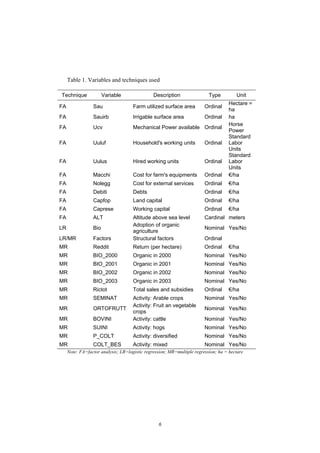
comparison is composed of five steps. Each step uses a specific multivariate
analysis technique (Table 1). The first two steps are used to obtain
homogenous sets of farms for the comparisons and tests done in the later
steps. In the first step, a factor analysis is performed using principal
components analysis and the Varimax rotation to extract a smaller number of
factors from several structural variables available on the sample farms. This
method is chosen to maximize the variability considered, while minimizing
the number of variables needed in subsequent analysis. For the second step,
the results of the factor analysis in the first step are used to identify
homogeneous groups within the Emilia-Romagna sample using a two-step
clustering technique that automatically manages categorical variables and
selects the optimal number of clusters.
In the third step, the factors affecting the choice to adopt organic farming are
analyzed using a logistic regression or LOGIT procedure following other
studies of innovation adoption (Jarvis, 1981; Rogers, 1983; Young and
Shumway, 1991; Sterns and Peterson, 1996; Neupane et al., 2002; Menard,
1
Available at this URL: http://www.finbin.umn.edu/.
5
2002). Since the Emilia-Romagna data set lacks information on farmer's
characteristics, the resulting choice model includes just structural variables:
[ ] i
i
i
i
i
X
X
P
P
Y
it ε
β
β
β +
+
+
+
=






−
= ...
1
ln
)
(
log 1
1
0
(1)
where Y is a (0,1) value, P is the probability that Y assumes a value equal to 1
given the level of the independent variables (in this case the structural factors
X1, X2,…, Xi ), β0 is the intercept and β1, β2,…, βi are the coefficients
associated with the independent variables, and εi is the error term. In this case,
the error term needs to be interpreted as the effect of variables not considered
in the equation, as well as measurement errors. The H1 hypothesis is verified
if any single independent variable in the logistic regression model and the
pseudo R-square index are significant.
In the fourth step, multiple linear regression is used to test the H2 hypothesis
of a relationship among organic farming and profitability:
i
i i
i
X
X
Y ε
β
β
β +
+
+
+
= ...
1
1
0
(2)
where Y is the income level and X1, X2,…, Xi are explanatory variables. The
hypothesis is verified if the dummy variables describing the adoption of
organic farming have significant coefficients. The relationship will be positive
or negative according to the sign of the coefficient.
In the fifth step, the economic results of organic and conventional farms in
Emilia-Romagna and then in Minnesota are compared using simple statistics.
The statistical significance of the differences between the means in the
Emilia-Romagna data is tested using a simple F-test.
5 Results and discussion
5.1 The choice to adopt organic farming in Emilia-Romagna
In the first step of the analysis, the factor analysis applied to the eleven
structural variables listed in Table 1 captured about 55% of their variability
using just 4 factors, all having a 99.9% significance level. Following Kaiser
(1974), the overall fit of the factor model is confirmed by the value of the
KMO test (0.61). These four factors are characterized as follows:
6
Table 1. Variables and techniques used
Technique Variable Description Type Unit
FA Sau Farm utilized surface area Ordinal
Hectare =
ha
FA Sauirb Irrigable surface area Ordinal ha
FA Ucv Mechanical Power available Ordinal
Horse
Power
FA Uuluf Household's working units Ordinal
Standard
Labor
Units
FA Uulus Hired working units Ordinal
Standard
Labor
Units
FA Macchi Cost for farm's equipments Ordinal €/ha
FA Nolegg Cost for external services Ordinal €/ha
FA Debiti Debts Ordinal €/ha
FA Capfop Land capital Ordinal €/ha
FA Caprese Working capital Ordinal €/ha
FA ALT Altitude above sea level Cardinal meters
LR Bio
Adoption of organic
agriculture
Nominal Yes/No
LR/MR Factors Structural factors Ordinal
MR Reddit Return (per hectare) Ordinal €/ha
MR BIO_2000 Organic in 2000 Nominal Yes/No
MR BIO_2001 Organic in 2001 Nominal Yes/No
MR BIO_2002 Organic in 2002 Nominal Yes/No
MR BIO_2003 Organic in 2003 Nominal Yes/No
MR Rictot Total sales and subsidies Ordinal €/ha
MR SEMINAT Activity: Arable crops Nominal Yes/No
MR ORTOFRUTT
Activity: Fruit an vegetable
crops
Nominal Yes/No
MR BOVINI Activity: cattle Nominal Yes/No
MR SUINI Activity: hogs Nominal Yes/No
MR P_COLT Activity: diversified Nominal Yes/No
MR COLT_BES Activity: mixed Nominal Yes/No
Note: FA=factor analysis; LR=logistic regression; MR=multiple regression; ha = hectare
7
F1: assets intensity
F2: labor intensity
F3: de-structuration
F4: flexibility and production potential
In the second step, the clustering technique applied to the scores obtained by
each observation in the data set verified the existence of a structural
homogeneity among the organic farms in the sample. The clustering
procedure defined three clusters, each including organic farms.
Cluster 1 is composed of 354 farms, of which 56 are organic. This cluster
mainly includes mid-size farms in the hilly area with vineyards and dairy
production. Household members are the main source of labor, and most of the
farm's operations are carried out using their own equipment.
The remaining two clusters are mainly located in the plain area. Cluster 2 is
composed of 506 small farms, of which 17 are organic. These farms are
mainly operated directly by the farmer and are oriented to fruit growing. In
cluster 3, mid-size farms specialized in arable crops prevail, and outsourcing
for the farm's operations is quite common. Just 10 out of a total of 921 farms
grouped in this cluster are organic.
In the third step, logistic regression is unable to explain and foresee the choice
of the farmers when only structural factors are used as explanatory variables,
That is, the low level of the pseudo-R square index, 2
L
R , in all three groups
lets us reject the H1 hypothesis that structural variables are related to the
adoption of organic farming. This rejection highlights the need of further
information on other types of factors, especially those more closely linked to
personal characteristics of farmers. A slightly higher level of the pseudo-R
square index in cluster 1, suggests that structural variables may help explain
farmers’ choices if other variables were to be included also. The adoption of
organic farming seems to be more linked to (1) farming systems strictly
related to a household's control of the enterprising activity (factor 3 β***
= -
1.70) and (2) less labor intense activities (factor 2 β*
= -0.55).
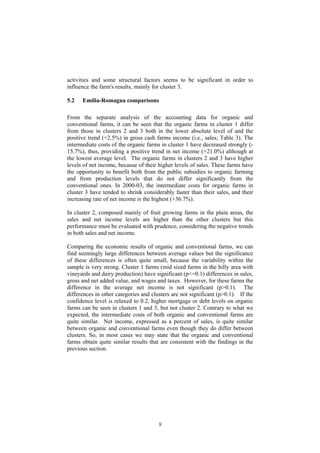
In the fourth step, the multiple regression analysis of per area income results
and several structural and diverse variables appears to reject the H2 hypothesis
of a correlation between the choice of adopting the organic farming and the
income level seem to be rejected (Table 2). The t-values associated to the β
coefficients of the dummy variables distinguishing the organic and non-
organic farms within each year show that the effects of this farm's feature are
8
statistically not different from zero for all 3 clusters and years considered. We
can interpret this to mean that the choice to adopt organic farming is not
relevant for the farm results as measured by income and that both organic and
non-organic farmers have succeeded in obtaining similar results from their
choices and actions.
Table 2: Multiple regression analysis: results
Cluster 1 Cluster 2 Cluster 3
VARIABLES
Std.
Beta
Coeff. t
Std.
Beta
Coeff. t
Std.
Beta
Coeff. t
BIO_2000 -0.18 -0.64 0.03 0.21 -0.01 -1.19
BIO_2001 -0.04 -1.17 -0.01 -0.92 0.00 0.38
BIO_2002 -0.04 -1.30 -0.01 -0.84 0.00 0.20
BIO_2003 -0.01 -0.34 -0.01 -0.51 0.00 -0.23
rictot 0.92*** 27.79 1.09*** 54.23 1.08*** 131.37
SEMINAT(a)
0.05 1.59 0.04 2.45
ORTFRUTT 0.04 1.36 0.02 1.07 0.03*** 4.40
VITE(b)
-0.36*** -4.46
BOVINI 0.06* 1.70 0.02 1.34 -0.07*** -8.69
SUINI 0.04 1.24 -0.18*** -10.62 -0.18*** -21.71
P_COLT 0.08 2.52 0.03 1.88 -0.01 -0.87
COLT_BES 0.03 0.97 0.01 0.73 -0.01 -1.77
Factor 1 -0.12*** -3.55 -0.12*** -6.35 -0.18*** -21.16
Factor 2 -0.13*** -3.65 -0.04 -2.31 -0.12*** -10.09
Factor 3 -0.02 -0.68 -0.04 -2.22 -0.04*** -4.88
Factor 4 -0.05 -1.35 -0.03 -1.43 -0.07*** -5.70
Adjusted R-squared 0.73 0.89 0.95
df1 15 15 15
df2 338 490 915
Sig. var. of F 0.00 0.00 0.00
* P<0.10, ** P<0.05, *** P<0.01
(a) variable excluded during the analysis of cluster 3
(b) variables excluded during the analysis of clusters 1 and 2
The high level of model fit (adjusted R-square higher than 70%) is to be
associated to the high level of farm's sales, which is a basic factor for
achieving a positive result. We did not include the cost of production, in order
to avoid a perfect fit (that would have been a trivial result of the analysis),
since our aim was to highlight the effect of other factors. The choice of the
9
activities and some structural factors seems to be significant in order to
influence the farm's results, mainly for cluster 3.
5.2 Emilia-Romagna comparisons
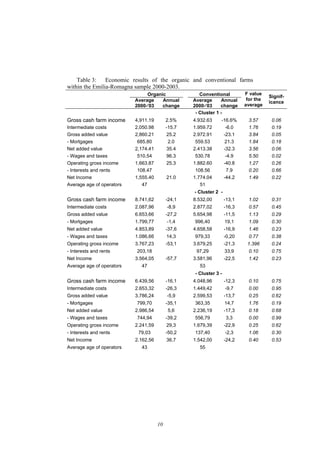
From the separate analysis of the accounting data for organic and
conventional farms, it can be seen that the organic farms in cluster 1 differ
from those in clusters 2 and 3 both in the lower absolute level of and the
positive trend (+2.5%) in gross cash farms income (i.e., sales; Table 3). The
intermediate costs of the organic farms in cluster 1 have decreased strongly (-
15.7%), thus, providing a positive trend in net income (+21.0%) although at
the lowest average level. The organic farms in clusters 2 and 3 have higher
levels of net income, because of their higher levels of sales. These farms have
the opportunity to benefit both from the public subsidies to organic farming
and from production levels that do not differ significantly from the
conventional ones. In 2000-03, the intermediate costs for organic farms in
cluster 3 have tended to shrink considerably faster than their sales, and their
increasing rate of net income is the highest (+36.7%).
In cluster 2, composed mainly of fruit growing farms in the plain areas, the
sales and net income levels are higher than the other clusters but this
performance must be evaluated with prudence, considering the negative trends
in both sales and net income.
Comparing the economic results of organic and conventional farms, we can
find seemingly large differences between average values but the significance
of these differences is often quite small, because the variability within the
sample is very strong. Cluster 1 farms (mid sized farms in the hilly area with
vineyards and dairy production) have significant (p<=0.1) differences in sales,
gross and net added value, and wages and taxes. However, for these farms the
difference in the average net income is not significant (p>0.1). The
differences in other categories and clusters are not significant (p>0.1). If the
confidence level is relaxed to 0.2, higher mortgage or debt levels on organic
farms can be seen in clusters 1 and 3, but not cluster 2. Contrary to what we
expected, the intermediate costs of both organic and conventional farms are
quite similar. Net income, expressed as a percent of sales, is quite similar
between organic and conventional farms even though they do differ between
clusters. So, in most cases we may state that the organic and conventional
farms obtain quite similar results that are consistent with the findings in the
previous section.
10
Table 3: Economic results of the organic and conventional farms
within the Emilia-Romagna sample 2000-2003.
Organic Conventional
Average
2000-‘03
Annual
change
Average
2000-‘03
Annual
change
F value
for the
average
Signif-
icance
- Cluster 1 -
Gross cash farm income 4,911.19 2.5% 4.932.63 -16.6% 3.57 0.06
Intermediate costs 2,050.98 -15.7 1.959.72 -6.0 1.76 0.19
Gross added value 2,860.21 25.2 2.972.91 -23.1 3.84 0.05
- Mortgages 685.80 2.0 559.53 21.3 1.84 0.18
Net added value 2,174.41 35.4 2.413.38 -32.3 3.56 0.06
- Wages and taxes 510.54 96.3 530.78 -4.9 5.50 0.02
Operating gross income 1,663.87 25.3 1.882.60 -40.8 1.27 0.26
- Interests and rents 108.47 108.56 7.9 0.20 0.66
Net Income 1,555.40 21.0 1.774.04 -44.2 1.49 0.22
Average age of operators 47 51
- Cluster 2 -
Gross cash farm income 8.741,62 -24,1 8.532,00 -13,1 1.02 0.31
Intermediate costs 2.087,96 -8,9 2.877,02 -16,3 0.57 0.45
Gross added value 6.653,66 -27,2 5.654,98 -11,5 1.13 0.29
- Mortgages 1.799,77 -1,4 996,40 19,1 1.09 0.30
Net added value 4.853,89 -37,6 4.658,58 -16,9 1.46 0.23
- Wages and taxes 1.086,66 14,3 979,33 -0,20 0.77 0.38
Operating gross income 3.767,23 -53,1 3.679,25 -21,3 1.396 0.24
- Interests and rents 203,18 97,29 33,9 0.10 0.75
Net Income 3.564,05 -57,7 3.581,96 -22,5 1.42 0.23
Average age of operators 47 53
- Cluster 3 -
Gross cash farm income 6.439,56 -16,1 4.048,96 -12,3 0.10 0.75
Intermediate costs 2.653,32 -26,3 1.449,42 -9,7 0.00 0.95
Gross added value 3.786,24 -5,9 2.599,53 -13,7 0.25 0.62
- Mortgages 799,70 -35,1 363,35 14,7 1.76 0.19
Net added value 2.986,54 5,6 2.236,19 -17,3 0.18 0.68
- Wages and taxes 744,94 -39,2 556,79 3,3 0.00 0.99
Operating gross income 2.241,59 29,3 1.679,39 -22,9 0.25 0.62
- Interests and rents 79,03 -50,2 137,40 -2,3 1.06 0.30
Net Income 2.162,56 36,7 1.542,00 -24,2 0.40 0.53
Average age of operators 43 55
11
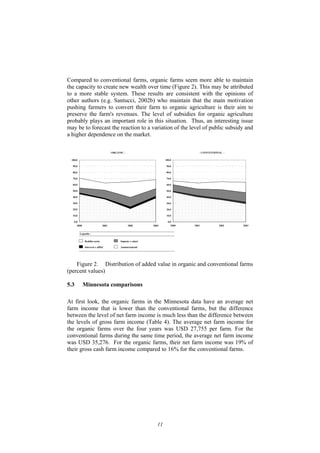
Compared to conventional farms, organic farms seem more able to maintain
the capacity to create new wealth over time (Figure 2). This may be attributed
to a more stable system. These results are consistent with the opinions of
other authors (e.g. Santucci, 2002b) who maintain that the main motivation
pushing farmers to convert their farm to organic agriculture is their aim to
preserve the farm's revenues. The level of subsidies for organic agriculture
probably plays an important role in this situation. Thus, an interesting issue
may be to forecast the reaction to a variation of the level of public subsidy and
a higher dependence on the market.
0,0
10,0
20,0
30,0
40,0
50,0
60,0
70,0
80,0
90,0
100,0
2000 2001 2002 2003
0,0
10,0
20,0
30,0
40,0
50,0
60,0
70,0
80,0
90,0
100,0
2000 2001 2002 2003
- ORGANIC - - CONVENTIONAL -
Interessi e affitti
Reddito netto
Ammortamenti
Imposte e salari
Legenda :
Figure 2. Distribution of added value in organic and conventional farms
(percent values)
5.3 Minnesota comparisons
At first look, the organic farms in the Minnesota data have an average net
farm income that is lower than the conventional farms, but the difference
between the level of net farm income is much less than the difference between
the levels of gross farm income (Table 4). The average net farm income for
the organic farms over the four years was USD 27,755 per farm. For the
conventional farms during the same time period, the average net farm income
was USD 35,276. For the organic farms, their net farm income was 19% of
their gross cash farm income compared to 16% for the conventional farms.
12
Average rates of return to assets (ROA) and equity (ROE) show a mixed
story. The 4-year average ROA was 5.9% for the organic farms and 5.8% for
the conventional farms. The rank was reversed for ROE; the organic farms
had an average ROE of 4.8% and 5.1% for conventional farms.
Financial efficiency, as measured by operating profit margin and asset
turnover rate, appears to be similar when comparing the 4-year average. But,
the annual averages for the two groups do vary considerably and do not
follow a similar pattern of deterioration and improvement.
The average financial condition of the farms also varies. The conventional
farms tend to be larger in terms of the value of assets. The 4-year average
value of total farm assets is USD 707,293 for the conventional farms and
USD 454,032 for the organic farms with assets valued at market. The organic
farms are carrying a smaller debt load, however, relative to their asset value.
With assets valued at market, the 4-year average farm debt-to-asset ratio was
51% for the conventional farms and 41% for the organic farms. Annual
variation in the debt-to-asset ratio is not very great, and the difference in the
relative debt load is also stable over this time period.
Conventional farms are larger in terms of crop acreage: 547 crop acres (221
hectares) versus 374 acres (151 hectares) for organic farms. The absolute
number of acres rented is greater for conventional farms, but rented land as a
percentage of total cropland is only slightly larger for conventional farms:
66% compared to 62%.
The amount of labor used on the farm also varied between the two groups of
farms. The conventional farms used more total hours per farm while the
organic farms used more labor per crop acre. The conventional farms had a
higher level of net farm income per hour of unpaid labor.
In general, this analysis seems to support the widely held view of organic
farms in Minnesota: on average, the organic farms in this data-set, tend to be
smaller, carried less debt, had lower crop yields, and produced less income
per farm and per hour compared to conventional farms. However, since
individual data were not accessible, the significance of these differences
cannot be tested.
13
Table 4. Average financial performance and other characteristics of
selected organic and conventional farms in Minnesota
Organic Conventional
Number of farms 42 2897
Gross cash farm income 143,211 225,215
Total cash farm expense -105,660 -180,766
Inventory change -548 +7,610
Depreciation & capital adjustments -9,248 -16,782
Net farm income 27755 35276
Labor and management earnings 16,759 20,035
Rate of return on assets 5.9 5.8
Rate of return on equity 4.8 5.1
Operating profit margin 14.7 14.5
Asset turnover rate 39.9 40
Solvency (market)
Number of sole proprietors 40 2,662
Ending farm assets 454,032 707,293
Ending farm liabilities 187,787 358,553
Ending farm net worth 266,245 348,740
Ending farm debt to asset ratio 41 51
Crop Acres
Total acres owned 186 235
Total crop acres 374 547
Total crop acres owned 142 188
Total crop acres cash rented 211 338
Total crop acres share rented 21 21
Average age of operators 46.7 44.6
Labor Analysis
Number of farms 40 2,833
Total unpaid labor hours 2,189 2,344
Total hired labor hours 448 478
Total labor hours per farm 2,638 2,822
Unpaid hours per operator 2,037 2,136
Value of farm production / hour 48.25 74.51
Net farm income / unpaid hour 12.13 14.88
Total labor hours per crop acre 7.1 5.2
Source: Farm Business Management Education, Minnesota State College and University
14
6 Final remarks
In this analysis and with the available data, we were unable to show that
income differences were due to adopting organic production methods. We
rejected both the hypothesis that structural variables are related to the
adoption of organic farming and the hypothesis that a direct relationship exists
between income level and organic farming adoption. Thus, income seems to
be more related to individual farmers' abilities to manage resources and
processes, not organic versus non-organic. However, since our data did not
include some possibly important variables, future research could utilize an
integrated dataset to analyze economic and financial performance as a
function of farm structure, management practices, and personal and household
characteristics.
7 References
Jarvis L.S. (1981), Predicting the diffusion of improved pastures in Uruguay,
American Journal of Agricultural Economics, 63: 495 502
Kaiser H.F. (1974), An index of factorial simplicity, Psychometrika, 39: 31-
36
Menard S. (2002), Applied logistic regression analysis, in: Quantitative
application in the social sciences, Sage University Paper, Thousand Oaks,
California
Neupane R.P., Sharma K.R., Thapa G.B. (2002), Adoption of agroforestry in
the hills of Nepal: a logistic regression analysis, Agricultural System, 72:
177-196.
Prochaska et al. (1992)
Rogers E.M. (ed., 1995), Diffusion of innovation, The Free Press, New York
Santucci F.M. – Chiorri M. (1996), Economia delle produzioni biologiche: il
caso dell’Umbria, Quaderno 19, Istituto di Economia e Politica Agraria,
Perugia
Santucci F.M. (2002a), Limiti e necessità della comparazione tra biologico e
convenzionale, in: L’agricoltura biologica in iItalia: metodologie di analisi
e risultati dell’utilizzo dei dati RICA, INEA – I metodi RICA, Roma, pp.
15-21.
Santucci F.M. (2002b), Convenienze micro-economiche dell’agricoltura
biologica, in: Problematiche dell’agricoltura italiana. Scenari possibili –
15
Agricoltura biologica, Accademia Nazionale di Agricoltura – Consiglio
Nazionale delle Ricerche, Bologna, pp. 125-185.
Sterns J.A. – Peterson H.C. (1996), The propensity to enter and exit export
markets, Sraff Paper 96-30, Department of Agricultural Economic, East
Lansing, Michigan
Young K.D. – Shumway C.R. (1991), Cow-calf producers’ perceived profit
maximization objective: a logit analysis, Southern Journal of Agricultural
Economics, 23: 129-136
Zanoli R. – Gambelli D. – Fiorani S. (2002), La comparazione economica tra
aziende biologiche e convenzionali: aspetti metodologici e strumenti
operativi, in: L’agricoltura biologica in Italia: metodologie di analisi e
risultati dell’utilizzo dei dati RICA, INEA – I metodi RICA, Roma, pp. 25-
40
View publication stats

A comparative profitability_analysis_of_organic_an

  • 1.
    See discussions, stats,and author profiles for this publication at: https://www.researchgate.net/publication/28684337 A Comparative Profitability Analysis of Organic and Conventional Farms in Emilia-Romagna and in Minnesota Article · January 2007 DOI: 10.1007/978-0-387-39582-1_3 · Source: OAI CITATIONS 10 READS 1,314 4 authors, including: Some of the authors of this publication are also working on these related projects: SISACER View project ANGELYS - A development of a new pear variety Angelys between sensory and marketing View project Maurizio Canavari University of Bologna 234 PUBLICATIONS   2,486 CITATIONS    SEE PROFILE Rino Ghelfi University of Bologna 34 PUBLICATIONS   92 CITATIONS    SEE PROFILE Sergio Rivaroli University of Bologna 40 PUBLICATIONS   139 CITATIONS    SEE PROFILE All content following this page was uploaded by Maurizio Canavari on 01 June 2014. The user has requested enhancement of the downloaded file.
  • 2.
    1 M. Canavari, R.Ghelfi, K. Olson, S. Rivaroli* A COMPARATIVE PROFITABILITY ANALYSIS OF ORGANIC AND CONVENTIONAL FARMS IN EMILIA-ROMAGNA AND IN MINNESOTA 1 Summary Recent discussion surrounding organic agriculture (also referred to as organic farming) has turned from just whether it represents a viable alternative to conventional agriculture to whether it would be adopted by a significant percentage of farmers. After a beginning phase in which the adoption was mainly due to an ethically based choice of the farmer, the success in the market and the increasing demand for organic products are increasing the number of farmers converting their farming system. Despite a still high relevance of non-economic factors and the uncertainty given by short-term and mid-term fluctuations of prices, a decisive point is whether the conversion to organic farming may be worthwhile from an economic perspective. The question remains as to how many farmers would convert to organic farming systems. The aim of the paper is to compare the actual and potential profitability of farms using organic production methods to those farms using conventional production methods. The analysis will be based on several data- sets, provided on the Italian side by Emilia-Romagna Region, Italian National Institute of Agricultural Economics (INEA), Italian National Institute of Statistics (Istat), and on the US side by the Department of Applied Economics, University of Minnesota. Keywords: farm accountancy, organic farming, innovation, profitability, comparative analysis, logistic regression 2 Introduction The advent (or return) of organic agriculture has been listed as one of the many innovations affecting and transforming the food industry today (Santucci, 2002a; Santucci and Chiorri, 1996). To the proponents of organic agriculture, it represents an alternative to conventional cultivation system.
  • 3.
    2 The adoption ofan innovation (such as organic farming) may be interpreted as a mental process leading the agricultural entrepreneur to form an opinion on the opportunity to make or not to make a certain choice (Rogers, 1983). According to Prochaska et al. (1992) this mental evolution develops through phases, characterizing the decision path of the entrepreneur. Figure 1 shows a typical decision path leading to acceptance or refusal of innovation and the influences of endogenous and exogenous factors. The endogenous factors are linked to changes in structural, managerial, socio-economic characteristics of the entrepreneur and of his or her family. The exogenous factors are linked to changes in institutions, infrastructures, socio-economic characteristics of the business environment and changes in demand and supply conditions within the market. Figure 1: the innovation-adoption decision process After a beginning phase in which the adoption of organic farming was mainly due to an ethically based choice of the farmer, the number of farmers converting to an organic farming system is increasing due to the early success in the market and the increasing demand for organic products. However, due to the continuing presence and importance of non-economic factors and the uncertainty given by short-term and mid-term fluctuations of prices, farmers are still debating whether the conversion to organic farming may be FASE di PREPARAZIONE Communication: information e way of diffusion, opinioni leaders ENDOGENOUS FACTORS Institutional: norms, regulations (local, national, and international) Motivational: Ethical, religious Social: Age, gender, household's composition, education EXOGENOUS FACTORS Managerial: Structural: Assets, farm size, type of activities, location , altimetria, forma di conduzione Market:,organization and supply-chain integration models DECISION Economical: Incentives, prices, profitability, costs of production, certification costs KNOWLEDGE FASE CONTEMPLATIVA FASE PRE-CONTEMPLATIVA AWARENESS
  • 4.
    3 worthwhile from aneconomic perspective. Thus, the question remains as to how many farmers would convert to organic farming systems. After the analysis of the influence of structural factors into the farmer’s decision process, the aim of the paper is to compare the actual and potential profitability of farms using organic production methods to those farms using conventional production methods. 3 Objectives and hypotheses The conceptual framework just described highlights the fact that the conversion to organic agriculture may be influenced by a set of factors of various nature. While it would be more desirable to jointly consider many elements that may influence a farmer's choice, the information available only allows us to test the influence of structural factors on the decision path followed by a group of agricultural enterprises in the Emilia-Romagna region. Based on the conceptual framework and the available data, the following hypotheses are tested. H1: structural characteristics of the farm are related to the adoption of organic farming; H2: a direct relationship exists between income level and organic farming adoption. A third objective is to compare the profitability of organic and conventional farms in Emilia-Romagna and in Minnesota. 4 Materials and methods The first part of this analysis was carried out using administrative and accounting data for Emilia-Romagna farms from 2000 through 2003. This database consists of the bookkeeping data from a sample of farms within of the European Union Network of Farm Accountancy Data (FADN). The information can be considered as representative of an average situation for the 2000-2003 period. A sub-group was selected from the whole sample consisting of those farms using organic farming methods and receiving EU subsidies for sustaining this practice. While homogeneous in terms of organic farming practices, these farms are different in terms of size, type of farmers, and so on. The
  • 5.
    4 accountancy data havebeen standardized, so the economic parameters are consistent and comparable across the sample and also with the group of US farms being used for comparison. In Minnesota, the data for this report was obtained from the University of Minnesota’s Center for Farm Financial Management’s (CFFM’s) FINBIN© database system.1 However, since we did not have access to individual observations, comparable farms were obtained by selecting and deselecting size and other characteristics of the organic farms (within FINBIN’s reporting system) to obtain as homogeneous a group of farms as possible given the limits in the absolute number of farms classified as organic and the reporting mechanisms within FINBIN. A balance had to be made between having a sufficient number of reporting farms and the breadth of the characteristics. In the four years from 2000 through 2003, there were 42 observations of organic farms: 10 from 2000, 11 from 2001, 10 from 2002, and 11 from 2003. These 42 farms were specified as being predominately crop; dairy; crop and dairy; crop and hog; crop and beef; and other more diversified farms. The conventional farm observations were 2,897; 397 from 2000, 439 from 2001, 996 from 2002, and 1,065 from 2003. The analysis used to test the H1 and H2 hypotheses and the profitability comparison is composed of five steps. Each step uses a specific multivariate analysis technique (Table 1). The first two steps are used to obtain homogenous sets of farms for the comparisons and tests done in the later steps. In the first step, a factor analysis is performed using principal components analysis and the Varimax rotation to extract a smaller number of factors from several structural variables available on the sample farms. This method is chosen to maximize the variability considered, while minimizing the number of variables needed in subsequent analysis. For the second step, the results of the factor analysis in the first step are used to identify homogeneous groups within the Emilia-Romagna sample using a two-step clustering technique that automatically manages categorical variables and selects the optimal number of clusters. In the third step, the factors affecting the choice to adopt organic farming are analyzed using a logistic regression or LOGIT procedure following other studies of innovation adoption (Jarvis, 1981; Rogers, 1983; Young and Shumway, 1991; Sterns and Peterson, 1996; Neupane et al., 2002; Menard, 1 Available at this URL: http://www.finbin.umn.edu/.
  • 6.
    5 2002). Since theEmilia-Romagna data set lacks information on farmer's characteristics, the resulting choice model includes just structural variables: [ ] i i i i i X X P P Y it ε β β β + + + + =       − = ... 1 ln ) ( log 1 1 0 (1) where Y is a (0,1) value, P is the probability that Y assumes a value equal to 1 given the level of the independent variables (in this case the structural factors X1, X2,…, Xi ), β0 is the intercept and β1, β2,…, βi are the coefficients associated with the independent variables, and εi is the error term. In this case, the error term needs to be interpreted as the effect of variables not considered in the equation, as well as measurement errors. The H1 hypothesis is verified if any single independent variable in the logistic regression model and the pseudo R-square index are significant. In the fourth step, multiple linear regression is used to test the H2 hypothesis of a relationship among organic farming and profitability: i i i i X X Y ε β β β + + + + = ... 1 1 0 (2) where Y is the income level and X1, X2,…, Xi are explanatory variables. The hypothesis is verified if the dummy variables describing the adoption of organic farming have significant coefficients. The relationship will be positive or negative according to the sign of the coefficient. In the fifth step, the economic results of organic and conventional farms in Emilia-Romagna and then in Minnesota are compared using simple statistics. The statistical significance of the differences between the means in the Emilia-Romagna data is tested using a simple F-test. 5 Results and discussion 5.1 The choice to adopt organic farming in Emilia-Romagna In the first step of the analysis, the factor analysis applied to the eleven structural variables listed in Table 1 captured about 55% of their variability using just 4 factors, all having a 99.9% significance level. Following Kaiser (1974), the overall fit of the factor model is confirmed by the value of the KMO test (0.61). These four factors are characterized as follows:
  • 7.
    6 Table 1. Variablesand techniques used Technique Variable Description Type Unit FA Sau Farm utilized surface area Ordinal Hectare = ha FA Sauirb Irrigable surface area Ordinal ha FA Ucv Mechanical Power available Ordinal Horse Power FA Uuluf Household's working units Ordinal Standard Labor Units FA Uulus Hired working units Ordinal Standard Labor Units FA Macchi Cost for farm's equipments Ordinal €/ha FA Nolegg Cost for external services Ordinal €/ha FA Debiti Debts Ordinal €/ha FA Capfop Land capital Ordinal €/ha FA Caprese Working capital Ordinal €/ha FA ALT Altitude above sea level Cardinal meters LR Bio Adoption of organic agriculture Nominal Yes/No LR/MR Factors Structural factors Ordinal MR Reddit Return (per hectare) Ordinal €/ha MR BIO_2000 Organic in 2000 Nominal Yes/No MR BIO_2001 Organic in 2001 Nominal Yes/No MR BIO_2002 Organic in 2002 Nominal Yes/No MR BIO_2003 Organic in 2003 Nominal Yes/No MR Rictot Total sales and subsidies Ordinal €/ha MR SEMINAT Activity: Arable crops Nominal Yes/No MR ORTOFRUTT Activity: Fruit an vegetable crops Nominal Yes/No MR BOVINI Activity: cattle Nominal Yes/No MR SUINI Activity: hogs Nominal Yes/No MR P_COLT Activity: diversified Nominal Yes/No MR COLT_BES Activity: mixed Nominal Yes/No Note: FA=factor analysis; LR=logistic regression; MR=multiple regression; ha = hectare
  • 8.
    7 F1: assets intensity F2:labor intensity F3: de-structuration F4: flexibility and production potential In the second step, the clustering technique applied to the scores obtained by each observation in the data set verified the existence of a structural homogeneity among the organic farms in the sample. The clustering procedure defined three clusters, each including organic farms. Cluster 1 is composed of 354 farms, of which 56 are organic. This cluster mainly includes mid-size farms in the hilly area with vineyards and dairy production. Household members are the main source of labor, and most of the farm's operations are carried out using their own equipment. The remaining two clusters are mainly located in the plain area. Cluster 2 is composed of 506 small farms, of which 17 are organic. These farms are mainly operated directly by the farmer and are oriented to fruit growing. In cluster 3, mid-size farms specialized in arable crops prevail, and outsourcing for the farm's operations is quite common. Just 10 out of a total of 921 farms grouped in this cluster are organic. In the third step, logistic regression is unable to explain and foresee the choice of the farmers when only structural factors are used as explanatory variables, That is, the low level of the pseudo-R square index, 2 L R , in all three groups lets us reject the H1 hypothesis that structural variables are related to the adoption of organic farming. This rejection highlights the need of further information on other types of factors, especially those more closely linked to personal characteristics of farmers. A slightly higher level of the pseudo-R square index in cluster 1, suggests that structural variables may help explain farmers’ choices if other variables were to be included also. The adoption of organic farming seems to be more linked to (1) farming systems strictly related to a household's control of the enterprising activity (factor 3 β*** = - 1.70) and (2) less labor intense activities (factor 2 β* = -0.55). In the fourth step, the multiple regression analysis of per area income results and several structural and diverse variables appears to reject the H2 hypothesis of a correlation between the choice of adopting the organic farming and the income level seem to be rejected (Table 2). The t-values associated to the β coefficients of the dummy variables distinguishing the organic and non- organic farms within each year show that the effects of this farm's feature are
  • 9.
    8 statistically not differentfrom zero for all 3 clusters and years considered. We can interpret this to mean that the choice to adopt organic farming is not relevant for the farm results as measured by income and that both organic and non-organic farmers have succeeded in obtaining similar results from their choices and actions. Table 2: Multiple regression analysis: results Cluster 1 Cluster 2 Cluster 3 VARIABLES Std. Beta Coeff. t Std. Beta Coeff. t Std. Beta Coeff. t BIO_2000 -0.18 -0.64 0.03 0.21 -0.01 -1.19 BIO_2001 -0.04 -1.17 -0.01 -0.92 0.00 0.38 BIO_2002 -0.04 -1.30 -0.01 -0.84 0.00 0.20 BIO_2003 -0.01 -0.34 -0.01 -0.51 0.00 -0.23 rictot 0.92*** 27.79 1.09*** 54.23 1.08*** 131.37 SEMINAT(a) 0.05 1.59 0.04 2.45 ORTFRUTT 0.04 1.36 0.02 1.07 0.03*** 4.40 VITE(b) -0.36*** -4.46 BOVINI 0.06* 1.70 0.02 1.34 -0.07*** -8.69 SUINI 0.04 1.24 -0.18*** -10.62 -0.18*** -21.71 P_COLT 0.08 2.52 0.03 1.88 -0.01 -0.87 COLT_BES 0.03 0.97 0.01 0.73 -0.01 -1.77 Factor 1 -0.12*** -3.55 -0.12*** -6.35 -0.18*** -21.16 Factor 2 -0.13*** -3.65 -0.04 -2.31 -0.12*** -10.09 Factor 3 -0.02 -0.68 -0.04 -2.22 -0.04*** -4.88 Factor 4 -0.05 -1.35 -0.03 -1.43 -0.07*** -5.70 Adjusted R-squared 0.73 0.89 0.95 df1 15 15 15 df2 338 490 915 Sig. var. of F 0.00 0.00 0.00 * P<0.10, ** P<0.05, *** P<0.01 (a) variable excluded during the analysis of cluster 3 (b) variables excluded during the analysis of clusters 1 and 2 The high level of model fit (adjusted R-square higher than 70%) is to be associated to the high level of farm's sales, which is a basic factor for achieving a positive result. We did not include the cost of production, in order to avoid a perfect fit (that would have been a trivial result of the analysis), since our aim was to highlight the effect of other factors. The choice of the
  • 10.
    9 activities and somestructural factors seems to be significant in order to influence the farm's results, mainly for cluster 3. 5.2 Emilia-Romagna comparisons From the separate analysis of the accounting data for organic and conventional farms, it can be seen that the organic farms in cluster 1 differ from those in clusters 2 and 3 both in the lower absolute level of and the positive trend (+2.5%) in gross cash farms income (i.e., sales; Table 3). The intermediate costs of the organic farms in cluster 1 have decreased strongly (- 15.7%), thus, providing a positive trend in net income (+21.0%) although at the lowest average level. The organic farms in clusters 2 and 3 have higher levels of net income, because of their higher levels of sales. These farms have the opportunity to benefit both from the public subsidies to organic farming and from production levels that do not differ significantly from the conventional ones. In 2000-03, the intermediate costs for organic farms in cluster 3 have tended to shrink considerably faster than their sales, and their increasing rate of net income is the highest (+36.7%). In cluster 2, composed mainly of fruit growing farms in the plain areas, the sales and net income levels are higher than the other clusters but this performance must be evaluated with prudence, considering the negative trends in both sales and net income. Comparing the economic results of organic and conventional farms, we can find seemingly large differences between average values but the significance of these differences is often quite small, because the variability within the sample is very strong. Cluster 1 farms (mid sized farms in the hilly area with vineyards and dairy production) have significant (p<=0.1) differences in sales, gross and net added value, and wages and taxes. However, for these farms the difference in the average net income is not significant (p>0.1). The differences in other categories and clusters are not significant (p>0.1). If the confidence level is relaxed to 0.2, higher mortgage or debt levels on organic farms can be seen in clusters 1 and 3, but not cluster 2. Contrary to what we expected, the intermediate costs of both organic and conventional farms are quite similar. Net income, expressed as a percent of sales, is quite similar between organic and conventional farms even though they do differ between clusters. So, in most cases we may state that the organic and conventional farms obtain quite similar results that are consistent with the findings in the previous section.
  • 11.
    10 Table 3: Economicresults of the organic and conventional farms within the Emilia-Romagna sample 2000-2003. Organic Conventional Average 2000-‘03 Annual change Average 2000-‘03 Annual change F value for the average Signif- icance - Cluster 1 - Gross cash farm income 4,911.19 2.5% 4.932.63 -16.6% 3.57 0.06 Intermediate costs 2,050.98 -15.7 1.959.72 -6.0 1.76 0.19 Gross added value 2,860.21 25.2 2.972.91 -23.1 3.84 0.05 - Mortgages 685.80 2.0 559.53 21.3 1.84 0.18 Net added value 2,174.41 35.4 2.413.38 -32.3 3.56 0.06 - Wages and taxes 510.54 96.3 530.78 -4.9 5.50 0.02 Operating gross income 1,663.87 25.3 1.882.60 -40.8 1.27 0.26 - Interests and rents 108.47 108.56 7.9 0.20 0.66 Net Income 1,555.40 21.0 1.774.04 -44.2 1.49 0.22 Average age of operators 47 51 - Cluster 2 - Gross cash farm income 8.741,62 -24,1 8.532,00 -13,1 1.02 0.31 Intermediate costs 2.087,96 -8,9 2.877,02 -16,3 0.57 0.45 Gross added value 6.653,66 -27,2 5.654,98 -11,5 1.13 0.29 - Mortgages 1.799,77 -1,4 996,40 19,1 1.09 0.30 Net added value 4.853,89 -37,6 4.658,58 -16,9 1.46 0.23 - Wages and taxes 1.086,66 14,3 979,33 -0,20 0.77 0.38 Operating gross income 3.767,23 -53,1 3.679,25 -21,3 1.396 0.24 - Interests and rents 203,18 97,29 33,9 0.10 0.75 Net Income 3.564,05 -57,7 3.581,96 -22,5 1.42 0.23 Average age of operators 47 53 - Cluster 3 - Gross cash farm income 6.439,56 -16,1 4.048,96 -12,3 0.10 0.75 Intermediate costs 2.653,32 -26,3 1.449,42 -9,7 0.00 0.95 Gross added value 3.786,24 -5,9 2.599,53 -13,7 0.25 0.62 - Mortgages 799,70 -35,1 363,35 14,7 1.76 0.19 Net added value 2.986,54 5,6 2.236,19 -17,3 0.18 0.68 - Wages and taxes 744,94 -39,2 556,79 3,3 0.00 0.99 Operating gross income 2.241,59 29,3 1.679,39 -22,9 0.25 0.62 - Interests and rents 79,03 -50,2 137,40 -2,3 1.06 0.30 Net Income 2.162,56 36,7 1.542,00 -24,2 0.40 0.53 Average age of operators 43 55
  • 12.
    11 Compared to conventionalfarms, organic farms seem more able to maintain the capacity to create new wealth over time (Figure 2). This may be attributed to a more stable system. These results are consistent with the opinions of other authors (e.g. Santucci, 2002b) who maintain that the main motivation pushing farmers to convert their farm to organic agriculture is their aim to preserve the farm's revenues. The level of subsidies for organic agriculture probably plays an important role in this situation. Thus, an interesting issue may be to forecast the reaction to a variation of the level of public subsidy and a higher dependence on the market. 0,0 10,0 20,0 30,0 40,0 50,0 60,0 70,0 80,0 90,0 100,0 2000 2001 2002 2003 0,0 10,0 20,0 30,0 40,0 50,0 60,0 70,0 80,0 90,0 100,0 2000 2001 2002 2003 - ORGANIC - - CONVENTIONAL - Interessi e affitti Reddito netto Ammortamenti Imposte e salari Legenda : Figure 2. Distribution of added value in organic and conventional farms (percent values) 5.3 Minnesota comparisons At first look, the organic farms in the Minnesota data have an average net farm income that is lower than the conventional farms, but the difference between the level of net farm income is much less than the difference between the levels of gross farm income (Table 4). The average net farm income for the organic farms over the four years was USD 27,755 per farm. For the conventional farms during the same time period, the average net farm income was USD 35,276. For the organic farms, their net farm income was 19% of their gross cash farm income compared to 16% for the conventional farms.
  • 13.
    12 Average rates ofreturn to assets (ROA) and equity (ROE) show a mixed story. The 4-year average ROA was 5.9% for the organic farms and 5.8% for the conventional farms. The rank was reversed for ROE; the organic farms had an average ROE of 4.8% and 5.1% for conventional farms. Financial efficiency, as measured by operating profit margin and asset turnover rate, appears to be similar when comparing the 4-year average. But, the annual averages for the two groups do vary considerably and do not follow a similar pattern of deterioration and improvement. The average financial condition of the farms also varies. The conventional farms tend to be larger in terms of the value of assets. The 4-year average value of total farm assets is USD 707,293 for the conventional farms and USD 454,032 for the organic farms with assets valued at market. The organic farms are carrying a smaller debt load, however, relative to their asset value. With assets valued at market, the 4-year average farm debt-to-asset ratio was 51% for the conventional farms and 41% for the organic farms. Annual variation in the debt-to-asset ratio is not very great, and the difference in the relative debt load is also stable over this time period. Conventional farms are larger in terms of crop acreage: 547 crop acres (221 hectares) versus 374 acres (151 hectares) for organic farms. The absolute number of acres rented is greater for conventional farms, but rented land as a percentage of total cropland is only slightly larger for conventional farms: 66% compared to 62%. The amount of labor used on the farm also varied between the two groups of farms. The conventional farms used more total hours per farm while the organic farms used more labor per crop acre. The conventional farms had a higher level of net farm income per hour of unpaid labor. In general, this analysis seems to support the widely held view of organic farms in Minnesota: on average, the organic farms in this data-set, tend to be smaller, carried less debt, had lower crop yields, and produced less income per farm and per hour compared to conventional farms. However, since individual data were not accessible, the significance of these differences cannot be tested.
  • 14.
    13 Table 4. Averagefinancial performance and other characteristics of selected organic and conventional farms in Minnesota Organic Conventional Number of farms 42 2897 Gross cash farm income 143,211 225,215 Total cash farm expense -105,660 -180,766 Inventory change -548 +7,610 Depreciation & capital adjustments -9,248 -16,782 Net farm income 27755 35276 Labor and management earnings 16,759 20,035 Rate of return on assets 5.9 5.8 Rate of return on equity 4.8 5.1 Operating profit margin 14.7 14.5 Asset turnover rate 39.9 40 Solvency (market) Number of sole proprietors 40 2,662 Ending farm assets 454,032 707,293 Ending farm liabilities 187,787 358,553 Ending farm net worth 266,245 348,740 Ending farm debt to asset ratio 41 51 Crop Acres Total acres owned 186 235 Total crop acres 374 547 Total crop acres owned 142 188 Total crop acres cash rented 211 338 Total crop acres share rented 21 21 Average age of operators 46.7 44.6 Labor Analysis Number of farms 40 2,833 Total unpaid labor hours 2,189 2,344 Total hired labor hours 448 478 Total labor hours per farm 2,638 2,822 Unpaid hours per operator 2,037 2,136 Value of farm production / hour 48.25 74.51 Net farm income / unpaid hour 12.13 14.88 Total labor hours per crop acre 7.1 5.2 Source: Farm Business Management Education, Minnesota State College and University
  • 15.
    14 6 Final remarks Inthis analysis and with the available data, we were unable to show that income differences were due to adopting organic production methods. We rejected both the hypothesis that structural variables are related to the adoption of organic farming and the hypothesis that a direct relationship exists between income level and organic farming adoption. Thus, income seems to be more related to individual farmers' abilities to manage resources and processes, not organic versus non-organic. However, since our data did not include some possibly important variables, future research could utilize an integrated dataset to analyze economic and financial performance as a function of farm structure, management practices, and personal and household characteristics. 7 References Jarvis L.S. (1981), Predicting the diffusion of improved pastures in Uruguay, American Journal of Agricultural Economics, 63: 495 502 Kaiser H.F. (1974), An index of factorial simplicity, Psychometrika, 39: 31- 36 Menard S. (2002), Applied logistic regression analysis, in: Quantitative application in the social sciences, Sage University Paper, Thousand Oaks, California Neupane R.P., Sharma K.R., Thapa G.B. (2002), Adoption of agroforestry in the hills of Nepal: a logistic regression analysis, Agricultural System, 72: 177-196. Prochaska et al. (1992) Rogers E.M. (ed., 1995), Diffusion of innovation, The Free Press, New York Santucci F.M. – Chiorri M. (1996), Economia delle produzioni biologiche: il caso dell’Umbria, Quaderno 19, Istituto di Economia e Politica Agraria, Perugia Santucci F.M. (2002a), Limiti e necessità della comparazione tra biologico e convenzionale, in: L’agricoltura biologica in iItalia: metodologie di analisi e risultati dell’utilizzo dei dati RICA, INEA – I metodi RICA, Roma, pp. 15-21. Santucci F.M. (2002b), Convenienze micro-economiche dell’agricoltura biologica, in: Problematiche dell’agricoltura italiana. Scenari possibili –
  • 16.
    15 Agricoltura biologica, AccademiaNazionale di Agricoltura – Consiglio Nazionale delle Ricerche, Bologna, pp. 125-185. Sterns J.A. – Peterson H.C. (1996), The propensity to enter and exit export markets, Sraff Paper 96-30, Department of Agricultural Economic, East Lansing, Michigan Young K.D. – Shumway C.R. (1991), Cow-calf producers’ perceived profit maximization objective: a logit analysis, Southern Journal of Agricultural Economics, 23: 129-136 Zanoli R. – Gambelli D. – Fiorani S. (2002), La comparazione economica tra aziende biologiche e convenzionali: aspetti metodologici e strumenti operativi, in: L’agricoltura biologica in Italia: metodologie di analisi e risultati dell’utilizzo dei dati RICA, INEA – I metodi RICA, Roma, pp. 25- 40 View publication stats View publication stats