Truvia ™ rebiana  Zero-calorie sweetness  from the stevia leaf Background briefing: history and safety assessment
Contents Stevia – unique plant, unique story From Green to White Truvia™ rebiana Overview of research results  Expert reviews and approvals Summary of conclusions Implications for consumers  Stevia rebaudiana  Bertoni
Stevia: unique plant, unique story Shrub in the Asteraceae family native to northeastern Paraguay First discovered by indigenous people who used plant’s leaves to sweeten drinks By 1800s, stevia consumption established throughout South America, including Brazil and Argentina Food researchers worldwide have been working with stevia  for decades In 1931, French food chemists isolated compounds  (steviol glycosides) that give stevia its sweet taste Japan has been using stevia commercially for over  three decades Stevia-sweetened food and beverages are now  available to consumers on every continent US market opened in 2008 and France in 2009
Steviol glycosides – the sweet constituents 2 most predominant stevioside rebaudioside A Stevioside: R=H Rebaudioside A: R= 10+ glycosides in the leaf C H 2 C H 3 H H O O O O H 3 C H O O H O H H O O O O R H O O H O O H O H H O H O O H O O H O H H O
From Green to White Steviol  Glycosides Stevioside Rebaudioside A Others Rebiana The first fully characterised, high­purity form of rebaudioside A Other components Stevia rebaudiana  Bertoni  or  “ stevia ”
Stevia – the vocabulary Stevia General term used to refer to the plant and commercially to food uses of  Stevia rebaudiana  (botanical name) Stevia extract  refers to compounds isolated (extracted) from stevia without regard to purity or identity of the compounds Steviol glycosides Sweet tasting components in leaves of the stevia plant Leaf contains at least 10 unique steviol glycosides including   rebaudioside A, stevioside, rebaudioside C Rebaudioside A Best tasting steviol glycoside Also called “reb A” for short Purified from the leaf, it provides a clean, sweet taste Rebiana* Ingredient containing high-purity rebaudioside A Purity assures clean, sweet taste Rebiana is not less than 97% rebaudioside A * Appears on ingredient labels in the US Truvia  ™ Brand name of leading sweetener derived from Stevia
Attributes of rebiana Plant­derived, high potency, zero­calorie,  good tasting sweetener T he best tasting part of the stevia leaf –  not less than 97% rebaudioside A 200­300 times sweeter than sucrose Non­caloric, non­glycemic Good solubility Heat and pH stable in food and beverage systems
Introduction to Truvia ™ rebiana Truvia™ rebiana is comprised entirely of   purified steviol glycosides, containing not less than 97% rebaudioside A Truvia™ rebiana (ingredient) and   Truvia™ tabletop sweetener   launched in the USA in 2008: Brand has established leadership position in new category of zero-calorie, plant-derived, high intensity sweeteners Cargill, maker of Truvia ™  rebiana, has applied  for European regulatory approval European Food Safety Authority recently completed a safety assessment;  their Scientific Opinion published on 14 April 2010
EFSA Scientific Opinion EFSA confirmed that steviol glycosides are safe for use in foods and beverages “ Steviol glycosides complying with JECFA specifications are not carcinogenic, genotoxic or associated with any reproductive / developmental toxicity” EFSA established an Acceptable Daily Intake (ADI) for their safe consumption Expert panel established same ADI as previously established by JECFA EFSA Scientific Opinion is critical milestone in EU approval process; final EU regulatory approval likely to be in 2011
Rebiana safety programme objective Demonstrate the safety of rebiana  for consumption by  all consumers ,  in all foods, for all eating occasions  in all countries
Research on stevia and steviol glycosides Stevia and its components have been evaluated in a range of studies over the past five decades Studies varied widely in purpose, design and quality: Many small studies used a crude extract of stevia, making it  impossible to attribute the observed effects to any part of the leaf  Others injected steviol glycosides into animals or fed animals very large amounts of steviol (the breakdown product of the steviol glycosides) Minority of these studies raised questions about potential effects on reproductive health and kidney function Some human studies suggested beneficial effects  on blood pressure and blood sugar
Rebiana safety programme Cargill and The Coca Cola Company collaborated to develop the ingredient rebiana – high purity rebaudioside A With guidance from global food safety experts and leading external scientists, Cargill’s research programme set out to: Systematically evaluate a fully  characterised , high ­ purity form  of rebaudioside A Ensure stevioside safety data are relevant to rebaudioside A Resolve questions raised by regulatory authorities, with further clinical studies where appropriate
Research results overview Programme Area Findings / Implications Metabolism studies Metabolism of rebaudioside A is similar to that of stevioside Extensive toxicology data on stevioside can be applied to  rebiana General toxicology No signs of toxicity associated with daily consumption of the equivalent of 2,000 250ml servings of a rebiana-sweetened beverage   (for a 68kg person) No treatment-related effects on any organ, including kidneys and  male reproductive organs Multigenerational/ reproductive toxicology No treatment effects on reproductive health or developmental outcomes
Clinical programme Address JECFA request for additional data pertaining to potential pharmacological effects of steviol glycosides  in humans Blood pressure lowering effects Effects on blood glucose in people with diabetes Provide definitive data to further support the safety of rebiana Hemodynamic effects of rebaudioside A in healthy adults with normal and low-normal blood pressure (Blood pressure study) Chronic consumption of rebaudioside A in men and women  with type 2 diabetes mellitus (Diabetes study) Comparative pharmacokinetics of rebaudioside A and stevioside  in humans
Blood pressure study:  Changes from baseline to treatment for resting, seated blood pressure *ANCOVA; initial model included terms for baseline value, treatment, site, and treatment by site interaction.  Values for pre- to post-treatment change in DBP were ranked prior to analysis. SBP – systolic  blood pressure; DBP – diastolic blood pressure;  MAP – mean arterial pressure Maki et al. (2008) Food and Chem Toxicol 46:S40-S46 Resting,  Seated Measurements Rebaudioside A (n=50) Placebo (n=50) p-value* Mean ±SEM Baseline SBP (mm Hg) 110.0 ± 1.2 110.7 ± 1.3 0.683 SBP  Δ -1.3 ± 0.7 -0.4 ± 0.8 0.237 Baseline DBP (mm Hg) 70.3 ± 0.9 71.2 ± 0.9 0.529 DBP  Δ -1.3 ± 0.5 -0.7 ± 0.5 0.154 Baseline MAP (mm Hg) 83.6 ± 0.9 84.3 ± 1.0 0.554 MAP  Δ -1.3 ± 0.6 -0.6 ± 0.6 0.192
Diabetes study:  Glycosylated hemoglobin at baseline to weeks 4, 8, 12, 16 *P-values for the change from baseline are for the analysis of covariance with baseline value as the covariate.  All values were ranked prior to analysis. Maki et al. (2008) Food and Chem Toxicol. 46:S47-S63 Glycosylated hemoglobin Rebaudioside A (n=60) Placebo (n=62) p-value* Mean ±SEM Baseline (%) 6.71 ± 0.11 6.70 ± 0.10 0.964 Week 4  Δ  (%) 0.02 ± 0.03 0.02 ± 0.903 0.982 Week 8  Δ 0.11 ± 0.05 0.04 ± 0.04 0.574 Week 12  Δ 0.11 ± 0.05 0.07 ± 0.05 0.248 Week 16  Δ 0.11 ± 0.06 0.09 ± 0.05 0.355
Diabetes study:  Results of secondary outcomes No effect of rebaudioside A on the following outcomes: Fasting glucose, insulin, C-peptide Body weight Total-C, LDL-C, HDL-C, Non-HDL-C, triglycerides Maki et al. (2008) Food and Chem Toxicol. 46:S47-S63 Rebaudioside A (n=60) Placebo  (n=62) p-value Mean ± SEM Baseline SBP (mm Hg) 121.6 ± 1.4 126.0 ± 1.6 0.051 Δ  (mm Hg) -0.2 ± 1.0 -0.9 ± 1.1 0.775 Baseline DBP  72.5 ± 1.0 71.3 ± 1.1 0.429 Δ 0.2 ± 0.8 -1.1 ± 0.7 0.132
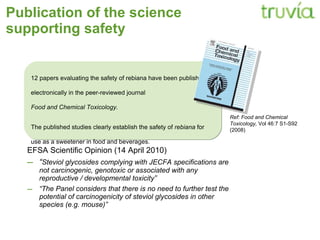
Publication of the science supporting safety EFSA Scientific Opinion (14 April 2010) “ Steviol glycosides complying with JECFA specifications are not carcinogenic, genotoxic or associated with any reproductive / developmental toxicity” “ The Panel considers that there is no need to further test the potential of carcinogenicity of steviol glycosides in other species (e.g. mouse)” 12 papers evaluating the safety of rebiana have been published electronically in the peer-reviewed journal  Food and Chemical Toxicology.  The published studies clearly establish the safety of  rebiana  for use as a sweetener in food and beverages.  Ref: Food and Chemical Toxicology,  Vol 46:7 S1-S92 (2008)
Expert reviews - 2008 Food and Chemical Toxicology Published safety studies Joint FAO/WHO Expert Committee on Food Additives (JECFA) Comprehensively examined the safety data and set a  permanent ADI GRAS (Generally  Recognised  As Safe) Independent Expert Panel Critically reviewed Truvia  ™ rebiana database of studies Determined its safety for general purpose use as a sweetener Food and Drug Administration (FDA) Issued no-objection letter Rebiana affirmed as Generally  Recognised as Safe  (GRAS) Toxicology Forum Panel multi-stakeholder symposium Reviewed safety of rebaudioside A
Expert reviews - 2009/10 French Food Safety Agency AFSSA Assessed safety of rebaudioside A Temporary legal approval of  ≥97% rebaudioside A for up to a maximum of 2 years, for use in certain food and beverages in France, published on 6 September 2009 First market in EU to approve European Food Safety Authority (EFSA) Reviewed safety of steviol glycosides, including rebaudioside A Expert panel’s Scientific Opinion officially published on 14 April 2010
Acceptable Daily Intake (ADI) Definition of ADI  Estimate of the amount of a food additive that can be consumed daily over an entire lifetime without appreciable health risk ADI for steviol glycosides is 4 mg/kg bw/day on a steviol basis  Established by JECFA and EFSA Translated for rebiana is 12 mg/kg bw/day Approximately equivalent to 23 teaspoons of Truvia™ tabletop sweetener every day over the course of a lifetime EFSA said ADI could be exceeded at max. proposed usage level Projected uses were based on provisional industry estimates and may need to be adjusted before final EU regulation
Summary of conclusions Truvia™ rebiana is safe for use in food and beverages   High purity rebaudioside A (rebiana) is fully differentiated from  crude stevia Truvia™ rebiana is reproducibly purified to specifications that exceed regulatory requirements Clinical studies indicate lack of pharmacological action of steviol glycosides No effect on blood pressure in individuals with normal and  low-normal blood pressure No effect on glucose homeostasis Successive independent expert assessments have validated the weight of safety evidence EFSA is the latest and most relevant to European regulatory approval
Implications for consumers Truvia™ sweetener provides a zero-calorie sweetening choice  for consumers Truvia™ sweetener is already in use in France following French regulatory approval of rebaudioside A Once approved for EU-wide use, it will be available as a tabletop sweetener and as an ingredient in foods and beverages As research and safety assessments show, it can safely be used  by all consumers, whether watching weight or managing diabetes
Key references Food and Chemical Toxicology  46 (2008) S1-S92 Peer-reviewed published papers;  available on request from Cargill EFSA Journal 2010;8(4):1537 http//www.efsa.europa.eu/en/scdocs/scdoc/1537  Joint FAO/WHO Expert Committee on Food Additives. 69 th  Meeting, 2008. JECFA/69/SC, 4 July 2008. Steviol glycosides ADI Food and Drug Administration (FDA), 2008.  http://www.fda.gov/Food/FoodIngredientsPackaging/GenerallyRecognizedasSafeGRAS/GRASListings/ucm154989.htm Journal officiel de la République Fran çaise, 6 September 2009,  éd. no. 206  http://textes.droit.org/JORF/2009/09/06/0206 - item 6
For further information or to request Food and Chemical Toxicology reprints contact: Amy Boileau,  Ph.D, R.D. Manager, Regulatory & Scientific Affairs Food Ingredients & Systems, Cargill [email_address] Truvia™ sweetener Zero-calorie sweetness from the stevia leaf

Truvia webinar final

  • 1.
    Truvia ™ rebiana Zero-calorie sweetness from the stevia leaf Background briefing: history and safety assessment
  • 2.
    Contents Stevia –unique plant, unique story From Green to White Truvia™ rebiana Overview of research results Expert reviews and approvals Summary of conclusions Implications for consumers Stevia rebaudiana Bertoni
  • 3.
    Stevia: unique plant,unique story Shrub in the Asteraceae family native to northeastern Paraguay First discovered by indigenous people who used plant’s leaves to sweeten drinks By 1800s, stevia consumption established throughout South America, including Brazil and Argentina Food researchers worldwide have been working with stevia for decades In 1931, French food chemists isolated compounds (steviol glycosides) that give stevia its sweet taste Japan has been using stevia commercially for over three decades Stevia-sweetened food and beverages are now available to consumers on every continent US market opened in 2008 and France in 2009
  • 4.
    Steviol glycosides –the sweet constituents 2 most predominant stevioside rebaudioside A Stevioside: R=H Rebaudioside A: R= 10+ glycosides in the leaf C H 2 C H 3 H H O O O O H 3 C H O O H O H H O O O O R H O O H O O H O H H O H O O H O O H O H H O
  • 5.
    From Green toWhite Steviol Glycosides Stevioside Rebaudioside A Others Rebiana The first fully characterised, high­purity form of rebaudioside A Other components Stevia rebaudiana Bertoni or “ stevia ”
  • 6.
    Stevia – thevocabulary Stevia General term used to refer to the plant and commercially to food uses of Stevia rebaudiana (botanical name) Stevia extract refers to compounds isolated (extracted) from stevia without regard to purity or identity of the compounds Steviol glycosides Sweet tasting components in leaves of the stevia plant Leaf contains at least 10 unique steviol glycosides including rebaudioside A, stevioside, rebaudioside C Rebaudioside A Best tasting steviol glycoside Also called “reb A” for short Purified from the leaf, it provides a clean, sweet taste Rebiana* Ingredient containing high-purity rebaudioside A Purity assures clean, sweet taste Rebiana is not less than 97% rebaudioside A * Appears on ingredient labels in the US Truvia ™ Brand name of leading sweetener derived from Stevia
  • 7.
    Attributes of rebianaPlant­derived, high potency, zero­calorie, good tasting sweetener T he best tasting part of the stevia leaf – not less than 97% rebaudioside A 200­300 times sweeter than sucrose Non­caloric, non­glycemic Good solubility Heat and pH stable in food and beverage systems
  • 8.
    Introduction to Truvia™ rebiana Truvia™ rebiana is comprised entirely of purified steviol glycosides, containing not less than 97% rebaudioside A Truvia™ rebiana (ingredient) and Truvia™ tabletop sweetener launched in the USA in 2008: Brand has established leadership position in new category of zero-calorie, plant-derived, high intensity sweeteners Cargill, maker of Truvia ™ rebiana, has applied for European regulatory approval European Food Safety Authority recently completed a safety assessment; their Scientific Opinion published on 14 April 2010
  • 9.
    EFSA Scientific OpinionEFSA confirmed that steviol glycosides are safe for use in foods and beverages “ Steviol glycosides complying with JECFA specifications are not carcinogenic, genotoxic or associated with any reproductive / developmental toxicity” EFSA established an Acceptable Daily Intake (ADI) for their safe consumption Expert panel established same ADI as previously established by JECFA EFSA Scientific Opinion is critical milestone in EU approval process; final EU regulatory approval likely to be in 2011
  • 10.
    Rebiana safety programmeobjective Demonstrate the safety of rebiana for consumption by all consumers , in all foods, for all eating occasions in all countries
  • 11.
    Research on steviaand steviol glycosides Stevia and its components have been evaluated in a range of studies over the past five decades Studies varied widely in purpose, design and quality: Many small studies used a crude extract of stevia, making it impossible to attribute the observed effects to any part of the leaf Others injected steviol glycosides into animals or fed animals very large amounts of steviol (the breakdown product of the steviol glycosides) Minority of these studies raised questions about potential effects on reproductive health and kidney function Some human studies suggested beneficial effects on blood pressure and blood sugar
  • 12.
    Rebiana safety programmeCargill and The Coca Cola Company collaborated to develop the ingredient rebiana – high purity rebaudioside A With guidance from global food safety experts and leading external scientists, Cargill’s research programme set out to: Systematically evaluate a fully characterised , high ­ purity form of rebaudioside A Ensure stevioside safety data are relevant to rebaudioside A Resolve questions raised by regulatory authorities, with further clinical studies where appropriate
  • 13.
    Research results overviewProgramme Area Findings / Implications Metabolism studies Metabolism of rebaudioside A is similar to that of stevioside Extensive toxicology data on stevioside can be applied to rebiana General toxicology No signs of toxicity associated with daily consumption of the equivalent of 2,000 250ml servings of a rebiana-sweetened beverage (for a 68kg person) No treatment-related effects on any organ, including kidneys and male reproductive organs Multigenerational/ reproductive toxicology No treatment effects on reproductive health or developmental outcomes
  • 14.
    Clinical programme AddressJECFA request for additional data pertaining to potential pharmacological effects of steviol glycosides in humans Blood pressure lowering effects Effects on blood glucose in people with diabetes Provide definitive data to further support the safety of rebiana Hemodynamic effects of rebaudioside A in healthy adults with normal and low-normal blood pressure (Blood pressure study) Chronic consumption of rebaudioside A in men and women with type 2 diabetes mellitus (Diabetes study) Comparative pharmacokinetics of rebaudioside A and stevioside in humans
  • 15.
    Blood pressure study: Changes from baseline to treatment for resting, seated blood pressure *ANCOVA; initial model included terms for baseline value, treatment, site, and treatment by site interaction. Values for pre- to post-treatment change in DBP were ranked prior to analysis. SBP – systolic blood pressure; DBP – diastolic blood pressure; MAP – mean arterial pressure Maki et al. (2008) Food and Chem Toxicol 46:S40-S46 Resting, Seated Measurements Rebaudioside A (n=50) Placebo (n=50) p-value* Mean ±SEM Baseline SBP (mm Hg) 110.0 ± 1.2 110.7 ± 1.3 0.683 SBP Δ -1.3 ± 0.7 -0.4 ± 0.8 0.237 Baseline DBP (mm Hg) 70.3 ± 0.9 71.2 ± 0.9 0.529 DBP Δ -1.3 ± 0.5 -0.7 ± 0.5 0.154 Baseline MAP (mm Hg) 83.6 ± 0.9 84.3 ± 1.0 0.554 MAP Δ -1.3 ± 0.6 -0.6 ± 0.6 0.192
  • 16.
    Diabetes study: Glycosylated hemoglobin at baseline to weeks 4, 8, 12, 16 *P-values for the change from baseline are for the analysis of covariance with baseline value as the covariate. All values were ranked prior to analysis. Maki et al. (2008) Food and Chem Toxicol. 46:S47-S63 Glycosylated hemoglobin Rebaudioside A (n=60) Placebo (n=62) p-value* Mean ±SEM Baseline (%) 6.71 ± 0.11 6.70 ± 0.10 0.964 Week 4 Δ (%) 0.02 ± 0.03 0.02 ± 0.903 0.982 Week 8 Δ 0.11 ± 0.05 0.04 ± 0.04 0.574 Week 12 Δ 0.11 ± 0.05 0.07 ± 0.05 0.248 Week 16 Δ 0.11 ± 0.06 0.09 ± 0.05 0.355
  • 17.
    Diabetes study: Results of secondary outcomes No effect of rebaudioside A on the following outcomes: Fasting glucose, insulin, C-peptide Body weight Total-C, LDL-C, HDL-C, Non-HDL-C, triglycerides Maki et al. (2008) Food and Chem Toxicol. 46:S47-S63 Rebaudioside A (n=60) Placebo (n=62) p-value Mean ± SEM Baseline SBP (mm Hg) 121.6 ± 1.4 126.0 ± 1.6 0.051 Δ (mm Hg) -0.2 ± 1.0 -0.9 ± 1.1 0.775 Baseline DBP 72.5 ± 1.0 71.3 ± 1.1 0.429 Δ 0.2 ± 0.8 -1.1 ± 0.7 0.132
  • 18.
    Publication of thescience supporting safety EFSA Scientific Opinion (14 April 2010) “ Steviol glycosides complying with JECFA specifications are not carcinogenic, genotoxic or associated with any reproductive / developmental toxicity” “ The Panel considers that there is no need to further test the potential of carcinogenicity of steviol glycosides in other species (e.g. mouse)” 12 papers evaluating the safety of rebiana have been published electronically in the peer-reviewed journal Food and Chemical Toxicology. The published studies clearly establish the safety of rebiana for use as a sweetener in food and beverages. Ref: Food and Chemical Toxicology, Vol 46:7 S1-S92 (2008)
  • 19.
    Expert reviews -2008 Food and Chemical Toxicology Published safety studies Joint FAO/WHO Expert Committee on Food Additives (JECFA) Comprehensively examined the safety data and set a permanent ADI GRAS (Generally Recognised As Safe) Independent Expert Panel Critically reviewed Truvia ™ rebiana database of studies Determined its safety for general purpose use as a sweetener Food and Drug Administration (FDA) Issued no-objection letter Rebiana affirmed as Generally Recognised as Safe (GRAS) Toxicology Forum Panel multi-stakeholder symposium Reviewed safety of rebaudioside A
  • 20.
    Expert reviews -2009/10 French Food Safety Agency AFSSA Assessed safety of rebaudioside A Temporary legal approval of ≥97% rebaudioside A for up to a maximum of 2 years, for use in certain food and beverages in France, published on 6 September 2009 First market in EU to approve European Food Safety Authority (EFSA) Reviewed safety of steviol glycosides, including rebaudioside A Expert panel’s Scientific Opinion officially published on 14 April 2010
  • 21.
    Acceptable Daily Intake(ADI) Definition of ADI Estimate of the amount of a food additive that can be consumed daily over an entire lifetime without appreciable health risk ADI for steviol glycosides is 4 mg/kg bw/day on a steviol basis Established by JECFA and EFSA Translated for rebiana is 12 mg/kg bw/day Approximately equivalent to 23 teaspoons of Truvia™ tabletop sweetener every day over the course of a lifetime EFSA said ADI could be exceeded at max. proposed usage level Projected uses were based on provisional industry estimates and may need to be adjusted before final EU regulation
  • 22.
    Summary of conclusionsTruvia™ rebiana is safe for use in food and beverages High purity rebaudioside A (rebiana) is fully differentiated from crude stevia Truvia™ rebiana is reproducibly purified to specifications that exceed regulatory requirements Clinical studies indicate lack of pharmacological action of steviol glycosides No effect on blood pressure in individuals with normal and low-normal blood pressure No effect on glucose homeostasis Successive independent expert assessments have validated the weight of safety evidence EFSA is the latest and most relevant to European regulatory approval
  • 23.
    Implications for consumersTruvia™ sweetener provides a zero-calorie sweetening choice for consumers Truvia™ sweetener is already in use in France following French regulatory approval of rebaudioside A Once approved for EU-wide use, it will be available as a tabletop sweetener and as an ingredient in foods and beverages As research and safety assessments show, it can safely be used by all consumers, whether watching weight or managing diabetes
  • 24.
    Key references Foodand Chemical Toxicology 46 (2008) S1-S92 Peer-reviewed published papers; available on request from Cargill EFSA Journal 2010;8(4):1537 http//www.efsa.europa.eu/en/scdocs/scdoc/1537 Joint FAO/WHO Expert Committee on Food Additives. 69 th Meeting, 2008. JECFA/69/SC, 4 July 2008. Steviol glycosides ADI Food and Drug Administration (FDA), 2008. http://www.fda.gov/Food/FoodIngredientsPackaging/GenerallyRecognizedasSafeGRAS/GRASListings/ucm154989.htm Journal officiel de la République Fran çaise, 6 September 2009, éd. no. 206 http://textes.droit.org/JORF/2009/09/06/0206 - item 6
  • 25.
    For further informationor to request Food and Chemical Toxicology reprints contact: Amy Boileau, Ph.D, R.D. Manager, Regulatory & Scientific Affairs Food Ingredients & Systems, Cargill [email_address] Truvia™ sweetener Zero-calorie sweetness from the stevia leaf

Editor's Notes

  • #2 To be introduced by moderator Vivienne Parry This week - on 14 April 2010 European Food Standards Authority published a positive Scientific Opinion on steviol glycosides Very important milestone in process towards European approval of stevia-based low calorie sweeteners, including Truvia™ sweetener, made by Cargill Truvia™ sweetener is the US brand leader in this new category of natural origin, plant-based sweeteners derived from the stevia leaf Purpose of this briefing is to provide an overview of the research and safety program which supports Truvia™ sweetener Introduce Dr * Amy Boileau, manager of Scientific and Regulatory Affairs at Cargill * Doctor not used in the US unless medical but important for European scientific audience. - While webinar taking place, you can submit questions to Amy at any time, and she will answer as many as we have time for at the end of her presentation. [ Just enter your question in the box provided on the right hand side of your screen – check]
  • #3 Over to Amy : welcome and thank you for joining us What I’m going to cover is The unique story of this unique plant – stevia –whose claim to fame is its natural sweetness Rebiana – the ingredient at the heart of this new category of stevia based sweeteners The wealth of scientific research that underpins it Numerous expert assessments of this safety by regulatory bodies – or bodies acting on behalf of regulators Finally = implications for consumers
  • #4 21 st century is catching up with knowledge that’s been around for centuries among the peoples of South America
  • #7 Lots of different words, unfamiliar names – let’s start with the vocabulary, which can seem complicated Stevia – a plant whose botanical name is stevia rebaudiana … . and the word generally used to describe extracts of stevia plant
  • #8 NB amy to mention versatility across types of foods and drinks Vivienne – either intervene – or Q at the end “What kind of applications is Truvia rebiana suited for?
  • #14 OUR PROGRAM INCLUDED intake, metabolism, pharmacokinetics, safety and randomized, controlled, double-blind human studies. First, we had to understand consumer intake levels. We evaluated rebiana for average and high-usage consumers to set dose levels in our safety studies. Next we went to pharmacokinetics and metabolism study This was to confirm that rebiana and stevioside were handled the same way in the body Safety, reproductive and developmental studies were conducted at very high doses to look at any effects on organ systems or reproductive health. Clinical studies included: A four-week multi-center study evaluating the effect of rebiana on blood pressure in people with normal to low-normal blood pressure and A 16-week multi-center study assessing the impact of rebiana on blood sugar in people with type 2 diabetes.
  • #15 Mention why clinical studies focused on normal – low blood pressure, not those with high BP
  • #16 Commentary to point out – for those who forget their maths and what P value means – figures of 0.05 or less would be significant These figures show that in these blood pressure studies, when comparing the group ingesting rebaudioside A with the placebo group after 4 weeks, there were no figures of less than 005 We also looked at whether the results were clinically significant – and they weren’t. (you’ll be able to download these charts at your leisure later)
  • #19 It is clear from the results of the research that rebiana is safe for its intended use. Bringing together, assessing and documenting the basis for safety of high purity rebaudioside A was a critical milestone in the development of this zero-calorie sweetener derived from the stevia leaf. It was also transparent – publishing and sharing the findings Publication of this safety assessment, based on the comprehensive research accumulated to date, paved the way for the regulatory approval , and the long-awaited availability of rebiana in foods and beverages.
  • #21 Stick exactly to slide re France: but also stress significant first step for Europe
  • #22 EFSA’s ANS Panel stated that ADI would be exceeded at maximum proposed use levels for steviol glycosides For comparison, the ADI is equivalent to approximately 23 teaspoons of Truvia™ tabletop sweetener every day over the course of a lifetime Projected use levels were based on provisional industry estimates.   In practice, maximum use limits in certain food and beverage categories may need to be adjusted before a final regulation is issued by the EU
  • #23 RHB’s draft of concluding comment.