Stevia: How Sweet is
it Really?
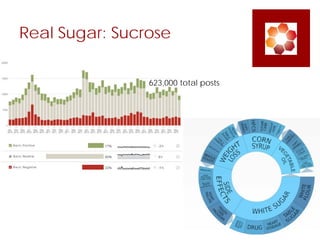
Real Sugar: Sucrose
623,000 total posts
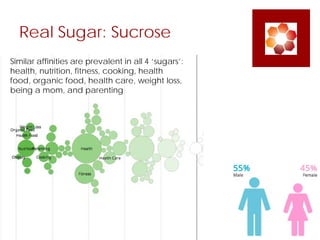
Real Sugar: Sucrose
Similar affinities are prevalent in all 4 ‘sugars’:
health, nutrition, fitness, cooking, health
food, organic food, health care, weight loss,
being a mom, and parenting
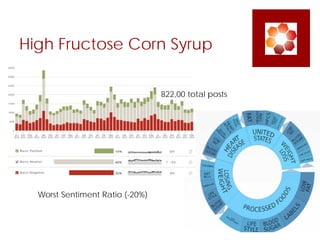
High Fructose Corn Syrup
 Best Sentiment Ratio (+10%)
Worst Sentiment Ratio (-20%)
822,00 total posts
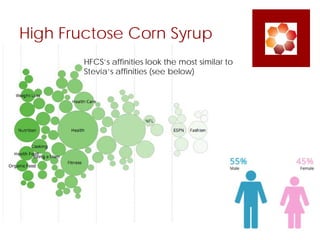
High Fructose Corn Syrup
HFCS’s affinities look the most similar to
Stevia’s affinities (see below)
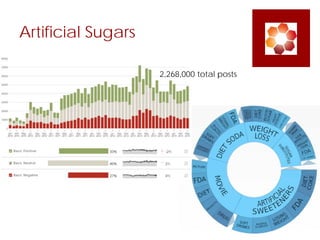
Artificial Sugars
2,268,000 total posts
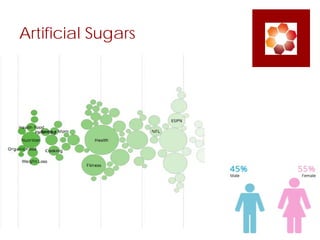
Artificial Sugars
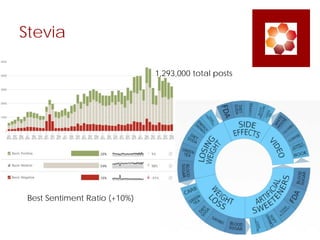
Stevia
Best Sentiment Ratio (+10%)
1,293,000 total posts
Stevia
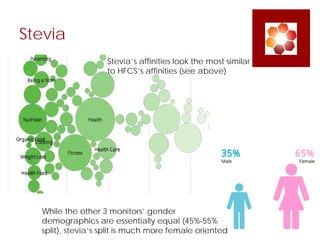
While the other 3 monitors’ gender
demographics are essentially equal (45%-55%
split), stevia’s split is much more female oriented
Stevia’s affinities look the most similar
to HFCS’s affinities (see above)
Lets Take a
Closer Look…
Stevia
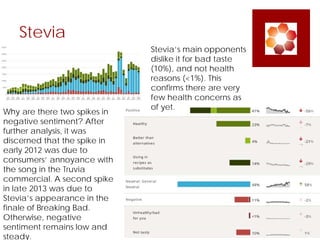
Why are there two spikes in
negative sentiment? After
further analysis, it was
discerned that the spike in
early 2012 was due to
consumers’ annoyance with
the song in the Truvia
commercial. A second spike
in late 2013 was due to
Stevia’s appearance in the
finale of Breaking Bad.
Otherwise, negative
sentiment remains low and
steady.
Stevia’s main opponents
dislike it for bad taste
(10%), and not health
reasons (<1%). This
confirms there are very
few health concerns as
of yet.
Stevia
Artificial Sugars
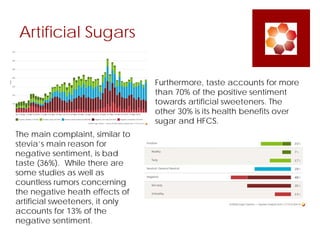
The main complaint, similar to
stevia’s main reason for
negative sentiment, is bad
taste (36%). While there are
some studies as well as
countless rumors concerning
the negative heath effects of
artificial sweeteners, it only
accounts for 13% of the
negative sentiment.
Furthermore, taste accounts for more
than 70% of the positive sentiment
towards artificial sweeteners. The
other 30% is its health benefits over
sugar and HFCS.
Artificial Sugars
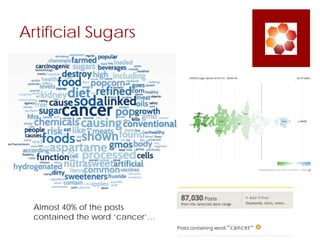
Almost 40% of the posts
contained the word ‘cancer’…
Analysis
After a close analysis of both stevia and artificial
sweeteners, bad taste was found to be the driver
of negative sentiment for both sugar alternatives.
Moreover, good taste was found to be the driver of
positive sentiment for artificial sweeteners.
Following this logic, it seems as though when it
comes down to it, taste is the major indicator of
whether consumers will buy a product, regardless
of other seemingly more important factors. In other
words, even if there are negative effects, such as
health consequences, associated with a product, if
it tastes good, there will always be people who
want to buy it and will buy it.
Analysis
However, when one examines stevia more closely,
although taste is certainly the driver of negative
sentiment, it is not the driver of the positive sentiment.
Health, including stevia in comparison to and as a
substitute for the current alternatives (sugar, HFCS, and
artificial sugars), accounts for 100% of the positive
sentiment towards stevia.
Overall, the negative sentiment for stevia, which is
derived from its somewhat bitter aftertaste, accounts
for only 11% of the conversation around stevia, while
the positive sentiment towards stevia’s health benefits
accounts for 41% of the conversation, almost three
times the overall volume of the negative sentiment.
Analysis
Although taste is inarguably a major factor in
consumers’ decisions in choosing what products to
buy, the health of a product is becoming an
increasingly important factor as well. In a world full
of sweetened packaged goods coupled with the
fact that humans innately crave sugar, sweetened
foods are not going anywhere. However,
consumers are becoming more cognizant of what
exactly they are putting into their bodies and are
looking for alternatives to sugar and HFCS, as both
have been irrefutably proven to be unhealthy. At
first, artificial sugars, such as Splenda and Sweet’N
Low, were the answer, and they were immediately
used as ingredients in beverages and packaged
goods alike. As skepticism builds for artificial sugars,
though, the new and improved answer is Stevia,
the natural plant-based sweetener.

Stevia: How Sweet Is It Really?

  • 1.
    Stevia: How Sweetis it Really?
  • 2.
  • 3.
    Real Sugar: Sucrose Similaraffinities are prevalent in all 4 ‘sugars’: health, nutrition, fitness, cooking, health food, organic food, health care, weight loss, being a mom, and parenting
  • 4.
    High Fructose CornSyrup  Best Sentiment Ratio (+10%) Worst Sentiment Ratio (-20%) 822,00 total posts
  • 5.
    High Fructose CornSyrup HFCS’s affinities look the most similar to Stevia’s affinities (see below)
  • 6.
  • 7.
  • 8.
    Stevia Best Sentiment Ratio(+10%) 1,293,000 total posts
  • 9.
    Stevia While the other3 monitors’ gender demographics are essentially equal (45%-55% split), stevia’s split is much more female oriented Stevia’s affinities look the most similar to HFCS’s affinities (see above)
  • 10.
  • 11.
    Stevia Why are theretwo spikes in negative sentiment? After further analysis, it was discerned that the spike in early 2012 was due to consumers’ annoyance with the song in the Truvia commercial. A second spike in late 2013 was due to Stevia’s appearance in the finale of Breaking Bad. Otherwise, negative sentiment remains low and steady. Stevia’s main opponents dislike it for bad taste (10%), and not health reasons (<1%). This confirms there are very few health concerns as of yet.
  • 12.
  • 13.
    Artificial Sugars The maincomplaint, similar to stevia’s main reason for negative sentiment, is bad taste (36%). While there are some studies as well as countless rumors concerning the negative heath effects of artificial sweeteners, it only accounts for 13% of the negative sentiment. Furthermore, taste accounts for more than 70% of the positive sentiment towards artificial sweeteners. The other 30% is its health benefits over sugar and HFCS.
  • 14.
    Artificial Sugars Almost 40%of the posts contained the word ‘cancer’…
  • 15.
    Analysis After a closeanalysis of both stevia and artificial sweeteners, bad taste was found to be the driver of negative sentiment for both sugar alternatives. Moreover, good taste was found to be the driver of positive sentiment for artificial sweeteners. Following this logic, it seems as though when it comes down to it, taste is the major indicator of whether consumers will buy a product, regardless of other seemingly more important factors. In other words, even if there are negative effects, such as health consequences, associated with a product, if it tastes good, there will always be people who want to buy it and will buy it.
  • 16.
    Analysis However, when oneexamines stevia more closely, although taste is certainly the driver of negative sentiment, it is not the driver of the positive sentiment. Health, including stevia in comparison to and as a substitute for the current alternatives (sugar, HFCS, and artificial sugars), accounts for 100% of the positive sentiment towards stevia. Overall, the negative sentiment for stevia, which is derived from its somewhat bitter aftertaste, accounts for only 11% of the conversation around stevia, while the positive sentiment towards stevia’s health benefits accounts for 41% of the conversation, almost three times the overall volume of the negative sentiment.
  • 17.
    Analysis Although taste isinarguably a major factor in consumers’ decisions in choosing what products to buy, the health of a product is becoming an increasingly important factor as well. In a world full of sweetened packaged goods coupled with the fact that humans innately crave sugar, sweetened foods are not going anywhere. However, consumers are becoming more cognizant of what exactly they are putting into their bodies and are looking for alternatives to sugar and HFCS, as both have been irrefutably proven to be unhealthy. At first, artificial sugars, such as Splenda and Sweet’N Low, were the answer, and they were immediately used as ingredients in beverages and packaged goods alike. As skepticism builds for artificial sugars, though, the new and improved answer is Stevia, the natural plant-based sweetener.