
Hardware Trojan Detection
Guided by
Dr. P. Kalpana
Professor
Department of ECE
PSG College of Technology
Presented by
S. Sri Nishith
15MV32
M.E. VLSI Design
Contents
• Objective
• Introduction
• Trojan detection techniques
• Types of hardware Trojan
• Literature survey
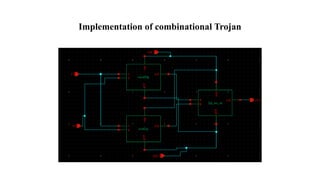
• Combinational Trojan
• Synchronous Trojan
• Pulse propagation driven Trojan detection
• Implementation and results
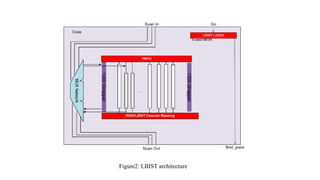
• LBIST architecture
• Conclusion
Objective
• The objective is to detect the presence of Trojan in the circuit by analysing power
and delay.
• To implement LBIST (Logic Built in Self-Test) in AES core in order to detect the
hardware Trojan by analysing area, power and test coverage.
Introduction
• Hardware Trojan is a malicious modification of the circuitry of an integrated
circuit.
• Extra circuitry added to specified design
•can cause malfunction
•steal secret information
•create backdoor for attack
Cont.
• The Trojan circuits cannot be easily detected during normal operating conditions
because it triggers at very rare condition.
• So Hardware Trojan must be detected in an IC before it is used in various
applications.
Trojan detection techniques
• To date there are mainly three side channel analysis techniques in hardware Trojan
detection they are
• Power measurement technique
• Path delay measurement
• Physical design based testing
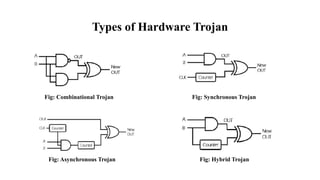
Types of Hardware Trojan
Fig: Combinational Trojan Fig: Synchronous Trojan
Fig: Asynchronous Trojan Fig: Hybrid Trojan
Literature survey
1. Nan Li, Gunnar Carlsson, Elena Dubrova, Kim Peters´en “Logic BIST: State-of-
the-Art and Open Problems” arXiv:1503.04628v1, 16 Mar 2015.
• The following problems need to be addressed to successfully deploy LBIST in the
industrial practice.
• LBIST methods which take advantage of multiple identical blocks/cores on a
chip need to be developed. Existing LBIST CAD tools do not exploit this
possibility. For example, to reduce the area overhead of LBIST, the same
pseudo-random test pattern generator can be used for testing identical blocks.
Cont.
2. Y.Jinand Y.Makris, “Hardware Trojan detection using path delay finger print,” in
Proc. Of the IEEE International Work shop on Hardware-Oriented Security and
Trust (HOST2008), pp.51–57, 2008
• Traditional function testing is less effective in detecting Trojan circuit for the
following reasons,
• The trigger condition of a Trojan rarely appears.
• The harm of Trojan circuits may emerge after a long time after
implementation.
Cont.
3. G. Hetherington, T. Fryars, N. Tamarapalli, M. Kassab, A. Hassan, and J. Rajski,
“Logic BIST for large industrial designs: real issues and case studies,” in
Proceedings of International Test Conference (ITC’1999), pp. 358 – 367, 1999.
• LBIST test method is an attractive alternative to ATPG tests which can test an
integrated circuit by its own.
• It operates by exercising the circuit logic and then detecting if the logic behaved as
intended using on chip test generator and test response
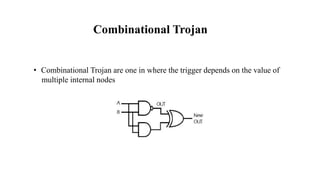
Combinational Trojan
• Combinational Trojan are one in where the trigger depends on the value of
multiple internal nodes
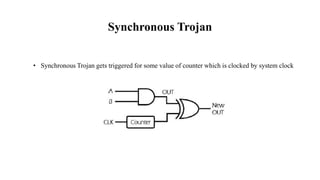
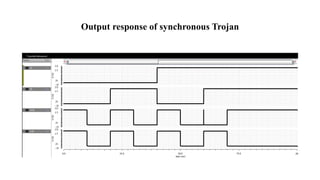
Synchronous Trojan
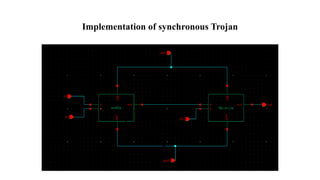
• Synchronous Trojan gets triggered for some value of counter which is clocked by system clock
Pulse propagation driven Trojan detection
• Pulse propagation driven approach for a generalized logic circuit consists of
following key elements
• Pulse sensitization is performed from selected logic circuit input to appropriate
logic circuit output.
• Trojan existence is determined by whether the injected pulse reaches the
circuit output using a pulse detector circuit.
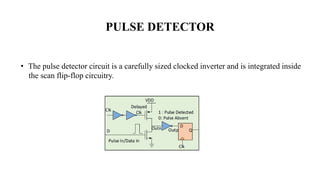
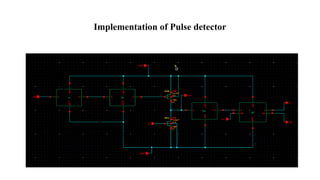
PULSE DETECTOR
• The pulse detector circuit is a carefully sized clocked inverter and is integrated inside
the scan flip-flop circuitry.
IMPLEMENTATION AND RESULTS
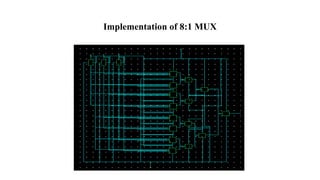
Implementation of 8:1 MUX
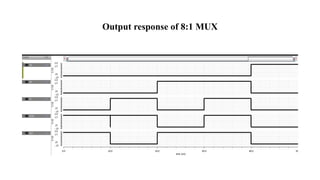
Output response of 8:1 MUX
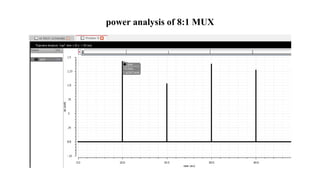
power analysis of 8:1 MUX
Implementation of combinational Trojan
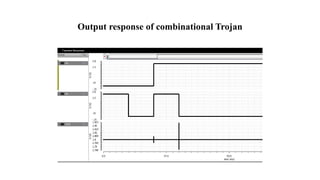
Output response of combinational Trojan
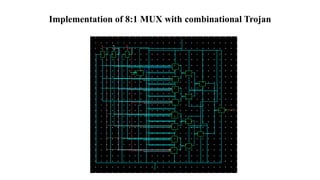
Implementation of 8:1 MUX with combinational Trojan
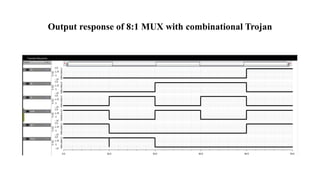
Output response of 8:1 MUX with combinational Trojan
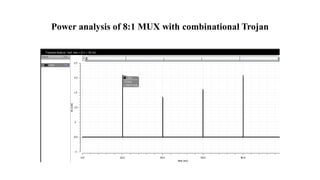
Power analysis of 8:1 MUX with combinational Trojan
Implementation of Pulse detector
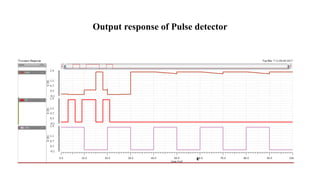
Output response of Pulse detector
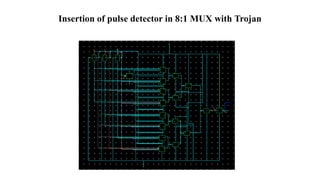
Insertion of pulse detector in 8:1 MUX with Trojan
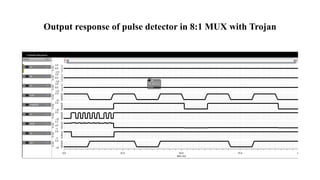
Output response of pulse detector in 8:1 MUX with Trojan
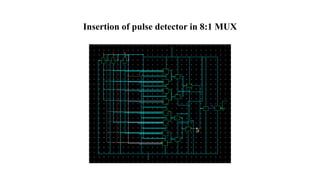
Insertion of pulse detector in 8:1 MUX
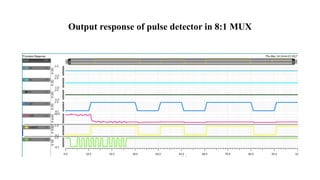
Output response of pulse detector in 8:1 MUX
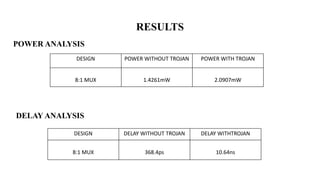
RESULTS
DESIGN POWER WITHOUT TROJAN POWER WITH TROJAN
8:1 MUX 1.4261mW 2.0907mW
POWER ANALYSIS
DELAY ANALYSIS
DESIGN DELAY WITHOUT TROJAN DELAY WITHTROJAN
8:1 MUX 368.4ps 10.64ns
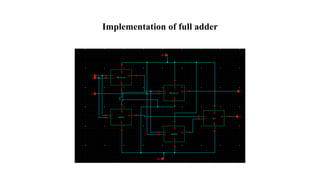
Implementation of full adder
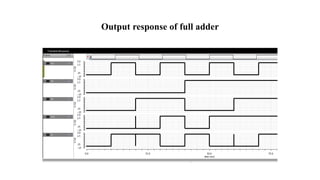
Output response of full adder
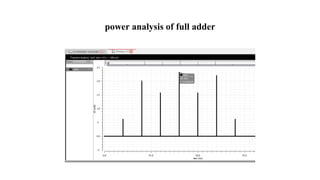
power analysis of full adder
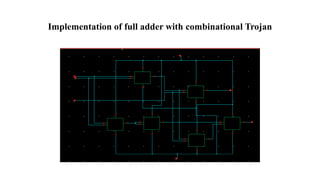
Implementation of full adder with combinational Trojan
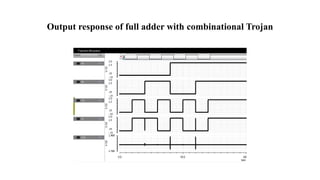
Output response of full adder with combinational Trojan
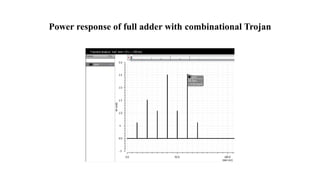
Power response of full adder with combinational Trojan
Implementation of synchronous Trojan
Output response of synchronous Trojan
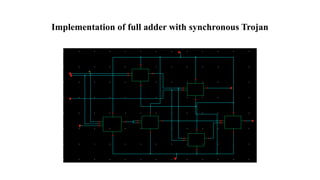
Implementation of full adder with synchronous Trojan
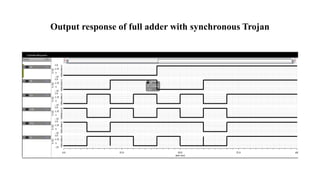
Output response of full adder with synchronous Trojan
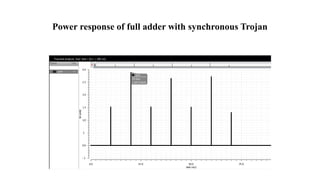
Power response of full adder with synchronous Trojan
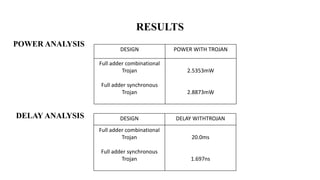
RESULTS
DESIGN POWER WITH TROJAN
Full adder combinational
Trojan
Full adder synchronous
Trojan
2.5353mW
2.8873mW
POWER ANALYSIS
DELAY ANALYSIS DESIGN DELAY WITHTROJAN
Full adder combinational
Trojan
Full adder synchronous
Trojan
20.0ms
1.697ns
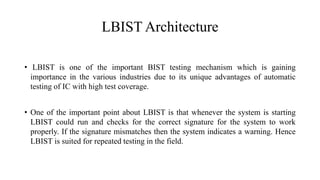
LBIST Architecture
• LBIST is one of the important BIST testing mechanism which is gaining
importance in the various industries due to its unique advantages of automatic
testing of IC with high test coverage.
• One of the important point about LBIST is that whenever the system is starting
LBIST could run and checks for the correct signature for the system to work
properly. If the signature mismatches then the system indicates a warning. Hence
LBIST is suited for repeated testing in the field.
Cont.
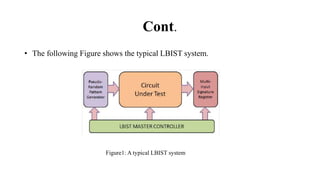
• The following Figure shows the typical LBIST system.
Figure1: A typical LBIST system
Cont.
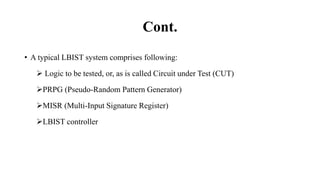
• A typical LBIST system comprises following:
 Logic to be tested, or, as is called Circuit under Test (CUT)
PRPG (Pseudo-Random Pattern Generator)
MISR (Multi-Input Signature Register)
LBIST controller
Figure2: LBIST architecture
Experimental Setup
• Tools Used
Cadence –RTL Compiler
For including LBIST to the Core and measuring area and power
Cadence -Encounter Test
For measuring the Test Coverage
• Benchmark Circuit Used
 Advanced Encryption System (AES) -128 bit
Parameters
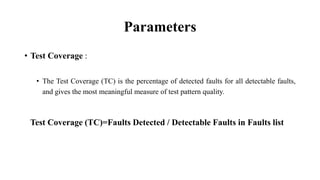
• Test Coverage :
• The Test Coverage (TC) is the percentage of detected faults for all detectable faults,
and gives the most meaningful measure of test pattern quality.
Test Coverage (TC)=Faults Detected / Detectable Faults in Faults list
Cont.
• Static Faults:
• Stuck-a-0 faults &
• stuck-a-1 faults
• Dynamic Faults:
• A delay fault (known as a dynamic or transition fault) models a specific
physical defect at a specific location.
• Dynamic faults may model the condition where a data transition is slow to rise
(transition from logical 0 to logical 1), or slow to fall (transition from logical 1
to logical 0).
Results
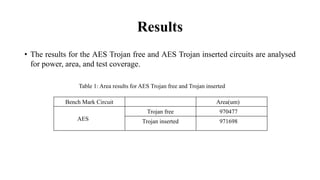
• The results for the AES Trojan free and AES Trojan inserted circuits are analysed
for power, area, and test coverage.
Table 1: Area results for AES Trojan free and Trojan inserted
Bench Mark Circuit Area(um)
AES
Trojan free 970477
Trojan inserted 971698
Cont.
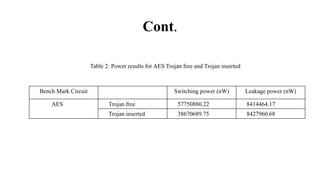
Bench Mark Circuit Switching power (nW) Leakage power (nW)
AES Trojan free 57750880.22 8414464.17
Trojan inserted 38670689.75 8427960.68
Table 2: Power results for AES Trojan free and Trojan inserted
Cont.
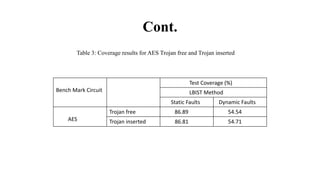
Bench Mark Circuit
Test Coverage (%)
LBIST Method
Static Faults Dynamic Faults
AES
Trojan free 86.89 54.54
Trojan inserted 86.81 54.71
Table 3: Coverage results for AES Trojan free and Trojan inserted
Conclusion
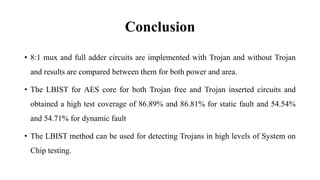
• 8:1 mux and full adder circuits are implemented with Trojan and without Trojan
and results are compared between them for both power and area.
• The LBIST for AES core for both Trojan free and Trojan inserted circuits and
obtained a high test coverage of 86.89% and 86.81% for static fault and 54.54%
and 54.71% for dynamic fault
• The LBIST method can be used for detecting Trojans in high levels of System on
Chip testing.
References
[1] Mitra, S., McCluskey, E J., Makar, S. (2002). Design for testability and testing of IEEE 1149.1
TAP controller. Proceedings 20th IEEE VLSI Test Symposium (VTS’02), pages 247-252.
2] Janusz Rajski, Katarzyna Radecka, Jerzy Tyszer. (1997). Arithmetic Built-In Self-Test for DSP
Cores. IEEE Transactions On Computer-Aided Design Of Integrated Circuits AndSystems.16(11):1-
7.
[3] Tobias Strauch. (2012). Single Cycle Access Structure for Logic Test. IEEE Transactions On Very
Large Scale Integration Systems. 20(5):878 – 891.
[4] Kedarnath J. Balakrishnan, and Nur A. Touba. (2006). Improving Linear Test Data Compression.
IEEE Transactions On Very Large Scale Integration Systems. 14(11):1227-1237.
[5] J. Rajski, J. Tyszer, M. Kassab, and N. Mukherjee, “Embedded deterministic test,” IEEE
Transactions on Computer-Aided Design of Integrated Circuits and Systems, vol. 23, pp. 776 – 792,
May 2004.
Cont.
[6] G. Hetherington, T. Fryars, N. Tamarapalli, M. Kassab, A. Hassan, and J. Rajski, “Logic BIST for
large industrial designs: real issues and case studies,” in Proceedings of International Test Conference
(ITC’1999), pp. 358 – 367, 1999.
[7] Alex Baumgarten, Michael Steffen, Matthew Clausman, Joseph Zambreno, "A case study in
hardware Trojan design and implementation," International Journal of Information Security, Volume
10, Issue 1, pp. 1‐14, 2011.
[8] Y.Jin and Y.Markis “Hardware trojan detection using path delay fingerprint”, IEEE intl. workshop
on Hardware oriented security and trust, pp.51-57,2008.
[9] Kurt Rosenfeld and Ramesh Karri. (2011). Security-Aware SoC Test Access Mechanism. IEEE
29th VLSI Test Symposium (VTS), pages 100-104.
[10] Luke pierce and Spyros Tragoudas. (2011) Multilevel Secure JTAG Architecture. IEEE 17th
International On-Line Symposium, pages 208-209.
[11] Nan Li, Gunnar Carlsson, Elena Dubrova, Kim Peters´en “Logic BIST: State-of-the-Art and Open
Problems” arXiv:1503.04628v1 [cs.AR] 16 Mar 2015
Cont.
[12] S. Deyati, B. J. Muldrey, A. Singh, and A. Chatterjee, "High Resolution Pulse Propagation Driven Trojan
Detection in Digital Logic: Optimization Algorithms and Infrastructure," in Test Symposium (ATS), 2014 IEEE
23rd Asian, 2014, pp. 200-205.
[13] M. Banga and M. S. Hsiao, "A Novel Sustained Vector Technique for the Detection of Hardware Trojans,"
in VLSI Design, 2009 22nd International Conference on, 2009, pp. 327-332.
[14] B. Cha and S. K. Gupta, "Trojan detection via delay measurements: A new approach to select paths and
vectors to maximize effectiveness and minimize cost," in Design, Automation & Test in Europe Conference &
Exhibition (DATE), 2013, 2013, pp. 1265-1270.
[15] F. Wolff, C. Papachristou, S. Bhunia, and R. S. Chakraborty, "Towards Trojan-Free Trusted ICs: Problem
Analysis and Detection Scheme," in Design, Automation and Test in Europe, 2008. DATE '08, 2008, pp. 1362-
1365.
[16] J. Yier and Y. Makris, "Hardware Trojan detection using path delay fingerprint," in HOST 2008., pp. 51-57.
[17] R. S. Chakraborty, S. Narasimhan, and S. Bhunia, "Hardware Trojan: Threats and emerging solutions," in
High Level Design Validation and Test Workshop, 2009. HLDVT 2009. IEEE International, 2009, pp. 166-171.
[18] https://en.wikipedia.org/w/index.php?title=Hardware_Trojan& oldid=740716473

trojan detection

  • 1.
    Hardware Trojan Detection Guidedby Dr. P. Kalpana Professor Department of ECE PSG College of Technology Presented by S. Sri Nishith 15MV32 M.E. VLSI Design
  • 2.
    Contents • Objective • Introduction •Trojan detection techniques • Types of hardware Trojan • Literature survey • Combinational Trojan • Synchronous Trojan • Pulse propagation driven Trojan detection • Implementation and results • LBIST architecture • Conclusion
  • 3.
    Objective • The objectiveis to detect the presence of Trojan in the circuit by analysing power and delay. • To implement LBIST (Logic Built in Self-Test) in AES core in order to detect the hardware Trojan by analysing area, power and test coverage.
  • 4.
    Introduction • Hardware Trojanis a malicious modification of the circuitry of an integrated circuit. • Extra circuitry added to specified design •can cause malfunction •steal secret information •create backdoor for attack
  • 5.
    Cont. • The Trojancircuits cannot be easily detected during normal operating conditions because it triggers at very rare condition. • So Hardware Trojan must be detected in an IC before it is used in various applications.
  • 6.
    Trojan detection techniques •To date there are mainly three side channel analysis techniques in hardware Trojan detection they are • Power measurement technique • Path delay measurement • Physical design based testing
  • 7.
    Types of HardwareTrojan Fig: Combinational Trojan Fig: Synchronous Trojan Fig: Asynchronous Trojan Fig: Hybrid Trojan
  • 8.
    Literature survey 1. NanLi, Gunnar Carlsson, Elena Dubrova, Kim Peters´en “Logic BIST: State-of- the-Art and Open Problems” arXiv:1503.04628v1, 16 Mar 2015. • The following problems need to be addressed to successfully deploy LBIST in the industrial practice. • LBIST methods which take advantage of multiple identical blocks/cores on a chip need to be developed. Existing LBIST CAD tools do not exploit this possibility. For example, to reduce the area overhead of LBIST, the same pseudo-random test pattern generator can be used for testing identical blocks.
  • 9.
    Cont. 2. Y.Jinand Y.Makris,“Hardware Trojan detection using path delay finger print,” in Proc. Of the IEEE International Work shop on Hardware-Oriented Security and Trust (HOST2008), pp.51–57, 2008 • Traditional function testing is less effective in detecting Trojan circuit for the following reasons, • The trigger condition of a Trojan rarely appears. • The harm of Trojan circuits may emerge after a long time after implementation.
  • 10.
    Cont. 3. G. Hetherington,T. Fryars, N. Tamarapalli, M. Kassab, A. Hassan, and J. Rajski, “Logic BIST for large industrial designs: real issues and case studies,” in Proceedings of International Test Conference (ITC’1999), pp. 358 – 367, 1999. • LBIST test method is an attractive alternative to ATPG tests which can test an integrated circuit by its own. • It operates by exercising the circuit logic and then detecting if the logic behaved as intended using on chip test generator and test response
  • 11.
    Combinational Trojan • CombinationalTrojan are one in where the trigger depends on the value of multiple internal nodes
  • 12.
    Synchronous Trojan • SynchronousTrojan gets triggered for some value of counter which is clocked by system clock
  • 13.
    Pulse propagation drivenTrojan detection • Pulse propagation driven approach for a generalized logic circuit consists of following key elements • Pulse sensitization is performed from selected logic circuit input to appropriate logic circuit output. • Trojan existence is determined by whether the injected pulse reaches the circuit output using a pulse detector circuit.
  • 14.
    PULSE DETECTOR • Thepulse detector circuit is a carefully sized clocked inverter and is integrated inside the scan flip-flop circuitry.
  • 15.
  • 16.
  • 17.
  • 18.
  • 19.
  • 20.
    Output response ofcombinational Trojan
  • 21.
    Implementation of 8:1MUX with combinational Trojan
  • 22.
    Output response of8:1 MUX with combinational Trojan
  • 23.
    Power analysis of8:1 MUX with combinational Trojan
  • 24.
  • 25.
    Output response ofPulse detector
  • 26.
    Insertion of pulsedetector in 8:1 MUX with Trojan
  • 27.
    Output response ofpulse detector in 8:1 MUX with Trojan
  • 28.
    Insertion of pulsedetector in 8:1 MUX
  • 29.
    Output response ofpulse detector in 8:1 MUX
  • 30.
    RESULTS DESIGN POWER WITHOUTTROJAN POWER WITH TROJAN 8:1 MUX 1.4261mW 2.0907mW POWER ANALYSIS DELAY ANALYSIS DESIGN DELAY WITHOUT TROJAN DELAY WITHTROJAN 8:1 MUX 368.4ps 10.64ns
  • 31.
  • 32.
  • 33.
  • 34.
    Implementation of fulladder with combinational Trojan
  • 35.
    Output response offull adder with combinational Trojan
  • 36.
    Power response offull adder with combinational Trojan
  • 37.
  • 38.
    Output response ofsynchronous Trojan
  • 39.
    Implementation of fulladder with synchronous Trojan
  • 40.
    Output response offull adder with synchronous Trojan
  • 41.
    Power response offull adder with synchronous Trojan
  • 42.
    RESULTS DESIGN POWER WITHTROJAN Full adder combinational Trojan Full adder synchronous Trojan 2.5353mW 2.8873mW POWER ANALYSIS DELAY ANALYSIS DESIGN DELAY WITHTROJAN Full adder combinational Trojan Full adder synchronous Trojan 20.0ms 1.697ns
  • 43.
    LBIST Architecture • LBISTis one of the important BIST testing mechanism which is gaining importance in the various industries due to its unique advantages of automatic testing of IC with high test coverage. • One of the important point about LBIST is that whenever the system is starting LBIST could run and checks for the correct signature for the system to work properly. If the signature mismatches then the system indicates a warning. Hence LBIST is suited for repeated testing in the field.
  • 44.
    Cont. • The followingFigure shows the typical LBIST system. Figure1: A typical LBIST system
  • 45.
    Cont. • A typicalLBIST system comprises following:  Logic to be tested, or, as is called Circuit under Test (CUT) PRPG (Pseudo-Random Pattern Generator) MISR (Multi-Input Signature Register) LBIST controller
  • 46.
  • 47.
    Experimental Setup • ToolsUsed Cadence –RTL Compiler For including LBIST to the Core and measuring area and power Cadence -Encounter Test For measuring the Test Coverage • Benchmark Circuit Used  Advanced Encryption System (AES) -128 bit
  • 48.
    Parameters • Test Coverage: • The Test Coverage (TC) is the percentage of detected faults for all detectable faults, and gives the most meaningful measure of test pattern quality. Test Coverage (TC)=Faults Detected / Detectable Faults in Faults list
  • 49.
    Cont. • Static Faults: •Stuck-a-0 faults & • stuck-a-1 faults • Dynamic Faults: • A delay fault (known as a dynamic or transition fault) models a specific physical defect at a specific location. • Dynamic faults may model the condition where a data transition is slow to rise (transition from logical 0 to logical 1), or slow to fall (transition from logical 1 to logical 0).
  • 50.
    Results • The resultsfor the AES Trojan free and AES Trojan inserted circuits are analysed for power, area, and test coverage. Table 1: Area results for AES Trojan free and Trojan inserted Bench Mark Circuit Area(um) AES Trojan free 970477 Trojan inserted 971698
  • 51.
    Cont. Bench Mark CircuitSwitching power (nW) Leakage power (nW) AES Trojan free 57750880.22 8414464.17 Trojan inserted 38670689.75 8427960.68 Table 2: Power results for AES Trojan free and Trojan inserted
  • 52.
    Cont. Bench Mark Circuit TestCoverage (%) LBIST Method Static Faults Dynamic Faults AES Trojan free 86.89 54.54 Trojan inserted 86.81 54.71 Table 3: Coverage results for AES Trojan free and Trojan inserted
  • 53.
    Conclusion • 8:1 muxand full adder circuits are implemented with Trojan and without Trojan and results are compared between them for both power and area. • The LBIST for AES core for both Trojan free and Trojan inserted circuits and obtained a high test coverage of 86.89% and 86.81% for static fault and 54.54% and 54.71% for dynamic fault • The LBIST method can be used for detecting Trojans in high levels of System on Chip testing.
  • 54.
    References [1] Mitra, S.,McCluskey, E J., Makar, S. (2002). Design for testability and testing of IEEE 1149.1 TAP controller. Proceedings 20th IEEE VLSI Test Symposium (VTS’02), pages 247-252. 2] Janusz Rajski, Katarzyna Radecka, Jerzy Tyszer. (1997). Arithmetic Built-In Self-Test for DSP Cores. IEEE Transactions On Computer-Aided Design Of Integrated Circuits AndSystems.16(11):1- 7. [3] Tobias Strauch. (2012). Single Cycle Access Structure for Logic Test. IEEE Transactions On Very Large Scale Integration Systems. 20(5):878 – 891. [4] Kedarnath J. Balakrishnan, and Nur A. Touba. (2006). Improving Linear Test Data Compression. IEEE Transactions On Very Large Scale Integration Systems. 14(11):1227-1237. [5] J. Rajski, J. Tyszer, M. Kassab, and N. Mukherjee, “Embedded deterministic test,” IEEE Transactions on Computer-Aided Design of Integrated Circuits and Systems, vol. 23, pp. 776 – 792, May 2004.
  • 55.
    Cont. [6] G. Hetherington,T. Fryars, N. Tamarapalli, M. Kassab, A. Hassan, and J. Rajski, “Logic BIST for large industrial designs: real issues and case studies,” in Proceedings of International Test Conference (ITC’1999), pp. 358 – 367, 1999. [7] Alex Baumgarten, Michael Steffen, Matthew Clausman, Joseph Zambreno, "A case study in hardware Trojan design and implementation," International Journal of Information Security, Volume 10, Issue 1, pp. 1‐14, 2011. [8] Y.Jin and Y.Markis “Hardware trojan detection using path delay fingerprint”, IEEE intl. workshop on Hardware oriented security and trust, pp.51-57,2008. [9] Kurt Rosenfeld and Ramesh Karri. (2011). Security-Aware SoC Test Access Mechanism. IEEE 29th VLSI Test Symposium (VTS), pages 100-104. [10] Luke pierce and Spyros Tragoudas. (2011) Multilevel Secure JTAG Architecture. IEEE 17th International On-Line Symposium, pages 208-209. [11] Nan Li, Gunnar Carlsson, Elena Dubrova, Kim Peters´en “Logic BIST: State-of-the-Art and Open Problems” arXiv:1503.04628v1 [cs.AR] 16 Mar 2015
  • 56.
    Cont. [12] S. Deyati,B. J. Muldrey, A. Singh, and A. Chatterjee, "High Resolution Pulse Propagation Driven Trojan Detection in Digital Logic: Optimization Algorithms and Infrastructure," in Test Symposium (ATS), 2014 IEEE 23rd Asian, 2014, pp. 200-205. [13] M. Banga and M. S. Hsiao, "A Novel Sustained Vector Technique for the Detection of Hardware Trojans," in VLSI Design, 2009 22nd International Conference on, 2009, pp. 327-332. [14] B. Cha and S. K. Gupta, "Trojan detection via delay measurements: A new approach to select paths and vectors to maximize effectiveness and minimize cost," in Design, Automation & Test in Europe Conference & Exhibition (DATE), 2013, 2013, pp. 1265-1270. [15] F. Wolff, C. Papachristou, S. Bhunia, and R. S. Chakraborty, "Towards Trojan-Free Trusted ICs: Problem Analysis and Detection Scheme," in Design, Automation and Test in Europe, 2008. DATE '08, 2008, pp. 1362- 1365. [16] J. Yier and Y. Makris, "Hardware Trojan detection using path delay fingerprint," in HOST 2008., pp. 51-57. [17] R. S. Chakraborty, S. Narasimhan, and S. Bhunia, "Hardware Trojan: Threats and emerging solutions," in High Level Design Validation and Test Workshop, 2009. HLDVT 2009. IEEE International, 2009, pp. 166-171. [18] https://en.wikipedia.org/w/index.php?title=Hardware_Trojan& oldid=740716473