“Tomorrow’s terrorist may be able to do
more damage with a keyboard than with
a bomb”
Content
Introduction
Cyber terrorism
Common attack
Examples
Black Out Day
Traditional terrorism
Affect In Future
Need to do
Prevention & Protection
Conclusion
INTRODUCTION
As the use of Internet is increasing day by day,
traditional concepts and methods of terrorism
have taken new dimensions.
 Individuals or groups can use the anonymity
afforded by cyberspace to threaten citizens,
specific groups (i.e. with membership based on
ethnicity or belief), communities and even the
countries.
What is Cyber terrorism???
Cyber terrorism is a phrase used to describe the
use of Internet based attacks in terrorist activities,
including acts of deliberate, large-scale disruption
of computer networks, especially of personal
computers attached to the Internet, by the means
of tools such as computer viruses.
Features of Cyber Terrorism
 Difficulty Identifying Attackers: It remains difficult to determine
the identity of the initiators of most cyber attacks.
 Lack of Boundaries: Attacks can originate from anywhere in the
world and from multiple locations simultaneously.
 Speed of Development: The time between the discovery of a new
vulnerability and the emergence of a new tool or technique that
exploits the vulnerability is getting shorter
 Low Cost of Tools: The technology employed in attacks is simple
to use, inexpensive, and widely available.
 Automated Methods: The methods of attack have become
automated and more sophisticated, resulting in greater damage from
a single attack.
Examples of Cyber terrorism..
Hacking into computer systems.
Introducing viruses to vulnerable networks.
Website Defacing.
Denial-of-Service(DoS) attacks.
Terroristic threats made via e-mail.
How does Cyber Terrorism work?
 Hacking : To gain access to (a computer file or network)
illegally or without authorization.
 Misinformation: To provide with incorrect information.
 Virus: A computer program that duplicates itself in a manner
that is harmful to normal computer use. Most viruses work by
attaching themselves to another program. The amount of
damage varies; viruses may erase all data or do nothing but
reproduce themselves.
 Worm: A malicious program that replicates itself until it fills all
of the storage space on a drive or network.
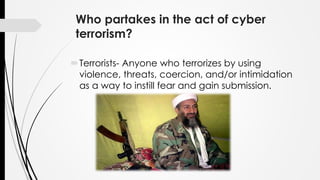
Who partakes in the act of cyber
terrorism?
Terrorists- Anyone who terrorizes by using
violence, threats, coercion, and/or intimidation
as a way to instill fear and gain submission.
3 most common attack methods
IP spoofing.
Password Cracking.
Denial-of-service attacks.
IP Spoofing
Refers to creation of IP packets with forged source
IP address with the purpose of concealing the
identity of sender.
Mostly used in Denial-of-Service attacks.
Most effective in corporate networks where users
can log in without a username or password.
Password Cracking
Password cracking can be implemented using
brute-force attacks, Trojan horse programs and IP
spoofing.
Password attacks usually refer to repeated
attempts to identify a user account and/or
password; these repeated attempts are called
brute-force attacks.
One example is weak encryption(LM hash) used
by Microsoft windows XP, can easily be attacked
Denial-of-Service attacks
Denial-of-service attacks focus on making a
service unavailable to intended users.
2 forms of DoS attacks: those that crash services
and those that flood services.
One common attack method involves
saturating the target machine with
communications requests such that it cannot
respond to the traffic.
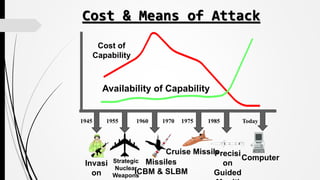
Cost of
Capability
Availability of Capability
1955 1960 1970 1975 1985
Invasi
on
Precisi
on
Guided
ComputerStrategic
Nuclear
Weapons
Cruise Missile
Cost & Means of Attack
1945 Today
Missiles
ICBM & SLBM
Examples of Cyber terrorist attacks:
9/11 attack.
Ahmedabad bomb blast.
26/11 Mumbai attack.
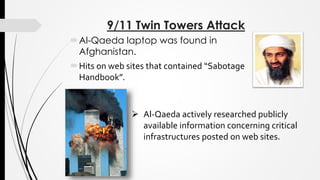
9/11 Twin Towers Attack
Al-Qaeda laptop was found in
Afghanistan.
Hits on web sites that contained “Sabotage
Handbook”.
 Al-Qaeda actively researched publicly
available information concerning critical
infrastructures posted on web sites.
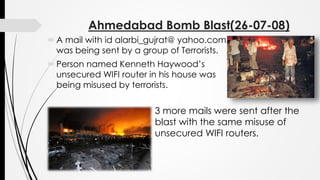
Ahmedabad Bomb Blast(26-07-08)
A mail with id alarbi_gujrat@ yahoo.com
was being sent by a group of Terrorists.
Person named Kenneth Haywood’s
unsecured WIFI router in his house was
being misused by terrorists.
3 more mails were sent after the
blast with the same misuse of
unsecured WIFI routers.
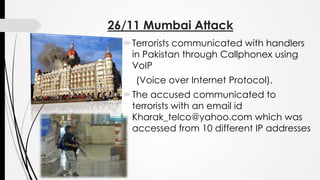
26/11 Mumbai Attack
Terrorists communicated with handlers
in Pakistan through Callphonex using
VoIP
(Voice over Internet Protocol).
The accused communicated to
terrorists with an email id
Kharak_telco@yahoo.com which was
accessed from 10 different IP addresses
Black Out Day
 It was first cyber war at “New York” city on 14th,August,2003
 Real incidents that horribly suffered New York for 3 days
 The hacker attacks on power lines
 Before 3 days some one some where realize the virus named as “
BLASTER”
 And it a self active
 100 power plants are shut down
 By the incident effects on whole traffic ,air line power ,water system &
nuclear reactor too
 New York government struggled 3 months to find the accused
 That was Russian government is totally responsibility to this act
CYBER TERRORISM IN INDIA
 ECIL(Electronic Corporation of India Limited) which was invented electro
voting system in India , controlling parliament security system , Nuclear
plants ,Defense etc.
 ECIL CYBER website was hacked by Phrozenmyst
 Not only ECIL and also ISRO ,BARC
 The hacker Phrozenmyst was stolen sensitive data from ECIL and pasted
on PAGEBIN website
 Due to they are making some illegal tenders and he tweet on his tweeter
account
 From 2010 to Pakistan and china attacking the India by cyber
 Recently Pakistan is made a successfully attack on India by an fake
currency at elections time
Cyber terrorism against traditional terrorism
In the future, cyber terrorism may become a feasible option
to traditional physical acts of violence due to:
a. Perceived anonymity.
b. Low risk of detection.
c. Low investment.
d. Operate from nearly any location.
e. Few resources are needed
How does Cyber Terrorism affect you
and your future?
Air traffic control towers or our airlines
infrastructure could be hacked into.
Banking systems could be violated and all of
our money could be stolen.
Bombs and other explosives could be set off by
remote.
Hospitals could lose all of their information.
Learn Government secrets and plans
The tampering of our water systems.
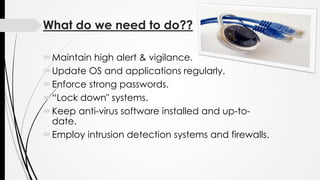
What do we need to do??
Maintain high alert & vigilance.
Update OS and applications regularly.
Enforce strong passwords.
“Lock down" systems.
Keep anti-virus software installed and up-to-
date.
Employ intrusion detection systems and firewalls.
Prevention & Protection:
Be cautious about opening email attachments.
Complete Software Updates
Create difficult passwords
Download anti-virus software
Uninstall unused applications or services
CONCLUSION:
 Cyber terrorism is a scary concept for many reasons.
 It can do possible serious damages to various aspects of our
lives. It is even scarier that cyber terrorism is so difficult to
catch and track and prosecute.
 The information age has brought us many good things, but
along with those good things came some bad things too.
 All we can do as citizens is to protect ourselves by protecting
our information, who we give it to and how much we give it
out.
 Our government is trying to do its part, so let’s support them
and their efforts and stop this cyber battle.
QUERIES PLEASE…
TEJESH
THANK
YOU

CYBER TERRORISM

  • 2.
    “Tomorrow’s terrorist maybe able to do more damage with a keyboard than with a bomb”
  • 3.
    Content Introduction Cyber terrorism Common attack Examples BlackOut Day Traditional terrorism Affect In Future Need to do Prevention & Protection Conclusion
  • 4.
    INTRODUCTION As the useof Internet is increasing day by day, traditional concepts and methods of terrorism have taken new dimensions.  Individuals or groups can use the anonymity afforded by cyberspace to threaten citizens, specific groups (i.e. with membership based on ethnicity or belief), communities and even the countries.
  • 5.
    What is Cyberterrorism??? Cyber terrorism is a phrase used to describe the use of Internet based attacks in terrorist activities, including acts of deliberate, large-scale disruption of computer networks, especially of personal computers attached to the Internet, by the means of tools such as computer viruses.
  • 6.
    Features of CyberTerrorism  Difficulty Identifying Attackers: It remains difficult to determine the identity of the initiators of most cyber attacks.  Lack of Boundaries: Attacks can originate from anywhere in the world and from multiple locations simultaneously.  Speed of Development: The time between the discovery of a new vulnerability and the emergence of a new tool or technique that exploits the vulnerability is getting shorter  Low Cost of Tools: The technology employed in attacks is simple to use, inexpensive, and widely available.  Automated Methods: The methods of attack have become automated and more sophisticated, resulting in greater damage from a single attack.
  • 7.
    Examples of Cyberterrorism.. Hacking into computer systems. Introducing viruses to vulnerable networks. Website Defacing. Denial-of-Service(DoS) attacks. Terroristic threats made via e-mail.
  • 8.
    How does CyberTerrorism work?  Hacking : To gain access to (a computer file or network) illegally or without authorization.  Misinformation: To provide with incorrect information.  Virus: A computer program that duplicates itself in a manner that is harmful to normal computer use. Most viruses work by attaching themselves to another program. The amount of damage varies; viruses may erase all data or do nothing but reproduce themselves.  Worm: A malicious program that replicates itself until it fills all of the storage space on a drive or network.
  • 9.
    Who partakes inthe act of cyber terrorism? Terrorists- Anyone who terrorizes by using violence, threats, coercion, and/or intimidation as a way to instill fear and gain submission.
  • 10.
    3 most commonattack methods IP spoofing. Password Cracking. Denial-of-service attacks.
  • 11.
    IP Spoofing Refers tocreation of IP packets with forged source IP address with the purpose of concealing the identity of sender. Mostly used in Denial-of-Service attacks. Most effective in corporate networks where users can log in without a username or password.
  • 12.
    Password Cracking Password crackingcan be implemented using brute-force attacks, Trojan horse programs and IP spoofing. Password attacks usually refer to repeated attempts to identify a user account and/or password; these repeated attempts are called brute-force attacks. One example is weak encryption(LM hash) used by Microsoft windows XP, can easily be attacked
  • 13.
    Denial-of-Service attacks Denial-of-service attacksfocus on making a service unavailable to intended users. 2 forms of DoS attacks: those that crash services and those that flood services. One common attack method involves saturating the target machine with communications requests such that it cannot respond to the traffic.
  • 14.
    Cost of Capability Availability ofCapability 1955 1960 1970 1975 1985 Invasi on Precisi on Guided ComputerStrategic Nuclear Weapons Cruise Missile Cost & Means of Attack 1945 Today Missiles ICBM & SLBM
  • 15.
    Examples of Cyberterrorist attacks: 9/11 attack. Ahmedabad bomb blast. 26/11 Mumbai attack.
  • 16.
    9/11 Twin TowersAttack Al-Qaeda laptop was found in Afghanistan. Hits on web sites that contained “Sabotage Handbook”.  Al-Qaeda actively researched publicly available information concerning critical infrastructures posted on web sites.
  • 17.
    Ahmedabad Bomb Blast(26-07-08) Amail with id alarbi_gujrat@ yahoo.com was being sent by a group of Terrorists. Person named Kenneth Haywood’s unsecured WIFI router in his house was being misused by terrorists. 3 more mails were sent after the blast with the same misuse of unsecured WIFI routers.
  • 18.
    26/11 Mumbai Attack Terroristscommunicated with handlers in Pakistan through Callphonex using VoIP (Voice over Internet Protocol). The accused communicated to terrorists with an email id Kharak_telco@yahoo.com which was accessed from 10 different IP addresses
  • 19.
    Black Out Day It was first cyber war at “New York” city on 14th,August,2003  Real incidents that horribly suffered New York for 3 days  The hacker attacks on power lines  Before 3 days some one some where realize the virus named as “ BLASTER”  And it a self active  100 power plants are shut down  By the incident effects on whole traffic ,air line power ,water system & nuclear reactor too  New York government struggled 3 months to find the accused  That was Russian government is totally responsibility to this act
  • 20.
    CYBER TERRORISM ININDIA  ECIL(Electronic Corporation of India Limited) which was invented electro voting system in India , controlling parliament security system , Nuclear plants ,Defense etc.  ECIL CYBER website was hacked by Phrozenmyst  Not only ECIL and also ISRO ,BARC  The hacker Phrozenmyst was stolen sensitive data from ECIL and pasted on PAGEBIN website  Due to they are making some illegal tenders and he tweet on his tweeter account  From 2010 to Pakistan and china attacking the India by cyber  Recently Pakistan is made a successfully attack on India by an fake currency at elections time
  • 21.
    Cyber terrorism againsttraditional terrorism In the future, cyber terrorism may become a feasible option to traditional physical acts of violence due to: a. Perceived anonymity. b. Low risk of detection. c. Low investment. d. Operate from nearly any location. e. Few resources are needed
  • 22.
    How does CyberTerrorism affect you and your future? Air traffic control towers or our airlines infrastructure could be hacked into. Banking systems could be violated and all of our money could be stolen. Bombs and other explosives could be set off by remote. Hospitals could lose all of their information. Learn Government secrets and plans The tampering of our water systems.
  • 23.
    What do weneed to do?? Maintain high alert & vigilance. Update OS and applications regularly. Enforce strong passwords. “Lock down" systems. Keep anti-virus software installed and up-to- date. Employ intrusion detection systems and firewalls.
  • 24.
    Prevention & Protection: Becautious about opening email attachments. Complete Software Updates Create difficult passwords Download anti-virus software Uninstall unused applications or services
  • 25.
    CONCLUSION:  Cyber terrorismis a scary concept for many reasons.  It can do possible serious damages to various aspects of our lives. It is even scarier that cyber terrorism is so difficult to catch and track and prosecute.  The information age has brought us many good things, but along with those good things came some bad things too.  All we can do as citizens is to protect ourselves by protecting our information, who we give it to and how much we give it out.  Our government is trying to do its part, so let’s support them and their efforts and stop this cyber battle.
  • 26.
  • 27.
  • 28.