Trillium Health Centre  and  The Canadian Positive Deviance Project Trillium Health Centre’s Positively Deviant Story Presented by:  Louise Koyanagi, RN, BScN Monday December 6, 2010 New Approach to Containing Superbugs Webex Teleconference
Interdisciplinary Team Members  Pilot Site Lead: Louise Koyanagi Lead RN, The Betty Wallace Women’s Health Centre Positive Deviance Core Team Registered Nurses (6) IPAC practitioner (1) Hospitality Associate (1) PD Coach (1) - external Trillium Pilot Units West Toronto-Complex Continuing Care Unit Mississauga-Neurosurgery 2B
Aim: Positive Deviance at Trillium To implement Positive Deviance (PD) methodology to all staff, creating positive social and behavioural change in infection control practices for at least the duration of the project (September 2009 –May 2011).  To reduce and maintain Antibiotic Resistant Organisms (ARO) acquired in hospital (AIH) to zero by utilizing Positive Deviance methodology through the organization.
PD as an Enabler Support of Janet Davidson O.C., President and CEO, senior management and Infection Prevention and Control Alignment with Trillium’s Philosophy of Care and Strategic Themes On-going support from external “PD Coaches” Monthly all-sites teleconferences, facilitated by project leaders Enthusiastic core team of staff to initiate the project locally  Generates discussion and involves “front-line” staff
Path to Implementation of PD News blasts through internal news medium;  i CARE and Trillium News and Events HIROC/Axiom news article (January 29, 2010) about Trillium’s involvement with the PD Project Meetings with Senior Management team Lunch and Learn sessions for all staff at Mississauga and West Toronto “ Buzz Meetings” with eight individual units Discovery and Action Dialogues (DADs) Social network mapping survey (April 2010)
Lessons Learned Although a “front-line” approach, support from Managers imperative  Greater participation when individual units/groups approached Present PD information at scheduled staff meetings Informal meetings with part-time and allied health staff most effective Incentives (i.e. coffee shop gift cards)
More Lessons Learned Hospitality and portering staff appreciative to have a forum for their voices to be heard Share responsibilities within the Core Team “ Meeting requests” via e-mail Regular updates to senior management team TRIZ vs. DADs for time constraints
Barriers to Overcome Unit demands (patient acuity, staffing) Time spent on Discovery and Action Dialogues (DADs) Cultural shift to front-line staff (skepticism) Time constraints  core team staff availability of meeting space Language Computer access Two site hospital model
Pilot Units Chosen May 2010 Neurosurgery 2B (acute care) Complex Continuing Care (long term care) Data collection specific to these two units In addition, generalized data collection for hospital will be shared Support from unit Managers to facilitate staff participation
Pilot Units Complex Continuing Care and Rehabilitation , Trillium – West Toronto (60 beds) Staff Compliment (78): 18 Full-time RNs (including 1 Clinical Educator) 14 Part-time/casual RNs 20 Full-time RPNs 14 Part-time/casual RPNs 12 Allied Health staff (Physiotherapist, Occupational Therapists, Pharmacist, Dietician, Social Worker, Unit Clerks & Hospitality Associates) Neurosurgery 2B , Trillium – Mississauga (29 beds) Staff compliment (64): 31 Full-time RNs (including 1 ACNP & 1 Clinical Educator) 12 Part-time/casual RNs 4 Full-time RPNs 2 Part-time/casual RPNs 15 Allied Health staff (Physiotherapist, Occupational Therapists, Pharmacist, Dietician, Social Worker, Unit Clerks & Hospitality Associates)
PD in Action ‘Beat It!’ Improvisation  The “Nurse Jackson” concept created through a performance by front line staff and family on Complex Continuing Care (West Toronto)  “Nurse Jackson” revisited with 75 colleagues participating at M-site Exaggerated poor infection control practices by a health care providers.  The performers used humor to highlight the seriousness of infection transmission in hospital.  This resulted in the implementation of code word “Nurse Jackson”, now used on a regular basis by staff on Q-CCC, to address their colleagues (at all levels) in a non-threatening manner.  (Adapted from presentation to Quality Storyboard submission by Jackie Nugent, Trish Hutton and PD Team, 2010)
Changes Implemented Culture Shift/Open Communication Daily DADs between ALL staff creating a ‘no-blame’ culture. The ‘voice’ of the Hospitality Associate (HA) now stronger and valued.  Improved collaboration between all staff on the unit regarding Infection Prevention and Control measures  (Adapted from presentation to Quality Storyboard submission by Jackie Nugent, Trish Hutton and PD Team, 2010)
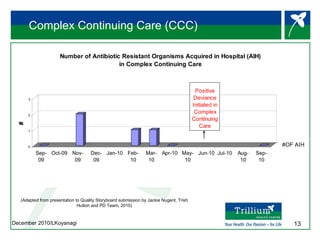
Complex Continuing Care (CCC) (Adapted from presentation to Quality Storyboard submission by Jackie Nugent, Trish Hutton and PD Team, 2010)
“Nurse Jackson” Showed Us… Non-blaming, fun ways address serious unit concerns and show proven long term benefits, out-weighing short term struggles Staff engagement is the key to making sustainable changes  Acknowledging the expertise of our front line colleagues shifts the focus for change from a ‘top down’ approach  to a grass roots model (Adapted from presentation to Quality Storyboard submission by Jackie Nugent, Trish Hutton  and PD Team, 2010)
“Nurse Jackson”  Awareness and Satisfaction Survey Results 96% of all staff knew the meaning of code word “Nurse Jackson” Survey include Nursing, Allied health, Unit Coordination Associates (UCA), HAs and student nurses. 45% indicated they have comfortably used the term “Nurse Jackson” to address IPAC matters. 31% indicated that they have been called “Nurse Jackson”, heightening their awareness and immediate improvement of personal IPAC practices. 93% of staff rated the Nurse Jackson concept as:  “ outstanding” highly functional relevant to their practice and have witnessed a notable improvement in IPAC practices on the unit.
Evidence of Sustainability  Surveillance: Hand hygiene audits; DADs, Staff/patient surveys Quarterly reporting of Acquired in Hospital (AIH) Antibiotic Resistant Organisms (ARO) will be displayed for review and discussion of the findings Quarterly usage reporting will be shared. This will include such items as soap, purell and personal protective equipment (PPE) Staff requesting to view Improvisation Video. 96% (CCC) staff surveyed indicated interest in future IPAC initiatives. (Adapted from presentation to Quality Storyboard submission by Jackie Nugent, Trish Hutton and PD Team, 2010)
Next Steps “ Nurse Jackson” presented to Trillium President and Vice President weekly meeting in August 2010 for organization wide awareness and support. “ Nurse Jackson” presented with positive response to: Halton and Neighboring Districts Infection Control Group Peel Community and Long-term Care Regional Infection Control Network.  Nurse Jackson unleashed during Improv Event during Infection Control week with approximately 75 people in attendance. Nurse Jackson concept to be adopted as a learning/teaching tool to new hires and student orientation of CCC services Future Nursing Journal Article (Adapted from presentation to Quality Storyboard submission by Jackie Nugent, Trish Hutton  and PD Team, 2010)
Trillium PD Core Team Louise Koyanagi, RN, Pilot Site Lead, The Canadian Deviance Project Lead Nurse, The Betty Wallace Women’s Health Centre Tricia Hutton, RN, Infection Prevention and Control Diane Wienwurm, Infection Control Practitioner Gillian Dennis, RN, Oncology Clinic Doug Hogan, RN, Clinical Leader, 6J Oncology/Medicine Jackie Nugent, RN, Clinical Leader, Complex Continuing Care Joe Pasia, RN, Manager, Neurosurgery 2B Serena Johnson, Hospitality Associate, Complex Continuing Care Erika Bailey, PD Coach, Erika Lee Bailey and Associates
Contact Information For further information about Trillium’s PD journey… Louise Koyanagi, RN, BScN Pilot Site Lead, The Canadian PD Project Trillium Health Centre-West Toronto 150 Sherway Drive Toronto, ON M9C 1A5 E-mail: lkoyanagi@thc.on.ca Tel: 416-259-7580 ext. 5776 Fax: 416-521-4036

Trillium's PD Story 2010

  • 1.
    Trillium Health Centre and The Canadian Positive Deviance Project Trillium Health Centre’s Positively Deviant Story Presented by: Louise Koyanagi, RN, BScN Monday December 6, 2010 New Approach to Containing Superbugs Webex Teleconference
  • 2.
    Interdisciplinary Team Members Pilot Site Lead: Louise Koyanagi Lead RN, The Betty Wallace Women’s Health Centre Positive Deviance Core Team Registered Nurses (6) IPAC practitioner (1) Hospitality Associate (1) PD Coach (1) - external Trillium Pilot Units West Toronto-Complex Continuing Care Unit Mississauga-Neurosurgery 2B
  • 3.
    Aim: Positive Devianceat Trillium To implement Positive Deviance (PD) methodology to all staff, creating positive social and behavioural change in infection control practices for at least the duration of the project (September 2009 –May 2011). To reduce and maintain Antibiotic Resistant Organisms (ARO) acquired in hospital (AIH) to zero by utilizing Positive Deviance methodology through the organization.
  • 4.
    PD as anEnabler Support of Janet Davidson O.C., President and CEO, senior management and Infection Prevention and Control Alignment with Trillium’s Philosophy of Care and Strategic Themes On-going support from external “PD Coaches” Monthly all-sites teleconferences, facilitated by project leaders Enthusiastic core team of staff to initiate the project locally Generates discussion and involves “front-line” staff
  • 5.
    Path to Implementationof PD News blasts through internal news medium; i CARE and Trillium News and Events HIROC/Axiom news article (January 29, 2010) about Trillium’s involvement with the PD Project Meetings with Senior Management team Lunch and Learn sessions for all staff at Mississauga and West Toronto “ Buzz Meetings” with eight individual units Discovery and Action Dialogues (DADs) Social network mapping survey (April 2010)
  • 6.
    Lessons Learned Althougha “front-line” approach, support from Managers imperative Greater participation when individual units/groups approached Present PD information at scheduled staff meetings Informal meetings with part-time and allied health staff most effective Incentives (i.e. coffee shop gift cards)
  • 7.
    More Lessons LearnedHospitality and portering staff appreciative to have a forum for their voices to be heard Share responsibilities within the Core Team “ Meeting requests” via e-mail Regular updates to senior management team TRIZ vs. DADs for time constraints
  • 8.
    Barriers to OvercomeUnit demands (patient acuity, staffing) Time spent on Discovery and Action Dialogues (DADs) Cultural shift to front-line staff (skepticism) Time constraints core team staff availability of meeting space Language Computer access Two site hospital model
  • 9.
    Pilot Units ChosenMay 2010 Neurosurgery 2B (acute care) Complex Continuing Care (long term care) Data collection specific to these two units In addition, generalized data collection for hospital will be shared Support from unit Managers to facilitate staff participation
  • 10.
    Pilot Units ComplexContinuing Care and Rehabilitation , Trillium – West Toronto (60 beds) Staff Compliment (78): 18 Full-time RNs (including 1 Clinical Educator) 14 Part-time/casual RNs 20 Full-time RPNs 14 Part-time/casual RPNs 12 Allied Health staff (Physiotherapist, Occupational Therapists, Pharmacist, Dietician, Social Worker, Unit Clerks & Hospitality Associates) Neurosurgery 2B , Trillium – Mississauga (29 beds) Staff compliment (64): 31 Full-time RNs (including 1 ACNP & 1 Clinical Educator) 12 Part-time/casual RNs 4 Full-time RPNs 2 Part-time/casual RPNs 15 Allied Health staff (Physiotherapist, Occupational Therapists, Pharmacist, Dietician, Social Worker, Unit Clerks & Hospitality Associates)
  • 11.
    PD in Action‘Beat It!’ Improvisation The “Nurse Jackson” concept created through a performance by front line staff and family on Complex Continuing Care (West Toronto) “Nurse Jackson” revisited with 75 colleagues participating at M-site Exaggerated poor infection control practices by a health care providers. The performers used humor to highlight the seriousness of infection transmission in hospital. This resulted in the implementation of code word “Nurse Jackson”, now used on a regular basis by staff on Q-CCC, to address their colleagues (at all levels) in a non-threatening manner. (Adapted from presentation to Quality Storyboard submission by Jackie Nugent, Trish Hutton and PD Team, 2010)
  • 12.
    Changes Implemented CultureShift/Open Communication Daily DADs between ALL staff creating a ‘no-blame’ culture. The ‘voice’ of the Hospitality Associate (HA) now stronger and valued. Improved collaboration between all staff on the unit regarding Infection Prevention and Control measures (Adapted from presentation to Quality Storyboard submission by Jackie Nugent, Trish Hutton and PD Team, 2010)
  • 13.
    Complex Continuing Care(CCC) (Adapted from presentation to Quality Storyboard submission by Jackie Nugent, Trish Hutton and PD Team, 2010)
  • 14.
    “Nurse Jackson” ShowedUs… Non-blaming, fun ways address serious unit concerns and show proven long term benefits, out-weighing short term struggles Staff engagement is the key to making sustainable changes Acknowledging the expertise of our front line colleagues shifts the focus for change from a ‘top down’ approach to a grass roots model (Adapted from presentation to Quality Storyboard submission by Jackie Nugent, Trish Hutton and PD Team, 2010)
  • 15.
    “Nurse Jackson” Awareness and Satisfaction Survey Results 96% of all staff knew the meaning of code word “Nurse Jackson” Survey include Nursing, Allied health, Unit Coordination Associates (UCA), HAs and student nurses. 45% indicated they have comfortably used the term “Nurse Jackson” to address IPAC matters. 31% indicated that they have been called “Nurse Jackson”, heightening their awareness and immediate improvement of personal IPAC practices. 93% of staff rated the Nurse Jackson concept as: “ outstanding” highly functional relevant to their practice and have witnessed a notable improvement in IPAC practices on the unit.
  • 16.
    Evidence of Sustainability Surveillance: Hand hygiene audits; DADs, Staff/patient surveys Quarterly reporting of Acquired in Hospital (AIH) Antibiotic Resistant Organisms (ARO) will be displayed for review and discussion of the findings Quarterly usage reporting will be shared. This will include such items as soap, purell and personal protective equipment (PPE) Staff requesting to view Improvisation Video. 96% (CCC) staff surveyed indicated interest in future IPAC initiatives. (Adapted from presentation to Quality Storyboard submission by Jackie Nugent, Trish Hutton and PD Team, 2010)
  • 17.
    Next Steps “Nurse Jackson” presented to Trillium President and Vice President weekly meeting in August 2010 for organization wide awareness and support. “ Nurse Jackson” presented with positive response to: Halton and Neighboring Districts Infection Control Group Peel Community and Long-term Care Regional Infection Control Network. Nurse Jackson unleashed during Improv Event during Infection Control week with approximately 75 people in attendance. Nurse Jackson concept to be adopted as a learning/teaching tool to new hires and student orientation of CCC services Future Nursing Journal Article (Adapted from presentation to Quality Storyboard submission by Jackie Nugent, Trish Hutton and PD Team, 2010)
  • 18.
    Trillium PD CoreTeam Louise Koyanagi, RN, Pilot Site Lead, The Canadian Deviance Project Lead Nurse, The Betty Wallace Women’s Health Centre Tricia Hutton, RN, Infection Prevention and Control Diane Wienwurm, Infection Control Practitioner Gillian Dennis, RN, Oncology Clinic Doug Hogan, RN, Clinical Leader, 6J Oncology/Medicine Jackie Nugent, RN, Clinical Leader, Complex Continuing Care Joe Pasia, RN, Manager, Neurosurgery 2B Serena Johnson, Hospitality Associate, Complex Continuing Care Erika Bailey, PD Coach, Erika Lee Bailey and Associates
  • 19.
    Contact Information Forfurther information about Trillium’s PD journey… Louise Koyanagi, RN, BScN Pilot Site Lead, The Canadian PD Project Trillium Health Centre-West Toronto 150 Sherway Drive Toronto, ON M9C 1A5 E-mail: lkoyanagi@thc.on.ca Tel: 416-259-7580 ext. 5776 Fax: 416-521-4036

Editor's Notes

  • #5 Through support of the CEO, senior management and Infection Prevention and Control, the core team was able to embrace learning about the PD project and subsequent training. Front line staff identified as nurses, physicians, allied health, environmental and hospitality associates. Trillium’s PD Coach, Erika Bailey was instrumental in allowing us to grow in our knowledge of Positive Deviance, without being restrictive, by guiding us in the PD principles Monthly all-sites updates, facilitated by project leaders, provided a forum to share ideas and learn from each other.
  • #6 Meetings with Senior Management team to present details of project requirements and verify support Lunch and Learn (Nov. 2009): 4 sessions in total, 2 per site Buzz Meetings (Jan/Feb 2010) with: Facilities Services Diagnostic Imaging at WT and M Neuro/MSK Emergency (M) Surgery 3C Courtyard (WT) Nursing Advisory Council DADs (March 2010) with staff from: Emergency, Courtyard, Neuro 2B, Nursing office and Portering/HAs Participated in HIROC ( Healthcare Insurance Reciprocal of Canada) Axiom News article about Trillium’s involvement (January 29/10)
  • #7 Incentives: Food (needed) Tim Horton’s Gift cards (survey completion)
  • #9 Acute units felt that a 15-20 minute DAD is too time consuming for them to be “away” from their patient load Time constraints – Core team: Full/part time staff already with full schedules, who must fit the PD needs with their own schedules Staff: staff shortages/additional work loads cause staff to be hesitant to participate Barriers: Language – if English is not first language, participation in paper surveys difficult Computer access – not all hospitality/portering staff have on-line access or comfort level with this mode of communication
  • #18 Increased engagement with Neuro 2B, to include TRIZ exercises with staff Maintain momentum with CCC staff to identify the positive deviants who can affect change. Potential to incorporate this methodology to any problem