Inova Health System


                Picker Grant
                   Update
                    For
           Patient Advisory Team

            Oct. 26, 2011
   Mary Ann Friesen PhD, RN, CPHQ
    Angela Servidio RN, BSN, BA
                                    1
• Explore the patient perceptions of bedside handoffs
  will kick of in 2011
• Always Event


                                                        2
Picker Institute

  Dedicated to advancing the principles of
    patient-centered care.

  Sponsors awards, research and education to
    promote patient-centered care and the
    patient-centered care movement.


                                                3
Always Events

 • Picker has determined that an organizing principle
   focused on the concept of Always Events℠ can be
   implemented to drive the system to become more
   patient-centered.
 • “Never Events” refer to incidents that should never
   happen in the delivery of care.
 • Patient-focused Always Events℠ are aspects of the
   patient and family experience that should always
   occur.

 *Brochures


                                                         4
Always Events℠ Challenge Grant Recipients Announced!

• Organization/Institution: Inova Health System
  Principal Investigator(s): Mary Ann Friesen, PhD, RN, CPHQ
  Project Title: Developing a Patient-Centered Approach to
  Handoffs
• Always Event(s): Patients will always be included in the
  ISHAPED handoff shift-to-shift hand-off process at the bedside
  as this will add an additional layer of safety by allowing the
  patient to communicate potential safety concerns.

* Page 6


                                                                   5
Journey

 • Handoff Issues Identified
      – Agency for Healthcare Research & Quality Hospital Survey on Patient Safety
        Culture
      – Variance Across System
 •   Quality Leadership CE
 •   System Kaizen – LEAN (March 2010)
 •   Pilot Projects
 •   Systemwide Rollout
 •   Research
      – Nursing Research
      – IRC
      – IRB
 • Education Plan
      – Development
      – Production


                                                                                     6
Picker – will support Development of Education Program

• A collaborative exchange of information (conference calls,
  webinars, and listserv communications).
• Learning network for achieving the selected Always
  Events℠
• Development of key messages and media tools
  http://alwaysevents.pickerinstitute.org/?cat=7


                                                               7
Background


 • “current state of scientific knowledge regarding hospital
   handoffs is limited” (Arora, V.M, Manjarrez, Dressler, D.D, Dresler, D.D, Basaviah, P,
     Halasyamani, L, Kripalani, S., 2009 p. 437)


 • “Despite the well-known negative consequences of
   inadequate nursing handoffs, very little research has
   been done to identify best practices.. (Riesenberg, L.A , Leitzsch, J.,
     Cunningham, J.M., (2010) p. 24)


 Australian Council for Safety and Quality in Health Care. (2005). Clinical handover and patient safety literature review report. Retrieved January 5, 2006, from
 http://www.safetyandquality.org/index.cfm?page=Publications#clinhovrlit
                                                                                                                                                                    8
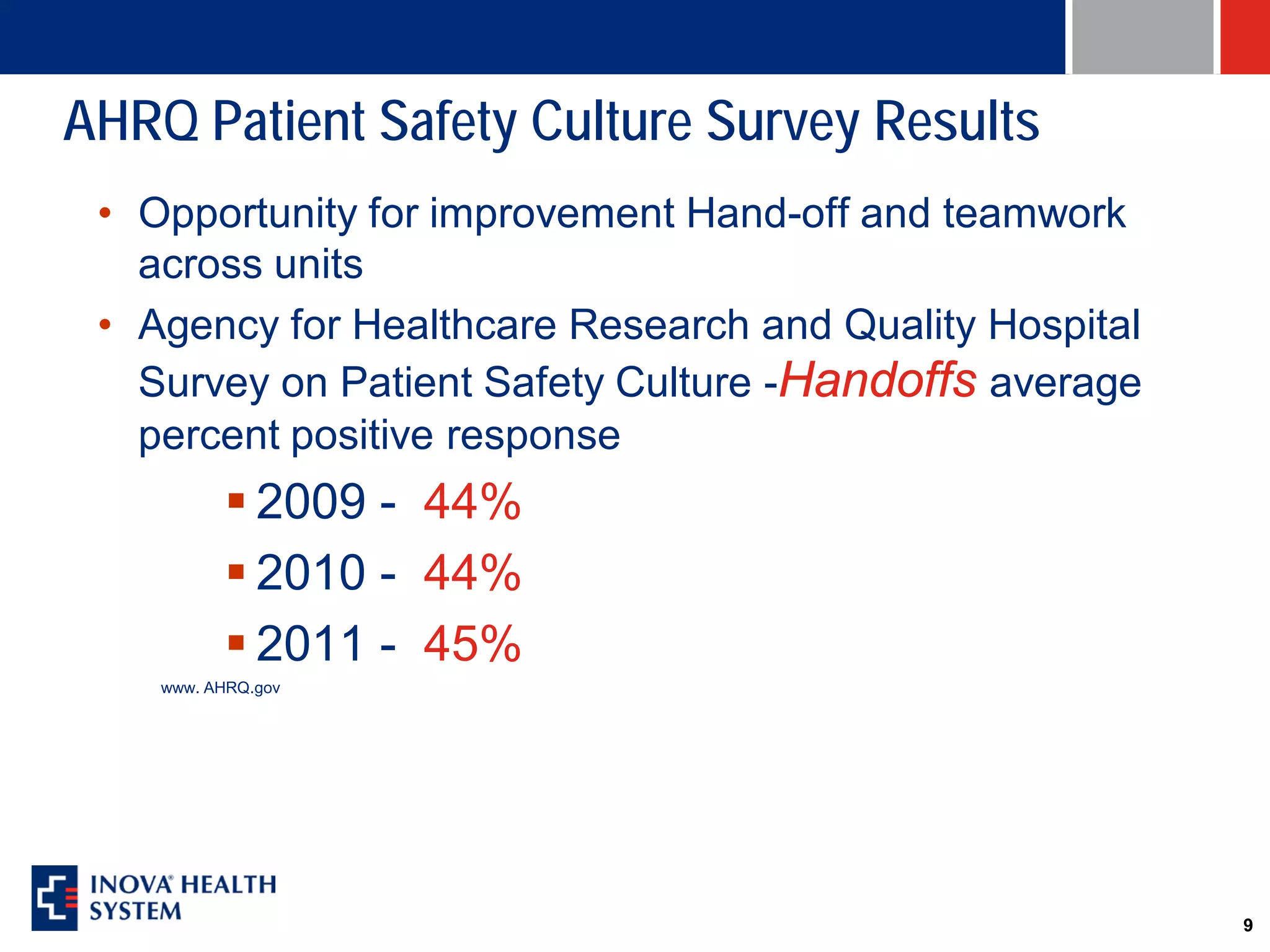
AHRQ Patient Safety Culture Survey Results
 • Opportunity for improvement Hand-off and teamwork
   across units
 • Agency for Healthcare Research and Quality Hospital
   Survey on Patient Safety Culture -Handoffs average
   percent positive response
           2009 - 44%
           2010 - 44%
           2011 - 45%
    www. AHRQ.gov


                                                         9
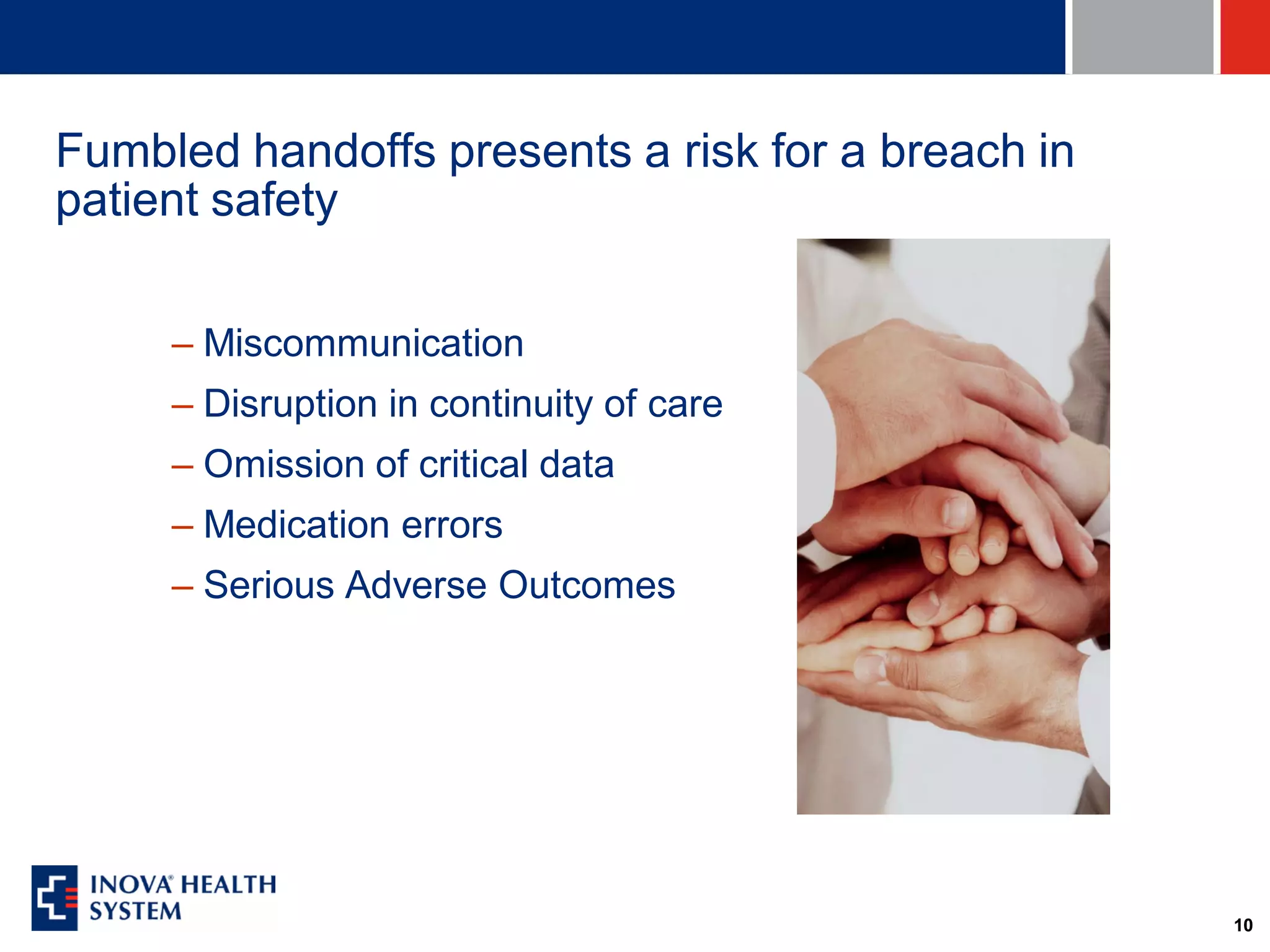
Fumbled handoffs presents a risk for a breach in
patient safety

     – Miscommunication
     – Disruption in continuity of care
     – Omission of critical data
     – Medication errors
     – Serious Adverse Outcomes


                                                   10
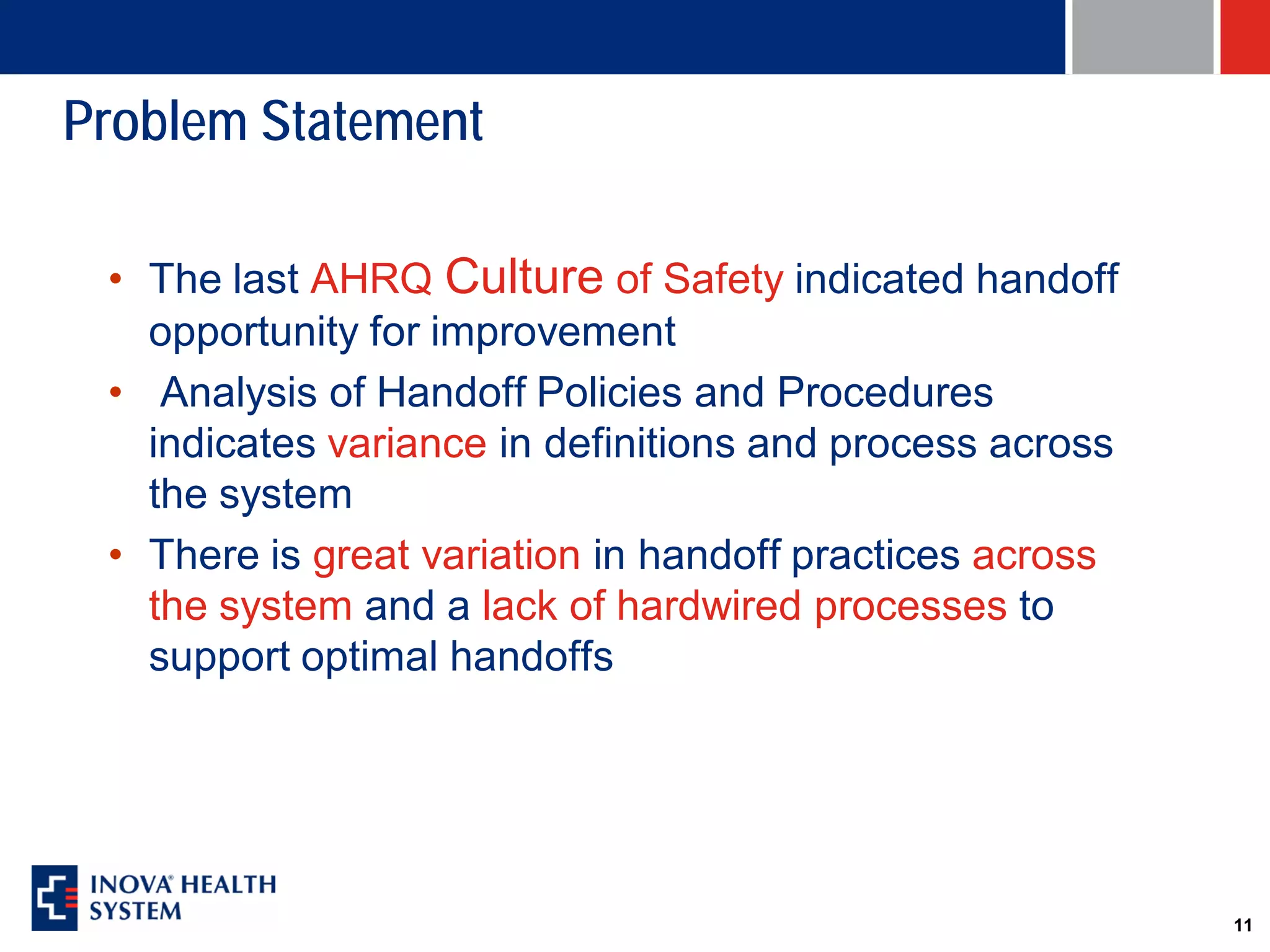
Problem Statement

 • The last AHRQ Culture of Safety indicated handoff
   opportunity for improvement
 • Analysis of Handoff Policies and Procedures
   indicates variance in definitions and process across
   the system
 • There is great variation in handoff practices across
   the system and a lack of hardwired processes to
   support optimal handoffs


                                                          11
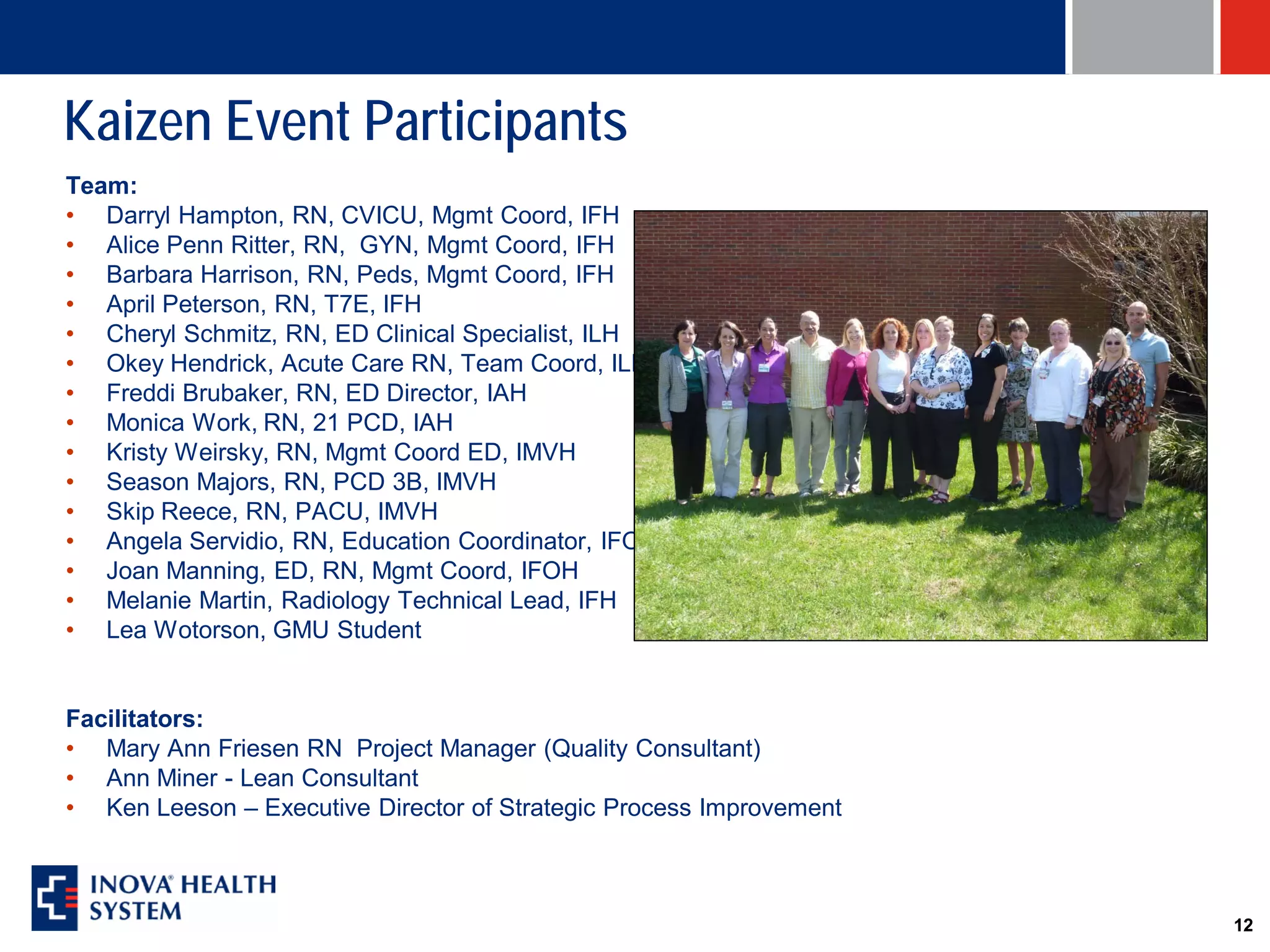
Kaizen Event Participants
Team:
• Darryl Hampton, RN, CVICU, Mgmt Coord, IFH
• Alice Penn Ritter, RN, GYN, Mgmt Coord, IFH
• Barbara Harrison, RN, Peds, Mgmt Coord, IFH
• April Peterson, RN, T7E, IFH
• Cheryl Schmitz, RN, ED Clinical Specialist, ILH
• Okey Hendrick, Acute Care RN, Team Coord, ILH
• Freddi Brubaker, RN, ED Director, IAH
• Monica Work, RN, 21 PCD, IAH
• Kristy Weirsky, RN, Mgmt Coord ED, IMVH
• Season Majors, RN, PCD 3B, IMVH
• Skip Reece, RN, PACU, IMVH
• Angela Servidio, RN, Education Coordinator, IFOH
• Joan Manning, ED, RN, Mgmt Coord, IFOH
• Melanie Martin, Radiology Technical Lead, IFH
• Lea Wotorson, GMU Student


Facilitators:
• Mary Ann Friesen RN Project Manager (Quality Consultant)
• Ann Miner - Lean Consultant
• Ken Leeson – Executive Director of Strategic Process Improvement


                                                                     12
Goals and Objectives of System Handoff Kaizen
Performance Improvement - Continuous improvement
  • Provide training/exposure to the various handoff
    methodologies that have been tried with success
  • Select a guiding methodology for patient handoffs
  • Identify key components of effective handoff
    processes using the selected methodology
  • Draft a deployment plan


                                                        13
Team Reviewed Examples of Strategies and Best
Practices  (Patterson et al 2004; Park & Mishkin 2005)
                        • Interactive, face-to-face handoff is
                                                           preferred
                                                         • Limit interruptions
                                                         • Read-back
                                                         • Un-ambiguous transfer of
                                                           responsibility
                                                         • Critical situation delay transfer
                                                         • Written summary/information
                                                         • Receive paperwork
                                                         • Make it clear - who for what
                                                         • Monitor
                                                         • Educate
                                                         • Support “Good Catch”


                                                                                               14
ISHAPED

      I   Introduce
      S   Story
      H   History
      A   Assessment
      P   Plan
      E   Error Prevention
      D   Dialogue

                             15
What is a “Handoff” ?
 • “The transfer of information (along with authority and
   responsibility) during transitions in care across the continuum;
   to include an opportunity to ask questions, clarify and confirm.”
   (Agency for Healthcare Research and Quality, 2006)*
     – Transfer of information
     – Transfer of responsibility
     – Accountability
     – Acknowledgement
     – Interaction
     – Verification
     – Opportunity to address patient safety


                                                                       16
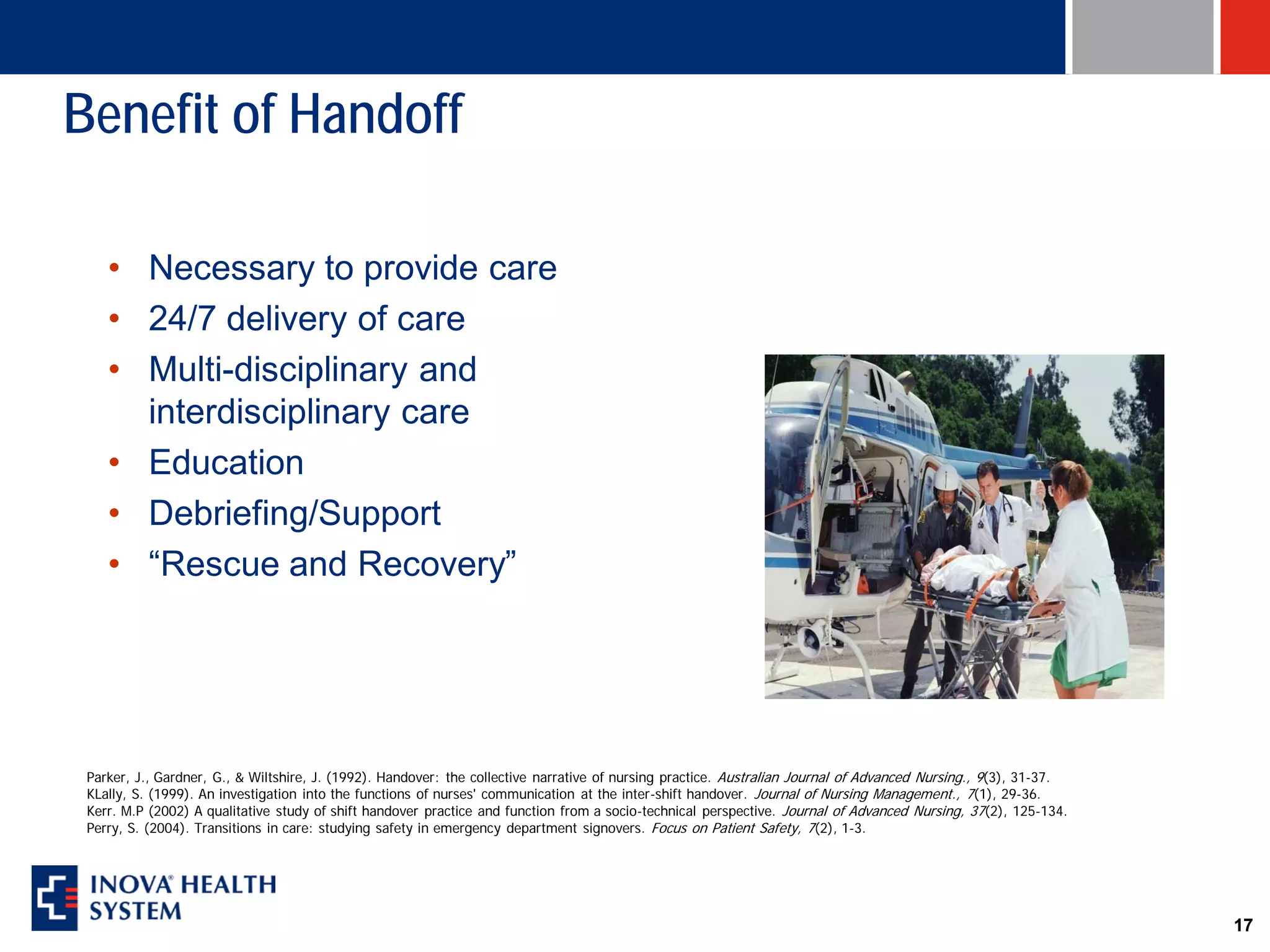
Benefit of Handoff

    • Necessary to provide care
    • 24/7 delivery of care
    • Multi-disciplinary and
      interdisciplinary care
    • Education
    • Debriefing/Support
    • “Rescue and Recovery”


 Parker, J., Gardner, G., & Wiltshire, J. (1992). Handover: the collective narrative of nursing practice. Australian Journal of Advanced Nursing., 9(3), 31-37.
 KLally, S. (1999). An investigation into the functions of nurses' communication at the inter-shift handover. Journal of Nursing Management., 7(1), 29-36.
 Kerr. M.P (2002) A qualitative study of shift handover practice and function from a socio-technical perspective. Journal of Advanced Nursing, 37(2), 125-134.
 Perry, S. (2004). Transitions in care: studying safety in emergency department signovers. Focus on Patient Safety, 7(2), 1-3.


                                                                                                                                                                  17
Causes of Handoff Failures
 • Lack of formal tools to support transitions in
   care
 • Handoffs vary greatly – lack of
   standardization (expectation)
 • Not interactional
 • Interruptions - staggering
 • Memory lapse - omissions
 • Verbal issues - accents, sound alike
   medications, acronyms, abbreviations, lack of
   common understanding
 • Lack of access to patient data
 • Need for skill and education


                                                    18
Where are we today?

       • We have an opportunity at Inova to improve handoffs,
         healthcare communication and culture of safety.
       • “Very little evidence to support the use of any specific,
         structure, protocol or method.” Riesenberg, L et al. (2009)
                – Need for discipline specific handoffs studies
                – Different content needed for different areas


Riesenberg, L et al. (2009) Residents’ and attending physicians’ handoffs: A systematic review of the literature. Academic Medicine 84(12) p. 1775-1787.


                                                                                                                                                           19
Goals

 •   Improve communication and handoff process
 •   Improve patient safety
 •   Improve team work and collaboration
 •   Improve staff satisfaction with handoff process
 •   Improve patient satisfaction

 • Patient Centered Handoff


                                                       20
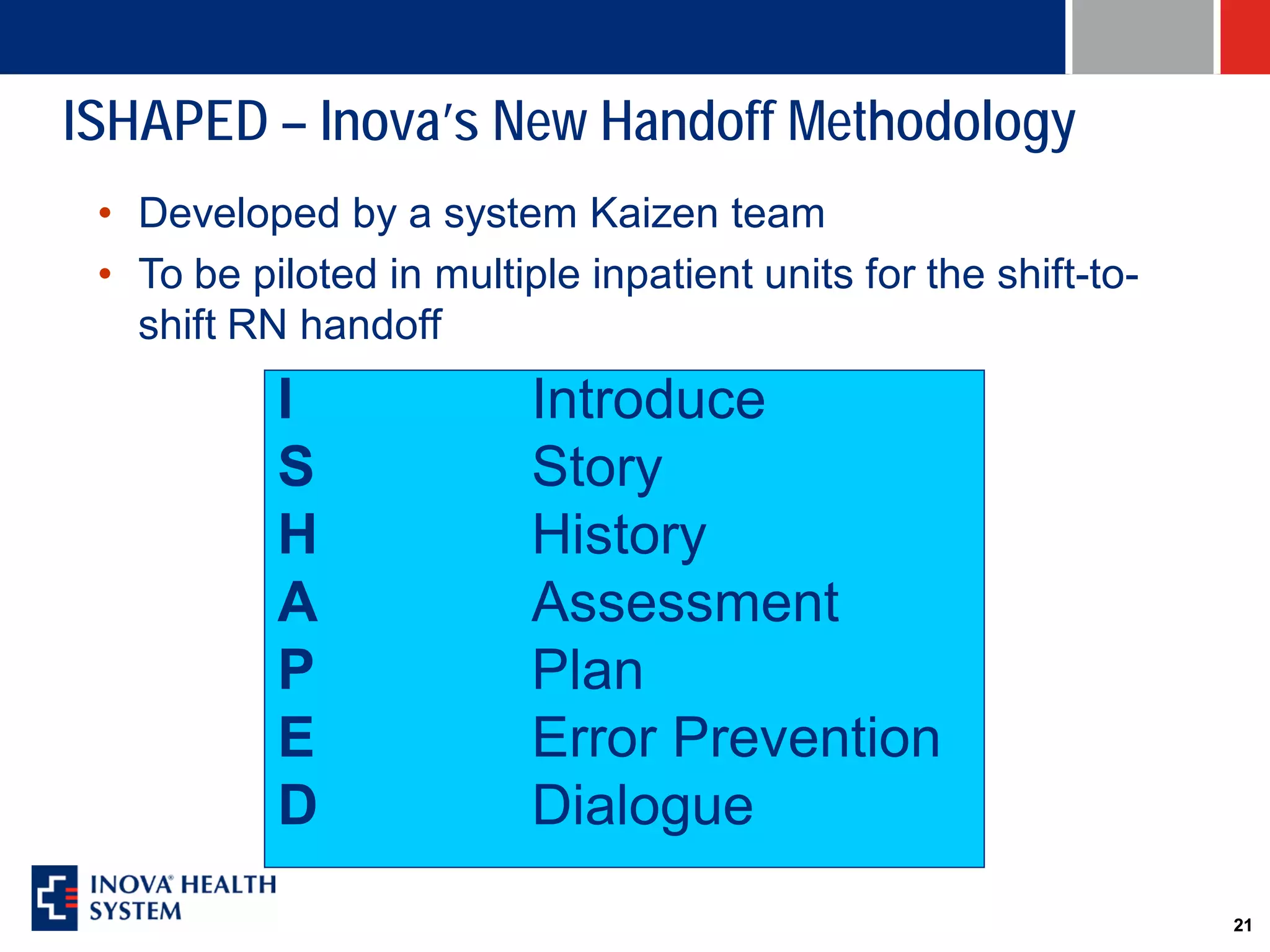
ISHAPED – Inova’s New Handoff Methodology
 • Developed by a system Kaizen team
 • To be piloted in multiple inpatient units for the shift-to-
   shift RN handoff
           I              Introduce
           S              Story
           H              History
           A              Assessment
           P              Plan
           E              Error Prevention
           D              Dialogue
                                                                 21
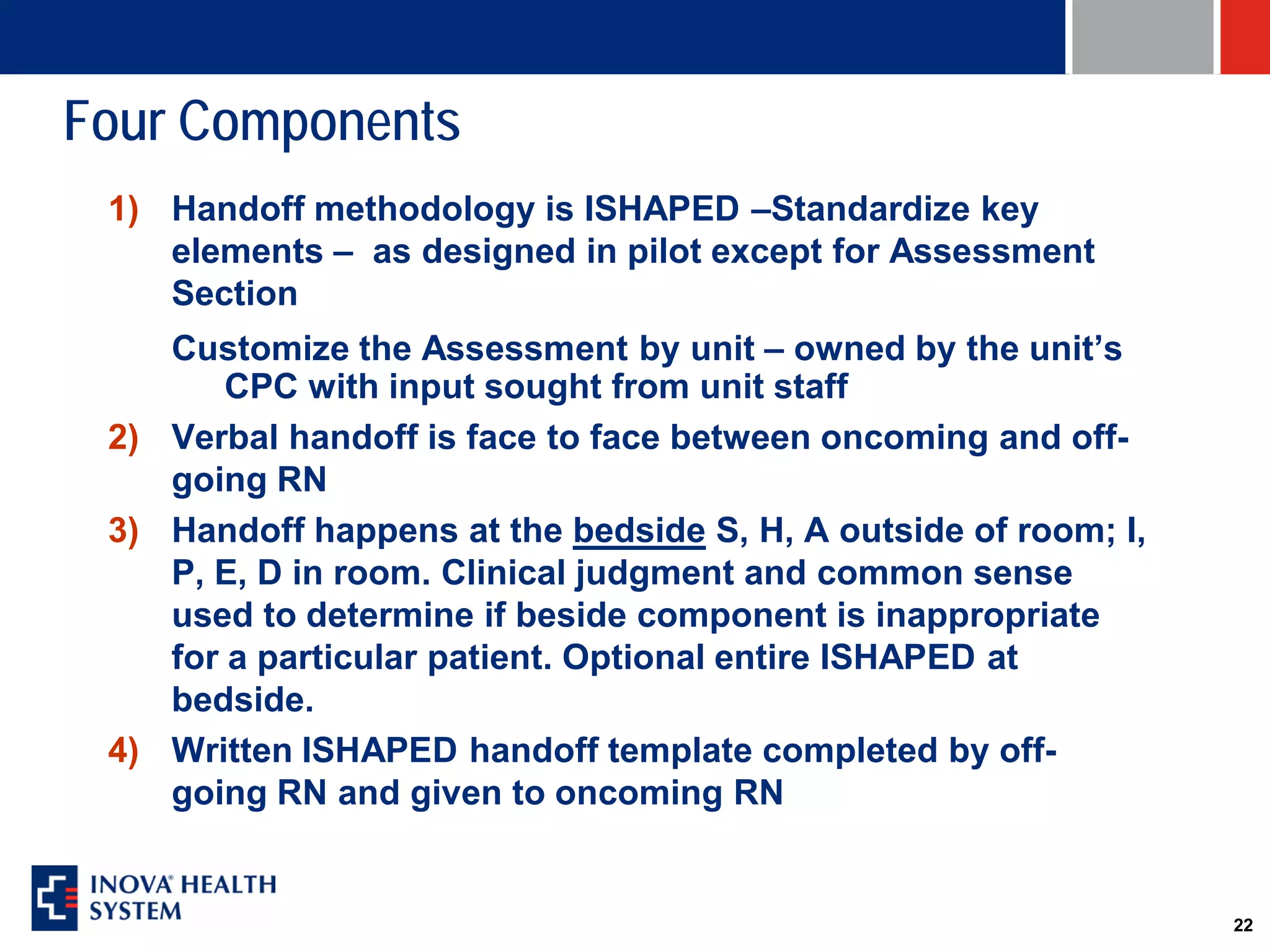
Four Components
 1) Handoff methodology is ISHAPED –Standardize key
    elements – as designed in pilot except for Assessment
    Section
    Customize the Assessment by unit – owned by the unit’s
        CPC with input sought from unit staff
 2) Verbal handoff is face to face between oncoming and off-
    going RN
 3) Handoff happens at the bedside S, H, A outside of room; I,
    P, E, D in room. Clinical judgment and common sense
    used to determine if beside component is inappropriate
    for a particular patient. Optional entire ISHAPED at
    bedside.
 4) Written ISHAPED handoff template completed by off-
    going RN and given to oncoming RN


                                                                 22
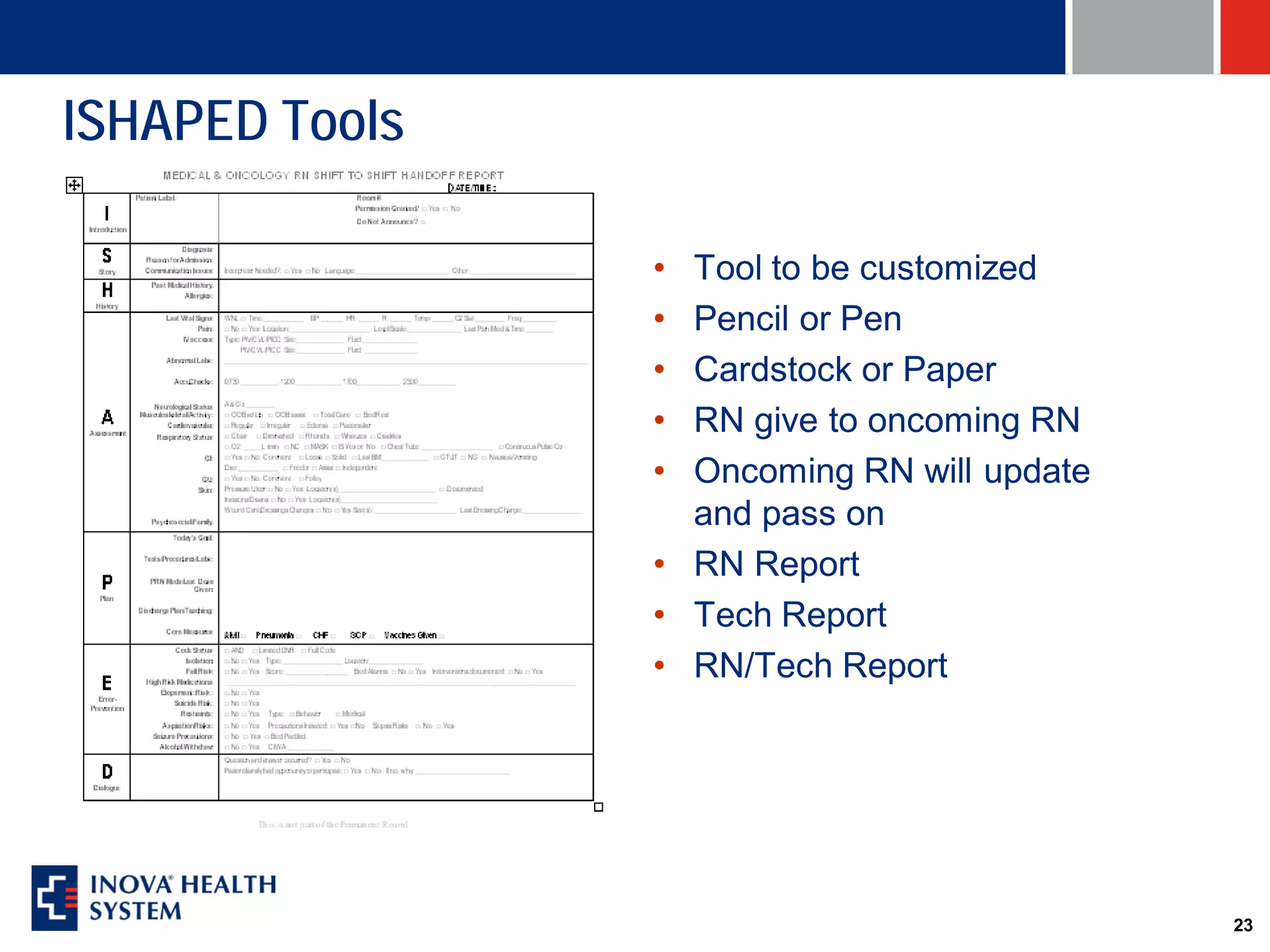
ISHAPED Tools

                • Tool to be customized
                • Pencil or Pen
                • Cardstock or Paper
                • RN give to oncoming RN
                • Oncoming RN will update
                  and pass on
                • RN Report
                • Tech Report
                • RN/Tech Report


                                            23
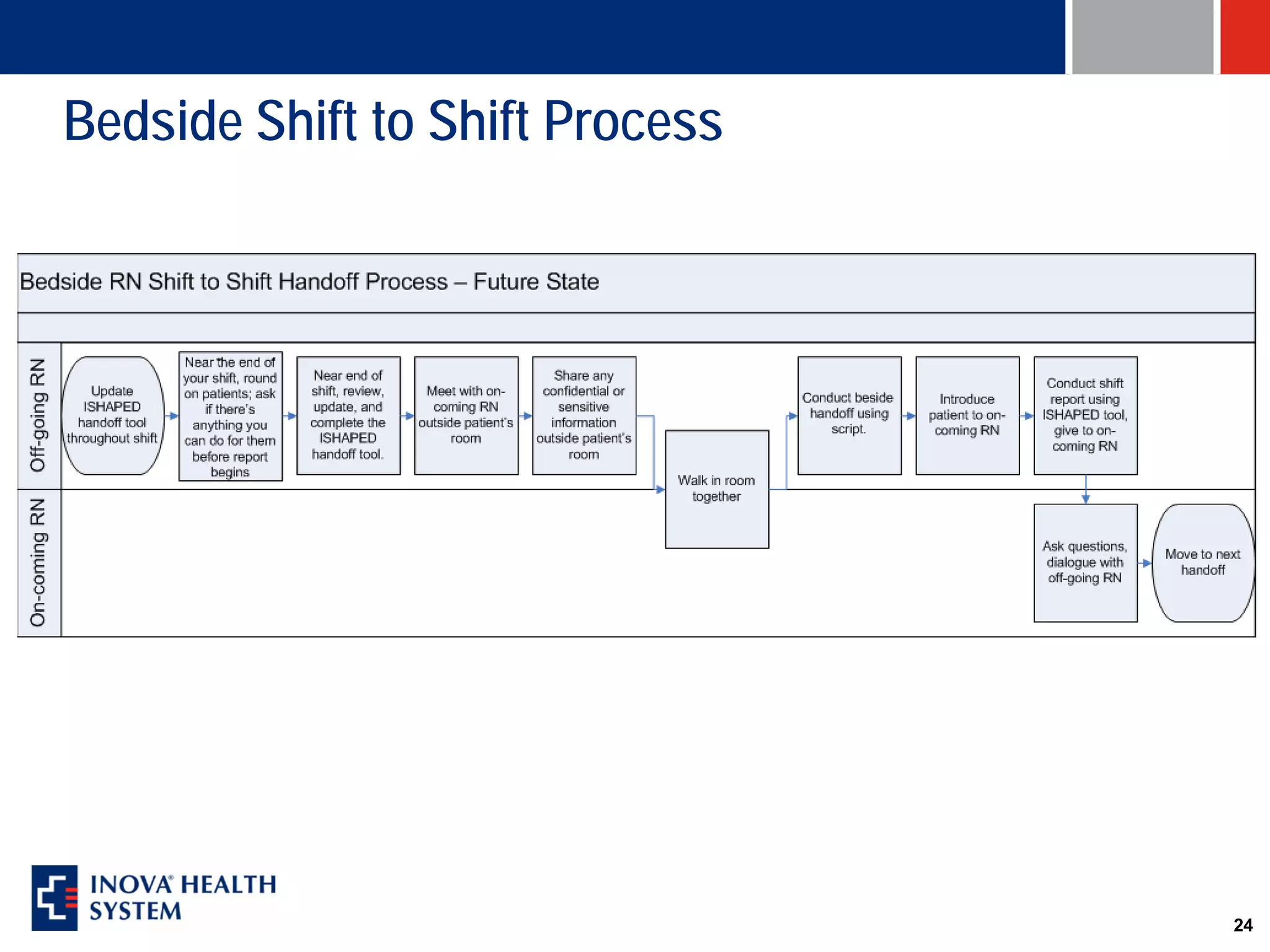
Bedside Shift to Shift Process


                                 24
Qualitative Results from RN Handoff Perception
Survey
 Summary
 Patient do not want handoff ????????
 Patient do want handoff???????

 New Term Bedside Shift to Shift Report


                                                 25
Nurses should include:

 • AIDET Acknowledge, Introduce, Duration, Explanations,
   Thank you
 • Method to identify those patients who do not wish to
   participate
 • RN performs hand-off tasks such as:
         Checking MAG
         Checking chart orders
         Checking computer for medications charted
         Checking computer for orders reviewed by RN
         In room: Whiteboards, IV lines, etc.

                                                           26
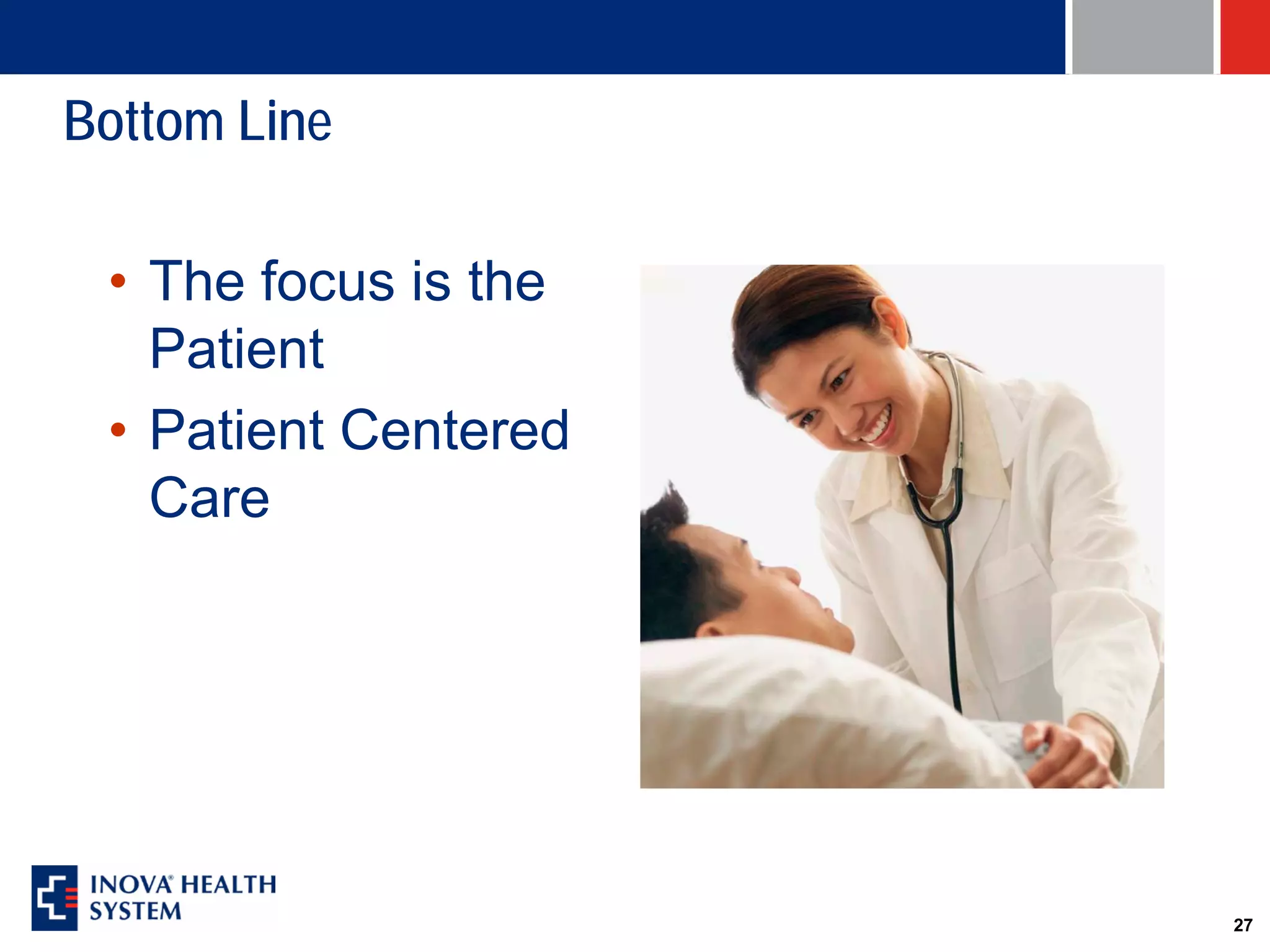
Bottom Line

 • The focus is the
   Patient
 • Patient Centered
   Care


                      27
Next Steps

 • Youtube
 • Revise Protocol – (IRB)
 • Patient and Family Developing a Patient Centered Approach to
   Handoffs Research Team Advisory Board will include patient
   and families to assure that the experiences, perceptions and
   knowledge are recognized and utilized.
 • Interviews
 • Analysis
 • Education Plan
 • Education Materials
 • Video


                                                                  28

Inova Health System: Developing a patient centered approach to handoffs

  • 1.
    Inova Health System Picker Grant Update For Patient Advisory Team Oct. 26, 2011 Mary Ann Friesen PhD, RN, CPHQ Angela Servidio RN, BSN, BA 1
  • 2.
    • Explore thepatient perceptions of bedside handoffs will kick of in 2011 • Always Event 2
  • 3.
    Picker Institute Dedicated to advancing the principles of patient-centered care. Sponsors awards, research and education to promote patient-centered care and the patient-centered care movement. 3
  • 4.
    Always Events •Picker has determined that an organizing principle focused on the concept of Always Events℠ can be implemented to drive the system to become more patient-centered. • “Never Events” refer to incidents that should never happen in the delivery of care. • Patient-focused Always Events℠ are aspects of the patient and family experience that should always occur. *Brochures 4
  • 5.
    Always Events℠ ChallengeGrant Recipients Announced! • Organization/Institution: Inova Health System Principal Investigator(s): Mary Ann Friesen, PhD, RN, CPHQ Project Title: Developing a Patient-Centered Approach to Handoffs • Always Event(s): Patients will always be included in the ISHAPED handoff shift-to-shift hand-off process at the bedside as this will add an additional layer of safety by allowing the patient to communicate potential safety concerns. * Page 6 5
  • 6.
    Journey • HandoffIssues Identified – Agency for Healthcare Research & Quality Hospital Survey on Patient Safety Culture – Variance Across System • Quality Leadership CE • System Kaizen – LEAN (March 2010) • Pilot Projects • Systemwide Rollout • Research – Nursing Research – IRC – IRB • Education Plan – Development – Production 6
  • 7.
    Picker – willsupport Development of Education Program • A collaborative exchange of information (conference calls, webinars, and listserv communications). • Learning network for achieving the selected Always Events℠ • Development of key messages and media tools http://alwaysevents.pickerinstitute.org/?cat=7 7
  • 8.
    Background • “currentstate of scientific knowledge regarding hospital handoffs is limited” (Arora, V.M, Manjarrez, Dressler, D.D, Dresler, D.D, Basaviah, P, Halasyamani, L, Kripalani, S., 2009 p. 437) • “Despite the well-known negative consequences of inadequate nursing handoffs, very little research has been done to identify best practices.. (Riesenberg, L.A , Leitzsch, J., Cunningham, J.M., (2010) p. 24) Australian Council for Safety and Quality in Health Care. (2005). Clinical handover and patient safety literature review report. Retrieved January 5, 2006, from http://www.safetyandquality.org/index.cfm?page=Publications#clinhovrlit 8
  • 9.
    AHRQ Patient SafetyCulture Survey Results • Opportunity for improvement Hand-off and teamwork across units • Agency for Healthcare Research and Quality Hospital Survey on Patient Safety Culture -Handoffs average percent positive response  2009 - 44%  2010 - 44%  2011 - 45% www. AHRQ.gov 9
  • 10.
    Fumbled handoffs presentsa risk for a breach in patient safety – Miscommunication – Disruption in continuity of care – Omission of critical data – Medication errors – Serious Adverse Outcomes 10
  • 11.
    Problem Statement •The last AHRQ Culture of Safety indicated handoff opportunity for improvement • Analysis of Handoff Policies and Procedures indicates variance in definitions and process across the system • There is great variation in handoff practices across the system and a lack of hardwired processes to support optimal handoffs 11
  • 12.
    Kaizen Event Participants Team: •Darryl Hampton, RN, CVICU, Mgmt Coord, IFH • Alice Penn Ritter, RN, GYN, Mgmt Coord, IFH • Barbara Harrison, RN, Peds, Mgmt Coord, IFH • April Peterson, RN, T7E, IFH • Cheryl Schmitz, RN, ED Clinical Specialist, ILH • Okey Hendrick, Acute Care RN, Team Coord, ILH • Freddi Brubaker, RN, ED Director, IAH • Monica Work, RN, 21 PCD, IAH • Kristy Weirsky, RN, Mgmt Coord ED, IMVH • Season Majors, RN, PCD 3B, IMVH • Skip Reece, RN, PACU, IMVH • Angela Servidio, RN, Education Coordinator, IFOH • Joan Manning, ED, RN, Mgmt Coord, IFOH • Melanie Martin, Radiology Technical Lead, IFH • Lea Wotorson, GMU Student Facilitators: • Mary Ann Friesen RN Project Manager (Quality Consultant) • Ann Miner - Lean Consultant • Ken Leeson – Executive Director of Strategic Process Improvement 12
  • 13.
    Goals and Objectivesof System Handoff Kaizen Performance Improvement - Continuous improvement • Provide training/exposure to the various handoff methodologies that have been tried with success • Select a guiding methodology for patient handoffs • Identify key components of effective handoff processes using the selected methodology • Draft a deployment plan 13
  • 14.
    Team Reviewed Examplesof Strategies and Best Practices (Patterson et al 2004; Park & Mishkin 2005) • Interactive, face-to-face handoff is preferred • Limit interruptions • Read-back • Un-ambiguous transfer of responsibility • Critical situation delay transfer • Written summary/information • Receive paperwork • Make it clear - who for what • Monitor • Educate • Support “Good Catch” 14
  • 15.
    ISHAPED I Introduce S Story H History A Assessment P Plan E Error Prevention D Dialogue 15
  • 16.
    What is a“Handoff” ? • “The transfer of information (along with authority and responsibility) during transitions in care across the continuum; to include an opportunity to ask questions, clarify and confirm.” (Agency for Healthcare Research and Quality, 2006)* – Transfer of information – Transfer of responsibility – Accountability – Acknowledgement – Interaction – Verification – Opportunity to address patient safety 16
  • 17.
    Benefit of Handoff • Necessary to provide care • 24/7 delivery of care • Multi-disciplinary and interdisciplinary care • Education • Debriefing/Support • “Rescue and Recovery” Parker, J., Gardner, G., & Wiltshire, J. (1992). Handover: the collective narrative of nursing practice. Australian Journal of Advanced Nursing., 9(3), 31-37. KLally, S. (1999). An investigation into the functions of nurses' communication at the inter-shift handover. Journal of Nursing Management., 7(1), 29-36. Kerr. M.P (2002) A qualitative study of shift handover practice and function from a socio-technical perspective. Journal of Advanced Nursing, 37(2), 125-134. Perry, S. (2004). Transitions in care: studying safety in emergency department signovers. Focus on Patient Safety, 7(2), 1-3. 17
  • 18.
    Causes of HandoffFailures • Lack of formal tools to support transitions in care • Handoffs vary greatly – lack of standardization (expectation) • Not interactional • Interruptions - staggering • Memory lapse - omissions • Verbal issues - accents, sound alike medications, acronyms, abbreviations, lack of common understanding • Lack of access to patient data • Need for skill and education 18
  • 19.
    Where are wetoday? • We have an opportunity at Inova to improve handoffs, healthcare communication and culture of safety. • “Very little evidence to support the use of any specific, structure, protocol or method.” Riesenberg, L et al. (2009) – Need for discipline specific handoffs studies – Different content needed for different areas Riesenberg, L et al. (2009) Residents’ and attending physicians’ handoffs: A systematic review of the literature. Academic Medicine 84(12) p. 1775-1787. 19
  • 20.
    Goals • Improve communication and handoff process • Improve patient safety • Improve team work and collaboration • Improve staff satisfaction with handoff process • Improve patient satisfaction • Patient Centered Handoff 20
  • 21.
    ISHAPED – Inova’sNew Handoff Methodology • Developed by a system Kaizen team • To be piloted in multiple inpatient units for the shift-to- shift RN handoff I Introduce S Story H History A Assessment P Plan E Error Prevention D Dialogue 21
  • 22.
    Four Components 1)Handoff methodology is ISHAPED –Standardize key elements – as designed in pilot except for Assessment Section Customize the Assessment by unit – owned by the unit’s CPC with input sought from unit staff 2) Verbal handoff is face to face between oncoming and off- going RN 3) Handoff happens at the bedside S, H, A outside of room; I, P, E, D in room. Clinical judgment and common sense used to determine if beside component is inappropriate for a particular patient. Optional entire ISHAPED at bedside. 4) Written ISHAPED handoff template completed by off- going RN and given to oncoming RN 22
  • 23.
    ISHAPED Tools • Tool to be customized • Pencil or Pen • Cardstock or Paper • RN give to oncoming RN • Oncoming RN will update and pass on • RN Report • Tech Report • RN/Tech Report 23
  • 24.
    Bedside Shift toShift Process 24
  • 25.
    Qualitative Results fromRN Handoff Perception Survey Summary Patient do not want handoff ???????? Patient do want handoff??????? New Term Bedside Shift to Shift Report 25
  • 26.
    Nurses should include: • AIDET Acknowledge, Introduce, Duration, Explanations, Thank you • Method to identify those patients who do not wish to participate • RN performs hand-off tasks such as: Checking MAG Checking chart orders Checking computer for medications charted Checking computer for orders reviewed by RN In room: Whiteboards, IV lines, etc. 26
  • 27.
    Bottom Line •The focus is the Patient • Patient Centered Care 27
  • 28.
    Next Steps •Youtube • Revise Protocol – (IRB) • Patient and Family Developing a Patient Centered Approach to Handoffs Research Team Advisory Board will include patient and families to assure that the experiences, perceptions and knowledge are recognized and utilized. • Interviews • Analysis • Education Plan • Education Materials • Video 28