Modalities of Care

            Nelia B. Perez RN, MSN
                  PCU – MJCN


Fall 2010
Learning Objectives
            • differentiate among various types of patient
              care delivery systems
            • discuss the relationship between managed
              care and case management
            • list the essential components of total patient
              care, team nursing, primary nursing, and case
              management
            • discuss how work redesign may affect social
              relationships on a unit
            • explain what effect staff mix has on work
              design and the patient care organization


Fall 2010
• What is our focus……
            • Why are we here…….
            • ….patients now more than ever
              need reassurance that they are
              indeed the focus of the healthcare
              team       - Joan Shinkus Clark


Fall 2010
Traditional Modes of Care Delivery
•   Total Patient Care
•   Functional Nursing
•   Team and Modular Nursing
•   Primary Nursing
•   Case Management

• Care delivery modalities (modes) affect autonomy and
  job satisfaction.
• Direct pt care functions are actually caring for pt.
• Indirect pt care functions are like being able to self
  schedule, charting
• All of these depend on what mode of care you are
  using, and on how or when you get to use them
    Fall 2010
Total Patient Care
• Total patient care - nurses assume total
  responsibility for meeting all needs of assigned
  patients during their time on duty
  – For the entire shift nurse takes care of pt. Initially
    occurred in ICU units
  – Form of primary nursing
  – Advantages – intensity of focus on the pt thru-out that
    shift
  – Disadvantages – lack of communication and lack of
    continuity over time. Just meeting daily needs, not trying
    to make a plan and get them out
  Fall 2010
Functional Method
• Functional nursing - work assignment by functions or
  tasks, such as passing medicine, doing dressing
  changes, giving baths, or taking vital signs
• Assignment by function. Everybody has a task. Norm in
  the US hospitals from late 1800’s til the end of WWII.
  There was a shortage of nurses at the time, so we put
  people in who can do things, like a team who went thru
  and checked dressings, a team that took vital signs, etc.
• Advantage – no role confusion. You knew what you
  were doing. This method is efficient and cheap.
• Disadvantage – client couldn’t identify who their
  caretaker was, because there were so many caretakers.
   Fall 2010
Team Nursing
• Team nursing - a team of RNs, licensed practical
  nurses (LPNs), and aides under the supervision of
  one nurse, called the team leader
  – Group can be 10-20 pt’s to 4-5 nurses. Over each group
    of teams is a charge nurse. Has evolved into modular
    nursing (more of a spacial thing). Clients are grouped by
    a floor plan, happens a lot in ED’s. We’re in pod A, which
    has 10 beds, it’s intermediate care, and we’re in pod A
    all day. RN assigns work on team members expertise.
    Who’s good at what, what can this person do, and
    where do you want to put them. You’re accountable for
    delegating things to people who are trained to do them.
  Fall 2010
Primary Nursing
• Primary nursing is an approach in which a nurse has
  responsibility and accountability for the continuous
  guidance of specific clients from hospital admission
  through discharge
  – She would be assigned a group of pt’s (kind of like a
    nurse manager) and she’s responsible for them their
    entire hospital stay. Ponder thinks it sounds very
    challenging.
  – Hallmark to this is that you have
    autonomy/accountability 24 hours a day. You make
    treatment decisions and what not
  Fall 2010
Case Management
• Case management in acute care hospital nursing
  has been defined as a system of client care delivery
  that focuses on the achievement of client outcomes
  within effective and appropriate time frames and
  resources
  – Also focus on containing health care costs first for the
       pt, then for the facility.
  – Practicing case manamgement can also be- I get this pt
       and I check him and I consult all these specialists (like
       neurologist and social workers) about his condition and
       checking his discharge stuff and looking over everything.
       Sometimes hospitals don’t have specific case managers,
       but every nurse is expected to be their pt’s case
       manager…
  Fall 2010
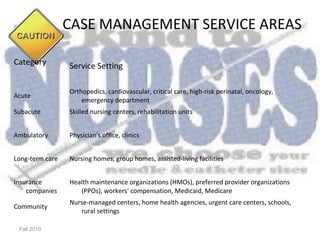
CASE MANAGEMENT SERVICE AREAS

Category         Service Setting

                 Orthopedics, cardiovascular, critical care, high-risk perinatal, oncology,
Acute
                     emergency department
Subacute         Skilled nursing centers, rehabilitation units


Ambulatory       Physician's office, clinics


Long-term care   Nursing homes, group homes, assisted-living facilities


Insurance        Health maintenance organizations (HMOs), preferred provider organizations
    companies       (PPOs), workers' compensation, Medicaid, Medicare
                 Nurse-managed centers, home health agencies, urgent care centers, schools,
Community
                    rural settings

 Fall 2010
Disease Management
• Common high-cost, high-resource utilization
  diseases
• Population-based health care
  – Covered lives
• Continuous health improvement
• A population with a costly disease, people who are
  on outpt dialysis. Focus is on the population. We
  want to provide optimal, cost effective care. By
  doing this we can actually do a lot of prevention
  (hopefully). Going to diabetic clinic and teaching
  them so we can hopefully prevent them from
  reaching the need for outpt dialysis.
Differentiated Nursing Practice
• Education Model (Type 1)
  – Based on type of education
  – They’ve been trying to do this for a long time
• Competency Model (Type 2)
  – Based on individual skill level
• Benner’s Novice to Expert (goes along with
  competency model)
  – Novice
  – Advanced beginner
  – Competent nurse
  – Proficient nurse
  – Expert
  Fall 2010
Differentiated Nursing Practice Cont.
• To match the pt’s needs with nursing competence,
  and have the most efficient use of nursing
  resources.
• Education based thing really irritates Ponder. She
  thinks RN’s who pass boards are RN’s who pass
  boards.
• Competency she agrees with. Placing SICU nursing
  in SICU, not taking a newborn nurse and putting
  them in SICU. That’s not fair to the SICU pt.
• Match the pt’s needs with the abilities of the nurse
The Future
• Nursing shortages and health care reform have had
  a strong impact on the creation of new and
  evolving types of patient care delivery models.
  – We’re seeing pt focus teams. By that she means the
    teams have nurses, PT, OT, Dietary, any body else that
    you can possibly thing of. Everyone gets an input, and
    you have all the teams working together.
The challenges

            •   Cost containment
            •   Demand for quality outcomes
            •   Information age
            •   Patient population
            •   Multigenerational workforce


Fall 2010
The Optimum Mode of Care
• Carefully constructed
• Not based solely on economics


  Fall 2010
Integrating Leadership Roles
• No one best mode
• Accomplishment of unit goals
• Seeking solutions not finding fault
      – Working together
•   Facilitates innovative thinking
•   Ensures adequate resources
•   Reduce resistance
•   Remember, change is inevitable

Fall 2010
Summary
• Nursing leaders and managers have the responsibility to
  facilitate the design of care delivery models
• Nurses deliver and coordinate patient care
• The challenges for patient care in the future are massive
• The work environment of the nurse is dramatically
  different from any other time
• Discover innovative ways to organize and deliver care


   Fall 2010
“Nursing is not just an ART, it has
      a heART. Nursing is not just a
   SCIENCE, but it has a conSCIENCE.”
              - Anonymous


Fall 2010

Modalities

  • 1.
    Modalities of Care Nelia B. Perez RN, MSN PCU – MJCN Fall 2010
  • 2.
    Learning Objectives • differentiate among various types of patient care delivery systems • discuss the relationship between managed care and case management • list the essential components of total patient care, team nursing, primary nursing, and case management • discuss how work redesign may affect social relationships on a unit • explain what effect staff mix has on work design and the patient care organization Fall 2010
  • 3.
    • What isour focus…… • Why are we here……. • ….patients now more than ever need reassurance that they are indeed the focus of the healthcare team - Joan Shinkus Clark Fall 2010
  • 4.
    Traditional Modes ofCare Delivery • Total Patient Care • Functional Nursing • Team and Modular Nursing • Primary Nursing • Case Management • Care delivery modalities (modes) affect autonomy and job satisfaction. • Direct pt care functions are actually caring for pt. • Indirect pt care functions are like being able to self schedule, charting • All of these depend on what mode of care you are using, and on how or when you get to use them Fall 2010
  • 5.
    Total Patient Care •Total patient care - nurses assume total responsibility for meeting all needs of assigned patients during their time on duty – For the entire shift nurse takes care of pt. Initially occurred in ICU units – Form of primary nursing – Advantages – intensity of focus on the pt thru-out that shift – Disadvantages – lack of communication and lack of continuity over time. Just meeting daily needs, not trying to make a plan and get them out Fall 2010
  • 6.
    Functional Method • Functionalnursing - work assignment by functions or tasks, such as passing medicine, doing dressing changes, giving baths, or taking vital signs • Assignment by function. Everybody has a task. Norm in the US hospitals from late 1800’s til the end of WWII. There was a shortage of nurses at the time, so we put people in who can do things, like a team who went thru and checked dressings, a team that took vital signs, etc. • Advantage – no role confusion. You knew what you were doing. This method is efficient and cheap. • Disadvantage – client couldn’t identify who their caretaker was, because there were so many caretakers. Fall 2010
  • 7.
    Team Nursing • Teamnursing - a team of RNs, licensed practical nurses (LPNs), and aides under the supervision of one nurse, called the team leader – Group can be 10-20 pt’s to 4-5 nurses. Over each group of teams is a charge nurse. Has evolved into modular nursing (more of a spacial thing). Clients are grouped by a floor plan, happens a lot in ED’s. We’re in pod A, which has 10 beds, it’s intermediate care, and we’re in pod A all day. RN assigns work on team members expertise. Who’s good at what, what can this person do, and where do you want to put them. You’re accountable for delegating things to people who are trained to do them. Fall 2010
  • 8.
    Primary Nursing • Primarynursing is an approach in which a nurse has responsibility and accountability for the continuous guidance of specific clients from hospital admission through discharge – She would be assigned a group of pt’s (kind of like a nurse manager) and she’s responsible for them their entire hospital stay. Ponder thinks it sounds very challenging. – Hallmark to this is that you have autonomy/accountability 24 hours a day. You make treatment decisions and what not Fall 2010
  • 9.
    Case Management • Casemanagement in acute care hospital nursing has been defined as a system of client care delivery that focuses on the achievement of client outcomes within effective and appropriate time frames and resources – Also focus on containing health care costs first for the pt, then for the facility. – Practicing case manamgement can also be- I get this pt and I check him and I consult all these specialists (like neurologist and social workers) about his condition and checking his discharge stuff and looking over everything. Sometimes hospitals don’t have specific case managers, but every nurse is expected to be their pt’s case manager… Fall 2010
  • 10.
    CASE MANAGEMENT SERVICEAREAS Category Service Setting Orthopedics, cardiovascular, critical care, high-risk perinatal, oncology, Acute emergency department Subacute Skilled nursing centers, rehabilitation units Ambulatory Physician's office, clinics Long-term care Nursing homes, group homes, assisted-living facilities Insurance Health maintenance organizations (HMOs), preferred provider organizations companies (PPOs), workers' compensation, Medicaid, Medicare Nurse-managed centers, home health agencies, urgent care centers, schools, Community rural settings Fall 2010
  • 11.
    Disease Management • Commonhigh-cost, high-resource utilization diseases • Population-based health care – Covered lives • Continuous health improvement • A population with a costly disease, people who are on outpt dialysis. Focus is on the population. We want to provide optimal, cost effective care. By doing this we can actually do a lot of prevention (hopefully). Going to diabetic clinic and teaching them so we can hopefully prevent them from reaching the need for outpt dialysis.
  • 12.
    Differentiated Nursing Practice •Education Model (Type 1) – Based on type of education – They’ve been trying to do this for a long time • Competency Model (Type 2) – Based on individual skill level • Benner’s Novice to Expert (goes along with competency model) – Novice – Advanced beginner – Competent nurse – Proficient nurse – Expert Fall 2010
  • 13.
    Differentiated Nursing PracticeCont. • To match the pt’s needs with nursing competence, and have the most efficient use of nursing resources. • Education based thing really irritates Ponder. She thinks RN’s who pass boards are RN’s who pass boards. • Competency she agrees with. Placing SICU nursing in SICU, not taking a newborn nurse and putting them in SICU. That’s not fair to the SICU pt. • Match the pt’s needs with the abilities of the nurse
  • 14.
    The Future • Nursingshortages and health care reform have had a strong impact on the creation of new and evolving types of patient care delivery models. – We’re seeing pt focus teams. By that she means the teams have nurses, PT, OT, Dietary, any body else that you can possibly thing of. Everyone gets an input, and you have all the teams working together.
  • 15.
    The challenges • Cost containment • Demand for quality outcomes • Information age • Patient population • Multigenerational workforce Fall 2010
  • 16.
    The Optimum Modeof Care • Carefully constructed • Not based solely on economics Fall 2010
  • 17.
    Integrating Leadership Roles •No one best mode • Accomplishment of unit goals • Seeking solutions not finding fault – Working together • Facilitates innovative thinking • Ensures adequate resources • Reduce resistance • Remember, change is inevitable Fall 2010
  • 18.
    Summary • Nursing leadersand managers have the responsibility to facilitate the design of care delivery models • Nurses deliver and coordinate patient care • The challenges for patient care in the future are massive • The work environment of the nurse is dramatically different from any other time • Discover innovative ways to organize and deliver care Fall 2010
  • 19.
    “Nursing is notjust an ART, it has a heART. Nursing is not just a SCIENCE, but it has a conSCIENCE.” - Anonymous Fall 2010