MATHEMATICS
3rd
Quarter Examination
Directions:
Read and analyze each
item carefully. Write the
letter of your answer.
1. Which of the following quadrilaterals
has diagonals that do not bisect each
other?
A. Square C. Rectangle
B. Rhombus D. Trapezoid
2. The diagonals of an isosceles
trapezoid are represented by 4x – 47
and 2x + 31. What is the value of x?
A. 38 B. 39 C. 47 D. 49
3. If a quadrilateral is a kite, then its
diagonals are _______________.
A.Congruent B. Proportional
C. Perpendicular D. Parallel
4. A trapezoid is a parallelogram.
A. True C. Maybe
B. False D. Sometimes true
5. Two consecutive angles of a
parallelogram are supplementary.
A. Always true C. Never true
B. Sometimes true D. Sometimes false
6. Which of the following properties of a
quadrilateral is NOT TRUE?
A. A rectangle is a parallelogram.
B. A quadrilateral is a parallelogram if all sides are
parallel.
C. Diagonals of quadrilaterals bisect each other.
D. A quadrilateral is a parallelogram if both pairs of
opposite angles are congruent.
7. Two consecutive angles of a
parallelogram have measures of (2x + 7)°
and (3x - 2)°. What is the measure of
the larger angle?
A. 103° B. 73° C. 133° D. 107°
9. What is the perimeter of a kite if the
sides are 15 centimeters and 16
centimeters?
A. 60 cm C. 62 cm
B. 61 cm D. 63 cm
11. Which of the following statements is
TRUE?
A. A kite has two parallel sides.
B. A kite has four congruent angles
C. The diagonals of a kite are
perpendicular.
D. The diagonals of a kite are congruent.
12. What is the measure of the mid-
segment of a trapezoid if the measures of
the bases are 20 and 28, respectively?
A. 21 B. 22 C. 23 D. 24
13. If the legs of a trapezoid are
congruent, then the trapezoid is a
________________ trapezoid.
A. equilateral C. irregular
B. isosceles D. absolute
14. Which of the following ratios are
equivalent?
A. 3:5 and 15:20 C. 2:7 and 14:49
B. 4:3 and 30:24 D. 6:5 and 36:42
15. The length and width of a rectangular
garden are in the ratio of 6:3. If the length
is 24 feet, what is the width?
A. 6 feet C. 18 feet
B. 12 feet D. 24 feet
In a class, the ratio of the boys to the girls is
5:3. There are 15 girls in the class.
16. Which of the following equations represents
the correct proportion of the number of boys to
the number of girls in the class?
A. C. 5:3 = 30:15
B. D.
In a class, the ratio of the boys to the girls is
5:3. There are 15 girls in the class.
17. How many boys are there in the class?
A. 10 boys C. 20 boys
B. 15 boys D. 25 boys
18. A rope that is 64 feet long is divided into two
segments with a ratio of 3 : 5. What is the length of
the shorter segment?
A. 20 feet C. 40 feet
B. 24 feet D. 44 feet
19. Which of the following corresponds to AG?
A. GT B. SG C. IT D. AT
20. Which of the following is equal to ?
A. B. C. D.
21. If ABC DEF, which of the following
statements is FALSE?
A. A D C. CBA DEF
B. = D. =
22. If ABCD EFGH, then which of the
following is correct?
A H C. C F
B. B G D H
22. If ABCD EFGH, then which of the
following is correct?
A H C. C F
B. B G D H
The figure below shows that PAST is similar to ORAL. The sides
of PAST are 12 centimeters, 16 centimeters, 20 centimeters, and 24
centimeters. The shortest side of ORAL is 6 centimeters.
23. What is the length of the longest side of ORAL?
A. 12cm B. 15cm C. 18cm D. 21cm
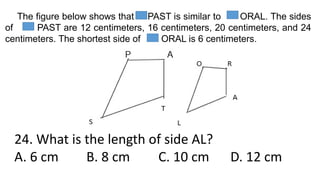
The figure below shows that PAST is similar to ORAL. The sides
of PAST are 12 centimeters, 16 centimeters, 20 centimeters, and 24
centimeters. The shortest side of ORAL is 6 centimeters.
24. What is the length of side AL?
A. 6 cm B. 8 cm C. 10 cm D. 12 cm
The figure below shows that PAST is similar to ORAL. The sides
of PAST are 12 centimeters, 16 centimeters, 20 centimeters, and 24
centimeters. The shortest side of ORAL is 6 centimeters.
25. What is the ratio of the perimeter of PAST to ORAL?
A. 2:1 B. 1:3 C. 3:2 D. 2:3
27. Which of the following is the measure of
A.62° B. 118° C. 56° D. 112°
28. What should be the missing part so that
the given = is correct?
A. x B. y C. x + y D. c
30. What is the value of three times the
length of RK?
A. 18 B. 21 C. 24 D. 27
31. What is the value of TK minus twice TA?
A. 6 B. 8 C. 9 D. 10
32. What is the absolute difference of TA
and KM?
A. 6 B. 8 C. 9 D. 10
33. Which of the following groups of
quadrilaterals have perpendicular
diagonals?
A. Rectangle, square
B. Rhombus, rectangle
C. Rhombus, square
D. Rectangle, rhombus, and square
34. What is the perimeter of a kite if the
sides are 13 centimeters and 17
centimeters?
A. 60 cm C. 40 cm
B. 50 cm D. 30 cm
35. The bases of a trapezoid are the
__________ sides.
A. parallel
B. nonparallel sides
C. equal
D. perpendicular
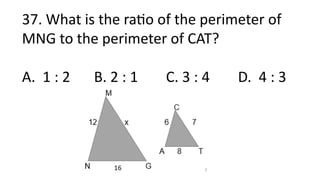
36. What is the length of side MG?
A. 13 units C. 15 units
B. 14 units D. 16 units
37. What is the ratio of the perimeter of
MNG to the perimeter of CAT?
A. 1 : 2 B. 2 : 1 C. 3 : 4 D. 4 : 3
38. In a parallelogram RSTW, diagonals RT
and SW are perpendicular bisectors of each
other. Parallelogram RSTW must be a:
I. Rectangle II. Rhombus III. Square
A. I c. II and III
B. II D. I, II, and III
39. What condition will make parallelogram
WXYZ a rectangle?
A. WX YZ
B. is a right-angle
C. WX ll YZ
D. WX and YZ bisect each other
40. In NEAT, the diagonal ET forms
NET and ATE. What kind of triangles
are formed?
A. Isosceles triangles
B. Equilateral triangles
C. Scalene triangles
d. Equiangular triangles

3RD-QUARTER-EXAM-MATHEMATICS.pptx MATH 9

  • 1.
  • 2.
    Directions: Read and analyzeeach item carefully. Write the letter of your answer.
  • 3.
    1. Which ofthe following quadrilaterals has diagonals that do not bisect each other? A. Square C. Rectangle B. Rhombus D. Trapezoid
  • 4.
    2. The diagonalsof an isosceles trapezoid are represented by 4x – 47 and 2x + 31. What is the value of x? A. 38 B. 39 C. 47 D. 49
  • 5.
    3. If aquadrilateral is a kite, then its diagonals are _______________. A.Congruent B. Proportional C. Perpendicular D. Parallel
  • 6.
    4. A trapezoidis a parallelogram. A. True C. Maybe B. False D. Sometimes true
  • 7.
    5. Two consecutiveangles of a parallelogram are supplementary. A. Always true C. Never true B. Sometimes true D. Sometimes false
  • 8.
    6. Which ofthe following properties of a quadrilateral is NOT TRUE? A. A rectangle is a parallelogram. B. A quadrilateral is a parallelogram if all sides are parallel. C. Diagonals of quadrilaterals bisect each other. D. A quadrilateral is a parallelogram if both pairs of opposite angles are congruent.
  • 9.
    7. Two consecutiveangles of a parallelogram have measures of (2x + 7)° and (3x - 2)°. What is the measure of the larger angle? A. 103° B. 73° C. 133° D. 107°
  • 11.
    9. What isthe perimeter of a kite if the sides are 15 centimeters and 16 centimeters? A. 60 cm C. 62 cm B. 61 cm D. 63 cm
  • 13.
    11. Which ofthe following statements is TRUE? A. A kite has two parallel sides. B. A kite has four congruent angles C. The diagonals of a kite are perpendicular. D. The diagonals of a kite are congruent.
  • 14.
    12. What isthe measure of the mid- segment of a trapezoid if the measures of the bases are 20 and 28, respectively? A. 21 B. 22 C. 23 D. 24
  • 15.
    13. If thelegs of a trapezoid are congruent, then the trapezoid is a ________________ trapezoid. A. equilateral C. irregular B. isosceles D. absolute
  • 16.
    14. Which ofthe following ratios are equivalent? A. 3:5 and 15:20 C. 2:7 and 14:49 B. 4:3 and 30:24 D. 6:5 and 36:42
  • 17.
    15. The lengthand width of a rectangular garden are in the ratio of 6:3. If the length is 24 feet, what is the width? A. 6 feet C. 18 feet B. 12 feet D. 24 feet
  • 18.
    In a class,the ratio of the boys to the girls is 5:3. There are 15 girls in the class. 16. Which of the following equations represents the correct proportion of the number of boys to the number of girls in the class? A. C. 5:3 = 30:15 B. D.
  • 19.
    In a class,the ratio of the boys to the girls is 5:3. There are 15 girls in the class. 17. How many boys are there in the class? A. 10 boys C. 20 boys B. 15 boys D. 25 boys
  • 20.
    18. A ropethat is 64 feet long is divided into two segments with a ratio of 3 : 5. What is the length of the shorter segment? A. 20 feet C. 40 feet B. 24 feet D. 44 feet
  • 21.
    19. Which ofthe following corresponds to AG? A. GT B. SG C. IT D. AT
  • 22.
    20. Which ofthe following is equal to ? A. B. C. D.
  • 23.
    21. If ABCDEF, which of the following statements is FALSE? A. A D C. CBA DEF B. = D. =
  • 24.
    22. If ABCDEFGH, then which of the following is correct? A H C. C F B. B G D H
  • 25.
    22. If ABCDEFGH, then which of the following is correct? A H C. C F B. B G D H
  • 26.
    The figure belowshows that PAST is similar to ORAL. The sides of PAST are 12 centimeters, 16 centimeters, 20 centimeters, and 24 centimeters. The shortest side of ORAL is 6 centimeters. 23. What is the length of the longest side of ORAL? A. 12cm B. 15cm C. 18cm D. 21cm
  • 27.
    The figure belowshows that PAST is similar to ORAL. The sides of PAST are 12 centimeters, 16 centimeters, 20 centimeters, and 24 centimeters. The shortest side of ORAL is 6 centimeters. 24. What is the length of side AL? A. 6 cm B. 8 cm C. 10 cm D. 12 cm
  • 28.
    The figure belowshows that PAST is similar to ORAL. The sides of PAST are 12 centimeters, 16 centimeters, 20 centimeters, and 24 centimeters. The shortest side of ORAL is 6 centimeters. 25. What is the ratio of the perimeter of PAST to ORAL? A. 2:1 B. 1:3 C. 3:2 D. 2:3
  • 30.
    27. Which ofthe following is the measure of A.62° B. 118° C. 56° D. 112°
  • 31.
    28. What shouldbe the missing part so that the given = is correct? A. x B. y C. x + y D. c
  • 32.
    30. What isthe value of three times the length of RK? A. 18 B. 21 C. 24 D. 27
  • 33.
    31. What isthe value of TK minus twice TA? A. 6 B. 8 C. 9 D. 10
  • 34.
    32. What isthe absolute difference of TA and KM? A. 6 B. 8 C. 9 D. 10
  • 35.
    33. Which ofthe following groups of quadrilaterals have perpendicular diagonals? A. Rectangle, square B. Rhombus, rectangle C. Rhombus, square D. Rectangle, rhombus, and square
  • 36.
    34. What isthe perimeter of a kite if the sides are 13 centimeters and 17 centimeters? A. 60 cm C. 40 cm B. 50 cm D. 30 cm
  • 37.
    35. The basesof a trapezoid are the __________ sides. A. parallel B. nonparallel sides C. equal D. perpendicular
  • 38.
    36. What isthe length of side MG? A. 13 units C. 15 units B. 14 units D. 16 units
  • 39.
    37. What isthe ratio of the perimeter of MNG to the perimeter of CAT? A. 1 : 2 B. 2 : 1 C. 3 : 4 D. 4 : 3
  • 40.
    38. In aparallelogram RSTW, diagonals RT and SW are perpendicular bisectors of each other. Parallelogram RSTW must be a: I. Rectangle II. Rhombus III. Square A. I c. II and III B. II D. I, II, and III
  • 41.
    39. What conditionwill make parallelogram WXYZ a rectangle? A. WX YZ B. is a right-angle C. WX ll YZ D. WX and YZ bisect each other
  • 42.
    40. In NEAT,the diagonal ET forms NET and ATE. What kind of triangles are formed? A. Isosceles triangles B. Equilateral triangles C. Scalene triangles d. Equiangular triangles