1
2
3
4
5
6
7
8
m
n
t
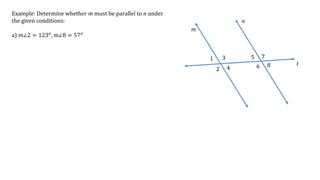
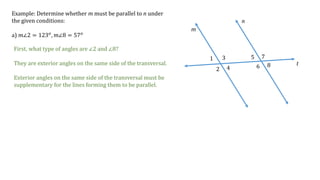
Example: Determine whether m must be parallel to n under
the given conditions:
a) 𝑚∠2 = 123 𝑜
, 𝑚∠8 = 57 𝑜
1
2
3
4
5
6
7
8
m
n
t
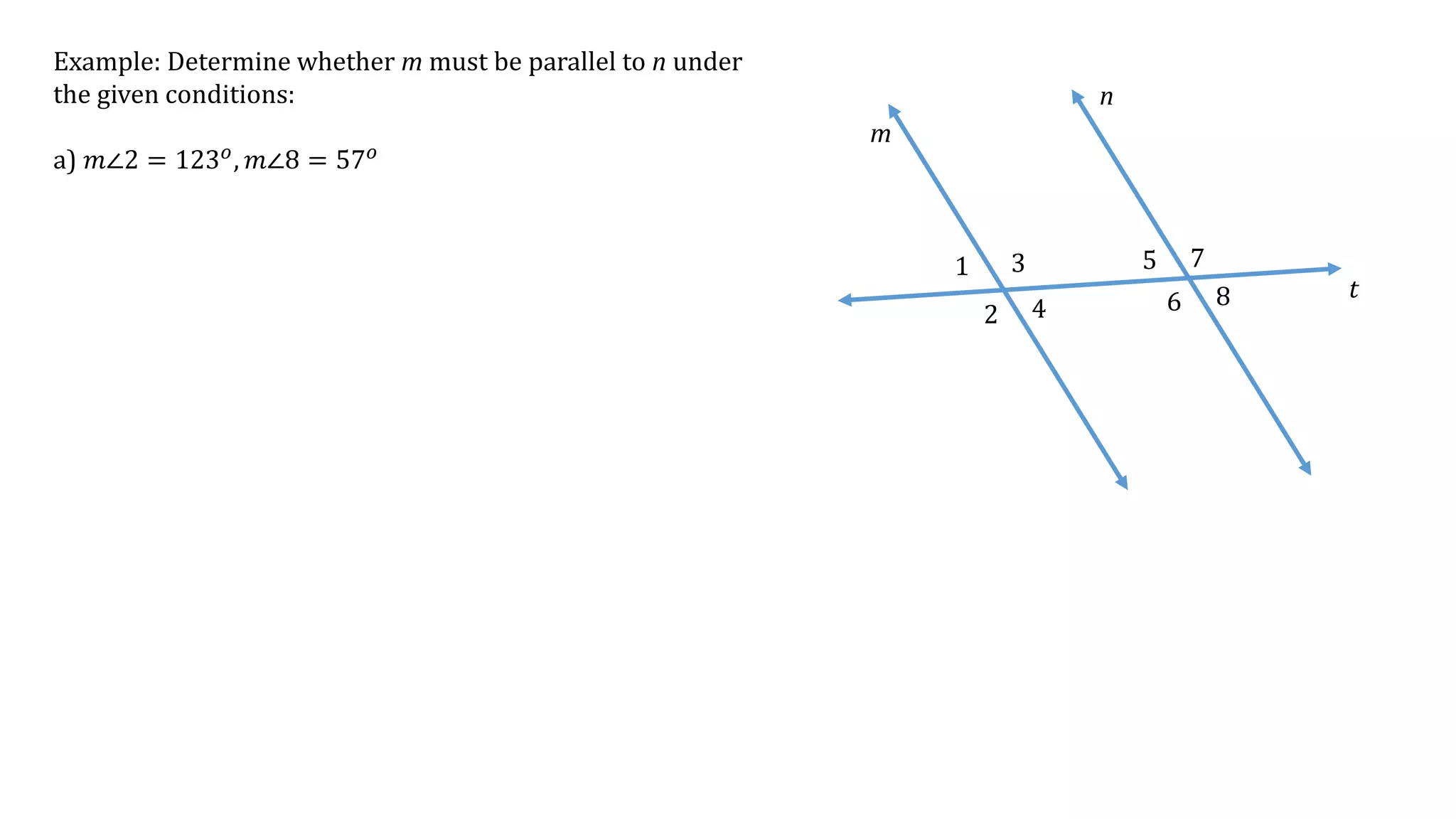
Example: Determine whether m must be parallel to n under
the given conditions:
a) 𝑚∠2 = 123 𝑜
, 𝑚∠8 = 57 𝑜
First, what type of angles are ∠2 and ∠8?
1
2
3
4
5
6
7
8
m
n
t
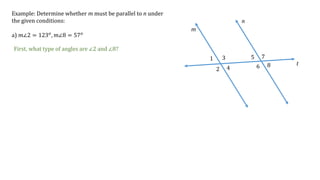
Example: Determine whether m must be parallel to n under
the given conditions:
a) 𝑚∠2 = 123 𝑜
, 𝑚∠8 = 57 𝑜
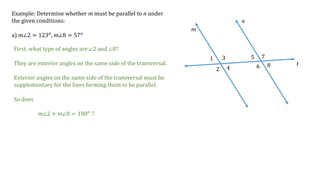
First, what type of angles are ∠2 and ∠8?
They are exterior angles on the same side of the transversal.
1
2
3
4
5
6
7
8
m
n
t
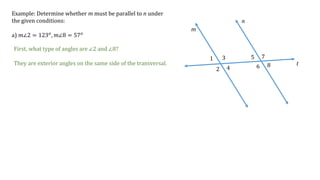
Example: Determine whether m must be parallel to n under
the given conditions:
a) 𝑚∠2 = 123 𝑜
, 𝑚∠8 = 57 𝑜
First, what type of angles are ∠2 and ∠8?
They are exterior angles on the same side of the transversal.
Exterior angles on the same side of the transversal must be
supplementary for the lines forming them to be parallel.
1
2
3
4
5
6
7
8
m
n
t
Example: Determine whether m must be parallel to n under
the given conditions:
a) 𝑚∠2 = 123 𝑜
, 𝑚∠8 = 57 𝑜
First, what type of angles are ∠2 and ∠8?
They are exterior angles on the same side of the transversal.
Exterior angles on the same side of the transversal must be
supplementary for the lines forming them to be parallel.
So does
𝑚∠2 + 𝑚∠8 = 180 𝑜 ?
1
2
3
4
5
6
7
8
m
n
t
Example: Determine whether m must be parallel to n under
the given conditions:
a) 𝑚∠2 = 123 𝑜
, 𝑚∠8 = 57 𝑜
First, what type of angles are ∠2 and ∠8?
They are exterior angles on the same side of the transversal.
Exterior angles on the same side of the transversal must be
supplementary for the lines forming them to be parallel.
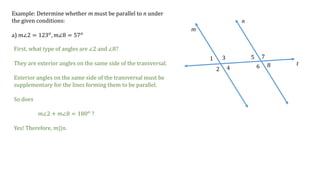
So does
𝑚∠2 + 𝑚∠8 = 180 𝑜 ?
Yes! Therefore, 𝑚||𝑛.
1
2
3
4
5
6
7
8
m
n
t
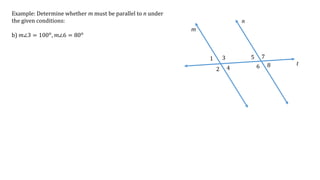
Example: Determine whether m must be parallel to n under
the given conditions:
b) 𝑚∠3 = 100 𝑜
, 𝑚∠6 = 80 𝑜
1
2
3
4
5
6
7
8
m
n
t
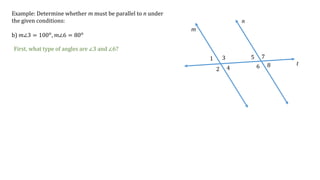
Example: Determine whether m must be parallel to n under
the given conditions:
b) 𝑚∠3 = 100 𝑜
, 𝑚∠6 = 80 𝑜
First, what type of angles are ∠3 and ∠6?
1
2
3
4
5
6
7
8
m
n
t
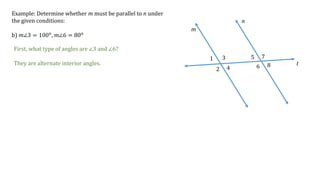
Example: Determine whether m must be parallel to n under
the given conditions:
b) 𝑚∠3 = 100 𝑜
, 𝑚∠6 = 80 𝑜
First, what type of angles are ∠3 and ∠6?
They are alternate interior angles.
1
2
3
4
5
6
7
8
m
n
t
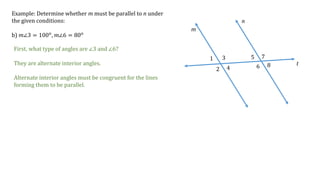
Example: Determine whether m must be parallel to n under
the given conditions:
b) 𝑚∠3 = 100 𝑜
, 𝑚∠6 = 80 𝑜
First, what type of angles are ∠3 and ∠6?
They are alternate interior angles.
Alternate interior angles must be congruent for the lines
forming them to be parallel.
1
2
3
4
5
6
7
8
m
n
t
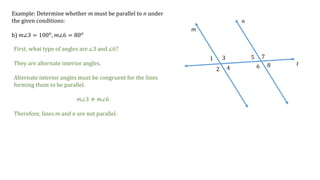
Example: Determine whether m must be parallel to n under
the given conditions:
b) 𝑚∠3 = 100 𝑜
, 𝑚∠6 = 80 𝑜
First, what type of angles are ∠3 and ∠6?
They are alternate interior angles.
Alternate interior angles must be congruent for the lines
forming them to be parallel.
𝑚∠3 ≠ 𝑚∠6
Therefore, lines m and n are not parallel.

Determining whether lines are parallel

  • 1.
    1 2 3 4 5 6 7 8 m n t Example: Determine whetherm must be parallel to n under the given conditions: a) 𝑚∠2 = 123 𝑜 , 𝑚∠8 = 57 𝑜
  • 2.
    1 2 3 4 5 6 7 8 m n t Example: Determine whetherm must be parallel to n under the given conditions: a) 𝑚∠2 = 123 𝑜 , 𝑚∠8 = 57 𝑜 First, what type of angles are ∠2 and ∠8?
  • 3.
    1 2 3 4 5 6 7 8 m n t Example: Determine whetherm must be parallel to n under the given conditions: a) 𝑚∠2 = 123 𝑜 , 𝑚∠8 = 57 𝑜 First, what type of angles are ∠2 and ∠8? They are exterior angles on the same side of the transversal.
  • 4.
    1 2 3 4 5 6 7 8 m n t Example: Determine whetherm must be parallel to n under the given conditions: a) 𝑚∠2 = 123 𝑜 , 𝑚∠8 = 57 𝑜 First, what type of angles are ∠2 and ∠8? They are exterior angles on the same side of the transversal. Exterior angles on the same side of the transversal must be supplementary for the lines forming them to be parallel.
  • 5.
    1 2 3 4 5 6 7 8 m n t Example: Determine whetherm must be parallel to n under the given conditions: a) 𝑚∠2 = 123 𝑜 , 𝑚∠8 = 57 𝑜 First, what type of angles are ∠2 and ∠8? They are exterior angles on the same side of the transversal. Exterior angles on the same side of the transversal must be supplementary for the lines forming them to be parallel. So does 𝑚∠2 + 𝑚∠8 = 180 𝑜 ?
  • 6.
    1 2 3 4 5 6 7 8 m n t Example: Determine whetherm must be parallel to n under the given conditions: a) 𝑚∠2 = 123 𝑜 , 𝑚∠8 = 57 𝑜 First, what type of angles are ∠2 and ∠8? They are exterior angles on the same side of the transversal. Exterior angles on the same side of the transversal must be supplementary for the lines forming them to be parallel. So does 𝑚∠2 + 𝑚∠8 = 180 𝑜 ? Yes! Therefore, 𝑚||𝑛.
  • 7.
    1 2 3 4 5 6 7 8 m n t Example: Determine whetherm must be parallel to n under the given conditions: b) 𝑚∠3 = 100 𝑜 , 𝑚∠6 = 80 𝑜
  • 8.
    1 2 3 4 5 6 7 8 m n t Example: Determine whetherm must be parallel to n under the given conditions: b) 𝑚∠3 = 100 𝑜 , 𝑚∠6 = 80 𝑜 First, what type of angles are ∠3 and ∠6?
  • 9.
    1 2 3 4 5 6 7 8 m n t Example: Determine whetherm must be parallel to n under the given conditions: b) 𝑚∠3 = 100 𝑜 , 𝑚∠6 = 80 𝑜 First, what type of angles are ∠3 and ∠6? They are alternate interior angles.
  • 10.
    1 2 3 4 5 6 7 8 m n t Example: Determine whetherm must be parallel to n under the given conditions: b) 𝑚∠3 = 100 𝑜 , 𝑚∠6 = 80 𝑜 First, what type of angles are ∠3 and ∠6? They are alternate interior angles. Alternate interior angles must be congruent for the lines forming them to be parallel.
  • 11.
    1 2 3 4 5 6 7 8 m n t Example: Determine whetherm must be parallel to n under the given conditions: b) 𝑚∠3 = 100 𝑜 , 𝑚∠6 = 80 𝑜 First, what type of angles are ∠3 and ∠6? They are alternate interior angles. Alternate interior angles must be congruent for the lines forming them to be parallel. 𝑚∠3 ≠ 𝑚∠6 Therefore, lines m and n are not parallel.