Business Models emerging in e-
commerce area
Business Models emerging in e-commerce area
• Consumer-to-consumer (C2C)
– eBay, Half.com, Craigslist.com
– Helps consumers connect with other consumers to
conduct business (or make trades)
• Peer-to-peer (P2P)
– The Pirate Bay, Cloud mark
– Technology enabling consumers to share files and services
via the Web, without a common server
• Mobile commerce (m-commerce)
– eBay Mobile, PayPay Mobile
– Extending business applications using wireless technology
E-Commerce Enablers
• Firms whose business model is focused on providing the
infrastructure necessary for e-commerce companies
to exist, grow, and prosper
• E-commerce enablers include firms that provide:
– Hardware: Web servers
– Software: operating systems and server software
– Networking: routers
– Security: encryption software
– E-commerce software systems
– Streaming and rich media solutions
– Customer relationship management software
– Payment systems
– Performance enhancement
– Databases
– Hosting services
How the Internet and the Web Change Business: Strategy,
Structure, and Process
• In general, the Internet is an open standards system
available to all players, and this fact inherently makes it
easy for new competitors to enter the marketplace and
offer substitute products or channels of delivery
• E-commerce has an impact on industry structure in a
wide range of product, service, and content industries
• Table 2.7 suggests some of the implications of each
unique feature for the overall business environment –
industry structure, business strategies, and operations
How the Internet and the Web Change Business: Strategy,
Structure, and Process
• E-commerce changes industry structure, in some
industries more than others
• Industry structure refers to the nature of the players in an
industry and their relative bargaining power
• The level of industry competition is altered through
changes in five forces:
– Barriers to entry
– Bargaining power of buyers
– Bargaining power of suppliers
– Threat of substitute products or services
– Rivalry among existing competitors
• A comprehensive description of how the Internet impacts
industry structure is shown in Figure 2.4
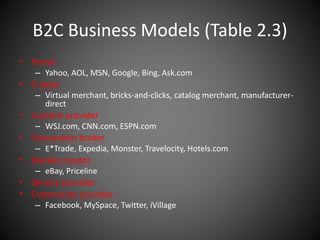
B2C Business Models (Table 2.3)
• Portal
– Yahoo, AOL, MSN, Google, Bing, Ask.com
• E-tailer
– Virtual merchant, bricks-and-clicks, catalog merchant, manufacturer-
direct
• Content provider
– WSJ.com, CNN.com, ESPN.com
• Transaction broker
– E*Trade, Expedia, Monster, Travelocity, Hotels.com
• Market creator
– eBay, Priceline
• Service provider
• Community provider
– Facebook, MySpace, Twitter, iVillage
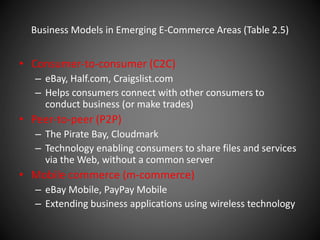
Business Models in Emerging E-Commerce Areas (Table 2.5)
• Consumer-to-consumer (C2C)
– eBay, Half.com, Craigslist.com
– Helps consumers connect with other consumers to
conduct business (or make trades)
• Peer-to-peer (P2P)
– The Pirate Bay, Cloudmark
– Technology enabling consumers to share files and services
via the Web, without a common server
• Mobile commerce (m-commerce)
– eBay Mobile, PayPay Mobile
– Extending business applications using wireless technology
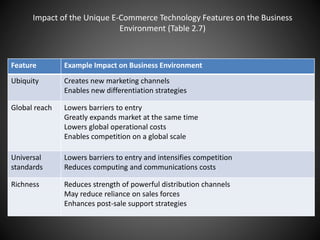
Impact of the Unique E-Commerce Technology Features on the Business
Environment (Table 2.7)
Feature Example Impact on Business Environment
Ubiquity Creates new marketing channels
Enables new differentiation strategies
Global reach Lowers barriers to entry
Greatly expands market at the same time
Lowers global operational costs
Enables competition on a global scale
Universal
standards
Lowers barriers to entry and intensifies competition
Reduces computing and communications costs
Richness Reduces strength of powerful distribution channels
May reduce reliance on sales forces
Enhances post-sale support strategies
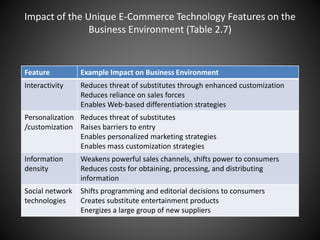
Impact of the Unique E-Commerce Technology Features on the
Business Environment (Table 2.7)
Feature Example Impact on Business Environment
Interactivity Reduces threat of substitutes through enhanced customization
Reduces reliance on sales forces
Enables Web-based differentiation strategies
Personalization
/customization
Reduces threat of substitutes
Raises barriers to entry
Enables personalized marketing strategies
Enables mass customization strategies
Information
density
Weakens powerful sales channels, shifts power to consumers
Reduces costs for obtaining, processing, and distributing
information
Social network
technologies
Shifts programming and editorial decisions to consumers
Creates substitute entertainment products
Energizes a large group of new suppliers

Business models emerging in e commerce area

  • 1.
    Business Models emergingin e- commerce area
  • 2.
    Business Models emergingin e-commerce area • Consumer-to-consumer (C2C) – eBay, Half.com, Craigslist.com – Helps consumers connect with other consumers to conduct business (or make trades) • Peer-to-peer (P2P) – The Pirate Bay, Cloud mark – Technology enabling consumers to share files and services via the Web, without a common server • Mobile commerce (m-commerce) – eBay Mobile, PayPay Mobile – Extending business applications using wireless technology
  • 3.
    E-Commerce Enablers • Firmswhose business model is focused on providing the infrastructure necessary for e-commerce companies to exist, grow, and prosper • E-commerce enablers include firms that provide: – Hardware: Web servers – Software: operating systems and server software – Networking: routers – Security: encryption software – E-commerce software systems – Streaming and rich media solutions – Customer relationship management software – Payment systems – Performance enhancement – Databases – Hosting services
  • 4.
    How the Internetand the Web Change Business: Strategy, Structure, and Process • In general, the Internet is an open standards system available to all players, and this fact inherently makes it easy for new competitors to enter the marketplace and offer substitute products or channels of delivery • E-commerce has an impact on industry structure in a wide range of product, service, and content industries • Table 2.7 suggests some of the implications of each unique feature for the overall business environment – industry structure, business strategies, and operations
  • 5.
    How the Internetand the Web Change Business: Strategy, Structure, and Process • E-commerce changes industry structure, in some industries more than others • Industry structure refers to the nature of the players in an industry and their relative bargaining power • The level of industry competition is altered through changes in five forces: – Barriers to entry – Bargaining power of buyers – Bargaining power of suppliers – Threat of substitute products or services – Rivalry among existing competitors • A comprehensive description of how the Internet impacts industry structure is shown in Figure 2.4
  • 6.
    B2C Business Models(Table 2.3) • Portal – Yahoo, AOL, MSN, Google, Bing, Ask.com • E-tailer – Virtual merchant, bricks-and-clicks, catalog merchant, manufacturer- direct • Content provider – WSJ.com, CNN.com, ESPN.com • Transaction broker – E*Trade, Expedia, Monster, Travelocity, Hotels.com • Market creator – eBay, Priceline • Service provider • Community provider – Facebook, MySpace, Twitter, iVillage
  • 7.
    Business Models inEmerging E-Commerce Areas (Table 2.5) • Consumer-to-consumer (C2C) – eBay, Half.com, Craigslist.com – Helps consumers connect with other consumers to conduct business (or make trades) • Peer-to-peer (P2P) – The Pirate Bay, Cloudmark – Technology enabling consumers to share files and services via the Web, without a common server • Mobile commerce (m-commerce) – eBay Mobile, PayPay Mobile – Extending business applications using wireless technology
  • 8.
    Impact of theUnique E-Commerce Technology Features on the Business Environment (Table 2.7) Feature Example Impact on Business Environment Ubiquity Creates new marketing channels Enables new differentiation strategies Global reach Lowers barriers to entry Greatly expands market at the same time Lowers global operational costs Enables competition on a global scale Universal standards Lowers barriers to entry and intensifies competition Reduces computing and communications costs Richness Reduces strength of powerful distribution channels May reduce reliance on sales forces Enhances post-sale support strategies
  • 9.
    Impact of theUnique E-Commerce Technology Features on the Business Environment (Table 2.7) Feature Example Impact on Business Environment Interactivity Reduces threat of substitutes through enhanced customization Reduces reliance on sales forces Enables Web-based differentiation strategies Personalization /customization Reduces threat of substitutes Raises barriers to entry Enables personalized marketing strategies Enables mass customization strategies Information density Weakens powerful sales channels, shifts power to consumers Reduces costs for obtaining, processing, and distributing information Social network technologies Shifts programming and editorial decisions to consumers Creates substitute entertainment products Energizes a large group of new suppliers