1
Vaginitis
Trichomoniasis
Jagdish ola
2
Vaginal Environment
• The vagina is a dynamic ecosystem that
contains approximately 109
bacterial colony-
forming units.
• Normal vaginal discharge is clear to white,
odorless, and of high viscosity.
• Normal bacterial flora is dominated by
lactobacilli – other potential pathogens present.
• Acidic environment (pH 3.8-4.2) inhibits the
overgrowth of bacteria
• Some lactobacilli also produce H2O2, a potential
microbicide
Vaginitis Curriculum
3
Vaginitis
• Usually characterized by:
– Vaginal discharge
– Vulvar itching
– Irritation
– Odor
• Common types
– Trichomoniasis (15%-20%)
– Bacterial vaginosis (40%-45%)
– Vulvovaginal candidiasis (20%-25%)
Vaginitis Curriculum
4
Other Causes of Vaginitis
• Mucopurulent cervicitis
• Herpes simplex virus
• Atrophic vaginitis
• Allergic reactions
• Vulvar vestibulitis
• Foreign bodies
Vaginitis Curriculum
5
Diagnosis of Vaginitis
• Patient history
• Visual inspection of
internal/external genitalia
• Appearance of discharge
• Collection of specimen
• Preparation and examination of
specimen slide
Vaginitis Curriculum
6
Other Diagnostics for Vaginitis
• DNA probes
• Cultures
• Fem Examine Test Card™
• PIP Activity Test Card™
Vaginitis Curriculum
7
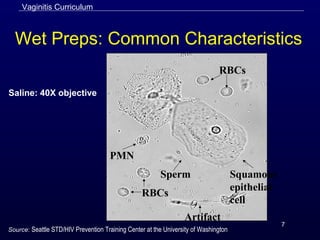
Wet Preps: Common Characteristics
RBCs
Squamous
epithelial
cell
PMN
RBCs
Sperm
Artifact
Saline: 40X objective
Vaginitis Curriculum
Source: Seattle STD/HIV Prevention Training Center at the University of Washington
8
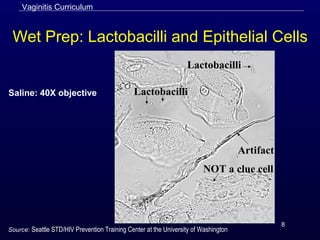
Wet Prep: Lactobacilli and Epithelial Cells
Saline: 40X objective Lactobacilli
Lactobacilli
Artifact
NOT a clue cell
Vaginitis Curriculum
Source: Seattle STD/HIV Prevention Training Center at the University of Washington
9
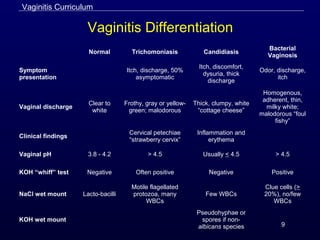
Vaginitis Differentiation
Vaginitis Curriculum
Normal Trichomoniasis Candidiasis
Bacterial
Vaginosis
Symptom
presentation
Itch, discharge, 50%
asymptomatic
Itch, discomfort,
dysuria, thick
discharge
Odor, discharge,
itch
Vaginal discharge
Clear to
white
Frothy, gray or yellow-
green; malodorous
Thick, clumpy, white
“cottage cheese”
Homogenous,
adherent, thin,
milky white;
malodorous “foul
fishy”
Clinical findings
Cervical petechiae
“strawberry cervix”
Inflammation and
erythema
Vaginal pH 3.8 - 4.2 > 4.5 Usually < 4.5 > 4.5
KOH “whiff” test Negative Often positive Negative Positive
NaCl wet mount Lacto-bacilli
Motile flagellated
protozoa, many
WBCs
Few WBCs
Clue cells (>
20%), no/few
WBCs
KOH wet mount
Pseudohyphae or
spores if non-
albicans species
10
Vaginitis
Trichomonas vaginalis
Trichomoniasis Curriculum
11
Learning Objectives
Upon completion of this content, the learner will be able to:
1. Describe the epidemiology of trichomoniasis in the U.S.
2. Describe the pathogenesis of T. vaginalis.
3. Describe the clinical manifestations of trichomoniasis.
4. Identify common methods used in the diagnosis of trichomoniasis.
5. List CDC-recommended treatment regimens for trichomoniasis.
6. Describe patient follow up and partner management for
trichomoniasis.
7. Describe appropriate prevention counseling messages for patients
with trichomoniasis.
Trichomoniasis Curriculum
12
Lessons
I.Pathogenesis
II.Clinical manifestations
III.Diagnosis
IV.Patient management
V.Prevention
Trichomoniasis Curriculum
13
Risk Factors
• Multiple sexual partners
• Lower socioeconomic status
• History of STDs
• Lack of condom use
EpidemiologyTrichomoniasis Curriculum
14
Transmission
• Almost always sexually transmitted
• T. vaginalis may persist for months to
years in epithelial crypts and
periglandular areas
• Transmission between female sex
partners has been documented
EpidemiologyTrichomoniasis Curriculum
15
Pathogenesis
Trichomoniasis Curriculum
16
Microbiology
• Etiologic agent
– Trichomonas vaginalis - flagellated
anaerobic protozoa
– Only protozoan that infects the genital tract
• Possible association with
– Pre-term rupture of membranes and pre-
term delivery
– Increased risk of HIV acquisition
PathogenesisTrichomoniasis Curriculum
17
Trichomonas vaginalis
Source: CDC, National Center for Infectious Diseases, Division of Parasitic Diseases
Trichomoniasis Curriculum Pathogenesis
18
Clinical Manifestations
Trichomoniasis Curriculum
19
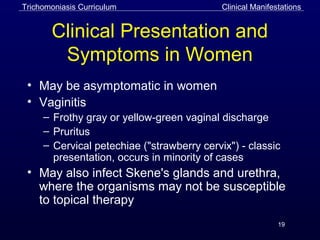
Clinical Presentation and
Symptoms in Women
• May be asymptomatic in women
• Vaginitis
– Frothy gray or yellow-green vaginal discharge
– Pruritus
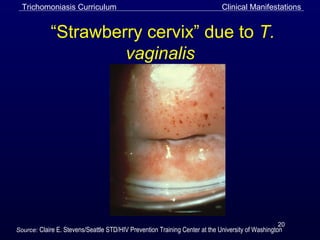
– Cervical petechiae ("strawberry cervix") - classic
presentation, occurs in minority of cases
• May also infect Skene's glands and urethra,
where the organisms may not be susceptible
to topical therapy
Clinical ManifestationsTrichomoniasis Curriculum
20
“Strawberry cervix” due to T.
vaginalis
Source: Claire E. Stevens/Seattle STD/HIV Prevention Training Center at the University of Washington
Trichomoniasis Curriculum Clinical Manifestations
21
T. vaginalis in Men
• May cause up to 11%-13% of
nongonococcal urethritis in males
• Urethral trichomoniasis has been
associated with increased shedding of
HIV in HIV-infected men
• Frequently asymptomatic
Trichomoniasis Curriculum Clinical Manifestations
22
Diagnosis
Trichomoniasis Curriculum
23
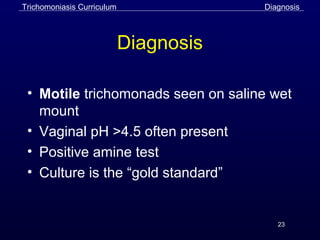
Diagnosis
• Motile trichomonads seen on saline wet
mount
• Vaginal pH >4.5 often present
• Positive amine test
• Culture is the “gold standard”
DiagnosisTrichomoniasis Curriculum
24
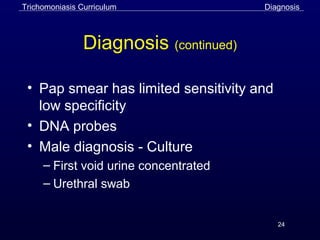
Diagnosis (continued)
• Pap smear has limited sensitivity and
low specificity
• DNA probes
• Male diagnosis - Culture
– First void urine concentrated
– Urethral swab
Trichomoniasis Curriculum Diagnosis
25
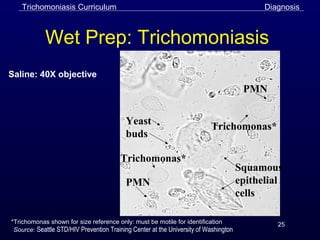
Wet Prep: Trichomoniasis
Saline: 40X objective
*Trichomonas shown for size reference only: must be motile for identification
PMN
Trichomonas*
Squamous
epithelial
cells
PMN
Trichomonas*
Yeast
buds
Source: Seattle STD/HIV Prevention Training Center at the University of Washington
Trichomoniasis Curriculum Diagnosis
26
Patient Management
Trichomoniasis Curriculum
27
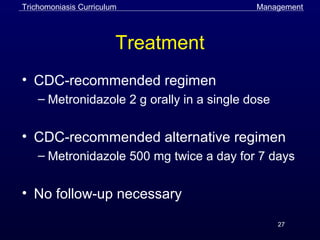
Treatment
• CDC-recommended regimen
– Metronidazole 2 g orally in a single dose
• CDC-recommended alternative regimen
– Metronidazole 500 mg twice a day for 7 days
• No follow-up necessary
ManagementTrichomoniasis Curriculum
28
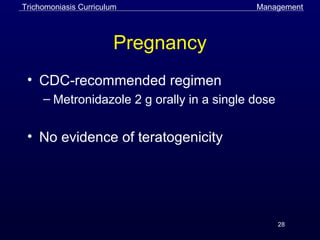
Pregnancy
• CDC-recommended regimen
– Metronidazole 2 g orally in a single dose
• No evidence of teratogenicity
Trichomoniasis Curriculum Management
29
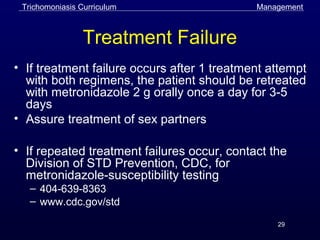
Treatment Failure
• If treatment failure occurs after 1 treatment attempt
with both regimens, the patient should be retreated
with metronidazole 2 g orally once a day for 3-5
days
• Assure treatment of sex partners
• If repeated treatment failures occur, contact the
Division of STD Prevention, CDC, for
metronidazole-susceptibility testing
– 404-639-8363
– www.cdc.gov/std
Trichomoniasis Curriculum Management
30
Prevention
Trichomoniasis Curriculum
31
Partner Management
• Sex partners should be treated
• Patients should be instructed to avoid
sex until they and their sex partners are
cured (when therapy has been
completed and patient and partner(s)
are asymptomatic)
PreventionTrichomoniasis Curriculum
32
Patient Counseling and Education
• Nature of the disease
– May be symptomatic or asymptomatic,
douching may worsen vaginal discharge,
untreated trichomoniasis associated with
adverse pregnancy outcomes
• Transmission issues
– Almost always sexually transmitted, fomite
transmission rare, may persist for months
to years, associated with increased
susceptibility to HIV acquisition
Trichomoniasis Curriculum Prevention
33
Risk Reduction
The clinician should:
• Assess patient’s potential for behavior change
• Discuss individualized risk-reduction plans
with the patient
• Discuss prevention strategies such as
abstinence, monogamy, use of condoms, and
limiting the number of sex partners
• Latex condoms, when used consistently and
correctly, can reduce the risk of transmission
of T. vaginalis
Trichomoniasis Curriculum Prevention

Trichomoniasis by jagdish ola

  • 1.
  • 2.
    2 Vaginal Environment • Thevagina is a dynamic ecosystem that contains approximately 109 bacterial colony- forming units. • Normal vaginal discharge is clear to white, odorless, and of high viscosity. • Normal bacterial flora is dominated by lactobacilli – other potential pathogens present. • Acidic environment (pH 3.8-4.2) inhibits the overgrowth of bacteria • Some lactobacilli also produce H2O2, a potential microbicide Vaginitis Curriculum
  • 3.
    3 Vaginitis • Usually characterizedby: – Vaginal discharge – Vulvar itching – Irritation – Odor • Common types – Trichomoniasis (15%-20%) – Bacterial vaginosis (40%-45%) – Vulvovaginal candidiasis (20%-25%) Vaginitis Curriculum
  • 4.
    4 Other Causes ofVaginitis • Mucopurulent cervicitis • Herpes simplex virus • Atrophic vaginitis • Allergic reactions • Vulvar vestibulitis • Foreign bodies Vaginitis Curriculum
  • 5.
    5 Diagnosis of Vaginitis •Patient history • Visual inspection of internal/external genitalia • Appearance of discharge • Collection of specimen • Preparation and examination of specimen slide Vaginitis Curriculum
  • 6.
    6 Other Diagnostics forVaginitis • DNA probes • Cultures • Fem Examine Test Card™ • PIP Activity Test Card™ Vaginitis Curriculum
  • 7.
    7 Wet Preps: CommonCharacteristics RBCs Squamous epithelial cell PMN RBCs Sperm Artifact Saline: 40X objective Vaginitis Curriculum Source: Seattle STD/HIV Prevention Training Center at the University of Washington
  • 8.
    8 Wet Prep: Lactobacilliand Epithelial Cells Saline: 40X objective Lactobacilli Lactobacilli Artifact NOT a clue cell Vaginitis Curriculum Source: Seattle STD/HIV Prevention Training Center at the University of Washington
  • 9.
    9 Vaginitis Differentiation Vaginitis Curriculum NormalTrichomoniasis Candidiasis Bacterial Vaginosis Symptom presentation Itch, discharge, 50% asymptomatic Itch, discomfort, dysuria, thick discharge Odor, discharge, itch Vaginal discharge Clear to white Frothy, gray or yellow- green; malodorous Thick, clumpy, white “cottage cheese” Homogenous, adherent, thin, milky white; malodorous “foul fishy” Clinical findings Cervical petechiae “strawberry cervix” Inflammation and erythema Vaginal pH 3.8 - 4.2 > 4.5 Usually < 4.5 > 4.5 KOH “whiff” test Negative Often positive Negative Positive NaCl wet mount Lacto-bacilli Motile flagellated protozoa, many WBCs Few WBCs Clue cells (> 20%), no/few WBCs KOH wet mount Pseudohyphae or spores if non- albicans species
  • 10.
  • 11.
    11 Learning Objectives Upon completionof this content, the learner will be able to: 1. Describe the epidemiology of trichomoniasis in the U.S. 2. Describe the pathogenesis of T. vaginalis. 3. Describe the clinical manifestations of trichomoniasis. 4. Identify common methods used in the diagnosis of trichomoniasis. 5. List CDC-recommended treatment regimens for trichomoniasis. 6. Describe patient follow up and partner management for trichomoniasis. 7. Describe appropriate prevention counseling messages for patients with trichomoniasis. Trichomoniasis Curriculum
  • 12.
  • 13.
    13 Risk Factors • Multiplesexual partners • Lower socioeconomic status • History of STDs • Lack of condom use EpidemiologyTrichomoniasis Curriculum
  • 14.
    14 Transmission • Almost alwayssexually transmitted • T. vaginalis may persist for months to years in epithelial crypts and periglandular areas • Transmission between female sex partners has been documented EpidemiologyTrichomoniasis Curriculum
  • 15.
  • 16.
    16 Microbiology • Etiologic agent –Trichomonas vaginalis - flagellated anaerobic protozoa – Only protozoan that infects the genital tract • Possible association with – Pre-term rupture of membranes and pre- term delivery – Increased risk of HIV acquisition PathogenesisTrichomoniasis Curriculum
  • 17.
    17 Trichomonas vaginalis Source: CDC,National Center for Infectious Diseases, Division of Parasitic Diseases Trichomoniasis Curriculum Pathogenesis
  • 18.
  • 19.
    19 Clinical Presentation and Symptomsin Women • May be asymptomatic in women • Vaginitis – Frothy gray or yellow-green vaginal discharge – Pruritus – Cervical petechiae ("strawberry cervix") - classic presentation, occurs in minority of cases • May also infect Skene's glands and urethra, where the organisms may not be susceptible to topical therapy Clinical ManifestationsTrichomoniasis Curriculum
  • 20.
    20 “Strawberry cervix” dueto T. vaginalis Source: Claire E. Stevens/Seattle STD/HIV Prevention Training Center at the University of Washington Trichomoniasis Curriculum Clinical Manifestations
  • 21.
    21 T. vaginalis inMen • May cause up to 11%-13% of nongonococcal urethritis in males • Urethral trichomoniasis has been associated with increased shedding of HIV in HIV-infected men • Frequently asymptomatic Trichomoniasis Curriculum Clinical Manifestations
  • 22.
  • 23.
    23 Diagnosis • Motile trichomonadsseen on saline wet mount • Vaginal pH >4.5 often present • Positive amine test • Culture is the “gold standard” DiagnosisTrichomoniasis Curriculum
  • 24.
    24 Diagnosis (continued) • Papsmear has limited sensitivity and low specificity • DNA probes • Male diagnosis - Culture – First void urine concentrated – Urethral swab Trichomoniasis Curriculum Diagnosis
  • 25.
    25 Wet Prep: Trichomoniasis Saline:40X objective *Trichomonas shown for size reference only: must be motile for identification PMN Trichomonas* Squamous epithelial cells PMN Trichomonas* Yeast buds Source: Seattle STD/HIV Prevention Training Center at the University of Washington Trichomoniasis Curriculum Diagnosis
  • 26.
  • 27.
    27 Treatment • CDC-recommended regimen –Metronidazole 2 g orally in a single dose • CDC-recommended alternative regimen – Metronidazole 500 mg twice a day for 7 days • No follow-up necessary ManagementTrichomoniasis Curriculum
  • 28.
    28 Pregnancy • CDC-recommended regimen –Metronidazole 2 g orally in a single dose • No evidence of teratogenicity Trichomoniasis Curriculum Management
  • 29.
    29 Treatment Failure • Iftreatment failure occurs after 1 treatment attempt with both regimens, the patient should be retreated with metronidazole 2 g orally once a day for 3-5 days • Assure treatment of sex partners • If repeated treatment failures occur, contact the Division of STD Prevention, CDC, for metronidazole-susceptibility testing – 404-639-8363 – www.cdc.gov/std Trichomoniasis Curriculum Management
  • 30.
  • 31.
    31 Partner Management • Sexpartners should be treated • Patients should be instructed to avoid sex until they and their sex partners are cured (when therapy has been completed and patient and partner(s) are asymptomatic) PreventionTrichomoniasis Curriculum
  • 32.
    32 Patient Counseling andEducation • Nature of the disease – May be symptomatic or asymptomatic, douching may worsen vaginal discharge, untreated trichomoniasis associated with adverse pregnancy outcomes • Transmission issues – Almost always sexually transmitted, fomite transmission rare, may persist for months to years, associated with increased susceptibility to HIV acquisition Trichomoniasis Curriculum Prevention
  • 33.
    33 Risk Reduction The clinicianshould: • Assess patient’s potential for behavior change • Discuss individualized risk-reduction plans with the patient • Discuss prevention strategies such as abstinence, monogamy, use of condoms, and limiting the number of sex partners • Latex condoms, when used consistently and correctly, can reduce the risk of transmission of T. vaginalis Trichomoniasis Curriculum Prevention