TRICHOMONIASIS
DR. ELIOBA J. RAIMON
RESIDENT – OBSTETRICS & GYNECOLOGY
MENTOR
PROF. UBARNEL
Trichomoniasis by Dr. Elioba
10/17/2023 1
PRESENTATION OUTLINE
Introduction
Prevalence
Microbiology
Transmission
Clinical features
Diagnosis
Differential diagnosis
Treatment
Prevention
10/17/2023 Trichomoniasis by Dr. Elioba 2
INTRODUCTION
Trichomoniasis is a genitourinary infection with the protozoan
Trichomonas vaginalis.
It is the most common nonviral sexually transmitted infection (STI)
worldwide
Females are affected more often than males.
Trichomoniasis is one of the three common infectious causes of
vaginal complaints among reproductive-aged females, along with
bacterial vaginosis (BV) and candida vulvovaginitis
10/17/2023 Trichomoniasis by Dr. Elioba 3
PREVALENCE
Global estimates in 2020 156 million new Trichomoniasis
infections occurred (WHO)
Use of nucleic acid amplification tests (NAATs) results in higher
prevalence rates compared with wet mount microscopy and
vaginal pH testing
Studies that used NAATs to detect T. vaginalis in US women
reported overall prevalence ranges from 8.7 to 27 percent
A meta analysis of 18 studies including over 37,000 self-reported
women from African countries noted prevalence rates ranging from
2 to nearly 30 percent
10/17/2023 Trichomoniasis by Dr. Elioba 4
MICROBIOLOGY
The organism responsible for Trichomoniasis is the flagellated
protozoan T. vaginalis, which principally infects the squamous
epithelium in the urogenital tract: vagina, urethra, and
paraurethral glands
Other less common sites include the cervix, bladder, Bartholin
glands, and prostate. Positive tests from oral and rectal sites have
also been reported
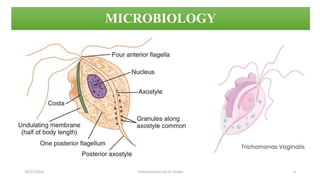
The parasite is a pear- or round-shaped organism with four
anterior flagella and an undulating membrane that causes the
characteristic motility seen on a diagnostic wet-mount slide of
vaginal sections
10/17/2023 Trichomoniasis by Dr. Elioba 5
10/17/2023 Trichomoniasis by Dr. Elioba 6
MICROBIOLOGY
TRANSMISSION
Humans are the only natural host
Trichomoniasis is sexually transmitted disease
The incubation period is unknown; however, in vitro studies
suggest an incubation period of 4 to 28 days in approximately
50 percent of patients
Coexistence of T. vaginalis and bacterial vaginosis (BV) is
common; coinfection rates ranging from 20 - 60 to 80 percent
have been reported
10/17/2023 Trichomoniasis by Dr. Elioba 7
CLINICAL FEATURES
Trichomoniasis infection ranges from an acute, severe inflammatory disease
to an asymptomatic carrier state.
Acute infection
Symptoms include a purulent, malodorous, thin vaginal discharge
associated with burning, pruritus, dysuria, frequency, lower
abdominal pain, and/or dyspareunia.
However, typical symptoms may occur in only 11 to 17 percent of
those with confirmed infection; thus, providers should have a low
threshold to test for Trichomonas when any vaginal discomfort is present.
Symptoms may be worse during menstruation.
Postcoital bleeding can occur.
10/17/2023 Trichomoniasis by Dr. Elioba 8
CLINICAL FEATURES
10/17/2023 Trichomoniasis by Dr. Elioba 9
Chronic infection
Signs and symptoms of chronic infection are milder
May include pruritus and dyspareunia, with scanty vaginal discharge
Physical examination findings
Physical examination often reveals erythema of the vulva and vaginal
mucosa.
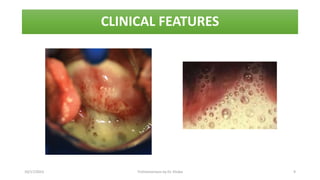
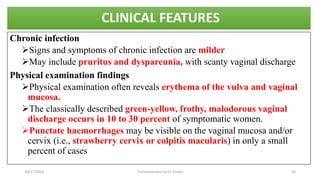
The classically described green-yellow, frothy, malodorous vaginal
discharge occurs in 10 to 30 percent of symptomatic women.
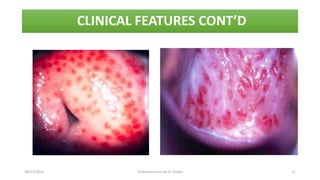
Punctate haemorrhages may be visible on the vaginal mucosa and/or
cervix (i.e., strawberry cervix or colpitis macularis) in only a small
percent of cases
CLINICAL FEATURES
10/17/2023 Trichomoniasis by Dr. Elioba 10
10/17/2023 Trichomoniasis by Dr. Elioba 11
CLINICAL FEATURES CONT’D
CLINICAL CONSEQUENCES
Nonpregnant patient
Untreated T. vaginalis infection
may result in:
Urethritis or cystitis.
Post hysterectomy cuff
cellulitis or abscess.
Pelvic inflammatory disease.
Infertility.
Increased risk of HIV
acquisition and transmission
Acquisition of other STIs
Pregnant patient
T. vaginalis infection during
pregnancy is associated with
adverse obstetric outcomes
including:-
Premature rupture of the
membranes
Preterm delivery
Low birth weight
10/17/2023 Trichomoniasis by Dr. Elioba 12
DIAGNOSIS
The diagnosis of T. vaginalis is based on testing
Positive nucleic acid amplification test (NAAT)
Motile trichomonads on wet mount of vaginal secretions
Positive culture, or positive rapid antigen or nucleic acid
probe test that confirms T. Vaginalis infection
10/17/2023 Trichomoniasis by Dr. Elioba 13
DIFFERENTIAL DIAGNOSIS
Bacterial vaginosis (BV)
Candida vulvovaginitis
Cervical infections
Atrophic vaginitis in hypo estrogenic females
10/17/2023 Trichomoniasis by Dr. Elioba 14
TREATMENT
Treatment is indicated for both symptomatic and asymptomatic patients.
Treatment has limited side effects, is associated with a high cure rate, likely
reduces the prevalence of T. vaginalis carriage in the population, reduces
transmission of the parasite, and reduces the risk of sequelae
DRUGS
Oral metronidazole 500 mg twice daily for seven days (first line)
Tinidazole 2g oral single dose or 500 mg orally twice daily for five days
according to WHO
Secnidazole 2g oral single dose
10/17/2023 Trichomoniasis by Dr. Elioba 15
PREVENTION
The risk of acquiring T. vaginalis infection can be reduced by
correct and consistent use of condoms
Limit your number of sex partners
Be monogamous
Do not douche
10/17/2023 Trichomoniasis by Dr. Elioba 16
REFERENCE
1. Up to date - Trichomoniasis: Clinical manifestations, diagnosis and
treatment, 23 September 2022
2. William gynaecology, 3rd edition
3. Schwebke J, Merriweather A, Massingale S, et al. Screening for
Trichomonas vaginalis in a Large High-Risk Population: Prevalence
Among Men and Women Determined by Nucleic Acid Amplification
Testing. Sex Transm Dis 2018; 45:e23
10/17/2023 Trichomoniasis by Dr. Elioba 17

TRICHOMONIASIS by Dr. Elioba.pptx

  • 1.
    TRICHOMONIASIS DR. ELIOBA J.RAIMON RESIDENT – OBSTETRICS & GYNECOLOGY MENTOR PROF. UBARNEL Trichomoniasis by Dr. Elioba 10/17/2023 1
  • 2.
  • 3.
    INTRODUCTION Trichomoniasis is agenitourinary infection with the protozoan Trichomonas vaginalis. It is the most common nonviral sexually transmitted infection (STI) worldwide Females are affected more often than males. Trichomoniasis is one of the three common infectious causes of vaginal complaints among reproductive-aged females, along with bacterial vaginosis (BV) and candida vulvovaginitis 10/17/2023 Trichomoniasis by Dr. Elioba 3
  • 4.
    PREVALENCE Global estimates in2020 156 million new Trichomoniasis infections occurred (WHO) Use of nucleic acid amplification tests (NAATs) results in higher prevalence rates compared with wet mount microscopy and vaginal pH testing Studies that used NAATs to detect T. vaginalis in US women reported overall prevalence ranges from 8.7 to 27 percent A meta analysis of 18 studies including over 37,000 self-reported women from African countries noted prevalence rates ranging from 2 to nearly 30 percent 10/17/2023 Trichomoniasis by Dr. Elioba 4
  • 5.
    MICROBIOLOGY The organism responsiblefor Trichomoniasis is the flagellated protozoan T. vaginalis, which principally infects the squamous epithelium in the urogenital tract: vagina, urethra, and paraurethral glands Other less common sites include the cervix, bladder, Bartholin glands, and prostate. Positive tests from oral and rectal sites have also been reported The parasite is a pear- or round-shaped organism with four anterior flagella and an undulating membrane that causes the characteristic motility seen on a diagnostic wet-mount slide of vaginal sections 10/17/2023 Trichomoniasis by Dr. Elioba 5
  • 6.
    10/17/2023 Trichomoniasis byDr. Elioba 6 MICROBIOLOGY
  • 7.
    TRANSMISSION Humans are theonly natural host Trichomoniasis is sexually transmitted disease The incubation period is unknown; however, in vitro studies suggest an incubation period of 4 to 28 days in approximately 50 percent of patients Coexistence of T. vaginalis and bacterial vaginosis (BV) is common; coinfection rates ranging from 20 - 60 to 80 percent have been reported 10/17/2023 Trichomoniasis by Dr. Elioba 7
  • 8.
    CLINICAL FEATURES Trichomoniasis infectionranges from an acute, severe inflammatory disease to an asymptomatic carrier state. Acute infection Symptoms include a purulent, malodorous, thin vaginal discharge associated with burning, pruritus, dysuria, frequency, lower abdominal pain, and/or dyspareunia. However, typical symptoms may occur in only 11 to 17 percent of those with confirmed infection; thus, providers should have a low threshold to test for Trichomonas when any vaginal discomfort is present. Symptoms may be worse during menstruation. Postcoital bleeding can occur. 10/17/2023 Trichomoniasis by Dr. Elioba 8
  • 9.
  • 10.
    Chronic infection Signs andsymptoms of chronic infection are milder May include pruritus and dyspareunia, with scanty vaginal discharge Physical examination findings Physical examination often reveals erythema of the vulva and vaginal mucosa. The classically described green-yellow, frothy, malodorous vaginal discharge occurs in 10 to 30 percent of symptomatic women. Punctate haemorrhages may be visible on the vaginal mucosa and/or cervix (i.e., strawberry cervix or colpitis macularis) in only a small percent of cases CLINICAL FEATURES 10/17/2023 Trichomoniasis by Dr. Elioba 10
  • 11.
    10/17/2023 Trichomoniasis byDr. Elioba 11 CLINICAL FEATURES CONT’D
  • 12.
    CLINICAL CONSEQUENCES Nonpregnant patient UntreatedT. vaginalis infection may result in: Urethritis or cystitis. Post hysterectomy cuff cellulitis or abscess. Pelvic inflammatory disease. Infertility. Increased risk of HIV acquisition and transmission Acquisition of other STIs Pregnant patient T. vaginalis infection during pregnancy is associated with adverse obstetric outcomes including:- Premature rupture of the membranes Preterm delivery Low birth weight 10/17/2023 Trichomoniasis by Dr. Elioba 12
  • 13.
    DIAGNOSIS The diagnosis ofT. vaginalis is based on testing Positive nucleic acid amplification test (NAAT) Motile trichomonads on wet mount of vaginal secretions Positive culture, or positive rapid antigen or nucleic acid probe test that confirms T. Vaginalis infection 10/17/2023 Trichomoniasis by Dr. Elioba 13
  • 14.
    DIFFERENTIAL DIAGNOSIS Bacterial vaginosis(BV) Candida vulvovaginitis Cervical infections Atrophic vaginitis in hypo estrogenic females 10/17/2023 Trichomoniasis by Dr. Elioba 14
  • 15.
    TREATMENT Treatment is indicatedfor both symptomatic and asymptomatic patients. Treatment has limited side effects, is associated with a high cure rate, likely reduces the prevalence of T. vaginalis carriage in the population, reduces transmission of the parasite, and reduces the risk of sequelae DRUGS Oral metronidazole 500 mg twice daily for seven days (first line) Tinidazole 2g oral single dose or 500 mg orally twice daily for five days according to WHO Secnidazole 2g oral single dose 10/17/2023 Trichomoniasis by Dr. Elioba 15
  • 16.
    PREVENTION The risk ofacquiring T. vaginalis infection can be reduced by correct and consistent use of condoms Limit your number of sex partners Be monogamous Do not douche 10/17/2023 Trichomoniasis by Dr. Elioba 16
  • 17.
    REFERENCE 1. Up todate - Trichomoniasis: Clinical manifestations, diagnosis and treatment, 23 September 2022 2. William gynaecology, 3rd edition 3. Schwebke J, Merriweather A, Massingale S, et al. Screening for Trichomonas vaginalis in a Large High-Risk Population: Prevalence Among Men and Women Determined by Nucleic Acid Amplification Testing. Sex Transm Dis 2018; 45:e23 10/17/2023 Trichomoniasis by Dr. Elioba 17