1
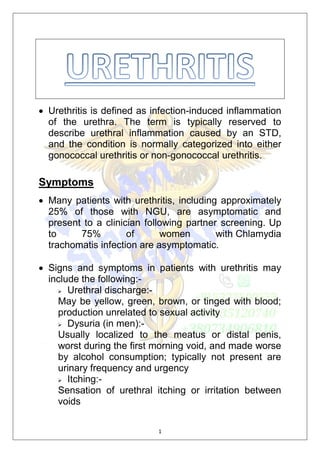
 Urethritis is defined as infection-induced inflammation
of the urethra. The term is typically reserved to
describe urethral inflammation caused by an STD,
and the condition is normally categorized into either
gonococcal urethritis or non-gonococcal urethritis.
Symptoms
 Many patients with urethritis, including approximately
25% of those with NGU, are asymptomatic and
present to a clinician following partner screening. Up
to 75% of women with Chlamydia
trachomatis infection are asymptomatic.
 Signs and symptoms in patients with urethritis may
include the following:-
 Urethral discharge:-
May be yellow, green, brown, or tinged with blood;
production unrelated to sexual activity
 Dysuria (in men):-
Usually localized to the meatus or distal penis,
worst during the first morning void, and made worse
by alcohol consumption; typically not present are
urinary frequency and urgency
 Itching:-
Sensation of urethral itching or irritation between
voids
2
 Orchalgia:-
Heaviness in the male genitals
 Worsens during menstrual cycle (occasionally).
 Systemic symptoms (eg, fever, chills, sweats,
nausea): Typically absent
Diagnosis
 Most patients with urethritis do not appear ill and do
not present with signs of sepsis.
 The primary focus of the examination is on the
genitalia.
 Examination in male patients with urethritis includes
the following:-
 Inspect the underwear for secretions
 Penis: Examine for skin lesions that may
indicate other STDs (eg, condyloma
acuminatum, herpes simplex, syphilis); in
uncircumcised men, retract the foreskin to
assess for lesions and exudate
 Urethra: Examine lumen of the distal urethral
meatus for lesions, stricture, or obvious
urethral discharge; palpate along urethra for
areas of fluctuance, tenderness, or warmth
suggestive of abscess or for firmness
suggesting foreign body
 Testes: Examine for evidence of mass or
inflammation; palpate the spermatic cord,
looking for swelling, tenderness, or warmth
suggestive of orchitis or epididymitis
 Lymphatics: Check for inguinal adenopathy
 Prostate: Palpate for tenderness or bogginess
suggestive of prostatitis
3
 Rectal: During the digital rectal examination,
note any perianal lesions
 Examine female patients in the lithotomy position.
Include the following evaluation:
 Skin: Assess for lesions that may indicate
other STDs
 Urethra: Strip the urethra for any discharge
 Pelvis: Complete pelvic examination, including
the cervix
 Urethritis can be diagnosed based on the presence
of one or more of the following:
 A mucopurulent or purulent urethral discharge
 Urethral smear that demonstrates at least 5
leukocytes per oil immersion field on
microscopy
 First-voided urine specimen that demonstrates
leukocyte esterase on dipstick test or at least
10 WBCs/hpf on microscopy
 All patients with urethritis should be tested
for Neisseria gonorrhoeae and C trachomatis.
Laboratory studies may include the following:
 Gram stain
 Endourethral and/or endocervical culture
for N gonorrhoeae and C trachomatis
 Urinalysis: Not useful test in urethritis, except
to help exclude cystitis or pyelonephritis
 Nucleic acid–based tests: For C
trachomatis and N gonorrhoeae (urine
specimens) and other Chlamydia species
(endourethral samples)
 Nucleic acid amplification tests (eg, PCR
for N gonorrhoeae, Chlamydiaspecies)
4
 KOH preparation: to evaluate for fungal
organisms
 Wet mount preparation: To detect the
movement/presence of Trichomonas
 STD testing for syphilis serology (VDRL) and
HIV serology
 Nasopharyngeal and/or rectal swabs: For
gonorrhea screening in men who have sex
with men
 Pregnancy testing: In women who have had
unprotected intercourse
 Imaging studies, specifically retrograde
urethrography, are unnecessary in patients with
urethritis, except in cases of trauma or possible
foreign body insertion.
 Patients with urethritis may undergo the following
procedures:
 Catherization: In cases of urethral trauma; to
avoid urinary retention and tamponade
urethral bleeding
 Cystoscopy: In cases when catherization is
not possible, for placement of a catheter; to
remove foreign body or stone in the urethra
 Dilation of urethral strictures with filiforms
and followers
 Placement of suprapubic tube: In severe
cases of urethral trauma that prevent
placement of urethral catheters or in the
absence of adequate facilities for emergent
cystoscopy; temporizing measure to divert
urine and relieve patient discomfort
5
Management
 Symptoms of urethritis spontaneously resolve over
time, regardless of treatment. Administer antibiotics
that cover both GU and NGU. Regardless of
symptoms, administer antibiotics to the following
individuals:
 Patients with positive Gram stain or culture
results
 All sexual partners of the above patients
 Patients with negative Gram stain results and
a history consistent with urethritis who are
not likely to return for follow-up and/or are
likely to continue transmitting infection
 Antibiotics used in the treatment of urethritis include
the following:
 Azithromycin
 Ceftriaxone
 Cefixime
 Ciprofloxacin
 Ofloxacin
 Doxycycline
 Moxifloxacin
Causes
 Both bacteria and viruses may cause urethritis. The
same bacteria that cause this condition are E
coli, chlamydia, gonorrhea.
 These bacteria also cause urinary tract
infections and some sexually transmitted diseases.
6
Viral causes are herpes simplex virus and
cytomegalovirus.
 Other causes include:-
 Injury
 Sensitivity to the chemicals used in
spermicides or contraceptive jellies, or foams
 Sometimes the cause is unknown.
 Risks for urethritis include:
 Being a female
 Being male, ages 20 to 35
 Having many sexual partners
 High-risk sexual behavior (such as anal sex
without a condom)
 History of sexually transmitted diseases
Exams and Tests
 The health care provider will examine you. In men,
the exam will include the abdomen, bladder area,
penis, and scrotum.
 The physical exam may show:
 Discharge from the penis
 Tender and enlarged lymph nodes in the groin
area
 Tender and swollen penis
 A digital rectal exam will also be performed.
7
 Women will have abdominal and pelvic exams. The
provider will check for:
 Discharge from the urethra
 Tenderness of the lower abdomen
 Tenderness of the urethra
Your provider may look into your bladder using a tube
with a camera on the end. This is called cystoscopy.
 The following tests may be done:
 Complete blood count (CBC)
 C-reactive protein test
 Pelvic ultrasound (women only)
 Pregnancy test (women only)
 Urinalysis and urine cultures
 Tests for gonorrhea, chlamydia, and other
sexually transmitted illnesses (STI)
 Urethral swab
Treatment
 The goals of treatment are to:
 Get rid of the cause of infection
 Improve symptoms
 Prevent the spread of infection
 If we have a bacterial infection, we will be given
antibiotics.
 We may take pain relievers, urinary pain reliever
along with antibiotics.
8
 People with urethritis who are being treated should
avoid sex, or use condoms during sex.
 Our sexual partner must also be treated if the
condition is caused by an infection.
 Urethritis caused by trauma or chemical irritants is
treated by avoiding the source of injury or irritation.
 Urethritis that does not clear up after antibiotic
treatment and lasts for at least 6 weeks is called
chronic urethritis.
 Different antibiotics may be used to treat this
problem.
Complications
 Men with urethritis are at risk for the following:
 Bladder infection (cystitis)
 Epididymitis
 Infection in the testicles (orchitis)
 Prostate infection (prostatitis)
After a severe infection, the urethra may become
scarred and then narrowed.
 Women with urethritis are at risk for the following:
 Bladder infection (cystitis)
 Cervicitis
 Pelvic inflammatory disease (PID -- an
infection of the uterus lining, fallopian tubes,
or ovaries)
9
Prevention
 Things we can do to help avoid urethritis include:
 Keep the area around the opening of the
urethra clean.
 Follow safer sex practices. Have one sexual
partner only (monogamy) and use condoms.
Reference:-
 Kapitan Pediatrics Book
 GHAI Essential Pediatrics (Eighth Edition)
 Health line ( https://www.healthline.com )
 WebMd ( https://www.webmd.com )
 Mayo Clinic ( https://www.mayclinic.org )
 My Self

Urethritis

  • 1.
    1  Urethritis isdefined as infection-induced inflammation of the urethra. The term is typically reserved to describe urethral inflammation caused by an STD, and the condition is normally categorized into either gonococcal urethritis or non-gonococcal urethritis. Symptoms  Many patients with urethritis, including approximately 25% of those with NGU, are asymptomatic and present to a clinician following partner screening. Up to 75% of women with Chlamydia trachomatis infection are asymptomatic.  Signs and symptoms in patients with urethritis may include the following:-  Urethral discharge:- May be yellow, green, brown, or tinged with blood; production unrelated to sexual activity  Dysuria (in men):- Usually localized to the meatus or distal penis, worst during the first morning void, and made worse by alcohol consumption; typically not present are urinary frequency and urgency  Itching:- Sensation of urethral itching or irritation between voids
  • 2.
    2  Orchalgia:- Heaviness inthe male genitals  Worsens during menstrual cycle (occasionally).  Systemic symptoms (eg, fever, chills, sweats, nausea): Typically absent Diagnosis  Most patients with urethritis do not appear ill and do not present with signs of sepsis.  The primary focus of the examination is on the genitalia.  Examination in male patients with urethritis includes the following:-  Inspect the underwear for secretions  Penis: Examine for skin lesions that may indicate other STDs (eg, condyloma acuminatum, herpes simplex, syphilis); in uncircumcised men, retract the foreskin to assess for lesions and exudate  Urethra: Examine lumen of the distal urethral meatus for lesions, stricture, or obvious urethral discharge; palpate along urethra for areas of fluctuance, tenderness, or warmth suggestive of abscess or for firmness suggesting foreign body  Testes: Examine for evidence of mass or inflammation; palpate the spermatic cord, looking for swelling, tenderness, or warmth suggestive of orchitis or epididymitis  Lymphatics: Check for inguinal adenopathy  Prostate: Palpate for tenderness or bogginess suggestive of prostatitis
  • 3.
    3  Rectal: Duringthe digital rectal examination, note any perianal lesions  Examine female patients in the lithotomy position. Include the following evaluation:  Skin: Assess for lesions that may indicate other STDs  Urethra: Strip the urethra for any discharge  Pelvis: Complete pelvic examination, including the cervix  Urethritis can be diagnosed based on the presence of one or more of the following:  A mucopurulent or purulent urethral discharge  Urethral smear that demonstrates at least 5 leukocytes per oil immersion field on microscopy  First-voided urine specimen that demonstrates leukocyte esterase on dipstick test or at least 10 WBCs/hpf on microscopy  All patients with urethritis should be tested for Neisseria gonorrhoeae and C trachomatis. Laboratory studies may include the following:  Gram stain  Endourethral and/or endocervical culture for N gonorrhoeae and C trachomatis  Urinalysis: Not useful test in urethritis, except to help exclude cystitis or pyelonephritis  Nucleic acid–based tests: For C trachomatis and N gonorrhoeae (urine specimens) and other Chlamydia species (endourethral samples)  Nucleic acid amplification tests (eg, PCR for N gonorrhoeae, Chlamydiaspecies)
  • 4.
    4  KOH preparation:to evaluate for fungal organisms  Wet mount preparation: To detect the movement/presence of Trichomonas  STD testing for syphilis serology (VDRL) and HIV serology  Nasopharyngeal and/or rectal swabs: For gonorrhea screening in men who have sex with men  Pregnancy testing: In women who have had unprotected intercourse  Imaging studies, specifically retrograde urethrography, are unnecessary in patients with urethritis, except in cases of trauma or possible foreign body insertion.  Patients with urethritis may undergo the following procedures:  Catherization: In cases of urethral trauma; to avoid urinary retention and tamponade urethral bleeding  Cystoscopy: In cases when catherization is not possible, for placement of a catheter; to remove foreign body or stone in the urethra  Dilation of urethral strictures with filiforms and followers  Placement of suprapubic tube: In severe cases of urethral trauma that prevent placement of urethral catheters or in the absence of adequate facilities for emergent cystoscopy; temporizing measure to divert urine and relieve patient discomfort
  • 5.
    5 Management  Symptoms ofurethritis spontaneously resolve over time, regardless of treatment. Administer antibiotics that cover both GU and NGU. Regardless of symptoms, administer antibiotics to the following individuals:  Patients with positive Gram stain or culture results  All sexual partners of the above patients  Patients with negative Gram stain results and a history consistent with urethritis who are not likely to return for follow-up and/or are likely to continue transmitting infection  Antibiotics used in the treatment of urethritis include the following:  Azithromycin  Ceftriaxone  Cefixime  Ciprofloxacin  Ofloxacin  Doxycycline  Moxifloxacin Causes  Both bacteria and viruses may cause urethritis. The same bacteria that cause this condition are E coli, chlamydia, gonorrhea.  These bacteria also cause urinary tract infections and some sexually transmitted diseases.
  • 6.
    6 Viral causes areherpes simplex virus and cytomegalovirus.  Other causes include:-  Injury  Sensitivity to the chemicals used in spermicides or contraceptive jellies, or foams  Sometimes the cause is unknown.  Risks for urethritis include:  Being a female  Being male, ages 20 to 35  Having many sexual partners  High-risk sexual behavior (such as anal sex without a condom)  History of sexually transmitted diseases Exams and Tests  The health care provider will examine you. In men, the exam will include the abdomen, bladder area, penis, and scrotum.  The physical exam may show:  Discharge from the penis  Tender and enlarged lymph nodes in the groin area  Tender and swollen penis  A digital rectal exam will also be performed.
  • 7.
    7  Women willhave abdominal and pelvic exams. The provider will check for:  Discharge from the urethra  Tenderness of the lower abdomen  Tenderness of the urethra Your provider may look into your bladder using a tube with a camera on the end. This is called cystoscopy.  The following tests may be done:  Complete blood count (CBC)  C-reactive protein test  Pelvic ultrasound (women only)  Pregnancy test (women only)  Urinalysis and urine cultures  Tests for gonorrhea, chlamydia, and other sexually transmitted illnesses (STI)  Urethral swab Treatment  The goals of treatment are to:  Get rid of the cause of infection  Improve symptoms  Prevent the spread of infection  If we have a bacterial infection, we will be given antibiotics.  We may take pain relievers, urinary pain reliever along with antibiotics.
  • 8.
    8  People withurethritis who are being treated should avoid sex, or use condoms during sex.  Our sexual partner must also be treated if the condition is caused by an infection.  Urethritis caused by trauma or chemical irritants is treated by avoiding the source of injury or irritation.  Urethritis that does not clear up after antibiotic treatment and lasts for at least 6 weeks is called chronic urethritis.  Different antibiotics may be used to treat this problem. Complications  Men with urethritis are at risk for the following:  Bladder infection (cystitis)  Epididymitis  Infection in the testicles (orchitis)  Prostate infection (prostatitis) After a severe infection, the urethra may become scarred and then narrowed.  Women with urethritis are at risk for the following:  Bladder infection (cystitis)  Cervicitis  Pelvic inflammatory disease (PID -- an infection of the uterus lining, fallopian tubes, or ovaries)
  • 9.
    9 Prevention  Things wecan do to help avoid urethritis include:  Keep the area around the opening of the urethra clean.  Follow safer sex practices. Have one sexual partner only (monogamy) and use condoms. Reference:-  Kapitan Pediatrics Book  GHAI Essential Pediatrics (Eighth Edition)  Health line ( https://www.healthline.com )  WebMd ( https://www.webmd.com )  Mayo Clinic ( https://www.mayclinic.org )  My Self