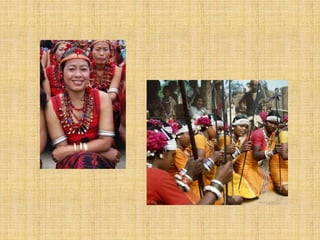
TRIBAL COMMUNITIES
TRIBAL PROBLEMS AND EFFECTS OF
DETRIBALIZATION
INTRODUCTION
• Definition of tribes:
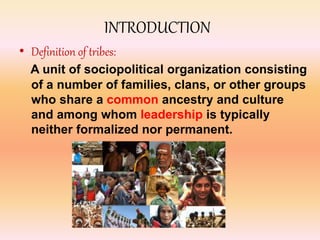
A unit of sociopolitical organization consisting
of a number of families, clans, or other groups
who share a common ancestry and culture
and among whom leadership is typically
neither formalized nor permanent.
FEATURES OF TRIBAL SOCIETY
• The tribe inhabits and remains within definite
and common topography.
• The members of a tribe possess a mutual unity.
• The members of a tribe speak a common
language
• Each tribe has the practice of marrying members
within their own tribes.
TRIBAL COMMUNITY IN INDIA
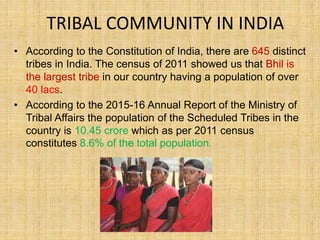
• According to the Constitution of India, there are 645 distinct
tribes in India. The census of 2011 showed us that Bhil is
the largest tribe in our country having a population of over
40 lacs.
• According to the 2015-16 Annual Report of the Ministry of
Tribal Affairs the population of the Scheduled Tribes in the
country is 10.45 crore which as per 2011 census
constitutes 8.6% of the total population.
Tribes in India are different from similar groups
around the world. They are not homogenous group
and within themselves they are at various stages of
integration with the larger society.
According to Andre Beteille, in India the encounters
between tribe and civilization have taken place
under historical conditions in different times.
So they have faced various problems in different
times of their life.
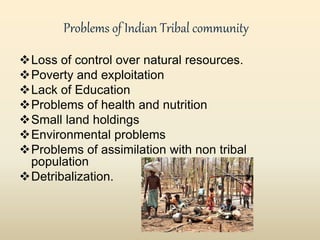
Problems of Indian Tribal community
Loss of control over natural resources.
Poverty and exploitation
Lack of Education
Problems of health and nutrition
Small land holdings
Environmental problems
Problems of assimilation with non tribal
population
Detribalization.
DETRIBALIZATION
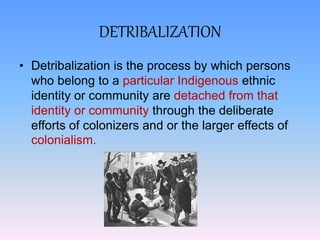
• Detribalization is the process by which persons
who belong to a particular Indigenous ethnic
identity or community are detached from that
identity or community through the deliberate
efforts of colonizers and or the larger effects of
colonialism.
Detribalization was systematically executed by
detaching members from identifying with
communities extrinsic to the colony so that they
could be "modernized," Westernized, and, in
most circumstances, Christianized, for the
prosperity of the colonial state
IN INDIA THERE HAS Been DETRIBALIZATION PROCESS IN
THE PAST HISTORY.
IMPACT OF CHRISTANITY.
IMPACT OF Industrialization.
Effects of Detribalization
POSITIVE EFFECTS:
 Access of modern culture.
 Decrease of superstition.
 Access to different social facilities.
NEGETIVE EFFECTS
 Loss of own identity
 Loss of own cultural norms.
 Loss of own language
 Loss of own administrative system.
Tribal development
 Efforts have been made since
Independence to improve the condition of
tribes. The following measures deserve
our attention:
• Recognizing traditional rights to land.
• Distribution of land to the tribes and
development of land already in their
possession.
• Anti poverty programmes.
• Tribal development blocks.
• Development of cottage industries
THANK YOU

Tribal communities

  • 1.
    TRIBAL COMMUNITIES TRIBAL PROBLEMSAND EFFECTS OF DETRIBALIZATION
  • 2.
    INTRODUCTION • Definition oftribes: A unit of sociopolitical organization consisting of a number of families, clans, or other groups who share a common ancestry and culture and among whom leadership is typically neither formalized nor permanent.
  • 3.
    FEATURES OF TRIBALSOCIETY • The tribe inhabits and remains within definite and common topography. • The members of a tribe possess a mutual unity. • The members of a tribe speak a common language • Each tribe has the practice of marrying members within their own tribes.
  • 4.
    TRIBAL COMMUNITY ININDIA • According to the Constitution of India, there are 645 distinct tribes in India. The census of 2011 showed us that Bhil is the largest tribe in our country having a population of over 40 lacs. • According to the 2015-16 Annual Report of the Ministry of Tribal Affairs the population of the Scheduled Tribes in the country is 10.45 crore which as per 2011 census constitutes 8.6% of the total population.
  • 5.
    Tribes in Indiaare different from similar groups around the world. They are not homogenous group and within themselves they are at various stages of integration with the larger society. According to Andre Beteille, in India the encounters between tribe and civilization have taken place under historical conditions in different times. So they have faced various problems in different times of their life.
  • 6.
    Problems of IndianTribal community Loss of control over natural resources. Poverty and exploitation Lack of Education Problems of health and nutrition Small land holdings Environmental problems Problems of assimilation with non tribal population Detribalization.
  • 7.
    DETRIBALIZATION • Detribalization isthe process by which persons who belong to a particular Indigenous ethnic identity or community are detached from that identity or community through the deliberate efforts of colonizers and or the larger effects of colonialism.
  • 8.
    Detribalization was systematicallyexecuted by detaching members from identifying with communities extrinsic to the colony so that they could be "modernized," Westernized, and, in most circumstances, Christianized, for the prosperity of the colonial state IN INDIA THERE HAS Been DETRIBALIZATION PROCESS IN THE PAST HISTORY. IMPACT OF CHRISTANITY. IMPACT OF Industrialization.
  • 9.
    Effects of Detribalization POSITIVEEFFECTS:  Access of modern culture.  Decrease of superstition.  Access to different social facilities. NEGETIVE EFFECTS  Loss of own identity  Loss of own cultural norms.  Loss of own language  Loss of own administrative system.
  • 10.
    Tribal development  Effortshave been made since Independence to improve the condition of tribes. The following measures deserve our attention: • Recognizing traditional rights to land. • Distribution of land to the tribes and development of land already in their possession. • Anti poverty programmes. • Tribal development blocks. • Development of cottage industries
  • 12.