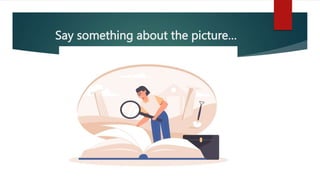
Say something about the picture…
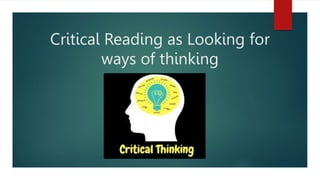
Critical Reading as Looking for
ways of thinking
What does Critical Reading mean?
What is Critical Reading?
 Critical reading is the close, careful reading of a text that is undertaken in
order to understand it fully and assess its merits.
 It involves asking questions about the author’s intention, the text’s structure
and purpose, and the meanings of individual words and phrases.
Two Kinds of Information:
 Explicit Information is the information stated in the text. Readers can see
the piece of information stated in the given passage.
 Implicit information is the information not directly presented in the text.
As readers, we need to read between the lines to understand the details
that the writer is trying to tell us.
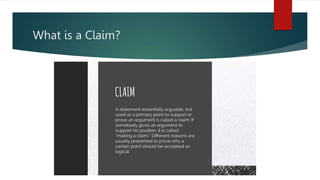
What is a Claim?
Tiongson (2016) gave the following
characteristics of good claims:
1. A claim should be argumentative and debatable.
2. A claim should be specific and focused.
3. A claim should be interesting and engaging.
4. A claim should be logical.
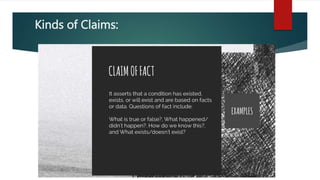
Kinds of Claims:
Examples of Claims of Fact
 The oldest known disease in the world is leprosy.
 Generally, obesity causes health problems.
 Neil Armstrong was the first man to step on the moon.
 The first Mindanaoan President is Rodrigo Duterte.
 The earth is warming rapidly.
Examples of Claims of Value
 It is better to be feared than loved.
 Cheating is not good.
 Gay marriage is immoral.
 Buying a house is a lot better than building it.
 Rock music sucks.
 The government is doing a great job during the Covid-19
pandemic
Examples of Claims of Policy
 The mayor should suspend the classes today.
 You must send your children to public schools.
 The government should legalize medicinal marijuana.
 The Boy Scouts should not have to include gay scout leaders.
 Local Malls should not open during the general community quarantine.
Goals of Critical Reading…
Prentice Hall has enumerated the following critical reading skills:
 The ability to distinguish between fact and opinion
 The ability to identify the author’s purpose
 The ability to recognize the author’s tone
 The ability to make inferences
Making Inferences
 An inference is an idea or conclusion that’s drawn from
evidence and reasoning.
A conclusion is a decision you reach that makes sense
after you think about the details or facts that you have
read.
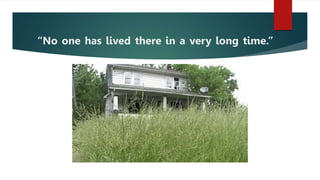
 Imagine you are walking down the street and you come across a house
with overgrown grass that reaches waist-height, no lights in the
windows, and the paint that is peeling off the siding.
 What might you think about this house?
Let’s think of this…
“No one has lived there in a very long time.”
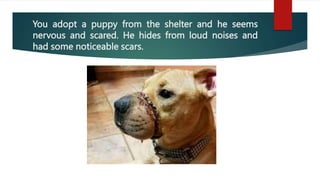
You adopt a puppy from the shelter and he seems
nervous and scared. He hides from loud noises and
had some noticeable scars.
Context of Text Development
 Being a critical reader also involves understanding that texts
are always developed with a certain context.
What is Context?
 Context is defined as the social, cultural, political, historical, and other
related circumstances that surround the texts and form the terms from
which it can be better understood and evaluated.
 It also refers to the occasion or situation that informs the reader about
why a document was written.
The two ways in identifying the context of
text development
Hypertext and Intertext
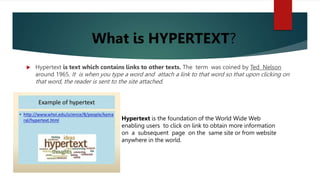
 Hypertext is text which contains links to other texts. The term was coined by Ted Nelson
around 1965. It is when you type a word and attach a link to that word so that upon clicking on
that word, the reader is sent to the site attached.
Hypertext is the foundation of the World Wide Web
enabling users to click on link to obtain more information
on a subsequent page on the same site or from website
anywhere in the world.
What is HYPERTEXT?
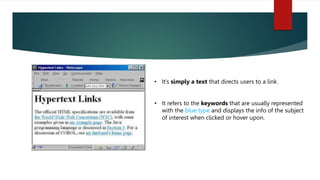
• It’s simply a text that directs users to a link.
• It refers to the keywords that are usually represented
with the blue type and displays the info of the subject
of interest when clicked or hover upon.
Hypertext contains…
 Hypertext materials include pictures, video materials animated
and audio illustrations. All those possibilities make hypertext
materials content high and suitable for educational purposes.
 Hypertext connects topic on a screen to related information,
graphics, videos, and music – information is not simply related
to text.
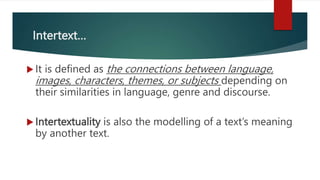
Intertext…
 It is defined as the connections between language,
images, characters, themes, or subjects depending on
their similarities in language, genre and discourse.
 Intertextuality is also the modelling of a text’s meaning
by another text.
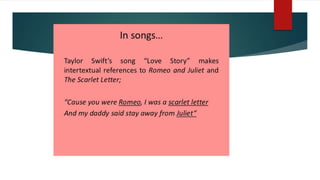
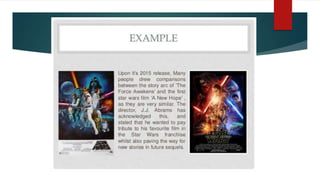
Below are examples of many famous writings that
employ the use of intertextuality:
 1. The main plotline of Disney’s The Lion King is a take on
Shakespeare’s Hamlet.
 2. The structure of James Joyce’s Ulysses is modeled after Homer’s Odyssey.
 3. J.K. Rowling’s Harry Potter series makes use of T.H. White’s The Sword in the
Stone, C. S. Lewis’s The Chronicles of Narnia, and J.R.R. Tolkien’s Lord of the
Rings.
 4. Jane Smiley’s A Thousand Acres is a contemporary retelling of
Shakespeare’s King Lear.
Textual Evidence
 Textual evidence is information gathered from the text that supports your assertion or
counterclaim about the text.
 It refers to any proof of an argument, a claim, a counterclaim, an assertion cited in the text leading
to a conclusion.
In expressing your judgment about the
text,
 First, state your idea about the text.
 To determine evidence from the text, look for clues and keywords that
support your idea about the text.
 Quote or paraphrase the part of the text that helped you come up with
your idea.
 Use quotation marks to quote a part of the text. If it is from a book,
indicate the page number at the end of your sentence.
 Lastly, express how the quote supports your idea.
Types of textual evidence:
 Referencing. This is the act of mentioning a specific section of the text like an event or action.
Examples:
1. According to Fussell, „The Oxford Book of English Verse presides over the Great War in a way that
has never been fully appreciated’ (159).
2. Strickland tells the story of Minty Nelson, a 27-year-old Seattle University employee and student,
whose encounter with a census worker epitomizes the identity battle faced constantly by multiracial
people.
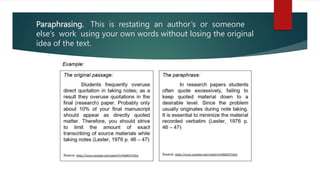
Paraphrasing. This is restating an author’s or someone
else’s work using your own words without losing the original
idea of the text.
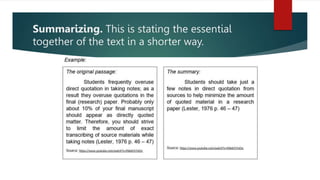
Summarizing. This is stating the essential
together of the text in a shorter way.
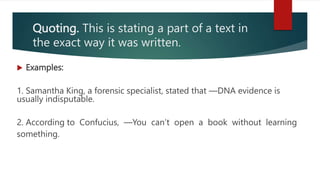
Quoting. This is stating a part of a text in
the exact way it was written.
 Examples:
1. Samantha King, a forensic specialist, stated that ―DNA evidence is
usually indisputable.
2. According to Confucius, ―You can’t open a book without learning
something.
References:
 https://www.masterclass.com/articles/how-to-apply-literary-inspiration-to-your-writing#7-examples-of-intertextuality
 Explicitand Implicit Information. Retrieved from
https://link.quipper.com/en/organizations/547ffb8bd2b76d0002002 618/curricul um#curriculum
 McGaan, L. PhD. (2016). Argumentation. Retrieved from
https://department.monm.edu/cata/mcgaan/classes/cata335/Oclai ms.335.html Olivieri, P. (n.d.). How to Teach Text Evidence:
A Step-by- Step Guide. [online] Rockin Resources. Available at:
https://blog.teacherspayteachers.com/teach-textevidence/ [Accessed 28 Aug. 2019].
 Perez, R.E. (2014). Exit essay: Save the Filipino language. Retrieved from http://rjaperez.tumblr.com/post/95149266012/exit-
essay-save- the-filipinolanguage
 Reid, S. (n.d). Claims for Written Argument. Available @ https://www.mesacc.edu/~paoih30491/ArgumentSampleClaimofFact
Def.html Dayagbil, Felomina, et. Al (2016). Critical Reading and Writing for the Senior High School. Lorimar Publishing,
Inc., Quezon City.
 http://ollie.dcccd.edu/Services/StudyHelp/StudySkills/sub/rdgcri.ht m https://www.slideshare.net/marykatrinebelino/critical-
reading-as- reasoning- 7847430
Thank you for listening! 

Report LED 204.pptx

  • 1.
    Say something aboutthe picture…
  • 2.
    Critical Reading asLooking for ways of thinking
  • 3.
    What does CriticalReading mean?
  • 4.
    What is CriticalReading?  Critical reading is the close, careful reading of a text that is undertaken in order to understand it fully and assess its merits.  It involves asking questions about the author’s intention, the text’s structure and purpose, and the meanings of individual words and phrases.
  • 5.
    Two Kinds ofInformation:  Explicit Information is the information stated in the text. Readers can see the piece of information stated in the given passage.  Implicit information is the information not directly presented in the text. As readers, we need to read between the lines to understand the details that the writer is trying to tell us.
  • 6.
    What is aClaim?
  • 7.
    Tiongson (2016) gavethe following characteristics of good claims: 1. A claim should be argumentative and debatable. 2. A claim should be specific and focused. 3. A claim should be interesting and engaging. 4. A claim should be logical.
  • 8.
  • 9.
    Examples of Claimsof Fact  The oldest known disease in the world is leprosy.  Generally, obesity causes health problems.  Neil Armstrong was the first man to step on the moon.  The first Mindanaoan President is Rodrigo Duterte.  The earth is warming rapidly.
  • 11.
    Examples of Claimsof Value  It is better to be feared than loved.  Cheating is not good.  Gay marriage is immoral.  Buying a house is a lot better than building it.  Rock music sucks.  The government is doing a great job during the Covid-19 pandemic
  • 13.
    Examples of Claimsof Policy  The mayor should suspend the classes today.  You must send your children to public schools.  The government should legalize medicinal marijuana.  The Boy Scouts should not have to include gay scout leaders.  Local Malls should not open during the general community quarantine.
  • 14.
    Goals of CriticalReading… Prentice Hall has enumerated the following critical reading skills:  The ability to distinguish between fact and opinion  The ability to identify the author’s purpose  The ability to recognize the author’s tone  The ability to make inferences
  • 15.
    Making Inferences  Aninference is an idea or conclusion that’s drawn from evidence and reasoning.
  • 16.
    A conclusion isa decision you reach that makes sense after you think about the details or facts that you have read.  Imagine you are walking down the street and you come across a house with overgrown grass that reaches waist-height, no lights in the windows, and the paint that is peeling off the siding.  What might you think about this house? Let’s think of this…
  • 17.
    “No one haslived there in a very long time.”
  • 18.
    You adopt apuppy from the shelter and he seems nervous and scared. He hides from loud noises and had some noticeable scars.
  • 19.
    Context of TextDevelopment  Being a critical reader also involves understanding that texts are always developed with a certain context.
  • 20.
    What is Context? Context is defined as the social, cultural, political, historical, and other related circumstances that surround the texts and form the terms from which it can be better understood and evaluated.  It also refers to the occasion or situation that informs the reader about why a document was written.
  • 21.
    The two waysin identifying the context of text development Hypertext and Intertext
  • 22.
     Hypertext istext which contains links to other texts. The term was coined by Ted Nelson around 1965. It is when you type a word and attach a link to that word so that upon clicking on that word, the reader is sent to the site attached. Hypertext is the foundation of the World Wide Web enabling users to click on link to obtain more information on a subsequent page on the same site or from website anywhere in the world. What is HYPERTEXT?
  • 23.
    • It’s simplya text that directs users to a link. • It refers to the keywords that are usually represented with the blue type and displays the info of the subject of interest when clicked or hover upon.
  • 24.
    Hypertext contains…  Hypertextmaterials include pictures, video materials animated and audio illustrations. All those possibilities make hypertext materials content high and suitable for educational purposes.  Hypertext connects topic on a screen to related information, graphics, videos, and music – information is not simply related to text.
  • 26.
    Intertext…  It isdefined as the connections between language, images, characters, themes, or subjects depending on their similarities in language, genre and discourse.  Intertextuality is also the modelling of a text’s meaning by another text.
  • 29.
    Below are examplesof many famous writings that employ the use of intertextuality:  1. The main plotline of Disney’s The Lion King is a take on Shakespeare’s Hamlet.  2. The structure of James Joyce’s Ulysses is modeled after Homer’s Odyssey.  3. J.K. Rowling’s Harry Potter series makes use of T.H. White’s The Sword in the Stone, C. S. Lewis’s The Chronicles of Narnia, and J.R.R. Tolkien’s Lord of the Rings.  4. Jane Smiley’s A Thousand Acres is a contemporary retelling of Shakespeare’s King Lear.
  • 30.
    Textual Evidence  Textualevidence is information gathered from the text that supports your assertion or counterclaim about the text.  It refers to any proof of an argument, a claim, a counterclaim, an assertion cited in the text leading to a conclusion.
  • 31.
    In expressing yourjudgment about the text,  First, state your idea about the text.  To determine evidence from the text, look for clues and keywords that support your idea about the text.  Quote or paraphrase the part of the text that helped you come up with your idea.  Use quotation marks to quote a part of the text. If it is from a book, indicate the page number at the end of your sentence.  Lastly, express how the quote supports your idea.
  • 32.
    Types of textualevidence:  Referencing. This is the act of mentioning a specific section of the text like an event or action. Examples: 1. According to Fussell, „The Oxford Book of English Verse presides over the Great War in a way that has never been fully appreciated’ (159). 2. Strickland tells the story of Minty Nelson, a 27-year-old Seattle University employee and student, whose encounter with a census worker epitomizes the identity battle faced constantly by multiracial people.
  • 33.
    Paraphrasing. This isrestating an author’s or someone else’s work using your own words without losing the original idea of the text.
  • 34.
    Summarizing. This isstating the essential together of the text in a shorter way.
  • 35.
    Quoting. This isstating a part of a text in the exact way it was written.  Examples: 1. Samantha King, a forensic specialist, stated that ―DNA evidence is usually indisputable. 2. According to Confucius, ―You can’t open a book without learning something.
  • 36.
    References:  https://www.masterclass.com/articles/how-to-apply-literary-inspiration-to-your-writing#7-examples-of-intertextuality  ExplicitandImplicit Information. Retrieved from https://link.quipper.com/en/organizations/547ffb8bd2b76d0002002 618/curricul um#curriculum  McGaan, L. PhD. (2016). Argumentation. Retrieved from https://department.monm.edu/cata/mcgaan/classes/cata335/Oclai ms.335.html Olivieri, P. (n.d.). How to Teach Text Evidence: A Step-by- Step Guide. [online] Rockin Resources. Available at: https://blog.teacherspayteachers.com/teach-textevidence/ [Accessed 28 Aug. 2019].  Perez, R.E. (2014). Exit essay: Save the Filipino language. Retrieved from http://rjaperez.tumblr.com/post/95149266012/exit- essay-save- the-filipinolanguage  Reid, S. (n.d). Claims for Written Argument. Available @ https://www.mesacc.edu/~paoih30491/ArgumentSampleClaimofFact Def.html Dayagbil, Felomina, et. Al (2016). Critical Reading and Writing for the Senior High School. Lorimar Publishing, Inc., Quezon City.  http://ollie.dcccd.edu/Services/StudyHelp/StudySkills/sub/rdgcri.ht m https://www.slideshare.net/marykatrinebelino/critical- reading-as- reasoning- 7847430
  • 37.
    Thank you forlistening! 