The landscape approach:
    Ten principles to apply at the nexus of
agriculture, conservation and other competing
                  land-uses	
  
               Terry Sunderland
               Tree Diversity Day
           CBD COP, Hyderabad, India
               11th October 2012
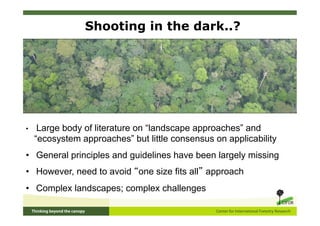
Shooting in the dark..?


•     Large body of literature on “landscape approaches” and
     “ecosystem approaches” but little consensus on applicability
•  General principles and guidelines have been largely missing
•  However, need to avoid “one size fits all” approach
•  Complex landscapes; complex challenges
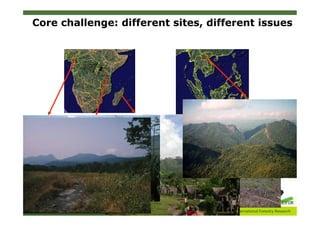
Core challenge: different sites, different issues
New approaches
•  Since	
  2008,	
  CIFOR	
  and	
  mul5ple	
  partners	
  working	
  on	
  defining	
  
   and	
  refining	
  broad	
  “landscape	
  approaches”	
  building	
  on	
  
   previous	
  ini5a5ves	
  
•  How?	
  Review	
  of	
  published	
  literature,	
  mul5ple	
  workshops	
  for	
  
   consensus	
  building,	
  conferences/side	
  events,	
  e.g.	
  Diversitas,	
  
   IUFRO,	
  CBD	
  Bonn,	
  Nagoya	
  	
  
•  Validated	
  by	
  survey	
  of	
  field	
  prac55oners	
  
•  Based	
  on	
  this	
  on-­‐going	
  work,	
  SBSTTA	
  commissioned	
  a	
  report	
  
   on	
  “sustainable	
  use	
  of	
  biodiversity	
  at	
  the	
  landscape	
  
   scale”	
  (see	
  
   hSp://www.cbd.int/doc/mee5ngs/sbsSa/sbsSa-­‐15/official/
   sbsSa-­‐15-­‐13-­‐en.pdf)	


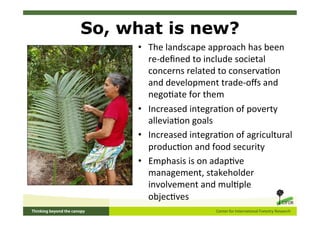
So, what is new?
     •  The	
  landscape	
  approach	
  has	
  been	
  
        re-­‐defined	
  to	
  include	
  societal	
  
        concerns	
  related	
  to	
  conserva5on	
  
        and	
  development	
  trade-­‐offs	
  and	
  
        nego5ate	
  for	
  them	
  
     •  Increased	
  integra5on	
  of	
  poverty	
  
        allevia5on	
  goals	
  
     •  Increased	
  integra5on	
  of	
  agricultural	
  
        produc5on	
  and	
  food	
  security	
  
     •  Emphasis	
  is	
  on	
  adap5ve	
  
        management,	
  stakeholder	
  
        involvement	
  and	
  mul5ple	
  
        objec5ves	


The “Ten Commandments”...?
Ten principles for a landscape approach
•    Con5nual	
  learning	
  and	
  adap5ve	
  management	
  
•    Common	
  concern	
  entry	
  point	
  
•    Mul5ple	
  scales	
  
•    Mul5-­‐func5onality	
  
•    Mul5-­‐stakeholder	
  
•    Nego5ated	
  and	
  transparent	
  change	
  
•    Clarifica5on	
  of	
  rights	
  and	
  principles	
  
•    Par5cipatory	
  and	
  user-­‐friendly	
  monitoring	
  
•    Resilience	
  
•    Strengthened	
  stakeholder	
  capacity	
  
What impact?
    •  Recommenda5on	
  XV/6	
  
       "sustainable	
  use"	
  from	
  SBSTTA	
  
       XV	
  (includes	
  work	
  on	
  bushmeat)	
  
    •  Tabled	
  for	
  adop5on	
  at	
  this	
  COP	
  
       by	
  par5es	
  
    •  Sayer	
  et	
  al:	
  The	
  landscape	
  
       approach:	
  ten	
  principles	
  to	
  apply	
  
       at	
  the	
  nexus	
  of	
  agriculture,	
  
       conserva5on	
  and	
  other	
  
       compe5ng	
  land	
  uses	
  [in	
  press]	
  
       Proceedings	
  of	
  the	
  Na2onal	
  
       Academy	
  of	
  Science	
  
Thanks!	
  
         THINKING beyond the canopy

Tree diversityday2012-sunderland.pptx

  • 1.
    The landscape approach: Ten principles to apply at the nexus of agriculture, conservation and other competing land-uses   Terry Sunderland Tree Diversity Day CBD COP, Hyderabad, India 11th October 2012
  • 2.
    Shooting in thedark..? •  Large body of literature on “landscape approaches” and “ecosystem approaches” but little consensus on applicability •  General principles and guidelines have been largely missing •  However, need to avoid “one size fits all” approach •  Complex landscapes; complex challenges
  • 3.
    Core challenge: differentsites, different issues
  • 4.
    New approaches •  Since  2008,  CIFOR  and  mul5ple  partners  working  on  defining   and  refining  broad  “landscape  approaches”  building  on   previous  ini5a5ves   •  How?  Review  of  published  literature,  mul5ple  workshops  for   consensus  building,  conferences/side  events,  e.g.  Diversitas,   IUFRO,  CBD  Bonn,  Nagoya     •  Validated  by  survey  of  field  prac55oners   •  Based  on  this  on-­‐going  work,  SBSTTA  commissioned  a  report   on  “sustainable  use  of  biodiversity  at  the  landscape   scale”  (see   hSp://www.cbd.int/doc/mee5ngs/sbsSa/sbsSa-­‐15/official/ sbsSa-­‐15-­‐13-­‐en.pdf)        
  • 5.
    So, what isnew? •  The  landscape  approach  has  been   re-­‐defined  to  include  societal   concerns  related  to  conserva5on   and  development  trade-­‐offs  and   nego5ate  for  them   •  Increased  integra5on  of  poverty   allevia5on  goals   •  Increased  integra5on  of  agricultural   produc5on  and  food  security   •  Emphasis  is  on  adap5ve   management,  stakeholder   involvement  and  mul5ple   objec5ves    
  • 6.
  • 7.
    Ten principles fora landscape approach •  Con5nual  learning  and  adap5ve  management   •  Common  concern  entry  point   •  Mul5ple  scales   •  Mul5-­‐func5onality   •  Mul5-­‐stakeholder   •  Nego5ated  and  transparent  change   •  Clarifica5on  of  rights  and  principles   •  Par5cipatory  and  user-­‐friendly  monitoring   •  Resilience   •  Strengthened  stakeholder  capacity  
  • 8.
    What impact? •  Recommenda5on  XV/6   "sustainable  use"  from  SBSTTA   XV  (includes  work  on  bushmeat)   •  Tabled  for  adop5on  at  this  COP   by  par5es   •  Sayer  et  al:  The  landscape   approach:  ten  principles  to  apply   at  the  nexus  of  agriculture,   conserva5on  and  other   compe5ng  land  uses  [in  press]   Proceedings  of  the  Na2onal   Academy  of  Science  
  • 9.
    Thanks!   THINKING beyond the canopy