RENDERING
Rendering
• Rendering has historically been defined as separation of fat
from animal tissues by the application of heat
• Rendering of animal tissues involves conversion of carcasses
into three end products—
carcass meal (proteinaceous solids)
amelted fat
water
Using
• Mechanical processes (e.g., grinding, mixing,
pressing, centrifuging)
• Thermal processes (e.g., cooking, evaporating, and
drying), and sometimes chemical processes (e.g., solvent
extraction)..
Raw materials for rendering
• Packinghouse by-products, such as organ fats, offal,
bones and blood
• Boning house material which consists of bones and
meat trimmings
• Meat market trimmings including adipose and inter-
muscular fats, bone, cartilage and meat trimmings
• Restaurant greases: Recovered cooking oils (these
are processed and stored separately)
• Fallen animals
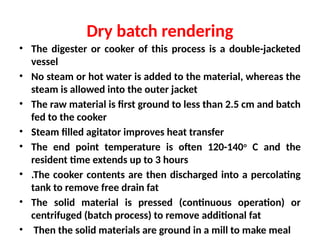
Wet rendering(Autoclave)
• The pre-ground raw materials are cooked a 140 oC in a closed
digester (autoclave) under a pressure of 40-60 psi by direct
injection of steam on to the raw materials for 3-4 hours
• pressure is slowly released and the liquid and the solid phases
are allowed to separate
• The fat, which floats on top, is drawn off and can be polished
further in disk centrifuge to remove residual water and fine
particles
• Residual solid material (Cracklings or Greaves- residual
meat fibers/ solid material left behind after all fat have
been extracted) is removed and pressed to remove
additional water (stick water) before being dried and
milled
Comparison of different rendering systems
Wet rendering
Adv:
Wet rendering produces good quality fat
Disadv:
ď‚§ Requires long cooking times (3-4 hours)
ď‚§ It is labour intensive
ď‚§ Significant losses (up to 20% loss in stick water)
because soluble and suspended materials are lost
ď‚§ Energy intensive
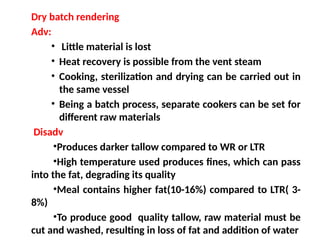
Dry batch rendering
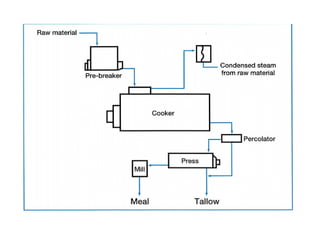
• The digester or cooker of this process is a double-jacketed
vessel
• No steam or hot water is added to the material, whereas the
steam is allowed into the outer jacket
• The raw material is first ground to less than 2.5 cm and batch
fed to the cooker
• Steam filled agitator improves heat transfer
• The end point temperature is often 120-140o
C and the
resident time extends up to 3 hours
• .The cooker contents are then discharged into a percolating
tank to remove free drain fat
• The solid material is pressed (continuous operation) or
centrifuged (batch process) to remove additional fat
• Then the solid materials are ground in a mill to make meal
Dry batch rendering
Adv:
• Little material is lost
• Heat recovery is possible from the vent steam
• Cooking, sterilization and drying can be carried out in
the same vessel
• Being a batch process, separate cookers can be set for
different raw materials
Disadv
•Produces darker tallow compared to WR or LTR
•High temperature used produces fines, which can pass
into the fat, degrading its quality
•Meal contains higher fat(10-16%) compared to LTR( 3-
8%)
•To produce good quality tallow, raw material must be
cut and washed, resulting in loss of fat and addition of water
Continuous low temperature rendering or
mechanical dewatering systems
• Uses either a dry or wet(steam injection) cooker
• Raw material minced, passed to low temp cooker called as
coagulator or pre-heater or melting section
• Material heated to 60-90 ˚C in short time (10-30 min)
• Cells break, liberate tallow
• Liquid tallow pressed out in a continuous screw press along
with water( equal in volume to that in raw material, or
higher if live steam is injected)
• Solids sent to a cooker/drier
• The liquid mixture sent to an evaporator or a centrifuge.
Evaporaor operates a low pressure, hence at temp much
less than 100 Ëš C
• Water, fat and solids removed
Continuous LTR
Adv:
• Raw material need not be washed
• The colour of paunch contents do not get
fixed on to tallow
• Fat in the meal is less (3-8% )compared to
high temp systems(Batch HTR- 10-16%)
DRY AND WET RENDERING - DIFFERENT METHODS OF RENDERING

DRY AND WET RENDERING - DIFFERENT METHODS OF RENDERING

  • 1.
  • 2.
    Rendering • Rendering hashistorically been defined as separation of fat from animal tissues by the application of heat • Rendering of animal tissues involves conversion of carcasses into three end products— carcass meal (proteinaceous solids) amelted fat water Using • Mechanical processes (e.g., grinding, mixing, pressing, centrifuging) • Thermal processes (e.g., cooking, evaporating, and drying), and sometimes chemical processes (e.g., solvent extraction)..
  • 3.
    Raw materials forrendering • Packinghouse by-products, such as organ fats, offal, bones and blood • Boning house material which consists of bones and meat trimmings • Meat market trimmings including adipose and inter- muscular fats, bone, cartilage and meat trimmings • Restaurant greases: Recovered cooking oils (these are processed and stored separately) • Fallen animals
  • 4.
    Wet rendering(Autoclave) • Thepre-ground raw materials are cooked a 140 oC in a closed digester (autoclave) under a pressure of 40-60 psi by direct injection of steam on to the raw materials for 3-4 hours • pressure is slowly released and the liquid and the solid phases are allowed to separate • The fat, which floats on top, is drawn off and can be polished further in disk centrifuge to remove residual water and fine particles • Residual solid material (Cracklings or Greaves- residual meat fibers/ solid material left behind after all fat have been extracted) is removed and pressed to remove additional water (stick water) before being dried and milled
  • 5.
    Comparison of differentrendering systems Wet rendering Adv: Wet rendering produces good quality fat Disadv: ď‚§ Requires long cooking times (3-4 hours) ď‚§ It is labour intensive ď‚§ Significant losses (up to 20% loss in stick water) because soluble and suspended materials are lost ď‚§ Energy intensive
  • 7.
    Dry batch rendering •The digester or cooker of this process is a double-jacketed vessel • No steam or hot water is added to the material, whereas the steam is allowed into the outer jacket • The raw material is first ground to less than 2.5 cm and batch fed to the cooker • Steam filled agitator improves heat transfer • The end point temperature is often 120-140o C and the resident time extends up to 3 hours • .The cooker contents are then discharged into a percolating tank to remove free drain fat • The solid material is pressed (continuous operation) or centrifuged (batch process) to remove additional fat • Then the solid materials are ground in a mill to make meal
  • 8.
    Dry batch rendering Adv: •Little material is lost • Heat recovery is possible from the vent steam • Cooking, sterilization and drying can be carried out in the same vessel • Being a batch process, separate cookers can be set for different raw materials Disadv •Produces darker tallow compared to WR or LTR •High temperature used produces fines, which can pass into the fat, degrading its quality •Meal contains higher fat(10-16%) compared to LTR( 3- 8%) •To produce good quality tallow, raw material must be cut and washed, resulting in loss of fat and addition of water
  • 10.
    Continuous low temperaturerendering or mechanical dewatering systems • Uses either a dry or wet(steam injection) cooker • Raw material minced, passed to low temp cooker called as coagulator or pre-heater or melting section • Material heated to 60-90 ˚C in short time (10-30 min) • Cells break, liberate tallow • Liquid tallow pressed out in a continuous screw press along with water( equal in volume to that in raw material, or higher if live steam is injected) • Solids sent to a cooker/drier • The liquid mixture sent to an evaporator or a centrifuge. Evaporaor operates a low pressure, hence at temp much less than 100 ˚ C • Water, fat and solids removed
  • 11.
    Continuous LTR Adv: • Rawmaterial need not be washed • The colour of paunch contents do not get fixed on to tallow • Fat in the meal is less (3-8% )compared to high temp systems(Batch HTR- 10-16%)