
TRANSPORT IN PLANTS
Transport types to water potential
NCRT
Cytoplasmic streaming is an active process ..
• In rooted plants, transport in xylem (of water and
minerals) is essentially unidirectional, from roots to the
stems.
• Organic and mineral nutrients however, undergo
multidirectional transport through the phloem.
• When any plant part undergoes senescence, nutrients
may be withdrawn from such regions and moved to the
growing parts.
• Hormones transported, though in very small amounts,
sometimes in a strictly polarised or unidirectional
manner from where they are synthesised to other parts.
Diffusion
• Diffusion Movement by diffusion is passive.
• No energy expenditure takes place.
• random fashion..
• Diffusion is a slow process and is not dependent on a
‘living system’.
• Diffusion is obvious in gases and liquids, but diffusion in
solids rather than of solids is more likely.
• Diffusion in solid medium is not possible rather than if
solids present in liquid or gaseous medium ,it is more
likely to be diffused.
• Diffusion is very important to plants since it is the only
means for gaseous movement within the plant body.
Diffusion importance in plants..
• Diffusion is very important to plants since it is the only
means for gaseous movement within the plant body.
Diffusion rates are affected by ?
• Gradient of concentration,
• the permeability of the membrane separating them,
• temperature
• pressure.
Can solids diffuse in solids?
Diffusion depend on
• The diffusion rate depends on the size of the
substances;
• Smaller substances diffuse faster.
• The diffusion of any substance across a membrane also
depends on its solubility in lipids…
• .
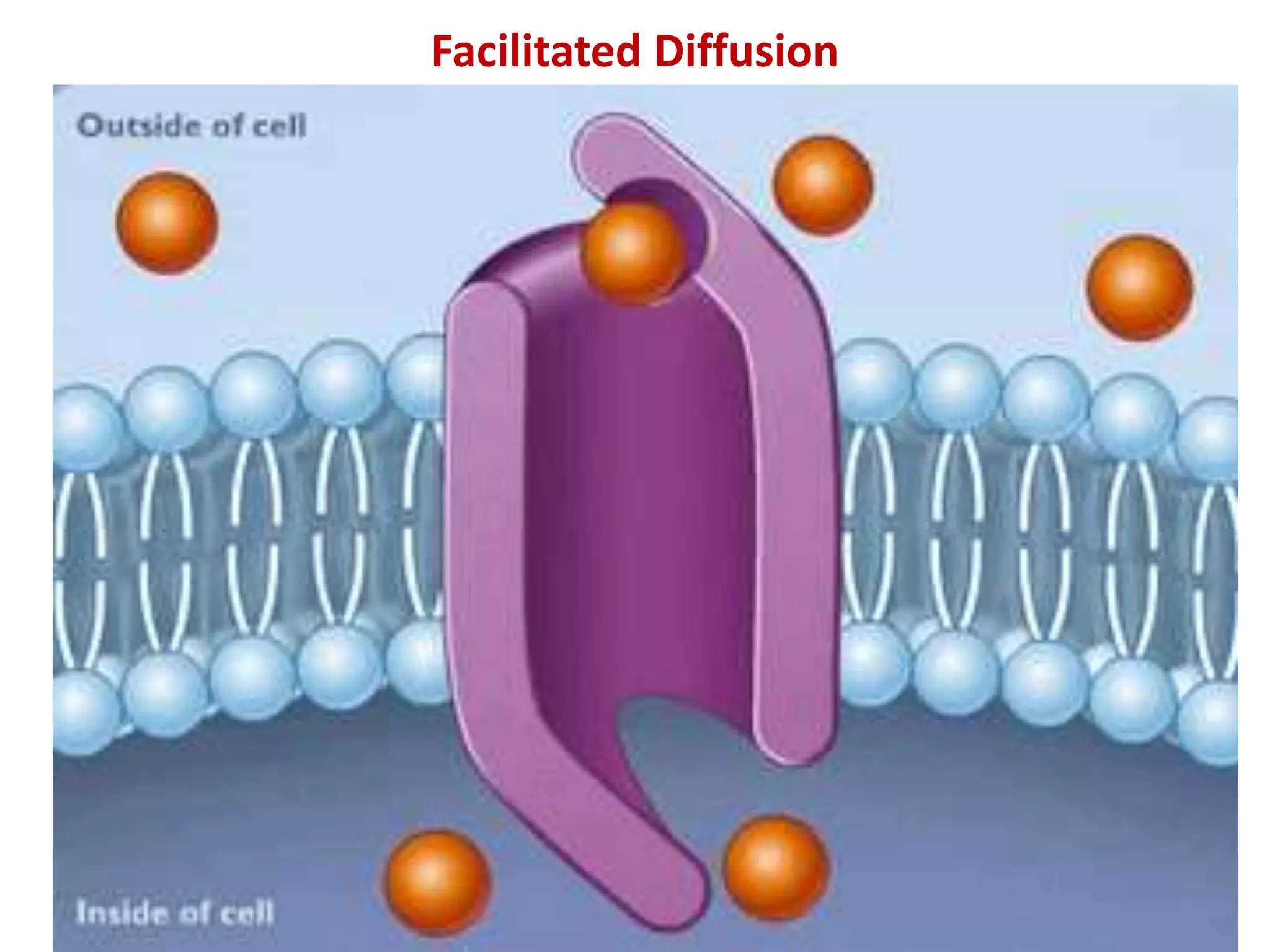
Facilitated Diffusion
• Substances soluble in lipids diffuse through the
membrane faster.
• Substances that have a hydrophilic moiety, find it
difficult to pass through the membrane; their
movement has to be facilitated.
• In facilitated diffusion special proteins help move
substances across membranes without expenditure of
ATP energy.
• Transport rate reaches a maximum when all of the
protein transporters are being used (saturation).
• It is sensitive to inhibitors which react with protein side
chains.
Channels
• The proteins form channels in the membrane for
molecules to pass through.
• Some channels are always open; others can be
controlled.
• Some are large, allowing a variety of molecules to cross.
Porins:
• The porins are proteins that form huge pores in the
outer membranes of the plastids, mitochondria and
some bacteria..
• allowing molecules up to the size of small proteins to
pass through.
outer membrane of Gram negative bacteria,
some Gram positive
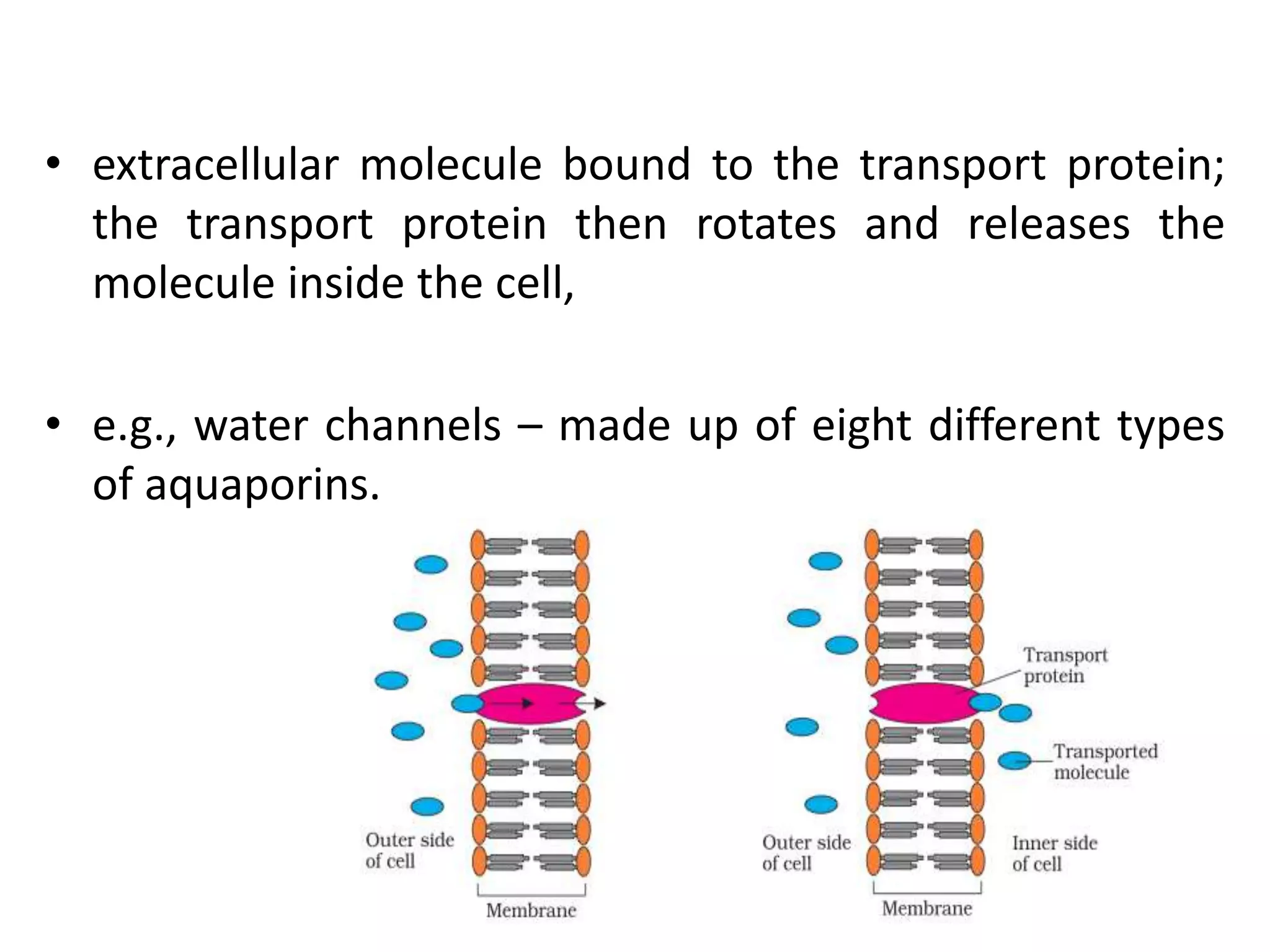
• extracellular molecule bound to the transport protein;
the transport protein then rotates and releases the
molecule inside the cell,
• e.g., water channels – made up of eight different types
of aquaporins.
molecule moves across a membrane independent of
other molecules, the process is called uniport
• In a symport,
both molecules
cross the
membrane in
the same
direction;
• In an antiport,
they move in
opposite
directions
Active transport
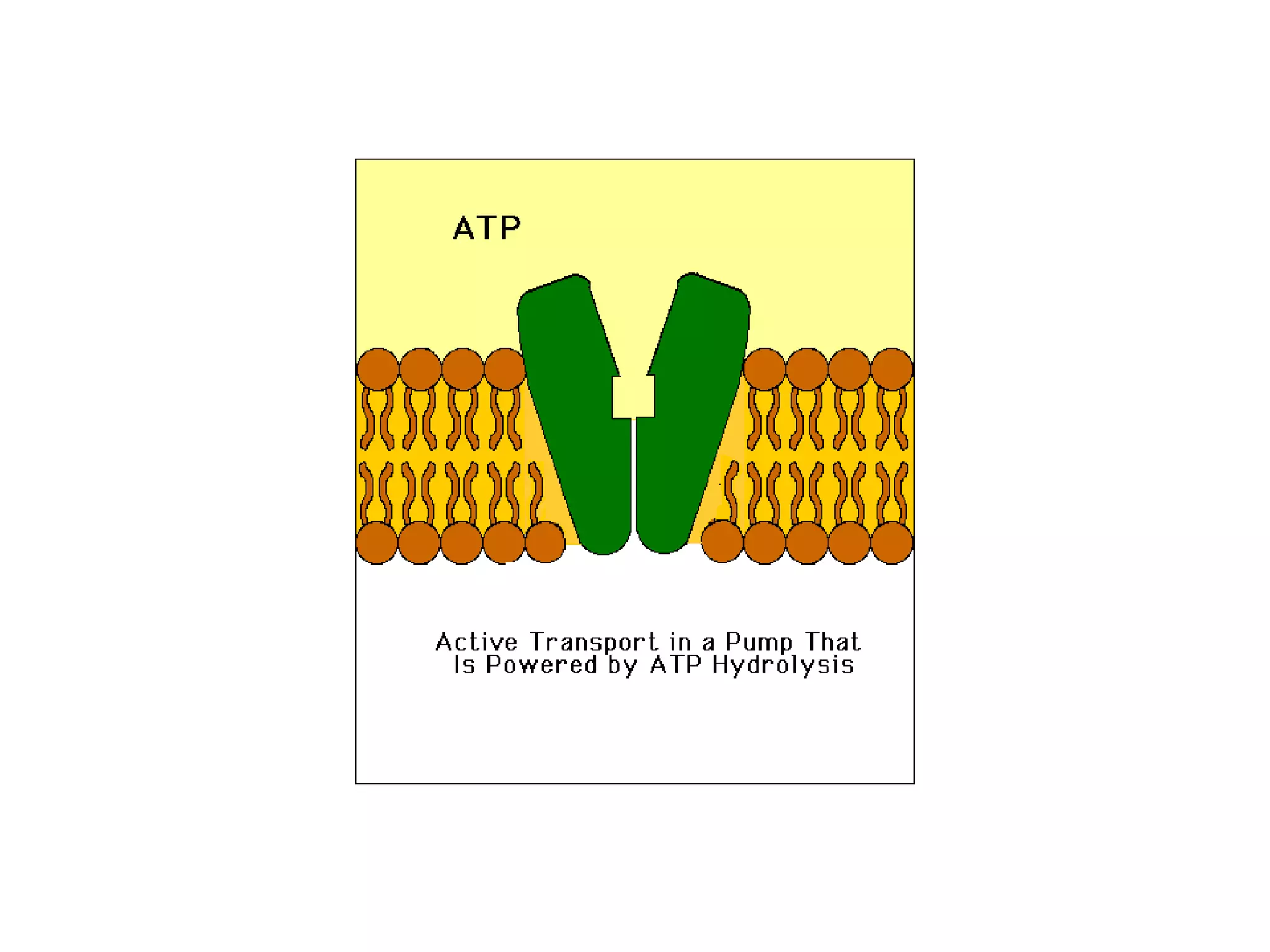
• Active transport uses energy to pump molecules against
a concentration gradient.
• Active transport is carried out by membrane-proteins.
• Ion Pumps are proteins that use energy to carry
substances across the cell membrane.
Active transport
• Transport rate reaches a maximum when all the protein
transporters are being used or are saturated.
• Like enzymes the carrier protein is very specific in what
it carries across the membrane.
• These proteins are sensitive to inhibitors that react with
protein side chains.
MELVIN CALVIN
• Calvin and co-workers put radioactivity to beneficial
use..
• He Studied reactions in green plants forming sugar and
other substances from raw materials like carbon dioxide,
water and minerals by labelling the carbon dioxide with
C14..
• The principles of photosynthesis as established by Calvin
are, at present, being used in studies in solar energy
Just after world war II, when the world was
under shock after the Hiroshima-Nagasaki
bombings, and seeing the ill effects of radio-
activity.
PLANT-WATER RELATIONS
• It provides the medium in which most substances are
dissolved.
• The protoplasm of the cells is nothing but water in
which different molecules are dissolved and (several
particles) suspended.
•
• A watermelon has over 92 per cent water.
• most herbaceous plants have only about 10 to 15 per cent
of its fresh weight as dry matter.
• In herbaceous plants, water normally constitutes more than
90% of fresh weight,
• distribution of water within a plant varies :
• woody parts have relatively very little water.
• while soft parts mostly contain
• A seed may appear dry but it still has water – otherwise
it would not be alive and respiring!..
• Terrestrial plants take up huge amount water daily but
most of it is lost to the air through evaporation from the
leaves, i.e., transpiration.
• A mature corn plant absorbs almost 3 litres of water in
a day.
• while a mustard plant absorbs water equal to its own
weight in about 5 hours.
• water is often the limiting factor for plant growth and
productivity in both agricultural and natural
environments.
Water Potential
• Water potential (Ψw ) is a concept fundamental to
understanding water movement.
• Solute potential (Ψs ) and pressure potential (Ψ p ) are
the two main components that determine water
potential.
• Water molecules possess kinetic energy.
• The greater the concentration of water in a system, the
greater is its kinetic energy or ‘water potential’.
• If two systems containing water are in contact, the net
movement of water molecules from the system with
higher energy to the one with lower energy.
• Water potential is denoted by the Greek symbol Psi or Ψ.
pressure units such as pascals (Pa).
• The water potential of pure water at standard
temperatures, which is not under any pressure, is taken to
be zero
• If some solute is dissolved in pure water result reducing its
water potential.
• Hence, all solutions have a lower water potential than pure
water.
• Lowering of water potential due to dissolution of a solute is
called solute potential or Ψs .
• Ψs is always negative.
• The more the solute molecules, the lower (more
negative) is the Ψs .
• For a solution at atmospheric pressure ..
• (water potential) Ψw = (solute potential) Ψs .
• If a pressure greater than atmospheric pressure is
applied to pure water or a solution, its water potential
increases.
• It is equivalent to pumping water from one place to
another.
• when water enters a plant cell due to diffusion causing a
pressure built up against the cell wall, it makes the cell
turgid ..
• Plants show turgor pressure when their cells are turgid
from the pressure exerted by water molecules against
the cell wall. this increases the pressure potential.
• Pressure potential is usually positive.
• Pressure potential is denoted as Ψp .
•
• Water potential of a cell is affected by both solute and
pressure potential.
• The relationship between them is as follows: Ψw = Ψs +
Ψp
Matric potential Ψm
• Matric potential Ψm is the term used for the surface to
which water molecules are absorbed.
• Soil particles, cell wall to which water molecules are
absorbed.
In case of fully turgid cell
• For example cell has Ψs = -10 and Ψp = +10 the result
water potential will be?
• Ψw= Ψs+ Ψp
• Ψw= -10 bars+ 10 bars
• Ψw= 0 bars.
• As the cell absorbs more and more water its Turgor
Pressure increases and Osmotic Pressure decreases.
• Turgid cells cannot absorb any more water.
IN case of flaccid cell
• For example cell has Ψs = -10 and Ψp = 0 the result
water potential will be?
• Ψw= Ψs+ Ψp
• Ψw= -10 bars+ 0 bars
• Ψw= -10 bars
• Ψw= Ψs
• The water potential of cell is -10bars, which is less than
water potential of pure water.
A and B are two adjacent cells:
Cell A osmotic potential is -16 and pressure potential is
8 bars..
Cell B osmotic potential is -12 and pressure potential is
2 bars?
THANK YOU
Dr. HarinathaReddy Aswartha
Assistant professor
Department of Microbiology
ANDHRAPRADESH
INDIA

Transport in plants chapter 11 - ncert

  • 1.
    TRANSPORT IN PLANTS Transporttypes to water potential NCRT
  • 2.
    Cytoplasmic streaming isan active process ..
  • 3.
    • In rootedplants, transport in xylem (of water and minerals) is essentially unidirectional, from roots to the stems. • Organic and mineral nutrients however, undergo multidirectional transport through the phloem.
  • 4.
    • When anyplant part undergoes senescence, nutrients may be withdrawn from such regions and moved to the growing parts. • Hormones transported, though in very small amounts, sometimes in a strictly polarised or unidirectional manner from where they are synthesised to other parts.
  • 5.
    Diffusion • Diffusion Movementby diffusion is passive. • No energy expenditure takes place. • random fashion.. • Diffusion is a slow process and is not dependent on a ‘living system’.
  • 6.
    • Diffusion isobvious in gases and liquids, but diffusion in solids rather than of solids is more likely. • Diffusion in solid medium is not possible rather than if solids present in liquid or gaseous medium ,it is more likely to be diffused. • Diffusion is very important to plants since it is the only means for gaseous movement within the plant body.
  • 7.
    Diffusion importance inplants.. • Diffusion is very important to plants since it is the only means for gaseous movement within the plant body.
  • 8.
    Diffusion rates areaffected by ? • Gradient of concentration, • the permeability of the membrane separating them, • temperature • pressure.
  • 9.
  • 10.
    Diffusion depend on •The diffusion rate depends on the size of the substances; • Smaller substances diffuse faster. • The diffusion of any substance across a membrane also depends on its solubility in lipids… • .
  • 11.
  • 12.
    Facilitated Diffusion • Substancessoluble in lipids diffuse through the membrane faster. • Substances that have a hydrophilic moiety, find it difficult to pass through the membrane; their movement has to be facilitated.
  • 14.
    • In facilitateddiffusion special proteins help move substances across membranes without expenditure of ATP energy. • Transport rate reaches a maximum when all of the protein transporters are being used (saturation). • It is sensitive to inhibitors which react with protein side chains.
  • 15.
    Channels • The proteinsform channels in the membrane for molecules to pass through. • Some channels are always open; others can be controlled. • Some are large, allowing a variety of molecules to cross.
  • 16.
    Porins: • The porinsare proteins that form huge pores in the outer membranes of the plastids, mitochondria and some bacteria.. • allowing molecules up to the size of small proteins to pass through. outer membrane of Gram negative bacteria, some Gram positive
  • 17.
    • extracellular moleculebound to the transport protein; the transport protein then rotates and releases the molecule inside the cell, • e.g., water channels – made up of eight different types of aquaporins.
  • 18.
    molecule moves acrossa membrane independent of other molecules, the process is called uniport • In a symport, both molecules cross the membrane in the same direction; • In an antiport, they move in opposite directions
  • 21.
    Active transport • Activetransport uses energy to pump molecules against a concentration gradient. • Active transport is carried out by membrane-proteins. • Ion Pumps are proteins that use energy to carry substances across the cell membrane.
  • 22.
    Active transport • Transportrate reaches a maximum when all the protein transporters are being used or are saturated. • Like enzymes the carrier protein is very specific in what it carries across the membrane. • These proteins are sensitive to inhibitors that react with protein side chains.
  • 24.
    MELVIN CALVIN • Calvinand co-workers put radioactivity to beneficial use.. • He Studied reactions in green plants forming sugar and other substances from raw materials like carbon dioxide, water and minerals by labelling the carbon dioxide with C14.. • The principles of photosynthesis as established by Calvin are, at present, being used in studies in solar energy Just after world war II, when the world was under shock after the Hiroshima-Nagasaki bombings, and seeing the ill effects of radio- activity.
  • 25.
    PLANT-WATER RELATIONS • Itprovides the medium in which most substances are dissolved. • The protoplasm of the cells is nothing but water in which different molecules are dissolved and (several particles) suspended. •
  • 26.
    • A watermelonhas over 92 per cent water. • most herbaceous plants have only about 10 to 15 per cent of its fresh weight as dry matter. • In herbaceous plants, water normally constitutes more than 90% of fresh weight, • distribution of water within a plant varies : • woody parts have relatively very little water. • while soft parts mostly contain
  • 27.
    • A seedmay appear dry but it still has water – otherwise it would not be alive and respiring!.. • Terrestrial plants take up huge amount water daily but most of it is lost to the air through evaporation from the leaves, i.e., transpiration.
  • 28.
    • A maturecorn plant absorbs almost 3 litres of water in a day. • while a mustard plant absorbs water equal to its own weight in about 5 hours. • water is often the limiting factor for plant growth and productivity in both agricultural and natural environments.
  • 29.
    Water Potential • Waterpotential (Ψw ) is a concept fundamental to understanding water movement. • Solute potential (Ψs ) and pressure potential (Ψ p ) are the two main components that determine water potential.
  • 30.
    • Water moleculespossess kinetic energy. • The greater the concentration of water in a system, the greater is its kinetic energy or ‘water potential’. • If two systems containing water are in contact, the net movement of water molecules from the system with higher energy to the one with lower energy.
  • 31.
    • Water potentialis denoted by the Greek symbol Psi or Ψ. pressure units such as pascals (Pa). • The water potential of pure water at standard temperatures, which is not under any pressure, is taken to be zero
  • 32.
    • If somesolute is dissolved in pure water result reducing its water potential. • Hence, all solutions have a lower water potential than pure water. • Lowering of water potential due to dissolution of a solute is called solute potential or Ψs . • Ψs is always negative.
  • 33.
    • The morethe solute molecules, the lower (more negative) is the Ψs . • For a solution at atmospheric pressure .. • (water potential) Ψw = (solute potential) Ψs .
  • 34.
    • If apressure greater than atmospheric pressure is applied to pure water or a solution, its water potential increases. • It is equivalent to pumping water from one place to another. • when water enters a plant cell due to diffusion causing a pressure built up against the cell wall, it makes the cell turgid ..
  • 35.
    • Plants showturgor pressure when their cells are turgid from the pressure exerted by water molecules against the cell wall. this increases the pressure potential. • Pressure potential is usually positive. • Pressure potential is denoted as Ψp . •
  • 36.
    • Water potentialof a cell is affected by both solute and pressure potential. • The relationship between them is as follows: Ψw = Ψs + Ψp
  • 37.
    Matric potential Ψm •Matric potential Ψm is the term used for the surface to which water molecules are absorbed. • Soil particles, cell wall to which water molecules are absorbed.
  • 39.
    In case offully turgid cell • For example cell has Ψs = -10 and Ψp = +10 the result water potential will be? • Ψw= Ψs+ Ψp • Ψw= -10 bars+ 10 bars • Ψw= 0 bars. • As the cell absorbs more and more water its Turgor Pressure increases and Osmotic Pressure decreases. • Turgid cells cannot absorb any more water.
  • 40.
    IN case offlaccid cell • For example cell has Ψs = -10 and Ψp = 0 the result water potential will be? • Ψw= Ψs+ Ψp • Ψw= -10 bars+ 0 bars • Ψw= -10 bars • Ψw= Ψs • The water potential of cell is -10bars, which is less than water potential of pure water.
  • 41.
    A and Bare two adjacent cells: Cell A osmotic potential is -16 and pressure potential is 8 bars.. Cell B osmotic potential is -12 and pressure potential is 2 bars?
  • 42.
    THANK YOU Dr. HarinathaReddyAswartha Assistant professor Department of Microbiology ANDHRAPRADESH INDIA