Transition from Work to School
Interview with J
Say
Depends on type of school
Affluent High School
They don't know what they want to do other than make money
Want to work for Myself
Entrepreneurial
Not really sure what that means
Lower- Socio High School
Lack of confidence in going to college
Lack of documentation
Lack of community resources - parents can't open doors
When students have an internship
More confident if not sure
Gives practical knowledge of job - creates confidence
It helps them decide if this is what they want to go in to.
Paves way for future satisfaction
If I were in charge
Throw out traditional teaching styles
Every student needs a semester of career 101
Resume writing
Application writing
Personal presentation
Presenting yourself at the interview
Online persona
Interviewing
Written and oral communication
References
Knowing who they are
How to find a good one
How to approach
Internship
Not for everyone
Need to want it
Encouragement to experience High School
If college bound
Confidence in the classroom
Solid background knowledge to bring to the table
Academic side
All students do something physical
Do something creative
Service - Volunteering - community service
If Career Bound
Confidence in the classroom
Confidence in life-long learning
All students do something physical
Do something creative
Service - Volunteering - community service
Retiring in a Year
Co-worker retiring the following year
Would like to find a way to "package" the curriculum for Charter Schools
Think
State standards confusing and limit what she can do
Is concerned where a career experience is currently embedded (usually English)
More can be done to make High School a valuable experience
The experience is as important for career bound as college bound
She has developed a valuable curriculum that she would like to take to other schools
Feel
The experience she has built is good and helps students succeed
All students should participate in a career experience
Some just need basic skills
An internship is valuable for some
Gives confidence
Frustration with the current teaching model
Frustration with some, not all, current standards
Possibly more important for lower socio-economic who don't know what they want to do
Do
Self assessment
Take Online assessment
What do you value
What are your skills
Pairs with professionals
Personal assessment
Interviewing
Practice with each other
Practice with adults
Aligns with Educational Career Action Plan (State Standard)
Required of all students in Arizona
Starts freshman year
Resumer writing
Often done in English class
Ethics in the workplace
Internship
4 hours a week
Field they are interested in
May do more than one
Treated like they are on the job
Speakers
Transition from High School to College
Careers that are cutting edge
Personal branding
Online presence
Longevity of electronic information
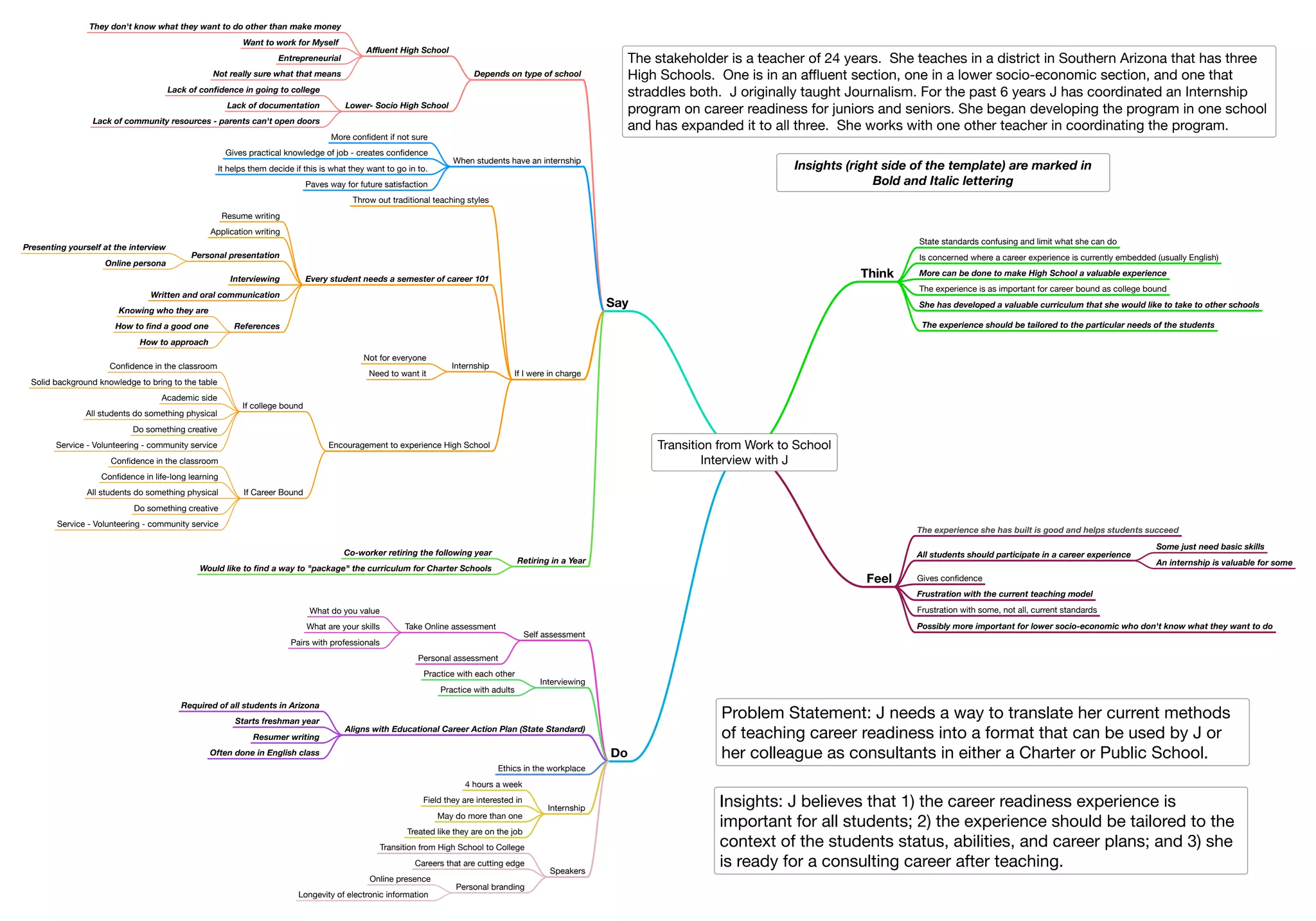
The stakeholder is a teacher of 24 years. She teaches in a district in Southern Arizona that has three
High Schools. One is in an affluent section, one in a lower socio-economic section, and one that
straddles both. J originally taught Journalism. For the past 6 years J has coordinated an Internship
program on career readiness for juniors and seniors. She began developing the program in one school
and has expanded it to all three. She works with one other teacher in coordinating the program.
Problem Statement: J needs a way to translate her current methods
of teaching career readiness into a format that can be used by J or
her colleague as consultants in either a Charter or Public School.
Insights: J believes that 1) the career readiness experience is
important for all students; 2) the experience should be tailored to the
context of the students status, abilities, and career plans; and 3) she
is ready for a consulting career after teaching.
The experience should be tailored to the particular needs of the students
Insights (right side of the template) are marked in
Bold and Italic lettering

Transition from work to school j

  • 1.
    Transition from Workto School Interview with J Say Depends on type of school Affluent High School They don't know what they want to do other than make money Want to work for Myself Entrepreneurial Not really sure what that means Lower- Socio High School Lack of confidence in going to college Lack of documentation Lack of community resources - parents can't open doors When students have an internship More confident if not sure Gives practical knowledge of job - creates confidence It helps them decide if this is what they want to go in to. Paves way for future satisfaction If I were in charge Throw out traditional teaching styles Every student needs a semester of career 101 Resume writing Application writing Personal presentation Presenting yourself at the interview Online persona Interviewing Written and oral communication References Knowing who they are How to find a good one How to approach Internship Not for everyone Need to want it Encouragement to experience High School If college bound Confidence in the classroom Solid background knowledge to bring to the table Academic side All students do something physical Do something creative Service - Volunteering - community service If Career Bound Confidence in the classroom Confidence in life-long learning All students do something physical Do something creative Service - Volunteering - community service Retiring in a Year Co-worker retiring the following year Would like to find a way to "package" the curriculum for Charter Schools Think State standards confusing and limit what she can do Is concerned where a career experience is currently embedded (usually English) More can be done to make High School a valuable experience The experience is as important for career bound as college bound She has developed a valuable curriculum that she would like to take to other schools Feel The experience she has built is good and helps students succeed All students should participate in a career experience Some just need basic skills An internship is valuable for some Gives confidence Frustration with the current teaching model Frustration with some, not all, current standards Possibly more important for lower socio-economic who don't know what they want to do Do Self assessment Take Online assessment What do you value What are your skills Pairs with professionals Personal assessment Interviewing Practice with each other Practice with adults Aligns with Educational Career Action Plan (State Standard) Required of all students in Arizona Starts freshman year Resumer writing Often done in English class Ethics in the workplace Internship 4 hours a week Field they are interested in May do more than one Treated like they are on the job Speakers Transition from High School to College Careers that are cutting edge Personal branding Online presence Longevity of electronic information The stakeholder is a teacher of 24 years. She teaches in a district in Southern Arizona that has three High Schools. One is in an affluent section, one in a lower socio-economic section, and one that straddles both. J originally taught Journalism. For the past 6 years J has coordinated an Internship program on career readiness for juniors and seniors. She began developing the program in one school and has expanded it to all three. She works with one other teacher in coordinating the program. Problem Statement: J needs a way to translate her current methods of teaching career readiness into a format that can be used by J or her colleague as consultants in either a Charter or Public School. Insights: J believes that 1) the career readiness experience is important for all students; 2) the experience should be tailored to the context of the students status, abilities, and career plans; and 3) she is ready for a consulting career after teaching. The experience should be tailored to the particular needs of the students Insights (right side of the template) are marked in Bold and Italic lettering