MINISTRY OF EDUCATION AND SCIENCE OF UKRAINE
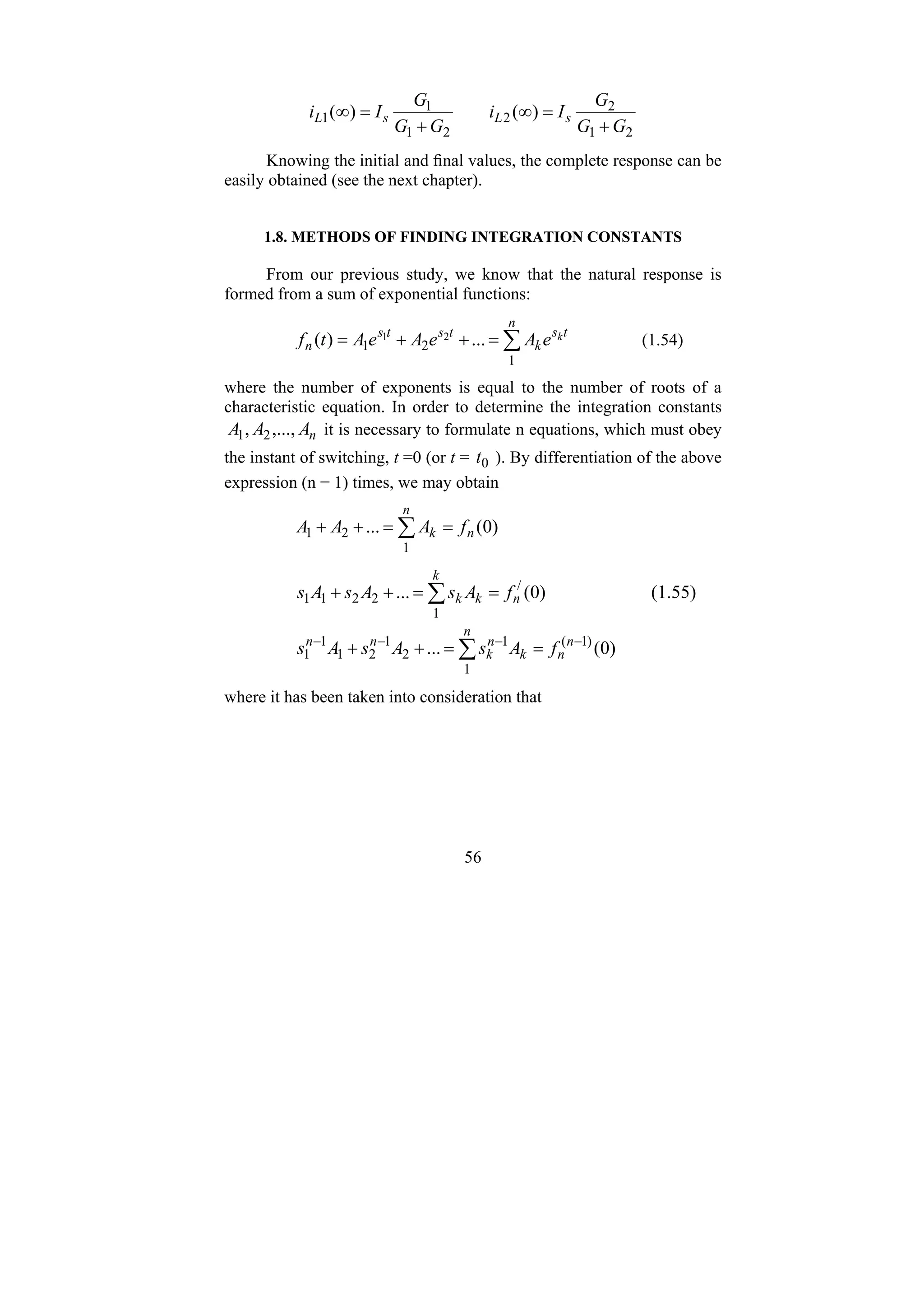
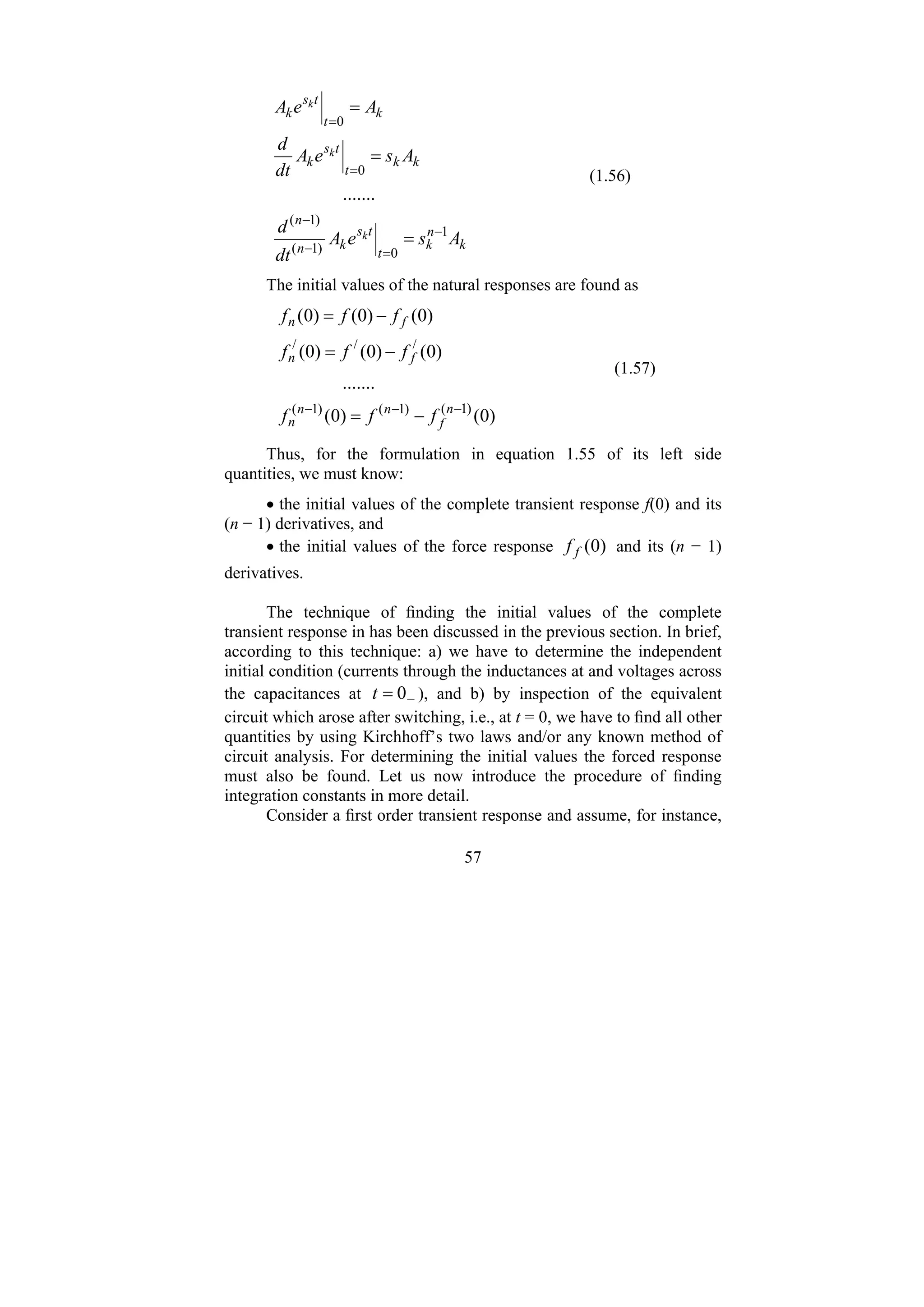
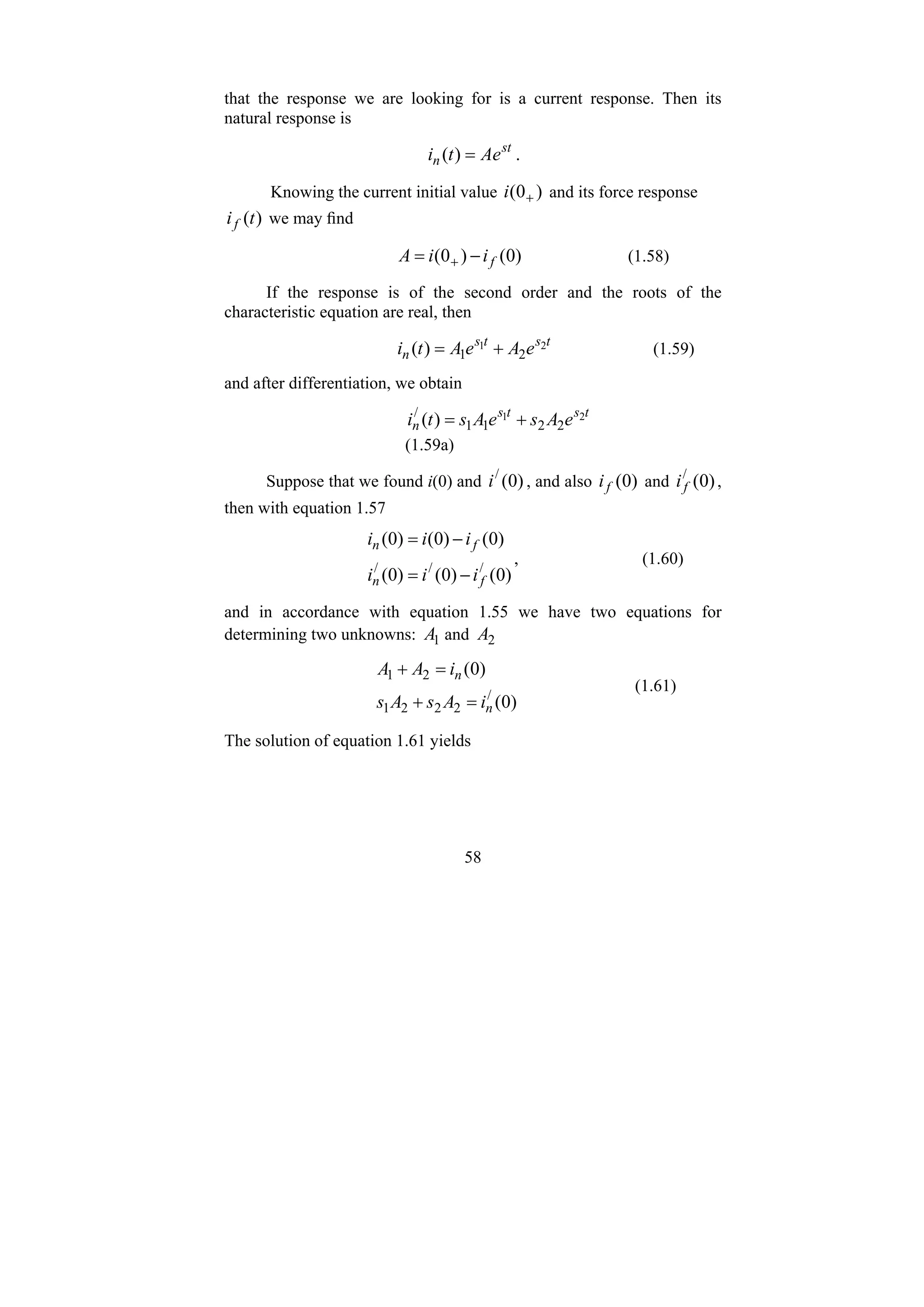
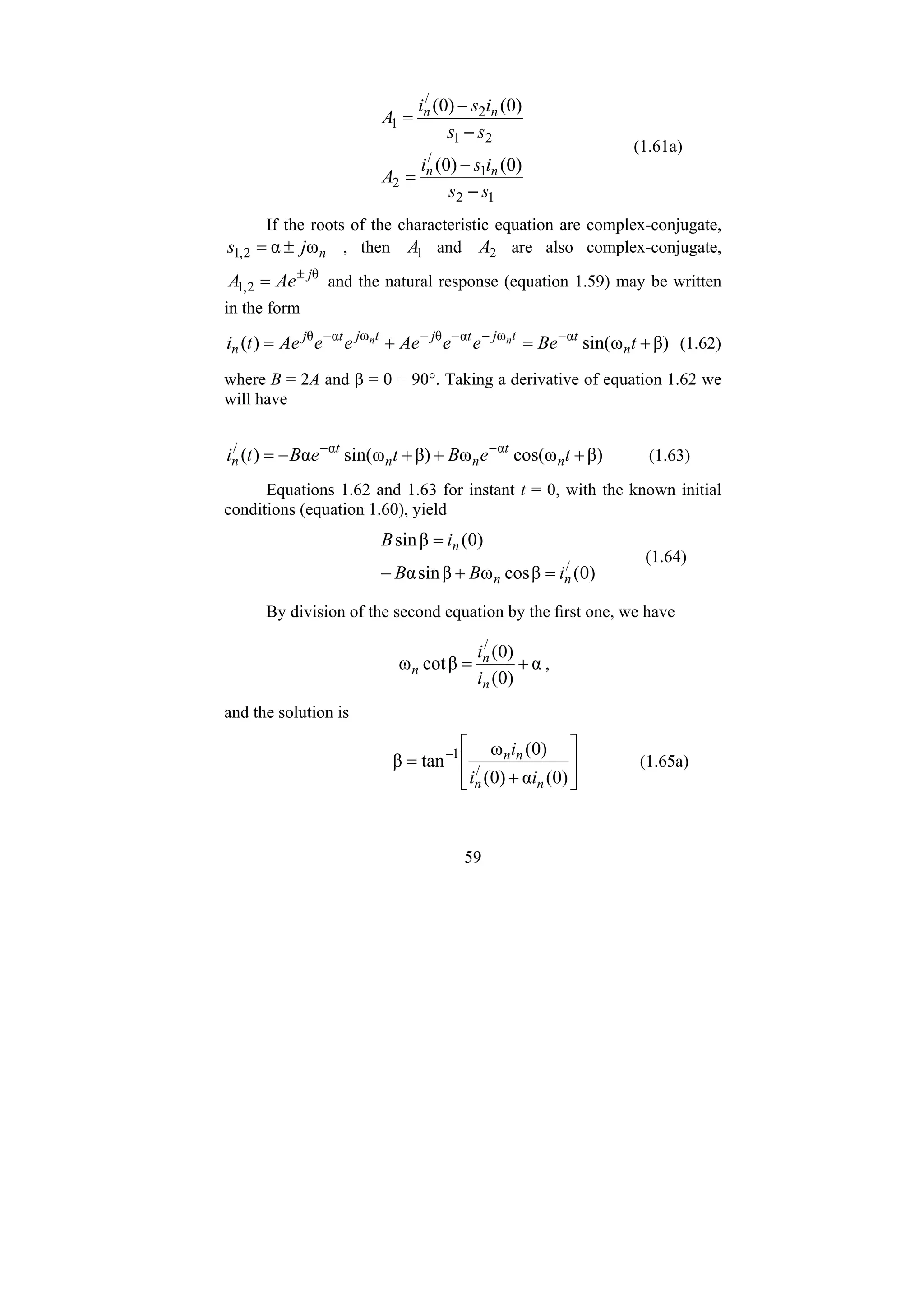
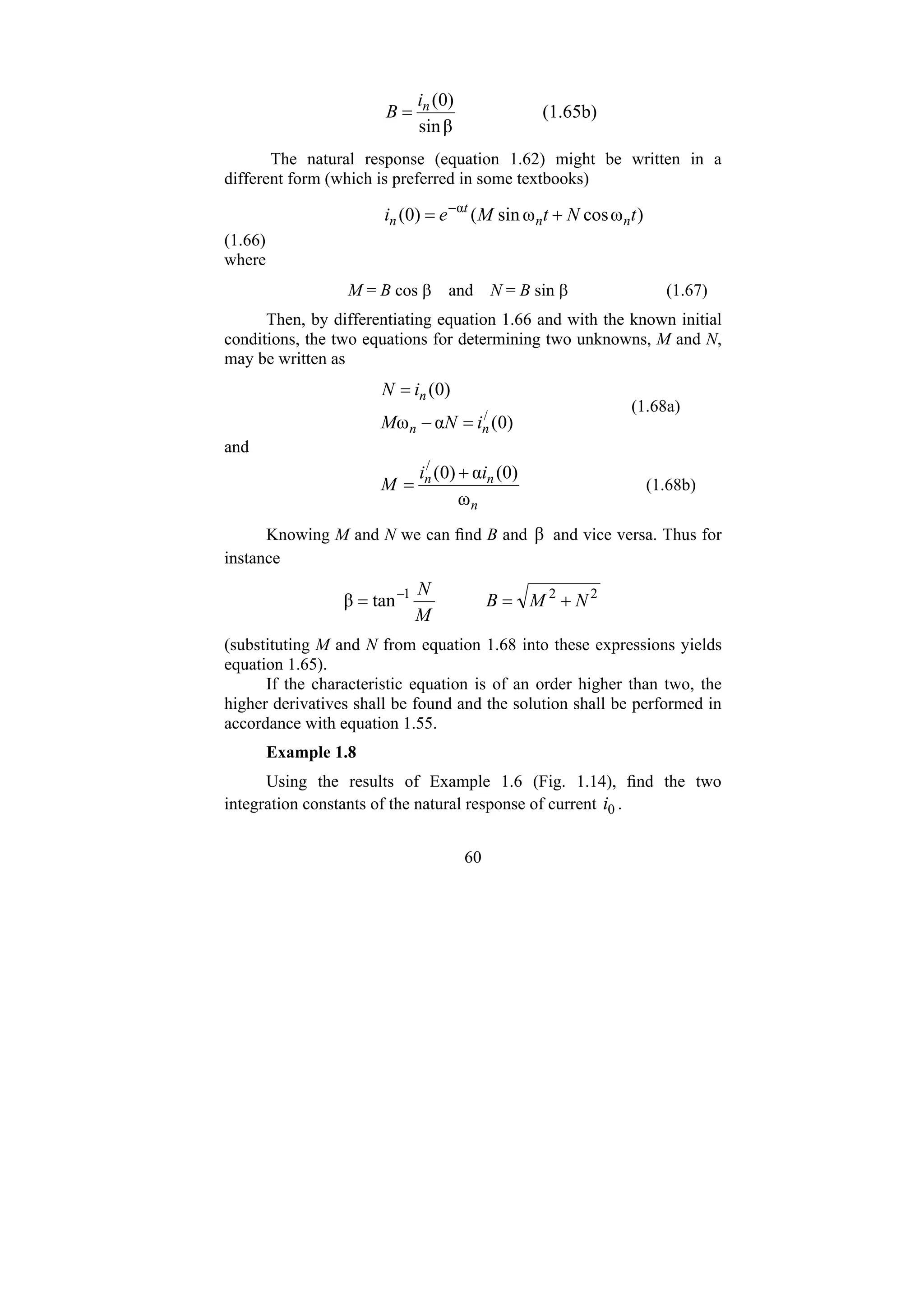
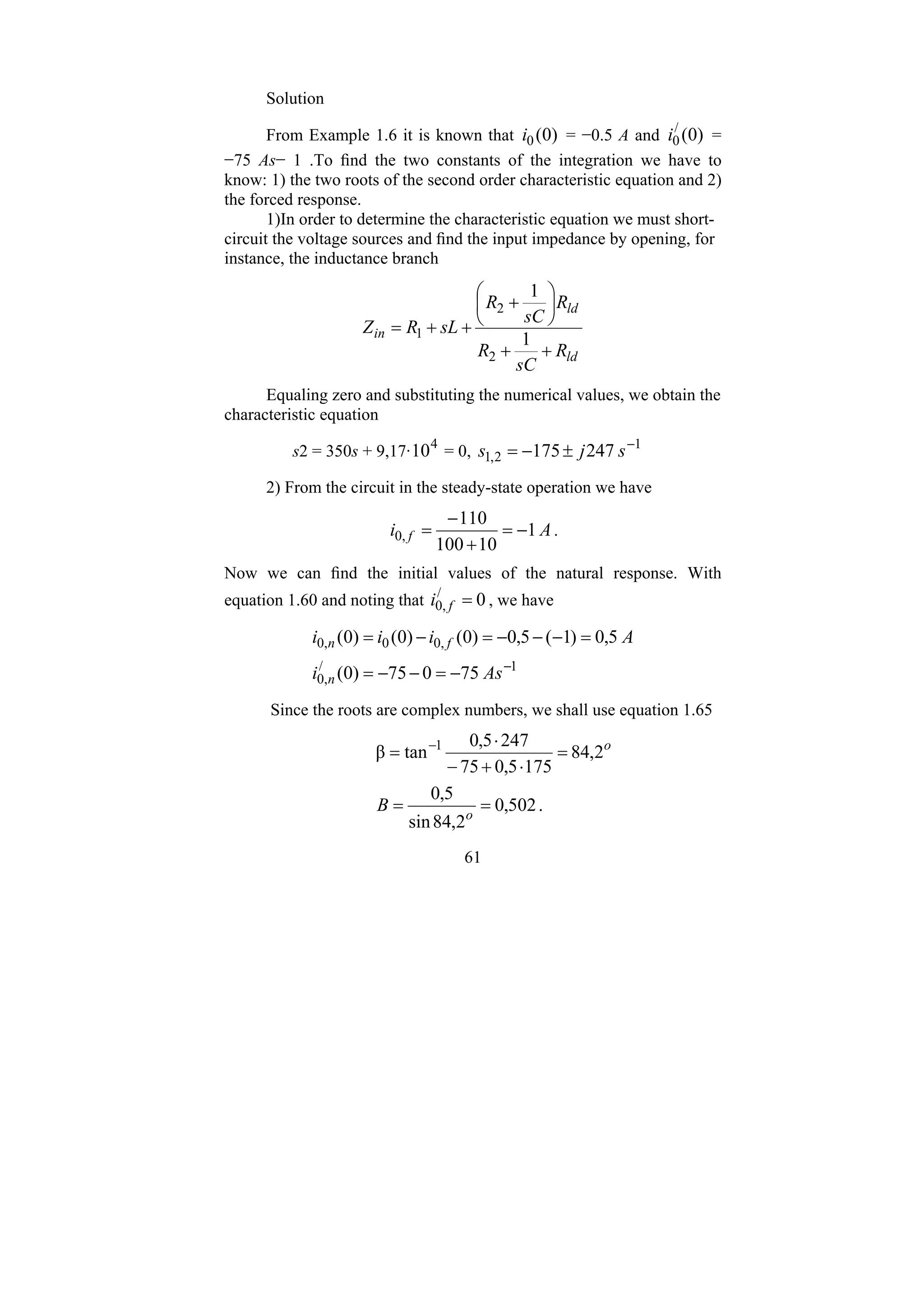
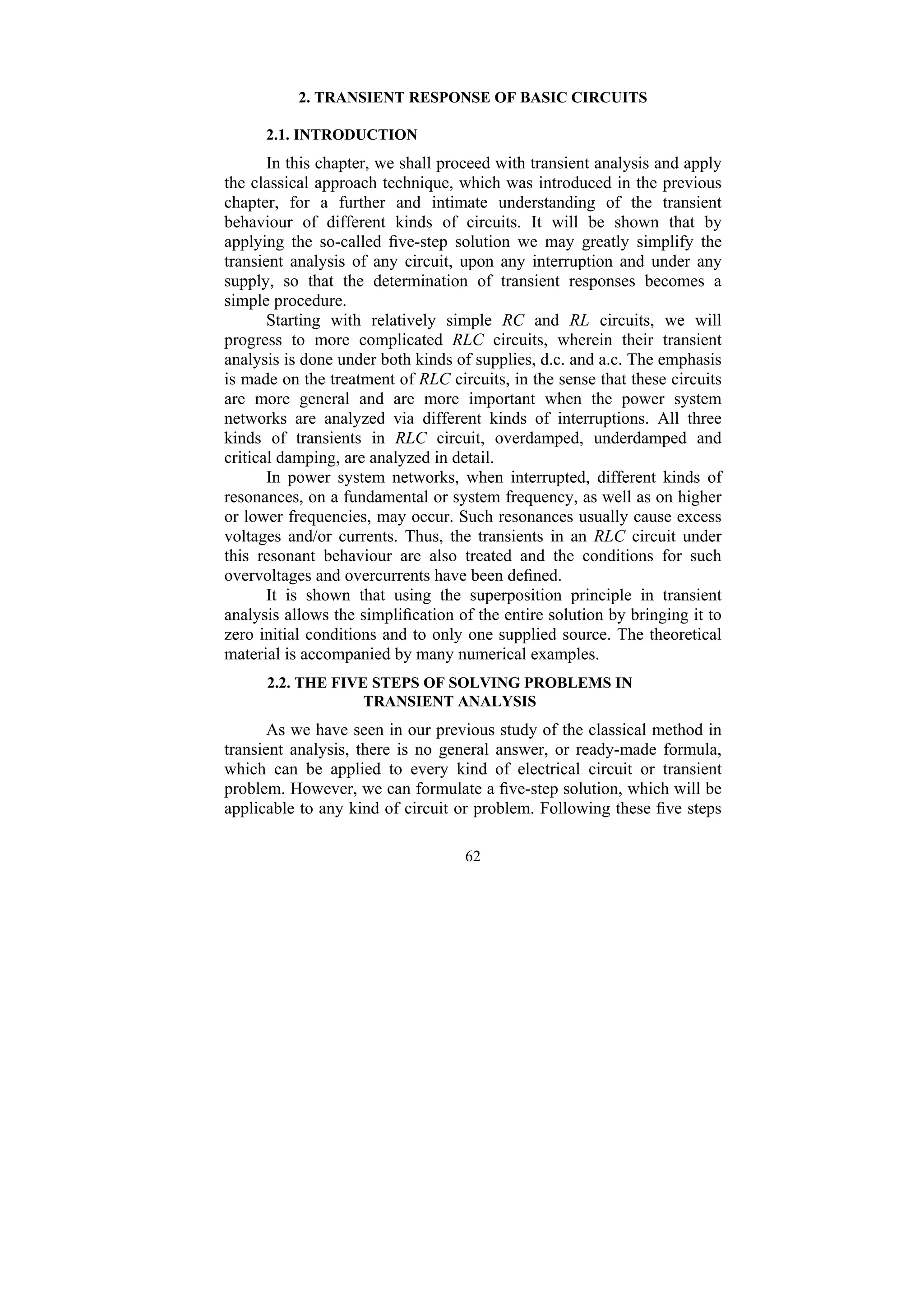
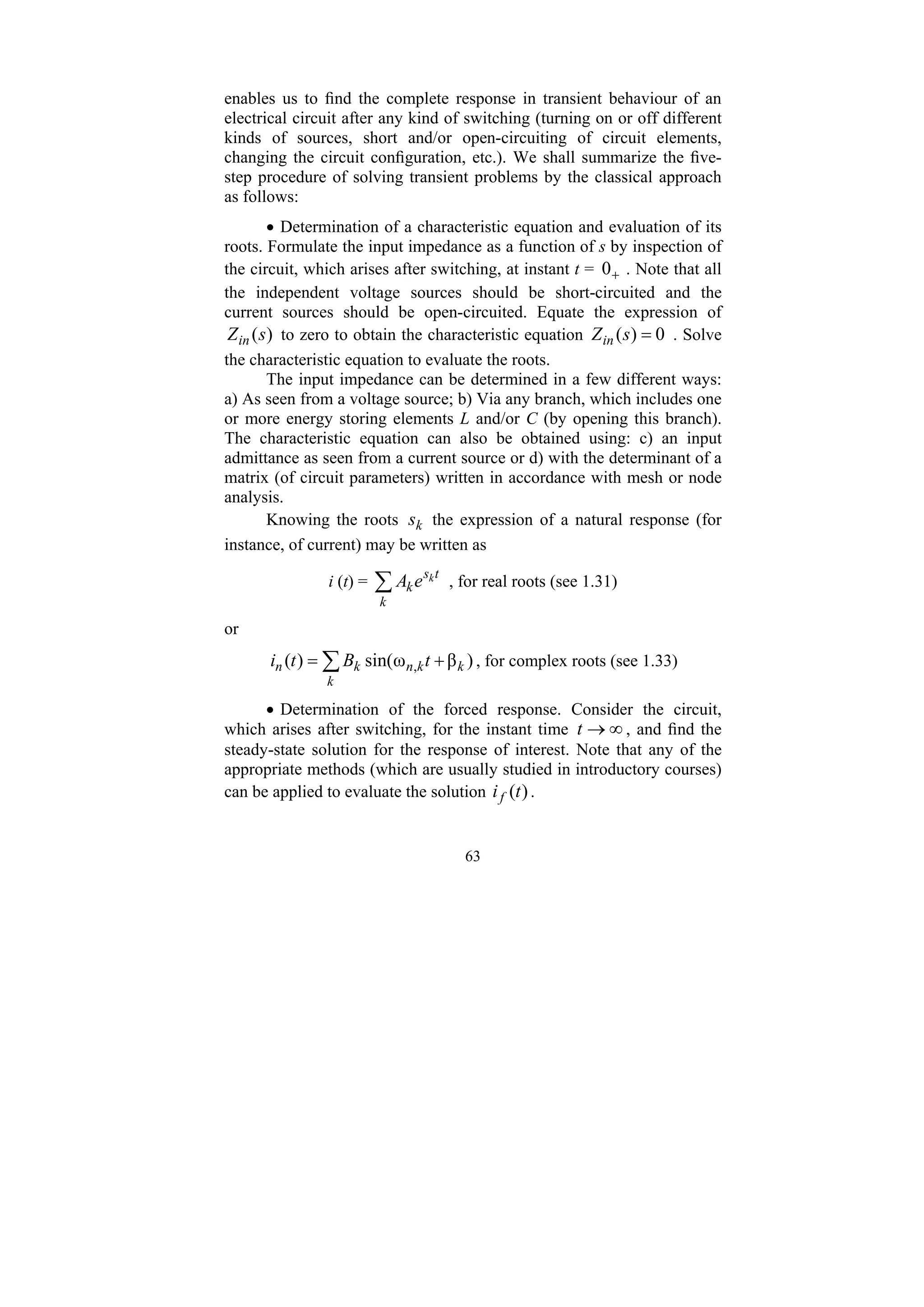
NATIONAL AVIATION UNIVERSITY
ELECTRICAL AND LIGHTING ENGINEERING
DEPARTMENT
A.A.ZELENKOV
TRANSIENT ANALYSIS OF ELECTRIC
POWER CIRCUITS
BY THE CLASSICAL METHOD
IN THE EXAMPLES
Training book
KYIV 2009
2
UDC 621.3(076)
Reviewer G.T.Gorohov – PhD, associate professor, Senior-scientific
worker of Ukraine Airforce scientific center.
Approved by the CSF drafting editorial board of Electronic and control
system institute, March 2009.
ZELENKOV A.A.
TRANSIENT ANALYSIS OF ELECTRIC POWER CIRCUITS BY THE
CLASSICAL METHOD IN THE EXAMPLES : Training book K.: NAU,
2009.- 154 p.
The manual “ TRANSIENT ANALYSIS OF ELECTRIC POWER CIRCUITS
BY THE CLASSICAL METHOD IN THE EXAMPLES” is intended for the students
of the senior courses of the electrical specialities, and those learning
automatic control theory.
The aim of this book is to help students to master the theory and
methods of solving problems in applied electricity. The book contains
typical problem solutions which give better insight into the theory and the
physical nature of various phenomena, suggest different approaches to the
problems, and illustrates the application of various theoretical principles.
The author has tried to follow a middle path between rigor and
completeness on one hand and application to practical situations on the
other.
The order in which the topics appear is that found mostly successful
in long experience of teaching the subject. Getting through the course
“ELECTRICAL ENGINEERING FUNDATION” the students may find this work
of assistance in preparing for the examination. The teachers may also find it
useful.
3
CONTENTS
PREFACE
CHAPTER 1. CLASSICAL APPROACH TO TRANSIENT
ANALYSIS
1.1. Introduction 6
1.2. Appearance of transients in electrical circuits 8
1.3. Differential equations describing electrical circuits 11
1.3.1. Exponential solution of a simple differential equation 14
1.4. Natural and forced responses 19
1.5. Characteristic equation and its determination 22
1.6. Roots of the characteristic equation and different kinds
of transient responses 29
1.6.1. First order characteristic equation 29
1.6.2. Second order characteristic equation 30
1.7. Independent and dependent initial conditions 34
1.7.1. Two switching laws (rules) 34
(a) First switching law (rule)
(b) Second switching law (rule)
1.7.2. Methods of finding independent initial conditions 37
1.7.3. Methods of finding dependent initial conditions 39
1.7.4. Generalized initial conditions 43
(a) Circuits containing capacitances
(b) Circuits containing inductances
4
1.8. Methods of finding integration constants 56
CHAPTER 2. TRANSIENT RESPONSE OF BASIC
CIRCUITS 62
2.1. Introduction 62
2.2. The five steps of solving problems in transient analysis 62
2.3. RL circuits 65
2.3.1. RL circuits under d.c. supply 65
2.3.2. RL circuits under a.c. supply 77
2.4. RC circuits 87
2.4.1. Discharging and charging a capacitor………………. 87
2.4.2. RC circuits under d.c. supply……………………….. 89
2.4.3. RC circuits under a.c. supply……………………….. 96
2.5. RLC circuits………………………………………………...104
2.5.1. RLC circuits under d.c. supply……………………….104
(a) Series connected RLC circuits
(b) Parallel connected RLC circuits
(c) Natural response by two nonzero initial conditions
2.5.2. RLC circuits under a.c. supply………………………131
2.5.3. Transients in RLC resonant circuits………………… 136
(a) Switching on a resonant RLC circuit
to an a.c. source
(b) Resonance at the fundamental (first) harmonic
(c) Frequency deviation in resonant circuits
2.5.4. Switching off in RLC circuits……………………….. 144
(a) Interruptions in a resonant circuit fed
from an a.c. source
5
PREFACE
Most of the textbooks on electrical and electronic engineering only
partially cover the topic of transients in simple RL , RC and RLC circuits
and the study of this topic is primarily done from an electronic engineer’s
viewpoint, i.e., with an emphasis on low-current systems, rather than from
an electrical engineer’s viewpoint, whose interest lies in high-current, high-
voltage power systems. In such systems a very clear differentiation between
steady-state and transient behaviour of circuits is made. Such a division is
based on the concept that steady-state behaviour is normal and transients
arise from the faults. The operation of most electronic circuits (such as
oscillators, switch capacitors, rectifiers, resonant circuits etc.) is based on
their transient behaviour, and therefore the transients here can be referred to
as ‘‘desirable’’. The transients in power systems are characterized as
completely ‘‘undesirable’’ and should be avoided; and subsequently, when
they do occur, in some very critical situations, they may result in the
electrical failure of large power systems and outages of big areas. Hence,
the Institute of Electrical and Electronic Engineers (IEEE) has recently paid
enormous attention to the importance of power engineering education in
general, and transient analysis in particular.
It is with the belief that transient analysis of power systems is one of
the most important topics in power engineering analysis that the author
proudly presents this book, which is wholly dedicated to this topic.
Of course, there are many good books in this field, some of which are
listed in the book; however they are written on a specific technical level or
on a high theoretical level and are intended for top specialists. On the other
hand, introductory courses, as was already mentioned, only give a
superfical knowledge of transient analysis. So that there is a gap between
introductory courses and the above books.
The present book is designed to fill this gap. It covers the topic of
transient analysis from simple to complicated, and being on an intermediate
level, this book therefore is a link between introductory courses and more
specific technical books. The appropriate level and the concentration of all
the topic sunder one cover make this book very special in the field under
consideration. The author believes that this book will be very helpful for all
those specializing in electrical engineering and power systems. It is
recommended as a textbook for specialized under graduate and graduate
curriculum, and can also be used for master and doctoral studies. Engineers
6
in the field may also find this book useful as a handbook and / or resource
book that can be kept handy to review specific points. Theoreticians /
researchers who are looking for the mathematical background of transients
in electric circuits may also find this book helpful in their work.
The presentation of the covered material is geared to readers who are
being exposed to (a) the basic concept of electric circuits based on their
earlier study of physics and / or introductory courses in circuit analysis, and
(b) basic mathematics, including differentiation and integration techniques
This book is composed of two chapters. The study of transients, as
mentioned, is presented from simple to complicated. Chapters 1 and 2 are
dedicated to the classical method of transient analysis, which is traditional
for many introductory courses. However, these two chapters cover much
more material giving the mathematical as well as the physical view of
transient behaviour of electrical circuits. So-called incorrect initial
conditions and two generalized commutation laws, which are important for
a better understanding of the transient behaviour of transformers and
synchronous machines, are also discussed in Chapter 2.
CHAPTER 1. CLASSICAL APPROACH TO
TRANSIENT ANALYSIS
1.1. INTRODUCTION
Transient analysis(or just transients) of electrical circuits is as
important as steady-state analysis. When transients occur, the currents and
voltages in some parts of the circuit may many times exceed those that exist
in normal behaviour and may destroy the circuit equipment in its proper
operation. We may distinguish the transient behaviour of an electrical
circuit from its steady-state, in that during the transients all the quantities,
such as currents, voltages, power and energy, are changed in time, while in
steady-state they remain invariant, i.e. constant (in d.c. operation) or
periodical (in a.c. operation) having constant amplitudes and phase angles.
The cause of transients is any kind of changing in circuit parameters
and/or in circuit configuration, which usually occur as a result of switching
(commutation), short, and/or open circuiting, change in the operation of
sources etc. The changes of currents, voltages etc. during the transients are
not instantaneous and take some time, even though they are extremely fast
with a duration of milliseconds or even microseconds. These very fast
changes, however, cannot be instantaneous (or abrupt) since the transient
7
processes are attained by the interchange of energy, which is usually stored
in the magnetic field of inductances or/and the electrical field of
capacitances. Any change in energy cannot be abrupt otherwise it will
result in infinite power (as the power is a derivative of energy,
dt
dw
p = ),
which is in contrast to physical reality. All transient changes, which are
also called transient responses (or just responses), vanish and, after their
disappearance, a new steady-state operation is established. In this respect,
we may say that the transient describes the circuit behaviour between two
steady-states: an old one, which was prior to changes, and a new one,
which arises after the changes.
A few methods of transient analysis are known: the classical method,
The Cauchy-Heaviside (C-H) operational method, the Fourier
transformation method and the Laplace transformation method. The C-H
operational or symbolic (formal) method is based on replacing a derivative
by symbol ⎟
⎟
⎠
⎞
⎜
⎜
⎝
⎛
↔
⎟
⎠
⎞
⎜
⎝
⎛
s
dt
d
s and an integral by
∫ ↔
s
dt
1
Although these operations are also used in the Laplace transform
method, the C-H operational method is not as systematic and as rigorous as
the Laplace transform method, and therefore it has been abandoned in
favour of the Laplace method. The two transformation methods, Laplace
and Fourier, will be studied in the following chapters. Comparing the
classical method and the transformation method it should be noted that the
latter requires more knowledge of mathematics and is less related to the
physical matter of transient behaviour of electric circuits than the former.
This chapter is concerned with the classical method of transient
analysis. This method is based on the determination of differential
equations and splitting the solution into two components: natural and
forced responses. The classical method is fairly complicated
mathematically, but is simple in engineering practice. Thus, in our present
study we will apply some known methods of steady-state analysis, which
will allow us to simplify the classical approach of transient analysis.
8
1.2. APPEARANCE OF TRANSIENTS IN ELECTRICAL
CIRCUITS
In the analysis of an electrical system (as in any physical system), we
must distinguish between the stationary operation or steady-state and the
dynamical operation or transient-state.
An electrical system is said to be in steady-state when the variables
describing its behaviour (voltages, currents, etc.) are either invariant with
time (d.c. circuits) or are periodic functions of time (a.c. circuits). An
electrical system is said to be in transient-state when the variables are
changed non-periodically, i.e., when the system is not in steady-state. The
transient-state vanishes with time and a new steady-state regime appears.
Hence, we can say that the transient-state, or just transients, is usually the
transmission state from one steady-state to another.
The parameters L and C are characterized by their ability to store
energy:
magnetic energy
2
2
1
ψ
2
1
Li
i
wL =
=
in the magnetic field and electric energy
2
2
1
2
1
Cv
qv
wC =
=
in the electric field of the circuit. The voltage and current sources are the
elements through which the energy is supplied to the circuit. Thus, it may
be said that an electrical circuit, as a physical system, is characterized by
certain energy conditions in its steady-state behaviour. Under steady-state
conditions the energy stored in the various inductances and capacitances,
and supplied by the sources in a d.c. circuit, are constant; whereas in an a.c.
circuit the energy is being changed (transferred between the magnetic and
electric fields and supplied by sources) periodically.
When any sudden change occurs in a circuit, there is usually a
redistribution of energy between L -s and C-s, and a change in the energy
status of the sources, which is required by the new conditions. These
energy distributions cannot take place instantaneously, but during some
9
period of time, which brings about the transient-state.
The main reason for this statement is that an instantaneous change of
energy would require infinite power, which is associated with
inductors/capacitors. As previously mentioned, power is a derivative of
energy and any abrupt change in energy will result in an infinite power.
Since infinite power is not realizable in physical systems, the energy cannot
change abruptly, but only within some period of time in which transients
occur. Thus, from a physical point of view it may be said that the transient-
state exists in physical systems while the energy conditions of one steady-
state are being changed to those of another.
Our next conclusion is about the current and voltage. To change
magnetic energy requires a change of current through inductances.
Therefore, currents in inductive circuits, or inductive branches of the
circuit, cannot change abruptly. From another point of view, the change of
current in an inductor brings about the induced voltage of magnitude
dt
di
L
.An instantaneous change of current would therefore require an infinite
voltage, which is also unrealizable in practice. Since the induced voltage is
also given as
dt
dψ
, where ψ is a magnetic flux, the magnetic flux of a
circuit cannot suddenly change.
Similarly, we may conclude that to change the electric energy
requires a change in voltage across a capacitor, which is given by
C
q
v = ,
where q is the charge. Therefore, neither the voltage across a capacitor nor
its charge can be abruptly changed. In addition, the rate of voltage change
is
C
i
dt
dq
C
dt
dv
=
=
1
, and the instantaneous change of voltage brings about
infinite current, which is also unrealizable in practice. Therefore, we may
summarize that any change in an electrical circuit, which brings about a
change in energy distribution, will result in a transient-state.
In other words, by any switching, interrupting, short-circuiting as well as
any rapid changes in the structure of an electric circuit, the transient
phenomena will occur. Generally speaking, every change of state leads to a
temporary deviation from one regular, steady-state performance of the
circuit to another one. The redistribution of energy, following the above
10
changes, i.e., the transient-state, theoretically takes infinite time. However,
in reality the transient behaviour of an electrical circuit continues a
relatively very short period of time, after which the voltages and currents
almost achieve their new steady-state values.
The change in the energy distribution during the transient behaviour
of electrical circuits is governed by the principle of energy conservation,
i.e., the amount of supplied energy is equal to the amount of stored energy
plus the energy dissipation. The rate of energy dissipation affects the time
interval of the transients. The higher the energy dissipation, the shorter is
the transient-state. Energy dissipation occurs in circuit resistances and its
storage takes place in inductances and capacitances. In circuits, which
consist of only resistances, and neither inductances nor capacitances, the
transient-state will not occur at all and the change from one steady-state to
another will take place instantaneously. However, since even resistive
circuits contain some inductances and capacitances the transients will
practically appear also in such circuits; but these transients are very short
and not significant, so that they are usually neglected.
Transients in electrical circuits can be recognized as either desirable
or undesirable. In power system networks, the transient phenomena are
wholly undesirable as they may bring about an increase in the magnitude of
the voltages and currents and in the density of the energy in some or in
most parts of modern power systems. All of this might result in equipment
distortion, thermal and/or electrodynamics’ destruction, system stability
interference and in extreme cases an outage of the whole system.
In contrast to these unwanted transients, there are desirable and
controlled transients, which exist in a great variety of electronic equipment
in communication, control and computation systems whose normal
operation is based on switching processes.
The transient phenomena occur in electric systems either by
intentional switching processes consisting of the correct manipulation of
the controlling apparatus, or by unintentional processes, which may arise
from ground faults, short-circuits, a break of conductors and/or insulators,
lightning strokes (particularly in high voltage and long distance systems)
and similar inadvertent processes.
As was mentioned previously, there are a few methods of solving
transient problems. The most widely known of these appears in all
introductory textbooks and is used for solving simpler problems. It is called
the classical method. Other useful methods are Laplace and Fourier
11
transformation methods. These two methods are more general and are used
for solving problems that are more complicated.
1.3. DIFFERENTIAL EQUATIONS DESCRIBING
ELECTRICAL CIRCUITS
Circuit analysis, as a physical system, is completely described by
integrodifferential equations written for voltages and/or currents, which
characterize circuit behaviour. For linear circuits these equations are called
linear differential equations with constant coefficients, i.e. in which every
term is of the first degree in the dependent variable or one of its derivatives.
Thus, for example, for the circuit of three basic elements: R, L and C
connected in series and driven by a voltage source v(t), Fig.1.1, we may
apply Kirchhoff’s voltage law
)
(t
v
v
v
v C
L
R =
+
+ ,
in which
,
∫
=
=
=
idt
v
dt
di
L
v
Ri
v
C
L
R
and then we have
∫ =
+
+ )
(
1
t
v
idt
C
Ri
dt
di
L . (1.1)
v( t)
R L
C
i(t)
Fig.1.1
After the differentiation of both sides of equation 1.1 with respect to
time, the result is a second order differential equation
12
dt
dv
i
c
dt
di
R
dt
i
d
L =
+
+
1
2
2
(1.2)
The same results may be obtained by writing two simultaneous first
order differential equations for two unknowns, i and C
v :
i
C
dt
dvC 1
= (1.3a)
)
(t
v
v
dt
di
L
Ri C =
+
+ . (1.3b)
After differentiation of equation 1.3b and substituting
dt
dvC
by
equation 1.3a, we obtain the same (as equation 1.2) second order singular
equation. The solution of differential equations can be completed only if the
initial conditions are specified. It is obvious that in the same circuit under
the same commutation, but with different initial conditions, its transient
response will be different. For more complicated circuits, built from a
number of loops (nodes), we will have a set of differential equations, which
should be written in accordance with Kirchhoff ’s two laws or with nodal
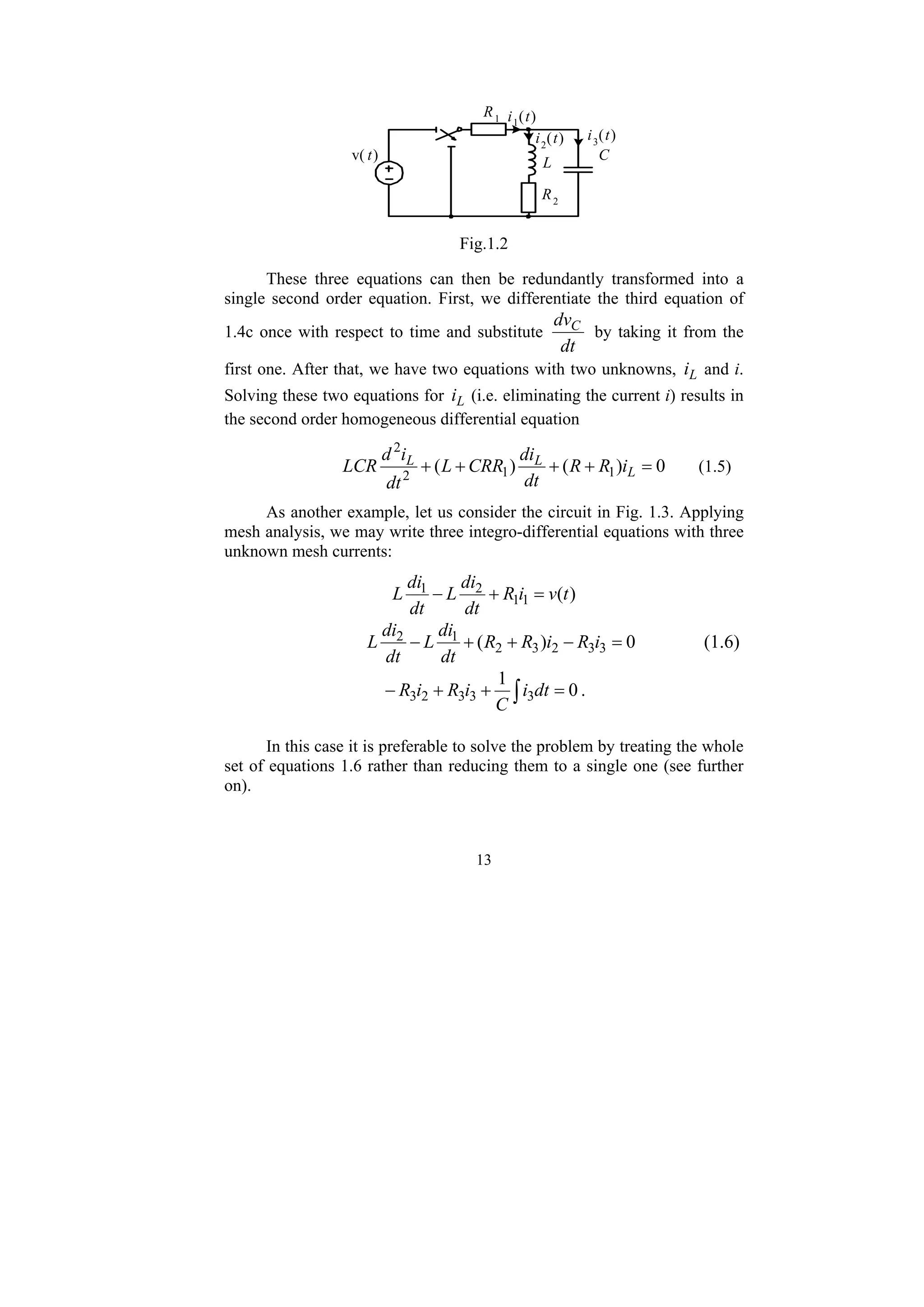
and/or mesh analysis. For example, considering the circuit shown in Fig.
1.2, after switching, we will have a circuit, which consists of two loops and
two nodes. By applying Kirchhoff’s two laws, we may write three equations
with three unknowns, i, L
i and C
v ,
0
=
−
+ i
i
dt
dv
C L
C
(1.4a)
0
1 =
+
+ Ri
i
R
dt
di
L L
L
(1.4b)
0
1 =
−
+ C
L
L
v
i
R
dt
di
L (1.4c)
13
R1
v( t) C
R2
L
i1(t)
i2
(t) i3
(t)
Fig.1.2
These three equations can then be redundantly transformed into a
single second order equation. First, we differentiate the third equation of
1.4c once with respect to time and substitute
dt
dvC
by taking it from the
first one. After that, we have two equations with two unknowns, L
i and i.
Solving these two equations for L
i (i.e. eliminating the current i) results in
the second order homogeneous differential equation
0
)
(
)
( 1
1
2
2
=
+
+
+
+ L
L
L
i
R
R
dt
di
CRR
L
dt
i
d
LCR (1.5)
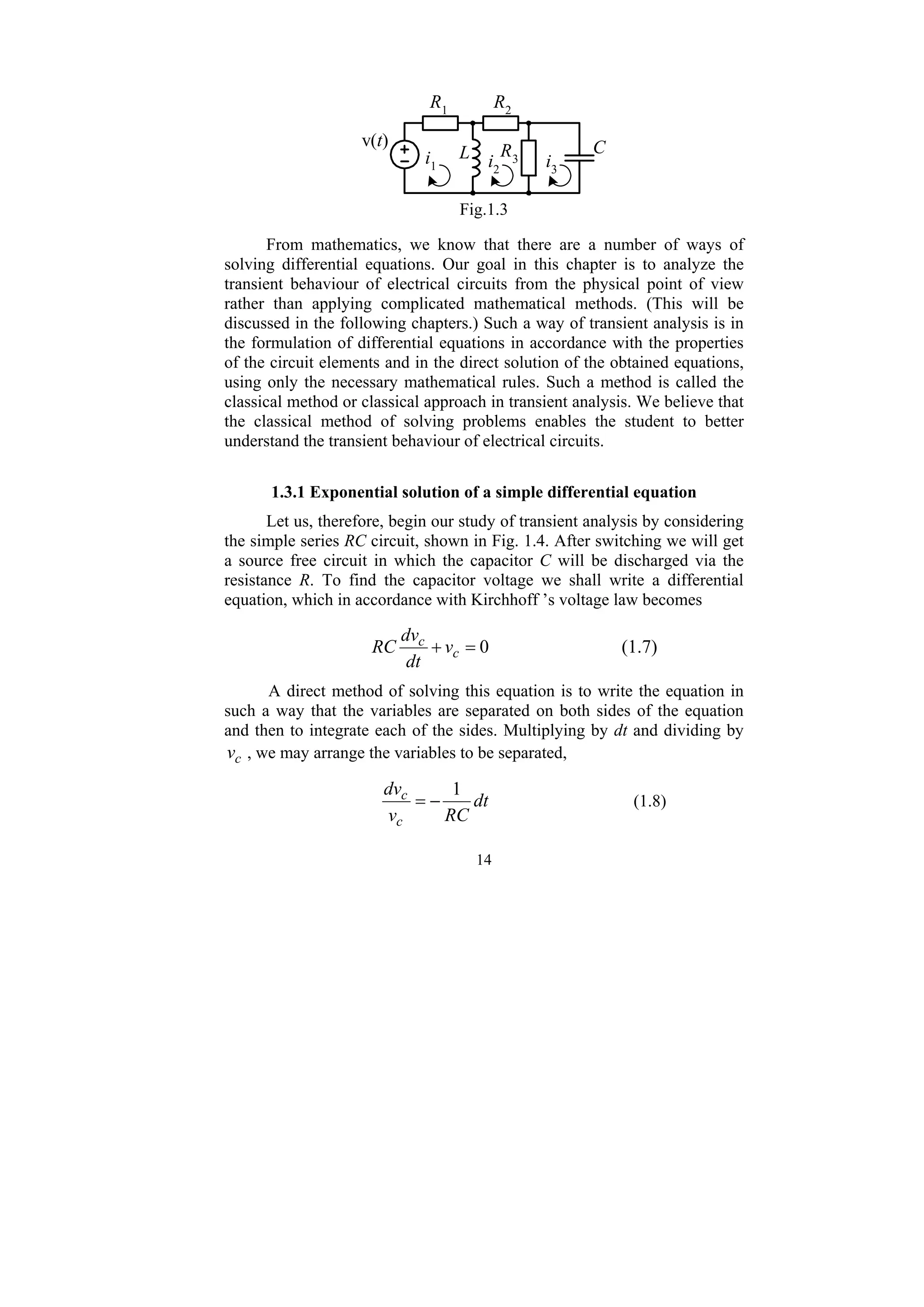
As another example, let us consider the circuit in Fig. 1.3. Applying
mesh analysis, we may write three integro-differential equations with three
unknown mesh currents:
)
(
1
1
2
1
t
v
i
R
dt
di
L
dt
di
L =
+
−
0
)
( 3
3
2
3
2
1
2
=
−
+
+
− i
R
i
R
R
dt
di
L
dt
di
L (1.6)
∫ =
+
+
− 0
1
3
3
3
2
3 dt
i
C
i
R
i
R .
In this case it is preferable to solve the problem by treating the whole
set of equations 1.6 rather than reducing them to a single one (see further
on).
14
v(t)
R2
L C
R1
R3
i1 i2
i3
Fig.1.3
From mathematics, we know that there are a number of ways of
solving differential equations. Our goal in this chapter is to analyze the
transient behaviour of electrical circuits from the physical point of view
rather than applying complicated mathematical methods. (This will be
discussed in the following chapters.) Such a way of transient analysis is in
the formulation of differential equations in accordance with the properties
of the circuit elements and in the direct solution of the obtained equations,
using only the necessary mathematical rules. Such a method is called the
classical method or classical approach in transient analysis. We believe that
the classical method of solving problems enables the student to better
understand the transient behaviour of electrical circuits.
1.3.1 Exponential solution of a simple differential equation
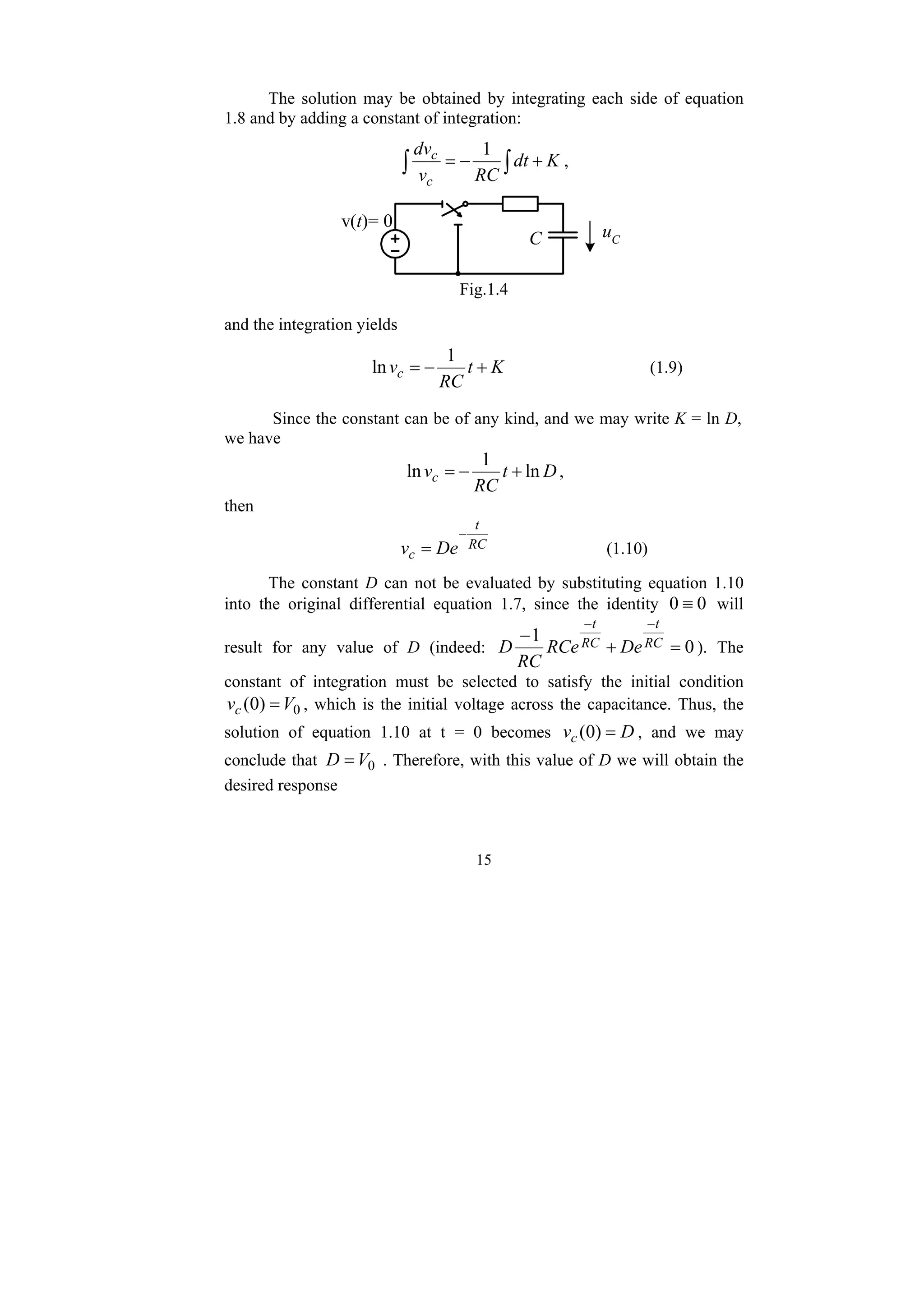
Let us, therefore, begin our study of transient analysis by considering
the simple series RC circuit, shown in Fig. 1.4. After switching we will get
a source free circuit in which the capacitor C will be discharged via the
resistance R. To find the capacitor voltage we shall write a differential
equation, which in accordance with Kirchhoff ’s voltage law becomes
0
=
+ c
c
v
dt
dv
RC (1.7)
A direct method of solving this equation is to write the equation in
such a way that the variables are separated on both sides of the equation
and then to integrate each of the sides. Multiplying by dt and dividing by
c
v , we may arrange the variables to be separated,
dt
RC
v
dv
c
c 1
−
= (1.8)
15
The solution may be obtained by integrating each side of equation
1.8 and by adding a constant of integration:
∫ ∫ +
−
= K
dt
RC
v
dv
c
c 1
,
v(t)= 0
C uC
Fig.1.4
and the integration yields
K
t
RC
vc +
−
=
1
ln (1.9)
Since the constant can be of any kind, and we may write K = ln D,
we have
D
t
RC
vc ln
1
ln +
−
= ,
then
RC
t
c De
v
−
= (1.10)
The constant D can not be evaluated by substituting equation 1.10
into the original differential equation 1.7, since the identity 0
0 ≡ will
result for any value of D (indeed: 0
1
=
+
−
−
−
RC
t
RC
t
De
RCe
RC
D ). The
constant of integration must be selected to satisfy the initial condition
0
)
0
( V
vc = , which is the initial voltage across the capacitance. Thus, the
solution of equation 1.10 at t = 0 becomes D
vc =
)
0
( , and we may
conclude that 0
V
D = . Therefore, with this value of D we will obtain the
desired response
16
RC
t
c e
V
t
v
−
= 0
)
( (1.11)
We shall consider the nature of this response. At zero time, the
voltage is the assumed value 0
V and, as time increases, the voltage
decreases and approaches zero, following the physical rule that any
condenser shall finally be discharged and its final voltage therefore reduces
to zero.
Let us now find the time that would be required for the voltage to
drop to zero if it continued to drop linearly at its initial rate. This value of
time, usually designated by t, is called the time constant. The value of t can
be found with the derivative of )
(t
vc at zero time, which is proportional to
the angle c between the tangent to the voltage curve at t = 0, and the t-axis,
i.e.,
RC
V
e
V
dt
d
t
RC
t
0
0
0
−
=
⎟
⎟
⎠
⎞
⎜
⎜
⎝
⎛
=
−
or
τ = RC
and equation 1.11 might be written in the form
τ
0
)
(
t
c e
V
t
v
−
= (1.12)
The units of the time constant are seconds ([τ] = [R][C] = Ω·F), so
that the exponent t/RC is dimensionless, as it is supposed to be.
Another interpretation of the time constant is obtained from the fact
that in the time interval of one time constant the voltage drops relatively to
its initial value, to the reciprocal of e; indeed, at t = τ we have
%)
8
,
36
(
368
,
0
1
0
=
= −
e
V
vc
. At the end of the 5t interval the voltage is less
than one percent of its initial value. Thus, it is usual to presume that in the
time interval of three to five time constants, the transient response declines
to zero or, in other words, we may say that the duration of the transient
17
response is about five time constants. Note again that, precisely speaking,
the transient response declines to zero in infinite time, since 0
→
−t
e ,
when ∞
→
t .
Before we continue our discussion of a more general analysis of
transient circuits, let us check the power and energy relationships during
the period of transient response. The power being dissipated in the resistor
R, or its reciprocal G, is
RC
t
c
R e
GV
Gv
p
2
2
0
2
−
=
= , (1.13)
and the total dissipated energy (turned into heat) is found by integrating
equation 1.13 from zero time to infinite time
∫ ∫
∞ ∞
∞
−
−
=
−
=
=
=
0 0
2
0
0
2
2
0
2
0
2
1
2
CV
e
RC
G
V
e
G
V
dt
p
w RC
t
RC
t
R
R .
This is actually the energy being stored in the capacitor at the
beginning of the transient. This result means that all the initial energy,
stored in the capacitor, dissipates in the circuit resistances during the
transient period.
Example 1.1
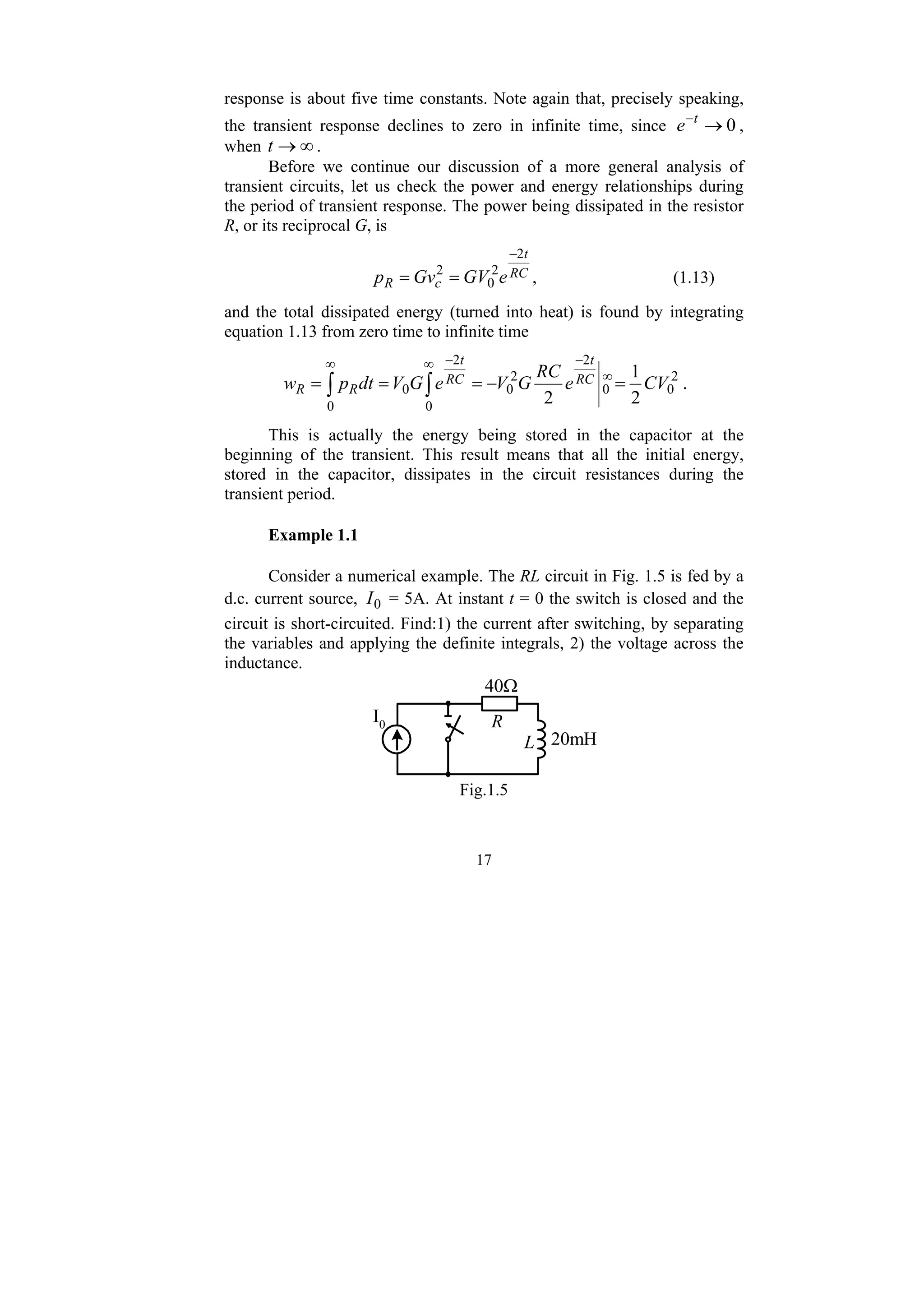
Consider a numerical example. The RL circuit in Fig. 1.5 is fed by a
d.c. current source, 0
I = 5A. At instant t = 0 the switch is closed and the
circuit is short-circuited. Find:1) the current after switching, by separating
the variables and applying the definite integrals, 2) the voltage across the
inductance.
40Ω
20mH
L
R
I0
Fig.1.5
18
Solution
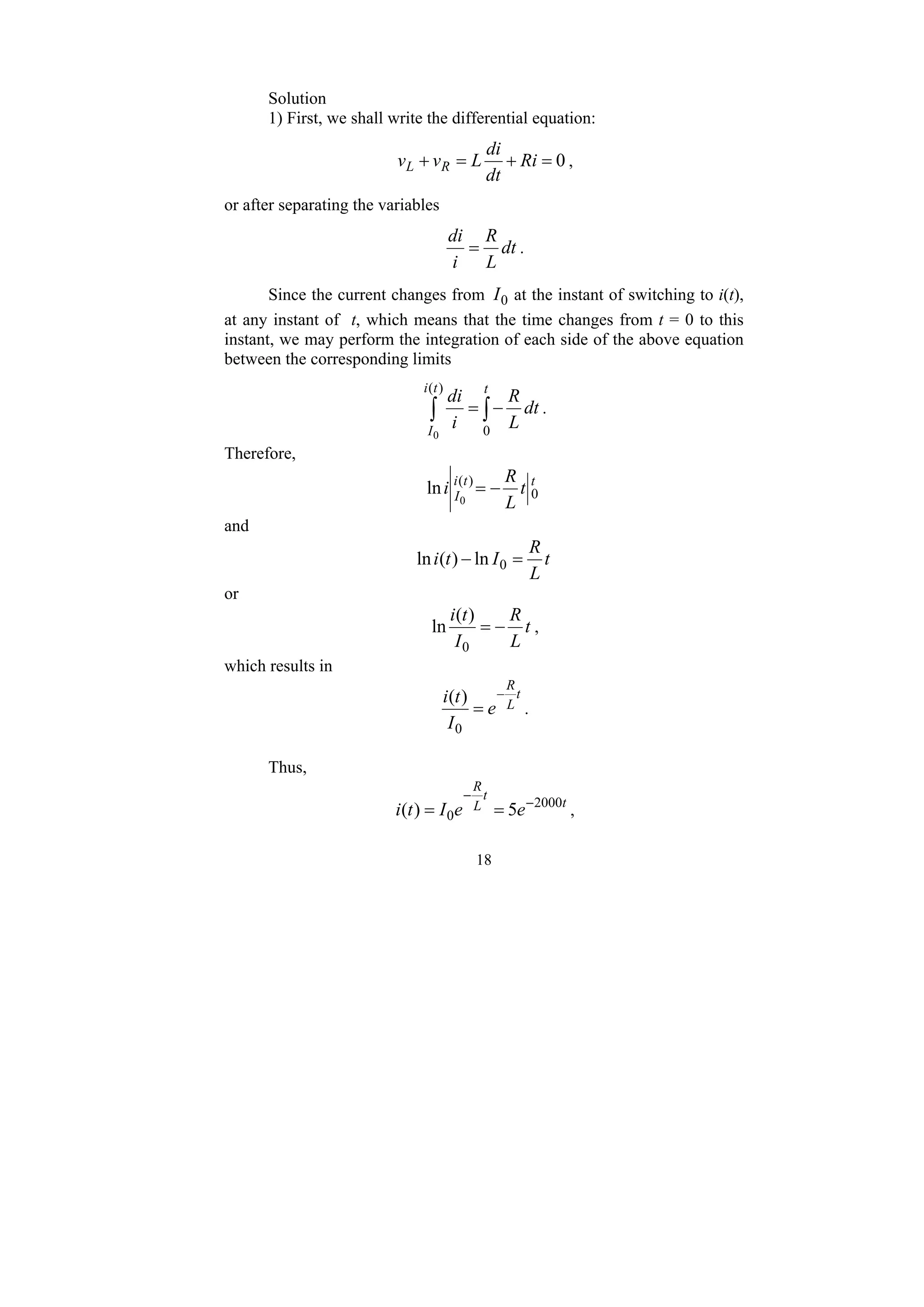
1) First, we shall write the differential equation:
0
=
+
=
+ Ri
dt
di
L
v
v R
L ,
or after separating the variables
dt
L
R
i
di
= .
Since the current changes from 0
I at the instant of switching to i(t),
at any instant of t, which means that the time changes from t = 0 to this
instant, we may perform the integration of each side of the above equation
between the corresponding limits
∫ ∫−
=
)
(
0
0
t
i
I
t
dt
L
R
i
di
.
Therefore,
t
t
i
I t
L
R
i 0
)
(
0
ln −
=
and
t
L
R
I
t
i =
− 0
ln
)
(
ln
or
t
L
R
I
t
i
−
=
0
)
(
ln ,
which results in
t
L
R
e
I
t
i −
=
0
)
(
.
Thus,
t
t
L
R
e
e
I
t
i 2000
0 5
)
( −
−
=
= ,
19
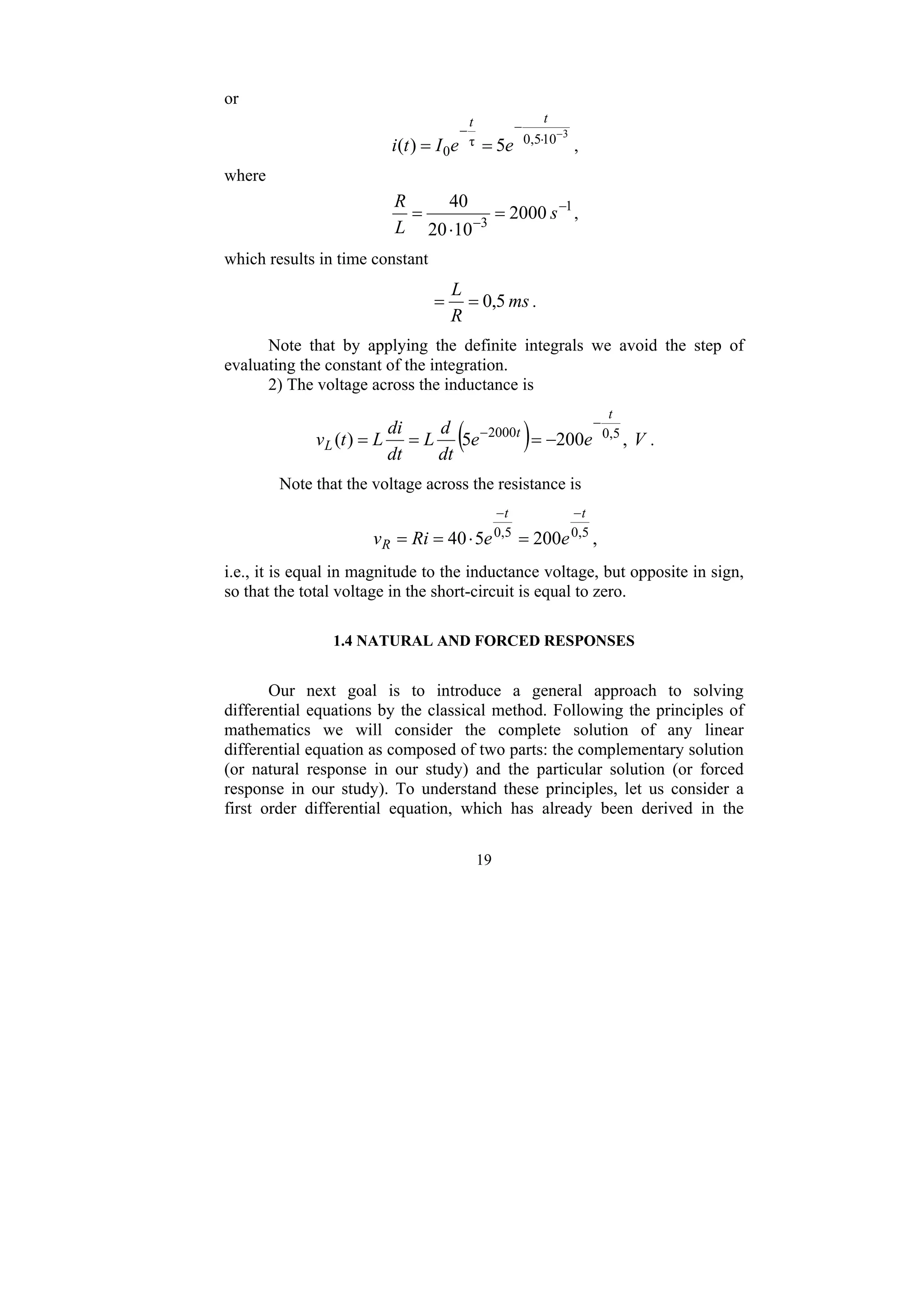
or
3
10
5
,
0
τ
0 5
)
(
−
⋅
−
−
=
=
t
t
e
e
I
t
i ,
where
1
3
2000
10
20
40 −
−
=
⋅
= s
L
R
,
which results in time constant
ms
R
L
5
,
0
=
= .
Note that by applying the definite integrals we avoid the step of
evaluating the constant of the integration.
2) The voltage across the inductance is
( ) V
e
e
dt
d
L
dt
di
L
t
v
t
t
L ,
200
5
)
( 5
,
0
2000
−
−
−
=
=
= .
Note that the voltage across the resistance is
5
,
0
5
,
0
200
5
40
t
t
R e
e
Ri
v
−
−
=
⋅
=
= ,
i.e., it is equal in magnitude to the inductance voltage, but opposite in sign,
so that the total voltage in the short-circuit is equal to zero.
1.4 NATURAL AND FORCED RESPONSES
Our next goal is to introduce a general approach to solving
differential equations by the classical method. Following the principles of
mathematics we will consider the complete solution of any linear
differential equation as composed of two parts: the complementary solution
(or natural response in our study) and the particular solution (or forced
response in our study). To understand these principles, let us consider a
first order differential equation, which has already been derived in the
20
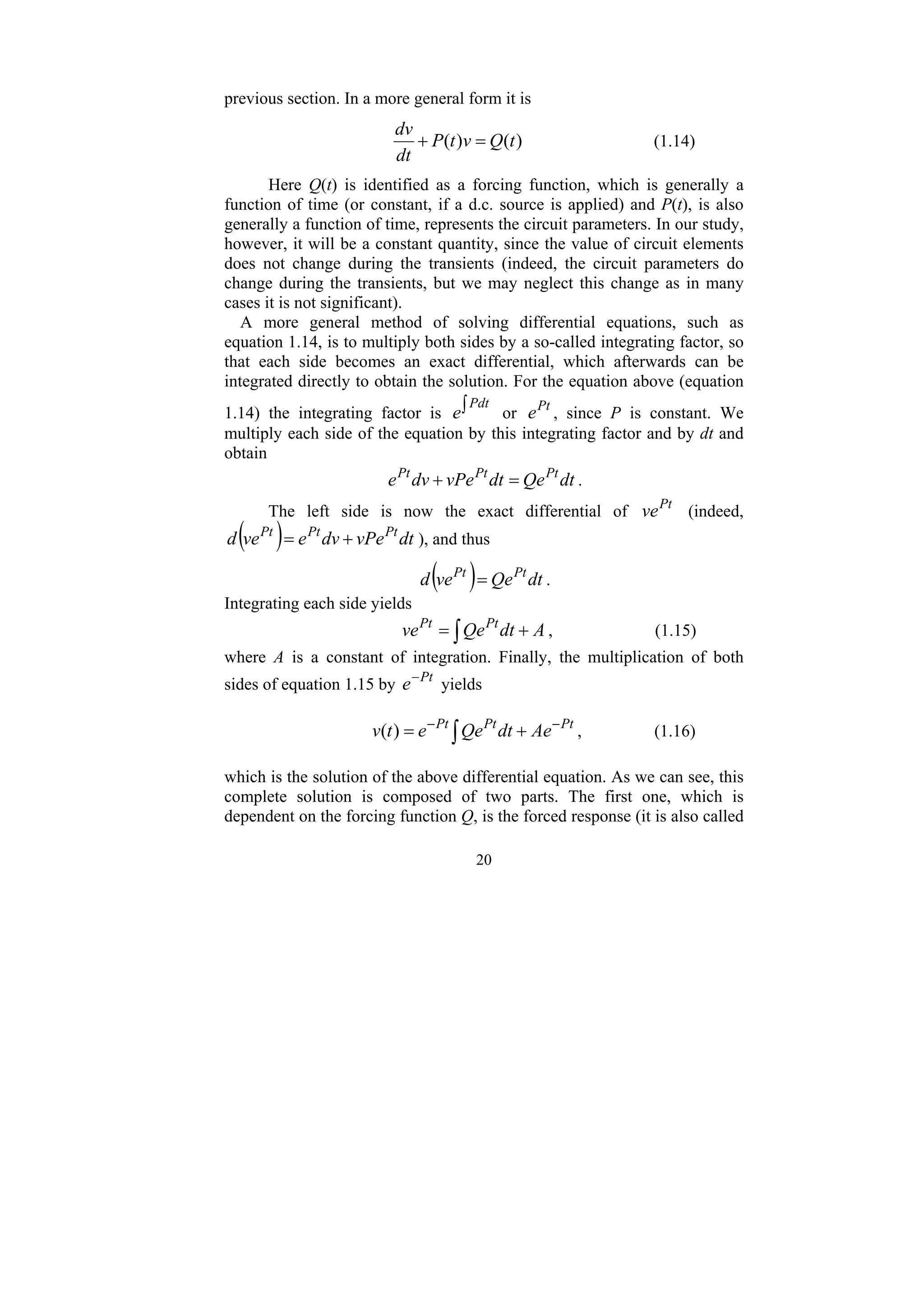
previous section. In a more general form it is
)
(
)
( t
Q
v
t
P
dt
dv
=
+ (1.14)
Here Q(t) is identified as a forcing function, which is generally a
function of time (or constant, if a d.c. source is applied) and P(t), is also
generally a function of time, represents the circuit parameters. In our study,
however, it will be a constant quantity, since the value of circuit elements
does not change during the transients (indeed, the circuit parameters do
change during the transients, but we may neglect this change as in many
cases it is not significant).
A more general method of solving differential equations, such as
equation 1.14, is to multiply both sides by a so-called integrating factor, so
that each side becomes an exact differential, which afterwards can be
integrated directly to obtain the solution. For the equation above (equation
1.14) the integrating factor is ∫Pdt
e or Pt
e , since P is constant. We
multiply each side of the equation by this integrating factor and by dt and
obtain
dt
Qe
dt
vPe
dv
e Pt
Pt
Pt
=
+ .
The left side is now the exact differential of Pt
ve (indeed,
( ) dt
vPe
dv
e
ve
d Pt
Pt
Pt
+
= ), and thus
( ) dt
Qe
ve
d Pt
Pt
= .
Integrating each side yields
∫ +
= A
dt
Qe
ve Pt
Pt
, (1.15)
where A is a constant of integration. Finally, the multiplication of both
sides of equation 1.15 by Pt
e−
yields
Pt
Pt
Pt
Ae
dt
Qe
e
t
v −
−
+
= ∫
)
( , (1.16)
which is the solution of the above differential equation. As we can see, this
complete solution is composed of two parts. The first one, which is
dependent on the forcing function Q, is the forced response (it is also called
21
the steady-state response or the particular solution or the particular
integral). The second one, which does not depend on the forcing function,
but only on the circuit parameters P (the types of elements, their values,
interconnections, etc) and on the initial conditions A, i.e., on the ‘‘nature’’
of the circuit, is the natural response. It is also called the solution of the
homogeneous equation, which does not include the source function and has
anything but zero on its right side.
Following this rule, we will solve differential equations by finding
natural and forced responses separately and combining them for a complete
solution. This principle of dividing the solution of the differential equations
into two components can also be understood by applying the superposition
theorem. Since the differential equations, under study, are linear as well as
the electrical circuits, we may assert that superposition is also applicable
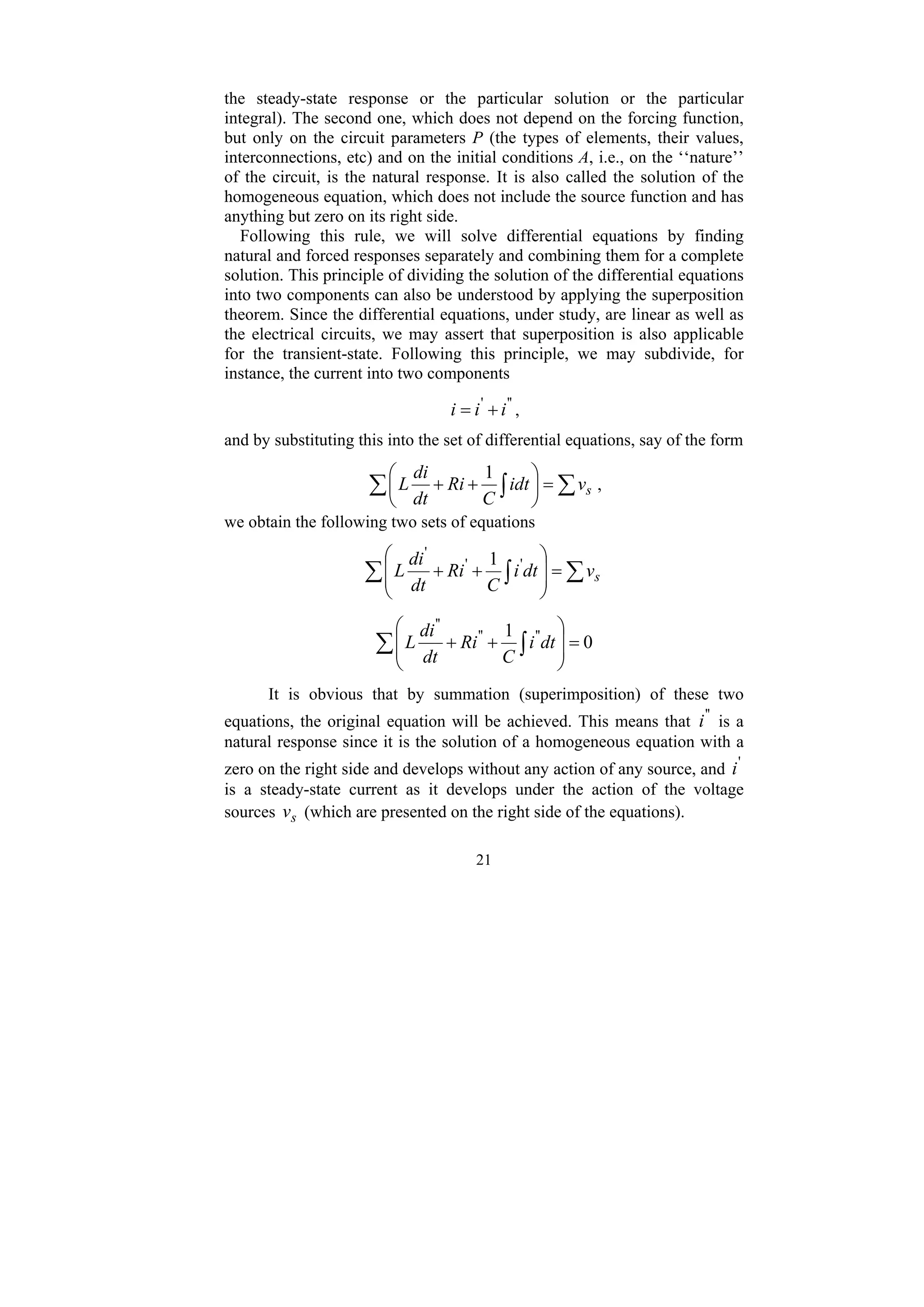
for the transient-state. Following this principle, we may subdivide, for
instance, the current into two components
'
'
'
i
i
i +
= ,
and by substituting this into the set of differential equations, say of the form
∑
∑ ∫ =
⎟
⎠
⎞
⎜
⎝
⎛
+
+ s
v
idt
C
Ri
dt
di
L
1
,
we obtain the following two sets of equations
∑
∑ ∫ =
⎟
⎟
⎠
⎞
⎜
⎜
⎝
⎛
+
+ s
v
dt
i
C
Ri
dt
di
L '
'
'
1
0
1 '
'
'
'
'
'
=
⎟
⎟
⎠
⎞
⎜
⎜
⎝
⎛
+
+
∑ ∫ dt
i
C
Ri
dt
di
L
It is obvious that by summation (superimposition) of these two
equations, the original equation will be achieved. This means that '
'
i is a
natural response since it is the solution of a homogeneous equation with a
zero on the right side and develops without any action of any source, and '
i
is a steady-state current as it develops under the action of the voltage
sources s
v (which are presented on the right side of the equations).
22
The most difficult part in the classical method of solving differential
equations is evaluating the particular integral in equation 1.16, especially
when the forcing function is not a simple d.c. or exponential source.
However, in circuit analysis we can use all the methods: node/mesh
analysis, circuit theorems, the phasor method for a.c. circuits (which are all
given in introductory courses on steady-state analysis) to find the forced
response. In relation to the natural response, the most difficult part is to
formulate the characteristic equation (see further on) and to find its roots.
Here in circuit analysis we also have special methods for evaluating the
characteristic equation simply by inspection of the analyzed circuit,
avoiding the formulation of differential equations.
Finally, it is worthwhile to clarify the use of exponential functions as
an integrating factor in solving linear differential equations. As we have
seen in the previous section, such differential equations in general consist
of the second (or higher) derivative, the first derivative and the function
itself, each multiplied by a constant factor. If the sum of all these
derivatives (the function itself might be treated as a derivative of order
zero) achieves zero, it becomes a homogeneous equation. A function whose
derivatives have the same form as the function itself is an exponential
function, so it may satisfy these kinds of equations. Substituting this
function into the differential equation, whose right side is zero (a
homogeneous differential equation) the exponential factor in each member
of the equation might be simply crossed out, so that the remaining
equation’s coefficients will be only circuit parameters. Such an equation is
called a characteristic equation.
1.5 CHARACTERISTIC EQUATION AND ITS DETERMINATION
Let us start by considering the simple circuit in which an RL in series
is switching on to a d.c. voltage source. Let the desired response in this
circuit be current i(t). We shall first express it as the sum of the natural and
forced currents
f
n i
i
i +
= .
The form of the natural response, as was shown, must be an
exponential function, st
n Ae
i = . Substituting this response into the
23
homogeneous differential equation, which is 0
=
+ Ri
dt
di
L , we obtain
0
=
+ R
e
Lse st
st
, or
Ls + R = 0. (1.17a)
This is a characteristic (or auxiliary) equation, in which the left side
expresses the input impedance seen from the source terminals of the
analyzed circuit.
R
Ls
s
Zin +
=
)
( . (1.17b)
We may treat s as the complex frequency s = σ + jω. Note that by
equaling this expression of circuit impedance to zero, we obtain the
characteristic equation. Solving this equation we have
R
L
L
R
s =
−
= τ
and . (1.18)
Hence, the natural response is
t
L
R
n Ae
i
−
= . (1.19)
Subsequently, the root of the characteristic equation defines the
exponent of the natural response. The fact that the input impedance of the
circuit should be equaled to zero can be explained from a physical point of
view (this fact is proven more correctly mathematically in Laplace
transformation). Since the natural response does not depend on the source,
the latter should be ‘‘killed’’. This action results in short-circuiting the
entire circuit, i.e. its input impedance.
Consider now a parallel LR circuit switching to a d.c. current source
in which the desired response is )
(t
vL , as shown in Fig.1.6. Here,
‘‘killing’’ the current source results in open-circuiting.
L
R
I0
Fig.1.6
24
This means that the input admittance should be equaled to zero.
Thus,
0
1
1
=
+
sL
R
,
or
sL + R = 0,
which however gives the same root
R
L
L
R
s =
−
= τ
and . (1.20)
Next, we will consider a more complicated circuit, shown in
Fig.1.7(a). This circuit, after switching and short-circuiting the remaining
voltage source, will be as shown in Fig.1.7(b). The input impedance of this
circuit ‘‘measured’’ at the switch (which is the same as seen from the
‘‘killed’’ source) is
)
//(
//
)
( 2
4
3
1 sL
R
R
R
R
s
Zin +
+
=
or
1
2
4
3
1
1
1
1
)
(
−
⎟
⎟
⎠
⎞
⎜
⎜
⎝
⎛
+
+
+
+
=
sL
R
R
R
R
s
Zin .
Evaluating this expression and equaling it to zero yields
0
)
)(
( 4
3
1
2
4
3
4
1
3
1 =
+
+
+
+ R
R
R
sL
R
R
R
R
R
R
R ,
and the root is
4
3
4
1
3
1
4
3
2
4
2
1
3
2
1
4
3
1
,
R
R
R
R
R
R
R
R
R
R
R
R
R
R
R
R
R
R
R
L
R
s eq
eq
+
+
+
+
+
=
−
=
It is worthwhile to mention that the same results can be obtained if
the input impedance is ‘‘measured’’ from the inductance branch, i.e. the
energy-storing element, as is shown in Fig. 1.7(c).
25
.
v1
a
v2
R1
R2
R3 R4
L
b
R1
R2
R3 R4
L
zin(s)
c
R1 R2
R3 R4
L
zin
(s)
Fig.1.7
The characteristic equation can also be determined by inspection of
the differential equation or set of equations. Consider the second-order
differential equation like in equation 1.2
)
(
)
(
1
)
(
)
(
2
2
t
g
t
i
C
dt
t
di
R
dt
t
i
d
L =
+
+ (1.21)
Replacing each derivative by n
s , where n is the order of the
derivative (the function by itself is considered as a zero-order derivative),
we may obtain the characteristic equation:
0
1
2
=
+
+
LC
s
L
R
s (1.22)
This characteristic equation is of the second order (in accordance
with the second order differential equation) and it possesses two roots 1
s
and 2
s .
If any system is described by a set of integro-differential equations,
like in equation 1.6, then we shall first rewrite it in a slightly different form
as homogeneous equations
26
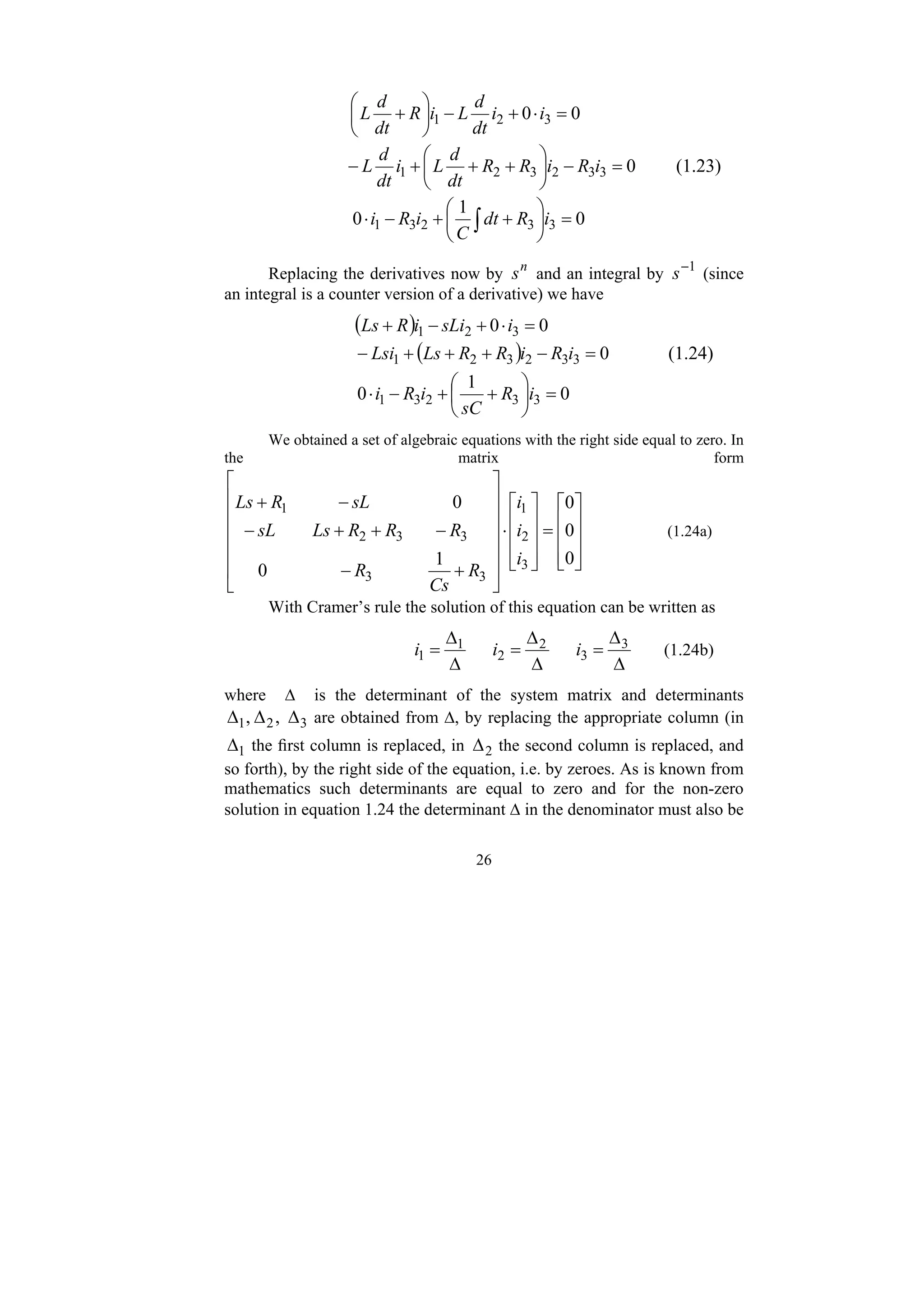
0
0 3
2
1 =
⋅
+
−
⎟
⎠
⎞
⎜
⎝
⎛
+ i
i
dt
d
L
i
R
dt
d
L
0
3
3
2
3
2
1 =
−
⎟
⎠
⎞
⎜
⎝
⎛
+
+
+
− i
R
i
R
R
dt
d
L
i
dt
d
L (1.23)
0
1
0 3
3
2
3
1 =
⎟
⎠
⎞
⎜
⎝
⎛
+
+
−
⋅ ∫ i
R
dt
C
i
R
i
Replacing the derivatives now by n
s and an integral by 1
−
s (since
an integral is a counter version of a derivative) we have
( ) 0
0 3
2
1 =
⋅
+
−
+ i
sLi
i
R
Ls
( ) 0
3
3
2
3
2
1 =
−
+
+
+
− i
R
i
R
R
Ls
Lsi (1.24)
0
1
0 3
3
2
3
1 =
⎟
⎠
⎞
⎜
⎝
⎛
+
+
−
⋅ i
R
sC
i
R
i
We obtained a set of algebraic equations with the right side equal to zero. In
the matrix form
⎥
⎥
⎥
⎦
⎤
⎢
⎢
⎢
⎣
⎡
=
⎥
⎥
⎥
⎦
⎤
⎢
⎢
⎢
⎣
⎡
⋅
⎥
⎥
⎥
⎥
⎥
⎦
⎤
⎢
⎢
⎢
⎢
⎢
⎣
⎡
+
−
−
+
+
−
−
+
0
0
0
1
0
0
3
2
1
3
3
3
3
2
1
i
i
i
R
Cs
R
R
R
R
Ls
sL
sL
R
Ls
(1.24a)
With Cramer’s rule the solution of this equation can be written as
Δ
Δ
=
Δ
Δ
=
Δ
Δ
= 3
3
2
2
1
1 i
i
i (1.24b)
where Δ is the determinant of the system matrix and determinants
3
2
1 ,
, Δ
Δ
Δ are obtained from Δ, by replacing the appropriate column (in
1
Δ the first column is replaced, in 2
Δ the second column is replaced, and
so forth), by the right side of the equation, i.e. by zeroes. As is known from
mathematics such determinants are equal to zero and for the non-zero
solution in equation 1.24 the determinant Δ in the denominator must also be
27
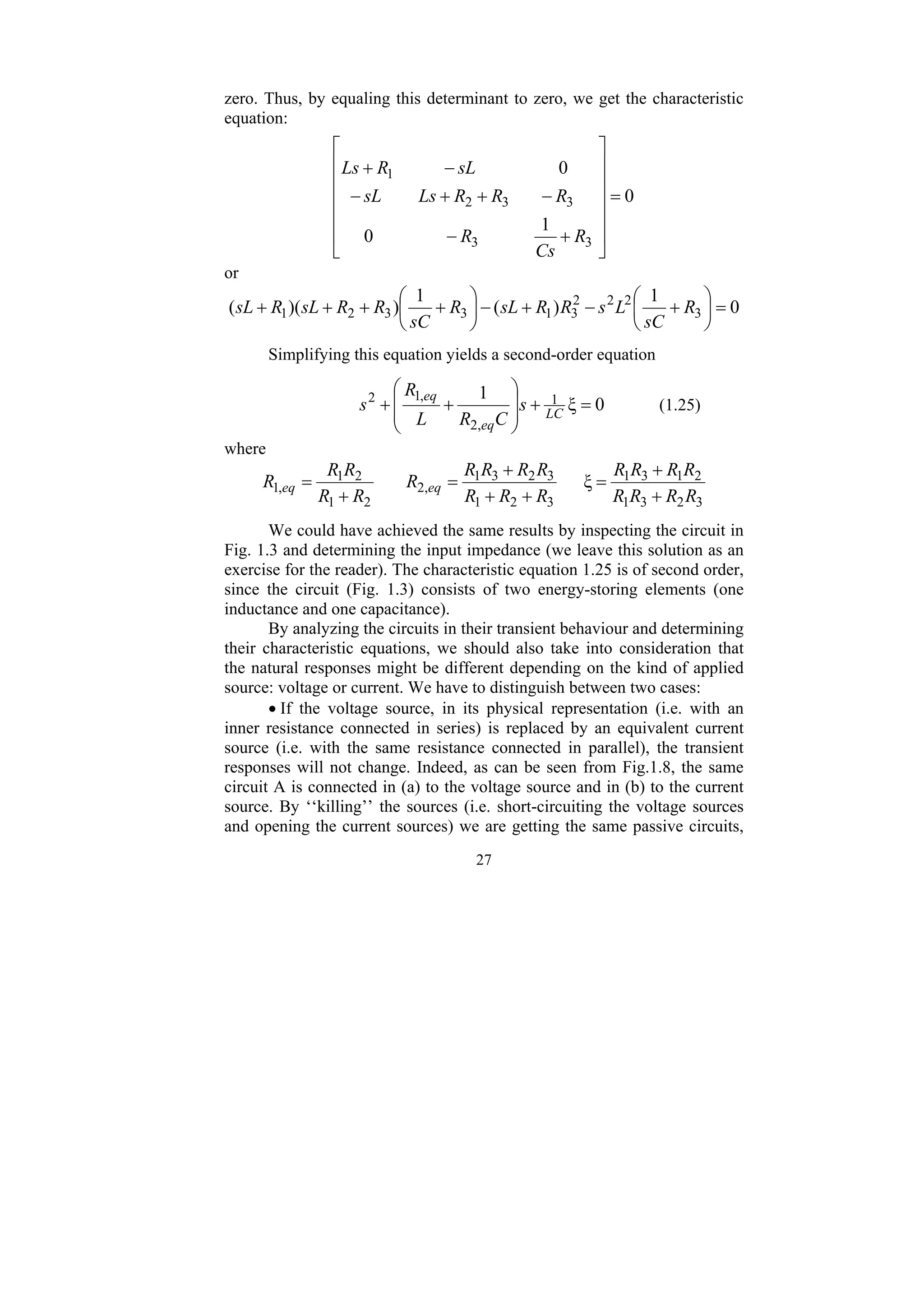
zero. Thus, by equaling this determinant to zero, we get the characteristic
equation:
0
1
0
0
3
3
3
3
2
1
=
⎥
⎥
⎥
⎥
⎥
⎦
⎤
⎢
⎢
⎢
⎢
⎢
⎣
⎡
+
−
−
+
+
−
−
+
R
Cs
R
R
R
R
Ls
sL
sL
R
Ls
or
0
1
)
(
1
)
)(
( 3
2
2
2
3
1
3
3
2
1 =
⎟
⎠
⎞
⎜
⎝
⎛
+
−
+
−
⎟
⎠
⎞
⎜
⎝
⎛
+
+
+
+ R
sC
L
s
R
R
sL
R
sC
R
R
sL
R
sL
Simplifying this equation yields a second-order equation
0
ξ
1 1
,
2
,
1
2
=
+
⎟
⎟
⎠
⎞
⎜
⎜
⎝
⎛
+
+ LC
eq
eq
s
C
R
L
R
s (1.25)
where
3
2
3
1
2
1
3
1
3
2
1
3
2
3
1
,
2
2
1
2
1
,
1 ξ
R
R
R
R
R
R
R
R
R
R
R
R
R
R
R
R
R
R
R
R
R eq
eq
+
+
=
+
+
+
=
+
=
We could have achieved the same results by inspecting the circuit in
Fig. 1.3 and determining the input impedance (we leave this solution as an
exercise for the reader). The characteristic equation 1.25 is of second order,
since the circuit (Fig. 1.3) consists of two energy-storing elements (one
inductance and one capacitance).
By analyzing the circuits in their transient behaviour and determining
their characteristic equations, we should also take into consideration that
the natural responses might be different depending on the kind of applied
source: voltage or current. We have to distinguish between two cases:
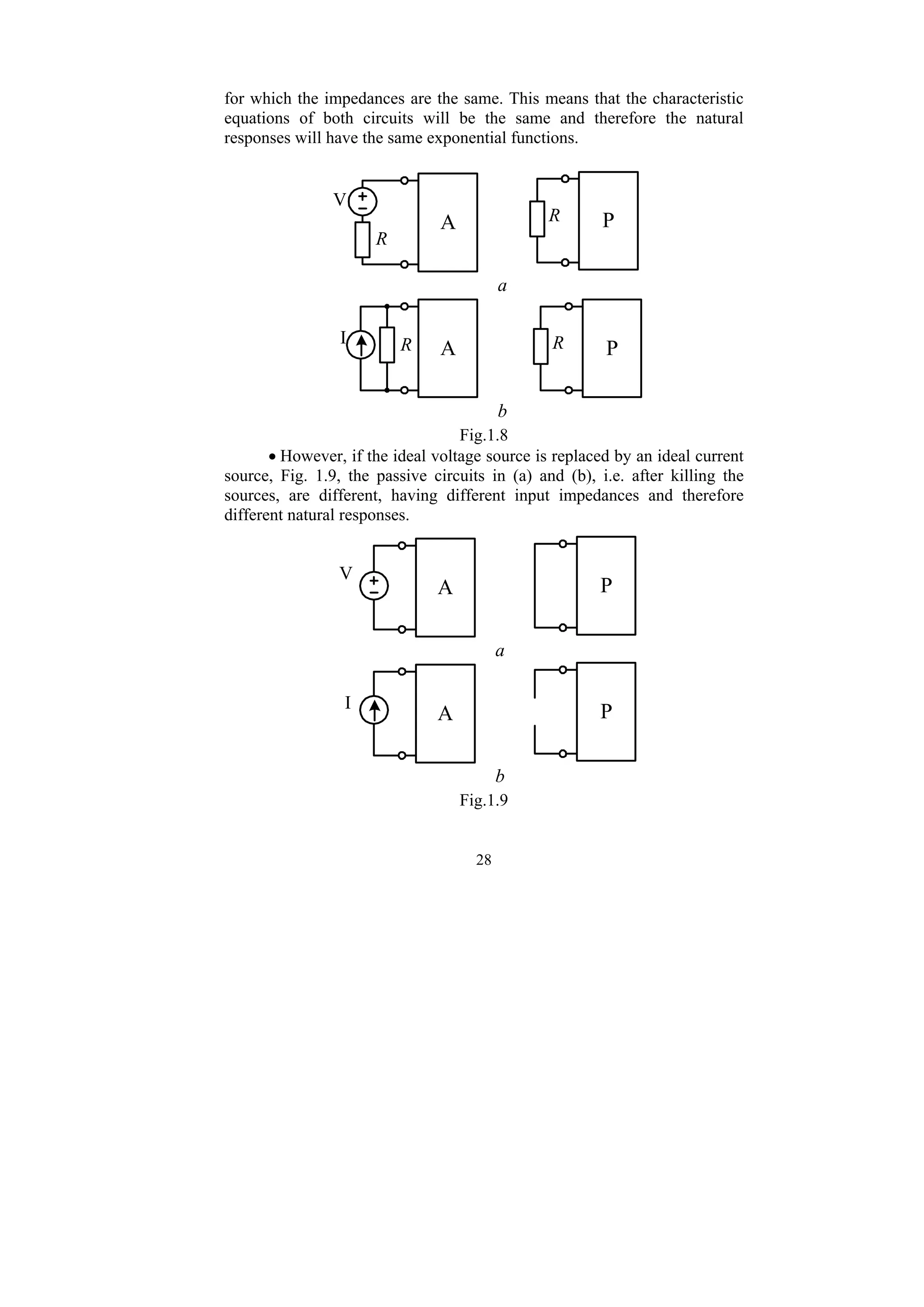
• If the voltage source, in its physical representation (i.e. with an
inner resistance connected in series) is replaced by an equivalent current
source (i.e. with the same resistance connected in parallel), the transient
responses will not change. Indeed, as can be seen from Fig.1.8, the same
circuit A is connected in (a) to the voltage source and in (b) to the current
source. By ‘‘killing’’ the sources (i.e. short-circuiting the voltage sources
and opening the current sources) we are getting the same passive circuits,
28
for which the impedances are the same. This means that the characteristic
equations of both circuits will be the same and therefore the natural
responses will have the same exponential functions.
A
V
P
a
I
b
R
R
R A P
R
Fig.1.8
• However, if the ideal voltage source is replaced by an ideal current
source, Fig. 1.9, the passive circuits in (a) and (b), i.e. after killing the
sources, are different, having different input impedances and therefore
different natural responses.
A
V
P
a
A
I
P
b
Fig.1.9
29
1.6. ROOTS OF THE CHARACTERISTIC EQUATION AND DIFFERENT
KINDS OF TRANSIENT RESPONSES
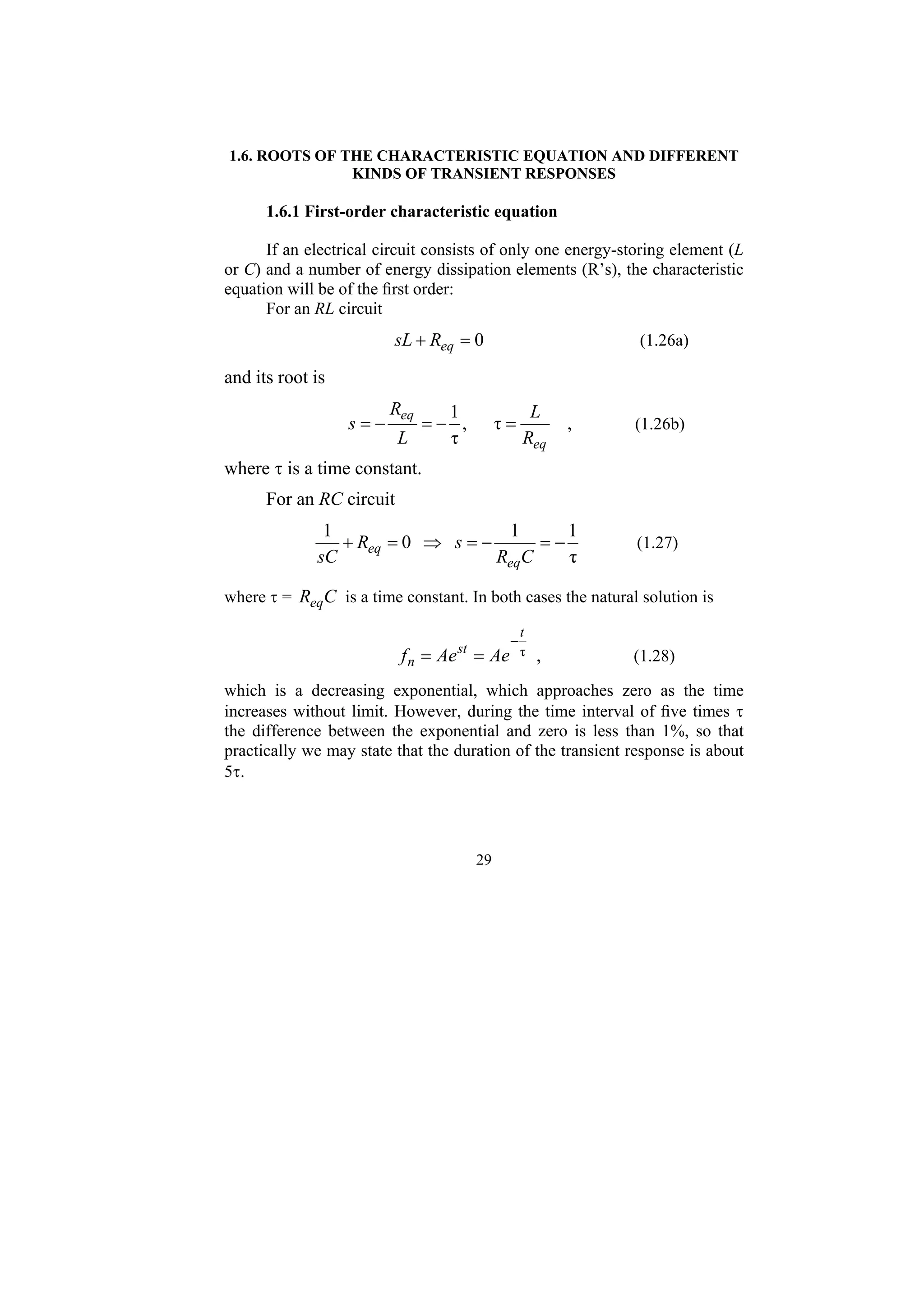
1.6.1 First-order characteristic equation
If an electrical circuit consists of only one energy-storing element (L
or C) and a number of energy dissipation elements (R’s), the characteristic
equation will be of the first order:
For an RL circuit
0
=
+ eq
R
sL (1.26a)
and its root is
,
τ
,
τ
1
eq
eq
R
L
L
R
s =
−
=
−
= (1.26b)
where τ is a time constant.
For an RC circuit
τ
1
1
0
1
−
=
−
=
⇒
=
+
C
R
s
R
sC eq
eq (1.27)
where τ = C
Req is a time constant. In both cases the natural solution is
,
τ
t
st
n Ae
Ae
f
−
=
= (1.28)
which is a decreasing exponential, which approaches zero as the time
increases without limit. However, during the time interval of five times τ
the difference between the exponential and zero is less than 1%, so that
practically we may state that the duration of the transient response is about
5τ.
30
1.6.2 Second-order characteristic equation
If an electrical circuit consists of two energy-storing elements,
then the characteristic equation will be of the second order. For an
electrical circuit, which consists of an inductance, capacitance and
several resistances this equation may look like equations 1.22, 1.25 or in
a generalized form
0
ω
α
2 2
d
2
=
+
+
s (1.29)
The coefficients in the above equation shall be introduced as
follows: α as the exponential damping coefficient and d
ω as a resonant
frequency. For a series RLC circuit α = R/2L and
LC
d
1
ω
ω 0 =
= .
For a parallel RLC circuit α = 1/2RC and
LC
d
1
ω
ω 0 =
= , which is
the same as in a series circuit. For more complicated circuits, as in Fig.
1.3, the above terms may look like
⎟
⎟
⎠
⎞
⎜
⎜
⎝
⎛
+
=
C
R
L
R
eq
eq
,
2
,
1 1
2
1
α
which is actually combined from those coefficients for the series and
parallel circuits and ξ
ω
ω 0
=
d , where ξ is a distortion coefficient,
which influences the resonant/oscillatory frequency.
The two roots of a second order (quadratic) equation 1.29 are
given as
2
2
1 ω
α
α d
s −
+
−
= (1.30a)
2
2
1 ω
α
α d
s −
−
−
= (1.30b)
and the natural response in this case is
t
s
t
s
n e
A
e
A
t
f 2
1
2
1
)
( +
= (1.31)
Since each of these two exponentials is a solution of the given
31
differential equation, it can be shown that the sum of the two solutions is
also a solution (it can be shown, for example, by substituting equation
1.31 into the considered equation. The proof of it is left for the reader as
an exercise.)
As is known from mathematics, the two roots of a quadratic
equation can be one of three kinds:
• negative real different, such as 1
2 s
s > , if d
ω
α > ;
• negative real equal, such as s
s
s =
= 1
2 , if d
ω
α = ;
• complex conjugate, such as n
j
s ω
α
2
,
1 ±
−
= , if d
ω
α < , where
2
2
d α
ω
ω −
=
n is the frequency of oscillation or natural frequency
(see further on).
A detailed analysis of the natural response of all three cases will
be given in the next chapter. Here, we will restrict ourselves to their
short specification.
Overdamping. In this case, the natural response (equation 1.31)
is given as the sum of two decreasing exponential forms, both of which
approach zero as ∞
→
t . However, since 1
2 s
s > , the term of 2
s has
a more rapid rate of decrease so that the transients’ time interval is
defined by
⎟
⎟
⎠
⎞
⎜
⎜
⎝
⎛
≈
1
1
1
5
s
t
s tr .
Critical damping. In this case, the natural response (equation
1.31) converts into the form
st
n e
A
t
A
t
f −
+
= )
(
)
( 2
1 . (1.32)
Underdamping. In this case, the natural response becomes
oscillatory, which may be imaged as a decaying alternating current
(voltage)
32
β)
ω
sin(
)
( α
+
= −
t
Be
t
f n
t
n (1.33)
Here term α is the rate of decay and n
ω is the angular frequency of the
oscillations.
Now the critical damping may be interpreted as the boundary case
between the overdamped and underdamped responses. It should be
noted however that the critical damping is of a more theoretical than
practical interest, since the exact satisfaction of the critical damping
condition d
ω
α = in a circuit, which has a variety of parameters, is of
very low probability. Therefore, the transient response in a second order
circuit will always be of an exponential or oscillatory form. Let us now
consider a numerical example.
Example 1.2
The circuit shown in Fig 1.10 represents an equivalent circuit of a
one-phase transformer and has the following parameters: 1
L = 0.06 H ,
2
L = 0.02 H , M = 0.03 H, 1
R = 6 Ω, 2
R = 1 Ω. If the transformer is
loaded by an inductive load, whose parameters are ld
L = 0.005 H and
ld
R = 9 Ω, a) determine the characteristic equation of a given circuit
and b) find the roots and write the expression of a natural response.
M
R1 R2
Rld
Lld
L1 L2
i2
i1
Fig.1.10
Solution
Using mesh analysis, we may write a set of two algebraic
equations (which represent two differential equations in operational
form)
33
0
)
( 2
1
1
1 =
−
+ sMi
i
sL
R
0
)
( 2
2
2
1 =
+
+
+
+
− i
sL
R
sL
R
sMi ld
ld
The determinant of this set of two equations is
)
(
)
(
det
2
2
1
1
ld
ld L
L
s
R
R
sM
sM
sL
R
+
+
+
−
−
+
= =
= /
2
1
1
/
2
/
2
1
2
/
2
1 )
(
)
( R
R
s
L
R
L
R
s
M
L
L +
+
+
− ,
where, to shorten the writing, we assigned ld
L
L
L +
= 2
/
2 and
ld
R
R
R +
= 2
/
2 .
Letting det = 0, we obtain the characteristic equation in the form
0
2
/
2
1
/
2
1
2
/
2
1
1
/
2
/
2
1
2
=
−
+
−
+
+
M
L
L
R
R
s
M
L
L
L
R
L
R
s
Substituting the given values, we have
0
10
10
10
5
,
12 4
2
2
=
⋅
+
⋅
+ s
s .
The roots of this equation are:
10
6
,
11
10
86
,
0 1
2
2
1
2
1
−
−
⋅
−
=
⋅
−
= s
s
s
s ,
which are two different negative real numbers. Therefore the natural
response is:
t
t
n e
A
e
A
t
f 116
2
86
1
)
( −
−
+
= ,
which consists of two exponential functions and is of the overdamped
kind.
It should be noted that in second order circuits, which contain two
energy-storing elements of the same kind (two L -s, or two C-s), the
transient response cannot be oscillatory and is always exponential
overdamped. It is worthwhile to analyze the roots of the above
characteristic equation. We may then obtain
34
[
⎥
⎦
⎤
−
−
+
±
±
+
−
=
/
2
1
2
/
2
1
2
1
/
2
/
2
1
1
/
2
/
2
1
2
/
2
1
2
,
1
)
(
4
)
(
)
(
)
(
2
1
R
R
M
L
L
L
R
L
R
L
R
L
R
M
L
L
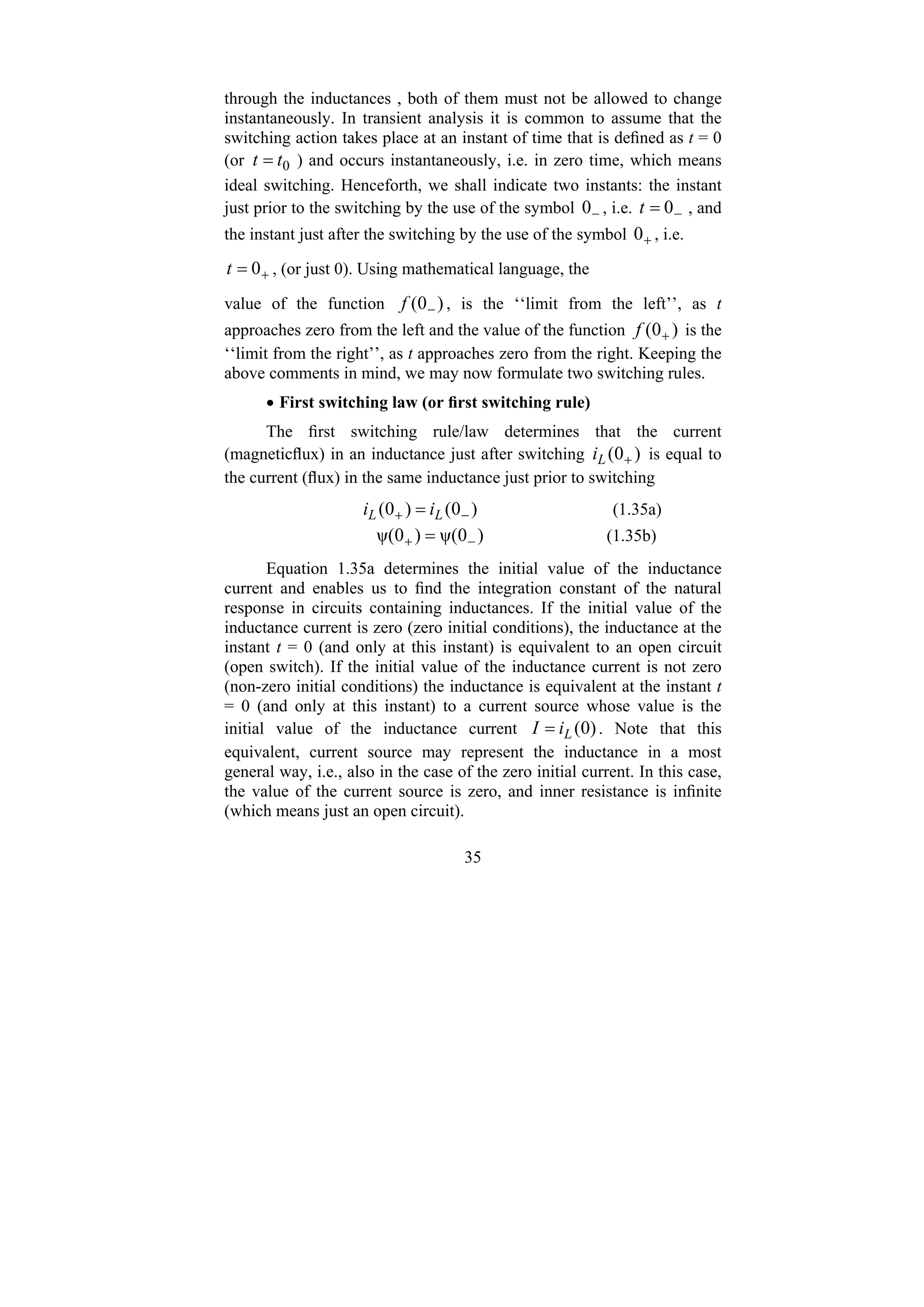
s
(1.34)
The expression under the square root can be simplified to the
form:
0
4
)
( 2
/
2
1
2
1
/
2
/
2
1 >
+
+ M
R
R
L
R
L
R ,
which is always positive, i.e., both roots are negative real numbers and
the transient response of the overdamped kind. These results once again
show that in a circuit, which contains energy-storing elements of the
same kind, the transient response cannot be oscillatory.
In conclusion, it is important to pay attention to the fact that all
the real roots of the characteristic equations, under study, were negative
as well as the real part of the complex roots. This very important fact
follows the physical reality that the natural response and transient-state
cannot exist in infinite time. As we already know, the natural response
takes place in the circuit free of sources and must vanish due to the
energy losses in the resistances. Thus, natural responses, as exponential
functions st
e , must be of a negative power (s < 0) to decay with time.
1.7. INDEPENDENT AND DEPENDENT INITIAL
CONDITIONS
From now on, we will use the term ‘‘switching’’ for any change
or interruption in an electrical circuit, planned as well as unplanned, i.e.
different kinds of faults or other sudden changes in energy distribution.
1.7.1 Two switching rules (laws)
The principle of a gradual change of energy in any physical
system, and specifically in an electrical circuit, means that the energy
stored in magnetic and electric fields cannot change instantaneously.
Since the magnetic energy is related to the magnetic flux and the current
35
through the inductances , both of them must not be allowed to change
instantaneously. In transient analysis it is common to assume that the
switching action takes place at an instant of time that is defined as t = 0
(or 0
t
t = ) and occurs instantaneously, i.e. in zero time, which means
ideal switching. Henceforth, we shall indicate two instants: the instant
just prior to the switching by the use of the symbol −
0 , i.e. −
= 0
t , and
the instant just after the switching by the use of the symbol +
0 , i.e.
+
= 0
t , (or just 0). Using mathematical language, the
value of the function )
0
( −
f , is the ‘‘limit from the left’’, as t
approaches zero from the left and the value of the function )
0
( +
f is the
‘‘limit from the right’’, as t approaches zero from the right. Keeping the
above comments in mind, we may now formulate two switching rules.
• First switching law (or first switching rule)
The first switching rule/law determines that the current
(magneticflux) in an inductance just after switching )
0
( +
L
i is equal to
the current (flux) in the same inductance just prior to switching
)
0
(
)
0
( −
+ = L
L i
i (1.35a)
)
0
ψ(
)
0
ψ( −
+ = (1.35b)
Equation 1.35a determines the initial value of the inductance
current and enables us to find the integration constant of the natural
response in circuits containing inductances. If the initial value of the
inductance current is zero (zero initial conditions), the inductance at the
instant t = 0 (and only at this instant) is equivalent to an open circuit
(open switch). If the initial value of the inductance current is not zero
(non-zero initial conditions) the inductance is equivalent at the instant t
= 0 (and only at this instant) to a current source whose value is the
initial value of the inductance current )
0
(
L
i
I = . Note that this
equivalent, current source may represent the inductance in a most
general way, i.e., also in the case of the zero initial current. In this case,
the value of the current source is zero, and inner resistance is infinite
(which means just an open circuit).
36
• Second switching law (or second switching rule)
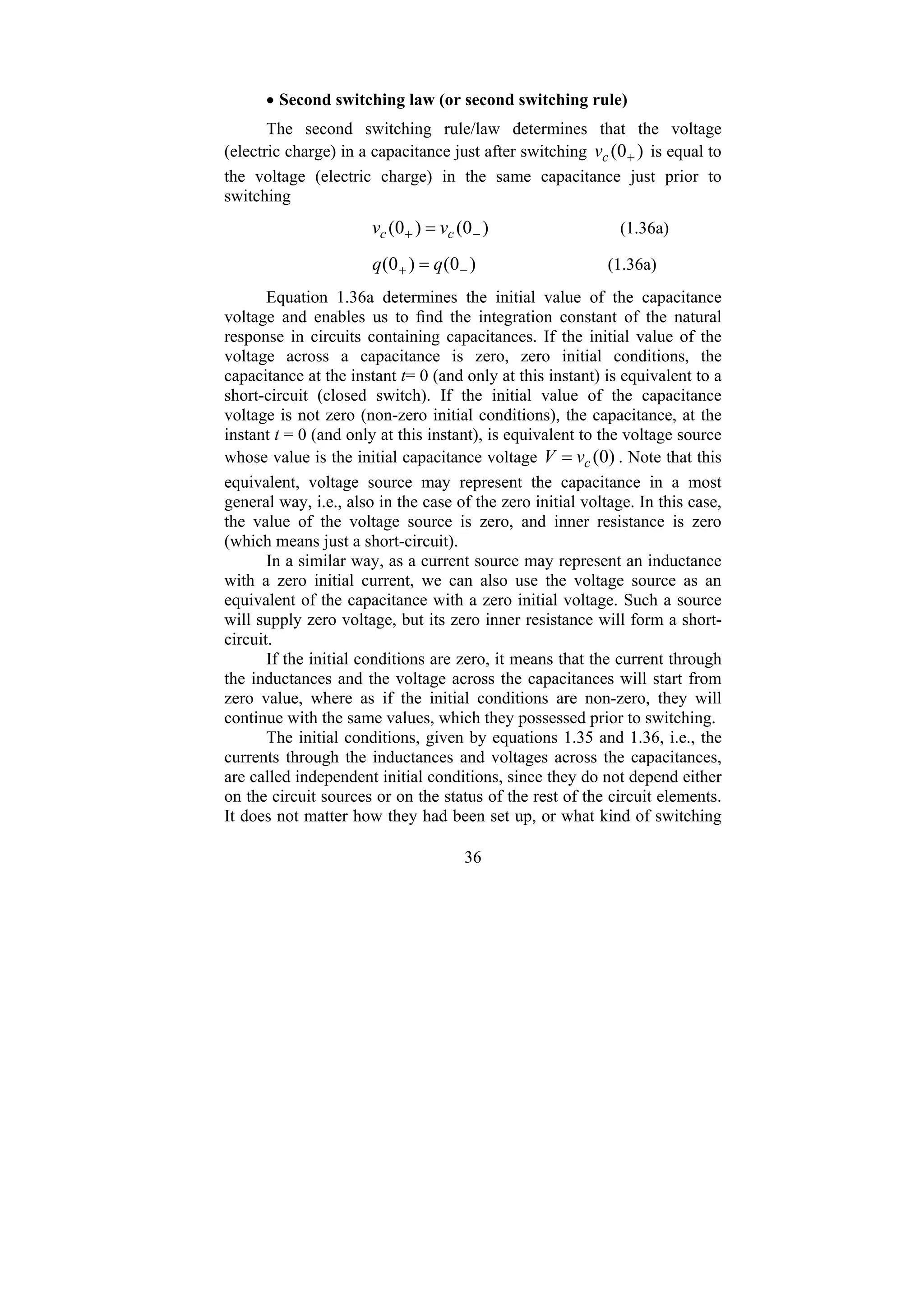
The second switching rule/law determines that the voltage
(electric charge) in a capacitance just after switching )
0
( +
c
v is equal to
the voltage (electric charge) in the same capacitance just prior to
switching
)
0
(
)
0
( −
+ = c
c v
v (1.36a)
)
0
(
)
0
( −
+ = q
q (1.36a)
Equation 1.36a determines the initial value of the capacitance
voltage and enables us to find the integration constant of the natural
response in circuits containing capacitances. If the initial value of the
voltage across a capacitance is zero, zero initial conditions, the
capacitance at the instant t= 0 (and only at this instant) is equivalent to a
short-circuit (closed switch). If the initial value of the capacitance
voltage is not zero (non-zero initial conditions), the capacitance, at the
instant t = 0 (and only at this instant), is equivalent to the voltage source
whose value is the initial capacitance voltage )
0
(
c
v
V = . Note that this
equivalent, voltage source may represent the capacitance in a most
general way, i.e., also in the case of the zero initial voltage. In this case,
the value of the voltage source is zero, and inner resistance is zero
(which means just a short-circuit).
In a similar way, as a current source may represent an inductance
with a zero initial current, we can also use the voltage source as an
equivalent of the capacitance with a zero initial voltage. Such a source
will supply zero voltage, but its zero inner resistance will form a short-
circuit.
If the initial conditions are zero, it means that the current through
the inductances and the voltage across the capacitances will start from
zero value, where as if the initial conditions are non-zero, they will
continue with the same values, which they possessed prior to switching.
The initial conditions, given by equations 1.35 and 1.36, i.e., the
currents through the inductances and voltages across the capacitances,
are called independent initial conditions, since they do not depend either
on the circuit sources or on the status of the rest of the circuit elements.
It does not matter how they had been set up, or what kind of switching
37
or interruption took place in the circuit.
The rest of the quantities in the circuit, i.e., the currents and the
voltages in the resistances, the voltages across the inductances and
currents through the capacitances, can change abruptly and their values
at the instant just after the switching ( +
= 0
t ) are called dependent
initial conditions. They depend on the independent initial conditions and
on the status of the rest of the circuit elements. The determination of the
dependent initial conditions is actually the most arduous part of the
classical method. In the next sections, methods of determining the initial
conditions will be introduced. We shall first, however, show how the
independent initial conditions can be found.
1.7.2 Methods of finding independent initial conditions
For the determination of independent initial conditions the given
circuit/network shall be inspected at its steady-state operation prior to
the switching. Let us illustrate this procedure in the following examples.
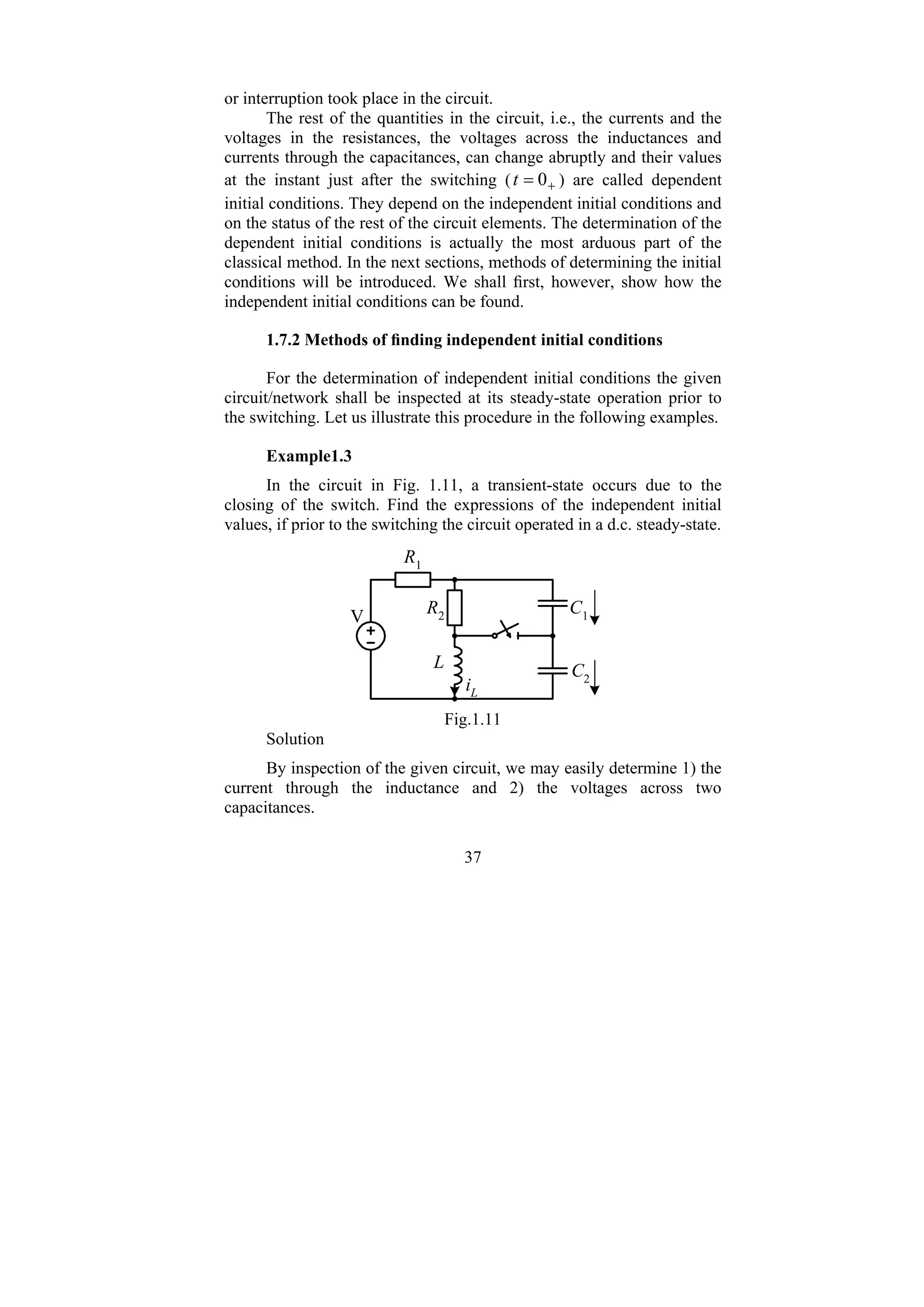
Example1.3
In the circuit in Fig. 1.11, a transient-state occurs due to the
closing of the switch. Find the expressions of the independent initial
values, if prior to the switching the circuit operated in a d.c. steady-state.
R1
R2
L
C1
C2
iL
V
Fig.1.11
Solution
By inspection of the given circuit, we may easily determine 1) the
current through the inductance and 2) the voltages across two
capacitances.
38
1) Since the two capacitances in a d.c. steady-state are like an
open switch the inductance current is
2
1
)
0
(
R
R
V
i s
L
+
=
−
2) Since the voltage across the inductance in a d.c. steady-state is
zero (the inductance provides a closed switch), the voltage across the
capacitances is
)
0
(
)
0
( 2 −
− = L
c i
R
v .
This voltage is divided between two capacitors in inverse
proportion to their values (which follows from the principle of their
charge equality, i.e., 2
1 2
1 c
c v
C
v
C = ), which yields:
2
1
1
2
2
1
2
2
)
0
(
)
0
(
)
0
(
)
0
(
2
1
C
C
C
i
R
v
C
C
C
i
R
v
L
c
L
c
+
=
+
=
−
−
−
−
.
Example 1.4
Find the independent initial conditions )
0
( −
L
i and )
0
( −
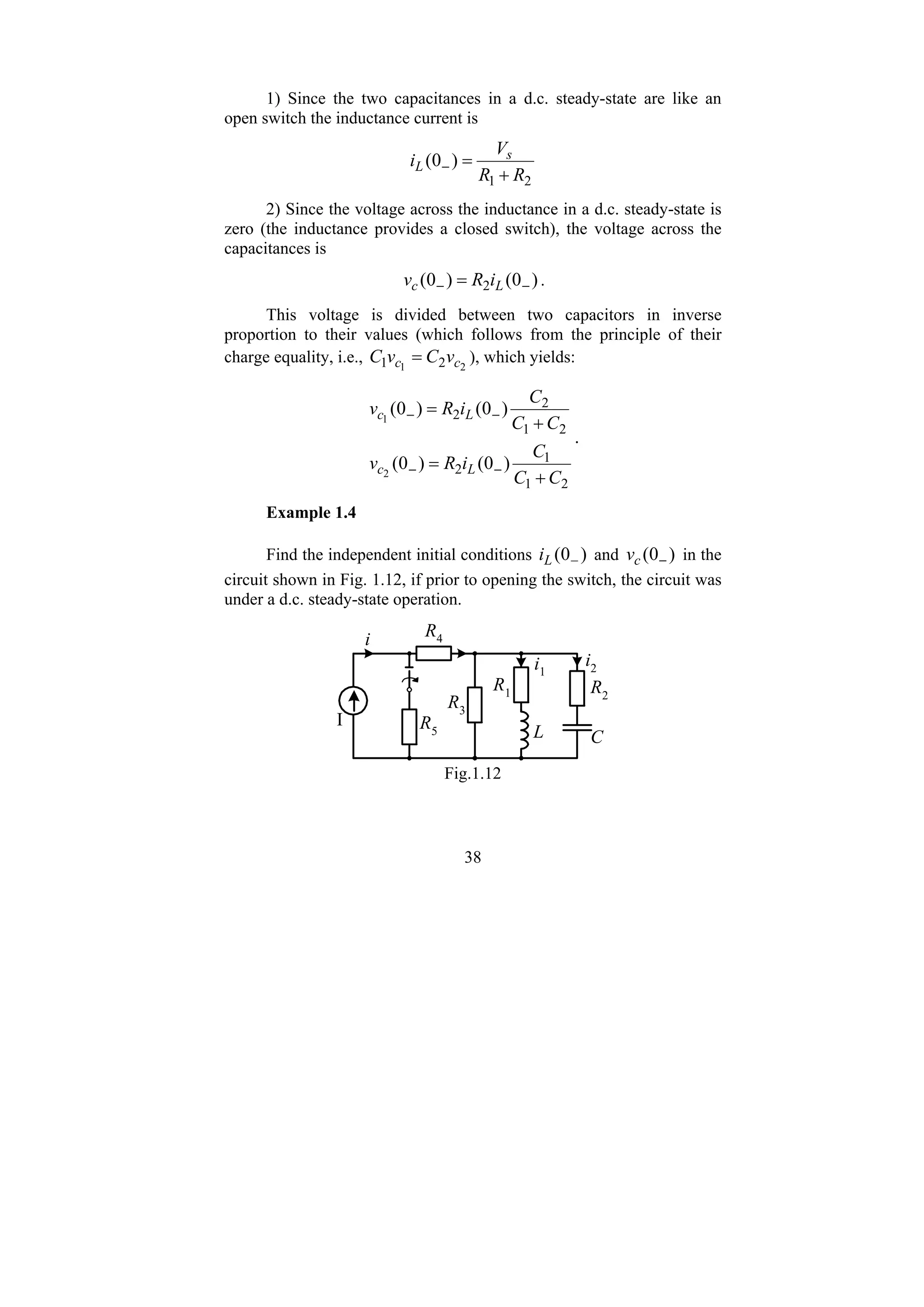
c
v in the
circuit shown in Fig. 1.12, if prior to opening the switch, the circuit was
under a d.c. steady-state operation.
R2
R1
R3
R4
R5 L C
I
i
i1
i2
Fig.1.12
39
Solution
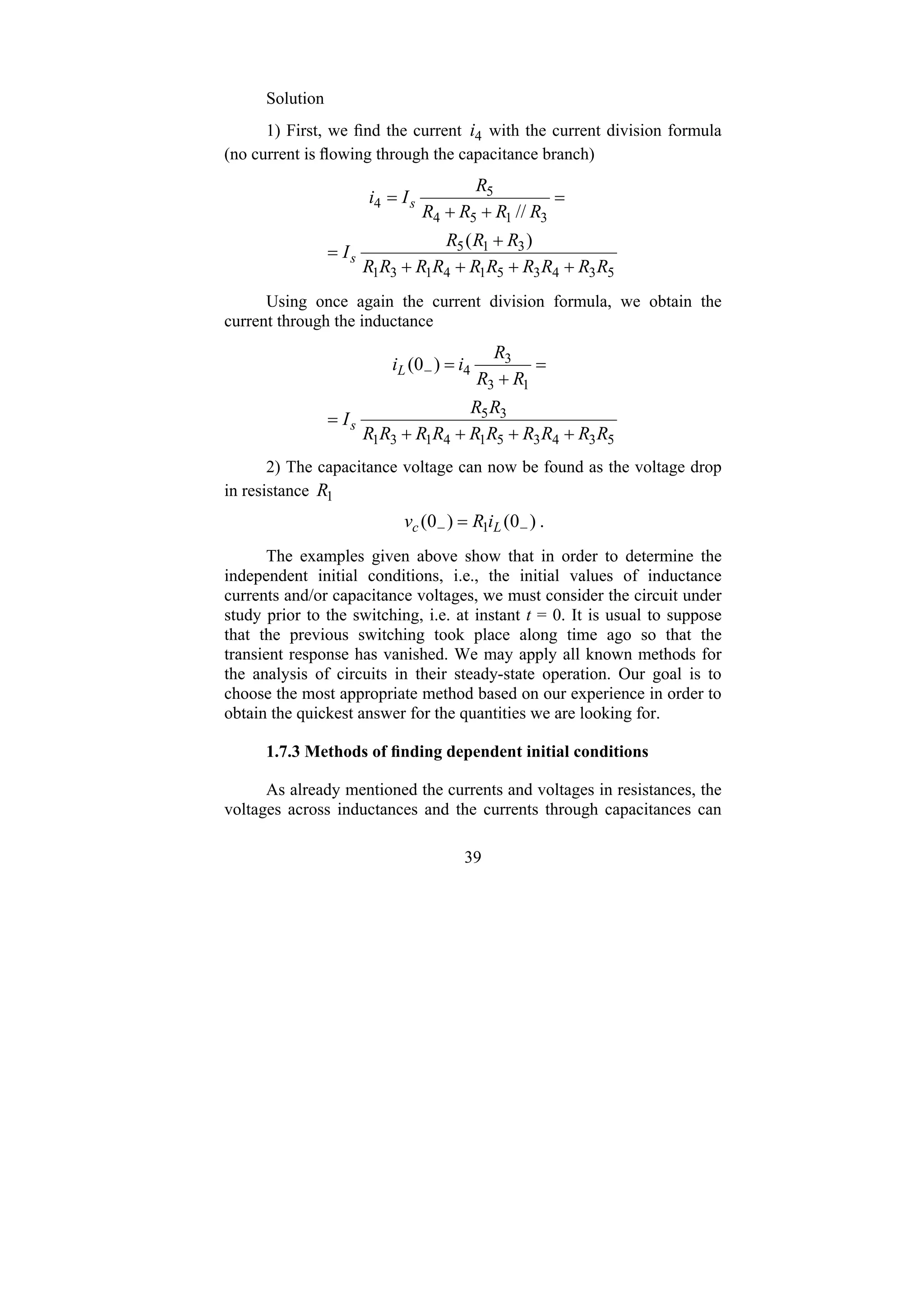
1) First, we find the current 4
i with the current division formula
(no current is flowing through the capacitance branch)
5
3
4
3
5
1
4
1
3
1
3
1
5
3
1
5
4
5
4
)
(
//
R
R
R
R
R
R
R
R
R
R
R
R
R
I
R
R
R
R
R
I
i
s
s
+
+
+
+
+
=
=
+
+
=
Using once again the current division formula, we obtain the
current through the inductance
5
3
4
3
5
1
4
1
3
1
3
5
1
3
3
4
)
0
(
R
R
R
R
R
R
R
R
R
R
R
R
I
R
R
R
i
i
s
L
+
+
+
+
=
=
+
=
−
2) The capacitance voltage can now be found as the voltage drop
in resistance 1
R
)
0
(
)
0
( 1 −
− = L
c i
R
v .
The examples given above show that in order to determine the
independent initial conditions, i.e., the initial values of inductance
currents and/or capacitance voltages, we must consider the circuit under
study prior to the switching, i.e. at instant t = 0. It is usual to suppose
that the previous switching took place along time ago so that the
transient response has vanished. We may apply all known methods for
the analysis of circuits in their steady-state operation. Our goal is to
choose the most appropriate method based on our experience in order to
obtain the quickest answer for the quantities we are looking for.
1.7.3 Methods of finding dependent initial conditions
As already mentioned the currents and voltages in resistances, the
voltages across inductances and the currents through capacitances can
40
change abruptly at the instant of switching. Therefore, the initial values
of these quantities should be found in the circuit just after switching,
i.e., at instant +
= 0
t . Their new values will depend on the new
operational conditions of the circuit, which have been generated after
switching, as well as on the values of the currents in the inductances and
voltages of the capacitances. For this reason we will call them
dependent initial conditions.
As we have already observed, the natural response in the circuit of
the second order is, for instance, of form equation 1.31. Therefore, two
arbitrary constants 1
A and 2
A , called integration constants, have to be
determined to satisfy the two initial conditions. One is the initial value
of the function and the other one, as we know from mathematics, is the
initial value of its first derivative. Thus, for circuits of the second order
or higher the initial values of derivatives at +
= 0
t must also be found.
We also consider the initial values of these derivatives as dependent
initial conditions.
In order to find the dependent initial conditions we must consider the
analyzed circuit, which has arisen after switching and in which all the
inductances and capacitances are replaced by current and voltage
sources (or, with zero initial conditions, by an open and/or short-circuit).
Note that this circuit fits only at the instant +
= 0
t . For finding the
desirable quantities, we may use all the known methods of steady-state
analysis. Let us introduce this technique by considering the following
examples.
Example1.5
Consider once again the circuit in Fig. 1.12. We now however
need to find the initial value of current )
0
(
2 +
i , which flows through the
capacitance and therefore can be changed instantaneously.
Solution
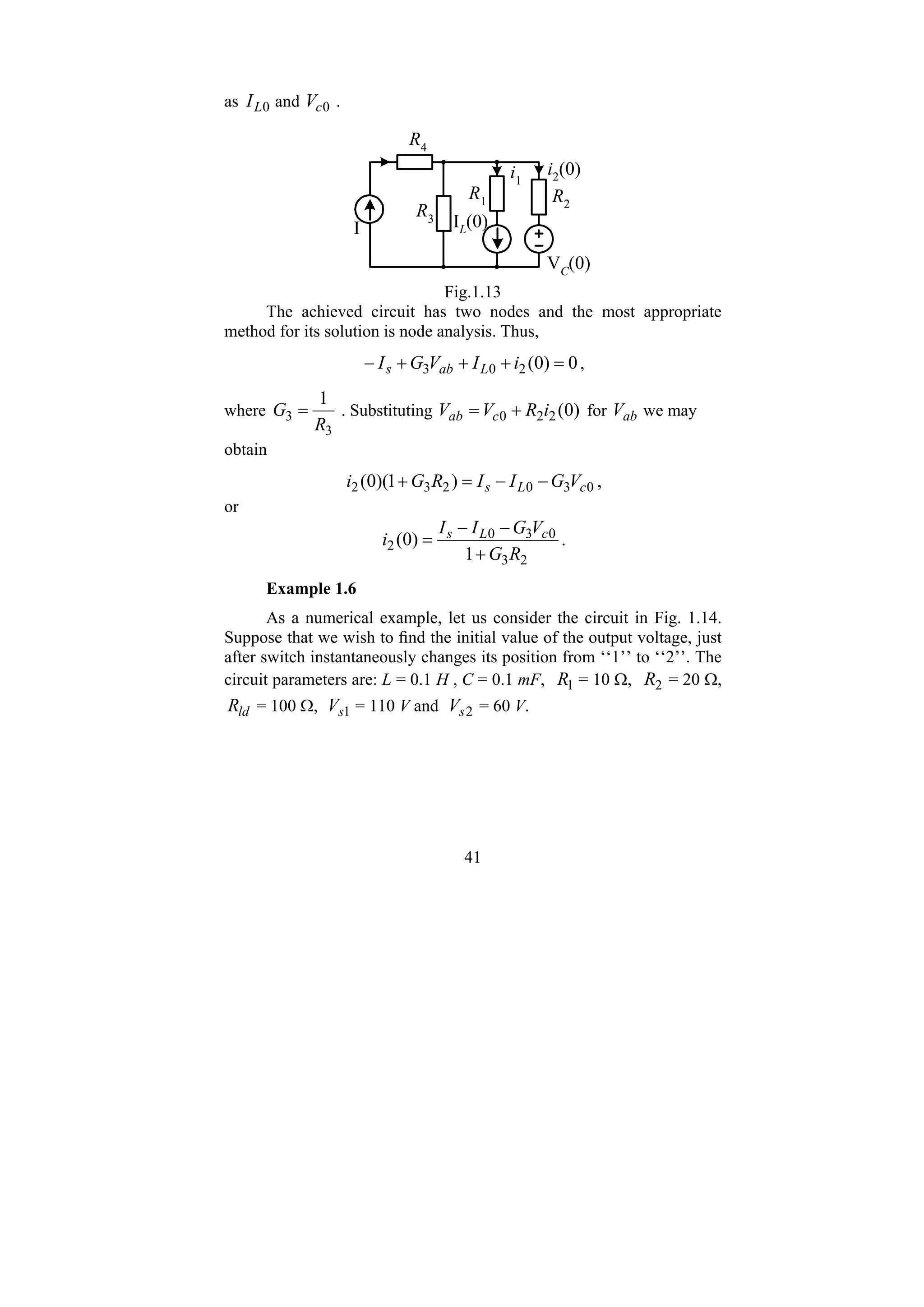
We start the solution by drawing the equivalent circuit for instant
+
= 0
t , i.e. just after switching, Fig. 1.13. The inductance and
capacitance in this circuit are replaced by the current and voltage
sources, whose values have been found in Example 1.4 and are assigned
41
as 0
L
I and 0
c
V .
R2
R1
R3
R4
IL(0)
I
i1
i2(0)
VC
(0)
Fig.1.13
The achieved circuit has two nodes and the most appropriate
method for its solution is node analysis. Thus,
0
)
0
(
2
0
3 =
+
+
+
− i
I
V
G
I L
ab
s ,
where
3
3
1
R
G = . Substituting )
0
(
2
2
0 i
R
V
V c
ab +
= for ab
V we may
obtain
0
3
0
2
3
2 )
1
)(
0
( c
L
s V
G
I
I
R
G
i −
−
=
+ ,
or
2
3
0
3
0
2
1
)
0
(
R
G
V
G
I
I
i c
L
s
+
−
−
= .
Example 1.6
As a numerical example, let us consider the circuit in Fig. 1.14.
Suppose that we wish to find the initial value of the output voltage, just
after switch instantaneously changes its position from ‘‘1’’ to ‘‘2’’. The
circuit parameters are: L = 0.1 H , C = 0.1 mF, 1
R = 10 Ω, 2
R = 20 Ω,
ld
R = 100 Ω, 1
s
V = 110 V and 2
s
V = 60 V.
42
R1
R2
L
Rld
C
V2
V1
V0
a
R1
R2
Rld
V2 V1
V0
b
VL
(0)
VC(0)
iC(0)
iL
(0) i0
(0)
Fig.1.14
Solution
In order to answer this question, we must first find the
independent initial conditions, i.e., )
0
( +
L
i and )
0
( +
c
v . By inspection
of the circuit for instant t = −
0 , Fig.1.14(a),we have
A
R
R
V
i
ld
s
L 1
10
100
110
)
0
(
1
1
=
+
=
+
=
− ,
and
V
R
R
R
V
v
ld
s
c 10
10
100
10
110
)
0
(
1
1
1 =
+
=
+
=
− .
With two switching rules we have
V
v
v
A
i
i
c
c
L
L
10
)
0
(
)
0
(
1
)
0
(
)
0
(
=
=
=
=
−
+
−
+
,
and we can now draw the equivalent circuit for instant t = +
0 ,
Fig.1.14(b).By inspection, using KCL (Kirchhoff ’s current law),we
have
)
0
(
)
( 2
1
2
1
2
2 c
s
s
ld v
V
V
i
i
R
i
R +
+
−
=
+
+ . (1.37)
Keeping in mind that 0
2 i
i = and )
0
(
1 L
i
i = , we obtain
43
A
R
R
i
R
v
V
V
i
ld
L
c
s
s
5
,
0
)
0
(
)
0
(
)
0
(
2
2
2
1
2 −
=
+
−
+
+
−
= .
Thus the initial value of the output current is −0,5 A. Note that,
prior to switching, the value of the output current was − 1 A, therefore,
with switching the current drops to half of its previous value.
The circuit of this example is of the second order and, as earlier
mentioned, its natural response consists of two unknown constants of
integration. Therefore, we shall also find the derivative of the output
current at instant t = +
0 .By differentiating equation 1.37 with respect
to time, and taking into consideration that 1
s
V and 2
s
V are constant, we
have
dt
dv
dt
di
R
dt
di
R
R c
L
ld =
+
+ 2
0
2 )
( ,
and, since L
L
v
L
dt
di 1
= and = c
c
i
C
dt
dv 1
= ,
⎥
⎦
⎤
⎢
⎣
⎡
−
+
=
=
)
0
(
)
0
(
1
1 2
2
0
0
L
c
ld
t
v
L
R
i
C
R
R
dt
di
.
By inspection of the circuit in Fig. 1.14(b) once again, we may find
.
5
,
0
)
0
(
)
0
(
)
0
(
40
)
0
(
)
0
(
)
0
(
0
1
0
1
A
i
i
i
V
i
R
i
R
V
v
L
c
L
ld
s
L
−
=
−
−
=
=
−
+
=
Thus,
1
0
0
75 −
=
−
= As
dt
di
t
.
1.7.4 Generalized initial conditions
Our study of initial conditions would not be complete without
mention of the so-called incorrect initial conditions, i.e. by which it
looks as though the two switching laws are disproved.
44
(a) Circuits containing capacitances
As an example of such a ‘‘disproval’’, consider the circuit in
Fig.1.15(a). In this circuit, the voltage across the capacitance prior to
switching is )
0
( −
c
v = 0 and after switching it should be s
c V
v =
+ )
0
( ,
because of the voltage source. Thus,
)
0
(
)
0
( −
+ ≠ c
c v
v
and the second switching law is disproved.
V0
iC
V
a
V
R2
L
C
R1
b
C
Fig.1.15
This paradox can be explained by the fact that the circuit in Fig
1.15(a) is not a physical reality, but only a mathematical model, since it
is built of two ideal elements: an ideal voltage source and an ideal
capacitance. However, every electrical element in practice has some
value of resistance, and generally speaking some value of inductance
(but this inductance is very small and in our future discussion it will be
neglected). Because, in a real switch, the switching process takes some
time (even very small), during which the spark appears, the latter is also
usually approximated by some value of resistance. By taking into
consideration just the resistances of the connecting wires and/or the
inner resistance of the source or the resistance of the spark, connected in
series, and a resistance, which represents the capacitor insulation,
connected in parallel, we obtain the circuit shown in Fig. 1.15(b). In this
circuit, the second switching law is correct and we may write
)
0
(
)
0
( −
+ = c
c v
v .
Now, at the instant of switching, i.e., at t = 0, the magnitude of the
voltage drop across this resistance will be as large as the source value.
As a result the current of the first moment will be very large, however
45
not unlimited, like it is supposed to be in Fig.1.24(a). In order to
illustrate the transient behaviour in the circuit discussed, let us turn to a
numerical example. Suppose that a 1.0 nF condenser is connected to a
100 V source and let the resistance of the connecting wires be about one
hundredth of an ohm. In such a case, the ‘‘spike’’ of the current will be
δ
I = 100/0.01=10000 A, which is a very large current in a 100V source
circuit (but it is not infinite). This current is able to charge the above
condenser during the time period of about s
11
10−
, since the required
charge is C
CV
q 7
2
9
10
10
10 −
−
=
⋅
=
= and
s
i
q
t 11
4
7
10
10
10 −
−
=
=
Δ
Δ
≅
Δ . This period of time is actually equal to the
time constant of the series RC circuit, s
RC 11
9
2
10
10
10
τ −
−
−
=
⋅
=
= .
From another point of view, the amount of the charge, which is
transferred by an exponentially decayed current, is equal to the product
of its initial value, 0
I and the time constant. Indeed, we have
∫ ∫
∞
∞
−
−
=
−
=
=
=
0
0
0
τ
0
τ
0 τ
τ)
( I
e
I
dt
e
I
idt
q
t
t
(1.38)
i.e., C
q 7
11
10
10
10000 −
−
=
⋅
= , as estimated earlier. This result
(equation 1.38) justifies using an impulse function d (see further on) for
representing very large (approaching infinity) magnitudes applying very
short (approaching zero) time intervals, whereas their product stays
finite.
Note that the second resistance 2
R is very large (hundreds of
mega ohms), so that the current through this resistance, being very small
(less than a tenth of a microampere), can be neglected.
In conclusion, when a capacitance is connected to a voltage
source, a very large current, tens of kiloamperes, charges the
capacitance during a vanishing time interval, so that we may say that the
capacitance voltage changes from zero to its final value, practically
immediately. However, of course, none of the physical laws, neither the
switching law nor the law of energy conservation, has been disproved.
46
As a second example, let us consider the circuit in Fig. 1.16(a). At first
glance, applying the second switching law, we have
0
)
0
(
)
0
(
)
0
(
)
0
(
2
2
1
1
=
=
=
=
−
+
−
+
c
c
s
c
c
v
v
V
v
v
(1.39)
But after switching, at t = 0, the capacitances are connected in
parallel, Fig. 1.16(b), and it is obvious that
)
0
(
)
0
( 2
1 −
+ = c
c v
v (1.40)
which is in contrast to equation 1.39.
a
C1
b
C2
R
V
C1
C2
V
R
Fig.1.16
To solve this problem we shall divide it into two stages. In the
first one, the second capacitance is charged practically immediately in
the same way that was explained in the previous example. During this
process, part of the first capacitance charge is transferred by a current
impulse to the second capacitance, so that the entire charge is distributed
between the two capacitances in reciprocal proportion to their values.
The common voltage of these two capacitances, connected in parallel,
after the switching at instant t = 0, is reduced to a new value lower than
the applied voltage s
V
.In the second stage of the transient process in this circuit, the two
capacitances will be charged up so that the voltage across the two of
them will increase up to the applied voltage s
V . To solve this second
stage problem we have to know the new initial voltage in equation 1.40.
We shall find it in accordance with equation 1.36b which, as was
mentioned earlier, expresses the physical principal of continuous
47
electrical charges, i.e. the latter cannot change instantaneously. This
requirement is general but even more stringent than the requirement of
continuous voltages, and therefore is called the generalized second
switching law. Thus,
)
0
(
)
0
(
)
0
( 1
1 −
−
Σ
+
Σ =
= c
v
C
q
q (1.41)
This law states that: the total amount of charge in the circuit
cannot change instantaneously and its value prior to switching is equal
to its value just after the switching, i.e., the charge always changes
gradually.
Since the new equivalent capacitance after switching is
2
1 C
C
Ceq +
= , we may write
)
0
(
)
0
(
)
(
)
0
( 1
1
1
2
1 −
+
+
Σ =
+
= c
c v
C
v
C
C
q .
Since, in this example, s
c V
v =
− )
0
(
1 , we finally have
s
c
c V
C
C
C
v
C
C
C
v
2
1
1
1
2
1
1
1 )
0
(
)
0
(
+
=
+
= −
+ (1.42)
With this initial condition, the integration constant can easily be found.
It is interesting to note that by taking into consideration the small
resistances (wires, sparks, etc.) the circuit becomes of second order and
its characteristic equations will have two roots (different real negative
numbers). One of them will be very small, determining the first stage of
transients, and the second one, relatively large, will determine the
second stage.
Let us now check the energy relations in this scheme, Fig. 1.16,
before and after switching. The energy stored in the electric field of the
first capacitance (prior to switching) is
2
1
2
1
1
2
1
)
0
(
2
1
)
0
( s
c
e V
C
V
C
w =
= −
− and the energy stored in the electric
field of both capacitances (after switching) is
)
0
(
)
(
2
1
)
0
( 2
2
1 +
+ +
= c
e v
C
C
w . Thus, the energy ‘‘lost’’ is
48
2
1
2
1
2
2
2
1
1
2
1
2
1
2
2
2
)
0
(
)
0
(
C
C
C
C
V
C
C
V
C
C
C
V
C
w
w
w
s
s
s
e
e
e
+
=
=
⎟
⎟
⎠
⎞
⎜
⎜
⎝
⎛
+
+
−
=
−
=
Δ +
−
(1.43)
This energy actually dissipates in the above-discussed resistances.
When two capacitances, connected in series, switch to the voltage
source, as shown in Fig. 1.17(a), the transients will also consist of two
stages. In the first stage, the current impulse will charge two
capacitances equally to the same charge
2
1
2
1
)
0
(
C
C
C
C
V
q s
+
=
+ (1.44)
but to different voltages, in reciprocal proportion to their values:
2
1
1
2
2
1
2
1 )
0
(
,
)
0
(
C
C
C
V
v
C
C
C
V
v s
c
s
c
+
=
+
= +
+ (1.45)
C1
C2
i
V
a
C1
C2
i
V
b
R1
R2
R
Fig.1.17
However, in accordance with the correct equivalent circuit in
Fig.1.17(b), the final steady-state voltages (at ∞
→
t ) across two
capacitances must be determined by the voltage division in proportion to
their resistances:
2
1
2
2
2
1
1
1 )
(
,
)
(
R
R
R
V
v
R
R
R
V
v s
c
s
c
+
=
∞
+
=
∞ (1.46)
This change in voltages, from equation 1.45 to equation 1.46,
49
takes place during the second stage with the time constant
2
1
2
1
τ
G
G
C
C
+
+
=
(proof of this expression is left to the reader as an exercise).
Finally it should be noted that the very fast charging of the
capacitances by the flow of very large currents (current impulses) results
in relatively small energy dissipation, so that usually no damage is
caused to the electrical equipment. Indeed, with the numerical data of
our first example, we may calculate
J
RI
dt
e
RI
w
t
d
5
11
2
4
2
2
δ
0
τ
2
2
δ 10
5
,
0
5
,
0
10
)
10
(
10
2
τ −
−
−
∞ −
⋅
=
⋅
⋅
=
=
= ∫ .
which is negligibly small. Checking the law of energy conservation, we
may find that the energy being delivered by the source is
2
0
0
0
s
V
c
s
c
s
s
s CV
dv
CV
dt
dt
dv
C
V
idt
V
w
s
=
=
=
= ∫
∫
∫
∞
∞
,
and the energy being stored into the capacitances is 2
2
1
s
e CV
w = , i.e.,
half of the energy delivered by the source is dissipated in the
resistances. Calculating this energy yields
J
CV
w s
s
5
4
9
2
10
5
,
0
2
10
10
2
−
−
⋅
=
⋅
=
=
Δ ,
as was previously calculated.
(b) Circuits containing inductances
We shall analyze the circuits containing inductances keeping in
mind that such circuits are dual to those containing capacitances and
using the results, which have been obtained in our previous discussion.
Consider the circuit shown in Fig. 1.28 in which the current prior to
switching is 0
)
0
( I
iL =
− and after switching is supposed to be
0
)
0
( =
+
L
i ,so that the first switching law is disproved
50
)
0
(
)
0
( −
+ ≠ L
L i
i
However, by taking into consideration the small parameters G,
L
R , and C, we may obtain the correct circuit, shown in Fig
1.18(b), in which all the physical laws are proven.
V
Ri
L
V
Ri
L
RL
C
G
a b
Fig.1.18
In this circuit, the open switch is replaced by a very small
conductance G (very big resistance), so that we can now write
)
0
(
)
0
( −
+ = L
L i
i , but because of the vanishingly small time constant τ
= GL , the current decays almost instantaneously.
From another point of view the almost abrupt change of
inductance current results in a very large voltage induced in inductance,
dt
di
L
vL = , which is applied practically all across the switch, and
causes an arc, which appears between the opening contacts of the
switch. Let us estimate the magnitude of such an overload across the
coil in Fig.1.18(a), having 0.1H and 20 Ω, which disconnects almost
instantaneously from the voltage source, and the current through the coil
prior to switching was 5A. Assume that the time of switching is
s
t μ
10
=
Δ (note that this time, during which the current changes from
the initial value to zero, can be achieved if the switch is replaced by a
resistor of at least 50 kΩ , as shown in Fig.1.18(b)), then the
overvoltage will be kV
t
i
L
V 50
10
5
1
,
0 5
max =
⋅
⋅
=
Δ
Δ
≅ .
51
Such a high voltage usually causes an arc, which appears between
the opening contacts of the switch. This transient phenomenon is of
great practical interest since in power system networks the load is
mostly of the inductance kind and any disconnection of the load and/or
short-circuited branch results in overvoltages and arcs. However, the
capacitances associated with all the electric parts of power systems
affect its transient behaviour and usually result in reducing the
overvoltages. (We will analyze this phenomenon in more detail also
taking into consideration the capacitances, see Chapter 2).
Consider next the circuit in Fig. 1.19, which is dual to the circuit
in Fig. 1.16. (It should be noted that the duality between the two circuits
above, Figs 1.18 and 1.19, and the corresponding capacitance circuits, in
Figs 1.14 and 1.16, is not full. For full duality the voltage sources must
be replaced by current sources. However, the quantities, the formulas,
and the transient behaviour are similar.) In this circuit, prior to
switching 0
1 )
0
( I
iL =
− and 0
)
0
(
2 =
−
L
i . Applying the first switching
law we shall write
0
)
0
(
)
0
(
)
0
(
)
0
(
12
2
0
1
1
=
=
=
=
−
+
−
+
L
L
L
L
i
i
I
i
i
(1.47)
Ri
V
L1
L2
Ri
V
L1
L2
b
a
Fig.1.19
After switching the two inductances are connected in series, Fig
1.19(b), therefore
)
0
(
)
0
( 2
1 −
+ = L
L i
i (1.48)
which is obviously contrary to equation 1.47. However, we may
52
consider the transient response of this circuit as similar to that in
capacitance and conclude that it is composed of two stages. In the first
stage, the currents change almost instantaneously, in a very short period
of time 0
→
Δt , so that voltage impulses appear across the inductances.
In the second stage, the current in both inductances changes gradually
from its initial value up to its steady-state value. In order to find the
initial value of the common current flowing through both inductances
connected in series ( just after switching and after accomplishing the
first stage) we may apply the so-called first generalized switching law
(equation 1.35b). This law states that: the total flux linkage in the circuit
cannot change instantaneously and its value prior to switching is equal
to its value just after switching, i.e. the flux linkage always changes
gradually.
If an electrical circuit contains only one inductance element, then
)
0
(
)
0
(
)
0
(
)
0
( +
−
−
+ =
→
= L
L
L
L i
i
Li
Li
and the first switching law regarding flux linkages (equation1.35b) is
reduced to a particular case with regard to the currents. For this reason
the first switching law, regarding flux linkages, is more general.
Applying the first generalized law to the circuit in Fig. 1.19, we
have
)
0
(
)
0
(
)
0
(
)
0
( 2
2
1
1
2
2
1
1 +
+
−
− +
=
+ L
L
L
L i
L
i
L
i
L
i
L (1.49)
or since )
0
(
)
0
(
)
0
( 2
1 +
+
+ =
= L
L
L i
i
i we have
2
1
2
2
1
1 )
0
(
)
0
(
)
0
(
L
L
i
L
i
L
i L
L
L
+
+
= −
−
+
Substituting 0
)
0
(
2 =
−
L
i and 0
1 )
0
( I
iL =
− the above expression
becomes
0
2
1
1
)
0
( I
L
L
L
iL
+
=
+ (1.50)
This equation enables us to determine the initial condition of the
inductance current in the second stage of a transient response.
53
The energy stored in the magnetic field of two inductances prior
to switching is
2
)
0
(
2
)
0
(
)
0
(
2
2
2
2
1
1 −
−
− +
= L
L
m
i
L
i
L
w (1.50a)
and after switching
2
)
0
(
)
(
)
0
(
2
2
1 +
+
+
= L
m
i
L
L
w (1.50b)
Then the amount of energy dissipated in the first stage of the
transients, i.e., in circuit resistances and in the arc, with equations 1.50a
and 1.50b will be
[ ]2
2
1
2
1
2
1
)
0
(
)
0
(
2
1
)
0
(
)
0
( −
−
+
− −
+
=
−
=
Δ L
L
m
m
m i
i
L
L
L
L
w
w
w (1.51)
For the circuit under consideration the above equation 1.51
becomes
2
0
2
1
2
1
2
1
I
L
L
L
L
wm
+
=
Δ (1.52)
It is interesting to note that this expression is similar to formula
1.43 for a capacitance circuit. Let us now consider a numerical example.
Example 1.7
In the circuit in Fig. 1.20(a) the switch opens at instant t = 0. Find
the initial current )
0
( +
i in the second stage of the transient response
and the energy dissipated in the first stage if the parameters are:
Ω
= 50
1
R , Ω
= 40
2
R , mH
L 160
1 = , mH
L 40
2 = , in
V = 200 V.
54
L2 L1
R1
R2
Uin
L2
L1
R1
R2
i(0+
)
b
a
Fig1.20
Solution.
The values of the two currents in circuit (a) are
A
R
V
i in
L 4
)
0
(
1
1 =
=
−
and
A
R
V
i in
L 5
)
0
(
2
2 =
=
−
Thus, the initial value of the current in circuit (b), in accordance
with equation 1.49, is
A
L
L
i
L
i
L
i L
L
L 2
,
2
40
160
5
40
4
160
)
0
(
)
0
(
)
0
(
2
1
2
2
1
1
+
⋅
−
⋅
=
+
−
= −
−
+ .
Note that for the calculation of the initial current )
0
( +
i in circuit
(b), we took into consideration that the current )
0
(
2 −
L
i is negative
since its direction is opposite to the direction of )
0
( +
i , which has been
chosen as the positive direction. The dissipation of energy, in
accordance with equation 1.51, is
[ ] J
L
L
i
i
L
L
w L
L
m 3
,
1
)
(
2
)
0
(
)
0
(
2
1
2
2
1
2
1
≅
+
−
=
Δ −
−
.
As a final example, consider the circuit in Fig. 1.21. This circuit of
55
two inductive branches in parallel to a current source is a complete dual
to the circuit, in which two capacitances in series are connected to a
voltage source.
L2
L1
G1 G2
I
Fig1.21
Prior to switching the inductances are short-circuited, so that both
currents )
0
(
1 −
L
i and )
0
(
2 −
L
i are equal to zero. The current of the
current source flows through the switch. (In the dual circuit, the voltages
across the capacitances prior to switching are also zero.) At the instant
of switching the currents through the inductances change almost
instantaneously, so that their sum should be s
I . This abrupt change of
currents results in a voltage impulse across the opening switch. Since
this voltage is much larger than the voltage drop on the resistances, we
may neglect these drops and assume that the inductances are connected
in parallel. As we know, the current is divided between two parallel
inductances in inverse proportion to the value of the inductances. Thus,
2
1
1
2
2
1
2
1 )
0
(
,
)
0
(
L
L
L
I
i
L
L
L
I
i s
L
s
L
+
=
+
= +
+ (1.53)
These expressions enable us to determine the initial condition in
the second stage of the transient response. The steady-state values of the
inductance currents will be directly proportional to the conductances 1
G
and 2
G . Hence, the induced voltages across the inductances will be
zero (the inductances are now short-circuited) and the resistive elements
are in parallel (note that in the capacitance circuit of Fig.1.17 the
voltages across the capacitances in steady-state are also directly
proportional, but to the resistances, which are parallel to the
capacitances).Thus,
56
2
1
2
2
2
1
1
1 )
(
)
(
G
G
G
I
i
G
G
G
I
i s
L
s
L
+
=
∞
+
=
∞
Knowing the initial and final values, the complete response can be
easily obtained (see the next chapter).
1.8. METHODS OF FINDING INTEGRATION CONSTANTS
From our previous study, we know that the natural response is
formed from a sum of exponential functions:
∑
=
+
+
=
n
t
s
k
t
s
t
s
n
k
e
A
e
A
e
A
t
f
1
2
1 ...
)
( 2
1 (1.54)
where the number of exponents is equal to the number of roots of a
characteristic equation. In order to determine the integration constants
n
A
A
A ,...,
, 2
1 it is necessary to formulate n equations, which must obey
the instant of switching, t =0 (or t = 0
t ). By differentiation of the above
expression (n − 1) times, we may obtain
)
0
(
...
1
2
1 n
n
k f
A
A
A =
=
+
+ ∑
)
0
(
... /
1
2
2
1
1 n
k
k
k f
A
s
A
s
A
s =
=
+
+ ∑ (1.55)
)
0
(
... )
1
(
1
1
2
1
2
1
1
1
−
−
−
−
=
=
+
+ ∑ n
n
n
k
n
k
n
n
f
A
s
A
s
A
s
where it has been taken into consideration that
57
k
n
k
t
t
s
k
n
n
k
k
t
t
s
k
k
t
t
s
k
A
s
e
A
dt
d
A
s
e
A
dt
d
A
e
A
k
k
k
1
0
)
1
(
)
1
(
0
0
.......
−
=
−
−
=
=
=
=
=
(1.56)
The initial values of the natural responses are found as
)
0
(
)
0
(
.......
)
0
(
)
0
(
)
0
(
)
0
(
)
0
(
)
0
(
)
1
(
)
1
(
)
1
(
/
/
/
−
−
−
−
=
−
=
−
=
n
f
n
n
n
f
n
f
n
f
f
f
f
f
f
f
f
f
(1.57)
Thus, for the formulation in equation 1.55 of its left side
quantities, we must know:
• the initial values of the complete transient response f(0) and its
(n − 1) derivatives, and
• the initial values of the force response )
0
(
f
f and its (n − 1)
derivatives.
The technique of finding the initial values of the complete
transient response in has been discussed in the previous section. In brief,
according to this technique: a) we have to determine the independent
initial condition (currents through the inductances at and voltages across
the capacitances at −
= 0
t ), and b) by inspection of the equivalent
circuit which arose after switching, i.e., at t = 0, we have to find all other
quantities by using Kirchhoff’s two laws and/or any known method of
circuit analysis. For determining the initial values the forced response
must also be found. Let us now introduce the procedure of finding
integration constants in more detail.
Consider a first order transient response and assume, for instance,
58
that the response we are looking for is a current response. Then its
natural response is
st
n Ae
t
i =
)
( .
Knowing the current initial value )
0
( +
i and its force response
)
(t
if we may find
)
0
(
)
0
( f
i
i
A −
= + (1.58)
If the response is of the second order and the roots of the
characteristic equation are real, then
t
s
t
s
n e
A
e
A
t
i 2
1
2
1
)
( +
= (1.59)
and after differentiation, we obtain
t
s
t
s
n e
A
s
e
A
s
t
i 2
1
2
2
1
1
/
)
( +
=
(1.59a)
Suppose that we found i(0) and )
0
(
/
i , and also )
0
(
f
i and )
0
(
/
f
i ,
then with equation 1.57
)
0
(
)
0
(
)
0
(
)
0
(
)
0
(
)
0
(
/
/
/
f
n
f
n
i
i
i
i
i
i
−
=
−
=
, (1.60)
and in accordance with equation 1.55 we have two equations for
determining two unknowns: 1
A and 2
A
)
0
(
)
0
(
/
2
2
2
1
2
1
n
n
i
A
s
A
s
i
A
A
=
+
=
+
(1.61)
The solution of equation 1.61 yields
59
1
2
1
/
2
2
1
2
/
1
)
0
(
)
0
(
)
0
(
)
0
(
s
s
i
s
i
A
s
s
i
s
i
A
n
n
n
n
−
−
=
−
−
=
(1.61a)
If the roots of the characteristic equation are complex-conjugate,
n
j
s ω
α
2
,
1 ±
= , then 1
A and 2
A are also complex-conjugate,
θ
2
,
1
j
Ae
A ±
= and the natural response (equation 1.59) may be written
in the form
β)
ω
sin(
)
( α
ω
α
θ
ω
α
θ
+
=
+
= −
−
−
−
−
t
Be
e
e
Ae
e
e
Ae
t
i n
t
t
j
t
j
t
j
t
j
n
n
n (1.62)
where B = 2A and β = θ + 90°. Taking a derivative of equation 1.62 we
will have
β)
ω
cos(
ω
β)
ω
sin(
α
)
( α
α
/
+
+
+
−
= −
−
t
e
B
t
e
B
t
i n
t
n
n
t
n (1.63)
Equations 1.62 and 1.63 for instant t = 0, with the known initial
conditions (equation 1.60), yield
)
0
(
β
cos
ω
β
sin
α
)
0
(
β
sin
/
n
n
n
i
B
B
i
B
=
+
−
=
(1.64)
By division of the second equation by the first one, we have
α
)
0
(
)
0
(
β
cot
ω
/
+
=
n
n
n
i
i
,
and the solution is
⎥
⎥
⎦
⎤
⎢
⎢
⎣
⎡
+
= −
)
0
(
α
)
0
(
)
0
(
ω
tan
β /
1
n
n
n
n
i
i
i
(1.65a)
60
β
sin
)
0
(
n
i
B = (1.65b)
The natural response (equation 1.62) might be written in a
different form (which is preferred in some textbooks)
)
ω
cos
ω
sin
(
)
0
( α
t
N
t
M
e
i n
n
t
n +
= −
(1.66)
where
M = B cos β and N = B sin β (1.67)
Then, by differentiating equation 1.66 and with the known initial
conditions, the two equations for determining two unknowns, M and N,
may be written as
)
0
(
α
ω
)
0
(
/
n
n
n
i
N
M
i
N
=
−
=
(1.68a)
and
n
n
n i
i
M
ω
)
0
(
α
)
0
(
/
+
= (1.68b)
Knowing M and N we can find B and β and vice versa. Thus for
instance
2
2
1
tan
β N
M
B
M
N
+
=
= −
(substituting M and N from equation 1.68 into these expressions yields
equation 1.65).
If the characteristic equation is of an order higher than two, the
higher derivatives shall be found and the solution shall be performed in
accordance with equation 1.55.
Example 1.8
Using the results of Example 1.6 (Fig. 1.14), find the two
integration constants of the natural response of current 0
i .
61
Solution
From Example 1.6 it is known that )
0
(
0
i = −0.5 A and )
0
(
/
0
i =
−75 As− 1 .To find the two constants of the integration we have to
know: 1) the two roots of the second order characteristic equation and 2)
the forced response.
1)In order to determine the characteristic equation we must short-
circuit the voltage sources and find the input impedance by opening, for
instance, the inductance branch
ld
ld
in
R
sC
R
R
sC
R
sL
R
Z
+
+
⎟
⎠
⎞
⎜
⎝
⎛
+
+
+
=
1
1
2
2
1
Equaling zero and substituting the numerical values, we obtain the
characteristic equation
s2 = 350s + 9,17· 4
10 = 0, 1
2
,
1 247
175 −
±
−
= s
j
s
2) From the circuit in the steady-state operation we have
A
i f 1
10
100
110
,
0 −
=
+
−
= .
Now we can find the initial values of the natural response. With
equation 1.60 and noting that 0
/
,
0 =
f
i , we have
1
/
,
0
,
0
0
,
0
75
0
75
)
0
(
5
,
0
)
1
(
5
,
0
)
0
(
)
0
(
)
0
(
−
−
=
−
−
=
=
−
−
−
=
−
=
As
i
A
i
i
i
n
f
n
Since the roots are complex numbers, we shall use equation 1.65
.
502
,
0
2
,
84
sin
5
,
0
2
,
84
175
5
,
0
75
247
5
,
0
tan
β 1
=
=
=
⋅
+
−
⋅
= −
o
o
B
62
2. TRANSIENT RESPONSE OF BASIC CIRCUITS
2.1. INTRODUCTION
In this chapter, we shall proceed with transient analysis and apply
the classical approach technique, which was introduced in the previous
chapter, for a further and intimate understanding of the transient
behaviour of different kinds of circuits. It will be shown that by
applying the so-called five-step solution we may greatly simplify the
transient analysis of any circuit, upon any interruption and under any
supply, so that the determination of transient responses becomes a
simple procedure.
Starting with relatively simple RC and RL circuits, we will
progress to more complicated RLC circuits, wherein their transient
analysis is done under both kinds of supplies, d.c. and a.c. The emphasis
is made on the treatment of RLC circuits, in the sense that these circuits
are more general and are more important when the power system
networks are analyzed via different kinds of interruptions. All three
kinds of transients in RLC circuit, overdamped, underdamped and
critical damping, are analyzed in detail.
In power system networks, when interrupted, different kinds of
resonances, on a fundamental or system frequency, as well as on higher
or lower frequencies, may occur. Such resonances usually cause excess
voltages and/or currents. Thus, the transients in an RLC circuit under
this resonant behaviour are also treated and the conditions for such
overvoltages and overcurrents have been defined.
It is shown that using the superposition principle in transient
analysis allows the simplification of the entire solution by bringing it to
zero initial conditions and to only one supplied source. The theoretical
material is accompanied by many numerical examples.
2.2. THE FIVE STEPS OF SOLVING PROBLEMS IN
TRANSIENT ANALYSIS
As we have seen in our previous study of the classical method in
transient analysis, there is no general answer, or ready-made formula,
which can be applied to every kind of electrical circuit or transient
problem. However, we can formulate a five-step solution, which will be
applicable to any kind of circuit or problem. Following these five steps
63
enables us to find the complete response in transient behaviour of an
electrical circuit after any kind of switching (turning on or off different
kinds of sources, short and/or open-circuiting of circuit elements,
changing the circuit configuration, etc.). We shall summarize the five-
step procedure of solving transient problems by the classical approach
as follows:
• Determination of a characteristic equation and evaluation of its
roots. Formulate the input impedance as a function of s by inspection of
the circuit, which arises after switching, at instant t = +
0 . Note that all
the independent voltage sources should be short-circuited and the
current sources should be open-circuited. Equate the expression of
)
(s
Zin to zero to obtain the characteristic equation 0
)
( =
s
Zin . Solve
the characteristic equation to evaluate the roots.
The input impedance can be determined in a few different ways:
a) As seen from a voltage source; b) Via any branch, which includes one
or more energy storing elements L and/or C (by opening this branch).
The characteristic equation can also be obtained using: c) an input
admittance as seen from a current source or d) with the determinant of a
matrix (of circuit parameters) written in accordance with mesh or node
analysis.
Knowing the roots k
s the expression of a natural response (for
instance, of current) may be written as
i (t) = ∑
k
t
s
k
k
e
A , for real roots (see 1.31)
or
∑ +
=
k
k
k
n
k
n t
B
t
i )
β
ω
sin(
)
( , , for complex roots (see 1.33)
• Determination of the forced response. Consider the circuit,
which arises after switching, for the instant time ∞
→
t , and find the
steady-state solution for the response of interest. Note that any of the
appropriate methods (which are usually studied in introductory courses)
can be applied to evaluate the solution )
(t
if .
64
• Determination of the independent initial conditions. Consider
the circuit, which existed prior to switching at instant −
= 0
t . Assuming
that the circuit is operating in steady state, find all the currents through
the inductances )
0
( −
L
i and all the voltages across the capacitances
)
0
( −
c
v . By applying two switching laws (1.35) and (1.36), evaluate the
independent initial conditions
)
0
(
)
0
(
),
0
(
)
0
( −
+
−
+ =
= c
c
L
L v
v
i
i (2.1)
• Determination of the dependent initial conditions. When the
desirable response is current or voltage, which can change abruptly, we
need to find their initial values, i.e. at the first moment after switching.
For this purpose the inductances must be replaced by current sources,
having the values of the currents through these inductances at the
moment prior to switching )
0
( −
L
i and the capacitances
should be replaced by voltage sources, having the values of the voltages
across these capacitances prior to switching )
0
( −
c
v . If the current
through an inductance prior to switching was zero, this inductance
should be replaced by an open circuit (i.e., open switch), and if the
voltage across a capacitance prior to switching was zero, this
capacitance should be replaced by a short circuit (i.e., closed switch).
By inspecting and solving this equivalent circuit, the initial values of the
desirable quantities can be found. If the characteristic equation is of the
second or higher order, the initial values of the derivatives must also be
found. This can be done by applying Kirchhoff’s two laws and using the
other known initial conditions.
• Determination of the integration constants. With all the known
initial conditions apply equations (1.58), (1.61) or (1.65), (1.68), and by
solving them find the constants of the integration (see section1.8). The
number of constants must be the same as the order of the characteristic
equation. For instance, if the characteristic equation is of the first order,
then only one constant of integration has to be calculated as
)
0
(
)
0
( f
i
i
A −
= + , (2.2a)
and the complete response will be
65
st
f
f e
i
i
t
i
t
i )]
0
(
)
0
(
[
)
(
)
( −
+
= + (2.2b)
Keeping the above-classified rules in mind, we shall analyze (in
the following sections) the transient behaviour of different circuits.
2.3. FIRST ORDER RL CIRCUITS
2.3.1. RL circuits under d.c. supply
Let us start with a simple RL series circuit, which is connected to
a d.c. voltage source, to illustrate how to determine its complete
response by using the 5-step solution method. This circuit has been
previously analyzed (in its short-circuiting behaviour) by applying a
mathematical approach.
• Determining the input impedance and equating it to zero yields
0
)
( =
+
= sL
R
s
Zin (2.3a)
The root of these equations is
L
R
s −
= (2.3b)
Thus, the natural response will be
t
L
R
n Ae
t
i
−
=
)
( (2.3c)
• The forced response, i.e. the steady-state current (after the
switch is closed, at ∞
→
t , the inductance is equivalent to a short
circuit) will be
∞
=
= I
R
V
t
i s
f )
( (2.4)
• Because the current through the inductance, prior to closing the
switch, was zero, the independent initial condition is
0
)
0
(
)
0
( =
= −
+ L
L i
i
66
• Since no dependent initial conditions are required, we proceed
straight to the 5th step.
• With equation 2.2a we have
∞
−
=
−
= I
R
V
A s
0 ,
and
⎟
⎟
⎠
⎞
⎜
⎜
⎝
⎛
−
=
−
=
−
∞
−
∞
∞
t
L
R
t
L
R
e
I
e
I
I
t
i 1
)
( . (2.5)
Note that the natural response, at t = 0, is exactly equal to the
steady-state response, but is opposite in sign, so that the whole current at
the first moment of the transient is zero (in accordance with the initial
conditions). It should once again be emphasized that the natural
response appears to insure the initial condition (at the beginning of the
transients) and disappears at the steady state (at the end of the
transients). It is logical therefore, to conclude that in a particular case,
when the steady state, i.e., the forced response at t = 0, equals the initial
condition, the natural response will not appear at all.
The time constant in this example is
s
R
L 1
τ
general
in
or
τ =
=
The time constant, in this example, is also found graphically as a
line segment on the asymptote, i.e. on the line of a steady-state value,
determined by the intercept of a tangent to the curve i(t) at t = 0 and the
asymptote.
Knowing the current response, we can now easily find the
voltages across the inductance, L
v and the resistance, R
v :
t
L
R
s
t
L
R
s
L e
V
e
L
R
R
V
L
dt
di
L
v
−
−
=
⎟
⎟
⎠
⎞
⎜
⎜
⎝
⎛
−
⎟
⎠
⎞
⎜
⎝
⎛
−
=
= ,
and
67
⎟
⎟
⎠
⎞
⎜
⎜
⎝
⎛
−
=
=
− t
L
R
s
R e
V
Ri
v 1 ,
where ∞
= RI
V .
As we can see at the first moment the whole voltage is applied to
the inductance and at the end of the transient it is applied to the
resistance. This voltage exchange between two circuit elements occurs
gradually during the transient.
Before we turn our attention to more complicated RL circuits,
consider once again the circuit of Fig1.6, which is presented here (for
the reader’s convenience) in Fig.2.1(a). The time constant of this circuit
has been found (see(1.20)) and is the same as in a series RL circuit.
Therefore the natural response (step1) is
t
L
R
Ae
−
. The forced response
(step2) here is s
f
L I
i =
, and the initial value (step 3) is zero. Hence, the
integration constant subsequently (step 5) is s
s I
I
A −
=
−
= 0 . Thus,
the complete response will be
⎟
⎟
⎠
⎞
⎜
⎜
⎝
⎛
−
=
− t
L
R
s
L e
I
i 1 , which is in the same
form as in the RL series circuit.
L
R
I
iL
L
R
I
iL
1
2
b
a
Fig.2.1
To complete our analysis of a simple RL series circuit, consider
the circuit in Fig. 2.1(b), in which the switch changes its position from
‘‘1’’ to ‘‘2’’ instantaneously and the inductance ‘‘discharges’’ through
the resistance. In this case, the natural response, obviously, is the same
as in the circuit (a), but the forced response is zero. Therefore, we have
68
t
L
R
s
t
L
R
L e
I
Ae
i
−
−
=
= , where s
I
A = since the initial value of the
inductance current (prior to switching) is s
I . Verifying the voltage
response is left to the reader.
Let us illustrate the 5-step method by considering more
complicated circuits in the following numerical examples.
Example2.1
In the circuit, Fig. 2.2, find current )
(
2 t
i after opening the switch.
The circuit parameters are 1
V = 20 V, 2
V = 4 V, 1
R = 8 Ω, 2
R = 2 Ω,
3
R = 4
R = 16 Ω and L = 1 mH.
Solution
1) We start our solution by expressing the impedance Z(s) of the
circuit that arises after switching, at the instant t = +
0 . We shall
determine )
(s
Zin as seen from source 2
V .(However, the impedance
)
(s
Zin can be found in a few different ways, as will be shown further
on.) By inspecting the circuit we have
4
3
4
3
2
)
(
R
R
R
R
R
sL
s
Zin
+
+
+
= .
R2
R1
R3
R4
V1 V2
L
Fig 2.2
Substituting the numerical values and equating the expression to
zero yields
0
8
2
10 3
=
+
+
−
s .
69
This equation has the root
1
100 −
−
= s
s and t = 0.01 s,
and the natural response will be
t
n Ae
i 100
,
2
−
= .
2) The forced response, i.e., the steady-state current f
i ,
2 , is found
in the circuit, that is derived from the given circuit after the switching, at
∞
→
t , while the inductance behaves as a short circuit
A
R
V
i
eq
f 4
,
0
10
4
2
,
2 =
=
= .
3) The independent initial condition, i.e., )
0
(
L
i is found in the
circuit prior to switching. Using Thevenin’s equivalent for the left part
of the circuit, as shown in (d), we have
A
R
R
V
V
i
i
Th
Th
1
4
2
10
4
)
0
(
)
0
(
2
2
2
2 −
=
+
−
=
+
−
=
= −
+ .
4) None of the dependent initial conditions is needed.
5) In order to evaluate constant A, we use equation 2.2a:
A
i
i
A f 4
,
1
4
,
0
1
)
0
(
)
0
(
2 −
=
−
−
=
−
= + . Thus the complete response is
A
e
t
i t
4
,
1
4
,
0
)
( 100
2
−
−
= .
Example 2.2
For the circuit shown in Fig. 2.3 find the current response )
(
1 t
i
after closing the switch. The circuit parameters are: 2
1 R
R = = 20 Ω, 1
L
= 0.1 H , 2
L = 0.4 H , s
V = 120 V.
70
R1
V
R2
L2
L1
Fig 2.3
Solution
1)The input impedance is found as seen from the 2
L branch (we just
‘‘measure’’ it from the open switch point of view), with the voltage source
short-circuited
1
1
1
1
2
2
)
(
sL
R
sL
R
R
sL
s
Zin
+
+
+
=
Equating this expression to zero and after simplification, we get
the characteristic equation
0
2
1
2
1
2
1
2
1
1
2
1
1
2
=
+
+
+
+
L
L
R
R
s
L
L
L
R
L
R
L
R
s ,
or by substituting the numerical data
0
10
10
3 4
2
2
=
+
⋅
+ s
s .
Thus, the roots of this equation are
1
2
1
1 262
2
,
38 −
−
−
=
−
= s
s
s
s ,
and the natural response is
t
t
n e
e
A
i 262
2
,
38
1
,
1
−
−
+
= .
2) By inspecting the circuit after the switch is closed, at ∞
→
t ,
we may determine the forced response
71
A
R
V
i s
f 6
20
120
1
,
1 =
=
= .
3) By inspection of the circuit prior to switching we observe that
A
iL 6
20
120
)
0
(
1 =
=
− and 0
)
0
(
2 =
−
L
i . Therefore, the independent
initial conditions are
0
)
0
(
,
6
)
0
( 2
1 =
= +
+ L
L i
A
i .
4) Since the characteristic equation is of the second order, and the
desired response, which is a current through a resistance, can be
changed abruptly, we need its two dependent initial conditions, namely:
0
1 and
)
0
(
=
t
dt
di
i .
By inspection of the circuit for instant +
= 0
t , we may find )
0
(
1
i
= 6 A. (Note that in this specific case the current 1
i does not change
abruptly and, therefore, its initial value equals its steady-state value, but
because the circuit is of the second order, the transient response of the
current is expected.)
By applying KCL we have 2
1
1 L
L i
i
i −
= and after the differentiation
and evaluation of t = 0 we obtain
)
0
(
1
)
0
(
1
2
2
1
1
0
2
0
1
0
L
L
t
t
t
v
L
v
L
dt
di
dt
di
dt
di
−
=
−
=
=
=
=
.
Since s
R V
v =
)
0
(
1 , then )
0
(
1
L
v = 0 and 120
)
0
(
)
0
( 2
1 =
= L
R v
v V.
Therefore, we have
300
4
,
0
120
0
0
−
=
−
=
=
t
dt
di
,
and we may obtain two equations
72
300
0
300
0
6
6
)
0
(
)
0
(
0
0
2
2
1
1
2
1
−
=
−
−
=
−
=
+
=
−
=
−
=
+
=
= t
f
t
f
dt
di
dt
di
A
s
A
s
i
i
A
A
.
Solving these two equations yields 34
,
1
1 −
=
A , 34
,
1
2 =
A and
the answer is
A
e
e
t
i t
34
,
1
34
,
1
6
)
( 262
2
,
38
1
−
−
+
−
=
Example2.3
Consider the circuit of the transformer of Example1.2, which is
shown here in Fig.2.4 in a slightly different form. For measuring
purposes, the transformer is connected to a 120 V d.c.-source. Find both
current 1
i and 2
i responses.
20V
20Ω 1Ω 9Ω
0.005H
0.02H
0.06H
i1 i2
0.03H
Fig.2.4
1) The characteristic equation and its roots have been found in
Example 1.2: 1
2
1
1 1160
,
86 −
−
−
=
−
= s
s
s
s . Therefore, the natural
responses are
t
t
n
t
t
n
e
B
e
B
i
e
A
e
A
i
1160
2
86
1
,
2
1160
2
86
1
,
1
−
−
−
−
+
=
+
=
.
2) The forced responses are found by inspection of the circuit
after switching ( ∞
→
t ):
73
0
,
20
6
120
,
2
1
,
1 =
=
=
= f
s
f i
A
R
V
i .
3) The independent initial conditions are zero, since prior to
switching no currents are flowing through the inductances:
0
)
0
(
)
0
(
,
0
)
0
(
)
0
( 2
2
1
1 =
=
=
= −
+
−
+ i
i
i
i .
4)In order to determine the integration constant we need to
evaluate the current derivatives. By inspection of the circuit in Fig.2.4,
we have )
0
(
1
L
v = 120 V, )
0
(
2
L
v = 0, and
0
120
0
1
0
2
2
0
2
0
1
1
=
+
=
+
=
=
=
=
t
t
t
t
dt
di
M
dt
di
L
dt
di
M
dt
di
L
.
Solving these two relatively simple equations yields
6000
,
5000
0
2
0
1
−
=
=
=
= t
t dt
di
dt
di
.
5) With the initial value of
20
20
0
)
0
(
)
0
(
)
0
( ,
1
1
,
1 −
=
−
=
−
= f
n i
i
i and the initial value of its
derivative
5000
0
5000
0
,
1
0
1
0
,
1
=
−
=
−
=
=
=
= t
f
t
t
n
dt
di
dt
di
dt
di
.
we obtain two equations in the two integration constants of current 1
i
,
5000
20
2
2
1
1
2
1
=
+
−
=
+
A
s
A
s
A
A
for which the solution is: 7
,
19
1 −
=
A , 3
,
0
2 −
=
A . In a similar way, the
two equations in the two integration constants of current 2
i
74
,
6000
0
2
2
1
1
2
1
−
=
+
=
+
B
s
B
s
B
B
for which the solution is 52
,
0
1 −
=
B , 52
,
0
2 =
B .
Therefore, the current responses are
.
52
,
0
52
,
0
3
,
0
4
,
19
20
1160
86
2
1160
86
1
t
t
t
t
e
e
i
e
e
i
−
−
−
−
+
−
=
−
−
=
Note that the second exponential parts decay much faster than the
first ones. Note also that the second exponential term in 1
i is relatively
small and might be completely neglected.
Example2.4
As a final example of inductive circuits let us consider the
‘‘inductance’’ node circuit, which is shown in Fig. 2.5. Find the currents
1
i and 2
i after switching, if the circuit parameters are: 2
1 L
L = = 0.05
H, 3
L = 0.15 H , 3
2
1 R
R
R =
= = 1 Ω and s
V = 15 V.
V
R1
L1
R2
L2
R3
L3
i1 i2
Fig.2.5
Solution
1) Let us determine the characteristic equation by using mesh
analysis. The impedance matrix is
75
⎥
⎦
⎤
⎢
⎣
⎡
+
+
−
+
−
+
=
=
⎥
⎦
⎤
⎢
⎣
⎡
+
+
+
+
−
+
−
+
+
+
2
2
,
0
)
1
15
,
0
(
)
1
15
,
0
(
2
2
,
0
)
(
)
(
)
(
)
(
3
2
3
2
3
3
3
1
3
1
3
1
s
s
s
s
R
R
L
L
s
R
sL
R
sL
R
R
L
L
s
Equating the determinant to zero and after simplification, we
obtain the characteristic equation
0
3
5
,
0
017
,
0 2
=
+
+ s
s ,
for which the roots are
.
20
6
,
8 1
1
1
−
−
−
−
= s
s
s
Thus, the natural responses of the currents are
.
20
2
6
,
8
1
,
2
20
2
6
,
8
1
,
1
t
t
n
t
t
n
e
B
e
B
i
e
A
e
A
i
−
−
−
−
+
=
+
=
2) The steady-state values of the currents are zero, since after
switching the circuit is source free.
3) The independent initial conditions can be found by inspection
of the circuit in Fig. 2.5 prior to switching and keeping in mind that all
the inductances are short-circuited
.
5
2
10
)
0
(
)
0
(
10
5
,
1
15
//
)
0
(
)
0
(
2
2
3
2
1
1
1
A
i
i
A
R
R
R
V
i
i s
=
=
=
=
=
+
=
=
−
−
Note that only two initial independent currents can be found
(although the circuit contains three inductances), since the third current
is dependent on two others. However, because the circuit is of the
second order, the two initial values are enough for solving this problem.
4) Next, we have to find the initial values of the current
76
derivatives for which we must find the voltage drops in the inductances
)
0
(
1
L
v and )
0
(
2
L
v for the instant of switching, i.e., t = 0. By
inspection of the circuits in Fig. 2.5, we have
).
0
(
)
0
(
,
15
)
0
(
)
0
(
,
15
)
0
(
)
0
(
3
2
3
1
2
1
L
L
L
L
L
L
v
v
v
v
v
v
=
−
=
+
−
=
+
(2.6)
With KCL we may write 3
2
1 i
i
i +
= and by differentiation
.
or
3
3
2
2
1
1
3
2
1
L
v
L
v
L
v
dt
di
dt
di
dt
di L
L
L
+
=
+
=
With equation 2.6b we have
1
1
1
3
2
3
2
3
2
3
2
1
1
75
,
60
)
(
or
,
1
1
1
L
L
L
L
L v
v
L
L
L
L
L
v
v
L
L
v
L
=
+
=
⎟
⎟
⎠
⎞
⎜
⎜
⎝
⎛
+
= ,
and with equation 2.6a 1
L
v = −8.57 V and 2
L
v = −6.43 V. Therefore,
.
6
,
128
05
,
0
43
,
6
4
,
171
05
,
0
57
,
8
1
1
2
2
0
2
1
1
0
1
−
−
−
=
−
=
=
−
=
−
=
=
=
=
As
L
v
dt
di
As
L
v
dt
di
L
t
L
t
5) We may now obtain a set of equations to evaluate the
integration constant
,
4
,
171
10
2
2
1
1
2
1
−
=
+
=
+
A
s
A
s
A
A
for which the solution is 5
,
2
1 ≅
A , 5
,
7
2 ≅
A . In a similar way we can
obtain
,
6
,
128
5
2
2
1
1
2
1
−
=
+
=
+
B
s
B
s
B
B
and the solution is 5
,
2
1 −
≅
B , 5
,
7
2 ≅
B . Therefore, two current
77
responses are
.
5
,
7
5
,
2
5
,
7
5
,
2
20
6
,
8
2
20
6
,
8
1
t
t
t
t
e
e
i
e
e
i
−
−
−
−
+
−
=
+
=
2.3.2 RL circuits under a.c. supply
As we already know, the natural response does not depend on the
source function, and therefore the first step of the solution, i.e.
determining the characteristic equation and evaluating its roots, is the
same as in previous cases. This is also understandable from the fact that
the natural response arises from the solution of the homogeneous
differential equation, which has zero on the right side. The forced
response can be determined from the steady-state solution of the given
circuit. The symbolic, or phasor, method should be used for this
solution.
To illustrate the above principles, let us consider the circuit shown
in Fig.2.6. The solution will be completed by applying the five steps as
previously done. In the first step, we have to determine the characteristic
equation and its root. However, for such a simple circuit it is already
known that s = −R/L. Therefore the natural responseis
R
L
Ae
i
t
n =
=
−
τ
,
τ . (2.7)
In the next step, our attention turns to obtaining the steady-state
current.
v(t)
i(t)
R
L
Fig.2.6
Applying the phasor method we have
78
)
φ
ψ
(
)
ω
( 2
2
−
∠
+
=
= v
m
m
m
L
R
V
Z
V
I ,
where v
j
m
m e
V
V ψ
= and i
j
m Ie
I ψ
= are voltage and current phasors
respectively and )
/
ω
(
tan
ψ
ψ
φ 1
R
L
i
v
−
=
−
= is the phase angle
difference between the voltage and current phasors. Thus,
)
ψ
ω
sin( i
m
f t
I
i +
= , (2.8)
where
2
2
)
ω
( L
R
V
I m
m
+
= .
In the next two steps, 3 and 4, we shall determine the only initial
condition, which is necessary to find the current through the inductance.
Since prior to switching this current was zero, we have
0
)
0
(
)
0
( =
= −
+ i
i . In the final step, with this initial value we may
obtain the integration constant
i
m
f I
i
i
A ψ
sin
)
0
(
)
0
( −
=
−
= . (2.9)
Thus, the complete response of an RL circuit to applying an a.c.
voltage source is
τ
ψ
sin
)
ψ
ω
sin(
)
(
t
i
m
i
m
n
f e
I
t
I
i
i
t
i
−
−
+
=
+
= . (2.10)
Example 2.5
In an RL circuit of Fig. 2.6, the switch closes at t = 0. Find the
complete current response, if R = 10 Ω, L = 0.01 H , and
)
15
1000
sin(
2
120 °
+
= t
vs V.
Solution.
79
1) The time constant of the circuit is
ms
R
L
1
10
10
01
,
0
τ 3
=
=
=
= −
and the natural response is
t
n Ae
i 1000
−
= .
2) The steady-state current is calculated by phasor analysis. The
impedance of the circuit is Z(jω) = R + jωL = 10 + j10 = Ω
∠ °
45
2
10 ,
the voltage source phasor is
°
= 15
2
100 j
sm e
V . Thus, the current
phasor will be
A
Z
V
I sm
f
°
°
°
−
∠
=
∠
∠
=
= 30
10
45
2
10
15
2
100
and the current versus time is
A
t
if )
30
1000
sin(
10 °
−
=
3)The initial condition is zero, i.e., 0
)
0
(
)
0
( =
= −
+ i
i .
4) Non-dependent initial conditions are needed.
5) The integration constant can now be found
5
)
30
sin(
10
0
)
0
(
)
0
( =
−
−
=
−
= °
f
i
i
A and the complete response is
A
e
t
t
i t
1000
5
)
30
1000
sin(
10
)
( −
°
+
−
= .
Example2.6
At the receiving end of the transmission line in a no-load
operation, a short-circuit fault occurs. The impedance of the line is
Ω
+
= )
5
1
( j
Z and the a.c. voltage at the sending end is 10 kV at 60
Hz. a) Find the transient short-circuit current if the instant of short-
80
circuiting is when the voltage phase angle is 1) φ
4
π
+
− ; 2) φ
2
π
+
−
and b) estimate the maximal short-circuit current and the applied voltage
phase angle under the given conditions.
Solution
a) First we shall evaluate the line inductance L = x/ω = 5/2π60 =
0,01326 ≅ 13,3 mH. The voltage at the sending end versus time is
)
ψ
ω
sin(
2
10 v
s t
v +
= .
1) The time constant of the line (which is represented by RL in
series) is τ = L /R = 13,3/1 = 13,3 ms or s = −1/τ = − 75,2 1
−
s and the
natural current is
t
n Ae
i 2
,
75
−
= .
2) The steady-state short current (r.m.s.) is found using phasor
analysis:
°
°
−
∠
=
∠
∠
=
+
∠
= 7
,
78
ψ
96
,
1
7
,
78
1
,
5
ψ
10
5
1
ψ
10
v
v
v
f
j
I .
Thus
°
−
+
= 7
,
78
ψ
377
sin( v
m
f t
I
i ,
where 2
96
,
1
=
m
I A and ω = 2π60 = 377 rad/s.
3) Because of the zero initial condition, 0
)
0
(
)
0
( =
= −
+ i
i .
5) We omit step 4) (since no dependent initial conditions are
needed) and evaluate constant A for two cases:
(1) v
ψ = −180°/4+78,7° = 33,7°
and
81
m
m
f I
I
i
i
a
2
2
)
7
,
78
7
,
33
sin(
0
)
0
(
)
0
( =
−
−
−
=
−
= °
°
.
Therefore, the complete response is
t
m
m
sc e
I
t
I
i 2
,
75
2
2
4
π
ω
sin −
+
⎟
⎠
⎞
⎜
⎝
⎛
−
=
(2) v
ψ = −180°/2 + 78,7° = − 11,3 °
and
m
m
f I
I
i
i
a =
−
−
−
=
−
= °
°
)
7
,
78
3
,
11
sin(
0
)
0
(
)
0
( .
Therefore, the complete response is
t
m
m
sc e
I
t
I
i 2
,
75
2
π
ω
sin −
+
⎟
⎠
⎞
⎜
⎝
⎛
−
= .
b) The maximal value of the short-circuit current is dependent on
the initial phase angle of the applied voltage and will appear if the
natural response is the largest possible one as in (2), i.e., when m
I
A = .
The instant at which the current reaches its peak is about half of the
period after switching. To find the exact time we have to equate the
current derivative to zero. Thus,
dt
di
dt
di
dt
di
dt
di
dt
di n
f
n
f
sc
−
=
=
+
= or
,
0 .
Performing this procedure we may find
τ
φ)
ψ
sin(
τ
1
φ)
ψ
ω
cos(
ω
t
v
m
v
m e
I
t
I
−
−
=
−
+ ,
or in accordance with (2)
82
ωτ
ω
ωτ
1
2
π
ω
cos
t
e
t
−
=
⎟
⎠
⎞
⎜
⎝
⎛
−
Taking into consideration that
5
ωτ =
⋅
=
R
L
L
x
we may solve the above transcendental equation finding
rad
t 03
,
3
ω (max) ≅ .
Therefore, the short-circuit current will reach its maximal value at
rad
t 03
,
3
ω (max) ≅ , and this value will be
m
m I
e
I
I 54
,
1
2
π
03
,
3
sin 5
03
,
3
max ≅
⎟
⎟
⎠
⎞
⎜
⎜
⎝
⎛
+
⎟
⎠
⎞
⎜
⎝
⎛
−
=
−
.
Example 2.7
The switch in the circuit of Fig. 2.7 closes at t = 0, after being
open for a long time. Find the transient current )
(
3 t
i , if 3
2
1 R
R
R =
= =
10 Ω, L = 0.01 H and 2
120
=
sm
V V at f = 50 Hz and v
ψ = 30°.
V R3
R1
R2
L
Fig2.7
Solution.
1) The simplest way to determine the characteristic equation is by
observing it from the inductive branch
83
0
//
)
( 3
1
2 =
+
+
= R
R
R
sL
s
Z .
With the given data we have 0,01s + 15 = 0, or 1
1500 −
−
= s
s ,
and
t
n Ae
i 1500
,
3
−
= .
2) The forced response of the current will be found by nodal
analysis
°
+
+
∠ ∠
=
=
⎥
⎦
⎤
⎢
⎣
⎡
+
+
+
=
°
6
,
35
1
,
41
1
1
1
314
,
0
1
1
2
30
120
3
2
1
1 j
L
s
a
R
jx
R
R
R
V
V ,
where L
x = ωL = 314·0,01 = 3,14 Ω. Thus
)
6
,
35
ω
sin(
2
11
,
4
and
6
,
35
11
,
4 ,
3
3
3
°
°
+
=
∠
=
= t
i
R
V
I f
a
.
3) The independent initial condition may be obtained from the
circuit prior to switching:
°
∠
=
+
+
= 1
,
21
92
,
5
2
1 L
s
L
jx
R
R
V
I .
Therefore, )
0
( −
L
i = 5.92 2 sin 21,1 ° = 3.0 A.
4) With the superposition principle being applied to the circuit in
Fig. 2.7, we obtain
A
i
i
i 74
,
2
2
3
20
2
60
)
0
(
)
0
(
)
0
( //
3
/
3
3 =
−
=
+
= .
Note that the current 3
i is a resistance current and it changes
abruptly.
5) The integration constant is now found as
84
64
,
0
6
,
35
sin
2
11
,
4
74
,
2
)
0
(
)
0
( ,
3
3 −
=
−
=
−
= °
f
i
i
A .
Therefore,
A
e
t
t
i t
1500
3 64
,
0
)
6
,
35
ω
sin(
2
11
,
4
)
( −
°
−
+
= .
Example 2.8
As our next example consider the circuit in Fig. 2.8 and find the
current through the switch, which closes at t = 0 after being open for a
long time. The circuit parameters are: 1
R = 2 Ω, 1
x = 10 Ω, 2
R = 20 Ω,
2
x = 50 Ω and 15
=
m
V V at f = 50 Hz and v
ψ = −15°.
R1
R2
L1
L2
V
Fig2.8
Solution
1) After short-circuiting, the circuit is divided into two parts, so
that each of them has two different time constants:
.
125
τ
1
,
96
,
7
20
314
50
ω
τ
,
9
,
62
τ
1
,
9
,
15
2
314
10
ω
τ
1
2
2
2
2
2
2
2
1
1
1
1
1
1
1
1
−
−
−
=
−
=
=
⋅
=
=
=
−
=
−
=
=
⋅
=
=
=
s
s
ms
R
x
R
L
s
s
ms
R
x
R
L
Thus, the natural response of the current contains two parts:
t
t
n
sw e
A
e
A
i 125
2
9
,
62
1
,
−
−
+
= .
2) The right loop of the circuit is free of sources, so that only the
left side current will contain the forced response:
85
2
2
,
1
10
2
15
+
=
f
i sin (314t − 15°− 1
tan−
10/2) = 1,47 sin (314t −
93.7°) A.
3) The independent initial conditions, i.e., the currents into two
inductances prior to switching, are the same:
2
2
2
60
22
15
)
0
(
)
0
(
)
0
(
+
=
=
= −
−
+ L
L
L i
i
i sin (− 15° − 1
tan−
60/22) =
-0,234 A.
4–5) Since non-dependent initial conditions are required, we may
now evaluate the integration constants:
)
0
(
)
0
( ,
1
1 f
L i
i
A −
= = −0.234 − 1,47 sin(−93,7) = 1,23,
0
)
0
(
2 −
= L
i
A = −0,234.
Therefore, the answer is:
A
e
e
t
i
i
i t
t
sw
125
9
,
62
2
1 234
,
0
23
,
1
)
7
,
93
314
sin(
47
,
1 −
−
°
+
+
−
=
−
= .
Example 2.9
Our final example of RL circuits will be the circuit shown in Fig.
2.9, in which both kinds of sources, d.c. and a.c., are presented.
Consider the above circuit and find the transient current through
resistance 1
R . The circuit parameters are: 2
1 R
R = = 5 Ω, L = 0.01 H ,
s
I = 4 A d.c. and )
(t
vs = 100 2 sin (1000t + 15°) V.
V I
R1
R2
L
Fig.2.9
86
Solution
1)The characteristic equation for this circuit may be determined as
0
10
01
,
0
0
)
( 2
1 =
+
→
=
+
+
= s
sL
R
R
s
Z ,
which gives s = − 1000 1
−
s or τ = 1 ms.
Thus,
t
n Ae
i 1000
,
1
−
= .
2) The forced response (using the superposition principle) is
2
2
10
10
2
100
2
+
+
−
=
+
= vs
Is
f i
i
i sin (1000t + 15°− 45°) =
= −2 + 10 sin(1000t − 30°) A.
3) The inductance current prior to (and after) switching is
A
I
i
i s
L
L 4
)
0
(
)
0
( =
=
= −
4) The initial value of the current through 1
R (the dependent
initial condition) is found in the circuit of Fig.2.9. By inspection of this
circuit, we shall conclude that this current is zero (since both branches
with current sources, which possess an infinite inner resistance, behave
as an open circuit for the voltage source, and the two equal current
sources are connected in the right loop in series without sending any
current to the left loop). Thus, 0
)
0
(
1 =
i .
5) The integration constant, therefore, is obtained as
=
−
= )
0
(
)
0
( ,
1
1 f
i
i
A 0 + 2 − 10 sin (− 30°) = 7 A.
Hence,
)
(
1 t
i = −2 + 10sin(1000t −30°) + 7 t
e 1000
−
A.
87
2.4. RC CIRCUITS
We shall approach the transient analysis of RC circuits keeping in
mind the principle of duality. As we have noted the RC circuit is dual to
the RL circuit. This means that we may use all the achievements and
results we obtained in the previous section regarding the inductive
circuit for capacitance circuit analysis. For instance, the time constant of
a simple RL circuit has been obtained as L
τ = L /R, for a simple RC
circuit it must be c
τ = C/G (i.e., L is replaced by C and R by G, which
are dual elements). Since G = 1/R, the time constant of an RC circuit
can, of course, be written as c
τ = RC. In the following sections, more
examples of such duality will be presented.
2.4.1 Discharging and charging a capacitor
Consider once again the RC circuit (also see section1.3.1) shown
in Fig.2.10, in which R and C are connected in parallel. Prior to
switching the capacitance was charged up to the voltage of the source
s
V . After opening the switch, the capacitance discharges through the
resistance.
V
R
C
Fig.2.10
The time constant of the circuits is τ = RC and the initial value of
the capacitance voltage is 0
c
V = s
V . The forced response component of
the capacitance voltage is zero, since the circuit after switching is source
free. Thus,
RC
t
c
c e
V
t
v
−
= 0
)
( . (2.11)
The current response will be
88
RC
t
c
c
c e
R
V
dt
dv
C
t
i
−
−
=
= 0
)
( . (2.12)
Note that 1) the current changes abruptly at t = 0 from zero (prior
to switching) to
R
Vc0
and 2) its direction is opposite to the charging
current.
Let us now show that the energy stored in the electric field of the
capacitance completely dissipates in the resistance, converging into
heat, during the transients. The energy stored is
2
2
0
c
e
CV
w = (2.13)
The energy dissipated is
2
2
2
0
0
2
2
0
0
2
2
0
0
2
c
RC
t
c
RC
t
c
c
R
CV
e
R
RCV
dt
e
R
V
dt
R
v
w =
−
=
=
= ∞
−
∞ −
∞
∫
∫ (2.14)
Hence, the energy conservation law has been conformed to.
Consider next the circuit of Fig. 2.11, in which the capacitance is
charging through the resistance after closing the switch. The natural
response of this circuit is similar to the previous circuit, i.e.,
RC
t
n
c Ae
v
−
=
,
V
R
C
Fig2.11
However, because of the presence of a voltage source, the forced
response (step 2) will be s
f
c V
v =
, , since in the steady-state operation
89
the current is zero (the capacitance is fully charged), and the voltage
across the capacitance is equal to the source voltage.
Next, we realize that the initial value of the capacitance voltage,
prior to switching (step 3), is zero, and the constant of integration (step
5) is obtained as s
s V
V
A −
=
−
= 0 .
The complete response, therefore is
⎟
⎟
⎠
⎞
⎜
⎜
⎝
⎛
−
=
−
=
−
−
RC
t
s
RC
t
s
s
c e
V
e
V
V
t
v 1
)
( . (2.15)
The current response can now be found as
RC
t
s
c
c e
R
V
dt
dv
C
t
i
−
=
=
)
( . (2.16)
2.4.2 RC circuits under d.c. supply
Let us now consider more complicated RC circuits, fed by a d.c.
source. If, for instance, in such circuits a few resistances are connected
in series/parallel, we may simplify the solution by determining eq
R and
reducing the circuit to a simple RC-series, or RC-parallel circuit. An
example of this follows.
Example 2.10
Consider the circuit of Fig. 2.12 with 4
3
2
1 R
R
R
R =
=
= = 50 Ω,
C = 100 μF and s
V = 250 V. Find the voltage across the capacitance
after the switch opens at t = 0.
V
C
R1
R4
R3
R2
Fig2.12
Solution
After the voltage source is ‘‘killed’’ (short-circuited), we may
90
determine the equivalent resistance, which is in series/parallel to the
capacitance, Fig. 2.12: 3
4
2
1 //
)
//
( R
R
R
R
Req +
= , which, upon
substituting the numerical values, results in eq
R = 30 Ω. Thus, the time
constant (step 1) is
6
10
100
30
τ −
⋅
⋅
=
= C
Req = 3 ms, and 3
,
t
n
c Ae
v
−
= , (t is in ms).
By inspection of the circuit in its steady-state operation ( ∞
→
t )
the voltage across the capacitor (the forced response) can readily be
found (step 2): f
c
v , = 50 V. The initial value of the capacitance voltage
(step 3) must be determined prior to switching:
V
R
R
R
V
v
v s
c
c 125
)
0
(
)
0
(
4
3
3
=
+
=
= −
+
Hence, the integration constant (step 5) is found to be
f
c
c v
v
A ,
)
0
( −
= = 125 − 50 = 75, and the complete response is
3
75
50
)
(
t
c e
t
v
−
+
= .
With the above expression of the integration constant (see step 5),
the complete response in the first order circuit can be written in
accordance with the following formula (given here in its general
notation, for either voltage or current):
τ
0
,
0 )
(
)
(
t
f
f
n
f e
f
f
f
f
f
t
f
−
−
+
=
+
= , (2.17)
where 0
f and 0
,
f
f are the initial values of the complete and the forced
responses respectively. Or in the form
τ
0
τ
1
)
(
t
t
f e
f
e
f
t
f
−
−
+
⎟
⎟
⎠
⎞
⎜
⎜
⎝
⎛
−
= , (2.18)
91
and for zero initial conditions ( 0
f = 0)
⎟
⎟
⎠
⎞
⎜
⎜
⎝
⎛
−
=
−
τ
1
)
(
t
f e
f
t
f . (2.19)
In the following examples, we shall consider more complicated
RC circuits.
Example 2.11
At the instant t = 0 the capacitance is switched between two
voltage sources, as shown in Fig. 2.13. The circuit parameters are 1
R =
20 Ω, 2
R = 10 , 4
3 R
R = = 100 Ω, C = 0,01 F, and the voltage sources
are 1
s
V = 60 V and 2
s
V = 120 V. Find voltage )
(t
vc and current )
(
2 t
i
for t > 0.
V1
V2
R1
R2
R3
R4
C
UC
Fig.2.13
Solution
1) The input impedance is:
4
3
2 //
//
1
)
( R
R
R
sC
s
Zin +
= .
Upon substitution of the numerical data and equating it to zero
yields
92
1
2
12
0
6
50
10
1 −
−
=
→
=
+ s
s
s
and the natural response becomes
t
n
c Ae
v 12
,
−
= .
2) The forced response is found as the voltage drop in two parallel
resistances 4
,
3
R = 50 Ω. With the voltage division formula, we obtain
V
R
R
R
V
v s
f
c 100
50
10
50
120
4
,
3
2
4
,
3
, =
+
=
+
=
3) The initial value of the capacitance voltage must be determined
from the circuit prior to switching. Applying the voltage division once
again, we have
V
v
v c
c 50
100
20
100
60
)
0
(
)
0
( =
+
=
= −
+ .
5) (Step 4 is omitted, as it is unnecessary). In accordance with
equation 2.17 we obtain
V
e
e
t
v t
t
c 50
100
)
100
50
(
100
)
( 12
12 −
−
−
=
−
+
= .
Current 2
i can now be easily found as
A
e
dt
dv
C
R
v
i
i
t
i t
c
c
c
R 5
2
)
( 12
4
,
3
2
−
+
=
+
=
+
=
Note that the current 2
i changes abruptly from zero to 7 A. Our
next example will be a second order RC circuit.
Example 2.12
Consider the second order RC circuit shown in Fig. 2.14, having
2
1000
=
s
v = 200 Ω, =
= 4
2 R
R 100 Ω, 2
1 C
C = == 100 μF and
two sources s
V = 300 V and s
I = 1 A. The switch opens at t = 0 after
93
having been closed for a long time. Find current )
(
2 t
i for t > 0.
R4
R3
R2
R1
I V
C1
C2
i1
i2 i3
Fig2.14
Solution
1) We shall determine the characteristic equation by using mesh
analysis for the circuit in Fig. 2.14 after opening the switch and with
‘‘killed’’ sources
0
1
1
0
1
1
1
3
3
2
2
2
3
2
2
2
1
2
1
=
⎟
⎟
⎠
⎞
⎜
⎜
⎝
⎛
+
+
−
=
−
⎟
⎟
⎠
⎞
⎜
⎜
⎝
⎛
+
+
+
i
R
sC
i
sC
i
sC
i
R
R
sC
sC
Equating the determinant for this set of equations to zero, we may
obtain the characteristic equation (note that 2
1 C
C = = C)
0
1
1
2
2
3
2
1 =
⎟
⎠
⎞
⎜
⎝
⎛
−
⎟
⎠
⎞
⎜
⎝
⎛
+
⎟
⎠
⎞
⎜
⎝
⎛
+
+
sC
R
sC
R
R
sC
Upon substituting the numerical data the above becomes
0
10
700
6 4
2
=
+
+ s
s , and the roots are 1
1 7
,
16 −
−
= s
s and
1
2 100 −
−
= s
s . Therefore, the natural response becomes
t
t
n e
A
e
A
i 100
2
7
,
16
1
,
2
−
−
+
= A
94
2) By inspection of the circuit in Fig. 2.14, in its steady-state
operation (after the switch had been open for a long time), we may
conclude that the only current flowing through resistance 2
R is the
current of the current source, i.e., s
f I
i =
,
2 = 1 A.
3) In order to determine the independent initial condition, i.e. the
capacitance voltages at t = 0, we shall consider the circuit equivalent for
this instant of time. Using the superposition principle, we may find the
current through resistance 3
R as
A
R
R
R
R
I
R
R
R
V
i s
s
5
,
0
400
100
1
400
300
4
3
2
4
4
3
2
3 −
=
+
+
−
+
+
= ,
and the voltage across capacitance 2
C as
V
R
i
V
V
v s
c
c 200
5
,
0
200
300
3
3
20
2 =
⋅
−
=
−
=
= . In a similar way
A
R
R
R
R
R
I
R
R
R
V
i s
s
5
,
1
4
3
2
3
2
4
3
2
4 =
+
+
+
+
+
+
= ,
and
4
4
10
1 )
0
( R
i
V
v c
c =
= = 100·1.5 = 150 V.
4) Since the response that we are looking for is the current in a
resistance, it can change abruptly. For this reason, and also since the
response is of the second order, we must determine the dependent initial
conditions, namely )
0
(
2
i and
0
2
=
t
dt
di
This step usually has an
abundance of calculations. (This is actually the reason why the
transformation methods, in which there is no need to determine the
dependent initial conditions, are preferable). However, let us now
perform these calculations in order to complete the classical approach.
In order to determine )
0
(
2
i we must consider the equivalent
circuit, which fits instant t = 0. With the mesh analysis we have
20
10
2
2
2
1 )
0
(
]
)
0
(
[ c
c
s V
V
R
i
I
i
R −
=
+
− , or
95
A
R
R
R
I
V
V
i s
c
c
5
,
0
)
0
(
2
1
1
20
10
2 =
+
+
−
= .
For the following calculations, we also need the currents through
the capacitances, i.e., through the voltage sources, which represent the
capacitances. First, we find current 3
i :
A
R
V
V
i c
s
5
,
0
200
200
300
3
20
3 =
−
=
−
=
then
A
i
i
i
A
i
I
i
c
s
c
1
)
0
(
)
0
(
)
0
(
5
,
0
)
0
(
)
0
(
3
2
2
2
1
=
+
=
=
−
=
In order to determine the derivative of 2
i , we shall write the KVL
equation for the middle loop :
0
)
( 2
2
2
2
1
1 =
+
+
−
−
− c
s
c v
R
i
i
I
R
v .
After differentiation we have
)
(
)
( 2
1
1
2
1
2
2
1 c
c
C
c
c
i
i
dt
dv
dt
dv
dt
di
R
R −
=
−
=
+ ,
or
7
,
16
)
(
)
(
1
2
1
2
1
0
2
−
=
−
+
=
=
c
c
t
i
i
C
R
R
dt
di
.
5) In accordance with equation 1.61 we can now find the
integration constants
7
,
16
5
,
0
)
0
(
)
0
(
0
,
2
0
2
2
2
1
1
,
2
2
2
1
−
=
−
=
+
−
=
−
=
+
=
= t
f
t
f
dt
di
dt
di
A
s
A
s
i
i
A
A
or
96
7
,
16
100
7
,
16
5
,
0
2
1
2
1
−
=
−
−
−
=
+
A
A
A
A
,
to which the solution is 3
,
0
and
8
,
0 2
1 =
−
= A
A .
Thus the complete response is
A
e
e
t
i t
t
3
,
0
8
,
0
1
)
( 100
7
,
16
2
−
−
+
−
=
2.4.3. RC circuits under a.c. supply
If the capacitive branch (series connected RC) switches to the a.c.
supply of the form )
ψ
ω
sin( v
sm
s t
V
v +
= , the forced response of the
capacitance voltage will be
)
2
π
φ
ψ
ω
sin(
,
, −
−
+
= v
m
c
f
c t
V
v (2.20)
Here phase angle v
ψ (switching angle), is appropriate to the
instant of switching t = 0
2
2
)
ω
/
1
(
ω
1
C
R
V
C
V sm
cm
+
= (2.21a)
and
)
ω
/
1
(
tan
φ 1
C
R
−
= −
(2.21b)
Since the natural response does not depend on the source, it is
RC
t
f
c Ae
v
−
=
, .
With zero initial conditions, i.e., )
0
(
c
v , the integration constant
becomes
π/2)
φ
ψ
sin(
)
0
(
)
0
( , −
−
−
=
−
= v
cm
f
c
c V
v
v
A . (2.22)
Thus, the complete response of the capacitance voltage will be
97
⎥
⎥
⎦
⎤
⎢
⎢
⎣
⎡
−
−
−
−
−
+
=
−
RC
t
v
v
cm
c e
t
V
t
v π/2)
φ
ψ
sin(
π/2)
φ
ψ
ω
sin(
)
( (2.23)
and of the current
⎥
⎥
⎦
⎤
⎢
⎢
⎣
⎡
−
−
+
−
+
=
−
RC
t
v
v
m
c e
RC
t
I
t
i π/2)
φ
ψ
sin(
ω
1
φ)
ψ
ω
sin(
)
( (2.24)
where
2
)
ω
/
1
(
1
ω
RC
R
V
CV
I sm
cm
m
+
=
= (2.25)
and
π/2)
φ
ψ
sin(
ω
−
−
= v
m
RC
I
A (2.26)
Since, during the transient behaviour, the natural response is
added to the forced response of the voltage and current, it may happen
that the complete responses will exceed their rated amplitudes. The
maximal values of overvoltages and current peaks depend on the
switching angle and time constant. If switching occurs at the moment
when the forced voltage equals its amplitude value, i.e. when the
switching angle φ
ψ =
v and with a large time constant, the overvoltage
may reach the value of an almost double amplitude, cm
V
2 . . It should be
noted that the current in this case will almost be its regular value, since
at the switching moment its forced response equals zero, and the initial
value of the natural response (equation2.26) is small because of the
large resistance due to the large time constant. On the other hand, if the
time constant is small due to the small resistance R, the current peak, at t
= 0, may reach a very high level, many times that of its rated amplitude.
However the overvoltage will not occur.
We shall now consider a few numerical examples.
98
Example 2.13
In the circuit of Fig. 2.15, with 2
1 R
R = = 5 Ω, C = 500 μF and
)
2
/
π
ω
sin(
2
100 +
= t
vs , find current i(t) after switching.
Solution
There are two ways of finding the current: 1) straightforwardly
and 2) first to find the capacitance voltage and then to perform the
differentiation
dt
dv
C
i c
= . We will present both ways.
R2
R1 C
v(t)
i
Fig2.15
1)The time constant (step1) is
3
6
10
5
,
2
10
500
5
τ −
−
⋅
=
⋅
⋅
=
= RC , therefore 1
400 −
= s
s and the
natural response is t
n Ae
i 400
−
= . The forced response (step 2) is
)
8
,
141
17,5sin(ω
φ)
2
/
π
ω
sin( °
+
=
−
+
= t
t
I
i m
f ,
where
A
Im 5
,
17
)
10
5
314
/
1
(
5
2
100
2
4
2
=
⋅
⋅
+
=
−
and
°
−
−
−
=
⋅
⋅
−
= 8
,
51
5
)
10
5
314
/(
1
tan
φ
4
1
.
The initial value of the capacitance voltage (the initial
independent condition, step 3) must be found in the circuit of Fig. 2.15
99
prior to switching
V
vc 8
,
40
2
π
10
37
,
6
tan
2
π
sin
37
,
6
10
37
,
6
2
100
)
0
( 1
2
2
=
⎟
⎠
⎞
⎜
⎝
⎛
−
−
−
+
⋅
= −
− ,
where
Ω
=
⋅
⋅
= −
37
,
6
10
5
314
1
4
c
x
The initial value of the current, which is the dependent initial
condition (step 4) may be found from the equivalent circuit, for the
instant of switching, t = 0:
A
i 1
,
20
5
8
,
40
2
100
)
0
( =
−
=
The integration constant and complete response (step 5) will then
be
)
0
(
)
0
( f
i
i
A −
= = 20,1 − 17,5 sin 141,8° = 9,3 A,
and
i(t) = 17,5 sin(314t + 141,8°) + 9,3 t
e 400
−
A.
2) The difference in the calculation according to way 2) is that we
do not need Step 4. Step 1 is the same; therefore, the natural response of
the capacitance voltage is t
n
c Ae
v 400
,
−
= , and we continue with Step 2:
V
t
t
v f
c
)
8
,
51
314
sin(
3
,
11
)
2
/
π
8
,
51
π/2
314
sin(
37
,
6
5
37
,
6
2
100
2
2
,
°
°
+
=
=
−
+
+
+
⋅
=
Step 3 has already been performed so we can calculate the
complete response as
)
(t
vc = 111,3 sin( 314t + 51,8°) − 46,7 t
e 400
−
V,
100
where
)
0
(
)
0
( , f
c
c v
v
A −
= = 40,8−111,3sin51,8°= − 46,7.
The current can now be evaluated as
A
e
t
dt
dv
C
i t
c
3
,
9
)
2
/
π
8
,
51
314
sin(
5
,
17 400
−
°
+
+
+
=
=
where
A
A
Im
3
,
9
)
7
,
46
)(
400
(
10
5
5
,
17
3
,
111
314
10
5
4
4
=
−
−
⋅
=
=
⋅
⋅
⋅
=
−
−
,
which is the same as previously obtained.
Example 2.14
In the circuit of Fig. 2.16, the switch closes at t = 0. Find the
current in the switching resistance 3
R . The circuit parameters are:
3
2
1 R
R
R =
= = 10 Ω, C = 250 μF and )
ψ
ω
sin(
2
100 v
s t
v +
= at f =
60 Hz. To determine the switching angle v
ψ , assume that at the instant
of switching s
v = 0 and its derivative is positive.
Solution
The voltage is zero if v
ψ is 0° or 180°. Since the derivative of the
sine wave at 0° is positive (and at 180° it is negative), we should choose
v
ψ = 0°.
i3
v(t) R1 R2
C
R3
Fig2.16
To determine the time constant (step 1) we shall first find the equivalent
resistance 3
1
2 // R
R
R
Req +
= = 10 + 5 = 15 Ω. Thus, τ = C
Req =
101
6
10
250
15 −
⋅
⋅ = 3,75 ms and 1
267
τ
1 −
−
=
−
= s
s . Therefore, the
natural response is
A
Ae
i t
n
267
,
3
−
=
2) The forced response shall be found by using node analysis
0
3
2
1
=
+
−
+
−
R
V
jx
R
V
R
V
V a
c
a
s
a
.
Upon substituting 4
10
5
,
2
377
1
−
⋅
⋅
= 10,6 for c
x , °
∠0
141 for
s
V and 10 for 3
R and 1
R the above equation becomes
0
10
6
,
10
10
10
141
=
+
−
+
− a
a
a V
j
V
V
to which the solution is
°
°
−
∠
=
=
−
∠
= 42
,
11
59
,
5
,
42
,
11
9
,
55
3
3
R
V
I
V a
a .
The forced response, therefore, is
f
i ,
3 = 5,59 sin(377t − 11,42° ) A.
3) The initial value of the capacitance voltage is found by
inspection of the circuit prior to switching. By using the voltage division
formula we have
°
−
∠
=
−
−
=
−
+
−
= 07
,
62
66
6
,
10
20
)
6
,
10
(
141
)
(
2
1 j
j
jx
R
R
jx
V
V
c
c
s
c .
Therefore,
)
0
(
c
v = 66sin(−62,07°) = −58,3 V.
4) The initial value of the current may now be found by inspection
102
of the circuit in Fig. 2.16, which fits the instant of switching, t = 0. At
this moment, the value of the voltage source is 0
)
0
( =
s
v and the
capacitance voltage is )
0
(
c
v = − 58,3 V. Using nodal analysis again, we
have
0
10
10
3
,
58
10
=
+
+
+ a
a
a V
V
V
,
to which the solution is a
V = −19,4 V and the initial value of current is
A
R
V
i a
94
,
1
)
0
(
3
3 −
=
= .
5) The integration constant will be )
0
(
)
0
( ,
3
3 f
i
i
A −
= = −1,94 −
5,59sin(−11,42°) = − 0,83, and the complete response is
A
e
t
t
i t
267
3 83
,
0
)
42
,
11
377
sin(
59
,
5
)
( −
°
−
−
=
Example 2.15
As a last example in this section, consider the circuit in Fig.2.17,
in which R = 100 Ω, C = 10 μF and two sources are
2
1000
=
s
v sin(1000t + 45°) V and s
I = 4 A d.c. Find the response of
the current through the voltage source after
opening the switch.
C
v(t) I
Fig2.17
Solution
The time constant (step 1) is τ = RC = 3
5
10
10
100 −
−
=
⋅ = 1 ms
or 1
1000 −
−
= s
s and t
n Ae
i 1000
−
= . The forced current (step 2) is
103
found as a steady-state current in Fig. 2.17 after opening the switch
°
°
∠
=
−
∠
=
−
= 90
10
100
100
45
2
1000
j
jx
R
V
I
c
s
in which
Ω
=
⋅
=
= −
100
10
10
1
ω
1
5
3
C
xc
Thus,
f
i = 10 sin( 1000t + 90° ) A.
The initial value of the capacitance voltage (step 3) must be
evaluated in the circuit 2.17 prior to switching. By inspecting this
circuit, and noting that the resistance and the current source are short-
circuited, we may conclude that this voltage is equal to source voltage
)
0
(
)
0
( s
c v
v = .
By inspection of the circuit in Fig.2.17, we shall find the initial
value of current i (step4), which is equal to the current source flowing
in a negative direction, i.e., i(0) = − 4A. (Note that two voltage sources
are equal and opposed to each other.)
Finally the complete response (step 5) in accordance with
equation 2.17 will be:
A
e
t
e
i
i
i
t
i t
st
f
f 14
)
90
1000
sin(
10
)]
0
(
)
0
(
[
)
( 1000
−
°
−
+
=
−
+
= ,
where f
i (0) = 10sin90° = 10 A. Note that the period of the forced
current is
ms
π
2
s
10
π
2
1000
π
2 3
=
⋅
=
= −
T .
2.5. RLC CIRCUITS
This section is devoted to analyzing very important circuits
containing three basic circuit elements: R, L , and C. These circuits are
104
considered important because the networks involved in many practical
transient problems in power systems can be reduced to one or to a
number of simple circuits made up of these three elements. In particular,
the most important are series or parallel RLC circuits, with which we
shall start our analysis.
From our preceding study, we already know that the transient
response of a second order circuit contains two exponential terms and
the natural component of the complete response might be of three
different kinds: overdamped, under-damped or critical damping. The
kind of response depends on the roots of the characteristic equation,
which in this case is a quadratic equation. We also know that in order to
determine two arbitrary integration constants, 1
A and 2
A ,we must find
two initial conditions: 1) the value of the function at the instant of
switching, f(0), and 2) the value of its derivative,
0
=
t
dt
df
In the following section, we shall deepen our knowledge of the
transient analysis of second order circuits in their practical behaviour
and by solving several practical examples
2.5.1 RLC circuits under d.c. supply
We shall start our practical study of transients in second order
circuits by considering examples in which the d.c. sources are applied.
At the same time, we must remember that only the forced response is
dependent on the sources. Natural responses on the other hand depend
only on the circuit configuration and its parameter and do not depend on
the sources. Therefore, by determining the natural responses we are
actually practicing solving problems for both kinds of sources, d.c. and
a.c. However, it should be mentioned that the natural response depends
on from which source the circuit is fed: the voltage source or the current
source. These two sources possess different inner resistances
(impedances) and therefore they determine whether the source branch is
short-circuited or open, which influences of course the equivalent
circuit.
In our next example, we shall elaborate on the methods of
determining characteristic equations and show how the kind of source
(voltage or current) and the way it is connected may influence the
105
characteristic equation. Let us determine the characteristic equation of
the circuit, shown in Fig. 2.18, depending on the kind of source: voltage
source or current source and on the place of its connection: (1) in series
with resistance 1
R , (2) in series with resistance 2
R , (3) between nodes
m–n.
R2
R3
L C
R1 R2
R3
L C
R1
a b
Fig.2.18
(1) Source connected in series with resistance 1
R
If a voltage source is connected in series with resistance 1
R , Fig.
2.18(a), we may use the input impedance method for determining the
characteristic equation. This impedance as seen from the source is
)
//(
1
)
( 3
2
1 sL
R
sC
R
R
s
Z +
⎟
⎠
⎞
⎜
⎝
⎛
+
+
= .
Performing the above operation and upon simplification and
equating Z(s) to zero we obtain
0
)
(
]
)
[(
)
(
3
1
3
1
3
2
2
1
2
2
1
=
+
+
+
+
+
+
+
+
R
R
s
L
C
R
R
R
R
R
R
LCs
R
R
(2.27)
and the roots of (2.27) are
LC
k
C
R
L
R
C
R
L
R
s
eq
eq 1
1
4
1
1
2
1
2
12
12
2
,
1 −
⎟
⎟
⎠
⎞
⎜
⎜
⎝
⎛
+
±
⎟
⎟
⎠
⎞
⎜
⎜
⎝
⎛
+
−
= .
where
106
2
1
3
1
2
1
12
2
1
,
,
R
R
R
R
k
R
R
R
R
R
R
R
R
j
i
eq
+
+
=
+
=
+
=
∑ .
If a current source is connected in series with resistance 1
R we
may use the input admittance method. By inspection of Fig.2.18(b), and
noting that the branch with resistance 1
R is opened ( 0
1 =
Y ), we have
0
1
1
1
0
)
(
3
2
=
+
+
+
+
=
sL
R
sC
R
s
Y ,
or, after simplification,
0
1
)
( 3
2
2
=
+
+
+ Cs
R
R
LCs (2.28)
and the roots of (2.28) are
3
2
23
2
23
23
2
,
1 ,
1
4
1
2
1
R
R
R
LC
L
R
L
R
s +
=
−
⎟
⎠
⎞
⎜
⎝
⎛
±
−
= .
Since the characteristic equations 2.27 and 2.28 are completely
different, and therefore their roots are also different, we may conclude
that the transient response in the same circuit, but upon applying
different kinds of sources, will be different.
(2) We leave this case to the reader to solve as an exercise.
(3) Source is connected between nodes m–n.
If a voltage source is connected between nodes m–n, the circuit is
separated into three independent branches: 1) a branch with resistance
1
R ,in which no transients occur at all; 2) a branch with 2
R and C in
series, for which the characteristic equation is 2
R Cs + 1 = 0; and 3) a
branch with 3
R and L in series, for which the characteristic equation is
Ls + 3
R = 0.
If a current source is connected between nodes m–n, by using the
rule in
Y (s) = 0 we may obtain
107
0
1
1
1
1
3
2
1
=
+
+
+
+
=
sL
R
sC
R
R
Yin .
Performing the above operations and upon simplification, we
obtain
0
)
(
]
)
[(
)
(
3
1
3
1
3
2
2
1
2
2
1
=
+
+
+
+
+
+
+
+
R
R
s
L
C
R
R
R
R
R
R
LCs
R
R
(2.29)
Note that this equation (2.29) is the same as (2.27), which can be
explained by the fact that connecting the sources in these two cases does
not influence the configuration of the circuit : the voltage source in (1)
keeps the branch short-circuited and the current source in (3) keeps the
entire circuit open-circuited. In all the other cases the sources change the
circuit configuration.
In the following analysis we shall discuss three different kinds of
responses: overdamped, underdamped, and critical damping, which may
occur in RLC circuits. Let us start with a free source simple RLC circuit.
(a) Series connected RLC circuits
Consider the circuit shown in Fig. 2.19. At the instant t = 0 the
switch is moved from position ‘‘1’’ to ‘‘2’’, so that the capacitor, which
is precharged to the initial voltage 0
V , discharges through the resistance
and inductance. Let us find the transient responses of )
(t
vc , i(t) and
)
(t
vL .
R L
C
iC
V0
1 2
i
Fig.2.19
The characteristic equation is
108
0
1
0
1 2
=
+
+
→
=
+
+
LC
s
L
R
s
sC
sL
R (2.30)
The roots of this equation are
LC
L
R
L
R
s
1
2
2
2
12 −
⎟
⎠
⎞
⎜
⎝
⎛
±
−
= (2.31a)
or as previously assigned (see section 1.6.2)
2
2
12 ω
α
α d
s −
±
−
= (2.31b)
where α = R/2L is the exponential damping coefficient and
LC
d
1
ω = isthe resonant frequency of the circuit.
An overdamped response. Assume that the roots (equation 2.30)
are real (or more precisely negative real) numbers, i.e., d
ω
α > or
C
L
R 2
> . The natural response will be the sum of two decreasing
exponential terms. For the capacitance voltage it will be
t
s
t
s
n
c e
A
e
A
v 2
1
2
1
, +
= .
Since the absolute value of 2
s is larger that that of 1
s , the second
term, containing this exponent, has the more rapid rate of decrease.
The circuit in Fig. 2.19 after switching becomes source free;
therefore, no forced response will occur and we continue with the
evaluation of the initial conditions. For the second order differential
equation, we need two initial conditions. The first one, an independent
initial condition, is the initial capacitance voltage, which is 0
V . The
second initial condition, a dependent one, is the derivative
dt
dvc
, which
can be expressed as a capacitance current divided by C
109
0
)
0
(
1
,
0
,
=
=
=
n
c
t
n
c
i
C
dt
dv
. (2.32)
This derivative equals zero, since in a series connection
)
0
(
)
0
( L
c i
i = and the current through an inductance prior to switching
is zero. Now we have two equations for determining two arbitrary
constants
0
2
2
1
1
0
2
1
=
+
=
+
A
s
A
s
V
A
A
(2.33)
The simultaneous solution of equations 2.33 yields
2
1
1
0
2
1
2
2
0
1 ,
s
s
s
V
A
s
s
s
V
A
−
=
−
= (2.34)
Therefore, the natural response of the capacitance voltage is
( )
t
s
t
s
n
c e
s
e
s
s
s
V
v 2
1
1
2
1
2
0
, −
−
= (2.35)
The current may now be obtained by a simple differentiation of
the capacitance voltage, which results in
( )
( ).
)
(
)
(
2
1
2
1
1
2
0
1
2
2
1
0
t
s
t
s
t
s
t
s
c
n
e
e
s
s
L
V
e
e
s
s
s
s
CV
dt
dv
C
t
i
−
−
=
=
−
−
=
=
(2.36)
(The reader can easily convince himself that 2
1s
s = 1/LC.) Finally, the
inductance voltage is found as
( ).
)
( 2
1
2
1
1
2
0
,
t
s
t
s
n
n
L e
s
e
s
s
s
V
dt
di
L
t
v −
−
=
= (2.37)
The overdamped response is also called an aperiodical response.
The energy exchange in such a response can be explained as follows.
110
The energy initially stored in the capacitance decreases continuously
with the decrease of the capacitance voltage. This energy is stored in the
inductance throughout the period that the current increases. Then, the
current decreases and the energy stored in the inductance decreases.
Throughout the entire transient response, all the energy dissipates into
resistance, converting into heat.
An underdamped response. Assume now that the roots of
equation 2.30 are complex conjugate numbers, i.e., d
ω
α < or
C
L
R 2
< , and n
j
s ω
α
2
,
1 ±
−
=
where 2
2
α
ω
ω −
= d
n is the frequency of the natural response, or
natural frequency, and α = R/2L is, as previously, the exponential
damping coefficient. As we have observed earlier (see section 1.6.2), the
natural response of, for instance, the capacitance voltage in this case
becomes a damped sinusoidal function of the form (1.33):
β)
ω
sin(
)
( α
, +
= −
t
Be
t
v n
t
n
c (2.38)
where the arbitrary constants B and β can be found as was previously by
solving two simultaneous equations
0,
β
cos
ω
β
sin
α
β
sin 0
=
+
−
=
n
V
B
to which the solution is (also see (1.65)):
α
ω
tan
β
,
β
sin
1
0 n
V
B −
=
=
By using trigonometrical identities we may also obtain:
n
d
n
n
n
n
V
V
B
ω
ω
ω
ω
α
ω
α
ω
β
tan
1
tanβ
β
sin
0
2
2
0
2
2
2
=
+
=
+
=
+
=
.
111
We may also look for the above response in the form of two
sinusoids as in (1.66):
)
ω
cos
ω
sin
(
)
( α
, t
N
t
M
e
t
v n
n
t
n
c +
= −
(2.39)
In this case, the arbitrary constants can be found, as in (1.68), with
0
0
,
=
=
t
n
c
dt
dv
and
.
ω
α
,
)
0
(
,
)
0
( 0
0
,
0
, V
M
V
v
N
V
v
n
n
c
n
c =
=
=
=
This results in
,
ω
ω
1
ω
α
,
α
ω
tan
β 0
2
2
0
2
2
1
n
d
n
n
V
V
N
M
B
M
N
=
+
=
+
=
=
= −
which is as was previously found. Therefore,
,
cosω
ω
sin
ω
α
)
( 0
0
, ⎟
⎟
⎠
⎞
⎜
⎜
⎝
⎛
+
= −
t
V
t
V
e
t
v n
n
n
st
n
c (2.40a)
or
β)
ω
sin(
ω
ω
)
( 0
, +
= −
t
e
V
t
v n
st
n
d
n
c . (2.40b)
The current becomes
ν)
β
ω
sin(
ω
)
( α
0
,
+
+
=
= −
t
e
L
V
dt
dv
C
t
i n
t
n
n
c
n ,
where
α
ω
ν
tan
−
= n
and, since °
=
+
= 180
ν
β
,
α
ω
β
tan n
. Therefore,
t
e
L
V
t
i n
t
n
n ω
sin
ω
)
( α
0 −
−
= (2.41)
112
The inductance voltage may now be found as
).
β
ω
sin(
ω
ω α
0
, −
=
= −
t
e
V
dt
di
L
v n
t
n
d
n
n
L (2.42)
This kind of response is also called an oscillatory or periodical
response.
The energy, initially stored in the capacitance, during this
response is interchanged between the capacitance and inductance and is
accompanied by energy dissipation into the resistance. The transients
will finish, when the entire capacitance energy
2
0
CV
is completely
dissipated.
Critical damping response: If the value of a resistance is close to
C
L
2 , i.e.,
C
L
R 2
→ , the natural frequency 0
4
1
ω 2
2
→
−
=
L
R
LC
n
and the ratio in equation 2.41
0
0
ω
ω
sin
→
n
nt
is indefinite. Applying
l’Hopital’s rule, gives
( )
.
1
1
ω
cos
)
ω
(
ω
ω
sin
ω
ω
ω
sin
0
ω
0
ω
0
ω
lim =
=
=
⎟
⎟
⎠
⎞
⎜
⎜
⎝
⎛
→
→
→ n
n
n
t
t
d
d
t
d
d
t n
n
n
n
n
n
n
Therefore in this critical response the current will be
t
n te
L
V
t
i α
0
)
( −
−
= , (2.43)
which is also aperiodical. The capacitance voltage can now be found as
),
1
α
(
α
1
1
)
(
1
)
( α
2
0
, −
−
⎟
⎠
⎞
⎜
⎝
⎛
−
=
= −
∫ t
e
L
V
C
dt
t
i
C
t
v t
n
n
c
113
or since
LC
1
α2
= ,
t
n
c e
t
V
v α
0
, )
α
1
( −
+
= . (2.44)
Finally, the inductive voltage is
( ) t
t
t
n
n
L e
t
V
te
e
V
dt
di
L
t
v α
0
α
α
0
, )
α
1
(
α
)
( −
−
−
−
−
=
−
−
=
= . (2.45)
The position of the roots on the complex plane (in other words the
dependency of a specific kind of natural response on the relationship
between the circuit parameters), is related to the quality factor of a
resonant RLC circuit. Indeed, by rewriting the critical damping
condition as
LC
L
R 1
2
= we have Q
R
C
L
=
=
2
1
, this in terms of the
resonant circuit is the quality factor. (In our future study, we shall call
C
L
Zc = a surge or natural impedance.) Hence, if Q < ½ , the natural
response is overdamped, if Q > 1/2 it is underdamped and if Q = 1/2
the response is critical damping . Hence, the natural response becomes
an underdamped oscillatory response, if the resistance of the RL C
circuit is relatively low compared to the natural impedance.
Two negative real roots are located on the negative axis (in the
left half of the complex plane), which indicates the overdamped
response. Note that | s
2
| > | s
1
| and therefore
t
s
e 2 decreases faster than
t
s
e 1 . Two equal negative roots s
1
= s
2
= −α, which indicate the critical
damping, are still located on the real axis at the boundary point, i.e., no
real roots are possible to the right of this point. In the third case the two
roots become complex-conjugate numbers, located on the left half circle
whose radius is the resonant frequency d
ω . This case indicates an
underdamped response, having an oscillatory waveform of natural
frequency. Note that the two frequencies ± d
jω represent a dissipation-
free oscillatory response since the damping coefficient a is zero. This is,
114
of course, a theoretical response: however there are very low resistive
circuits in which the natural response could be very close to the
theoretical one.
(b) Parallel connected RLC circuits
The circuit containing an RLC in parallel is shown in Fig. 2.20. At
the instant of t = 0 the switch is moved from position ‘‘1’’ to position
‘‘2’’, so that the initial value of the inductance current is L
i . In such a
way, this circuit is a full dual of the circuit containing an RLC in series
with an initial capacitance voltage. In order to perform the transient
analysis of this circuit we shall apply the principle of duality. As a
reminder of the principle of duality: the mathematical results for RLC in
series are appropriate for RLC in parallel after interchanging between
the dual parameters ( L
C
C
L
G
R →
→
→ ,
, ), and then the solutions
for currents are appropriate for voltages and vice versa. The roots of the
characteristic equation will be of the same form:
2
2
2
,
1 ω
α
α d
s −
±
−
= , but the meaning of a is different:
C
G
2
α =
(instead of
L
R
2
α = for a series circuit), however, it is more common to
write the above expression as
RC
2
1
α = . The resonant frequency
LC
d
1
ω = remains the same, since the interchange between L and C
does not change the expression.
L R
I0
iL
1
2
iC
C
iR
Fig2.20
Underdamped response: The common voltage of all three
115
elements is appropriate to the common current in the series circuit,
therefore (see equation 2.36) :
( ).
)
(
)
( 2
1
1
2
0 t
s
t
s
n e
e
s
s
C
I
t
v −
−
= (2.46)
The inductor current is appropriate to the capacitor voltage in the
series circuit, therefore (see (2.35))
( ).
)
( 2
1
1
2
1
2
0
,
t
s
t
s
n
L e
s
e
s
s
s
I
t
i −
−
= (2.47)
In a similar way, we shall conclude that the capacitor current is
appropriate to the inductance voltage (see equation 2.37)
( ).
)
( 2
1
2
1
1
2
0
,
t
s
t
s
n
c e
s
e
s
s
s
I
t
i −
−
= (2.48)
116
In order to check these results we shall apply the KCL for the
common node of the parallel connection and by noting that
R
v
i
t
n
n
R
)
(
, = , we may obtain
,
0
,
,
, =
+
+ n
R
n
c
n
L i
i
i
or
( ) ,
0
1
1
1
2
1
2
1
2
1
2
1
1
2
1
2
0
2
1
1
2
1
2
0
=
−
⎟
⎠
⎞
⎜
⎝
⎛
+
+
−
=
=
⎟
⎠
⎞
⎜
⎝
⎛
−
+
−
+
−
−
t
s
t
s
t
s
t
s
t
s
t
s
t
s
t
s
e
e
RC
s
s
s
s
I
e
RC
e
RC
e
s
e
s
e
s
e
s
s
s
I
since
RC
s
s
1
α
2
1
2 −
=
−
=
+ .
Overdamped response: The analysis of the overdamped
response in a parallel circuit can be performed in a similar way to an
underdamped response, i.e., by using the principle of duality. This is left
for the reader as an exercise.
(c) Natural response by two nonzero conditions
Our next approach in the transient analysis of an RLC circuit shall
be the more general case in which both energy-storing elements C and L
are previously charged. For this reason, let us consider the current in
Fig. 2.21. In this circuit prior to switching, the capacitance is charged to
voltage 0
c
V and there is current 0
L
I flowing through the inductance.
Therefore, this circuit differs from the one in Fig. 2.21 in that the initial
condition of the inductor current is now 0
)
0
( L
L I
i =
− , but not zero.
The capacitance current is now, after switching,
0
0 )
0
(
)
0
( L
L
c I
i
i −
=
−
= . By determining the initial value of the
capacitance voltage derivative in equation 2.32, we must substitute
0
L
I
− for )
0
(
c
i .
117
R L
C
iC
VS
iL
Fig2.21
Therefore,
,
1
0
0
L
t
c
I
C
dt
dv
−
=
=
and the set of equations for determining the constants of integration
becomes
,
1
0
2
2
1
1
0
2
1
L
c
I
C
A
s
A
s
V
A
A
−
=
+
=
+
(2.49)
to which the solution is
2
1
1
1
0
0
2
1
2
2
2
0
0
1
s
s
s
C
s
I
V
A
s
s
s
C
s
I
V
A L
c
L
c
−
⎟
⎟
⎠
⎞
⎜
⎜
⎝
⎛
+
=
−
⎟
⎟
⎠
⎞
⎜
⎜
⎝
⎛
+
= (2.50)
The natural responses of an RLC circuit will now be
t
s
L
c
t
s
L
c
n
c e
s
s
s
C
s
I
V
e
s
s
s
C
s
I
V
t
v 2
1
2
1
1
1
0
0
1
2
2
2
0
0
, )
(
−
⎟
⎟
⎠
⎞
⎜
⎜
⎝
⎛
+
+
−
⎟
⎟
⎠
⎞
⎜
⎜
⎝
⎛
+
= (2.51)
or in a slightly different way
( ) ( ),
)
(
)
( 2
1
2
1
1
2
0
1
2
1
2
0
,
t
s
t
s
L
t
s
t
s
c
n
c e
e
s
s
C
I
e
s
e
s
s
s
V
t
v −
−
+
−
−
= (2.52)
118
which differs from equation 2.35 by the additional term due to the
initial value of the current 0
L
I . The current response will now be
( ) ( ),
)
(
)
( 2
1
2
1
2
1
1
2
0
1
2
0 t
s
t
s
L
t
s
t
s
c
n e
s
e
s
s
s
I
e
e
s
s
L
V
t
i −
−
+
−
−
= (2.53)
and the inductance voltage
( ) ( ),
)
( 2
1
2
1 2
2
2
1
1
2
0
2
1
1
2
0
,
t
s
t
s
L
t
s
t
s
c
n
L e
s
e
s
s
s
LI
e
s
e
s
s
s
V
t
v −
−
+
−
−
= (2.54)
The above equations 2.52–2.54 can also be written in terms of
hyperbolical functions. Such expressions are used for transient analysis
in some professional books. We shall first write roots 1
s and 2
s in a
slightly different form
2
2
2
,
1 ω
α
γ
γ
α d
s −
=
±
−
= (2.55a)
then
LC
s
s
s
s d
1
ω
γ
α
γ,
2 2
2
2
2
1
1
2 =
=
−
=
−
=
− ,
and
( ) ]
γ
sinh
γ
[cosh
α
γ
γ
α
γ
α
2
,
1
t
t
e
e
e
e
e
e
e t
t
t
t
t
t
t
s
±
=
+
=
= −
−
−
±
−
(2.55b)
With the substitution of equation 2.55(a) for 2
,
1
s and taking into
account the above relationships, after a simple mathematical
rearrangement, one can readily obtain
t
L
c
n
c e
t
C
I
t
t
V
t
v α
0
0
, γ
sinh
γ
γ
sinh
γ
α
γ
cosh
)
( −
⎥
⎦
⎤
⎢
⎣
⎡
+
⎟
⎟
⎠
⎞
⎜
⎜
⎝
⎛
+
= , (2.56)
and
t
L
c
n e
t
t
I
t
L
V
t
i α
0
0
γ
sinh
γ
α
γ
cosh
γ
sinh
γ
)
( −
⎥
⎦
⎤
⎢
⎣
⎡
⎟
⎟
⎠
⎞
⎜
⎜
⎝
⎛
−
+
−
= (2.57)
119
It should be noted that
C
γ
1
and L
γ (like
C
ω
1
and L
ω ) are
some kinds of resistances in units of Ohms. For the overdamped
response
ω
α
2
,
1 j
s ±
−
= ,
which means that c must be substituted by jω and the hyperbolic sine
and cosine turn into trigonometric ones
t
n
n
L
n
n
c
n
c e
t
C
I
t
t
V
t
v α
0
0
, ω
sin
ω
ω
sin
γ
α
ω
cos
)
( −
⎥
⎦
⎤
⎢
⎣
⎡
+
⎟
⎟
⎠
⎞
⎜
⎜
⎝
⎛
+
= ,
or
t
n
c
n
n
L
n
c
n
c e
t
V
t
C
I
V
t
v α
0
0
0
, ω
cos
ω
sin
ω
ω
α
)
( −
⎥
⎥
⎦
⎤
⎢
⎢
⎣
⎡
+
⎟
⎟
⎠
⎞
⎜
⎜
⎝
⎛
+
= , (2.58)
(which, by assumption 0
0 =
L
I , turns into the previously obtained one
in equation 2.40a.)
At this point we shall once more turn our attention to the energy
relations in the RLC circuit upon its natural response. As we have
already observed, the energy is stored in the magnetic and electric fields
of the inductances and capacitances, and dissipates in the resistance. To
obtain the relation between these processes in a general form we shall
start with a differential equation describing the above circuit:
0
=
+
+ Ri
v
dt
di
L c .
Multiplying all the terms of the equation by
dt
dv
C
i c
= , we
obtain
0
2
=
+
+ Ri
dt
dv
Cv
dt
di
Li c
c .
120
Taking into consideration that
)
(
2
1 2
f
dt
d
dt
df
f =
we may rewrite
0
2
2
2
2
2
=
+
⎟
⎟
⎠
⎞
⎜
⎜
⎝
⎛
+
⎟
⎟
⎠
⎞
⎜
⎜
⎝
⎛
Ri
Cv
dt
d
Li
dt
d c
,
or
2
2
2
2
2
Ri
Cv
Li
dt
d c
−
=
⎟
⎟
⎠
⎞
⎜
⎜
⎝
⎛
+ . (2.59)
The term inside the parentheses gives the sum of the stored
energy and, therefore, the derivative of this energy is always negative
(if, of course, i ≠ 0), or, in other words, the total stored energy changes
by decreasing. The change of each of the terms inside the parentheses
can be either positive or negative (when the energy is exchanged
between the inductance and capacitance), but it is impossible for both of
them to change positively or increase. This means that the total stored
energy decreases during the transients and the rate of decreasing is equal
to the rate of its dissipating into resistance ( 2
Ri ).
At this point, we will continue our study of transients in RLC
circuits by solving numerical examples.
Example 2.16
In the circuit of Fig. 2.22 the switch is changed instantaneously
from position ‘‘1’’ to ‘‘2’’. The circuit parameters are: 1
R = 2 Ω, 2
R =
10 Ω, L = 0.1 H , C =
0,8 mF and V = 120 V. Find the transient response of the inductive
current.
121
R1
C R2
L
i
iC
iL
1
2
VS
Fig.2.22
Solution
The given circuit is slightly different from the previously studied
circuit in that the additional resistance is in series with the parallel-
connected inductance and capacitance branches.
In order to determine the characteristic equation and its roots
(step 1),we must indicate the input impedance (seen from the inductance
branch)
sC
R
sL
R
s
Z
1
//
)
( 1
2 +
+
= ,
which results in
0
1
1
1
2
1
1
2
2
=
+
+
⎟
⎟
⎠
⎞
⎜
⎜
⎝
⎛
+
+
LC
R
R
R
s
C
R
L
R
s
or
0
10
5
,
7
725 4
2
=
⋅
+
+ s
s ,
where
1
3
1
2
725
8
,
0
2
10
1
,
0
10
1
α
2 −
=
⋅
+
=
⎟
⎟
⎠
⎞
⎜
⎜
⎝
⎛
+
= s
C
R
L
R
s
rad
LC
R
R
R
d
4
1
2
1
10
5
,
7
1
ω ⋅
=
+
= .
122
Thus,
1
2
1
1 600
,
125 −
−
−
=
−
= s
s
s
s
and
t
t
n
c e
A
e
A
t
v 600
2
125
1
, )
( −
−
+
= .
Since the circuit after switching is source free, no forced response
(step 2) is expected. The initial conditions (step 3) are:
.
10
)
0
(
)
0
(
,
100
)
0
(
)
0
(
2
1
2
1
2
A
R
R
V
i
i
V
R
R
R
V
v
v
s
L
L
s
c
c
=
+
=
=
=
+
=
=
−
−
The initial value of the current derivative (step 4) is found as
0
10
10
100
)
0
(
)
0
(
)
0
( 2
0
=
⋅
−
=
−
=
=
= L
L
i
R
v
L
v
dt
di L
c
L
t
L
.
By solving the two equations below (step 5)
,
0
10
2
2
1
1
2
1
=
+
=
+
A
s
A
s
A
A
we have (see equation 2.36)
.
6
,
2
125
600
)
125
(
10
6
,
12
125
600
)
600
(
10
2
1
1
0
2
1
2
2
0
1
−
=
−
−
=
−
=
=
+
−
−
=
−
=
s
s
s
I
A
s
s
s
I
A
L
L
Thus,
.
6
,
2
6
,
12
)
( 600
125
A
e
e
t
i t
t
L
−
−
−
=
In the next example, we will consider an RLC circuit, having a
zero independent initial condition, which is connected to a d.c. power
123
supply.
Example 2.17
In the circuit with R = 100 Ω, 1
R = 5 Ω, 2
R = 3 Ω, L = 0,1 H , C
= 100 μF and s
V = 100 V, shown in Fig. 2.23, find current )
(t
iL . The
voltage source is applied at t = 0, due to the unit forcing function u(t).
R2
R1
R
L C
i1
i2
VS
i
Fig.2.23
Solution
The input impedance seen from the inductive branch is
R
sC
R
sL
R
s
Z //
1
)
( 2
1 ⎟
⎠
⎞
⎜
⎝
⎛
+
+
+
= ,
or, after performing the algebraic operations and equating it to zero, we
obtain the characteristic equation
0
1
)
(
1
2
1
2
1
2
=
+
+
+
⎟
⎟
⎠
⎞
⎜
⎜
⎝
⎛
+
+
+
LC
R
R
R
R
s
C
R
R
L
R
s
eq
,
where
2
2
1
2
1
R
R
R
R
RR
RR
Req
+
+
+
= .
Substituting the numerical values yields
0
10
2
,
10
2
,
176 4
2
=
⋅
+
+ s
s
to which the roots are:
124
1
2
,
1 307
1
,
88 −
±
−
= s
j
s .
Since the roots are complex numbers, the natural response is
β)
307
sin(
)
( 1
,
88
, +
= −
t
Be
t
i t
n
L .
The forced response is
A
R
R
V
i s
f
L 952
,
0
1
, =
+
=
The independent initial conditions are zero, therefore 0
)
0
( =
c
v
and 0
)
0
( =
L
i . The dependent initial condition is found in circuit,
which is appropriate to the instant of switching t = 0:
.
2
,
29
)
(
)
0
(
)
0
(
2
2
2
0
=
+
=
=
=
= L
R
R
R
V
L
R
i
L
v
dt
di s
L
t
L
The integration constant can now be found from
2
,
29
0
2
,
29
β
cos
ω
β
sin
α
952
,
0
952
,
0
0
)
0
(
)
0
(
β
sin
0
0
=
−
=
−
=
+
−
−
=
−
=
−
=
=
= t
f
t
n
f
dt
di
dt
di
B
B
i
i
B
to which the solution is
.
968
,
0
4
,
79
sin
952
,
0
4
,
79
88
952
,
0
2
,
29
307
tan
β 1
−
=
−
=
=
+
−
=
°
°
−
B
Therefore, the complete response is
A
t
e
i
i
i t
n
L
f
L
L )
4
,
79
307
sin(
968
,
0
952
,
0 1
,
88
,
,
°
−
+
−
=
+
=
Example 2.18
125
In the circuit with 2
1 R
R = = 10 Ω, L = 5 mH , C = 10 μF and s
V
= 100 V, in Fig. 2.24, find current )
(
2 t
i after the switch closes.
L
C
R1
R2
i1 i2
i3
VS
Fig.2.24
Solution
The input impedance seen from the source is
sC
R
sL
R
s
Zin
1
//
)
( 2
1 +
+
= .
Then the characteristic equation becomes
.
0
1
1
2
2
1
2
1
2
=
+
+
⎟
⎟
⎠
⎞
⎜
⎜
⎝
⎛
+
+
LC
R
R
R
s
C
R
L
R
s
Substituting the numerical values and solving this characteristic
equation, we obtain the roots:
1
3
2
,
1 10
)
2
6
( −
±
−
= s
j
s
The natural response becomes
β).
2000
sin(
6000
,
2 +
= −
t
Be
i t
n
The forced response is
.
5
2
1
,
2 A
R
R
V
i s
f =
+
=
The independent initial conditions are
.
0
)
0
(
,
5
)
0
(
)
0
(
2
1
1 =
=
+
=
= c
s
L v
A
R
R
V
i
i
126
In order to determine the initial conditions for current 2
i , which
can change abruptly, we must consider the given circuit at the moment
of t = 0. Since the capacitance at this moment is a short-circuit, the
current in 2
R drops to zero, i.e., 2
i = 0. With the KVL for the right loop
we have
,
0 2
2
2
2 c
c v
i
R
v
i
R =
→
=
−
and
.
10
5
5
10
10
1
)
0
(
1
1 4
5
3
2
0
2
⋅
=
⋅
=
= −
=
i
C
R
dt
di
t
Here )
0
(
)
0
( 1
3 i
i = = 5 A, since )
0
(
2
i = 0.
Our last step is to find the integration constants. We have
,
10
5
2000cosβ
β
sin
6000
5
)
0
(
)
0
(
β
sin
4
0
2
,
2
2
⋅
=
=
+
−
−
=
−
=
=
t
f
dt
di
i
i
B
to which the solution is
.
2
,
11
)
6
,
26
sin(
5
6
,
26
10
30
10
50
10
tan
β 3
3
4
1
=
−
−
=
−
=
⋅
−
⋅
−
=
°
°
−
B
Therefore, the complete response is
.
)
6
,
26
2000
sin(
2
,
11
5 2000
2 A
t
e
i t °
−
−
+
=
Example 2.19
Consider once again the circuit shown in Fig.2.18, which is
redrawn here, Fig.2.25. This circuit has been previously analyzed and it
was shown that the natural response is dependent on the kind of applied
source, voltage or current. We will now complete this analysis and find
127
the transient response a) of the current i(t) when a voltage source of
100 V is connected between nodes m–n, Fig.2.25(a); and (b) of the
voltage v(t) when a current source of 11 A is connected between nodes
m–n, Fig.2.25(b). The circuit parameters are 2
1 R
R = = 100 Ω, 3
R = 10
Ω, L = 20 mH and C = 2 μF .
R2 R3
L
C
R1
a
i1
i2
i3
i
VS
b
IS
R2 R3
L
C
R1
i1
i2
i3
i
Fig 2.25
Solution
(a) In this case an ideal voltage source is connected between
nodes m and n. Therefore each of the three branches operates
independently, and we may find each current very simply:
,
1
0
responce)
natural
(no
1
100
100
5000
2
,
2
,
2
2
1
,
1
2 A
e
e
R
V
i
i
i
A
R
V
i
t
t
s
s
n
f
s
f
−
=
+
=
+
=
=
=
=
where
,
5000
10
2
100
1
1 1
6
2
−
−
−
=
⋅
⋅
−
=
−
= s
RC
s
,
10
10 500
3
3
,
3
,
3
3
3 A
e
e
R
V
R
V
i
i
i t
t
s
s
s
n
f
−
−
−
=
−
=
+
=
where
128
.
500
10
20
10 1
3
3
3
−
−
−
=
⋅
−
=
−
= s
L
R
s
Therefore, the total current is
.
10
11 500
5000
3
2
1 A
e
e
i
i
i
i t
t −
−
−
+
=
+
+
=
(b) In this case, in order to find the transient response we shall, as
usual, apply the five-step solution. The characteristic equation (step 1)
for this circuit has already been determined in equation 2.27. With its
simplification, we have
,
0
1
)
(
1
2
1
3
1
2
1
2
=
+
+
+
⎥
⎦
⎤
⎢
⎣
⎡
+
+
+
LC
R
R
R
R
s
C
R
R
L
R
s
eq
where
.
2
3
2
3
1
2
1
R
R
R
R
R
R
R
R
Req
+
+
+
=
Upon substituting the numerical data the solution is
.
2500
2750 1
2
,
1
−
±
−
= s
j
s
Thus the natural response will be
β).
2500
sin(
2750
+
= −
t
Be
v t
n
The forced response (step 2) is
.
100
110
1000
11
3
1
3
1
V
R
R
R
R
I
v s
f =
=
+
=
The independent initial conditions (step 3) are zero, i.e., c
v (0) =
0, L
i (0) = 0. Next (step 4) we shall find the dependent initial
condition, which will be used to determine the voltage derivative:
the voltage drop in the inductance, which is open circuited
129
,
550
50
11
)
0
(
2
1
2
1
V
R
R
R
R
I
v s
L =
⋅
=
+
=
the capacitance current, since the capacitance is short-circuited
,
5
,
5
200
100
11
)
0
(
1
1
A
R
R
R
I
i s
c =
=
+
=
the initial value of the node voltage (which is the voltage across
the inductance) v(0) = L
v (0) = 550 V.
In order to determine the voltage derivative we shall apply
Kirchhoff ’s two laws
,
2
1 c
c
R
s
c
L
R v
i
R
i
R
v
I
i
i
i +
=
=
=
+
+
and, after differentiation, we have
.
0
2
dt
dv
dt
di
R
dt
dv
dt
di
dt
di
dt
di
c
c
c
L
R
+
=
=
+
+
By taking into consideration that
1
0
0
,
)
0
(
,
)
0
(
R
v
i
L
v
dt
di
C
i
dt
dv
R
L
t
L
c
t
c
=
=
=
=
=
the solution for 0
0
=
=
t
dt
dv
becomes
,
)
0
(
)
0
( 2
2
1
1
0
⎟
⎠
⎞
⎜
⎝
⎛
−
+
=
=
L
c
t
v
L
R
C
i
R
R
R
dt
dv
which, upon substitution of the data, results in
.
0
0
=
=
t
dt
dv
130
The integration constant, can now be found by solving the
following set of equations
.
0
β
cos
2500
β
sin
2750
450
100
550
)
0
(
)
0
(
β
sin
0
0
=
−
=
+
−
=
−
=
−
=
=
= t
f
t
f
dt
dv
dt
dv
v
v
B
The solution is
.
669
3
,
42
sin
450
3
,
42
75
,
2
5
2
tan
β 1
=
=
⋅
= °
°
−
B
Therefore, the complete response is
.
)
3
,
42
2500
sin(
669
100
)
( 2750
V
t
e
t
v t °
−
+
+
=
Note that this response is completely different from the one
achieved in circuit(a). However, the forced response here, i.e., the node
voltage, is 100 V, which is the same as the node voltage in circuit (a)
due to the100 V voltage source.
2.5.2. RLC circuits under a.c. supply
The analysis of an RLC circuit under a.c. supply does not differ
very much from one under d.c. supply, since the natural response does
not depend on the source and the five-step solution may again be
applied. However, the evaluation of the forced response is different and
somehow more labor consuming, since phasor analysis (based on using
complex numbers) must be applied. Let us now illustrate this approach
by solving numerical examples.
Example 2.20
Let us return to the circuit shown in Fig. 2.26 of Example 2.22
and suppose that the switch is moved from position ‘‘2’’ to ‘‘1’’,
connecting this circuit to the a.c. supply: )
ψ
ω
sin( v
m
s t
V
v +
= , having
m
V = 540 V at f = 50 Hz and v
ψ = 0°.
131
Find the current of the inductive branch, L
i , assuming that the
circuit parameters are: 1
R = 2 Ω, 2
R = 10 Ω, L = 0.1 H and the
capacitance C = 100 μF, whose value is chosen to improve the power
factor.
R1
C R2
L
i
iC
iL
VS
Fig.2.26
Solution
The characteristic equation of the circuit has been found in
Example 2.22, in which
2550
2
10
1
,
0
10
2
1
1
2
1
α
4
1
2
=
⎟
⎟
⎠
⎞
⎜
⎜
⎝
⎛
+
=
⎟
⎟
⎠
⎞
⎜
⎜
⎝
⎛
+
=
C
R
L
R
and
.
10
6
,
0
1
,
0
10
2
10
2
1
ω 6
4
1
2
1
2
⋅
=
+
=
+
=
LC
R
R
R
d
Thus, the roots are
1
2
1
1 5000
120 −
−
−
=
−
= s
s
s
s
and the natural response is
.
5000
2
120
1
,
t
t
n
L e
A
e
A
i −
−
+
=
132
The next step is to find the forced response. By using the phasor
analysis method we have
,
6
,
72
4
,
16
10
90
8
,
31
4
,
17
105
540
2
1
1 A
Z
Z
Z
Z
V
I
in
Lm
°
°
°
−
∠
=
−
∠
−
∠
=
+
=
where
.
4
,
17
105
,
8
,
31
ω
1
3
,
72
9
,
32
4
,
31
10
ω
2
1
2
1
1
1
2
2
°
°
−
∠
=
+
+
=
−
=
=
∠
=
+
=
+
=
Z
Z
Z
Z
R
Z
j
C
j
Z
j
L
j
R
Z
in
The forced response is
).
6
,
72
314
sin(
4
,
16
,
°
−
= t
i f
L
Since no initial energy is stored either in the capacitance or in the
inductance, the initial conditions are zero: c
v (0) = 0 and L
i (0) = 0. By
inspection of the circuit for the instant t = 0, Fig.2.26(b), in which the
capacitance is short-circuited, the inductance is open-circuited and the
instant value of the voltage source is zero, we may conclude that L
v (0)
= 0 . Therefore, the second initial condition for determining the
integration constant is
.
0
)
0
(
0
=
=
= L
v
dt
di l
t
L
Thus, we have
,
1540
)
6
,
72
cos(
314
4
,
16
0
65
,
15
)
6
,
72
sin(
4
,
16
0
)
0
(
)
0
(
0
,
0
2
2
1
1
,
2
1
−
=
−
⋅
−
=
−
=
+
=
−
−
=
−
=
+
°
=
=
°
t
f
L
t
L
f
L
L
dt
di
dt
di
A
s
A
s
i
i
A
A
and
133
.
0
07
,
0
72
,
15 2
1 ≅
−
=
= A
A
Therefore, the complete response is
.
7
,
15
)
6
,
72
314
sin(
4
,
16
)
( 120
A
e
t
t
i t
L
−
°
+
−
=
The time constant of the exponential term is τ = 1/120 = 8,3 ms.
Example 2.21
A capacitance of 200 μF is switched on at the end of a 1000 V,
60 Hz transmission line with R = 10 Ω and load 1
R = 30 Ω and L = 0,1
H , Fig. 2.27. Find the transient current i, if the instant of switching the
voltage phase angle is zero, v
ψ =0.
134
L
R
C
+
-
i
R1
VS
Fig.2.27
Solution
The characteristic equation is obtained by equating the input
impedance to zero
.
0
ω
α
2 2
2
=
+
+ d
s
s
Here
400
2
10
10
1
,
0
30
2
1
1
2
1
α
4
1
=
⎟
⎟
⎠
⎞
⎜
⎜
⎝
⎛
⋅
+
=
⎟
⎠
⎞
⎜
⎝
⎛
+
=
RC
L
R
and
,
10
20
2
1
,
0
10
10
10
30
1
ω 4
4
1
2
⋅
=
⋅
+
=
+
=
LC
R
R
R
d
which results in the roots
.
200
400
ω
α
α 1
2
2
2
,
1
−
±
−
=
−
±
−
= s
j
s d
Thus, the natural response is
β).
200
sin(
)
( 400
+
= −
t
Be
t
i t
n
The forced response is found by phasor analysis
,
50
2
,
47
50
2
,
21
1000 °
°
∠
=
−
∠
=
=
in
s
Z
V
I
135
where
.
50
2
,
21
3
,
13
ω
1
5
,
51
2
,
48
7
,
37
30
ω
2
1
2
1
2
1
1
°
°
−
∠
=
+
+
=
−
=
=
∠
=
+
=
+
=
Z
Z
Z
Z
R
Z
j
C
j
Z
j
L
j
R
Z
in
Therefore,
.
)
50
377
sin(
2
2
,
47 A
t
if
°
+
=
The independent initial conditions are c
v (0) = 0, L
i (0) = 25,7
sin 43,3° = 17,6 A, since prior to switching:
.
3
,
43
40
7
,
37
tan
φ
7
,
25
7
,
37
40
2
1000
)
(
1
2
2
2
2
1
,
°
−
=
=
=
+
=
+
+
=
L
s
m
L
x
R
R
V
I
The next step is to determine the initial values of i(0) and
0
=
t
dt
di
.Since the input voltage at t = 0 is zero and the capacitance
voltage is zero, we have i(0) = [v(0) − c
v (0)]/R = 0. The initial value of
the current derivative is found with Kirchhoff ’s voltage law applied to
the outer loop
,
0
=
+
+
− c
s v
Ri
v ,
and, after differentiation, we have
.
62100
10
)]
88
(
533
[
10
1
1 3
0
0
0
=
−
−
=
⎟
⎟
⎠
⎞
⎜
⎜
⎝
⎛
−
=
=
=
= t
c
t
s
t dt
dv
dt
dv
R
dt
di
Here
3
0
10
533
ψ
cos
377
2
1000 ⋅
=
⋅
=
=
v
t
s
dt
dv
and
136
,
10
88
)
6
,
17
(
2
10
1 3
4
0
⋅
−
=
−
=
=
=
c
t
c
i
C
dt
dv
because c
i (0) = − L
i (0) = − 17,6 (note that i(0) = 0). Hence, we now
have two simultaneous equations for finding the integration constants
,
10
9
,
45
50
cos
377
2
2
,
47
10
1
,
62
β
cos
200
β
sin
400
1
,
51
50
sin
2
2
,
47
0
)
0
(
)
0
(
β
sin
3
3
0
0
⋅
=
⋅
−
⋅
=
=
−
=
+
−
−
=
−
=
−
=
°
=
=
°
t
f
t
f
dt
di
dt
di
B
B
i
i
B
for which the solution is
.
6
,
137
2
,
158
sin
1
,
51
2
,
158
400
1
,
51
10
9
,
45
200
tan
β 3
1
−
=
−
=
=
+
−
⋅
= °
°
−
B
Thus, the complete response is
.
)
2
,
158
200
sin(
6
,
137
)
50
377
sin(
8
,
66 400
A
t
e
t
i t °
−
°
+
−
+
=
2.5.3 Transients in RLC resonant circuits
An RLC circuit whose quality factor Q is high (at least as large as
1/2) is considered a resonant circuit and, when interrupted, the transient
response will be oscillatory. If the natural frequency of such oscillations
is equal or close to some of the harmonics inherent in the system
voltages or currents, then the resonant conditions may occur. In power
system networks, the resonant circuit may arise in many cases of its
operation.
In transmission and distribution networks, resonance may occur if
an extended under ground cable (having preponderant capacitance) is
connected to an overhead line or transformer (having preponderant
induction). The natural frequency of such a system may be close to the
lower harmonics of the generating voltage. When feeder cables of high
137
capacitances are protected against short-circuit currents by series
reactors of high inductances, the resonance phenomenon may also arise.
Banks of condensers, used, for example, for power factor correction,
and directly connected under full voltage with the feeding transfor-mer,
may form a resonance circuit, i.e., where no suffcient damping
resistance is present. Such circuits contain relatively small inductances
and thus the frequency of the transient oscillation is extremely high.
Very large networks of high voltage may great capacitance the
transmission lines and the inductance of the transformers, that their
natural frequency approaches the system frequency. This may happen
due to line-to-ground fault and would lead to significant overvoltages of
fundamental frequency. More generally, it is certain that, for every
alteration in the circuits and/or variation of the load, the capacitances
and inductances of an actual network change substantially. In practice it
is found, therefore, that the resonance during the transients in power
systems, occur if and when the natural system frequency is equal or
close to one of the generalized frequencies. During the resonance some
harmonic voltages or currents, inherent in the source or in the load,
might be amplified and cause dangerous overvoltages and/or
overcurrents.
It should be noted that in symmetrical three-phase systems all
higher harmonics of a mode divisible by 2 or 3 vanish, the fifth and
seventh harmonics are the most significant ones due to the generated
voltages and the eleventh and the thirteenth are sometimes noticeable
due to the load containing electronic converters.
We shall consider the transients in the RLC resonant circuit in
more detail assuming that the resistances in such circuits are relatively
low, so that c
Z
R << , where
C
L
Zc = , which is called a natural or
characteristic impedance (or resistance); it is also sometimes called a
surge impedance.
(a) Switching on a resonant RLC circuit to an a.c. source
The natural response of the current in such a circuit, Fig. 2.28
may be written as
β)
ω
sin(
α
+
= −
t
e
I
i n
t
n
n (2.60)
138
R L
C
i
VS
LC
R <<
Fig.2.28
The natural response of the capacitance voltage will then be
β)],
ω
cos(
ω
β)
ω
sin(
α
[
)
ω
α
(
1
2
2
α
, +
−
+
−
+
=
=
−
∫ t
t
C
e
I
dt
i
C
v n
n
n
n
t
n
n
n
c
upon simplification, combining the sine and cosine terms to a common
sine term with the phase angle δ)
90
( +
°
,
δ),
90
(
β
ω
sin[
α
,
, +
−
+
= °
−
t
e
V
v n
t
n
c
n
c (2.61)
where
C
L
I
V n
n
c +
, , (2.62a)
n
ω
α
tan
δ 1
−
= , (2.62b)
and
.
1
ω
ω
α 2
2
2
LC
d
n +
=
+ (2.63)
The natural response of the inductive voltage may be found
simply by differentiation:
β)],
ω
cos(
ω
β)
ω
sin(
α
[
α
,
, +
+
+
−
=
= −
t
t
e
LI
dt
di
L
v n
n
n
t
n
n
L
n
L
or after simplification, as was previously done, we obtain
139
δ)].
90
(
β
ω
sin[
α
, +
+
+
= °
−
t
e
C
L
I
v n
t
n
n
L (2.64)
It is worthwhile to note here that by observing equation 2.61 and
equation 2.64 we realize that n
c
v , is lagging slightly more and n
L
v , is
leading slightly more than 90° with respect to the current. This is in
contrast to the steady-state operation of the RLC circuit, in which the
inductive and capacitive voltages are displaced by exactly ± 90° with
respect to the current. The difference, which is expressed by the angle δ
,is due to the exponential damping. This angle is analytically given by
equation 2.62b and indicates the deviation of the displacement angle
between the current and the inductive/capacitance voltage from 90°.
Since the resistance of the resonant circuits is relatively small, we may
approximate
C
L
R
LC
L
R
LC
n
2
δ
1
2
1
ω
2
≅
≅
⎟
⎠
⎞
⎜
⎝
⎛
−
= . (2.65)
For most of the parts of the power system networks resistance R
is much smaller than the natural impedance
C
L so that the angle d is
usually small and can be neglected.
By switching the RLC circuit, Fig. 2.28, to the voltage source
)
ψ
ω
sin( v
m
s t
V
v +
= (2.66)
the steady-state current will be
)
ψ
ω
sin( i
f
f t
I
i +
= (2.67)
the amplitude of which is
2
2
ω
1
ω ⎟
⎠
⎞
⎜
⎝
⎛
−
+
=
C
L
R
V
I m
f , (2.68)
140
and the phase shift is
R
C
L
v
i
ω
1
ω
tan
φ
φ
ψ
ψ 1
−
=
−
= −
(2.69)
The steady-state capacitance voltage is
).
90
ψ
ωt
sin(
ω
,
°
−
+
= i
f
f
c
C
I
v (2.70)
For the termination of the arbitrary constant, β, we shall solve a
set of equations, written for )
0
(
n
i and )
0
(
,n
c
v in the form:
).
0
(
)
0
(
)
0
(
)
0
(
)
0
(
)
0
(
,
, f
c
c
n
c
f
n
v
v
v
i
i
i
−
=
−
=
Since the independent initial conditions for current and
capacitance voltage are zero and the initial values of the forced current
and capacitance voltage are i
f
f I
i ψ
sin
)
0
( = , and
i
f
f
c
C
I
v ψ
cos
ω
)
0
(
, −
= we have
.
ψ
cos
ω
0
β
cos
ψ
sin
0
β
sin
i
f
n
i
f
n
C
I
C
L
I
I
I
+
=
−
−
=
(2.71)
The simultaneous solution of these two equations, by dividing the
first one by the second one, results in
.
ψ
tan
ω
ω
β
tan i
n
= (2.72)
Whereby the phase angle β of the natural current can be
determined and, with its value, the first equation in 2.71 give the initial
amplitude of the transient current
141
2
2 ω
ω
ψ
tan
1
1
ψ
sin
β
sin
ψ
sin
⎟
⎠
⎞
⎜
⎝
⎛
+
−
=
−
= n
i
i
f
i
f
n I
I
I
or
i
n
i
f
n I
I ψ
cos
ω
ω
ψ
sin 2
2
2
⎟
⎠
⎞
⎜
⎝
⎛
+
−
= (2.73)
The initial amplitude of the transient capacitance voltage can also
be found with equation 2.62(a)
i
n
i
f
n
n
c
C
L
I
C
L
I
V ψ
cos
ω
ω
ψ
sin 2
2
2
, ⎟
⎠
⎞
⎜
⎝
⎛
+
−
=
= ,
or, with the expression
C
I
V
f
f
c
ω
, = (see equation 2.70), we may obtain
i
n
i
f
c
n
c V
V ψ
sin
ω
ω
ψ
cos 2
2
2
,
, ⎟
⎟
⎠
⎞
⎜
⎜
⎝
⎛
+
−
= (2.74)
From the obtained equations 2.72, 2.73 and 2.74 we can
understand that the phase angle, β, and the amplitudes, n
I and n
c
V , , of
the transient current and
capacitance voltage depend on two parameters, namely, the instant of
switching, given by the phase angle i
ψ of the steady-state current and
the ratio of the natural, n
ω to the a.c. source frequency, ω. Using the
obtained results let us now discuss a couple of practical cases.
(b) Resonance at the fundamental (first) harmonic
In this case, with ω
ω =
n the above relationships become very
simple. According to equation 2.72
i
i ψ
β
ψ
tan
β
tan =
→
= (2.75)
142
i.e., the initial phase angles of the natural and forced currents are equal.
According to equations 2.73 and 2.74
f
c
n
c
f
n V
V
I
I ,
, −
=
−
= (2.76)
which means that the amplitudes of the natural current and capacitance
voltages are negatively equal (in other words they are in the opposite
phase) to their steady-state values. Since the frequencies ω and n
ω are
equal, we can combine the sine function of the forced response (the
steady-state value) and the natural response, and therefore the complete
response becomes
( )
( ) ).
90
ψ
ω
sin(
1
)
ψ
ω
sin(
1
α
,
α
°
−
−
−
+
−
=
+
−
=
i
t
f
c
c
i
t
f
t
e
V
v
t
e
I
i
(2.77)
The plot of the transient current is shown in Fig2.29.
t
it
0
Fig.2.29
As can be seen, in a resonant circuit the current along with the
voltages reach their maximal values during transients after a period of
3–5 times the time constant of the exponential term. Since the time
constant here is relatively low, due to the small resistances of the
resonant circuits the current and voltages reach their final values after
very many cycles. It should be noted that these values of current and
voltages at resonance here, are much larger than in a regular operation.
143
(c) Frequency deviation in resonant circuits
In this case, equations 2.75 and 2.76 can still be considered as
approximately true. However since the natural and the system
frequencies are only approximately (and not exactly) equal, we can no
longer combine the natural and steady-state harmonic functions and the
complete response will be of the form
[ ]
[ ].
)
90
ψ
ω
sin(
)
90
ψ
ω
sin(
)
ψ
ω
sin(
)
ψ
ω
sin(
α
,
α
°
−
°
−
−
+
−
−
+
=
+
−
+
=
i
n
t
i
f
c
c
i
n
t
i
f
t
e
t
V
v
t
e
t
I
i
(2.78)
Since the natural current / capacitance voltage now has a slightly
different frequency from the steady-state current / capacitance voltage,
they will be displaced in time soon after the switching instant.
Therefore, they will no longer subtract as in equation 2.77, but will
gradually shift into such a position that they will either add to each other
or subtract, as shown in Fig.2.30.
i
0 t
Fig.2.30
As can be seen with increasing time the addition and subtraction
of the two components occur periodically, so that beats of the total
current / voltage appear. These beats then diminish gradually and are
decayed after the period of the 3–5 time constant. It should also be noted
that, as seen in Fig. 2.30, the current/capacitance voltage soon after
switching rises up to nearly twice its large final value; so that in this
case switching the circuit to an a.c. supply will be more dangerous than
in the case of resonance proper. By combining the trigonometric
144
functions in equation 2.78 (after omitting the damping factor t
e α
−
and
the phase angle i
ψ , i.e., supposing that the switching occurs at i
ψ ) we
may obtain
.
2
ω
ω
cos
2
ω
ω
sin
2
2
ω
ω
cos
2
ω
ω
sin
2
, t
t
V
v
t
t
I
i
n
n
f
c
c
n
n
f
+
−
−
=
+
−
=
(2.79)
These expressions represent, however, the circuit behaviour only
a short time after the switching-on, as long as the damping effect is
small. In accordance with the above expressions, and by observing the
current change in Fig. 2.30, we can conclude that two oscillations are
presented in the above current curve. One is a rapid oscillation of high
frequency, which is a mean value of ω and n
ω , and the second one is a
sinusoidal variation of the amplitude of a much lower frequency, which
is the difference between ω and n
ω , and represents the beat frequency.
2.5.4. Switching-off in RLC circuits
We have seen above that very high voltages may develop if a
current is suddenly interrupted. However, the presence of capacitances,
which are associated with all electric circuit elements may change the
transient behavior of such circuits. Thus, the raised voltages charge all
these capacitances and thereby the actual voltages will be lower. To
show this, consider a very simple approximation of such an arrangement
by the parallel connection of L and C, as shown in Fig. 2.31
L
R
C
+
-
i
Fig.2.31
After instantaneously opening the switch, the current of the
145
inductance flows through the capacitance charging it up to the voltage of
c
V . The magnetic energy stored in the inductance, 2
2
1
L
m LI
W = , where
L
I is the current through the inductance prior to switching, will be
changed into the electric energy of the capacitance 2
2
1
c
e CV
W = . Since
both amounts of energy, at the first moment after switching, are equal
(by neglecting the energy dissipation due to low resistances), we have
2
2
2
2
L
c LI
CV
= ,
and the maximal transient overvoltage appearing across the switch is
L
c I
C
L
V = (2.80)
Recalling from section 1.7.4, Fig. 1.18(a), that the overvoltage, by
interrupting the coil of 0,1 H with the current of 5 A, was 50 kV, we can
now estimate it more precisely. Assuming that the equivalent
capacitance of the coil and the connecting cableis C = 6 nF, and is
connected in parallel to the coil, as shown in Fig. 2.31,
.
4
,
20
5
10
6
1
,
0
9
kV
Vc =
⋅
= −
Hence, for reducing the overvoltages, capacitances should be
used. Subsequently, by connecting the additional condensers of large
magnitudes, the overvoltage might be reduced to moderate values.
For a more exact calculation, we shall now also consider the
circuit resistances. By using the results obtained in the previous section,
we shall take into consideration that when the circuit is disconnected,
the forced response is absent. However, the independent initial values
are not zero, hence the initial value of the transient (natural) current
through the inductive branch is found as
,
0
)
0
(
0 −
= L
i
I (2.81a)
146
and similarly for the capacitance voltage
0
)
0
(
0 −
= c
v
V (2.81b)
With the current derivatives
0
)
0
(
)
0
(
0
0
,
0
0
−
=
−
=
=
=
=
=
t
L
t
n
L
L
L
t
L
dt
di
dt
di
L
Ri
V
L
v
dt
di
,
we have two equations for determining two integration constants
.
V
β)
cos
ω
β
sin
α
(
β
sin
0
0
0
L
RI
I
I
I
n
n
n
−
=
+
−
=
(2.82)
By dividing equation 2.82b by equation 2.82a, and substituting
R/2L for α and
2
2
1
⎟
⎠
⎞
⎜
⎝
⎛
−
L
R
LC
for n
ω upon simplification we obtain
.
2
2
β
tan
0
0
2
R
I
V
R
C
L
−
⎟
⎠
⎞
⎜
⎝
⎛
−
= (2.83a)
For circuits having small resistances, namely if
C
L
R
<<
2
, the
above equation becomes
147
.
2
β
tan
0
0 R
I
V
C
L
−
= (2.83b)
Using equation 2.83 with equation 2.82a, we may obtain (the
details of this computation are left for the reader to convince himself of
the obtained results)
,
2
2
2
2
0
0
2
0
2
2
0
0
2
0 ⎟
⎠
⎞
⎜
⎝
⎛
−
+
≅
⎟
⎠
⎞
⎜
⎝
⎛
−
⎟
⎠
⎞
⎜
⎝
⎛
−
+
=
RI
V
L
C
I
R
C
L
RI
V
I
In (2.84)
and with equation 2.62a
,
2
2
1
2
2
0
0
2
0
2
2
0
0
2
0
, ⎟
⎠
⎞
⎜
⎝
⎛
−
+
≅
⎟
⎠
⎞
⎜
⎝
⎛
−
⎟
⎠
⎞
⎜
⎝
⎛
−
+
=
=
RI
V
I
C
L
R
L
C
RI
V
I
C
L
I
C
L
V n
n
c
The above relationships express, in an exact and approximate
way, the amplitudes of transient oscillations of the current and
capacitance voltage. They are valid for switching-off in any d.c. as well
as in any a.c. circuit.
148
Example 2.22
Assume that, for reducing the overvoltage, which arises across the
switch, by disconnecting the previously considered coil of 0,1 H
inductance and 20 Ω inner resistance, the additional capacitance of 0,1
μF is connected in parallel to the coil, Fig. 2.31. Find the transient
voltage across the switch, if the applied voltage is 100 V dc.
Solution
We shall first find the current phase angle. Since
⎟
⎟
⎠
⎞
⎜
⎜
⎝
⎛
=
<<
⎟
⎠
⎞
⎜
⎝
⎛
= 3
10
10
2 C
L
R
, using equation 2.83b and taking into
consideration that s
V
V =
0 and
R
V
I s
=
0
.
α
ω
2
1
2
β
tan n
R
L
LC
R
R
C
L
=
=
−
=
The damping coefficient and the natural frequency are
s
rad
LC
s
L
R
n 10
1
ω
100
1
,
0
2
20
2
α 4
1
=
=
=
⋅
=
= −
therefore,
.
4
,
89
100
tan
α
ω
tan
β 1
1 °
−
−
=
=
= n
In accordance with the approximate expression (equation 2.85),
we have
V
R
C
L
V
V
V
R
V
C
L
V s
s
s
s
n
c 10
5
2
1 3
2
2
2
, ⋅
=
≅
⎟
⎠
⎞
⎜
⎝
⎛
−
−
=
Note that this value is less than the previous estimation. The
149
capacitance voltage versus time (equation 2.61) therefore, is
kV
δ)
2
10
sin(
5
)
90
δ
β
ω
sin(
)
( 4
100
α
,
, −
−
≅
−
−
+
−
= −
°
−
t
e
t
e
V
t
v t
t
n
c
n
c
,
where δ is a displacement angle (equation 2.62b): δ =
°
−
≅
⎟
⎟
⎠
⎞
⎜
⎜
⎝
⎛
6
,
0
ω
α
tan 1
n
(note that β = 90° − δ = 89,4° as calculated above).
The negative sign of the capacitance voltage indicates the discharging
process. The voltage across the switch can now be found as the
difference between the voltages of the source and the capacitance. Thus,
,
)
2
,
1
10
sin(
10
5
100
)
( 4
100
3
V
t
e
t
v
V
v t
c
s
sw
°
−
−
⋅
+
=
−
=
which for t = 0 gives sw
v zero. Instead, sw
v = 100 + 5· 3
10 sin(−1,2°)
≅ 0.
As can be seen this voltage does not suddenly jump to its maximal
value, but rises as a sinusoidal and reaches the peak after one-quarter of
the natural period (which in this example is about 1,57 ms).
Withinthistime, the contacts of the switch (circuit breaker) must have
separated enough to avoid any sparking or an arc formation.
The circuit in Fig. 2.32 represents a very special resonant circuit,
in which
C
L
R
R =
= 2
1 . As is known, the resonant frequency of such
a circuit may be any frequency, i.e., the resonance conditions take place
in this circuit, when it is connected to an a.c. source of any frequency. If
such a circuit is interrupted, for instance by being switched off, the two
currents c
i and L
i are always oppositely equal. In addition, since the
time constants of each branch are equal ( c
L C
R
R
L
τ
τ 2
1
=
=
= ), both
currents decay equally. Therefore, no current will flow through the
switch when interrupted, providing its sparkless operation.
150
R2
L
C
R1
+
-
iC
iL
Fig.2.32
(a) Interruptions in a resonant circuit fed from an a.c. source
Finally, consider a resonant RLC circuit when disconnected from
an a.c. source. The initial condition in such a circuit may be found from
its steady-state operation prior to switching. Let the driving voltage be
)
ψ
ω
sin( v
m
s t
V
v +
= , then the current and the capacitance voltage
(see, for example, the circuit in Fig. 2.31) are
)
ψ
ω
sin( i
m t
I
i +
=
),
ψ
ω
sin( v
m
c t
V
v +
= (2.86)
where
R
L
L
R
V
I m
m
ω
tan
φ
)
ω
(
1
2
2
−
=
→
+
= (2.87)
The initial conditions may now be found as
0
ψ
sin
)
0
( I
I
i i
m =
=
.
ψ
sin
)
0
( 0
V
V
v v
m
c =
= (2.88)
Since the forced response in the switched-off circuit is zero, the
initial values (equation 2.88) are used as the initial conditions for
determining the integration constants in equation 2.82. Therefore, by
substituting equation 2.88 in equations 2.83–2.85, and upon
simplification and approximation for very small resistances, we obtain
151
,
φ
sin
ψ
sin
ψ
sin
ω
ω
ψ
sin
ψ
sin
β
tan
v
i
n
v
m
i
m
V
I
C
L
=
= (2.89)
where it is taking into account that the ratio
,
φ
sin
ωL
I
V
m
m
=
and
i
n
i
m
v
n
i
m
n
I
I
I
ψ
cos
ω
ω
ψ
sin
ψ
sin
φ
sin
ω
ω
ψ
sin
2
2
2
2
2
⎟
⎟
⎠
⎞
⎜
⎜
⎝
⎛
+
≅
≅
⎟
⎟
⎠
⎞
⎜
⎜
⎝
⎛
+
=
(2.90)
i
n
i
s
v
i
n
s
n
c
V
V
V
ψ
sin
ω
ω
ψ
cos
ψ
sin
ψ
sin
ω
φ
sin
ω
2
2
2
2
2
,
⎟
⎠
⎞
⎜
⎝
⎛
+
≅
≅
+
⎟
⎠
⎞
⎜
⎝
⎛
=
(2.91)
where the second approximation (the right hand term) is done for ≅
φ
90°, i.e., 1
φ
sin ≅ and i
i
v ψ
cos
)
90
ψ
sin(
ψ
sin =
+
= °
.
As can be seen from the above expressions, the natural current
and capacitance voltage magnitudes are dependent on the phase
displacement angle ϕ (or the power factor of the circuit), on the ratio of
the natural frequency n
ω and the system frequency ω, and on the
current phase angle i
ψ , which is given by the instant of switching.
Therefore, in RLC circuits with a natural frequency higher than the
system frequency (which usually happens in power networks), the
transien tvoltage across the capacitance may attain its maximal value,
which is as large as the ratio of the frequencies. This occurs in highly
inductive circuits with ≅
φ 90° due to the interruption of the current
152
while passing through its amplitude, i.e., when i
ψ = 90°. However, the
switching-off practically occurs at the zero passage of the current, i.e.,
when i
ψ = 0. In this very favorable case the transient voltage
amplitude, with equation 2.91, will now be equal to the voltage before
the interruption. The voltage across the switch contacts reaches a
maximum, which, with small damping, is twice the value of the source
amplitude
,
2
max
, s
sw V
v =
and then decays gradually. The initial angle of the transient response in
this case, with equation 2.89, will be 0
≅ .
Suppose that the circuit in Fig. 2.31, which has been analyzed,
represents, for instance, the interruption at the sending end of the
underground cable or overhead line having a significant capacitance to
earth, while the circuit in Fig. 2.33 may represent the interruption at the
receiving end of such a cable or overhead line.
L
C
R
+
-
~
Fig.2.33
One of such interruptions could be a short-circuit fault and its
following switching-off. The analysis of this circuit is rather similar to
the previous one. The difference, though, is that here the initial
capacitance voltage is zero and the forced response is present.
Therefore, the initial conditions for the transient (natural) response will
be
,
)
0
(
)
0
(
)
0
(
)
0
(
)
0
(
)
0
(
0
,
,
0
,
V
v
v
v
I
i
i
i
f
c
c
n
c
f
L
n
L
=
−
=
=
−
=
(2.92)
and for the current derivative, we have
153
.
)
0
(
)
0
(
)
0
(
0
0
0
,
=
=
=
−
−
=
−
=
t
f
L
s
t
f
L
t
n
L
dt
di
L
Ri
v
dt
di
L
v
dt
di
The current through the inductance prior to switching might be
found as a short-circuit current
),
φ
ψ
ω
sin(
)
ω
( 2
2
sc
v
m
sc t
L
R
V
i −
+
+
= (2.93a)
where
R
L
sc
ω
tan
φ 1
−
= (2.93b)
and v
ψ is a voltage source phase angle at switching instant t = 0.
Since switching in a.c. circuits usually occurs at the moment when
the current passes zero, we shall assume that I
0
= 0 and y(0) = y− Q= 0
(or the voltage phase angle at the switching moment is equal to the
short-circuit phase angle).
Thus,
sc
v
I φ
ψ
0
0 =
→
= (2.94)
The forced response of the current and the capacitance voltage are
found in the circuit after the disconnection of the short-circuit current,
i.e. in the open-circuit, in which the cable or the line is disconnected (no
load operation). In this regime the entire circuit is highly capacitive
( L
C
ω
ω
1
>> ). Therefore, we have
.
90
φ
ω °
−
≅
→
≅ f
m
f C
V
I (2.95)
Now, the two equations for finding the integration constant are
v
f
o
v
f
f
n I
I
i
I ψ
cos
)
90
ψ
sin(
)
0
(
0
β
sin −
=
+
−
≅
−
=
154
,
ψ
sin
ω
ψ
sin
β)
cos
ω
β
sin
α
( v
f
n
v
m
n
n I
L
V
I −
=
+
− (2.96)
for which the solution is
.
αω
ψ
tan
)
ω
(ω
ω
ω
β
tan 2
2
+
+
−
=
v
n
n
(2.97)
Since in power system circuits the natural frequency usually is
much higher than the system frequency, the above expression might be
simplified for low resistive circuits to
.
ψ
tan
ω
ω
β
tan
v
n
−
≅ (2.97a)
Thus, the oscillation amplitudes of the natural current and
capacitance voltage are
,
ψ
sin
ω
ω
β
cos
1
β
sin
ψ
cos 2
v
n
f
f
v
f
n I
I
I
I ≅
+
=
= (2.98)
,
ψ
sin
ψ
sin
ω
ω
, v
m
v
n
f
n
n
c V
I
C
L
I
C
L
V =
≅
= (2.99)
where m
f CV
I ω
= .

Transient Analysis of Electrical Power Circuit.pdf

  • 1.
    MINISTRY OF EDUCATIONAND SCIENCE OF UKRAINE NATIONAL AVIATION UNIVERSITY ELECTRICAL AND LIGHTING ENGINEERING DEPARTMENT A.A.ZELENKOV TRANSIENT ANALYSIS OF ELECTRIC POWER CIRCUITS BY THE CLASSICAL METHOD IN THE EXAMPLES Training book KYIV 2009
  • 2.
    2 UDC 621.3(076) Reviewer G.T.Gorohov– PhD, associate professor, Senior-scientific worker of Ukraine Airforce scientific center. Approved by the CSF drafting editorial board of Electronic and control system institute, March 2009. ZELENKOV A.A. TRANSIENT ANALYSIS OF ELECTRIC POWER CIRCUITS BY THE CLASSICAL METHOD IN THE EXAMPLES : Training book K.: NAU, 2009.- 154 p. The manual “ TRANSIENT ANALYSIS OF ELECTRIC POWER CIRCUITS BY THE CLASSICAL METHOD IN THE EXAMPLES” is intended for the students of the senior courses of the electrical specialities, and those learning automatic control theory. The aim of this book is to help students to master the theory and methods of solving problems in applied electricity. The book contains typical problem solutions which give better insight into the theory and the physical nature of various phenomena, suggest different approaches to the problems, and illustrates the application of various theoretical principles. The author has tried to follow a middle path between rigor and completeness on one hand and application to practical situations on the other. The order in which the topics appear is that found mostly successful in long experience of teaching the subject. Getting through the course “ELECTRICAL ENGINEERING FUNDATION” the students may find this work of assistance in preparing for the examination. The teachers may also find it useful.
  • 3.
    3 CONTENTS PREFACE CHAPTER 1. CLASSICALAPPROACH TO TRANSIENT ANALYSIS 1.1. Introduction 6 1.2. Appearance of transients in electrical circuits 8 1.3. Differential equations describing electrical circuits 11 1.3.1. Exponential solution of a simple differential equation 14 1.4. Natural and forced responses 19 1.5. Characteristic equation and its determination 22 1.6. Roots of the characteristic equation and different kinds of transient responses 29 1.6.1. First order characteristic equation 29 1.6.2. Second order characteristic equation 30 1.7. Independent and dependent initial conditions 34 1.7.1. Two switching laws (rules) 34 (a) First switching law (rule) (b) Second switching law (rule) 1.7.2. Methods of finding independent initial conditions 37 1.7.3. Methods of finding dependent initial conditions 39 1.7.4. Generalized initial conditions 43 (a) Circuits containing capacitances (b) Circuits containing inductances
  • 4.
    4 1.8. Methods offinding integration constants 56 CHAPTER 2. TRANSIENT RESPONSE OF BASIC CIRCUITS 62 2.1. Introduction 62 2.2. The five steps of solving problems in transient analysis 62 2.3. RL circuits 65 2.3.1. RL circuits under d.c. supply 65 2.3.2. RL circuits under a.c. supply 77 2.4. RC circuits 87 2.4.1. Discharging and charging a capacitor………………. 87 2.4.2. RC circuits under d.c. supply……………………….. 89 2.4.3. RC circuits under a.c. supply……………………….. 96 2.5. RLC circuits………………………………………………...104 2.5.1. RLC circuits under d.c. supply……………………….104 (a) Series connected RLC circuits (b) Parallel connected RLC circuits (c) Natural response by two nonzero initial conditions 2.5.2. RLC circuits under a.c. supply………………………131 2.5.3. Transients in RLC resonant circuits………………… 136 (a) Switching on a resonant RLC circuit to an a.c. source (b) Resonance at the fundamental (first) harmonic (c) Frequency deviation in resonant circuits 2.5.4. Switching off in RLC circuits……………………….. 144 (a) Interruptions in a resonant circuit fed from an a.c. source
  • 5.
    5 PREFACE Most of thetextbooks on electrical and electronic engineering only partially cover the topic of transients in simple RL , RC and RLC circuits and the study of this topic is primarily done from an electronic engineer’s viewpoint, i.e., with an emphasis on low-current systems, rather than from an electrical engineer’s viewpoint, whose interest lies in high-current, high- voltage power systems. In such systems a very clear differentiation between steady-state and transient behaviour of circuits is made. Such a division is based on the concept that steady-state behaviour is normal and transients arise from the faults. The operation of most electronic circuits (such as oscillators, switch capacitors, rectifiers, resonant circuits etc.) is based on their transient behaviour, and therefore the transients here can be referred to as ‘‘desirable’’. The transients in power systems are characterized as completely ‘‘undesirable’’ and should be avoided; and subsequently, when they do occur, in some very critical situations, they may result in the electrical failure of large power systems and outages of big areas. Hence, the Institute of Electrical and Electronic Engineers (IEEE) has recently paid enormous attention to the importance of power engineering education in general, and transient analysis in particular. It is with the belief that transient analysis of power systems is one of the most important topics in power engineering analysis that the author proudly presents this book, which is wholly dedicated to this topic. Of course, there are many good books in this field, some of which are listed in the book; however they are written on a specific technical level or on a high theoretical level and are intended for top specialists. On the other hand, introductory courses, as was already mentioned, only give a superfical knowledge of transient analysis. So that there is a gap between introductory courses and the above books. The present book is designed to fill this gap. It covers the topic of transient analysis from simple to complicated, and being on an intermediate level, this book therefore is a link between introductory courses and more specific technical books. The appropriate level and the concentration of all the topic sunder one cover make this book very special in the field under consideration. The author believes that this book will be very helpful for all those specializing in electrical engineering and power systems. It is recommended as a textbook for specialized under graduate and graduate curriculum, and can also be used for master and doctoral studies. Engineers
  • 6.
    6 in the fieldmay also find this book useful as a handbook and / or resource book that can be kept handy to review specific points. Theoreticians / researchers who are looking for the mathematical background of transients in electric circuits may also find this book helpful in their work. The presentation of the covered material is geared to readers who are being exposed to (a) the basic concept of electric circuits based on their earlier study of physics and / or introductory courses in circuit analysis, and (b) basic mathematics, including differentiation and integration techniques This book is composed of two chapters. The study of transients, as mentioned, is presented from simple to complicated. Chapters 1 and 2 are dedicated to the classical method of transient analysis, which is traditional for many introductory courses. However, these two chapters cover much more material giving the mathematical as well as the physical view of transient behaviour of electrical circuits. So-called incorrect initial conditions and two generalized commutation laws, which are important for a better understanding of the transient behaviour of transformers and synchronous machines, are also discussed in Chapter 2. CHAPTER 1. CLASSICAL APPROACH TO TRANSIENT ANALYSIS 1.1. INTRODUCTION Transient analysis(or just transients) of electrical circuits is as important as steady-state analysis. When transients occur, the currents and voltages in some parts of the circuit may many times exceed those that exist in normal behaviour and may destroy the circuit equipment in its proper operation. We may distinguish the transient behaviour of an electrical circuit from its steady-state, in that during the transients all the quantities, such as currents, voltages, power and energy, are changed in time, while in steady-state they remain invariant, i.e. constant (in d.c. operation) or periodical (in a.c. operation) having constant amplitudes and phase angles. The cause of transients is any kind of changing in circuit parameters and/or in circuit configuration, which usually occur as a result of switching (commutation), short, and/or open circuiting, change in the operation of sources etc. The changes of currents, voltages etc. during the transients are not instantaneous and take some time, even though they are extremely fast with a duration of milliseconds or even microseconds. These very fast changes, however, cannot be instantaneous (or abrupt) since the transient
  • 7.
    7 processes are attainedby the interchange of energy, which is usually stored in the magnetic field of inductances or/and the electrical field of capacitances. Any change in energy cannot be abrupt otherwise it will result in infinite power (as the power is a derivative of energy, dt dw p = ), which is in contrast to physical reality. All transient changes, which are also called transient responses (or just responses), vanish and, after their disappearance, a new steady-state operation is established. In this respect, we may say that the transient describes the circuit behaviour between two steady-states: an old one, which was prior to changes, and a new one, which arises after the changes. A few methods of transient analysis are known: the classical method, The Cauchy-Heaviside (C-H) operational method, the Fourier transformation method and the Laplace transformation method. The C-H operational or symbolic (formal) method is based on replacing a derivative by symbol ⎟ ⎟ ⎠ ⎞ ⎜ ⎜ ⎝ ⎛ ↔ ⎟ ⎠ ⎞ ⎜ ⎝ ⎛ s dt d s and an integral by ∫ ↔ s dt 1 Although these operations are also used in the Laplace transform method, the C-H operational method is not as systematic and as rigorous as the Laplace transform method, and therefore it has been abandoned in favour of the Laplace method. The two transformation methods, Laplace and Fourier, will be studied in the following chapters. Comparing the classical method and the transformation method it should be noted that the latter requires more knowledge of mathematics and is less related to the physical matter of transient behaviour of electric circuits than the former. This chapter is concerned with the classical method of transient analysis. This method is based on the determination of differential equations and splitting the solution into two components: natural and forced responses. The classical method is fairly complicated mathematically, but is simple in engineering practice. Thus, in our present study we will apply some known methods of steady-state analysis, which will allow us to simplify the classical approach of transient analysis.
  • 8.
    8 1.2. APPEARANCE OFTRANSIENTS IN ELECTRICAL CIRCUITS In the analysis of an electrical system (as in any physical system), we must distinguish between the stationary operation or steady-state and the dynamical operation or transient-state. An electrical system is said to be in steady-state when the variables describing its behaviour (voltages, currents, etc.) are either invariant with time (d.c. circuits) or are periodic functions of time (a.c. circuits). An electrical system is said to be in transient-state when the variables are changed non-periodically, i.e., when the system is not in steady-state. The transient-state vanishes with time and a new steady-state regime appears. Hence, we can say that the transient-state, or just transients, is usually the transmission state from one steady-state to another. The parameters L and C are characterized by their ability to store energy: magnetic energy 2 2 1 ψ 2 1 Li i wL = = in the magnetic field and electric energy 2 2 1 2 1 Cv qv wC = = in the electric field of the circuit. The voltage and current sources are the elements through which the energy is supplied to the circuit. Thus, it may be said that an electrical circuit, as a physical system, is characterized by certain energy conditions in its steady-state behaviour. Under steady-state conditions the energy stored in the various inductances and capacitances, and supplied by the sources in a d.c. circuit, are constant; whereas in an a.c. circuit the energy is being changed (transferred between the magnetic and electric fields and supplied by sources) periodically. When any sudden change occurs in a circuit, there is usually a redistribution of energy between L -s and C-s, and a change in the energy status of the sources, which is required by the new conditions. These energy distributions cannot take place instantaneously, but during some
  • 9.
    9 period of time,which brings about the transient-state. The main reason for this statement is that an instantaneous change of energy would require infinite power, which is associated with inductors/capacitors. As previously mentioned, power is a derivative of energy and any abrupt change in energy will result in an infinite power. Since infinite power is not realizable in physical systems, the energy cannot change abruptly, but only within some period of time in which transients occur. Thus, from a physical point of view it may be said that the transient- state exists in physical systems while the energy conditions of one steady- state are being changed to those of another. Our next conclusion is about the current and voltage. To change magnetic energy requires a change of current through inductances. Therefore, currents in inductive circuits, or inductive branches of the circuit, cannot change abruptly. From another point of view, the change of current in an inductor brings about the induced voltage of magnitude dt di L .An instantaneous change of current would therefore require an infinite voltage, which is also unrealizable in practice. Since the induced voltage is also given as dt dψ , where ψ is a magnetic flux, the magnetic flux of a circuit cannot suddenly change. Similarly, we may conclude that to change the electric energy requires a change in voltage across a capacitor, which is given by C q v = , where q is the charge. Therefore, neither the voltage across a capacitor nor its charge can be abruptly changed. In addition, the rate of voltage change is C i dt dq C dt dv = = 1 , and the instantaneous change of voltage brings about infinite current, which is also unrealizable in practice. Therefore, we may summarize that any change in an electrical circuit, which brings about a change in energy distribution, will result in a transient-state. In other words, by any switching, interrupting, short-circuiting as well as any rapid changes in the structure of an electric circuit, the transient phenomena will occur. Generally speaking, every change of state leads to a temporary deviation from one regular, steady-state performance of the circuit to another one. The redistribution of energy, following the above
  • 10.
    10 changes, i.e., thetransient-state, theoretically takes infinite time. However, in reality the transient behaviour of an electrical circuit continues a relatively very short period of time, after which the voltages and currents almost achieve their new steady-state values. The change in the energy distribution during the transient behaviour of electrical circuits is governed by the principle of energy conservation, i.e., the amount of supplied energy is equal to the amount of stored energy plus the energy dissipation. The rate of energy dissipation affects the time interval of the transients. The higher the energy dissipation, the shorter is the transient-state. Energy dissipation occurs in circuit resistances and its storage takes place in inductances and capacitances. In circuits, which consist of only resistances, and neither inductances nor capacitances, the transient-state will not occur at all and the change from one steady-state to another will take place instantaneously. However, since even resistive circuits contain some inductances and capacitances the transients will practically appear also in such circuits; but these transients are very short and not significant, so that they are usually neglected. Transients in electrical circuits can be recognized as either desirable or undesirable. In power system networks, the transient phenomena are wholly undesirable as they may bring about an increase in the magnitude of the voltages and currents and in the density of the energy in some or in most parts of modern power systems. All of this might result in equipment distortion, thermal and/or electrodynamics’ destruction, system stability interference and in extreme cases an outage of the whole system. In contrast to these unwanted transients, there are desirable and controlled transients, which exist in a great variety of electronic equipment in communication, control and computation systems whose normal operation is based on switching processes. The transient phenomena occur in electric systems either by intentional switching processes consisting of the correct manipulation of the controlling apparatus, or by unintentional processes, which may arise from ground faults, short-circuits, a break of conductors and/or insulators, lightning strokes (particularly in high voltage and long distance systems) and similar inadvertent processes. As was mentioned previously, there are a few methods of solving transient problems. The most widely known of these appears in all introductory textbooks and is used for solving simpler problems. It is called the classical method. Other useful methods are Laplace and Fourier
  • 11.
    11 transformation methods. Thesetwo methods are more general and are used for solving problems that are more complicated. 1.3. DIFFERENTIAL EQUATIONS DESCRIBING ELECTRICAL CIRCUITS Circuit analysis, as a physical system, is completely described by integrodifferential equations written for voltages and/or currents, which characterize circuit behaviour. For linear circuits these equations are called linear differential equations with constant coefficients, i.e. in which every term is of the first degree in the dependent variable or one of its derivatives. Thus, for example, for the circuit of three basic elements: R, L and C connected in series and driven by a voltage source v(t), Fig.1.1, we may apply Kirchhoff’s voltage law ) (t v v v v C L R = + + , in which , ∫ = = = idt v dt di L v Ri v C L R and then we have ∫ = + + ) ( 1 t v idt C Ri dt di L . (1.1) v( t) R L C i(t) Fig.1.1 After the differentiation of both sides of equation 1.1 with respect to time, the result is a second order differential equation
  • 12.
    12 dt dv i c dt di R dt i d L = + + 1 2 2 (1.2) The sameresults may be obtained by writing two simultaneous first order differential equations for two unknowns, i and C v : i C dt dvC 1 = (1.3a) ) (t v v dt di L Ri C = + + . (1.3b) After differentiation of equation 1.3b and substituting dt dvC by equation 1.3a, we obtain the same (as equation 1.2) second order singular equation. The solution of differential equations can be completed only if the initial conditions are specified. It is obvious that in the same circuit under the same commutation, but with different initial conditions, its transient response will be different. For more complicated circuits, built from a number of loops (nodes), we will have a set of differential equations, which should be written in accordance with Kirchhoff ’s two laws or with nodal and/or mesh analysis. For example, considering the circuit shown in Fig. 1.2, after switching, we will have a circuit, which consists of two loops and two nodes. By applying Kirchhoff’s two laws, we may write three equations with three unknowns, i, L i and C v , 0 = − + i i dt dv C L C (1.4a) 0 1 = + + Ri i R dt di L L L (1.4b) 0 1 = − + C L L v i R dt di L (1.4c)
  • 13.
    13 R1 v( t) C R2 L i1(t) i2 (t)i3 (t) Fig.1.2 These three equations can then be redundantly transformed into a single second order equation. First, we differentiate the third equation of 1.4c once with respect to time and substitute dt dvC by taking it from the first one. After that, we have two equations with two unknowns, L i and i. Solving these two equations for L i (i.e. eliminating the current i) results in the second order homogeneous differential equation 0 ) ( ) ( 1 1 2 2 = + + + + L L L i R R dt di CRR L dt i d LCR (1.5) As another example, let us consider the circuit in Fig. 1.3. Applying mesh analysis, we may write three integro-differential equations with three unknown mesh currents: ) ( 1 1 2 1 t v i R dt di L dt di L = + − 0 ) ( 3 3 2 3 2 1 2 = − + + − i R i R R dt di L dt di L (1.6) ∫ = + + − 0 1 3 3 3 2 3 dt i C i R i R . In this case it is preferable to solve the problem by treating the whole set of equations 1.6 rather than reducing them to a single one (see further on).
  • 14.
    14 v(t) R2 L C R1 R3 i1 i2 i3 Fig.1.3 Frommathematics, we know that there are a number of ways of solving differential equations. Our goal in this chapter is to analyze the transient behaviour of electrical circuits from the physical point of view rather than applying complicated mathematical methods. (This will be discussed in the following chapters.) Such a way of transient analysis is in the formulation of differential equations in accordance with the properties of the circuit elements and in the direct solution of the obtained equations, using only the necessary mathematical rules. Such a method is called the classical method or classical approach in transient analysis. We believe that the classical method of solving problems enables the student to better understand the transient behaviour of electrical circuits. 1.3.1 Exponential solution of a simple differential equation Let us, therefore, begin our study of transient analysis by considering the simple series RC circuit, shown in Fig. 1.4. After switching we will get a source free circuit in which the capacitor C will be discharged via the resistance R. To find the capacitor voltage we shall write a differential equation, which in accordance with Kirchhoff ’s voltage law becomes 0 = + c c v dt dv RC (1.7) A direct method of solving this equation is to write the equation in such a way that the variables are separated on both sides of the equation and then to integrate each of the sides. Multiplying by dt and dividing by c v , we may arrange the variables to be separated, dt RC v dv c c 1 − = (1.8)
  • 15.
    15 The solution maybe obtained by integrating each side of equation 1.8 and by adding a constant of integration: ∫ ∫ + − = K dt RC v dv c c 1 , v(t)= 0 C uC Fig.1.4 and the integration yields K t RC vc + − = 1 ln (1.9) Since the constant can be of any kind, and we may write K = ln D, we have D t RC vc ln 1 ln + − = , then RC t c De v − = (1.10) The constant D can not be evaluated by substituting equation 1.10 into the original differential equation 1.7, since the identity 0 0 ≡ will result for any value of D (indeed: 0 1 = + − − − RC t RC t De RCe RC D ). The constant of integration must be selected to satisfy the initial condition 0 ) 0 ( V vc = , which is the initial voltage across the capacitance. Thus, the solution of equation 1.10 at t = 0 becomes D vc = ) 0 ( , and we may conclude that 0 V D = . Therefore, with this value of D we will obtain the desired response
  • 16.
    16 RC t c e V t v − = 0 ) ((1.11) We shall consider the nature of this response. At zero time, the voltage is the assumed value 0 V and, as time increases, the voltage decreases and approaches zero, following the physical rule that any condenser shall finally be discharged and its final voltage therefore reduces to zero. Let us now find the time that would be required for the voltage to drop to zero if it continued to drop linearly at its initial rate. This value of time, usually designated by t, is called the time constant. The value of t can be found with the derivative of ) (t vc at zero time, which is proportional to the angle c between the tangent to the voltage curve at t = 0, and the t-axis, i.e., RC V e V dt d t RC t 0 0 0 − = ⎟ ⎟ ⎠ ⎞ ⎜ ⎜ ⎝ ⎛ = − or τ = RC and equation 1.11 might be written in the form τ 0 ) ( t c e V t v − = (1.12) The units of the time constant are seconds ([τ] = [R][C] = Ω·F), so that the exponent t/RC is dimensionless, as it is supposed to be. Another interpretation of the time constant is obtained from the fact that in the time interval of one time constant the voltage drops relatively to its initial value, to the reciprocal of e; indeed, at t = τ we have %) 8 , 36 ( 368 , 0 1 0 = = − e V vc . At the end of the 5t interval the voltage is less than one percent of its initial value. Thus, it is usual to presume that in the time interval of three to five time constants, the transient response declines to zero or, in other words, we may say that the duration of the transient
  • 17.
    17 response is aboutfive time constants. Note again that, precisely speaking, the transient response declines to zero in infinite time, since 0 → −t e , when ∞ → t . Before we continue our discussion of a more general analysis of transient circuits, let us check the power and energy relationships during the period of transient response. The power being dissipated in the resistor R, or its reciprocal G, is RC t c R e GV Gv p 2 2 0 2 − = = , (1.13) and the total dissipated energy (turned into heat) is found by integrating equation 1.13 from zero time to infinite time ∫ ∫ ∞ ∞ ∞ − − = − = = = 0 0 2 0 0 2 2 0 2 0 2 1 2 CV e RC G V e G V dt p w RC t RC t R R . This is actually the energy being stored in the capacitor at the beginning of the transient. This result means that all the initial energy, stored in the capacitor, dissipates in the circuit resistances during the transient period. Example 1.1 Consider a numerical example. The RL circuit in Fig. 1.5 is fed by a d.c. current source, 0 I = 5A. At instant t = 0 the switch is closed and the circuit is short-circuited. Find:1) the current after switching, by separating the variables and applying the definite integrals, 2) the voltage across the inductance. 40Ω 20mH L R I0 Fig.1.5
  • 18.
    18 Solution 1) First, weshall write the differential equation: 0 = + = + Ri dt di L v v R L , or after separating the variables dt L R i di = . Since the current changes from 0 I at the instant of switching to i(t), at any instant of t, which means that the time changes from t = 0 to this instant, we may perform the integration of each side of the above equation between the corresponding limits ∫ ∫− = ) ( 0 0 t i I t dt L R i di . Therefore, t t i I t L R i 0 ) ( 0 ln − = and t L R I t i = − 0 ln ) ( ln or t L R I t i − = 0 ) ( ln , which results in t L R e I t i − = 0 ) ( . Thus, t t L R e e I t i 2000 0 5 ) ( − − = = ,
  • 19.
    19 or 3 10 5 , 0 τ 0 5 ) ( − ⋅ − − = = t t e e I t i , where 1 3 2000 10 20 40− − = ⋅ = s L R , which results in time constant ms R L 5 , 0 = = . Note that by applying the definite integrals we avoid the step of evaluating the constant of the integration. 2) The voltage across the inductance is ( ) V e e dt d L dt di L t v t t L , 200 5 ) ( 5 , 0 2000 − − − = = = . Note that the voltage across the resistance is 5 , 0 5 , 0 200 5 40 t t R e e Ri v − − = ⋅ = = , i.e., it is equal in magnitude to the inductance voltage, but opposite in sign, so that the total voltage in the short-circuit is equal to zero. 1.4 NATURAL AND FORCED RESPONSES Our next goal is to introduce a general approach to solving differential equations by the classical method. Following the principles of mathematics we will consider the complete solution of any linear differential equation as composed of two parts: the complementary solution (or natural response in our study) and the particular solution (or forced response in our study). To understand these principles, let us consider a first order differential equation, which has already been derived in the
  • 20.
    20 previous section. Ina more general form it is ) ( ) ( t Q v t P dt dv = + (1.14) Here Q(t) is identified as a forcing function, which is generally a function of time (or constant, if a d.c. source is applied) and P(t), is also generally a function of time, represents the circuit parameters. In our study, however, it will be a constant quantity, since the value of circuit elements does not change during the transients (indeed, the circuit parameters do change during the transients, but we may neglect this change as in many cases it is not significant). A more general method of solving differential equations, such as equation 1.14, is to multiply both sides by a so-called integrating factor, so that each side becomes an exact differential, which afterwards can be integrated directly to obtain the solution. For the equation above (equation 1.14) the integrating factor is ∫Pdt e or Pt e , since P is constant. We multiply each side of the equation by this integrating factor and by dt and obtain dt Qe dt vPe dv e Pt Pt Pt = + . The left side is now the exact differential of Pt ve (indeed, ( ) dt vPe dv e ve d Pt Pt Pt + = ), and thus ( ) dt Qe ve d Pt Pt = . Integrating each side yields ∫ + = A dt Qe ve Pt Pt , (1.15) where A is a constant of integration. Finally, the multiplication of both sides of equation 1.15 by Pt e− yields Pt Pt Pt Ae dt Qe e t v − − + = ∫ ) ( , (1.16) which is the solution of the above differential equation. As we can see, this complete solution is composed of two parts. The first one, which is dependent on the forcing function Q, is the forced response (it is also called
  • 21.
    21 the steady-state responseor the particular solution or the particular integral). The second one, which does not depend on the forcing function, but only on the circuit parameters P (the types of elements, their values, interconnections, etc) and on the initial conditions A, i.e., on the ‘‘nature’’ of the circuit, is the natural response. It is also called the solution of the homogeneous equation, which does not include the source function and has anything but zero on its right side. Following this rule, we will solve differential equations by finding natural and forced responses separately and combining them for a complete solution. This principle of dividing the solution of the differential equations into two components can also be understood by applying the superposition theorem. Since the differential equations, under study, are linear as well as the electrical circuits, we may assert that superposition is also applicable for the transient-state. Following this principle, we may subdivide, for instance, the current into two components ' ' ' i i i + = , and by substituting this into the set of differential equations, say of the form ∑ ∑ ∫ = ⎟ ⎠ ⎞ ⎜ ⎝ ⎛ + + s v idt C Ri dt di L 1 , we obtain the following two sets of equations ∑ ∑ ∫ = ⎟ ⎟ ⎠ ⎞ ⎜ ⎜ ⎝ ⎛ + + s v dt i C Ri dt di L ' ' ' 1 0 1 ' ' ' ' ' ' = ⎟ ⎟ ⎠ ⎞ ⎜ ⎜ ⎝ ⎛ + + ∑ ∫ dt i C Ri dt di L It is obvious that by summation (superimposition) of these two equations, the original equation will be achieved. This means that ' ' i is a natural response since it is the solution of a homogeneous equation with a zero on the right side and develops without any action of any source, and ' i is a steady-state current as it develops under the action of the voltage sources s v (which are presented on the right side of the equations).
  • 22.
    22 The most difficultpart in the classical method of solving differential equations is evaluating the particular integral in equation 1.16, especially when the forcing function is not a simple d.c. or exponential source. However, in circuit analysis we can use all the methods: node/mesh analysis, circuit theorems, the phasor method for a.c. circuits (which are all given in introductory courses on steady-state analysis) to find the forced response. In relation to the natural response, the most difficult part is to formulate the characteristic equation (see further on) and to find its roots. Here in circuit analysis we also have special methods for evaluating the characteristic equation simply by inspection of the analyzed circuit, avoiding the formulation of differential equations. Finally, it is worthwhile to clarify the use of exponential functions as an integrating factor in solving linear differential equations. As we have seen in the previous section, such differential equations in general consist of the second (or higher) derivative, the first derivative and the function itself, each multiplied by a constant factor. If the sum of all these derivatives (the function itself might be treated as a derivative of order zero) achieves zero, it becomes a homogeneous equation. A function whose derivatives have the same form as the function itself is an exponential function, so it may satisfy these kinds of equations. Substituting this function into the differential equation, whose right side is zero (a homogeneous differential equation) the exponential factor in each member of the equation might be simply crossed out, so that the remaining equation’s coefficients will be only circuit parameters. Such an equation is called a characteristic equation. 1.5 CHARACTERISTIC EQUATION AND ITS DETERMINATION Let us start by considering the simple circuit in which an RL in series is switching on to a d.c. voltage source. Let the desired response in this circuit be current i(t). We shall first express it as the sum of the natural and forced currents f n i i i + = . The form of the natural response, as was shown, must be an exponential function, st n Ae i = . Substituting this response into the
  • 23.
    23 homogeneous differential equation,which is 0 = + Ri dt di L , we obtain 0 = + R e Lse st st , or Ls + R = 0. (1.17a) This is a characteristic (or auxiliary) equation, in which the left side expresses the input impedance seen from the source terminals of the analyzed circuit. R Ls s Zin + = ) ( . (1.17b) We may treat s as the complex frequency s = σ + jω. Note that by equaling this expression of circuit impedance to zero, we obtain the characteristic equation. Solving this equation we have R L L R s = − = τ and . (1.18) Hence, the natural response is t L R n Ae i − = . (1.19) Subsequently, the root of the characteristic equation defines the exponent of the natural response. The fact that the input impedance of the circuit should be equaled to zero can be explained from a physical point of view (this fact is proven more correctly mathematically in Laplace transformation). Since the natural response does not depend on the source, the latter should be ‘‘killed’’. This action results in short-circuiting the entire circuit, i.e. its input impedance. Consider now a parallel LR circuit switching to a d.c. current source in which the desired response is ) (t vL , as shown in Fig.1.6. Here, ‘‘killing’’ the current source results in open-circuiting. L R I0 Fig.1.6
  • 24.
    24 This means thatthe input admittance should be equaled to zero. Thus, 0 1 1 = + sL R , or sL + R = 0, which however gives the same root R L L R s = − = τ and . (1.20) Next, we will consider a more complicated circuit, shown in Fig.1.7(a). This circuit, after switching and short-circuiting the remaining voltage source, will be as shown in Fig.1.7(b). The input impedance of this circuit ‘‘measured’’ at the switch (which is the same as seen from the ‘‘killed’’ source) is ) //( // ) ( 2 4 3 1 sL R R R R s Zin + + = or 1 2 4 3 1 1 1 1 ) ( − ⎟ ⎟ ⎠ ⎞ ⎜ ⎜ ⎝ ⎛ + + + + = sL R R R R s Zin . Evaluating this expression and equaling it to zero yields 0 ) )( ( 4 3 1 2 4 3 4 1 3 1 = + + + + R R R sL R R R R R R R , and the root is 4 3 4 1 3 1 4 3 2 4 2 1 3 2 1 4 3 1 , R R R R R R R R R R R R R R R R R R R L R s eq eq + + + + + = − = It is worthwhile to mention that the same results can be obtained if the input impedance is ‘‘measured’’ from the inductance branch, i.e. the energy-storing element, as is shown in Fig. 1.7(c).
  • 25.
    25 . v1 a v2 R1 R2 R3 R4 L b R1 R2 R3 R4 L zin(s) c R1R2 R3 R4 L zin (s) Fig.1.7 The characteristic equation can also be determined by inspection of the differential equation or set of equations. Consider the second-order differential equation like in equation 1.2 ) ( ) ( 1 ) ( ) ( 2 2 t g t i C dt t di R dt t i d L = + + (1.21) Replacing each derivative by n s , where n is the order of the derivative (the function by itself is considered as a zero-order derivative), we may obtain the characteristic equation: 0 1 2 = + + LC s L R s (1.22) This characteristic equation is of the second order (in accordance with the second order differential equation) and it possesses two roots 1 s and 2 s . If any system is described by a set of integro-differential equations, like in equation 1.6, then we shall first rewrite it in a slightly different form as homogeneous equations
  • 26.
    26 0 0 3 2 1 = ⋅ + − ⎟ ⎠ ⎞ ⎜ ⎝ ⎛ +i i dt d L i R dt d L 0 3 3 2 3 2 1 = − ⎟ ⎠ ⎞ ⎜ ⎝ ⎛ + + + − i R i R R dt d L i dt d L (1.23) 0 1 0 3 3 2 3 1 = ⎟ ⎠ ⎞ ⎜ ⎝ ⎛ + + − ⋅ ∫ i R dt C i R i Replacing the derivatives now by n s and an integral by 1 − s (since an integral is a counter version of a derivative) we have ( ) 0 0 3 2 1 = ⋅ + − + i sLi i R Ls ( ) 0 3 3 2 3 2 1 = − + + + − i R i R R Ls Lsi (1.24) 0 1 0 3 3 2 3 1 = ⎟ ⎠ ⎞ ⎜ ⎝ ⎛ + + − ⋅ i R sC i R i We obtained a set of algebraic equations with the right side equal to zero. In the matrix form ⎥ ⎥ ⎥ ⎦ ⎤ ⎢ ⎢ ⎢ ⎣ ⎡ = ⎥ ⎥ ⎥ ⎦ ⎤ ⎢ ⎢ ⎢ ⎣ ⎡ ⋅ ⎥ ⎥ ⎥ ⎥ ⎥ ⎦ ⎤ ⎢ ⎢ ⎢ ⎢ ⎢ ⎣ ⎡ + − − + + − − + 0 0 0 1 0 0 3 2 1 3 3 3 3 2 1 i i i R Cs R R R R Ls sL sL R Ls (1.24a) With Cramer’s rule the solution of this equation can be written as Δ Δ = Δ Δ = Δ Δ = 3 3 2 2 1 1 i i i (1.24b) where Δ is the determinant of the system matrix and determinants 3 2 1 , , Δ Δ Δ are obtained from Δ, by replacing the appropriate column (in 1 Δ the first column is replaced, in 2 Δ the second column is replaced, and so forth), by the right side of the equation, i.e. by zeroes. As is known from mathematics such determinants are equal to zero and for the non-zero solution in equation 1.24 the determinant Δ in the denominator must also be
  • 27.
    27 zero. Thus, byequaling this determinant to zero, we get the characteristic equation: 0 1 0 0 3 3 3 3 2 1 = ⎥ ⎥ ⎥ ⎥ ⎥ ⎦ ⎤ ⎢ ⎢ ⎢ ⎢ ⎢ ⎣ ⎡ + − − + + − − + R Cs R R R R Ls sL sL R Ls or 0 1 ) ( 1 ) )( ( 3 2 2 2 3 1 3 3 2 1 = ⎟ ⎠ ⎞ ⎜ ⎝ ⎛ + − + − ⎟ ⎠ ⎞ ⎜ ⎝ ⎛ + + + + R sC L s R R sL R sC R R sL R sL Simplifying this equation yields a second-order equation 0 ξ 1 1 , 2 , 1 2 = + ⎟ ⎟ ⎠ ⎞ ⎜ ⎜ ⎝ ⎛ + + LC eq eq s C R L R s (1.25) where 3 2 3 1 2 1 3 1 3 2 1 3 2 3 1 , 2 2 1 2 1 , 1 ξ R R R R R R R R R R R R R R R R R R R R R eq eq + + = + + + = + = We could have achieved the same results by inspecting the circuit in Fig. 1.3 and determining the input impedance (we leave this solution as an exercise for the reader). The characteristic equation 1.25 is of second order, since the circuit (Fig. 1.3) consists of two energy-storing elements (one inductance and one capacitance). By analyzing the circuits in their transient behaviour and determining their characteristic equations, we should also take into consideration that the natural responses might be different depending on the kind of applied source: voltage or current. We have to distinguish between two cases: • If the voltage source, in its physical representation (i.e. with an inner resistance connected in series) is replaced by an equivalent current source (i.e. with the same resistance connected in parallel), the transient responses will not change. Indeed, as can be seen from Fig.1.8, the same circuit A is connected in (a) to the voltage source and in (b) to the current source. By ‘‘killing’’ the sources (i.e. short-circuiting the voltage sources and opening the current sources) we are getting the same passive circuits,
  • 28.
    28 for which theimpedances are the same. This means that the characteristic equations of both circuits will be the same and therefore the natural responses will have the same exponential functions. A V P a I b R R R A P R Fig.1.8 • However, if the ideal voltage source is replaced by an ideal current source, Fig. 1.9, the passive circuits in (a) and (b), i.e. after killing the sources, are different, having different input impedances and therefore different natural responses. A V P a A I P b Fig.1.9
  • 29.
    29 1.6. ROOTS OFTHE CHARACTERISTIC EQUATION AND DIFFERENT KINDS OF TRANSIENT RESPONSES 1.6.1 First-order characteristic equation If an electrical circuit consists of only one energy-storing element (L or C) and a number of energy dissipation elements (R’s), the characteristic equation will be of the first order: For an RL circuit 0 = + eq R sL (1.26a) and its root is , τ , τ 1 eq eq R L L R s = − = − = (1.26b) where τ is a time constant. For an RC circuit τ 1 1 0 1 − = − = ⇒ = + C R s R sC eq eq (1.27) where τ = C Req is a time constant. In both cases the natural solution is , τ t st n Ae Ae f − = = (1.28) which is a decreasing exponential, which approaches zero as the time increases without limit. However, during the time interval of five times τ the difference between the exponential and zero is less than 1%, so that practically we may state that the duration of the transient response is about 5τ.
  • 30.
    30 1.6.2 Second-order characteristicequation If an electrical circuit consists of two energy-storing elements, then the characteristic equation will be of the second order. For an electrical circuit, which consists of an inductance, capacitance and several resistances this equation may look like equations 1.22, 1.25 or in a generalized form 0 ω α 2 2 d 2 = + + s (1.29) The coefficients in the above equation shall be introduced as follows: α as the exponential damping coefficient and d ω as a resonant frequency. For a series RLC circuit α = R/2L and LC d 1 ω ω 0 = = . For a parallel RLC circuit α = 1/2RC and LC d 1 ω ω 0 = = , which is the same as in a series circuit. For more complicated circuits, as in Fig. 1.3, the above terms may look like ⎟ ⎟ ⎠ ⎞ ⎜ ⎜ ⎝ ⎛ + = C R L R eq eq , 2 , 1 1 2 1 α which is actually combined from those coefficients for the series and parallel circuits and ξ ω ω 0 = d , where ξ is a distortion coefficient, which influences the resonant/oscillatory frequency. The two roots of a second order (quadratic) equation 1.29 are given as 2 2 1 ω α α d s − + − = (1.30a) 2 2 1 ω α α d s − − − = (1.30b) and the natural response in this case is t s t s n e A e A t f 2 1 2 1 ) ( + = (1.31) Since each of these two exponentials is a solution of the given
  • 31.
    31 differential equation, itcan be shown that the sum of the two solutions is also a solution (it can be shown, for example, by substituting equation 1.31 into the considered equation. The proof of it is left for the reader as an exercise.) As is known from mathematics, the two roots of a quadratic equation can be one of three kinds: • negative real different, such as 1 2 s s > , if d ω α > ; • negative real equal, such as s s s = = 1 2 , if d ω α = ; • complex conjugate, such as n j s ω α 2 , 1 ± − = , if d ω α < , where 2 2 d α ω ω − = n is the frequency of oscillation or natural frequency (see further on). A detailed analysis of the natural response of all three cases will be given in the next chapter. Here, we will restrict ourselves to their short specification. Overdamping. In this case, the natural response (equation 1.31) is given as the sum of two decreasing exponential forms, both of which approach zero as ∞ → t . However, since 1 2 s s > , the term of 2 s has a more rapid rate of decrease so that the transients’ time interval is defined by ⎟ ⎟ ⎠ ⎞ ⎜ ⎜ ⎝ ⎛ ≈ 1 1 1 5 s t s tr . Critical damping. In this case, the natural response (equation 1.31) converts into the form st n e A t A t f − + = ) ( ) ( 2 1 . (1.32) Underdamping. In this case, the natural response becomes oscillatory, which may be imaged as a decaying alternating current (voltage)
  • 32.
    32 β) ω sin( ) ( α + = − t Be t fn t n (1.33) Here term α is the rate of decay and n ω is the angular frequency of the oscillations. Now the critical damping may be interpreted as the boundary case between the overdamped and underdamped responses. It should be noted however that the critical damping is of a more theoretical than practical interest, since the exact satisfaction of the critical damping condition d ω α = in a circuit, which has a variety of parameters, is of very low probability. Therefore, the transient response in a second order circuit will always be of an exponential or oscillatory form. Let us now consider a numerical example. Example 1.2 The circuit shown in Fig 1.10 represents an equivalent circuit of a one-phase transformer and has the following parameters: 1 L = 0.06 H , 2 L = 0.02 H , M = 0.03 H, 1 R = 6 Ω, 2 R = 1 Ω. If the transformer is loaded by an inductive load, whose parameters are ld L = 0.005 H and ld R = 9 Ω, a) determine the characteristic equation of a given circuit and b) find the roots and write the expression of a natural response. M R1 R2 Rld Lld L1 L2 i2 i1 Fig.1.10 Solution Using mesh analysis, we may write a set of two algebraic equations (which represent two differential equations in operational form)
  • 33.
    33 0 ) ( 2 1 1 1 = − +sMi i sL R 0 ) ( 2 2 2 1 = + + + + − i sL R sL R sMi ld ld The determinant of this set of two equations is ) ( ) ( det 2 2 1 1 ld ld L L s R R sM sM sL R + + + − − + = = = / 2 1 1 / 2 / 2 1 2 / 2 1 ) ( ) ( R R s L R L R s M L L + + + − , where, to shorten the writing, we assigned ld L L L + = 2 / 2 and ld R R R + = 2 / 2 . Letting det = 0, we obtain the characteristic equation in the form 0 2 / 2 1 / 2 1 2 / 2 1 1 / 2 / 2 1 2 = − + − + + M L L R R s M L L L R L R s Substituting the given values, we have 0 10 10 10 5 , 12 4 2 2 = ⋅ + ⋅ + s s . The roots of this equation are: 10 6 , 11 10 86 , 0 1 2 2 1 2 1 − − ⋅ − = ⋅ − = s s s s , which are two different negative real numbers. Therefore the natural response is: t t n e A e A t f 116 2 86 1 ) ( − − + = , which consists of two exponential functions and is of the overdamped kind. It should be noted that in second order circuits, which contain two energy-storing elements of the same kind (two L -s, or two C-s), the transient response cannot be oscillatory and is always exponential overdamped. It is worthwhile to analyze the roots of the above characteristic equation. We may then obtain
  • 34.
    34 [ ⎥ ⎦ ⎤ − − + ± ± + − = / 2 1 2 / 2 1 2 1 / 2 / 2 1 1 / 2 / 2 1 2 / 2 1 2 , 1 ) ( 4 ) ( ) ( ) ( 2 1 R R M L L L R L R L R L R M L L s (1.34) The expression underthe square root can be simplified to the form: 0 4 ) ( 2 / 2 1 2 1 / 2 / 2 1 > + + M R R L R L R , which is always positive, i.e., both roots are negative real numbers and the transient response of the overdamped kind. These results once again show that in a circuit, which contains energy-storing elements of the same kind, the transient response cannot be oscillatory. In conclusion, it is important to pay attention to the fact that all the real roots of the characteristic equations, under study, were negative as well as the real part of the complex roots. This very important fact follows the physical reality that the natural response and transient-state cannot exist in infinite time. As we already know, the natural response takes place in the circuit free of sources and must vanish due to the energy losses in the resistances. Thus, natural responses, as exponential functions st e , must be of a negative power (s < 0) to decay with time. 1.7. INDEPENDENT AND DEPENDENT INITIAL CONDITIONS From now on, we will use the term ‘‘switching’’ for any change or interruption in an electrical circuit, planned as well as unplanned, i.e. different kinds of faults or other sudden changes in energy distribution. 1.7.1 Two switching rules (laws) The principle of a gradual change of energy in any physical system, and specifically in an electrical circuit, means that the energy stored in magnetic and electric fields cannot change instantaneously. Since the magnetic energy is related to the magnetic flux and the current
  • 35.
    35 through the inductances, both of them must not be allowed to change instantaneously. In transient analysis it is common to assume that the switching action takes place at an instant of time that is defined as t = 0 (or 0 t t = ) and occurs instantaneously, i.e. in zero time, which means ideal switching. Henceforth, we shall indicate two instants: the instant just prior to the switching by the use of the symbol − 0 , i.e. − = 0 t , and the instant just after the switching by the use of the symbol + 0 , i.e. + = 0 t , (or just 0). Using mathematical language, the value of the function ) 0 ( − f , is the ‘‘limit from the left’’, as t approaches zero from the left and the value of the function ) 0 ( + f is the ‘‘limit from the right’’, as t approaches zero from the right. Keeping the above comments in mind, we may now formulate two switching rules. • First switching law (or first switching rule) The first switching rule/law determines that the current (magneticflux) in an inductance just after switching ) 0 ( + L i is equal to the current (flux) in the same inductance just prior to switching ) 0 ( ) 0 ( − + = L L i i (1.35a) ) 0 ψ( ) 0 ψ( − + = (1.35b) Equation 1.35a determines the initial value of the inductance current and enables us to find the integration constant of the natural response in circuits containing inductances. If the initial value of the inductance current is zero (zero initial conditions), the inductance at the instant t = 0 (and only at this instant) is equivalent to an open circuit (open switch). If the initial value of the inductance current is not zero (non-zero initial conditions) the inductance is equivalent at the instant t = 0 (and only at this instant) to a current source whose value is the initial value of the inductance current ) 0 ( L i I = . Note that this equivalent, current source may represent the inductance in a most general way, i.e., also in the case of the zero initial current. In this case, the value of the current source is zero, and inner resistance is infinite (which means just an open circuit).
  • 36.
    36 • Second switchinglaw (or second switching rule) The second switching rule/law determines that the voltage (electric charge) in a capacitance just after switching ) 0 ( + c v is equal to the voltage (electric charge) in the same capacitance just prior to switching ) 0 ( ) 0 ( − + = c c v v (1.36a) ) 0 ( ) 0 ( − + = q q (1.36a) Equation 1.36a determines the initial value of the capacitance voltage and enables us to find the integration constant of the natural response in circuits containing capacitances. If the initial value of the voltage across a capacitance is zero, zero initial conditions, the capacitance at the instant t= 0 (and only at this instant) is equivalent to a short-circuit (closed switch). If the initial value of the capacitance voltage is not zero (non-zero initial conditions), the capacitance, at the instant t = 0 (and only at this instant), is equivalent to the voltage source whose value is the initial capacitance voltage ) 0 ( c v V = . Note that this equivalent, voltage source may represent the capacitance in a most general way, i.e., also in the case of the zero initial voltage. In this case, the value of the voltage source is zero, and inner resistance is zero (which means just a short-circuit). In a similar way, as a current source may represent an inductance with a zero initial current, we can also use the voltage source as an equivalent of the capacitance with a zero initial voltage. Such a source will supply zero voltage, but its zero inner resistance will form a short- circuit. If the initial conditions are zero, it means that the current through the inductances and the voltage across the capacitances will start from zero value, where as if the initial conditions are non-zero, they will continue with the same values, which they possessed prior to switching. The initial conditions, given by equations 1.35 and 1.36, i.e., the currents through the inductances and voltages across the capacitances, are called independent initial conditions, since they do not depend either on the circuit sources or on the status of the rest of the circuit elements. It does not matter how they had been set up, or what kind of switching
  • 37.
    37 or interruption tookplace in the circuit. The rest of the quantities in the circuit, i.e., the currents and the voltages in the resistances, the voltages across the inductances and currents through the capacitances, can change abruptly and their values at the instant just after the switching ( + = 0 t ) are called dependent initial conditions. They depend on the independent initial conditions and on the status of the rest of the circuit elements. The determination of the dependent initial conditions is actually the most arduous part of the classical method. In the next sections, methods of determining the initial conditions will be introduced. We shall first, however, show how the independent initial conditions can be found. 1.7.2 Methods of finding independent initial conditions For the determination of independent initial conditions the given circuit/network shall be inspected at its steady-state operation prior to the switching. Let us illustrate this procedure in the following examples. Example1.3 In the circuit in Fig. 1.11, a transient-state occurs due to the closing of the switch. Find the expressions of the independent initial values, if prior to the switching the circuit operated in a d.c. steady-state. R1 R2 L C1 C2 iL V Fig.1.11 Solution By inspection of the given circuit, we may easily determine 1) the current through the inductance and 2) the voltages across two capacitances.
  • 38.
    38 1) Since thetwo capacitances in a d.c. steady-state are like an open switch the inductance current is 2 1 ) 0 ( R R V i s L + = − 2) Since the voltage across the inductance in a d.c. steady-state is zero (the inductance provides a closed switch), the voltage across the capacitances is ) 0 ( ) 0 ( 2 − − = L c i R v . This voltage is divided between two capacitors in inverse proportion to their values (which follows from the principle of their charge equality, i.e., 2 1 2 1 c c v C v C = ), which yields: 2 1 1 2 2 1 2 2 ) 0 ( ) 0 ( ) 0 ( ) 0 ( 2 1 C C C i R v C C C i R v L c L c + = + = − − − − . Example 1.4 Find the independent initial conditions ) 0 ( − L i and ) 0 ( − c v in the circuit shown in Fig. 1.12, if prior to opening the switch, the circuit was under a d.c. steady-state operation. R2 R1 R3 R4 R5 L C I i i1 i2 Fig.1.12
  • 39.
    39 Solution 1) First, wefind the current 4 i with the current division formula (no current is flowing through the capacitance branch) 5 3 4 3 5 1 4 1 3 1 3 1 5 3 1 5 4 5 4 ) ( // R R R R R R R R R R R R R I R R R R R I i s s + + + + + = = + + = Using once again the current division formula, we obtain the current through the inductance 5 3 4 3 5 1 4 1 3 1 3 5 1 3 3 4 ) 0 ( R R R R R R R R R R R R I R R R i i s L + + + + = = + = − 2) The capacitance voltage can now be found as the voltage drop in resistance 1 R ) 0 ( ) 0 ( 1 − − = L c i R v . The examples given above show that in order to determine the independent initial conditions, i.e., the initial values of inductance currents and/or capacitance voltages, we must consider the circuit under study prior to the switching, i.e. at instant t = 0. It is usual to suppose that the previous switching took place along time ago so that the transient response has vanished. We may apply all known methods for the analysis of circuits in their steady-state operation. Our goal is to choose the most appropriate method based on our experience in order to obtain the quickest answer for the quantities we are looking for. 1.7.3 Methods of finding dependent initial conditions As already mentioned the currents and voltages in resistances, the voltages across inductances and the currents through capacitances can
  • 40.
    40 change abruptly atthe instant of switching. Therefore, the initial values of these quantities should be found in the circuit just after switching, i.e., at instant + = 0 t . Their new values will depend on the new operational conditions of the circuit, which have been generated after switching, as well as on the values of the currents in the inductances and voltages of the capacitances. For this reason we will call them dependent initial conditions. As we have already observed, the natural response in the circuit of the second order is, for instance, of form equation 1.31. Therefore, two arbitrary constants 1 A and 2 A , called integration constants, have to be determined to satisfy the two initial conditions. One is the initial value of the function and the other one, as we know from mathematics, is the initial value of its first derivative. Thus, for circuits of the second order or higher the initial values of derivatives at + = 0 t must also be found. We also consider the initial values of these derivatives as dependent initial conditions. In order to find the dependent initial conditions we must consider the analyzed circuit, which has arisen after switching and in which all the inductances and capacitances are replaced by current and voltage sources (or, with zero initial conditions, by an open and/or short-circuit). Note that this circuit fits only at the instant + = 0 t . For finding the desirable quantities, we may use all the known methods of steady-state analysis. Let us introduce this technique by considering the following examples. Example1.5 Consider once again the circuit in Fig. 1.12. We now however need to find the initial value of current ) 0 ( 2 + i , which flows through the capacitance and therefore can be changed instantaneously. Solution We start the solution by drawing the equivalent circuit for instant + = 0 t , i.e. just after switching, Fig. 1.13. The inductance and capacitance in this circuit are replaced by the current and voltage sources, whose values have been found in Example 1.4 and are assigned
  • 41.
    41 as 0 L I and0 c V . R2 R1 R3 R4 IL(0) I i1 i2(0) VC (0) Fig.1.13 The achieved circuit has two nodes and the most appropriate method for its solution is node analysis. Thus, 0 ) 0 ( 2 0 3 = + + + − i I V G I L ab s , where 3 3 1 R G = . Substituting ) 0 ( 2 2 0 i R V V c ab + = for ab V we may obtain 0 3 0 2 3 2 ) 1 )( 0 ( c L s V G I I R G i − − = + , or 2 3 0 3 0 2 1 ) 0 ( R G V G I I i c L s + − − = . Example 1.6 As a numerical example, let us consider the circuit in Fig. 1.14. Suppose that we wish to find the initial value of the output voltage, just after switch instantaneously changes its position from ‘‘1’’ to ‘‘2’’. The circuit parameters are: L = 0.1 H , C = 0.1 mF, 1 R = 10 Ω, 2 R = 20 Ω, ld R = 100 Ω, 1 s V = 110 V and 2 s V = 60 V.
  • 42.
    42 R1 R2 L Rld C V2 V1 V0 a R1 R2 Rld V2 V1 V0 b VL (0) VC(0) iC(0) iL (0) i0 (0) Fig.1.14 Solution Inorder to answer this question, we must first find the independent initial conditions, i.e., ) 0 ( + L i and ) 0 ( + c v . By inspection of the circuit for instant t = − 0 , Fig.1.14(a),we have A R R V i ld s L 1 10 100 110 ) 0 ( 1 1 = + = + = − , and V R R R V v ld s c 10 10 100 10 110 ) 0 ( 1 1 1 = + = + = − . With two switching rules we have V v v A i i c c L L 10 ) 0 ( ) 0 ( 1 ) 0 ( ) 0 ( = = = = − + − + , and we can now draw the equivalent circuit for instant t = + 0 , Fig.1.14(b).By inspection, using KCL (Kirchhoff ’s current law),we have ) 0 ( ) ( 2 1 2 1 2 2 c s s ld v V V i i R i R + + − = + + . (1.37) Keeping in mind that 0 2 i i = and ) 0 ( 1 L i i = , we obtain
  • 43.
    43 A R R i R v V V i ld L c s s 5 , 0 ) 0 ( ) 0 ( ) 0 ( 2 2 2 1 2 − = + − + + − = . Thusthe initial value of the output current is −0,5 A. Note that, prior to switching, the value of the output current was − 1 A, therefore, with switching the current drops to half of its previous value. The circuit of this example is of the second order and, as earlier mentioned, its natural response consists of two unknown constants of integration. Therefore, we shall also find the derivative of the output current at instant t = + 0 .By differentiating equation 1.37 with respect to time, and taking into consideration that 1 s V and 2 s V are constant, we have dt dv dt di R dt di R R c L ld = + + 2 0 2 ) ( , and, since L L v L dt di 1 = and = c c i C dt dv 1 = , ⎥ ⎦ ⎤ ⎢ ⎣ ⎡ − + = = ) 0 ( ) 0 ( 1 1 2 2 0 0 L c ld t v L R i C R R dt di . By inspection of the circuit in Fig. 1.14(b) once again, we may find . 5 , 0 ) 0 ( ) 0 ( ) 0 ( 40 ) 0 ( ) 0 ( ) 0 ( 0 1 0 1 A i i i V i R i R V v L c L ld s L − = − − = = − + = Thus, 1 0 0 75 − = − = As dt di t . 1.7.4 Generalized initial conditions Our study of initial conditions would not be complete without mention of the so-called incorrect initial conditions, i.e. by which it looks as though the two switching laws are disproved.
  • 44.
    44 (a) Circuits containingcapacitances As an example of such a ‘‘disproval’’, consider the circuit in Fig.1.15(a). In this circuit, the voltage across the capacitance prior to switching is ) 0 ( − c v = 0 and after switching it should be s c V v = + ) 0 ( , because of the voltage source. Thus, ) 0 ( ) 0 ( − + ≠ c c v v and the second switching law is disproved. V0 iC V a V R2 L C R1 b C Fig.1.15 This paradox can be explained by the fact that the circuit in Fig 1.15(a) is not a physical reality, but only a mathematical model, since it is built of two ideal elements: an ideal voltage source and an ideal capacitance. However, every electrical element in practice has some value of resistance, and generally speaking some value of inductance (but this inductance is very small and in our future discussion it will be neglected). Because, in a real switch, the switching process takes some time (even very small), during which the spark appears, the latter is also usually approximated by some value of resistance. By taking into consideration just the resistances of the connecting wires and/or the inner resistance of the source or the resistance of the spark, connected in series, and a resistance, which represents the capacitor insulation, connected in parallel, we obtain the circuit shown in Fig. 1.15(b). In this circuit, the second switching law is correct and we may write ) 0 ( ) 0 ( − + = c c v v . Now, at the instant of switching, i.e., at t = 0, the magnitude of the voltage drop across this resistance will be as large as the source value. As a result the current of the first moment will be very large, however
  • 45.
    45 not unlimited, likeit is supposed to be in Fig.1.24(a). In order to illustrate the transient behaviour in the circuit discussed, let us turn to a numerical example. Suppose that a 1.0 nF condenser is connected to a 100 V source and let the resistance of the connecting wires be about one hundredth of an ohm. In such a case, the ‘‘spike’’ of the current will be δ I = 100/0.01=10000 A, which is a very large current in a 100V source circuit (but it is not infinite). This current is able to charge the above condenser during the time period of about s 11 10− , since the required charge is C CV q 7 2 9 10 10 10 − − = ⋅ = = and s i q t 11 4 7 10 10 10 − − = = Δ Δ ≅ Δ . This period of time is actually equal to the time constant of the series RC circuit, s RC 11 9 2 10 10 10 τ − − − = ⋅ = = . From another point of view, the amount of the charge, which is transferred by an exponentially decayed current, is equal to the product of its initial value, 0 I and the time constant. Indeed, we have ∫ ∫ ∞ ∞ − − = − = = = 0 0 0 τ 0 τ 0 τ τ) ( I e I dt e I idt q t t (1.38) i.e., C q 7 11 10 10 10000 − − = ⋅ = , as estimated earlier. This result (equation 1.38) justifies using an impulse function d (see further on) for representing very large (approaching infinity) magnitudes applying very short (approaching zero) time intervals, whereas their product stays finite. Note that the second resistance 2 R is very large (hundreds of mega ohms), so that the current through this resistance, being very small (less than a tenth of a microampere), can be neglected. In conclusion, when a capacitance is connected to a voltage source, a very large current, tens of kiloamperes, charges the capacitance during a vanishing time interval, so that we may say that the capacitance voltage changes from zero to its final value, practically immediately. However, of course, none of the physical laws, neither the switching law nor the law of energy conservation, has been disproved.
  • 46.
    46 As a secondexample, let us consider the circuit in Fig. 1.16(a). At first glance, applying the second switching law, we have 0 ) 0 ( ) 0 ( ) 0 ( ) 0 ( 2 2 1 1 = = = = − + − + c c s c c v v V v v (1.39) But after switching, at t = 0, the capacitances are connected in parallel, Fig. 1.16(b), and it is obvious that ) 0 ( ) 0 ( 2 1 − + = c c v v (1.40) which is in contrast to equation 1.39. a C1 b C2 R V C1 C2 V R Fig.1.16 To solve this problem we shall divide it into two stages. In the first one, the second capacitance is charged practically immediately in the same way that was explained in the previous example. During this process, part of the first capacitance charge is transferred by a current impulse to the second capacitance, so that the entire charge is distributed between the two capacitances in reciprocal proportion to their values. The common voltage of these two capacitances, connected in parallel, after the switching at instant t = 0, is reduced to a new value lower than the applied voltage s V .In the second stage of the transient process in this circuit, the two capacitances will be charged up so that the voltage across the two of them will increase up to the applied voltage s V . To solve this second stage problem we have to know the new initial voltage in equation 1.40. We shall find it in accordance with equation 1.36b which, as was mentioned earlier, expresses the physical principal of continuous
  • 47.
    47 electrical charges, i.e.the latter cannot change instantaneously. This requirement is general but even more stringent than the requirement of continuous voltages, and therefore is called the generalized second switching law. Thus, ) 0 ( ) 0 ( ) 0 ( 1 1 − − Σ + Σ = = c v C q q (1.41) This law states that: the total amount of charge in the circuit cannot change instantaneously and its value prior to switching is equal to its value just after the switching, i.e., the charge always changes gradually. Since the new equivalent capacitance after switching is 2 1 C C Ceq + = , we may write ) 0 ( ) 0 ( ) ( ) 0 ( 1 1 1 2 1 − + + Σ = + = c c v C v C C q . Since, in this example, s c V v = − ) 0 ( 1 , we finally have s c c V C C C v C C C v 2 1 1 1 2 1 1 1 ) 0 ( ) 0 ( + = + = − + (1.42) With this initial condition, the integration constant can easily be found. It is interesting to note that by taking into consideration the small resistances (wires, sparks, etc.) the circuit becomes of second order and its characteristic equations will have two roots (different real negative numbers). One of them will be very small, determining the first stage of transients, and the second one, relatively large, will determine the second stage. Let us now check the energy relations in this scheme, Fig. 1.16, before and after switching. The energy stored in the electric field of the first capacitance (prior to switching) is 2 1 2 1 1 2 1 ) 0 ( 2 1 ) 0 ( s c e V C V C w = = − − and the energy stored in the electric field of both capacitances (after switching) is ) 0 ( ) ( 2 1 ) 0 ( 2 2 1 + + + = c e v C C w . Thus, the energy ‘‘lost’’ is
  • 48.
    48 2 1 2 1 2 2 2 1 1 2 1 2 1 2 2 2 ) 0 ( ) 0 ( C C C C V C C V C C C V C w w w s s s e e e + = = ⎟ ⎟ ⎠ ⎞ ⎜ ⎜ ⎝ ⎛ + + − = − = Δ + − (1.43) This energyactually dissipates in the above-discussed resistances. When two capacitances, connected in series, switch to the voltage source, as shown in Fig. 1.17(a), the transients will also consist of two stages. In the first stage, the current impulse will charge two capacitances equally to the same charge 2 1 2 1 ) 0 ( C C C C V q s + = + (1.44) but to different voltages, in reciprocal proportion to their values: 2 1 1 2 2 1 2 1 ) 0 ( , ) 0 ( C C C V v C C C V v s c s c + = + = + + (1.45) C1 C2 i V a C1 C2 i V b R1 R2 R Fig.1.17 However, in accordance with the correct equivalent circuit in Fig.1.17(b), the final steady-state voltages (at ∞ → t ) across two capacitances must be determined by the voltage division in proportion to their resistances: 2 1 2 2 2 1 1 1 ) ( , ) ( R R R V v R R R V v s c s c + = ∞ + = ∞ (1.46) This change in voltages, from equation 1.45 to equation 1.46,
  • 49.
    49 takes place duringthe second stage with the time constant 2 1 2 1 τ G G C C + + = (proof of this expression is left to the reader as an exercise). Finally it should be noted that the very fast charging of the capacitances by the flow of very large currents (current impulses) results in relatively small energy dissipation, so that usually no damage is caused to the electrical equipment. Indeed, with the numerical data of our first example, we may calculate J RI dt e RI w t d 5 11 2 4 2 2 δ 0 τ 2 2 δ 10 5 , 0 5 , 0 10 ) 10 ( 10 2 τ − − − ∞ − ⋅ = ⋅ ⋅ = = = ∫ . which is negligibly small. Checking the law of energy conservation, we may find that the energy being delivered by the source is 2 0 0 0 s V c s c s s s CV dv CV dt dt dv C V idt V w s = = = = ∫ ∫ ∫ ∞ ∞ , and the energy being stored into the capacitances is 2 2 1 s e CV w = , i.e., half of the energy delivered by the source is dissipated in the resistances. Calculating this energy yields J CV w s s 5 4 9 2 10 5 , 0 2 10 10 2 − − ⋅ = ⋅ = = Δ , as was previously calculated. (b) Circuits containing inductances We shall analyze the circuits containing inductances keeping in mind that such circuits are dual to those containing capacitances and using the results, which have been obtained in our previous discussion. Consider the circuit shown in Fig. 1.28 in which the current prior to switching is 0 ) 0 ( I iL = − and after switching is supposed to be 0 ) 0 ( = + L i ,so that the first switching law is disproved
  • 50.
    50 ) 0 ( ) 0 ( − + ≠L L i i However, by taking into consideration the small parameters G, L R , and C, we may obtain the correct circuit, shown in Fig 1.18(b), in which all the physical laws are proven. V Ri L V Ri L RL C G a b Fig.1.18 In this circuit, the open switch is replaced by a very small conductance G (very big resistance), so that we can now write ) 0 ( ) 0 ( − + = L L i i , but because of the vanishingly small time constant τ = GL , the current decays almost instantaneously. From another point of view the almost abrupt change of inductance current results in a very large voltage induced in inductance, dt di L vL = , which is applied practically all across the switch, and causes an arc, which appears between the opening contacts of the switch. Let us estimate the magnitude of such an overload across the coil in Fig.1.18(a), having 0.1H and 20 Ω, which disconnects almost instantaneously from the voltage source, and the current through the coil prior to switching was 5A. Assume that the time of switching is s t μ 10 = Δ (note that this time, during which the current changes from the initial value to zero, can be achieved if the switch is replaced by a resistor of at least 50 kΩ , as shown in Fig.1.18(b)), then the overvoltage will be kV t i L V 50 10 5 1 , 0 5 max = ⋅ ⋅ = Δ Δ ≅ .
  • 51.
    51 Such a highvoltage usually causes an arc, which appears between the opening contacts of the switch. This transient phenomenon is of great practical interest since in power system networks the load is mostly of the inductance kind and any disconnection of the load and/or short-circuited branch results in overvoltages and arcs. However, the capacitances associated with all the electric parts of power systems affect its transient behaviour and usually result in reducing the overvoltages. (We will analyze this phenomenon in more detail also taking into consideration the capacitances, see Chapter 2). Consider next the circuit in Fig. 1.19, which is dual to the circuit in Fig. 1.16. (It should be noted that the duality between the two circuits above, Figs 1.18 and 1.19, and the corresponding capacitance circuits, in Figs 1.14 and 1.16, is not full. For full duality the voltage sources must be replaced by current sources. However, the quantities, the formulas, and the transient behaviour are similar.) In this circuit, prior to switching 0 1 ) 0 ( I iL = − and 0 ) 0 ( 2 = − L i . Applying the first switching law we shall write 0 ) 0 ( ) 0 ( ) 0 ( ) 0 ( 12 2 0 1 1 = = = = − + − + L L L L i i I i i (1.47) Ri V L1 L2 Ri V L1 L2 b a Fig.1.19 After switching the two inductances are connected in series, Fig 1.19(b), therefore ) 0 ( ) 0 ( 2 1 − + = L L i i (1.48) which is obviously contrary to equation 1.47. However, we may
  • 52.
    52 consider the transientresponse of this circuit as similar to that in capacitance and conclude that it is composed of two stages. In the first stage, the currents change almost instantaneously, in a very short period of time 0 → Δt , so that voltage impulses appear across the inductances. In the second stage, the current in both inductances changes gradually from its initial value up to its steady-state value. In order to find the initial value of the common current flowing through both inductances connected in series ( just after switching and after accomplishing the first stage) we may apply the so-called first generalized switching law (equation 1.35b). This law states that: the total flux linkage in the circuit cannot change instantaneously and its value prior to switching is equal to its value just after switching, i.e. the flux linkage always changes gradually. If an electrical circuit contains only one inductance element, then ) 0 ( ) 0 ( ) 0 ( ) 0 ( + − − + = → = L L L L i i Li Li and the first switching law regarding flux linkages (equation1.35b) is reduced to a particular case with regard to the currents. For this reason the first switching law, regarding flux linkages, is more general. Applying the first generalized law to the circuit in Fig. 1.19, we have ) 0 ( ) 0 ( ) 0 ( ) 0 ( 2 2 1 1 2 2 1 1 + + − − + = + L L L L i L i L i L i L (1.49) or since ) 0 ( ) 0 ( ) 0 ( 2 1 + + + = = L L L i i i we have 2 1 2 2 1 1 ) 0 ( ) 0 ( ) 0 ( L L i L i L i L L L + + = − − + Substituting 0 ) 0 ( 2 = − L i and 0 1 ) 0 ( I iL = − the above expression becomes 0 2 1 1 ) 0 ( I L L L iL + = + (1.50) This equation enables us to determine the initial condition of the inductance current in the second stage of a transient response.
  • 53.
    53 The energy storedin the magnetic field of two inductances prior to switching is 2 ) 0 ( 2 ) 0 ( ) 0 ( 2 2 2 2 1 1 − − − + = L L m i L i L w (1.50a) and after switching 2 ) 0 ( ) ( ) 0 ( 2 2 1 + + + = L m i L L w (1.50b) Then the amount of energy dissipated in the first stage of the transients, i.e., in circuit resistances and in the arc, with equations 1.50a and 1.50b will be [ ]2 2 1 2 1 2 1 ) 0 ( ) 0 ( 2 1 ) 0 ( ) 0 ( − − + − − + = − = Δ L L m m m i i L L L L w w w (1.51) For the circuit under consideration the above equation 1.51 becomes 2 0 2 1 2 1 2 1 I L L L L wm + = Δ (1.52) It is interesting to note that this expression is similar to formula 1.43 for a capacitance circuit. Let us now consider a numerical example. Example 1.7 In the circuit in Fig. 1.20(a) the switch opens at instant t = 0. Find the initial current ) 0 ( + i in the second stage of the transient response and the energy dissipated in the first stage if the parameters are: Ω = 50 1 R , Ω = 40 2 R , mH L 160 1 = , mH L 40 2 = , in V = 200 V.
  • 54.
    54 L2 L1 R1 R2 Uin L2 L1 R1 R2 i(0+ ) b a Fig1.20 Solution. The valuesof the two currents in circuit (a) are A R V i in L 4 ) 0 ( 1 1 = = − and A R V i in L 5 ) 0 ( 2 2 = = − Thus, the initial value of the current in circuit (b), in accordance with equation 1.49, is A L L i L i L i L L L 2 , 2 40 160 5 40 4 160 ) 0 ( ) 0 ( ) 0 ( 2 1 2 2 1 1 + ⋅ − ⋅ = + − = − − + . Note that for the calculation of the initial current ) 0 ( + i in circuit (b), we took into consideration that the current ) 0 ( 2 − L i is negative since its direction is opposite to the direction of ) 0 ( + i , which has been chosen as the positive direction. The dissipation of energy, in accordance with equation 1.51, is [ ] J L L i i L L w L L m 3 , 1 ) ( 2 ) 0 ( ) 0 ( 2 1 2 2 1 2 1 ≅ + − = Δ − − . As a final example, consider the circuit in Fig. 1.21. This circuit of
  • 55.
    55 two inductive branchesin parallel to a current source is a complete dual to the circuit, in which two capacitances in series are connected to a voltage source. L2 L1 G1 G2 I Fig1.21 Prior to switching the inductances are short-circuited, so that both currents ) 0 ( 1 − L i and ) 0 ( 2 − L i are equal to zero. The current of the current source flows through the switch. (In the dual circuit, the voltages across the capacitances prior to switching are also zero.) At the instant of switching the currents through the inductances change almost instantaneously, so that their sum should be s I . This abrupt change of currents results in a voltage impulse across the opening switch. Since this voltage is much larger than the voltage drop on the resistances, we may neglect these drops and assume that the inductances are connected in parallel. As we know, the current is divided between two parallel inductances in inverse proportion to the value of the inductances. Thus, 2 1 1 2 2 1 2 1 ) 0 ( , ) 0 ( L L L I i L L L I i s L s L + = + = + + (1.53) These expressions enable us to determine the initial condition in the second stage of the transient response. The steady-state values of the inductance currents will be directly proportional to the conductances 1 G and 2 G . Hence, the induced voltages across the inductances will be zero (the inductances are now short-circuited) and the resistive elements are in parallel (note that in the capacitance circuit of Fig.1.17 the voltages across the capacitances in steady-state are also directly proportional, but to the resistances, which are parallel to the capacitances).Thus,
  • 56.
    56 2 1 2 2 2 1 1 1 ) ( ) ( G G G I i G G G I i s L s L + = ∞ + = ∞ Knowingthe initial and final values, the complete response can be easily obtained (see the next chapter). 1.8. METHODS OF FINDING INTEGRATION CONSTANTS From our previous study, we know that the natural response is formed from a sum of exponential functions: ∑ = + + = n t s k t s t s n k e A e A e A t f 1 2 1 ... ) ( 2 1 (1.54) where the number of exponents is equal to the number of roots of a characteristic equation. In order to determine the integration constants n A A A ,..., , 2 1 it is necessary to formulate n equations, which must obey the instant of switching, t =0 (or t = 0 t ). By differentiation of the above expression (n − 1) times, we may obtain ) 0 ( ... 1 2 1 n n k f A A A = = + + ∑ ) 0 ( ... / 1 2 2 1 1 n k k k f A s A s A s = = + + ∑ (1.55) ) 0 ( ... ) 1 ( 1 1 2 1 2 1 1 1 − − − − = = + + ∑ n n n k n k n n f A s A s A s where it has been taken into consideration that
  • 57.
    57 k n k t t s k n n k k t t s k k t t s k A s e A dt d A s e A dt d A e A k k k 1 0 ) 1 ( ) 1 ( 0 0 ....... − = − − = = = = = (1.56) The initial valuesof the natural responses are found as ) 0 ( ) 0 ( ....... ) 0 ( ) 0 ( ) 0 ( ) 0 ( ) 0 ( ) 0 ( ) 1 ( ) 1 ( ) 1 ( / / / − − − − = − = − = n f n n n f n f n f f f f f f f f f (1.57) Thus, for the formulation in equation 1.55 of its left side quantities, we must know: • the initial values of the complete transient response f(0) and its (n − 1) derivatives, and • the initial values of the force response ) 0 ( f f and its (n − 1) derivatives. The technique of finding the initial values of the complete transient response in has been discussed in the previous section. In brief, according to this technique: a) we have to determine the independent initial condition (currents through the inductances at and voltages across the capacitances at − = 0 t ), and b) by inspection of the equivalent circuit which arose after switching, i.e., at t = 0, we have to find all other quantities by using Kirchhoff’s two laws and/or any known method of circuit analysis. For determining the initial values the forced response must also be found. Let us now introduce the procedure of finding integration constants in more detail. Consider a first order transient response and assume, for instance,
  • 58.
    58 that the responsewe are looking for is a current response. Then its natural response is st n Ae t i = ) ( . Knowing the current initial value ) 0 ( + i and its force response ) (t if we may find ) 0 ( ) 0 ( f i i A − = + (1.58) If the response is of the second order and the roots of the characteristic equation are real, then t s t s n e A e A t i 2 1 2 1 ) ( + = (1.59) and after differentiation, we obtain t s t s n e A s e A s t i 2 1 2 2 1 1 / ) ( + = (1.59a) Suppose that we found i(0) and ) 0 ( / i , and also ) 0 ( f i and ) 0 ( / f i , then with equation 1.57 ) 0 ( ) 0 ( ) 0 ( ) 0 ( ) 0 ( ) 0 ( / / / f n f n i i i i i i − = − = , (1.60) and in accordance with equation 1.55 we have two equations for determining two unknowns: 1 A and 2 A ) 0 ( ) 0 ( / 2 2 2 1 2 1 n n i A s A s i A A = + = + (1.61) The solution of equation 1.61 yields
  • 59.
    59 1 2 1 / 2 2 1 2 / 1 ) 0 ( ) 0 ( ) 0 ( ) 0 ( s s i s i A s s i s i A n n n n − − = − − = (1.61a) If the rootsof the characteristic equation are complex-conjugate, n j s ω α 2 , 1 ± = , then 1 A and 2 A are also complex-conjugate, θ 2 , 1 j Ae A ± = and the natural response (equation 1.59) may be written in the form β) ω sin( ) ( α ω α θ ω α θ + = + = − − − − − t Be e e Ae e e Ae t i n t t j t j t j t j n n n (1.62) where B = 2A and β = θ + 90°. Taking a derivative of equation 1.62 we will have β) ω cos( ω β) ω sin( α ) ( α α / + + + − = − − t e B t e B t i n t n n t n (1.63) Equations 1.62 and 1.63 for instant t = 0, with the known initial conditions (equation 1.60), yield ) 0 ( β cos ω β sin α ) 0 ( β sin / n n n i B B i B = + − = (1.64) By division of the second equation by the first one, we have α ) 0 ( ) 0 ( β cot ω / + = n n n i i , and the solution is ⎥ ⎥ ⎦ ⎤ ⎢ ⎢ ⎣ ⎡ + = − ) 0 ( α ) 0 ( ) 0 ( ω tan β / 1 n n n n i i i (1.65a)
  • 60.
    60 β sin ) 0 ( n i B = (1.65b) Thenatural response (equation 1.62) might be written in a different form (which is preferred in some textbooks) ) ω cos ω sin ( ) 0 ( α t N t M e i n n t n + = − (1.66) where M = B cos β and N = B sin β (1.67) Then, by differentiating equation 1.66 and with the known initial conditions, the two equations for determining two unknowns, M and N, may be written as ) 0 ( α ω ) 0 ( / n n n i N M i N = − = (1.68a) and n n n i i M ω ) 0 ( α ) 0 ( / + = (1.68b) Knowing M and N we can find B and β and vice versa. Thus for instance 2 2 1 tan β N M B M N + = = − (substituting M and N from equation 1.68 into these expressions yields equation 1.65). If the characteristic equation is of an order higher than two, the higher derivatives shall be found and the solution shall be performed in accordance with equation 1.55. Example 1.8 Using the results of Example 1.6 (Fig. 1.14), find the two integration constants of the natural response of current 0 i .
  • 61.
    61 Solution From Example 1.6it is known that ) 0 ( 0 i = −0.5 A and ) 0 ( / 0 i = −75 As− 1 .To find the two constants of the integration we have to know: 1) the two roots of the second order characteristic equation and 2) the forced response. 1)In order to determine the characteristic equation we must short- circuit the voltage sources and find the input impedance by opening, for instance, the inductance branch ld ld in R sC R R sC R sL R Z + + ⎟ ⎠ ⎞ ⎜ ⎝ ⎛ + + + = 1 1 2 2 1 Equaling zero and substituting the numerical values, we obtain the characteristic equation s2 = 350s + 9,17· 4 10 = 0, 1 2 , 1 247 175 − ± − = s j s 2) From the circuit in the steady-state operation we have A i f 1 10 100 110 , 0 − = + − = . Now we can find the initial values of the natural response. With equation 1.60 and noting that 0 / , 0 = f i , we have 1 / , 0 , 0 0 , 0 75 0 75 ) 0 ( 5 , 0 ) 1 ( 5 , 0 ) 0 ( ) 0 ( ) 0 ( − − = − − = = − − − = − = As i A i i i n f n Since the roots are complex numbers, we shall use equation 1.65 . 502 , 0 2 , 84 sin 5 , 0 2 , 84 175 5 , 0 75 247 5 , 0 tan β 1 = = = ⋅ + − ⋅ = − o o B
  • 62.
    62 2. TRANSIENT RESPONSEOF BASIC CIRCUITS 2.1. INTRODUCTION In this chapter, we shall proceed with transient analysis and apply the classical approach technique, which was introduced in the previous chapter, for a further and intimate understanding of the transient behaviour of different kinds of circuits. It will be shown that by applying the so-called five-step solution we may greatly simplify the transient analysis of any circuit, upon any interruption and under any supply, so that the determination of transient responses becomes a simple procedure. Starting with relatively simple RC and RL circuits, we will progress to more complicated RLC circuits, wherein their transient analysis is done under both kinds of supplies, d.c. and a.c. The emphasis is made on the treatment of RLC circuits, in the sense that these circuits are more general and are more important when the power system networks are analyzed via different kinds of interruptions. All three kinds of transients in RLC circuit, overdamped, underdamped and critical damping, are analyzed in detail. In power system networks, when interrupted, different kinds of resonances, on a fundamental or system frequency, as well as on higher or lower frequencies, may occur. Such resonances usually cause excess voltages and/or currents. Thus, the transients in an RLC circuit under this resonant behaviour are also treated and the conditions for such overvoltages and overcurrents have been defined. It is shown that using the superposition principle in transient analysis allows the simplification of the entire solution by bringing it to zero initial conditions and to only one supplied source. The theoretical material is accompanied by many numerical examples. 2.2. THE FIVE STEPS OF SOLVING PROBLEMS IN TRANSIENT ANALYSIS As we have seen in our previous study of the classical method in transient analysis, there is no general answer, or ready-made formula, which can be applied to every kind of electrical circuit or transient problem. However, we can formulate a five-step solution, which will be applicable to any kind of circuit or problem. Following these five steps
  • 63.
    63 enables us tofind the complete response in transient behaviour of an electrical circuit after any kind of switching (turning on or off different kinds of sources, short and/or open-circuiting of circuit elements, changing the circuit configuration, etc.). We shall summarize the five- step procedure of solving transient problems by the classical approach as follows: • Determination of a characteristic equation and evaluation of its roots. Formulate the input impedance as a function of s by inspection of the circuit, which arises after switching, at instant t = + 0 . Note that all the independent voltage sources should be short-circuited and the current sources should be open-circuited. Equate the expression of ) (s Zin to zero to obtain the characteristic equation 0 ) ( = s Zin . Solve the characteristic equation to evaluate the roots. The input impedance can be determined in a few different ways: a) As seen from a voltage source; b) Via any branch, which includes one or more energy storing elements L and/or C (by opening this branch). The characteristic equation can also be obtained using: c) an input admittance as seen from a current source or d) with the determinant of a matrix (of circuit parameters) written in accordance with mesh or node analysis. Knowing the roots k s the expression of a natural response (for instance, of current) may be written as i (t) = ∑ k t s k k e A , for real roots (see 1.31) or ∑ + = k k k n k n t B t i ) β ω sin( ) ( , , for complex roots (see 1.33) • Determination of the forced response. Consider the circuit, which arises after switching, for the instant time ∞ → t , and find the steady-state solution for the response of interest. Note that any of the appropriate methods (which are usually studied in introductory courses) can be applied to evaluate the solution ) (t if .
  • 64.
    64 • Determination ofthe independent initial conditions. Consider the circuit, which existed prior to switching at instant − = 0 t . Assuming that the circuit is operating in steady state, find all the currents through the inductances ) 0 ( − L i and all the voltages across the capacitances ) 0 ( − c v . By applying two switching laws (1.35) and (1.36), evaluate the independent initial conditions ) 0 ( ) 0 ( ), 0 ( ) 0 ( − + − + = = c c L L v v i i (2.1) • Determination of the dependent initial conditions. When the desirable response is current or voltage, which can change abruptly, we need to find their initial values, i.e. at the first moment after switching. For this purpose the inductances must be replaced by current sources, having the values of the currents through these inductances at the moment prior to switching ) 0 ( − L i and the capacitances should be replaced by voltage sources, having the values of the voltages across these capacitances prior to switching ) 0 ( − c v . If the current through an inductance prior to switching was zero, this inductance should be replaced by an open circuit (i.e., open switch), and if the voltage across a capacitance prior to switching was zero, this capacitance should be replaced by a short circuit (i.e., closed switch). By inspecting and solving this equivalent circuit, the initial values of the desirable quantities can be found. If the characteristic equation is of the second or higher order, the initial values of the derivatives must also be found. This can be done by applying Kirchhoff’s two laws and using the other known initial conditions. • Determination of the integration constants. With all the known initial conditions apply equations (1.58), (1.61) or (1.65), (1.68), and by solving them find the constants of the integration (see section1.8). The number of constants must be the same as the order of the characteristic equation. For instance, if the characteristic equation is of the first order, then only one constant of integration has to be calculated as ) 0 ( ) 0 ( f i i A − = + , (2.2a) and the complete response will be
  • 65.
    65 st f f e i i t i t i )] 0 ( ) 0 ( [ ) ( ) (− + = + (2.2b) Keeping the above-classified rules in mind, we shall analyze (in the following sections) the transient behaviour of different circuits. 2.3. FIRST ORDER RL CIRCUITS 2.3.1. RL circuits under d.c. supply Let us start with a simple RL series circuit, which is connected to a d.c. voltage source, to illustrate how to determine its complete response by using the 5-step solution method. This circuit has been previously analyzed (in its short-circuiting behaviour) by applying a mathematical approach. • Determining the input impedance and equating it to zero yields 0 ) ( = + = sL R s Zin (2.3a) The root of these equations is L R s − = (2.3b) Thus, the natural response will be t L R n Ae t i − = ) ( (2.3c) • The forced response, i.e. the steady-state current (after the switch is closed, at ∞ → t , the inductance is equivalent to a short circuit) will be ∞ = = I R V t i s f ) ( (2.4) • Because the current through the inductance, prior to closing the switch, was zero, the independent initial condition is 0 ) 0 ( ) 0 ( = = − + L L i i
  • 66.
    66 • Since nodependent initial conditions are required, we proceed straight to the 5th step. • With equation 2.2a we have ∞ − = − = I R V A s 0 , and ⎟ ⎟ ⎠ ⎞ ⎜ ⎜ ⎝ ⎛ − = − = − ∞ − ∞ ∞ t L R t L R e I e I I t i 1 ) ( . (2.5) Note that the natural response, at t = 0, is exactly equal to the steady-state response, but is opposite in sign, so that the whole current at the first moment of the transient is zero (in accordance with the initial conditions). It should once again be emphasized that the natural response appears to insure the initial condition (at the beginning of the transients) and disappears at the steady state (at the end of the transients). It is logical therefore, to conclude that in a particular case, when the steady state, i.e., the forced response at t = 0, equals the initial condition, the natural response will not appear at all. The time constant in this example is s R L 1 τ general in or τ = = The time constant, in this example, is also found graphically as a line segment on the asymptote, i.e. on the line of a steady-state value, determined by the intercept of a tangent to the curve i(t) at t = 0 and the asymptote. Knowing the current response, we can now easily find the voltages across the inductance, L v and the resistance, R v : t L R s t L R s L e V e L R R V L dt di L v − − = ⎟ ⎟ ⎠ ⎞ ⎜ ⎜ ⎝ ⎛ − ⎟ ⎠ ⎞ ⎜ ⎝ ⎛ − = = , and
  • 67.
    67 ⎟ ⎟ ⎠ ⎞ ⎜ ⎜ ⎝ ⎛ − = = − t L R s R e V Ri v1 , where ∞ = RI V . As we can see at the first moment the whole voltage is applied to the inductance and at the end of the transient it is applied to the resistance. This voltage exchange between two circuit elements occurs gradually during the transient. Before we turn our attention to more complicated RL circuits, consider once again the circuit of Fig1.6, which is presented here (for the reader’s convenience) in Fig.2.1(a). The time constant of this circuit has been found (see(1.20)) and is the same as in a series RL circuit. Therefore the natural response (step1) is t L R Ae − . The forced response (step2) here is s f L I i = , and the initial value (step 3) is zero. Hence, the integration constant subsequently (step 5) is s s I I A − = − = 0 . Thus, the complete response will be ⎟ ⎟ ⎠ ⎞ ⎜ ⎜ ⎝ ⎛ − = − t L R s L e I i 1 , which is in the same form as in the RL series circuit. L R I iL L R I iL 1 2 b a Fig.2.1 To complete our analysis of a simple RL series circuit, consider the circuit in Fig. 2.1(b), in which the switch changes its position from ‘‘1’’ to ‘‘2’’ instantaneously and the inductance ‘‘discharges’’ through the resistance. In this case, the natural response, obviously, is the same as in the circuit (a), but the forced response is zero. Therefore, we have
  • 68.
    68 t L R s t L R L e I Ae i − − = = ,where s I A = since the initial value of the inductance current (prior to switching) is s I . Verifying the voltage response is left to the reader. Let us illustrate the 5-step method by considering more complicated circuits in the following numerical examples. Example2.1 In the circuit, Fig. 2.2, find current ) ( 2 t i after opening the switch. The circuit parameters are 1 V = 20 V, 2 V = 4 V, 1 R = 8 Ω, 2 R = 2 Ω, 3 R = 4 R = 16 Ω and L = 1 mH. Solution 1) We start our solution by expressing the impedance Z(s) of the circuit that arises after switching, at the instant t = + 0 . We shall determine ) (s Zin as seen from source 2 V .(However, the impedance ) (s Zin can be found in a few different ways, as will be shown further on.) By inspecting the circuit we have 4 3 4 3 2 ) ( R R R R R sL s Zin + + + = . R2 R1 R3 R4 V1 V2 L Fig 2.2 Substituting the numerical values and equating the expression to zero yields 0 8 2 10 3 = + + − s .
  • 69.
    69 This equation hasthe root 1 100 − − = s s and t = 0.01 s, and the natural response will be t n Ae i 100 , 2 − = . 2) The forced response, i.e., the steady-state current f i , 2 , is found in the circuit, that is derived from the given circuit after the switching, at ∞ → t , while the inductance behaves as a short circuit A R V i eq f 4 , 0 10 4 2 , 2 = = = . 3) The independent initial condition, i.e., ) 0 ( L i is found in the circuit prior to switching. Using Thevenin’s equivalent for the left part of the circuit, as shown in (d), we have A R R V V i i Th Th 1 4 2 10 4 ) 0 ( ) 0 ( 2 2 2 2 − = + − = + − = = − + . 4) None of the dependent initial conditions is needed. 5) In order to evaluate constant A, we use equation 2.2a: A i i A f 4 , 1 4 , 0 1 ) 0 ( ) 0 ( 2 − = − − = − = + . Thus the complete response is A e t i t 4 , 1 4 , 0 ) ( 100 2 − − = . Example 2.2 For the circuit shown in Fig. 2.3 find the current response ) ( 1 t i after closing the switch. The circuit parameters are: 2 1 R R = = 20 Ω, 1 L = 0.1 H , 2 L = 0.4 H , s V = 120 V.
  • 70.
    70 R1 V R2 L2 L1 Fig 2.3 Solution 1)The inputimpedance is found as seen from the 2 L branch (we just ‘‘measure’’ it from the open switch point of view), with the voltage source short-circuited 1 1 1 1 2 2 ) ( sL R sL R R sL s Zin + + + = Equating this expression to zero and after simplification, we get the characteristic equation 0 2 1 2 1 2 1 2 1 1 2 1 1 2 = + + + + L L R R s L L L R L R L R s , or by substituting the numerical data 0 10 10 3 4 2 2 = + ⋅ + s s . Thus, the roots of this equation are 1 2 1 1 262 2 , 38 − − − = − = s s s s , and the natural response is t t n e e A i 262 2 , 38 1 , 1 − − + = . 2) By inspecting the circuit after the switch is closed, at ∞ → t , we may determine the forced response
  • 71.
    71 A R V i s f 6 20 120 1 , 1= = = . 3) By inspection of the circuit prior to switching we observe that A iL 6 20 120 ) 0 ( 1 = = − and 0 ) 0 ( 2 = − L i . Therefore, the independent initial conditions are 0 ) 0 ( , 6 ) 0 ( 2 1 = = + + L L i A i . 4) Since the characteristic equation is of the second order, and the desired response, which is a current through a resistance, can be changed abruptly, we need its two dependent initial conditions, namely: 0 1 and ) 0 ( = t dt di i . By inspection of the circuit for instant + = 0 t , we may find ) 0 ( 1 i = 6 A. (Note that in this specific case the current 1 i does not change abruptly and, therefore, its initial value equals its steady-state value, but because the circuit is of the second order, the transient response of the current is expected.) By applying KCL we have 2 1 1 L L i i i − = and after the differentiation and evaluation of t = 0 we obtain ) 0 ( 1 ) 0 ( 1 2 2 1 1 0 2 0 1 0 L L t t t v L v L dt di dt di dt di − = − = = = = . Since s R V v = ) 0 ( 1 , then ) 0 ( 1 L v = 0 and 120 ) 0 ( ) 0 ( 2 1 = = L R v v V. Therefore, we have 300 4 , 0 120 0 0 − = − = = t dt di , and we may obtain two equations
  • 72.
    72 300 0 300 0 6 6 ) 0 ( ) 0 ( 0 0 2 2 1 1 2 1 − = − − = − = + = − = − = + = = t f t f dt di dt di A s A s i i A A . Solving thesetwo equations yields 34 , 1 1 − = A , 34 , 1 2 = A and the answer is A e e t i t 34 , 1 34 , 1 6 ) ( 262 2 , 38 1 − − + − = Example2.3 Consider the circuit of the transformer of Example1.2, which is shown here in Fig.2.4 in a slightly different form. For measuring purposes, the transformer is connected to a 120 V d.c.-source. Find both current 1 i and 2 i responses. 20V 20Ω 1Ω 9Ω 0.005H 0.02H 0.06H i1 i2 0.03H Fig.2.4 1) The characteristic equation and its roots have been found in Example 1.2: 1 2 1 1 1160 , 86 − − − = − = s s s s . Therefore, the natural responses are t t n t t n e B e B i e A e A i 1160 2 86 1 , 2 1160 2 86 1 , 1 − − − − + = + = . 2) The forced responses are found by inspection of the circuit after switching ( ∞ → t ):
  • 73.
    73 0 , 20 6 120 , 2 1 , 1 = = = = f s fi A R V i . 3) The independent initial conditions are zero, since prior to switching no currents are flowing through the inductances: 0 ) 0 ( ) 0 ( , 0 ) 0 ( ) 0 ( 2 2 1 1 = = = = − + − + i i i i . 4)In order to determine the integration constant we need to evaluate the current derivatives. By inspection of the circuit in Fig.2.4, we have ) 0 ( 1 L v = 120 V, ) 0 ( 2 L v = 0, and 0 120 0 1 0 2 2 0 2 0 1 1 = + = + = = = = t t t t dt di M dt di L dt di M dt di L . Solving these two relatively simple equations yields 6000 , 5000 0 2 0 1 − = = = = t t dt di dt di . 5) With the initial value of 20 20 0 ) 0 ( ) 0 ( ) 0 ( , 1 1 , 1 − = − = − = f n i i i and the initial value of its derivative 5000 0 5000 0 , 1 0 1 0 , 1 = − = − = = = = t f t t n dt di dt di dt di . we obtain two equations in the two integration constants of current 1 i , 5000 20 2 2 1 1 2 1 = + − = + A s A s A A for which the solution is: 7 , 19 1 − = A , 3 , 0 2 − = A . In a similar way, the two equations in the two integration constants of current 2 i
  • 74.
    74 , 6000 0 2 2 1 1 2 1 − = + = + B s B s B B for which thesolution is 52 , 0 1 − = B , 52 , 0 2 = B . Therefore, the current responses are . 52 , 0 52 , 0 3 , 0 4 , 19 20 1160 86 2 1160 86 1 t t t t e e i e e i − − − − + − = − − = Note that the second exponential parts decay much faster than the first ones. Note also that the second exponential term in 1 i is relatively small and might be completely neglected. Example2.4 As a final example of inductive circuits let us consider the ‘‘inductance’’ node circuit, which is shown in Fig. 2.5. Find the currents 1 i and 2 i after switching, if the circuit parameters are: 2 1 L L = = 0.05 H, 3 L = 0.15 H , 3 2 1 R R R = = = 1 Ω and s V = 15 V. V R1 L1 R2 L2 R3 L3 i1 i2 Fig.2.5 Solution 1) Let us determine the characteristic equation by using mesh analysis. The impedance matrix is
  • 75.
    75 ⎥ ⎦ ⎤ ⎢ ⎣ ⎡ + + − + − + = = ⎥ ⎦ ⎤ ⎢ ⎣ ⎡ + + + + − + − + + + 2 2 , 0 ) 1 15 , 0 ( ) 1 15 , 0 ( 2 2 , 0 ) ( ) ( ) ( ) ( 3 2 3 2 3 3 3 1 3 1 3 1 s s s s R R L L s R sL R sL R R L L s Equating the determinantto zero and after simplification, we obtain the characteristic equation 0 3 5 , 0 017 , 0 2 = + + s s , for which the roots are . 20 6 , 8 1 1 1 − − − − = s s s Thus, the natural responses of the currents are . 20 2 6 , 8 1 , 2 20 2 6 , 8 1 , 1 t t n t t n e B e B i e A e A i − − − − + = + = 2) The steady-state values of the currents are zero, since after switching the circuit is source free. 3) The independent initial conditions can be found by inspection of the circuit in Fig. 2.5 prior to switching and keeping in mind that all the inductances are short-circuited . 5 2 10 ) 0 ( ) 0 ( 10 5 , 1 15 // ) 0 ( ) 0 ( 2 2 3 2 1 1 1 A i i A R R R V i i s = = = = = + = = − − Note that only two initial independent currents can be found (although the circuit contains three inductances), since the third current is dependent on two others. However, because the circuit is of the second order, the two initial values are enough for solving this problem. 4) Next, we have to find the initial values of the current
  • 76.
    76 derivatives for whichwe must find the voltage drops in the inductances ) 0 ( 1 L v and ) 0 ( 2 L v for the instant of switching, i.e., t = 0. By inspection of the circuits in Fig. 2.5, we have ). 0 ( ) 0 ( , 15 ) 0 ( ) 0 ( , 15 ) 0 ( ) 0 ( 3 2 3 1 2 1 L L L L L L v v v v v v = − = + − = + (2.6) With KCL we may write 3 2 1 i i i + = and by differentiation . or 3 3 2 2 1 1 3 2 1 L v L v L v dt di dt di dt di L L L + = + = With equation 2.6b we have 1 1 1 3 2 3 2 3 2 3 2 1 1 75 , 60 ) ( or , 1 1 1 L L L L L v v L L L L L v v L L v L = + = ⎟ ⎟ ⎠ ⎞ ⎜ ⎜ ⎝ ⎛ + = , and with equation 2.6a 1 L v = −8.57 V and 2 L v = −6.43 V. Therefore, . 6 , 128 05 , 0 43 , 6 4 , 171 05 , 0 57 , 8 1 1 2 2 0 2 1 1 0 1 − − − = − = = − = − = = = = As L v dt di As L v dt di L t L t 5) We may now obtain a set of equations to evaluate the integration constant , 4 , 171 10 2 2 1 1 2 1 − = + = + A s A s A A for which the solution is 5 , 2 1 ≅ A , 5 , 7 2 ≅ A . In a similar way we can obtain , 6 , 128 5 2 2 1 1 2 1 − = + = + B s B s B B and the solution is 5 , 2 1 − ≅ B , 5 , 7 2 ≅ B . Therefore, two current
  • 77.
    77 responses are . 5 , 7 5 , 2 5 , 7 5 , 2 20 6 , 8 2 20 6 , 8 1 t t t t e e i e e i − − − − + − = + = 2.3.2 RLcircuits under a.c. supply As we already know, the natural response does not depend on the source function, and therefore the first step of the solution, i.e. determining the characteristic equation and evaluating its roots, is the same as in previous cases. This is also understandable from the fact that the natural response arises from the solution of the homogeneous differential equation, which has zero on the right side. The forced response can be determined from the steady-state solution of the given circuit. The symbolic, or phasor, method should be used for this solution. To illustrate the above principles, let us consider the circuit shown in Fig.2.6. The solution will be completed by applying the five steps as previously done. In the first step, we have to determine the characteristic equation and its root. However, for such a simple circuit it is already known that s = −R/L. Therefore the natural responseis R L Ae i t n = = − τ , τ . (2.7) In the next step, our attention turns to obtaining the steady-state current. v(t) i(t) R L Fig.2.6 Applying the phasor method we have
  • 78.
    78 ) φ ψ ( ) ω ( 2 2 − ∠ + = = v m m m L R V Z V I, where v j m m e V V ψ = and i j m Ie I ψ = are voltage and current phasors respectively and ) / ω ( tan ψ ψ φ 1 R L i v − = − = is the phase angle difference between the voltage and current phasors. Thus, ) ψ ω sin( i m f t I i + = , (2.8) where 2 2 ) ω ( L R V I m m + = . In the next two steps, 3 and 4, we shall determine the only initial condition, which is necessary to find the current through the inductance. Since prior to switching this current was zero, we have 0 ) 0 ( ) 0 ( = = − + i i . In the final step, with this initial value we may obtain the integration constant i m f I i i A ψ sin ) 0 ( ) 0 ( − = − = . (2.9) Thus, the complete response of an RL circuit to applying an a.c. voltage source is τ ψ sin ) ψ ω sin( ) ( t i m i m n f e I t I i i t i − − + = + = . (2.10) Example 2.5 In an RL circuit of Fig. 2.6, the switch closes at t = 0. Find the complete current response, if R = 10 Ω, L = 0.01 H , and ) 15 1000 sin( 2 120 ° + = t vs V. Solution.
  • 79.
    79 1) The timeconstant of the circuit is ms R L 1 10 10 01 , 0 τ 3 = = = = − and the natural response is t n Ae i 1000 − = . 2) The steady-state current is calculated by phasor analysis. The impedance of the circuit is Z(jω) = R + jωL = 10 + j10 = Ω ∠ ° 45 2 10 , the voltage source phasor is ° = 15 2 100 j sm e V . Thus, the current phasor will be A Z V I sm f ° ° ° − ∠ = ∠ ∠ = = 30 10 45 2 10 15 2 100 and the current versus time is A t if ) 30 1000 sin( 10 ° − = 3)The initial condition is zero, i.e., 0 ) 0 ( ) 0 ( = = − + i i . 4) Non-dependent initial conditions are needed. 5) The integration constant can now be found 5 ) 30 sin( 10 0 ) 0 ( ) 0 ( = − − = − = ° f i i A and the complete response is A e t t i t 1000 5 ) 30 1000 sin( 10 ) ( − ° + − = . Example2.6 At the receiving end of the transmission line in a no-load operation, a short-circuit fault occurs. The impedance of the line is Ω + = ) 5 1 ( j Z and the a.c. voltage at the sending end is 10 kV at 60 Hz. a) Find the transient short-circuit current if the instant of short-
  • 80.
    80 circuiting is whenthe voltage phase angle is 1) φ 4 π + − ; 2) φ 2 π + − and b) estimate the maximal short-circuit current and the applied voltage phase angle under the given conditions. Solution a) First we shall evaluate the line inductance L = x/ω = 5/2π60 = 0,01326 ≅ 13,3 mH. The voltage at the sending end versus time is ) ψ ω sin( 2 10 v s t v + = . 1) The time constant of the line (which is represented by RL in series) is τ = L /R = 13,3/1 = 13,3 ms or s = −1/τ = − 75,2 1 − s and the natural current is t n Ae i 2 , 75 − = . 2) The steady-state short current (r.m.s.) is found using phasor analysis: ° ° − ∠ = ∠ ∠ = + ∠ = 7 , 78 ψ 96 , 1 7 , 78 1 , 5 ψ 10 5 1 ψ 10 v v v f j I . Thus ° − + = 7 , 78 ψ 377 sin( v m f t I i , where 2 96 , 1 = m I A and ω = 2π60 = 377 rad/s. 3) Because of the zero initial condition, 0 ) 0 ( ) 0 ( = = − + i i . 5) We omit step 4) (since no dependent initial conditions are needed) and evaluate constant A for two cases: (1) v ψ = −180°/4+78,7° = 33,7° and
  • 81.
    81 m m f I I i i a 2 2 ) 7 , 78 7 , 33 sin( 0 ) 0 ( ) 0 ( = − − − = − =° ° . Therefore, the complete response is t m m sc e I t I i 2 , 75 2 2 4 π ω sin − + ⎟ ⎠ ⎞ ⎜ ⎝ ⎛ − = (2) v ψ = −180°/2 + 78,7° = − 11,3 ° and m m f I I i i a = − − − = − = ° ° ) 7 , 78 3 , 11 sin( 0 ) 0 ( ) 0 ( . Therefore, the complete response is t m m sc e I t I i 2 , 75 2 π ω sin − + ⎟ ⎠ ⎞ ⎜ ⎝ ⎛ − = . b) The maximal value of the short-circuit current is dependent on the initial phase angle of the applied voltage and will appear if the natural response is the largest possible one as in (2), i.e., when m I A = . The instant at which the current reaches its peak is about half of the period after switching. To find the exact time we have to equate the current derivative to zero. Thus, dt di dt di dt di dt di dt di n f n f sc − = = + = or , 0 . Performing this procedure we may find τ φ) ψ sin( τ 1 φ) ψ ω cos( ω t v m v m e I t I − − = − + , or in accordance with (2)
  • 82.
    82 ωτ ω ωτ 1 2 π ω cos t e t − = ⎟ ⎠ ⎞ ⎜ ⎝ ⎛ − Taking into considerationthat 5 ωτ = ⋅ = R L L x we may solve the above transcendental equation finding rad t 03 , 3 ω (max) ≅ . Therefore, the short-circuit current will reach its maximal value at rad t 03 , 3 ω (max) ≅ , and this value will be m m I e I I 54 , 1 2 π 03 , 3 sin 5 03 , 3 max ≅ ⎟ ⎟ ⎠ ⎞ ⎜ ⎜ ⎝ ⎛ + ⎟ ⎠ ⎞ ⎜ ⎝ ⎛ − = − . Example 2.7 The switch in the circuit of Fig. 2.7 closes at t = 0, after being open for a long time. Find the transient current ) ( 3 t i , if 3 2 1 R R R = = = 10 Ω, L = 0.01 H and 2 120 = sm V V at f = 50 Hz and v ψ = 30°. V R3 R1 R2 L Fig2.7 Solution. 1) The simplest way to determine the characteristic equation is by observing it from the inductive branch
  • 83.
    83 0 // ) ( 3 1 2 = + + =R R R sL s Z . With the given data we have 0,01s + 15 = 0, or 1 1500 − − = s s , and t n Ae i 1500 , 3 − = . 2) The forced response of the current will be found by nodal analysis ° + + ∠ ∠ = = ⎥ ⎦ ⎤ ⎢ ⎣ ⎡ + + + = ° 6 , 35 1 , 41 1 1 1 314 , 0 1 1 2 30 120 3 2 1 1 j L s a R jx R R R V V , where L x = ωL = 314·0,01 = 3,14 Ω. Thus ) 6 , 35 ω sin( 2 11 , 4 and 6 , 35 11 , 4 , 3 3 3 ° ° + = ∠ = = t i R V I f a . 3) The independent initial condition may be obtained from the circuit prior to switching: ° ∠ = + + = 1 , 21 92 , 5 2 1 L s L jx R R V I . Therefore, ) 0 ( − L i = 5.92 2 sin 21,1 ° = 3.0 A. 4) With the superposition principle being applied to the circuit in Fig. 2.7, we obtain A i i i 74 , 2 2 3 20 2 60 ) 0 ( ) 0 ( ) 0 ( // 3 / 3 3 = − = + = . Note that the current 3 i is a resistance current and it changes abruptly. 5) The integration constant is now found as
  • 84.
    84 64 , 0 6 , 35 sin 2 11 , 4 74 , 2 ) 0 ( ) 0 ( , 3 3 − = − = − =° f i i A . Therefore, A e t t i t 1500 3 64 , 0 ) 6 , 35 ω sin( 2 11 , 4 ) ( − ° − + = . Example 2.8 As our next example consider the circuit in Fig. 2.8 and find the current through the switch, which closes at t = 0 after being open for a long time. The circuit parameters are: 1 R = 2 Ω, 1 x = 10 Ω, 2 R = 20 Ω, 2 x = 50 Ω and 15 = m V V at f = 50 Hz and v ψ = −15°. R1 R2 L1 L2 V Fig2.8 Solution 1) After short-circuiting, the circuit is divided into two parts, so that each of them has two different time constants: . 125 τ 1 , 96 , 7 20 314 50 ω τ , 9 , 62 τ 1 , 9 , 15 2 314 10 ω τ 1 2 2 2 2 2 2 2 1 1 1 1 1 1 1 1 − − − = − = = ⋅ = = = − = − = = ⋅ = = = s s ms R x R L s s ms R x R L Thus, the natural response of the current contains two parts: t t n sw e A e A i 125 2 9 , 62 1 , − − + = . 2) The right loop of the circuit is free of sources, so that only the left side current will contain the forced response:
  • 85.
    85 2 2 , 1 10 2 15 + = f i sin (314t− 15°− 1 tan− 10/2) = 1,47 sin (314t − 93.7°) A. 3) The independent initial conditions, i.e., the currents into two inductances prior to switching, are the same: 2 2 2 60 22 15 ) 0 ( ) 0 ( ) 0 ( + = = = − − + L L L i i i sin (− 15° − 1 tan− 60/22) = -0,234 A. 4–5) Since non-dependent initial conditions are required, we may now evaluate the integration constants: ) 0 ( ) 0 ( , 1 1 f L i i A − = = −0.234 − 1,47 sin(−93,7) = 1,23, 0 ) 0 ( 2 − = L i A = −0,234. Therefore, the answer is: A e e t i i i t t sw 125 9 , 62 2 1 234 , 0 23 , 1 ) 7 , 93 314 sin( 47 , 1 − − ° + + − = − = . Example 2.9 Our final example of RL circuits will be the circuit shown in Fig. 2.9, in which both kinds of sources, d.c. and a.c., are presented. Consider the above circuit and find the transient current through resistance 1 R . The circuit parameters are: 2 1 R R = = 5 Ω, L = 0.01 H , s I = 4 A d.c. and ) (t vs = 100 2 sin (1000t + 15°) V. V I R1 R2 L Fig.2.9
  • 86.
    86 Solution 1)The characteristic equationfor this circuit may be determined as 0 10 01 , 0 0 ) ( 2 1 = + → = + + = s sL R R s Z , which gives s = − 1000 1 − s or τ = 1 ms. Thus, t n Ae i 1000 , 1 − = . 2) The forced response (using the superposition principle) is 2 2 10 10 2 100 2 + + − = + = vs Is f i i i sin (1000t + 15°− 45°) = = −2 + 10 sin(1000t − 30°) A. 3) The inductance current prior to (and after) switching is A I i i s L L 4 ) 0 ( ) 0 ( = = = − 4) The initial value of the current through 1 R (the dependent initial condition) is found in the circuit of Fig.2.9. By inspection of this circuit, we shall conclude that this current is zero (since both branches with current sources, which possess an infinite inner resistance, behave as an open circuit for the voltage source, and the two equal current sources are connected in the right loop in series without sending any current to the left loop). Thus, 0 ) 0 ( 1 = i . 5) The integration constant, therefore, is obtained as = − = ) 0 ( ) 0 ( , 1 1 f i i A 0 + 2 − 10 sin (− 30°) = 7 A. Hence, ) ( 1 t i = −2 + 10sin(1000t −30°) + 7 t e 1000 − A.
  • 87.
    87 2.4. RC CIRCUITS Weshall approach the transient analysis of RC circuits keeping in mind the principle of duality. As we have noted the RC circuit is dual to the RL circuit. This means that we may use all the achievements and results we obtained in the previous section regarding the inductive circuit for capacitance circuit analysis. For instance, the time constant of a simple RL circuit has been obtained as L τ = L /R, for a simple RC circuit it must be c τ = C/G (i.e., L is replaced by C and R by G, which are dual elements). Since G = 1/R, the time constant of an RC circuit can, of course, be written as c τ = RC. In the following sections, more examples of such duality will be presented. 2.4.1 Discharging and charging a capacitor Consider once again the RC circuit (also see section1.3.1) shown in Fig.2.10, in which R and C are connected in parallel. Prior to switching the capacitance was charged up to the voltage of the source s V . After opening the switch, the capacitance discharges through the resistance. V R C Fig.2.10 The time constant of the circuits is τ = RC and the initial value of the capacitance voltage is 0 c V = s V . The forced response component of the capacitance voltage is zero, since the circuit after switching is source free. Thus, RC t c c e V t v − = 0 ) ( . (2.11) The current response will be
  • 88.
    88 RC t c c c e R V dt dv C t i − − = = 0 ) (. (2.12) Note that 1) the current changes abruptly at t = 0 from zero (prior to switching) to R Vc0 and 2) its direction is opposite to the charging current. Let us now show that the energy stored in the electric field of the capacitance completely dissipates in the resistance, converging into heat, during the transients. The energy stored is 2 2 0 c e CV w = (2.13) The energy dissipated is 2 2 2 0 0 2 2 0 0 2 2 0 0 2 c RC t c RC t c c R CV e R RCV dt e R V dt R v w = − = = = ∞ − ∞ − ∞ ∫ ∫ (2.14) Hence, the energy conservation law has been conformed to. Consider next the circuit of Fig. 2.11, in which the capacitance is charging through the resistance after closing the switch. The natural response of this circuit is similar to the previous circuit, i.e., RC t n c Ae v − = , V R C Fig2.11 However, because of the presence of a voltage source, the forced response (step 2) will be s f c V v = , , since in the steady-state operation
  • 89.
    89 the current iszero (the capacitance is fully charged), and the voltage across the capacitance is equal to the source voltage. Next, we realize that the initial value of the capacitance voltage, prior to switching (step 3), is zero, and the constant of integration (step 5) is obtained as s s V V A − = − = 0 . The complete response, therefore is ⎟ ⎟ ⎠ ⎞ ⎜ ⎜ ⎝ ⎛ − = − = − − RC t s RC t s s c e V e V V t v 1 ) ( . (2.15) The current response can now be found as RC t s c c e R V dt dv C t i − = = ) ( . (2.16) 2.4.2 RC circuits under d.c. supply Let us now consider more complicated RC circuits, fed by a d.c. source. If, for instance, in such circuits a few resistances are connected in series/parallel, we may simplify the solution by determining eq R and reducing the circuit to a simple RC-series, or RC-parallel circuit. An example of this follows. Example 2.10 Consider the circuit of Fig. 2.12 with 4 3 2 1 R R R R = = = = 50 Ω, C = 100 μF and s V = 250 V. Find the voltage across the capacitance after the switch opens at t = 0. V C R1 R4 R3 R2 Fig2.12 Solution After the voltage source is ‘‘killed’’ (short-circuited), we may
  • 90.
    90 determine the equivalentresistance, which is in series/parallel to the capacitance, Fig. 2.12: 3 4 2 1 // ) // ( R R R R Req + = , which, upon substituting the numerical values, results in eq R = 30 Ω. Thus, the time constant (step 1) is 6 10 100 30 τ − ⋅ ⋅ = = C Req = 3 ms, and 3 , t n c Ae v − = , (t is in ms). By inspection of the circuit in its steady-state operation ( ∞ → t ) the voltage across the capacitor (the forced response) can readily be found (step 2): f c v , = 50 V. The initial value of the capacitance voltage (step 3) must be determined prior to switching: V R R R V v v s c c 125 ) 0 ( ) 0 ( 4 3 3 = + = = − + Hence, the integration constant (step 5) is found to be f c c v v A , ) 0 ( − = = 125 − 50 = 75, and the complete response is 3 75 50 ) ( t c e t v − + = . With the above expression of the integration constant (see step 5), the complete response in the first order circuit can be written in accordance with the following formula (given here in its general notation, for either voltage or current): τ 0 , 0 ) ( ) ( t f f n f e f f f f f t f − − + = + = , (2.17) where 0 f and 0 , f f are the initial values of the complete and the forced responses respectively. Or in the form τ 0 τ 1 ) ( t t f e f e f t f − − + ⎟ ⎟ ⎠ ⎞ ⎜ ⎜ ⎝ ⎛ − = , (2.18)
  • 91.
    91 and for zeroinitial conditions ( 0 f = 0) ⎟ ⎟ ⎠ ⎞ ⎜ ⎜ ⎝ ⎛ − = − τ 1 ) ( t f e f t f . (2.19) In the following examples, we shall consider more complicated RC circuits. Example 2.11 At the instant t = 0 the capacitance is switched between two voltage sources, as shown in Fig. 2.13. The circuit parameters are 1 R = 20 Ω, 2 R = 10 , 4 3 R R = = 100 Ω, C = 0,01 F, and the voltage sources are 1 s V = 60 V and 2 s V = 120 V. Find voltage ) (t vc and current ) ( 2 t i for t > 0. V1 V2 R1 R2 R3 R4 C UC Fig.2.13 Solution 1) The input impedance is: 4 3 2 // // 1 ) ( R R R sC s Zin + = . Upon substitution of the numerical data and equating it to zero yields
  • 92.
    92 1 2 12 0 6 50 10 1 − − = → = + s s s andthe natural response becomes t n c Ae v 12 , − = . 2) The forced response is found as the voltage drop in two parallel resistances 4 , 3 R = 50 Ω. With the voltage division formula, we obtain V R R R V v s f c 100 50 10 50 120 4 , 3 2 4 , 3 , = + = + = 3) The initial value of the capacitance voltage must be determined from the circuit prior to switching. Applying the voltage division once again, we have V v v c c 50 100 20 100 60 ) 0 ( ) 0 ( = + = = − + . 5) (Step 4 is omitted, as it is unnecessary). In accordance with equation 2.17 we obtain V e e t v t t c 50 100 ) 100 50 ( 100 ) ( 12 12 − − − = − + = . Current 2 i can now be easily found as A e dt dv C R v i i t i t c c c R 5 2 ) ( 12 4 , 3 2 − + = + = + = Note that the current 2 i changes abruptly from zero to 7 A. Our next example will be a second order RC circuit. Example 2.12 Consider the second order RC circuit shown in Fig. 2.14, having 2 1000 = s v = 200 Ω, = = 4 2 R R 100 Ω, 2 1 C C = == 100 μF and two sources s V = 300 V and s I = 1 A. The switch opens at t = 0 after
  • 93.
    93 having been closedfor a long time. Find current ) ( 2 t i for t > 0. R4 R3 R2 R1 I V C1 C2 i1 i2 i3 Fig2.14 Solution 1) We shall determine the characteristic equation by using mesh analysis for the circuit in Fig. 2.14 after opening the switch and with ‘‘killed’’ sources 0 1 1 0 1 1 1 3 3 2 2 2 3 2 2 2 1 2 1 = ⎟ ⎟ ⎠ ⎞ ⎜ ⎜ ⎝ ⎛ + + − = − ⎟ ⎟ ⎠ ⎞ ⎜ ⎜ ⎝ ⎛ + + + i R sC i sC i sC i R R sC sC Equating the determinant for this set of equations to zero, we may obtain the characteristic equation (note that 2 1 C C = = C) 0 1 1 2 2 3 2 1 = ⎟ ⎠ ⎞ ⎜ ⎝ ⎛ − ⎟ ⎠ ⎞ ⎜ ⎝ ⎛ + ⎟ ⎠ ⎞ ⎜ ⎝ ⎛ + + sC R sC R R sC Upon substituting the numerical data the above becomes 0 10 700 6 4 2 = + + s s , and the roots are 1 1 7 , 16 − − = s s and 1 2 100 − − = s s . Therefore, the natural response becomes t t n e A e A i 100 2 7 , 16 1 , 2 − − + = A
  • 94.
    94 2) By inspectionof the circuit in Fig. 2.14, in its steady-state operation (after the switch had been open for a long time), we may conclude that the only current flowing through resistance 2 R is the current of the current source, i.e., s f I i = , 2 = 1 A. 3) In order to determine the independent initial condition, i.e. the capacitance voltages at t = 0, we shall consider the circuit equivalent for this instant of time. Using the superposition principle, we may find the current through resistance 3 R as A R R R R I R R R V i s s 5 , 0 400 100 1 400 300 4 3 2 4 4 3 2 3 − = + + − + + = , and the voltage across capacitance 2 C as V R i V V v s c c 200 5 , 0 200 300 3 3 20 2 = ⋅ − = − = = . In a similar way A R R R R R I R R R V i s s 5 , 1 4 3 2 3 2 4 3 2 4 = + + + + + + = , and 4 4 10 1 ) 0 ( R i V v c c = = = 100·1.5 = 150 V. 4) Since the response that we are looking for is the current in a resistance, it can change abruptly. For this reason, and also since the response is of the second order, we must determine the dependent initial conditions, namely ) 0 ( 2 i and 0 2 = t dt di This step usually has an abundance of calculations. (This is actually the reason why the transformation methods, in which there is no need to determine the dependent initial conditions, are preferable). However, let us now perform these calculations in order to complete the classical approach. In order to determine ) 0 ( 2 i we must consider the equivalent circuit, which fits instant t = 0. With the mesh analysis we have 20 10 2 2 2 1 ) 0 ( ] ) 0 ( [ c c s V V R i I i R − = + − , or
  • 95.
    95 A R R R I V V i s c c 5 , 0 ) 0 ( 2 1 1 20 10 2 = + + − =. For the following calculations, we also need the currents through the capacitances, i.e., through the voltage sources, which represent the capacitances. First, we find current 3 i : A R V V i c s 5 , 0 200 200 300 3 20 3 = − = − = then A i i i A i I i c s c 1 ) 0 ( ) 0 ( ) 0 ( 5 , 0 ) 0 ( ) 0 ( 3 2 2 2 1 = + = = − = In order to determine the derivative of 2 i , we shall write the KVL equation for the middle loop : 0 ) ( 2 2 2 2 1 1 = + + − − − c s c v R i i I R v . After differentiation we have ) ( ) ( 2 1 1 2 1 2 2 1 c c C c c i i dt dv dt dv dt di R R − = − = + , or 7 , 16 ) ( ) ( 1 2 1 2 1 0 2 − = − + = = c c t i i C R R dt di . 5) In accordance with equation 1.61 we can now find the integration constants 7 , 16 5 , 0 ) 0 ( ) 0 ( 0 , 2 0 2 2 2 1 1 , 2 2 2 1 − = − = + − = − = + = = t f t f dt di dt di A s A s i i A A or
  • 96.
    96 7 , 16 100 7 , 16 5 , 0 2 1 2 1 − = − − − = + A A A A , to which thesolution is 3 , 0 and 8 , 0 2 1 = − = A A . Thus the complete response is A e e t i t t 3 , 0 8 , 0 1 ) ( 100 7 , 16 2 − − + − = 2.4.3. RC circuits under a.c. supply If the capacitive branch (series connected RC) switches to the a.c. supply of the form ) ψ ω sin( v sm s t V v + = , the forced response of the capacitance voltage will be ) 2 π φ ψ ω sin( , , − − + = v m c f c t V v (2.20) Here phase angle v ψ (switching angle), is appropriate to the instant of switching t = 0 2 2 ) ω / 1 ( ω 1 C R V C V sm cm + = (2.21a) and ) ω / 1 ( tan φ 1 C R − = − (2.21b) Since the natural response does not depend on the source, it is RC t f c Ae v − = , . With zero initial conditions, i.e., ) 0 ( c v , the integration constant becomes π/2) φ ψ sin( ) 0 ( ) 0 ( , − − − = − = v cm f c c V v v A . (2.22) Thus, the complete response of the capacitance voltage will be
  • 97.
    97 ⎥ ⎥ ⎦ ⎤ ⎢ ⎢ ⎣ ⎡ − − − − − + = − RC t v v cm c e t V t v π/2) φ ψ sin( π/2) φ ψ ω sin( ) ((2.23) and of the current ⎥ ⎥ ⎦ ⎤ ⎢ ⎢ ⎣ ⎡ − − + − + = − RC t v v m c e RC t I t i π/2) φ ψ sin( ω 1 φ) ψ ω sin( ) ( (2.24) where 2 ) ω / 1 ( 1 ω RC R V CV I sm cm m + = = (2.25) and π/2) φ ψ sin( ω − − = v m RC I A (2.26) Since, during the transient behaviour, the natural response is added to the forced response of the voltage and current, it may happen that the complete responses will exceed their rated amplitudes. The maximal values of overvoltages and current peaks depend on the switching angle and time constant. If switching occurs at the moment when the forced voltage equals its amplitude value, i.e. when the switching angle φ ψ = v and with a large time constant, the overvoltage may reach the value of an almost double amplitude, cm V 2 . . It should be noted that the current in this case will almost be its regular value, since at the switching moment its forced response equals zero, and the initial value of the natural response (equation2.26) is small because of the large resistance due to the large time constant. On the other hand, if the time constant is small due to the small resistance R, the current peak, at t = 0, may reach a very high level, many times that of its rated amplitude. However the overvoltage will not occur. We shall now consider a few numerical examples.
  • 98.
    98 Example 2.13 In thecircuit of Fig. 2.15, with 2 1 R R = = 5 Ω, C = 500 μF and ) 2 / π ω sin( 2 100 + = t vs , find current i(t) after switching. Solution There are two ways of finding the current: 1) straightforwardly and 2) first to find the capacitance voltage and then to perform the differentiation dt dv C i c = . We will present both ways. R2 R1 C v(t) i Fig2.15 1)The time constant (step1) is 3 6 10 5 , 2 10 500 5 τ − − ⋅ = ⋅ ⋅ = = RC , therefore 1 400 − = s s and the natural response is t n Ae i 400 − = . The forced response (step 2) is ) 8 , 141 17,5sin(ω φ) 2 / π ω sin( ° + = − + = t t I i m f , where A Im 5 , 17 ) 10 5 314 / 1 ( 5 2 100 2 4 2 = ⋅ ⋅ + = − and ° − − − = ⋅ ⋅ − = 8 , 51 5 ) 10 5 314 /( 1 tan φ 4 1 . The initial value of the capacitance voltage (the initial independent condition, step 3) must be found in the circuit of Fig. 2.15
  • 99.
    99 prior to switching V vc8 , 40 2 π 10 37 , 6 tan 2 π sin 37 , 6 10 37 , 6 2 100 ) 0 ( 1 2 2 = ⎟ ⎠ ⎞ ⎜ ⎝ ⎛ − − − + ⋅ = − − , where Ω = ⋅ ⋅ = − 37 , 6 10 5 314 1 4 c x The initial value of the current, which is the dependent initial condition (step 4) may be found from the equivalent circuit, for the instant of switching, t = 0: A i 1 , 20 5 8 , 40 2 100 ) 0 ( = − = The integration constant and complete response (step 5) will then be ) 0 ( ) 0 ( f i i A − = = 20,1 − 17,5 sin 141,8° = 9,3 A, and i(t) = 17,5 sin(314t + 141,8°) + 9,3 t e 400 − A. 2) The difference in the calculation according to way 2) is that we do not need Step 4. Step 1 is the same; therefore, the natural response of the capacitance voltage is t n c Ae v 400 , − = , and we continue with Step 2: V t t v f c ) 8 , 51 314 sin( 3 , 11 ) 2 / π 8 , 51 π/2 314 sin( 37 , 6 5 37 , 6 2 100 2 2 , ° ° + = = − + + + ⋅ = Step 3 has already been performed so we can calculate the complete response as ) (t vc = 111,3 sin( 314t + 51,8°) − 46,7 t e 400 − V,
  • 100.
    100 where ) 0 ( ) 0 ( , f c cv v A − = = 40,8−111,3sin51,8°= − 46,7. The current can now be evaluated as A e t dt dv C i t c 3 , 9 ) 2 / π 8 , 51 314 sin( 5 , 17 400 − ° + + + = = where A A Im 3 , 9 ) 7 , 46 )( 400 ( 10 5 5 , 17 3 , 111 314 10 5 4 4 = − − ⋅ = = ⋅ ⋅ ⋅ = − − , which is the same as previously obtained. Example 2.14 In the circuit of Fig. 2.16, the switch closes at t = 0. Find the current in the switching resistance 3 R . The circuit parameters are: 3 2 1 R R R = = = 10 Ω, C = 250 μF and ) ψ ω sin( 2 100 v s t v + = at f = 60 Hz. To determine the switching angle v ψ , assume that at the instant of switching s v = 0 and its derivative is positive. Solution The voltage is zero if v ψ is 0° or 180°. Since the derivative of the sine wave at 0° is positive (and at 180° it is negative), we should choose v ψ = 0°. i3 v(t) R1 R2 C R3 Fig2.16 To determine the time constant (step 1) we shall first find the equivalent resistance 3 1 2 // R R R Req + = = 10 + 5 = 15 Ω. Thus, τ = C Req =
  • 101.
    101 6 10 250 15 − ⋅ ⋅ =3,75 ms and 1 267 τ 1 − − = − = s s . Therefore, the natural response is A Ae i t n 267 , 3 − = 2) The forced response shall be found by using node analysis 0 3 2 1 = + − + − R V jx R V R V V a c a s a . Upon substituting 4 10 5 , 2 377 1 − ⋅ ⋅ = 10,6 for c x , ° ∠0 141 for s V and 10 for 3 R and 1 R the above equation becomes 0 10 6 , 10 10 10 141 = + − + − a a a V j V V to which the solution is ° ° − ∠ = = − ∠ = 42 , 11 59 , 5 , 42 , 11 9 , 55 3 3 R V I V a a . The forced response, therefore, is f i , 3 = 5,59 sin(377t − 11,42° ) A. 3) The initial value of the capacitance voltage is found by inspection of the circuit prior to switching. By using the voltage division formula we have ° − ∠ = − − = − + − = 07 , 62 66 6 , 10 20 ) 6 , 10 ( 141 ) ( 2 1 j j jx R R jx V V c c s c . Therefore, ) 0 ( c v = 66sin(−62,07°) = −58,3 V. 4) The initial value of the current may now be found by inspection
  • 102.
    102 of the circuitin Fig. 2.16, which fits the instant of switching, t = 0. At this moment, the value of the voltage source is 0 ) 0 ( = s v and the capacitance voltage is ) 0 ( c v = − 58,3 V. Using nodal analysis again, we have 0 10 10 3 , 58 10 = + + + a a a V V V , to which the solution is a V = −19,4 V and the initial value of current is A R V i a 94 , 1 ) 0 ( 3 3 − = = . 5) The integration constant will be ) 0 ( ) 0 ( , 3 3 f i i A − = = −1,94 − 5,59sin(−11,42°) = − 0,83, and the complete response is A e t t i t 267 3 83 , 0 ) 42 , 11 377 sin( 59 , 5 ) ( − ° − − = Example 2.15 As a last example in this section, consider the circuit in Fig.2.17, in which R = 100 Ω, C = 10 μF and two sources are 2 1000 = s v sin(1000t + 45°) V and s I = 4 A d.c. Find the response of the current through the voltage source after opening the switch. C v(t) I Fig2.17 Solution The time constant (step 1) is τ = RC = 3 5 10 10 100 − − = ⋅ = 1 ms or 1 1000 − − = s s and t n Ae i 1000 − = . The forced current (step 2) is
  • 103.
    103 found as asteady-state current in Fig. 2.17 after opening the switch ° ° ∠ = − ∠ = − = 90 10 100 100 45 2 1000 j jx R V I c s in which Ω = ⋅ = = − 100 10 10 1 ω 1 5 3 C xc Thus, f i = 10 sin( 1000t + 90° ) A. The initial value of the capacitance voltage (step 3) must be evaluated in the circuit 2.17 prior to switching. By inspecting this circuit, and noting that the resistance and the current source are short- circuited, we may conclude that this voltage is equal to source voltage ) 0 ( ) 0 ( s c v v = . By inspection of the circuit in Fig.2.17, we shall find the initial value of current i (step4), which is equal to the current source flowing in a negative direction, i.e., i(0) = − 4A. (Note that two voltage sources are equal and opposed to each other.) Finally the complete response (step 5) in accordance with equation 2.17 will be: A e t e i i i t i t st f f 14 ) 90 1000 sin( 10 )] 0 ( ) 0 ( [ ) ( 1000 − ° − + = − + = , where f i (0) = 10sin90° = 10 A. Note that the period of the forced current is ms π 2 s 10 π 2 1000 π 2 3 = ⋅ = = − T . 2.5. RLC CIRCUITS This section is devoted to analyzing very important circuits containing three basic circuit elements: R, L , and C. These circuits are
  • 104.
    104 considered important becausethe networks involved in many practical transient problems in power systems can be reduced to one or to a number of simple circuits made up of these three elements. In particular, the most important are series or parallel RLC circuits, with which we shall start our analysis. From our preceding study, we already know that the transient response of a second order circuit contains two exponential terms and the natural component of the complete response might be of three different kinds: overdamped, under-damped or critical damping. The kind of response depends on the roots of the characteristic equation, which in this case is a quadratic equation. We also know that in order to determine two arbitrary integration constants, 1 A and 2 A ,we must find two initial conditions: 1) the value of the function at the instant of switching, f(0), and 2) the value of its derivative, 0 = t dt df In the following section, we shall deepen our knowledge of the transient analysis of second order circuits in their practical behaviour and by solving several practical examples 2.5.1 RLC circuits under d.c. supply We shall start our practical study of transients in second order circuits by considering examples in which the d.c. sources are applied. At the same time, we must remember that only the forced response is dependent on the sources. Natural responses on the other hand depend only on the circuit configuration and its parameter and do not depend on the sources. Therefore, by determining the natural responses we are actually practicing solving problems for both kinds of sources, d.c. and a.c. However, it should be mentioned that the natural response depends on from which source the circuit is fed: the voltage source or the current source. These two sources possess different inner resistances (impedances) and therefore they determine whether the source branch is short-circuited or open, which influences of course the equivalent circuit. In our next example, we shall elaborate on the methods of determining characteristic equations and show how the kind of source (voltage or current) and the way it is connected may influence the
  • 105.
    105 characteristic equation. Letus determine the characteristic equation of the circuit, shown in Fig. 2.18, depending on the kind of source: voltage source or current source and on the place of its connection: (1) in series with resistance 1 R , (2) in series with resistance 2 R , (3) between nodes m–n. R2 R3 L C R1 R2 R3 L C R1 a b Fig.2.18 (1) Source connected in series with resistance 1 R If a voltage source is connected in series with resistance 1 R , Fig. 2.18(a), we may use the input impedance method for determining the characteristic equation. This impedance as seen from the source is ) //( 1 ) ( 3 2 1 sL R sC R R s Z + ⎟ ⎠ ⎞ ⎜ ⎝ ⎛ + + = . Performing the above operation and upon simplification and equating Z(s) to zero we obtain 0 ) ( ] ) [( ) ( 3 1 3 1 3 2 2 1 2 2 1 = + + + + + + + + R R s L C R R R R R R LCs R R (2.27) and the roots of (2.27) are LC k C R L R C R L R s eq eq 1 1 4 1 1 2 1 2 12 12 2 , 1 − ⎟ ⎟ ⎠ ⎞ ⎜ ⎜ ⎝ ⎛ + ± ⎟ ⎟ ⎠ ⎞ ⎜ ⎜ ⎝ ⎛ + − = . where
  • 106.
    106 2 1 3 1 2 1 12 2 1 , , R R R R k R R R R R R R R j i eq + + = + = + = ∑ . If acurrent source is connected in series with resistance 1 R we may use the input admittance method. By inspection of Fig.2.18(b), and noting that the branch with resistance 1 R is opened ( 0 1 = Y ), we have 0 1 1 1 0 ) ( 3 2 = + + + + = sL R sC R s Y , or, after simplification, 0 1 ) ( 3 2 2 = + + + Cs R R LCs (2.28) and the roots of (2.28) are 3 2 23 2 23 23 2 , 1 , 1 4 1 2 1 R R R LC L R L R s + = − ⎟ ⎠ ⎞ ⎜ ⎝ ⎛ ± − = . Since the characteristic equations 2.27 and 2.28 are completely different, and therefore their roots are also different, we may conclude that the transient response in the same circuit, but upon applying different kinds of sources, will be different. (2) We leave this case to the reader to solve as an exercise. (3) Source is connected between nodes m–n. If a voltage source is connected between nodes m–n, the circuit is separated into three independent branches: 1) a branch with resistance 1 R ,in which no transients occur at all; 2) a branch with 2 R and C in series, for which the characteristic equation is 2 R Cs + 1 = 0; and 3) a branch with 3 R and L in series, for which the characteristic equation is Ls + 3 R = 0. If a current source is connected between nodes m–n, by using the rule in Y (s) = 0 we may obtain
  • 107.
    107 0 1 1 1 1 3 2 1 = + + + + = sL R sC R R Yin . Performing theabove operations and upon simplification, we obtain 0 ) ( ] ) [( ) ( 3 1 3 1 3 2 2 1 2 2 1 = + + + + + + + + R R s L C R R R R R R LCs R R (2.29) Note that this equation (2.29) is the same as (2.27), which can be explained by the fact that connecting the sources in these two cases does not influence the configuration of the circuit : the voltage source in (1) keeps the branch short-circuited and the current source in (3) keeps the entire circuit open-circuited. In all the other cases the sources change the circuit configuration. In the following analysis we shall discuss three different kinds of responses: overdamped, underdamped, and critical damping, which may occur in RLC circuits. Let us start with a free source simple RLC circuit. (a) Series connected RLC circuits Consider the circuit shown in Fig. 2.19. At the instant t = 0 the switch is moved from position ‘‘1’’ to ‘‘2’’, so that the capacitor, which is precharged to the initial voltage 0 V , discharges through the resistance and inductance. Let us find the transient responses of ) (t vc , i(t) and ) (t vL . R L C iC V0 1 2 i Fig.2.19 The characteristic equation is
  • 108.
    108 0 1 0 1 2 = + + → = + + LC s L R s sC sL R (2.30) Theroots of this equation are LC L R L R s 1 2 2 2 12 − ⎟ ⎠ ⎞ ⎜ ⎝ ⎛ ± − = (2.31a) or as previously assigned (see section 1.6.2) 2 2 12 ω α α d s − ± − = (2.31b) where α = R/2L is the exponential damping coefficient and LC d 1 ω = isthe resonant frequency of the circuit. An overdamped response. Assume that the roots (equation 2.30) are real (or more precisely negative real) numbers, i.e., d ω α > or C L R 2 > . The natural response will be the sum of two decreasing exponential terms. For the capacitance voltage it will be t s t s n c e A e A v 2 1 2 1 , + = . Since the absolute value of 2 s is larger that that of 1 s , the second term, containing this exponent, has the more rapid rate of decrease. The circuit in Fig. 2.19 after switching becomes source free; therefore, no forced response will occur and we continue with the evaluation of the initial conditions. For the second order differential equation, we need two initial conditions. The first one, an independent initial condition, is the initial capacitance voltage, which is 0 V . The second initial condition, a dependent one, is the derivative dt dvc , which can be expressed as a capacitance current divided by C
  • 109.
    109 0 ) 0 ( 1 , 0 , = = = n c t n c i C dt dv . (2.32) This derivativeequals zero, since in a series connection ) 0 ( ) 0 ( L c i i = and the current through an inductance prior to switching is zero. Now we have two equations for determining two arbitrary constants 0 2 2 1 1 0 2 1 = + = + A s A s V A A (2.33) The simultaneous solution of equations 2.33 yields 2 1 1 0 2 1 2 2 0 1 , s s s V A s s s V A − = − = (2.34) Therefore, the natural response of the capacitance voltage is ( ) t s t s n c e s e s s s V v 2 1 1 2 1 2 0 , − − = (2.35) The current may now be obtained by a simple differentiation of the capacitance voltage, which results in ( ) ( ). ) ( ) ( 2 1 2 1 1 2 0 1 2 2 1 0 t s t s t s t s c n e e s s L V e e s s s s CV dt dv C t i − − = = − − = = (2.36) (The reader can easily convince himself that 2 1s s = 1/LC.) Finally, the inductance voltage is found as ( ). ) ( 2 1 2 1 1 2 0 , t s t s n n L e s e s s s V dt di L t v − − = = (2.37) The overdamped response is also called an aperiodical response. The energy exchange in such a response can be explained as follows.
  • 110.
    110 The energy initiallystored in the capacitance decreases continuously with the decrease of the capacitance voltage. This energy is stored in the inductance throughout the period that the current increases. Then, the current decreases and the energy stored in the inductance decreases. Throughout the entire transient response, all the energy dissipates into resistance, converting into heat. An underdamped response. Assume now that the roots of equation 2.30 are complex conjugate numbers, i.e., d ω α < or C L R 2 < , and n j s ω α 2 , 1 ± − = where 2 2 α ω ω − = d n is the frequency of the natural response, or natural frequency, and α = R/2L is, as previously, the exponential damping coefficient. As we have observed earlier (see section 1.6.2), the natural response of, for instance, the capacitance voltage in this case becomes a damped sinusoidal function of the form (1.33): β) ω sin( ) ( α , + = − t Be t v n t n c (2.38) where the arbitrary constants B and β can be found as was previously by solving two simultaneous equations 0, β cos ω β sin α β sin 0 = + − = n V B to which the solution is (also see (1.65)): α ω tan β , β sin 1 0 n V B − = = By using trigonometrical identities we may also obtain: n d n n n n V V B ω ω ω ω α ω α ω β tan 1 tanβ β sin 0 2 2 0 2 2 2 = + = + = + = .
  • 111.
    111 We may alsolook for the above response in the form of two sinusoids as in (1.66): ) ω cos ω sin ( ) ( α , t N t M e t v n n t n c + = − (2.39) In this case, the arbitrary constants can be found, as in (1.68), with 0 0 , = = t n c dt dv and . ω α , ) 0 ( , ) 0 ( 0 0 , 0 , V M V v N V v n n c n c = = = = This results in , ω ω 1 ω α , α ω tan β 0 2 2 0 2 2 1 n d n n V V N M B M N = + = + = = = − which is as was previously found. Therefore, , cosω ω sin ω α ) ( 0 0 , ⎟ ⎟ ⎠ ⎞ ⎜ ⎜ ⎝ ⎛ + = − t V t V e t v n n n st n c (2.40a) or β) ω sin( ω ω ) ( 0 , + = − t e V t v n st n d n c . (2.40b) The current becomes ν) β ω sin( ω ) ( α 0 , + + = = − t e L V dt dv C t i n t n n c n , where α ω ν tan − = n and, since ° = + = 180 ν β , α ω β tan n . Therefore, t e L V t i n t n n ω sin ω ) ( α 0 − − = (2.41)
  • 112.
    112 The inductance voltagemay now be found as ). β ω sin( ω ω α 0 , − = = − t e V dt di L v n t n d n n L (2.42) This kind of response is also called an oscillatory or periodical response. The energy, initially stored in the capacitance, during this response is interchanged between the capacitance and inductance and is accompanied by energy dissipation into the resistance. The transients will finish, when the entire capacitance energy 2 0 CV is completely dissipated. Critical damping response: If the value of a resistance is close to C L 2 , i.e., C L R 2 → , the natural frequency 0 4 1 ω 2 2 → − = L R LC n and the ratio in equation 2.41 0 0 ω ω sin → n nt is indefinite. Applying l’Hopital’s rule, gives ( ) . 1 1 ω cos ) ω ( ω ω sin ω ω ω sin 0 ω 0 ω 0 ω lim = = = ⎟ ⎟ ⎠ ⎞ ⎜ ⎜ ⎝ ⎛ → → → n n n t t d d t d d t n n n n n n n Therefore in this critical response the current will be t n te L V t i α 0 ) ( − − = , (2.43) which is also aperiodical. The capacitance voltage can now be found as ), 1 α ( α 1 1 ) ( 1 ) ( α 2 0 , − − ⎟ ⎠ ⎞ ⎜ ⎝ ⎛ − = = − ∫ t e L V C dt t i C t v t n n c
  • 113.
    113 or since LC 1 α2 = , t n ce t V v α 0 , ) α 1 ( − + = . (2.44) Finally, the inductive voltage is ( ) t t t n n L e t V te e V dt di L t v α 0 α α 0 , ) α 1 ( α ) ( − − − − − = − − = = . (2.45) The position of the roots on the complex plane (in other words the dependency of a specific kind of natural response on the relationship between the circuit parameters), is related to the quality factor of a resonant RLC circuit. Indeed, by rewriting the critical damping condition as LC L R 1 2 = we have Q R C L = = 2 1 , this in terms of the resonant circuit is the quality factor. (In our future study, we shall call C L Zc = a surge or natural impedance.) Hence, if Q < ½ , the natural response is overdamped, if Q > 1/2 it is underdamped and if Q = 1/2 the response is critical damping . Hence, the natural response becomes an underdamped oscillatory response, if the resistance of the RL C circuit is relatively low compared to the natural impedance. Two negative real roots are located on the negative axis (in the left half of the complex plane), which indicates the overdamped response. Note that | s 2 | > | s 1 | and therefore t s e 2 decreases faster than t s e 1 . Two equal negative roots s 1 = s 2 = −α, which indicate the critical damping, are still located on the real axis at the boundary point, i.e., no real roots are possible to the right of this point. In the third case the two roots become complex-conjugate numbers, located on the left half circle whose radius is the resonant frequency d ω . This case indicates an underdamped response, having an oscillatory waveform of natural frequency. Note that the two frequencies ± d jω represent a dissipation- free oscillatory response since the damping coefficient a is zero. This is,
  • 114.
    114 of course, atheoretical response: however there are very low resistive circuits in which the natural response could be very close to the theoretical one. (b) Parallel connected RLC circuits The circuit containing an RLC in parallel is shown in Fig. 2.20. At the instant of t = 0 the switch is moved from position ‘‘1’’ to position ‘‘2’’, so that the initial value of the inductance current is L i . In such a way, this circuit is a full dual of the circuit containing an RLC in series with an initial capacitance voltage. In order to perform the transient analysis of this circuit we shall apply the principle of duality. As a reminder of the principle of duality: the mathematical results for RLC in series are appropriate for RLC in parallel after interchanging between the dual parameters ( L C C L G R → → → , , ), and then the solutions for currents are appropriate for voltages and vice versa. The roots of the characteristic equation will be of the same form: 2 2 2 , 1 ω α α d s − ± − = , but the meaning of a is different: C G 2 α = (instead of L R 2 α = for a series circuit), however, it is more common to write the above expression as RC 2 1 α = . The resonant frequency LC d 1 ω = remains the same, since the interchange between L and C does not change the expression. L R I0 iL 1 2 iC C iR Fig2.20 Underdamped response: The common voltage of all three
  • 115.
    115 elements is appropriateto the common current in the series circuit, therefore (see equation 2.36) : ( ). ) ( ) ( 2 1 1 2 0 t s t s n e e s s C I t v − − = (2.46) The inductor current is appropriate to the capacitor voltage in the series circuit, therefore (see (2.35)) ( ). ) ( 2 1 1 2 1 2 0 , t s t s n L e s e s s s I t i − − = (2.47) In a similar way, we shall conclude that the capacitor current is appropriate to the inductance voltage (see equation 2.37) ( ). ) ( 2 1 2 1 1 2 0 , t s t s n c e s e s s s I t i − − = (2.48)
  • 116.
    116 In order tocheck these results we shall apply the KCL for the common node of the parallel connection and by noting that R v i t n n R ) ( , = , we may obtain , 0 , , , = + + n R n c n L i i i or ( ) , 0 1 1 1 2 1 2 1 2 1 2 1 1 2 1 2 0 2 1 1 2 1 2 0 = − ⎟ ⎠ ⎞ ⎜ ⎝ ⎛ + + − = = ⎟ ⎠ ⎞ ⎜ ⎝ ⎛ − + − + − − t s t s t s t s t s t s t s t s e e RC s s s s I e RC e RC e s e s e s e s s s I since RC s s 1 α 2 1 2 − = − = + . Overdamped response: The analysis of the overdamped response in a parallel circuit can be performed in a similar way to an underdamped response, i.e., by using the principle of duality. This is left for the reader as an exercise. (c) Natural response by two nonzero conditions Our next approach in the transient analysis of an RLC circuit shall be the more general case in which both energy-storing elements C and L are previously charged. For this reason, let us consider the current in Fig. 2.21. In this circuit prior to switching, the capacitance is charged to voltage 0 c V and there is current 0 L I flowing through the inductance. Therefore, this circuit differs from the one in Fig. 2.21 in that the initial condition of the inductor current is now 0 ) 0 ( L L I i = − , but not zero. The capacitance current is now, after switching, 0 0 ) 0 ( ) 0 ( L L c I i i − = − = . By determining the initial value of the capacitance voltage derivative in equation 2.32, we must substitute 0 L I − for ) 0 ( c i .
  • 117.
    117 R L C iC VS iL Fig2.21 Therefore, , 1 0 0 L t c I C dt dv − = = and theset of equations for determining the constants of integration becomes , 1 0 2 2 1 1 0 2 1 L c I C A s A s V A A − = + = + (2.49) to which the solution is 2 1 1 1 0 0 2 1 2 2 2 0 0 1 s s s C s I V A s s s C s I V A L c L c − ⎟ ⎟ ⎠ ⎞ ⎜ ⎜ ⎝ ⎛ + = − ⎟ ⎟ ⎠ ⎞ ⎜ ⎜ ⎝ ⎛ + = (2.50) The natural responses of an RLC circuit will now be t s L c t s L c n c e s s s C s I V e s s s C s I V t v 2 1 2 1 1 1 0 0 1 2 2 2 0 0 , ) ( − ⎟ ⎟ ⎠ ⎞ ⎜ ⎜ ⎝ ⎛ + + − ⎟ ⎟ ⎠ ⎞ ⎜ ⎜ ⎝ ⎛ + = (2.51) or in a slightly different way ( ) ( ), ) ( ) ( 2 1 2 1 1 2 0 1 2 1 2 0 , t s t s L t s t s c n c e e s s C I e s e s s s V t v − − + − − = (2.52)
  • 118.
    118 which differs fromequation 2.35 by the additional term due to the initial value of the current 0 L I . The current response will now be ( ) ( ), ) ( ) ( 2 1 2 1 2 1 1 2 0 1 2 0 t s t s L t s t s c n e s e s s s I e e s s L V t i − − + − − = (2.53) and the inductance voltage ( ) ( ), ) ( 2 1 2 1 2 2 2 1 1 2 0 2 1 1 2 0 , t s t s L t s t s c n L e s e s s s LI e s e s s s V t v − − + − − = (2.54) The above equations 2.52–2.54 can also be written in terms of hyperbolical functions. Such expressions are used for transient analysis in some professional books. We shall first write roots 1 s and 2 s in a slightly different form 2 2 2 , 1 ω α γ γ α d s − = ± − = (2.55a) then LC s s s s d 1 ω γ α γ, 2 2 2 2 2 1 1 2 = = − = − = − , and ( ) ] γ sinh γ [cosh α γ γ α γ α 2 , 1 t t e e e e e e e t t t t t t t s ± = + = = − − − ± − (2.55b) With the substitution of equation 2.55(a) for 2 , 1 s and taking into account the above relationships, after a simple mathematical rearrangement, one can readily obtain t L c n c e t C I t t V t v α 0 0 , γ sinh γ γ sinh γ α γ cosh ) ( − ⎥ ⎦ ⎤ ⎢ ⎣ ⎡ + ⎟ ⎟ ⎠ ⎞ ⎜ ⎜ ⎝ ⎛ + = , (2.56) and t L c n e t t I t L V t i α 0 0 γ sinh γ α γ cosh γ sinh γ ) ( − ⎥ ⎦ ⎤ ⎢ ⎣ ⎡ ⎟ ⎟ ⎠ ⎞ ⎜ ⎜ ⎝ ⎛ − + − = (2.57)
  • 119.
    119 It should benoted that C γ 1 and L γ (like C ω 1 and L ω ) are some kinds of resistances in units of Ohms. For the overdamped response ω α 2 , 1 j s ± − = , which means that c must be substituted by jω and the hyperbolic sine and cosine turn into trigonometric ones t n n L n n c n c e t C I t t V t v α 0 0 , ω sin ω ω sin γ α ω cos ) ( − ⎥ ⎦ ⎤ ⎢ ⎣ ⎡ + ⎟ ⎟ ⎠ ⎞ ⎜ ⎜ ⎝ ⎛ + = , or t n c n n L n c n c e t V t C I V t v α 0 0 0 , ω cos ω sin ω ω α ) ( − ⎥ ⎥ ⎦ ⎤ ⎢ ⎢ ⎣ ⎡ + ⎟ ⎟ ⎠ ⎞ ⎜ ⎜ ⎝ ⎛ + = , (2.58) (which, by assumption 0 0 = L I , turns into the previously obtained one in equation 2.40a.) At this point we shall once more turn our attention to the energy relations in the RLC circuit upon its natural response. As we have already observed, the energy is stored in the magnetic and electric fields of the inductances and capacitances, and dissipates in the resistance. To obtain the relation between these processes in a general form we shall start with a differential equation describing the above circuit: 0 = + + Ri v dt di L c . Multiplying all the terms of the equation by dt dv C i c = , we obtain 0 2 = + + Ri dt dv Cv dt di Li c c .
  • 120.
    120 Taking into considerationthat ) ( 2 1 2 f dt d dt df f = we may rewrite 0 2 2 2 2 2 = + ⎟ ⎟ ⎠ ⎞ ⎜ ⎜ ⎝ ⎛ + ⎟ ⎟ ⎠ ⎞ ⎜ ⎜ ⎝ ⎛ Ri Cv dt d Li dt d c , or 2 2 2 2 2 Ri Cv Li dt d c − = ⎟ ⎟ ⎠ ⎞ ⎜ ⎜ ⎝ ⎛ + . (2.59) The term inside the parentheses gives the sum of the stored energy and, therefore, the derivative of this energy is always negative (if, of course, i ≠ 0), or, in other words, the total stored energy changes by decreasing. The change of each of the terms inside the parentheses can be either positive or negative (when the energy is exchanged between the inductance and capacitance), but it is impossible for both of them to change positively or increase. This means that the total stored energy decreases during the transients and the rate of decreasing is equal to the rate of its dissipating into resistance ( 2 Ri ). At this point, we will continue our study of transients in RLC circuits by solving numerical examples. Example 2.16 In the circuit of Fig. 2.22 the switch is changed instantaneously from position ‘‘1’’ to ‘‘2’’. The circuit parameters are: 1 R = 2 Ω, 2 R = 10 Ω, L = 0.1 H , C = 0,8 mF and V = 120 V. Find the transient response of the inductive current.
  • 121.
    121 R1 C R2 L i iC iL 1 2 VS Fig.2.22 Solution The givencircuit is slightly different from the previously studied circuit in that the additional resistance is in series with the parallel- connected inductance and capacitance branches. In order to determine the characteristic equation and its roots (step 1),we must indicate the input impedance (seen from the inductance branch) sC R sL R s Z 1 // ) ( 1 2 + + = , which results in 0 1 1 1 2 1 1 2 2 = + + ⎟ ⎟ ⎠ ⎞ ⎜ ⎜ ⎝ ⎛ + + LC R R R s C R L R s or 0 10 5 , 7 725 4 2 = ⋅ + + s s , where 1 3 1 2 725 8 , 0 2 10 1 , 0 10 1 α 2 − = ⋅ + = ⎟ ⎟ ⎠ ⎞ ⎜ ⎜ ⎝ ⎛ + = s C R L R s rad LC R R R d 4 1 2 1 10 5 , 7 1 ω ⋅ = + = .
  • 122.
    122 Thus, 1 2 1 1 600 , 125 − − − = − =s s s s and t t n c e A e A t v 600 2 125 1 , ) ( − − + = . Since the circuit after switching is source free, no forced response (step 2) is expected. The initial conditions (step 3) are: . 10 ) 0 ( ) 0 ( , 100 ) 0 ( ) 0 ( 2 1 2 1 2 A R R V i i V R R R V v v s L L s c c = + = = = + = = − − The initial value of the current derivative (step 4) is found as 0 10 10 100 ) 0 ( ) 0 ( ) 0 ( 2 0 = ⋅ − = − = = = L L i R v L v dt di L c L t L . By solving the two equations below (step 5) , 0 10 2 2 1 1 2 1 = + = + A s A s A A we have (see equation 2.36) . 6 , 2 125 600 ) 125 ( 10 6 , 12 125 600 ) 600 ( 10 2 1 1 0 2 1 2 2 0 1 − = − − = − = = + − − = − = s s s I A s s s I A L L Thus, . 6 , 2 6 , 12 ) ( 600 125 A e e t i t t L − − − = In the next example, we will consider an RLC circuit, having a zero independent initial condition, which is connected to a d.c. power
  • 123.
    123 supply. Example 2.17 In thecircuit with R = 100 Ω, 1 R = 5 Ω, 2 R = 3 Ω, L = 0,1 H , C = 100 μF and s V = 100 V, shown in Fig. 2.23, find current ) (t iL . The voltage source is applied at t = 0, due to the unit forcing function u(t). R2 R1 R L C i1 i2 VS i Fig.2.23 Solution The input impedance seen from the inductive branch is R sC R sL R s Z // 1 ) ( 2 1 ⎟ ⎠ ⎞ ⎜ ⎝ ⎛ + + + = , or, after performing the algebraic operations and equating it to zero, we obtain the characteristic equation 0 1 ) ( 1 2 1 2 1 2 = + + + ⎟ ⎟ ⎠ ⎞ ⎜ ⎜ ⎝ ⎛ + + + LC R R R R s C R R L R s eq , where 2 2 1 2 1 R R R R RR RR Req + + + = . Substituting the numerical values yields 0 10 2 , 10 2 , 176 4 2 = ⋅ + + s s to which the roots are:
  • 124.
    124 1 2 , 1 307 1 , 88 − ± − =s j s . Since the roots are complex numbers, the natural response is β) 307 sin( ) ( 1 , 88 , + = − t Be t i t n L . The forced response is A R R V i s f L 952 , 0 1 , = + = The independent initial conditions are zero, therefore 0 ) 0 ( = c v and 0 ) 0 ( = L i . The dependent initial condition is found in circuit, which is appropriate to the instant of switching t = 0: . 2 , 29 ) ( ) 0 ( ) 0 ( 2 2 2 0 = + = = = = L R R R V L R i L v dt di s L t L The integration constant can now be found from 2 , 29 0 2 , 29 β cos ω β sin α 952 , 0 952 , 0 0 ) 0 ( ) 0 ( β sin 0 0 = − = − = + − − = − = − = = = t f t n f dt di dt di B B i i B to which the solution is . 968 , 0 4 , 79 sin 952 , 0 4 , 79 88 952 , 0 2 , 29 307 tan β 1 − = − = = + − = ° ° − B Therefore, the complete response is A t e i i i t n L f L L ) 4 , 79 307 sin( 968 , 0 952 , 0 1 , 88 , , ° − + − = + = Example 2.18
  • 125.
    125 In the circuitwith 2 1 R R = = 10 Ω, L = 5 mH , C = 10 μF and s V = 100 V, in Fig. 2.24, find current ) ( 2 t i after the switch closes. L C R1 R2 i1 i2 i3 VS Fig.2.24 Solution The input impedance seen from the source is sC R sL R s Zin 1 // ) ( 2 1 + + = . Then the characteristic equation becomes . 0 1 1 2 2 1 2 1 2 = + + ⎟ ⎟ ⎠ ⎞ ⎜ ⎜ ⎝ ⎛ + + LC R R R s C R L R s Substituting the numerical values and solving this characteristic equation, we obtain the roots: 1 3 2 , 1 10 ) 2 6 ( − ± − = s j s The natural response becomes β). 2000 sin( 6000 , 2 + = − t Be i t n The forced response is . 5 2 1 , 2 A R R V i s f = + = The independent initial conditions are . 0 ) 0 ( , 5 ) 0 ( ) 0 ( 2 1 1 = = + = = c s L v A R R V i i
  • 126.
    126 In order todetermine the initial conditions for current 2 i , which can change abruptly, we must consider the given circuit at the moment of t = 0. Since the capacitance at this moment is a short-circuit, the current in 2 R drops to zero, i.e., 2 i = 0. With the KVL for the right loop we have , 0 2 2 2 2 c c v i R v i R = → = − and . 10 5 5 10 10 1 ) 0 ( 1 1 4 5 3 2 0 2 ⋅ = ⋅ = = − = i C R dt di t Here ) 0 ( ) 0 ( 1 3 i i = = 5 A, since ) 0 ( 2 i = 0. Our last step is to find the integration constants. We have , 10 5 2000cosβ β sin 6000 5 ) 0 ( ) 0 ( β sin 4 0 2 , 2 2 ⋅ = = + − − = − = = t f dt di i i B to which the solution is . 2 , 11 ) 6 , 26 sin( 5 6 , 26 10 30 10 50 10 tan β 3 3 4 1 = − − = − = ⋅ − ⋅ − = ° ° − B Therefore, the complete response is . ) 6 , 26 2000 sin( 2 , 11 5 2000 2 A t e i t ° − − + = Example 2.19 Consider once again the circuit shown in Fig.2.18, which is redrawn here, Fig.2.25. This circuit has been previously analyzed and it was shown that the natural response is dependent on the kind of applied source, voltage or current. We will now complete this analysis and find
  • 127.
    127 the transient responsea) of the current i(t) when a voltage source of 100 V is connected between nodes m–n, Fig.2.25(a); and (b) of the voltage v(t) when a current source of 11 A is connected between nodes m–n, Fig.2.25(b). The circuit parameters are 2 1 R R = = 100 Ω, 3 R = 10 Ω, L = 20 mH and C = 2 μF . R2 R3 L C R1 a i1 i2 i3 i VS b IS R2 R3 L C R1 i1 i2 i3 i Fig 2.25 Solution (a) In this case an ideal voltage source is connected between nodes m and n. Therefore each of the three branches operates independently, and we may find each current very simply: , 1 0 responce) natural (no 1 100 100 5000 2 , 2 , 2 2 1 , 1 2 A e e R V i i i A R V i t t s s n f s f − = + = + = = = = where , 5000 10 2 100 1 1 1 6 2 − − − = ⋅ ⋅ − = − = s RC s , 10 10 500 3 3 , 3 , 3 3 3 A e e R V R V i i i t t s s s n f − − − = − = + = where
  • 128.
    128 . 500 10 20 10 1 3 3 3 − − − = ⋅ − = − = s L R s Therefore,the total current is . 10 11 500 5000 3 2 1 A e e i i i i t t − − − + = + + = (b) In this case, in order to find the transient response we shall, as usual, apply the five-step solution. The characteristic equation (step 1) for this circuit has already been determined in equation 2.27. With its simplification, we have , 0 1 ) ( 1 2 1 3 1 2 1 2 = + + + ⎥ ⎦ ⎤ ⎢ ⎣ ⎡ + + + LC R R R R s C R R L R s eq where . 2 3 2 3 1 2 1 R R R R R R R R Req + + + = Upon substituting the numerical data the solution is . 2500 2750 1 2 , 1 − ± − = s j s Thus the natural response will be β). 2500 sin( 2750 + = − t Be v t n The forced response (step 2) is . 100 110 1000 11 3 1 3 1 V R R R R I v s f = = + = The independent initial conditions (step 3) are zero, i.e., c v (0) = 0, L i (0) = 0. Next (step 4) we shall find the dependent initial condition, which will be used to determine the voltage derivative: the voltage drop in the inductance, which is open circuited
  • 129.
    129 , 550 50 11 ) 0 ( 2 1 2 1 V R R R R I v s L = ⋅ = + = thecapacitance current, since the capacitance is short-circuited , 5 , 5 200 100 11 ) 0 ( 1 1 A R R R I i s c = = + = the initial value of the node voltage (which is the voltage across the inductance) v(0) = L v (0) = 550 V. In order to determine the voltage derivative we shall apply Kirchhoff ’s two laws , 2 1 c c R s c L R v i R i R v I i i i + = = = + + and, after differentiation, we have . 0 2 dt dv dt di R dt dv dt di dt di dt di c c c L R + = = + + By taking into consideration that 1 0 0 , ) 0 ( , ) 0 ( R v i L v dt di C i dt dv R L t L c t c = = = = = the solution for 0 0 = = t dt dv becomes , ) 0 ( ) 0 ( 2 2 1 1 0 ⎟ ⎠ ⎞ ⎜ ⎝ ⎛ − + = = L c t v L R C i R R R dt dv which, upon substitution of the data, results in . 0 0 = = t dt dv
  • 130.
    130 The integration constant,can now be found by solving the following set of equations . 0 β cos 2500 β sin 2750 450 100 550 ) 0 ( ) 0 ( β sin 0 0 = − = + − = − = − = = = t f t f dt dv dt dv v v B The solution is . 669 3 , 42 sin 450 3 , 42 75 , 2 5 2 tan β 1 = = ⋅ = ° ° − B Therefore, the complete response is . ) 3 , 42 2500 sin( 669 100 ) ( 2750 V t e t v t ° − + + = Note that this response is completely different from the one achieved in circuit(a). However, the forced response here, i.e., the node voltage, is 100 V, which is the same as the node voltage in circuit (a) due to the100 V voltage source. 2.5.2. RLC circuits under a.c. supply The analysis of an RLC circuit under a.c. supply does not differ very much from one under d.c. supply, since the natural response does not depend on the source and the five-step solution may again be applied. However, the evaluation of the forced response is different and somehow more labor consuming, since phasor analysis (based on using complex numbers) must be applied. Let us now illustrate this approach by solving numerical examples. Example 2.20 Let us return to the circuit shown in Fig. 2.26 of Example 2.22 and suppose that the switch is moved from position ‘‘2’’ to ‘‘1’’, connecting this circuit to the a.c. supply: ) ψ ω sin( v m s t V v + = , having m V = 540 V at f = 50 Hz and v ψ = 0°.
  • 131.
    131 Find the currentof the inductive branch, L i , assuming that the circuit parameters are: 1 R = 2 Ω, 2 R = 10 Ω, L = 0.1 H and the capacitance C = 100 μF, whose value is chosen to improve the power factor. R1 C R2 L i iC iL VS Fig.2.26 Solution The characteristic equation of the circuit has been found in Example 2.22, in which 2550 2 10 1 , 0 10 2 1 1 2 1 α 4 1 2 = ⎟ ⎟ ⎠ ⎞ ⎜ ⎜ ⎝ ⎛ + = ⎟ ⎟ ⎠ ⎞ ⎜ ⎜ ⎝ ⎛ + = C R L R and . 10 6 , 0 1 , 0 10 2 10 2 1 ω 6 4 1 2 1 2 ⋅ = + = + = LC R R R d Thus, the roots are 1 2 1 1 5000 120 − − − = − = s s s s and the natural response is . 5000 2 120 1 , t t n L e A e A i − − + =
  • 132.
    132 The next stepis to find the forced response. By using the phasor analysis method we have , 6 , 72 4 , 16 10 90 8 , 31 4 , 17 105 540 2 1 1 A Z Z Z Z V I in Lm ° ° ° − ∠ = − ∠ − ∠ = + = where . 4 , 17 105 , 8 , 31 ω 1 3 , 72 9 , 32 4 , 31 10 ω 2 1 2 1 1 1 2 2 ° ° − ∠ = + + = − = = ∠ = + = + = Z Z Z Z R Z j C j Z j L j R Z in The forced response is ). 6 , 72 314 sin( 4 , 16 , ° − = t i f L Since no initial energy is stored either in the capacitance or in the inductance, the initial conditions are zero: c v (0) = 0 and L i (0) = 0. By inspection of the circuit for the instant t = 0, Fig.2.26(b), in which the capacitance is short-circuited, the inductance is open-circuited and the instant value of the voltage source is zero, we may conclude that L v (0) = 0 . Therefore, the second initial condition for determining the integration constant is . 0 ) 0 ( 0 = = = L v dt di l t L Thus, we have , 1540 ) 6 , 72 cos( 314 4 , 16 0 65 , 15 ) 6 , 72 sin( 4 , 16 0 ) 0 ( ) 0 ( 0 , 0 2 2 1 1 , 2 1 − = − ⋅ − = − = + = − − = − = + ° = = ° t f L t L f L L dt di dt di A s A s i i A A and
  • 133.
    133 . 0 07 , 0 72 , 15 2 1 ≅ − = =A A Therefore, the complete response is . 7 , 15 ) 6 , 72 314 sin( 4 , 16 ) ( 120 A e t t i t L − ° + − = The time constant of the exponential term is τ = 1/120 = 8,3 ms. Example 2.21 A capacitance of 200 μF is switched on at the end of a 1000 V, 60 Hz transmission line with R = 10 Ω and load 1 R = 30 Ω and L = 0,1 H , Fig. 2.27. Find the transient current i, if the instant of switching the voltage phase angle is zero, v ψ =0.
  • 134.
    134 L R C + - i R1 VS Fig.2.27 Solution The characteristic equationis obtained by equating the input impedance to zero . 0 ω α 2 2 2 = + + d s s Here 400 2 10 10 1 , 0 30 2 1 1 2 1 α 4 1 = ⎟ ⎟ ⎠ ⎞ ⎜ ⎜ ⎝ ⎛ ⋅ + = ⎟ ⎠ ⎞ ⎜ ⎝ ⎛ + = RC L R and , 10 20 2 1 , 0 10 10 10 30 1 ω 4 4 1 2 ⋅ = ⋅ + = + = LC R R R d which results in the roots . 200 400 ω α α 1 2 2 2 , 1 − ± − = − ± − = s j s d Thus, the natural response is β). 200 sin( ) ( 400 + = − t Be t i t n The forced response is found by phasor analysis , 50 2 , 47 50 2 , 21 1000 ° ° ∠ = − ∠ = = in s Z V I
  • 135.
    135 where . 50 2 , 21 3 , 13 ω 1 5 , 51 2 , 48 7 , 37 30 ω 2 1 2 1 2 1 1 ° ° − ∠ = + + = − = = ∠ = + = + = Z Z Z Z R Z j C j Z j L j R Z in Therefore, . ) 50 377 sin( 2 2 , 47 A t if ° + = The independentinitial conditions are c v (0) = 0, L i (0) = 25,7 sin 43,3° = 17,6 A, since prior to switching: . 3 , 43 40 7 , 37 tan φ 7 , 25 7 , 37 40 2 1000 ) ( 1 2 2 2 2 1 , ° − = = = + = + + = L s m L x R R V I The next step is to determine the initial values of i(0) and 0 = t dt di .Since the input voltage at t = 0 is zero and the capacitance voltage is zero, we have i(0) = [v(0) − c v (0)]/R = 0. The initial value of the current derivative is found with Kirchhoff ’s voltage law applied to the outer loop , 0 = + + − c s v Ri v , and, after differentiation, we have . 62100 10 )] 88 ( 533 [ 10 1 1 3 0 0 0 = − − = ⎟ ⎟ ⎠ ⎞ ⎜ ⎜ ⎝ ⎛ − = = = = t c t s t dt dv dt dv R dt di Here 3 0 10 533 ψ cos 377 2 1000 ⋅ = ⋅ = = v t s dt dv and
  • 136.
    136 , 10 88 ) 6 , 17 ( 2 10 1 3 4 0 ⋅ − = − = = = c t c i C dt dv because c i(0) = − L i (0) = − 17,6 (note that i(0) = 0). Hence, we now have two simultaneous equations for finding the integration constants , 10 9 , 45 50 cos 377 2 2 , 47 10 1 , 62 β cos 200 β sin 400 1 , 51 50 sin 2 2 , 47 0 ) 0 ( ) 0 ( β sin 3 3 0 0 ⋅ = ⋅ − ⋅ = = − = + − − = − = − = ° = = ° t f t f dt di dt di B B i i B for which the solution is . 6 , 137 2 , 158 sin 1 , 51 2 , 158 400 1 , 51 10 9 , 45 200 tan β 3 1 − = − = = + − ⋅ = ° ° − B Thus, the complete response is . ) 2 , 158 200 sin( 6 , 137 ) 50 377 sin( 8 , 66 400 A t e t i t ° − ° + − + = 2.5.3 Transients in RLC resonant circuits An RLC circuit whose quality factor Q is high (at least as large as 1/2) is considered a resonant circuit and, when interrupted, the transient response will be oscillatory. If the natural frequency of such oscillations is equal or close to some of the harmonics inherent in the system voltages or currents, then the resonant conditions may occur. In power system networks, the resonant circuit may arise in many cases of its operation. In transmission and distribution networks, resonance may occur if an extended under ground cable (having preponderant capacitance) is connected to an overhead line or transformer (having preponderant induction). The natural frequency of such a system may be close to the lower harmonics of the generating voltage. When feeder cables of high
  • 137.
    137 capacitances are protectedagainst short-circuit currents by series reactors of high inductances, the resonance phenomenon may also arise. Banks of condensers, used, for example, for power factor correction, and directly connected under full voltage with the feeding transfor-mer, may form a resonance circuit, i.e., where no suffcient damping resistance is present. Such circuits contain relatively small inductances and thus the frequency of the transient oscillation is extremely high. Very large networks of high voltage may great capacitance the transmission lines and the inductance of the transformers, that their natural frequency approaches the system frequency. This may happen due to line-to-ground fault and would lead to significant overvoltages of fundamental frequency. More generally, it is certain that, for every alteration in the circuits and/or variation of the load, the capacitances and inductances of an actual network change substantially. In practice it is found, therefore, that the resonance during the transients in power systems, occur if and when the natural system frequency is equal or close to one of the generalized frequencies. During the resonance some harmonic voltages or currents, inherent in the source or in the load, might be amplified and cause dangerous overvoltages and/or overcurrents. It should be noted that in symmetrical three-phase systems all higher harmonics of a mode divisible by 2 or 3 vanish, the fifth and seventh harmonics are the most significant ones due to the generated voltages and the eleventh and the thirteenth are sometimes noticeable due to the load containing electronic converters. We shall consider the transients in the RLC resonant circuit in more detail assuming that the resistances in such circuits are relatively low, so that c Z R << , where C L Zc = , which is called a natural or characteristic impedance (or resistance); it is also sometimes called a surge impedance. (a) Switching on a resonant RLC circuit to an a.c. source The natural response of the current in such a circuit, Fig. 2.28 may be written as β) ω sin( α + = − t e I i n t n n (2.60)
  • 138.
    138 R L C i VS LC R << Fig.2.28 Thenatural response of the capacitance voltage will then be β)], ω cos( ω β) ω sin( α [ ) ω α ( 1 2 2 α , + − + − + = = − ∫ t t C e I dt i C v n n n n t n n n c upon simplification, combining the sine and cosine terms to a common sine term with the phase angle δ) 90 ( + ° , δ), 90 ( β ω sin[ α , , + − + = ° − t e V v n t n c n c (2.61) where C L I V n n c + , , (2.62a) n ω α tan δ 1 − = , (2.62b) and . 1 ω ω α 2 2 2 LC d n + = + (2.63) The natural response of the inductive voltage may be found simply by differentiation: β)], ω cos( ω β) ω sin( α [ α , , + + + − = = − t t e LI dt di L v n n n t n n L n L or after simplification, as was previously done, we obtain
  • 139.
    139 δ)]. 90 ( β ω sin[ α , + + + = ° − t e C L I vn t n n L (2.64) It is worthwhile to note here that by observing equation 2.61 and equation 2.64 we realize that n c v , is lagging slightly more and n L v , is leading slightly more than 90° with respect to the current. This is in contrast to the steady-state operation of the RLC circuit, in which the inductive and capacitive voltages are displaced by exactly ± 90° with respect to the current. The difference, which is expressed by the angle δ ,is due to the exponential damping. This angle is analytically given by equation 2.62b and indicates the deviation of the displacement angle between the current and the inductive/capacitance voltage from 90°. Since the resistance of the resonant circuits is relatively small, we may approximate C L R LC L R LC n 2 δ 1 2 1 ω 2 ≅ ≅ ⎟ ⎠ ⎞ ⎜ ⎝ ⎛ − = . (2.65) For most of the parts of the power system networks resistance R is much smaller than the natural impedance C L so that the angle d is usually small and can be neglected. By switching the RLC circuit, Fig. 2.28, to the voltage source ) ψ ω sin( v m s t V v + = (2.66) the steady-state current will be ) ψ ω sin( i f f t I i + = (2.67) the amplitude of which is 2 2 ω 1 ω ⎟ ⎠ ⎞ ⎜ ⎝ ⎛ − + = C L R V I m f , (2.68)
  • 140.
    140 and the phaseshift is R C L v i ω 1 ω tan φ φ ψ ψ 1 − = − = − (2.69) The steady-state capacitance voltage is ). 90 ψ ωt sin( ω , ° − + = i f f c C I v (2.70) For the termination of the arbitrary constant, β, we shall solve a set of equations, written for ) 0 ( n i and ) 0 ( ,n c v in the form: ). 0 ( ) 0 ( ) 0 ( ) 0 ( ) 0 ( ) 0 ( , , f c c n c f n v v v i i i − = − = Since the independent initial conditions for current and capacitance voltage are zero and the initial values of the forced current and capacitance voltage are i f f I i ψ sin ) 0 ( = , and i f f c C I v ψ cos ω ) 0 ( , − = we have . ψ cos ω 0 β cos ψ sin 0 β sin i f n i f n C I C L I I I + = − − = (2.71) The simultaneous solution of these two equations, by dividing the first one by the second one, results in . ψ tan ω ω β tan i n = (2.72) Whereby the phase angle β of the natural current can be determined and, with its value, the first equation in 2.71 give the initial amplitude of the transient current
  • 141.
    141 2 2 ω ω ψ tan 1 1 ψ sin β sin ψ sin ⎟ ⎠ ⎞ ⎜ ⎝ ⎛ + − = − = n i i f i f nI I I or i n i f n I I ψ cos ω ω ψ sin 2 2 2 ⎟ ⎠ ⎞ ⎜ ⎝ ⎛ + − = (2.73) The initial amplitude of the transient capacitance voltage can also be found with equation 2.62(a) i n i f n n c C L I C L I V ψ cos ω ω ψ sin 2 2 2 , ⎟ ⎠ ⎞ ⎜ ⎝ ⎛ + − = = , or, with the expression C I V f f c ω , = (see equation 2.70), we may obtain i n i f c n c V V ψ sin ω ω ψ cos 2 2 2 , , ⎟ ⎟ ⎠ ⎞ ⎜ ⎜ ⎝ ⎛ + − = (2.74) From the obtained equations 2.72, 2.73 and 2.74 we can understand that the phase angle, β, and the amplitudes, n I and n c V , , of the transient current and capacitance voltage depend on two parameters, namely, the instant of switching, given by the phase angle i ψ of the steady-state current and the ratio of the natural, n ω to the a.c. source frequency, ω. Using the obtained results let us now discuss a couple of practical cases. (b) Resonance at the fundamental (first) harmonic In this case, with ω ω = n the above relationships become very simple. According to equation 2.72 i i ψ β ψ tan β tan = → = (2.75)
  • 142.
    142 i.e., the initialphase angles of the natural and forced currents are equal. According to equations 2.73 and 2.74 f c n c f n V V I I , , − = − = (2.76) which means that the amplitudes of the natural current and capacitance voltages are negatively equal (in other words they are in the opposite phase) to their steady-state values. Since the frequencies ω and n ω are equal, we can combine the sine function of the forced response (the steady-state value) and the natural response, and therefore the complete response becomes ( ) ( ) ). 90 ψ ω sin( 1 ) ψ ω sin( 1 α , α ° − − − + − = + − = i t f c c i t f t e V v t e I i (2.77) The plot of the transient current is shown in Fig2.29. t it 0 Fig.2.29 As can be seen, in a resonant circuit the current along with the voltages reach their maximal values during transients after a period of 3–5 times the time constant of the exponential term. Since the time constant here is relatively low, due to the small resistances of the resonant circuits the current and voltages reach their final values after very many cycles. It should be noted that these values of current and voltages at resonance here, are much larger than in a regular operation.
  • 143.
    143 (c) Frequency deviationin resonant circuits In this case, equations 2.75 and 2.76 can still be considered as approximately true. However since the natural and the system frequencies are only approximately (and not exactly) equal, we can no longer combine the natural and steady-state harmonic functions and the complete response will be of the form [ ] [ ]. ) 90 ψ ω sin( ) 90 ψ ω sin( ) ψ ω sin( ) ψ ω sin( α , α ° − ° − − + − − + = + − + = i n t i f c c i n t i f t e t V v t e t I i (2.78) Since the natural current / capacitance voltage now has a slightly different frequency from the steady-state current / capacitance voltage, they will be displaced in time soon after the switching instant. Therefore, they will no longer subtract as in equation 2.77, but will gradually shift into such a position that they will either add to each other or subtract, as shown in Fig.2.30. i 0 t Fig.2.30 As can be seen with increasing time the addition and subtraction of the two components occur periodically, so that beats of the total current / voltage appear. These beats then diminish gradually and are decayed after the period of the 3–5 time constant. It should also be noted that, as seen in Fig. 2.30, the current/capacitance voltage soon after switching rises up to nearly twice its large final value; so that in this case switching the circuit to an a.c. supply will be more dangerous than in the case of resonance proper. By combining the trigonometric
  • 144.
    144 functions in equation2.78 (after omitting the damping factor t e α − and the phase angle i ψ , i.e., supposing that the switching occurs at i ψ ) we may obtain . 2 ω ω cos 2 ω ω sin 2 2 ω ω cos 2 ω ω sin 2 , t t V v t t I i n n f c c n n f + − − = + − = (2.79) These expressions represent, however, the circuit behaviour only a short time after the switching-on, as long as the damping effect is small. In accordance with the above expressions, and by observing the current change in Fig. 2.30, we can conclude that two oscillations are presented in the above current curve. One is a rapid oscillation of high frequency, which is a mean value of ω and n ω , and the second one is a sinusoidal variation of the amplitude of a much lower frequency, which is the difference between ω and n ω , and represents the beat frequency. 2.5.4. Switching-off in RLC circuits We have seen above that very high voltages may develop if a current is suddenly interrupted. However, the presence of capacitances, which are associated with all electric circuit elements may change the transient behavior of such circuits. Thus, the raised voltages charge all these capacitances and thereby the actual voltages will be lower. To show this, consider a very simple approximation of such an arrangement by the parallel connection of L and C, as shown in Fig. 2.31 L R C + - i Fig.2.31 After instantaneously opening the switch, the current of the
  • 145.
    145 inductance flows throughthe capacitance charging it up to the voltage of c V . The magnetic energy stored in the inductance, 2 2 1 L m LI W = , where L I is the current through the inductance prior to switching, will be changed into the electric energy of the capacitance 2 2 1 c e CV W = . Since both amounts of energy, at the first moment after switching, are equal (by neglecting the energy dissipation due to low resistances), we have 2 2 2 2 L c LI CV = , and the maximal transient overvoltage appearing across the switch is L c I C L V = (2.80) Recalling from section 1.7.4, Fig. 1.18(a), that the overvoltage, by interrupting the coil of 0,1 H with the current of 5 A, was 50 kV, we can now estimate it more precisely. Assuming that the equivalent capacitance of the coil and the connecting cableis C = 6 nF, and is connected in parallel to the coil, as shown in Fig. 2.31, . 4 , 20 5 10 6 1 , 0 9 kV Vc = ⋅ = − Hence, for reducing the overvoltages, capacitances should be used. Subsequently, by connecting the additional condensers of large magnitudes, the overvoltage might be reduced to moderate values. For a more exact calculation, we shall now also consider the circuit resistances. By using the results obtained in the previous section, we shall take into consideration that when the circuit is disconnected, the forced response is absent. However, the independent initial values are not zero, hence the initial value of the transient (natural) current through the inductive branch is found as , 0 ) 0 ( 0 − = L i I (2.81a)
  • 146.
    146 and similarly forthe capacitance voltage 0 ) 0 ( 0 − = c v V (2.81b) With the current derivatives 0 ) 0 ( ) 0 ( 0 0 , 0 0 − = − = = = = = t L t n L L L t L dt di dt di L Ri V L v dt di , we have two equations for determining two integration constants . V β) cos ω β sin α ( β sin 0 0 0 L RI I I I n n n − = + − = (2.82) By dividing equation 2.82b by equation 2.82a, and substituting R/2L for α and 2 2 1 ⎟ ⎠ ⎞ ⎜ ⎝ ⎛ − L R LC for n ω upon simplification we obtain . 2 2 β tan 0 0 2 R I V R C L − ⎟ ⎠ ⎞ ⎜ ⎝ ⎛ − = (2.83a) For circuits having small resistances, namely if C L R << 2 , the above equation becomes
  • 147.
    147 . 2 β tan 0 0 R I V C L − = (2.83b) Usingequation 2.83 with equation 2.82a, we may obtain (the details of this computation are left for the reader to convince himself of the obtained results) , 2 2 2 2 0 0 2 0 2 2 0 0 2 0 ⎟ ⎠ ⎞ ⎜ ⎝ ⎛ − + ≅ ⎟ ⎠ ⎞ ⎜ ⎝ ⎛ − ⎟ ⎠ ⎞ ⎜ ⎝ ⎛ − + = RI V L C I R C L RI V I In (2.84) and with equation 2.62a , 2 2 1 2 2 0 0 2 0 2 2 0 0 2 0 , ⎟ ⎠ ⎞ ⎜ ⎝ ⎛ − + ≅ ⎟ ⎠ ⎞ ⎜ ⎝ ⎛ − ⎟ ⎠ ⎞ ⎜ ⎝ ⎛ − + = = RI V I C L R L C RI V I C L I C L V n n c The above relationships express, in an exact and approximate way, the amplitudes of transient oscillations of the current and capacitance voltage. They are valid for switching-off in any d.c. as well as in any a.c. circuit.
  • 148.
    148 Example 2.22 Assume that,for reducing the overvoltage, which arises across the switch, by disconnecting the previously considered coil of 0,1 H inductance and 20 Ω inner resistance, the additional capacitance of 0,1 μF is connected in parallel to the coil, Fig. 2.31. Find the transient voltage across the switch, if the applied voltage is 100 V dc. Solution We shall first find the current phase angle. Since ⎟ ⎟ ⎠ ⎞ ⎜ ⎜ ⎝ ⎛ = << ⎟ ⎠ ⎞ ⎜ ⎝ ⎛ = 3 10 10 2 C L R , using equation 2.83b and taking into consideration that s V V = 0 and R V I s = 0 . α ω 2 1 2 β tan n R L LC R R C L = = − = The damping coefficient and the natural frequency are s rad LC s L R n 10 1 ω 100 1 , 0 2 20 2 α 4 1 = = = ⋅ = = − therefore, . 4 , 89 100 tan α ω tan β 1 1 ° − − = = = n In accordance with the approximate expression (equation 2.85), we have V R C L V V V R V C L V s s s s n c 10 5 2 1 3 2 2 2 , ⋅ = ≅ ⎟ ⎠ ⎞ ⎜ ⎝ ⎛ − − = Note that this value is less than the previous estimation. The
  • 149.
    149 capacitance voltage versustime (equation 2.61) therefore, is kV δ) 2 10 sin( 5 ) 90 δ β ω sin( ) ( 4 100 α , , − − ≅ − − + − = − ° − t e t e V t v t t n c n c , where δ is a displacement angle (equation 2.62b): δ = ° − ≅ ⎟ ⎟ ⎠ ⎞ ⎜ ⎜ ⎝ ⎛ 6 , 0 ω α tan 1 n (note that β = 90° − δ = 89,4° as calculated above). The negative sign of the capacitance voltage indicates the discharging process. The voltage across the switch can now be found as the difference between the voltages of the source and the capacitance. Thus, , ) 2 , 1 10 sin( 10 5 100 ) ( 4 100 3 V t e t v V v t c s sw ° − − ⋅ + = − = which for t = 0 gives sw v zero. Instead, sw v = 100 + 5· 3 10 sin(−1,2°) ≅ 0. As can be seen this voltage does not suddenly jump to its maximal value, but rises as a sinusoidal and reaches the peak after one-quarter of the natural period (which in this example is about 1,57 ms). Withinthistime, the contacts of the switch (circuit breaker) must have separated enough to avoid any sparking or an arc formation. The circuit in Fig. 2.32 represents a very special resonant circuit, in which C L R R = = 2 1 . As is known, the resonant frequency of such a circuit may be any frequency, i.e., the resonance conditions take place in this circuit, when it is connected to an a.c. source of any frequency. If such a circuit is interrupted, for instance by being switched off, the two currents c i and L i are always oppositely equal. In addition, since the time constants of each branch are equal ( c L C R R L τ τ 2 1 = = = ), both currents decay equally. Therefore, no current will flow through the switch when interrupted, providing its sparkless operation.
  • 150.
    150 R2 L C R1 + - iC iL Fig.2.32 (a) Interruptions ina resonant circuit fed from an a.c. source Finally, consider a resonant RLC circuit when disconnected from an a.c. source. The initial condition in such a circuit may be found from its steady-state operation prior to switching. Let the driving voltage be ) ψ ω sin( v m s t V v + = , then the current and the capacitance voltage (see, for example, the circuit in Fig. 2.31) are ) ψ ω sin( i m t I i + = ), ψ ω sin( v m c t V v + = (2.86) where R L L R V I m m ω tan φ ) ω ( 1 2 2 − = → + = (2.87) The initial conditions may now be found as 0 ψ sin ) 0 ( I I i i m = = . ψ sin ) 0 ( 0 V V v v m c = = (2.88) Since the forced response in the switched-off circuit is zero, the initial values (equation 2.88) are used as the initial conditions for determining the integration constants in equation 2.82. Therefore, by substituting equation 2.88 in equations 2.83–2.85, and upon simplification and approximation for very small resistances, we obtain
  • 151.
    151 , φ sin ψ sin ψ sin ω ω ψ sin ψ sin β tan v i n v m i m V I C L = = (2.89) where itis taking into account that the ratio , φ sin ωL I V m m = and i n i m v n i m n I I I ψ cos ω ω ψ sin ψ sin φ sin ω ω ψ sin 2 2 2 2 2 ⎟ ⎟ ⎠ ⎞ ⎜ ⎜ ⎝ ⎛ + ≅ ≅ ⎟ ⎟ ⎠ ⎞ ⎜ ⎜ ⎝ ⎛ + = (2.90) i n i s v i n s n c V V V ψ sin ω ω ψ cos ψ sin ψ sin ω φ sin ω 2 2 2 2 2 , ⎟ ⎠ ⎞ ⎜ ⎝ ⎛ + ≅ ≅ + ⎟ ⎠ ⎞ ⎜ ⎝ ⎛ = (2.91) where the second approximation (the right hand term) is done for ≅ φ 90°, i.e., 1 φ sin ≅ and i i v ψ cos ) 90 ψ sin( ψ sin = + = ° . As can be seen from the above expressions, the natural current and capacitance voltage magnitudes are dependent on the phase displacement angle ϕ (or the power factor of the circuit), on the ratio of the natural frequency n ω and the system frequency ω, and on the current phase angle i ψ , which is given by the instant of switching. Therefore, in RLC circuits with a natural frequency higher than the system frequency (which usually happens in power networks), the transien tvoltage across the capacitance may attain its maximal value, which is as large as the ratio of the frequencies. This occurs in highly inductive circuits with ≅ φ 90° due to the interruption of the current
  • 152.
    152 while passing throughits amplitude, i.e., when i ψ = 90°. However, the switching-off practically occurs at the zero passage of the current, i.e., when i ψ = 0. In this very favorable case the transient voltage amplitude, with equation 2.91, will now be equal to the voltage before the interruption. The voltage across the switch contacts reaches a maximum, which, with small damping, is twice the value of the source amplitude , 2 max , s sw V v = and then decays gradually. The initial angle of the transient response in this case, with equation 2.89, will be 0 ≅ . Suppose that the circuit in Fig. 2.31, which has been analyzed, represents, for instance, the interruption at the sending end of the underground cable or overhead line having a significant capacitance to earth, while the circuit in Fig. 2.33 may represent the interruption at the receiving end of such a cable or overhead line. L C R + - ~ Fig.2.33 One of such interruptions could be a short-circuit fault and its following switching-off. The analysis of this circuit is rather similar to the previous one. The difference, though, is that here the initial capacitance voltage is zero and the forced response is present. Therefore, the initial conditions for the transient (natural) response will be , ) 0 ( ) 0 ( ) 0 ( ) 0 ( ) 0 ( ) 0 ( 0 , , 0 , V v v v I i i i f c c n c f L n L = − = = − = (2.92) and for the current derivative, we have
  • 153.
    153 . ) 0 ( ) 0 ( ) 0 ( 0 0 0 , = = = − − = − = t f L s t f L t n L dt di L Ri v dt di L v dt di The current throughthe inductance prior to switching might be found as a short-circuit current ), φ ψ ω sin( ) ω ( 2 2 sc v m sc t L R V i − + + = (2.93a) where R L sc ω tan φ 1 − = (2.93b) and v ψ is a voltage source phase angle at switching instant t = 0. Since switching in a.c. circuits usually occurs at the moment when the current passes zero, we shall assume that I 0 = 0 and y(0) = y− Q= 0 (or the voltage phase angle at the switching moment is equal to the short-circuit phase angle). Thus, sc v I φ ψ 0 0 = → = (2.94) The forced response of the current and the capacitance voltage are found in the circuit after the disconnection of the short-circuit current, i.e. in the open-circuit, in which the cable or the line is disconnected (no load operation). In this regime the entire circuit is highly capacitive ( L C ω ω 1 >> ). Therefore, we have . 90 φ ω ° − ≅ → ≅ f m f C V I (2.95) Now, the two equations for finding the integration constant are v f o v f f n I I i I ψ cos ) 90 ψ sin( ) 0 ( 0 β sin − = + − ≅ − =
  • 154.
    154 , ψ sin ω ψ sin β) cos ω β sin α ( v f n v m n n I L V I− = + − (2.96) for which the solution is . αω ψ tan ) ω (ω ω ω β tan 2 2 + + − = v n n (2.97) Since in power system circuits the natural frequency usually is much higher than the system frequency, the above expression might be simplified for low resistive circuits to . ψ tan ω ω β tan v n − ≅ (2.97a) Thus, the oscillation amplitudes of the natural current and capacitance voltage are , ψ sin ω ω β cos 1 β sin ψ cos 2 v n f f v f n I I I I ≅ + = = (2.98) , ψ sin ψ sin ω ω , v m v n f n n c V I C L I C L V = ≅ = (2.99) where m f CV I ω = .