@PlymUniASTI /PlymUniASTIasti@plymouth.ac.ukwww.plymouth.ac.uk/asti
Learning Analytics: What Do Stakeholders Really Think?
Prof Neil Witt, Dr Anne McDermott, Prof Pauline Kneale & Prof David Coslett
Academic Support, Technology & Innovation
 ASTI and Teaching and Learning Support
investigating the potential of using Learning
Analytics as a means of enhancing the student
experience
 Grant from the HEA’s Strategic Excellence Initiative
for Vice-Chancellors
Background
Teaching and Learning Support
Academic Support, Technology & Innovation
 The electronic footprint our students leave behind when they
interact with our digital systems
e.g. digital learning environment, electronic library, ePortfolio
 This and other data sources used to track student engagement
and to identify those who may be in danger of failing
 Web pages and apps used to present various data visualisations
for personal tutors, students and others
Teaching and Learning Support
Definition of Learning Analytics
Academic Support, Technology & Innovation
Teaching and Learning Support
Definition of Learning Analytics
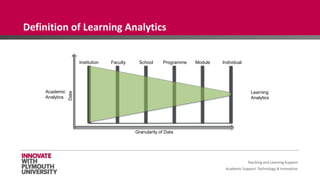
Institution Faculty School Programme Module Individual
Academic
Analytics
Learning
Analytics
Data
Granularity of Data
Academic Support, Technology & Innovation
Teaching and Learning Support
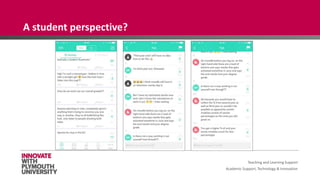
A student perspective?
Academic Support, Technology & Innovation
Teaching and Learning Support
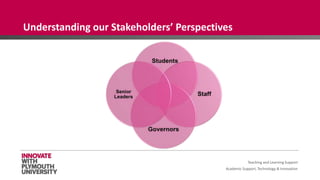
Understanding our Stakeholders’ Perspectives
Academic Support, Technology & Innovation
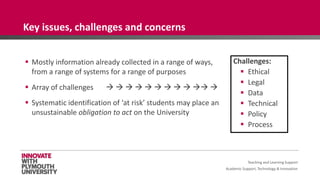
 Mostly information already collected in a range of ways,
from a range of systems for a range of purposes
 Array of challenges           
 Systematic identification of ‘at risk’ students may place an
unsustainable obligation to act on the University
Challenges:
 Ethical
 Legal
 Data
 Technical
 Policy
 Process
Teaching and Learning Support
Key issues, challenges and concerns
Academic Support, Technology & Innovation
 Transparency vital to maintain trust
 High degree of confidence that staff
would deal with their data in a
‘professional way’
 Varied in degree of comfort with easy
access to data about their own
performance - closely monitored
students seemed least worried e.g. health
areas
 Most, but not all, keen to compare their
profile with anonymised cohort average or
an ‘ideal’ student, so consider ‘opt out/in’
 Could motivate some but discourage others
 University’s response to a ‘red flag’ should
not be an automatic process but the start of
a conversation
Teaching and Learning Support
Stakeholder Perspectives:
Students
Academic Support, Technology & Innovation
 More concerns than students over legal /
ethical data use
 Support and training to understand
responsibilities
 Need for openness and transparency
 Focus should be on benefitting student
not institution
 Questioned effect on retention students leave
for many reasons
 Policy changes needed, e.g. attendance
monitoring
 Much of this data is already collected in
disparate ways
 Need to ensure compliance with legislation
for current, retrospective and future use of
data
Teaching and Learning Support
Stakeholder Perspectives:
Academic, Technical & Support Staff
Academic Support, Technology & Innovation
 Need shared vision of what is meant
by Learning Analytics
 Culture of respect for information and
anonymity required
 Concerns about the scope and quality
of current data
 Analytics data should be triangulated
with other information
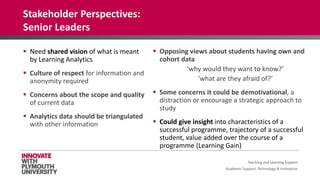
 Opposing views about students having own and
cohort data
‘why would they want to know?’
‘what are they afraid of?’
 Some concerns it could be demotivational, a
distraction or encourage a strategic approach to
study
 Could give insight into characteristics of a
successful programme, trajectory of a successful
student, value added over the course of a
programme (Learning Gain)
Teaching and Learning Support
Stakeholder Perspectives:
Senior Leaders
Academic Support, Technology & Innovation
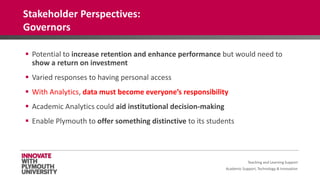
 Potential to increase retention and enhance performance but would need to
show a return on investment
 Varied responses to having personal access
 With Analytics, data must become everyone’s responsibility
 Academic Analytics could aid institutional decision-making
 Enable Plymouth to offer something distinctive to its students
Teaching and Learning Support
Stakeholder Perspectives:
Governors
Academic Support, Technology & Innovation
Teaching and Learning Support
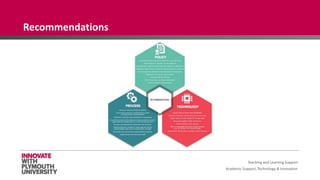
Recommendations
Academic Support, Technology & Innovation
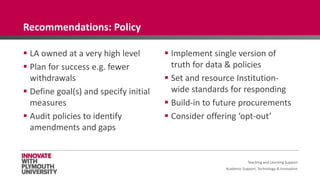
 LA owned at a very high level
 Plan for success e.g. fewer
withdrawals
 Define goal(s) and specify initial
measures
 Audit policies to identify
amendments and gaps
 Implement single version of
truth for data & policies
 Set and resource Institution-
wide standards for responding
 Build-in to future procurements
 Consider offering ‘opt-out’
Teaching and Learning Support
Recommendations: Policy
Academic Support, Technology & Innovation
 Consent agreements and
statements in line with planned use
 Choice of Learning Analytics
solution
 Implement institution-wide
standards for responding
 Governance requires a
multidisciplinary team including
students
 Digital literacy & training for staff
 Be open and transparent,
particularly with students
 Be aware there will be false
negatives/ false positives
 Staff development to make
responsibilities clear and
support policy changes
Teaching and Learning Support
Recommendations: Process
Academic Support, Technology & Innovation
 Bring silos together (e.g. data
warehouse)
 Single version of truth needed
for chosen data
 Specify data currently easily
accessible
 Establish ownership,
stewardship and users of data
 Agreements with 3rd party
provider to reflect new use
 Unique identifier work required
 Work out synergies with other
existing projects (e.g. S3, Mobile
With Plymouth app)
Teaching and Learning Support
Recommendations: Technology
Academic Support, Technology & Innovation
 A response to a ‘red flag’ should not be
an automatic process but the start of a
conversation
 Implement single version of truth for
data and policies
 Policy changes needed, e.g. attendance
monitoring
 Support and training to understand
responsibilities and support policy
changes
 Culture of respect for information
and anonymity required
 Establish ownership, stewardship and
users of data
 Policies and data need to be owned
centrally (i.e. Academic Registry)
 With Analytics, data must become
everyone’s responsibility
Teaching and Learning Support
Institutional Checklist
Academic Support, Technology & Innovation
 Senior Sponsorship is essential
 Single Version of the truth for all data and policies
 Have an “owner” for data and revised/updated/new policies
 Use available solutions (i.e. Jisc toolkit, Mobile With Plymouth, S3)
 Use analytics to support personal tutoring and institutional decision making
 Learning Analytics is about Culture Change, not technology
Teaching and Learning Support
Making it so
Academic Support, Technology & Innovation
Thank you
Questions?

Learning Analytics - What Do Stakeholders Really Think?

  • 1.
    @PlymUniASTI /PlymUniASTIasti@plymouth.ac.ukwww.plymouth.ac.uk/asti Learning Analytics:What Do Stakeholders Really Think? Prof Neil Witt, Dr Anne McDermott, Prof Pauline Kneale & Prof David Coslett
  • 2.
    Academic Support, Technology& Innovation  ASTI and Teaching and Learning Support investigating the potential of using Learning Analytics as a means of enhancing the student experience  Grant from the HEA’s Strategic Excellence Initiative for Vice-Chancellors Background Teaching and Learning Support
  • 3.
    Academic Support, Technology& Innovation  The electronic footprint our students leave behind when they interact with our digital systems e.g. digital learning environment, electronic library, ePortfolio  This and other data sources used to track student engagement and to identify those who may be in danger of failing  Web pages and apps used to present various data visualisations for personal tutors, students and others Teaching and Learning Support Definition of Learning Analytics
  • 4.
    Academic Support, Technology& Innovation Teaching and Learning Support Definition of Learning Analytics Institution Faculty School Programme Module Individual Academic Analytics Learning Analytics Data Granularity of Data
  • 5.
    Academic Support, Technology& Innovation Teaching and Learning Support A student perspective?
  • 6.
    Academic Support, Technology& Innovation Teaching and Learning Support Understanding our Stakeholders’ Perspectives
  • 7.
    Academic Support, Technology& Innovation  Mostly information already collected in a range of ways, from a range of systems for a range of purposes  Array of challenges             Systematic identification of ‘at risk’ students may place an unsustainable obligation to act on the University Challenges:  Ethical  Legal  Data  Technical  Policy  Process Teaching and Learning Support Key issues, challenges and concerns
  • 8.
    Academic Support, Technology& Innovation  Transparency vital to maintain trust  High degree of confidence that staff would deal with their data in a ‘professional way’  Varied in degree of comfort with easy access to data about their own performance - closely monitored students seemed least worried e.g. health areas  Most, but not all, keen to compare their profile with anonymised cohort average or an ‘ideal’ student, so consider ‘opt out/in’  Could motivate some but discourage others  University’s response to a ‘red flag’ should not be an automatic process but the start of a conversation Teaching and Learning Support Stakeholder Perspectives: Students
  • 9.
    Academic Support, Technology& Innovation  More concerns than students over legal / ethical data use  Support and training to understand responsibilities  Need for openness and transparency  Focus should be on benefitting student not institution  Questioned effect on retention students leave for many reasons  Policy changes needed, e.g. attendance monitoring  Much of this data is already collected in disparate ways  Need to ensure compliance with legislation for current, retrospective and future use of data Teaching and Learning Support Stakeholder Perspectives: Academic, Technical & Support Staff
  • 10.
    Academic Support, Technology& Innovation  Need shared vision of what is meant by Learning Analytics  Culture of respect for information and anonymity required  Concerns about the scope and quality of current data  Analytics data should be triangulated with other information  Opposing views about students having own and cohort data ‘why would they want to know?’ ‘what are they afraid of?’  Some concerns it could be demotivational, a distraction or encourage a strategic approach to study  Could give insight into characteristics of a successful programme, trajectory of a successful student, value added over the course of a programme (Learning Gain) Teaching and Learning Support Stakeholder Perspectives: Senior Leaders
  • 11.
    Academic Support, Technology& Innovation  Potential to increase retention and enhance performance but would need to show a return on investment  Varied responses to having personal access  With Analytics, data must become everyone’s responsibility  Academic Analytics could aid institutional decision-making  Enable Plymouth to offer something distinctive to its students Teaching and Learning Support Stakeholder Perspectives: Governors
  • 12.
    Academic Support, Technology& Innovation Teaching and Learning Support Recommendations
  • 13.
    Academic Support, Technology& Innovation  LA owned at a very high level  Plan for success e.g. fewer withdrawals  Define goal(s) and specify initial measures  Audit policies to identify amendments and gaps  Implement single version of truth for data & policies  Set and resource Institution- wide standards for responding  Build-in to future procurements  Consider offering ‘opt-out’ Teaching and Learning Support Recommendations: Policy
  • 14.
    Academic Support, Technology& Innovation  Consent agreements and statements in line with planned use  Choice of Learning Analytics solution  Implement institution-wide standards for responding  Governance requires a multidisciplinary team including students  Digital literacy & training for staff  Be open and transparent, particularly with students  Be aware there will be false negatives/ false positives  Staff development to make responsibilities clear and support policy changes Teaching and Learning Support Recommendations: Process
  • 15.
    Academic Support, Technology& Innovation  Bring silos together (e.g. data warehouse)  Single version of truth needed for chosen data  Specify data currently easily accessible  Establish ownership, stewardship and users of data  Agreements with 3rd party provider to reflect new use  Unique identifier work required  Work out synergies with other existing projects (e.g. S3, Mobile With Plymouth app) Teaching and Learning Support Recommendations: Technology
  • 16.
    Academic Support, Technology& Innovation  A response to a ‘red flag’ should not be an automatic process but the start of a conversation  Implement single version of truth for data and policies  Policy changes needed, e.g. attendance monitoring  Support and training to understand responsibilities and support policy changes  Culture of respect for information and anonymity required  Establish ownership, stewardship and users of data  Policies and data need to be owned centrally (i.e. Academic Registry)  With Analytics, data must become everyone’s responsibility Teaching and Learning Support Institutional Checklist
  • 17.
    Academic Support, Technology& Innovation  Senior Sponsorship is essential  Single Version of the truth for all data and policies  Have an “owner” for data and revised/updated/new policies  Use available solutions (i.e. Jisc toolkit, Mobile With Plymouth, S3)  Use analytics to support personal tutoring and institutional decision making  Learning Analytics is about Culture Change, not technology Teaching and Learning Support Making it so
  • 18.
    Academic Support, Technology& Innovation Thank you Questions?