Transformative Teaching: Applying
Research-based Knowledge and
Principles to enhance Learning
By : Deborah E. Bandahala
Master Teacher 1
Talon-Talon National High School
“The quality of an
education system
cannot exceed
the quality of its
teachers.” (McKinsey,
2007)
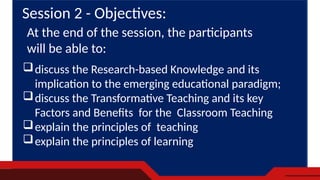
discuss the Research-based Knowledge and its
implication to the emerging educational paradigm;
discuss the Transformative Teaching and its key
Factors and Benefits for the Classroom Teaching
explain the principles of teaching
explain the principles of learning
Session 2 - Objectives:
At the end of the session, the participants
will be able to:
RESEARCH-BASED KNOWLEDGE AND
PRINCIPLES OF TEACHING AND
LEARNING
Philippine
Professional
Standards
For Teachers
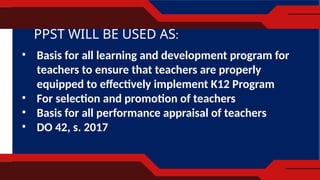
PPST WILL BE USED AS:
• Basis for all learning and development program for
teachers to ensure that teachers are properly
equipped to effectively implement K12 Program
• For selection and promotion of teachers
• Basis for all performance appraisal of teachers
• DO 42, s. 2017
DOMAINS OF PPST
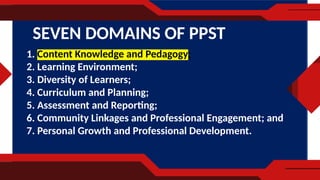
SEVEN DOMAINS OF PPST
1. Content Knowledge and Pedagogy;
2. Learning Environment;
3. Diversity of Learners;
4. Curriculum and Planning;
5. Assessment and Reporting;
6. Community Linkages and Professional Engagement; and
7. Personal Growth and Professional Development.
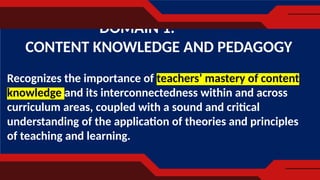
SEVEN DOMAINS OF PPST
Recognizes the importance of teachers’ mastery of content
knowledge and its interconnectedness within and across
curriculum areas, coupled with a sound and critical
understanding of the application of theories and principles
of teaching and learning.
DOMAIN 1.
CONTENT KNOWLEDGE AND PEDAGOGY
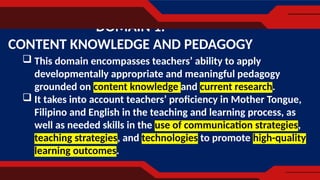
 This domain encompasses teachers’ ability to apply
developmentally appropriate and meaningful pedagogy
grounded on content knowledge and current research.
 It takes into account teachers’ proficiency in Mother Tongue,
Filipino and English in the teaching and learning process, as
well as needed skills in the use of communication strategies,
teaching strategies, and technologies to promote high-quality
learning outcomes.
DOMAIN 1.
CONTENT KNOWLEDGE AND PEDAGOGY
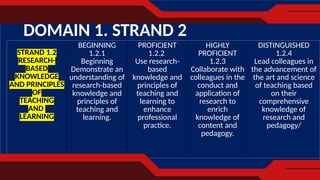
DOMAIN 1. STRAND 2
STRAND 1.2
RESEARCH-
BASED
KNOWLEDGE
AND PRINCIPLES
OF
TEACHING
AND
LEARNING
BEGINNING
1.2.1
Beginning
Demonstrate an
understanding of
research-based
knowledge and
principles of
teaching and
learning.
PROFICIENT
1.2.2
Use research-
based
knowledge and
principles of
teaching and
learning to
enhance
professional
practice.
HIGHLY
PROFICIENT
1.2.3
Collaborate with
colleagues in the
conduct and
application of
research to
enrich
knowledge of
content and
pedagogy.
DISTINGUISHED
1.2.4
Lead colleagues in
the advancement of
the art and science
of teaching based
on their
comprehensive
knowledge of
research and
pedagogy/
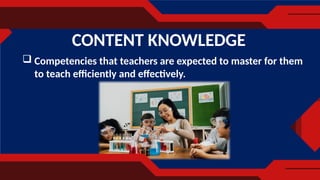
 Competencies that teachers are expected to master for them
to teach efficiently and effectively.
CONTENT KNOWLEDGE
1. Content knowledge and its application within and across curriculum
areas
2. Research-based knowledge and principles of teaching and learning
3. Positive use of ICT
4. Strategies for promoting literacy and numeracy
5. Strategies for developing critical and creative thinking, as well as other
higher-order thinking skills
6. Mother Tongue, Filipino and English in teaching and learning
7. Classroom communication strategies
DOMAIN 1. CONTENT KNOWLEDGE AND PEDAGOGY IS
COMPOSED OF SEVEN STRANDS
RESEARCH-BASED KNOWLEDGE
• Information, knowledge or data acquired through
systematic investigation and logical study
RESEARCH
• Scholarly activity that
consist of addressing a
specific problem through
collection, analysis and
interpretation of data (or
scientific information or
facts) Wa-Mbaleka, 2019
CHARACTERISTICS
SPECIFIC
PROBLEM
EMPIRICAL
SYSTEMATIC
Because it is there to help solve the problem
Based on experience or observation
Follow a specific process and a specific set
of guidelines and principles
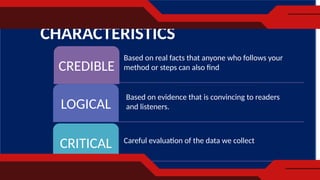
CHARACTERISTICS
CREDIBLE
LOGICAL
CRITICAL
Based on real facts that anyone who follows your
method or steps can also find
Based on evidence that is convincing to readers
and listeners.
Careful evaluation of the data we collect
EDUCATIONAL REFORM
SHOULD BE A BY-
PRODUCT OF RESEARCH
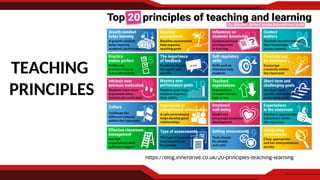
https://blog.innerdrive.co.uk/20-principles-teaching-learning
TEACHING
PRINCIPLES
Transformative
Teaching
ACTIVITY
Mathematics
ACTIVITY
English
ACTIVITY
Science
ACTIVITY
TLE
ACTIVITY
Social Science
ACTIVITY
Physical Science
ACTIVITY
Edukasyon sa Pagpapakatao
(ESP)
ACTIVITY
Filipino
ACTIVITY
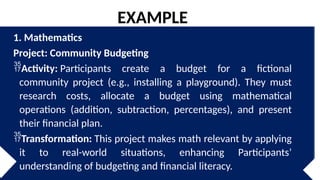
1. Mathematics
Project: Community Budgeting
Activity: Participants create a budget for a fictional
community project (e.g., installing a playground). They must
research costs, allocate a budget using mathematical
operations (addition, subtraction, percentages), and present
their financial plan.
Transformation: This project makes math relevant by applying
it to real-world situations, enhancing Participants’
understanding of budgeting and financial literacy.
EXAMPLE
2. English
Project: Multi-genre Research Paper
Activity: Participants choose a significant social issue (e.g.,
climate change or human rights) and conduct research to write
a multi-genre paper that includes various formats such as
essays, poetry, articles, and art.
Transformation: This approach encourages creativity and
critical thinking, allowing Participants to explore different ways
to express their understanding of a complex issue while
improving their writing skills.
EXAMPLE
3. Science
Project: Environmental Sustainability
Activity: Participants investigate a local environmental issue
(like water pollution) and develop a sustainability project. They
collaborate with local organizations to create a plan that
includes research, experimentation, and proposals for
community workshops.
Transformation: This hands-on project emphasizes scientific
inquiry, data analysis, and community impact, empowering
Participants to apply scientific concepts to real-world challenges.
EXAMPLE
4. Technology and Livelihood Education (TLE)
Project: Entrepreneurial Business Plan
Activity: Participants develop a business plan for a sustainable
product or service, incorporating concepts from marketing,
finance, and production. They create prototypes and pitch their
business ideas to a panel of "investors" (peers or teachers).
Transformation: This project enhances Participants’
understanding of entrepreneurship, critical thinking, and
practical skills while connecting classroom learning to real-world
applications.
EXAMPLE
5. Social Science
Project: Cultural Heritage Fair
Activity: Participants research and present on a culture or
community within their country, creating exhibits,
performances, or presentations that highlight traditions, values,
and historical significance.
Transformation: This project fosters appreciation for diversity
and critical thinking as Participants engage with cultural studies,
encouraging empathy and understanding of different
perspectives.
EXAMPLE
6. Physical Education
Project: Health and Fitness Campaign
Activity: Participants design a health and fitness campaign for
their school, focusing on issues like nutrition, exercise, and
mental well-being. They create materials, host events, and
measure the campaign’s impact on their peers’ health behaviors.
Transformation: This initiative promotes leadership and
advocacy skills, encouraging Participants to take responsibility
for their health and that of their community.
ACTIVITY
7. Edukasyon sa Pagpapakatao (ESP)
Project: Community Service Learning
• Activity: Participants identify a social issue in their
community (e.g., waste management) and develop a
service project to address it. This might include organizing
clean-up drives, awareness campaigns, or partnering with
local NGOs.
• Transformation: By participating in community service,
Participants learn about social responsibility, ethics, and
EXAMPLE
8. Filipino
Project: Filipino Cultural Heritage Documentary
Activity: Participants create a documentary about a
specific aspect of Filipino culture, such as traditional
festivals, cuisine, or regional customs. They research,
conduct interviews, and use multimedia tools to produce
their documentary.
Transformation: This project deepens Participants '
appreciation for their cultural heritage while developing
EXAMPLE
BACKGROUND
Transformative teaching is a
method of instruction that
involves creating an
environment where students are
at the center of the learning
process and are encouraged to
question their assumptions,
values, and beliefs.
V
O
C
A
B
U
L
A
R
https://blog.innerdrive.co.uk/20-principles-teaching-learning
A Paradigm Shift in Education
Transformative teaching is a dynamic
approach to education that goes beyond
simply imparting knowledge.
The Goal of Transformative
Teaching
- is to enhance students' intellectual and
personal growth by helping them
develop a deeper understanding of the
subject matter and their ability to apply
it in real-world contexts
https://blog.innerdrive.co.uk/20-principles-teaching-learning
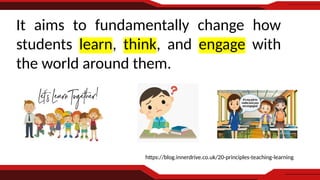
It aims to fundamentally change how
students learn, think, and engage with
the world around them.
https://blog.innerdrive.co.uk/20-principles-teaching-learning
This approach emphasizes the
application of research-based
knowledge and principles to create a
learning environment.
https://blog.innerdrive.co.uk/20-principles-teaching-learning
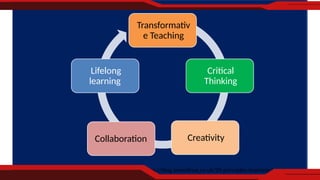
Transformativ
e Teaching
Critical
Thinking
Creativity
Collaboration
Lifelong
learning
https://blog.innerdrive.co.uk/20-principles-teaching-learning
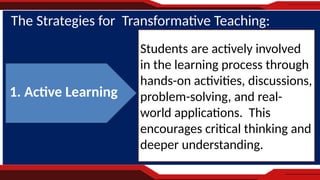
The Strategies for Transformative Teaching:
Students are actively involved
in the learning process through
hands-on activities, discussions,
problem-solving, and real-
world applications. This
encourages critical thinking and
deeper understanding.
1. Active Learning
https://blog.innerdrive.co.uk/20-principles-teaching-learning
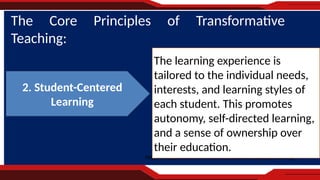
The Core Principles of Transformative
Teaching:
The learning experience is
tailored to the individual needs,
interests, and learning styles of
each student. This promotes
autonomy, self-directed learning,
and a sense of ownership over
their education.

2. Student-Centered
Learning
https://blog.innerdrive.co.uk/20-principles-teaching-learning
The Core Principles of Transformative
Teaching:
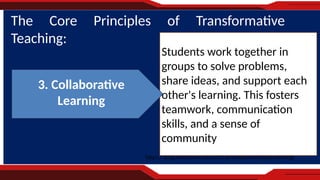
Students work together in
groups to solve problems,
share ideas, and support each
other's learning. This fosters
teamwork, communication
skills, and a sense of
community
3. Collaborative
Learning
https://blog.innerdrive.co.uk/20-principles-teaching-learning
The Core Principles of Transformative
Teaching:
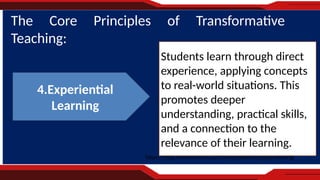
Students learn through direct
experience, applying concepts
to real-world situations. This
promotes deeper
understanding, practical skills,
and a connection to the
relevance of their learning.
4.Experiential
Learning
https://blog.innerdrive.co.uk/20-principles-teaching-learning
The Core Principles of Transformative
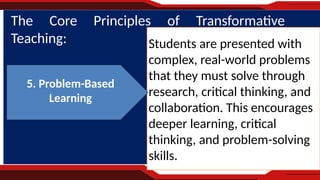
Teaching: Students are presented with
complex, real-world problems
that they must solve through
research, critical thinking, and
collaboration. This encourages
deeper learning, critical
thinking, and problem-solving
skills.
5. Problem-Based
Learning
https://blog.innerdrive.co.uk/20-principles-teaching-learning
Theoretical Underpinnings of Transformative
Teaching :
Transformative teaching is not a one-size-
fits-all approach. It requires teachers to
be flexible, adaptable, and responsive to
the needs of their students.
https://blog.innerdrive.co.uk/20-principles-teaching-learning
Theoretical Underpinnings of Transformative
Teaching :
1. Constructivism
- Learning is an active process where
students construct their own
understanding based on experiences
and interactions with the world.
https://blog.innerdrive.co.uk/20-principles-teaching-learning
Theoretical Underpinnings of Transformative
Teaching :
2. Social Constructivism
- Learning is shaped by social
interactions, cultural contexts, and
collaboration with others.
https://blog.innerdrive.co.uk/20-principles-teaching-learning
Theoretical Underpinnings of Transformative
Teaching :
- Students' beliefs about their abilities
(self-efficacy) play a crucial role in their
motivation, effort, and achievement.
3. Social Cognitive Theory
https://blog.innerdrive.co.uk/20-principles-teaching-learning
Theoretical Underpinnings of Transformative
Teaching :
- Learning involves a process of critical
reflection and transformation of one's
assumptions, beliefs, and perspectives.
4. Transformative Learning Theory
https://blog.innerdrive.co.uk/20-principles-teaching-learning
Theoretical Underpinnings of Transformative
Teaching :
5. Change Theory
- Personal change involves a conscious
process of self-reflection, goal setting,
and deliberate action
https://blog.innerdrive.co.uk/20-principles-teaching-learning
Theoretical Underpinnings of Transformative
Teaching :
5. Change Theory
- Personal change involves a conscious
process of self-reflection, goal setting,
and deliberate action
https://blog.innerdrive.co.uk/20-principles-teaching-learning
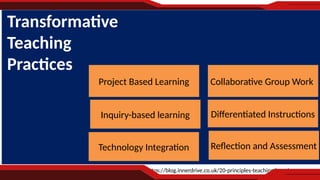
Transformative
Teaching
Practices
Project Based Learning
Inquiry-based learning
Technology Integration Reflection and Assessment
Differentiated Instructions
Collaborative Group Work
https://blog.innerdrive.co.uk/20-principles-teaching-learning
Theoretical Underpinnings of Transformative
Teaching :
The Benefits of Transformative Teaching
1.Increased student engagement and
motivation
2.Improved academic performance
3.Development of higher-order thinking skills
4.Preparation for success in the 21st century
5.Increased teacher satisfaction
Question:
1. As teacher in the modern era,
what transformative teaching
strategy/ies that you would
incorporate in your teaching?
Question:
1. How do you assess the
transformative teaching?
Research-based Knowledge on the
Principles of Teaching to enhance
Learning
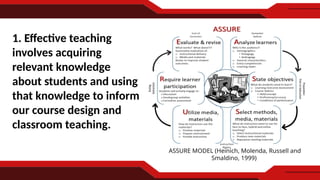
1. Effective teaching
involves acquiring
relevant knowledge
about students and using
that knowledge to inform
our course design and
classroom teaching.
ASSURE MODEL (Heinich, Molenda, Russell and
Smaldino, 1999)
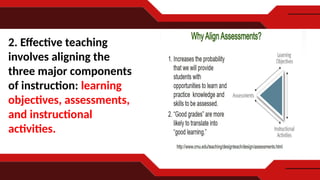
2. Effective teaching
involves aligning the
three major components
of instruction: learning
objectives, assessments,
and instructional
activities.
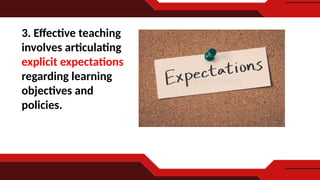
3. Effective teaching
involves articulating
explicit expectations
regarding learning
objectives and
policies.
4. Effective
teaching involves
prioritizing the
knowledge and
skills we choose to
focus on.
5. Effective teaching
involves recognizing
and overcoming our
expert blind spots.
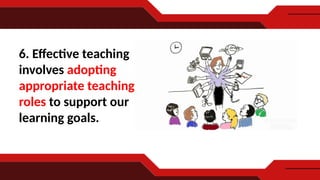
6. Effective teaching
involves adopting
appropriate teaching
roles to support our
learning goals.
7. Effective teaching
involves progressively
refining our courses
based on reflection
and feedback.
8. Effective teaching
involves progressively
refining our courses
based on reflection and
feedback.
Research-based Knowledge
on the Principles of Learning
to enhance Learning
Eberly Center for Teaching Excellence, Carnegie Mellon University
1. Students’ prior
knowledge can help
or hinder learning
To apply this principle, consider the following
teaching techniques:
 Administer a diagnostic assessment or have students
assess their own prior knowledge
 Use brainstorming to reveal prior knowledge.
 Identify discipline-specific conventions explicitly.
 Ask students to make and test predictions.
2. Students’
motivation
determines, directs,
and sustains what
they do to learn
To apply this principle, consider the following
teaching techniques:
 Connect the material to students’ interests.
 Provide authentic, real-world tasks
 Show relevance to students’ current academic lives.
 Provide rubrics
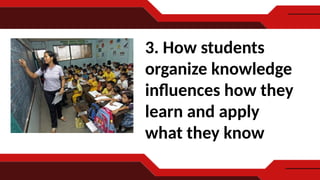
3. How students
organize knowledge
influences how they
learn and apply
what they know
To apply this principle, consider the following
teaching techniques:
 Provide students with the organizational structure of
the course.
 Share the organization of each lecture, lab, or
discussion explicitly
 Make connections among concepts explicit.
 Ask students to draw a concept map to expose their
understanding of how course material is organized.
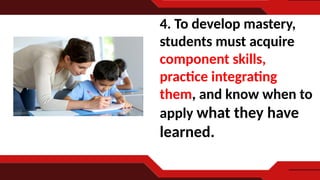
4. To develop mastery,
students must acquire
component skills,
practice integrating
them, and know when to
apply what they have
learned.
To apply this principle, consider the following teachin
techniques:
 Provide isolated practice of weak or missing skills.
 Give students opportunities to practice skills
including low-stakes, ungraded assignments
 Give students opportunities to apply skills or
knowledge in diverse contexts.
 Specify skills or knowledge and ask students to
Identify contexts in which they apply.
5. Goal-directed
practice coupled with
targeted feedback
enhances the quality
of students’ learning
To apply this principle, consider the following
teaching techniques:
 Be explicit about your goals in your course materials
Stage assignments by breaking tasks into smaller
assignments.
 Look for patterns of errors in student work.
 Prioritize your feedback
 Incorporate peer feedback.
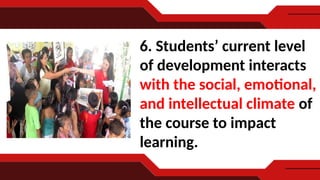
6. Students’ current level
of development interacts
with the social, emotional,
and intellectual climate of
the course to impact
learning.
To apply this principle, consider the
following teaching techniques:
 Make uncertainty safe.
 Examine your assumptions about students.
 Model inclusive language, behavior, and attitudes
 Establish and reinforce ground rules for interaction
 Use the syllabus and first day of class to establish
the course climate
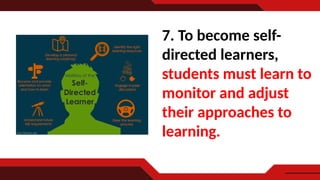
7. To become self-
directed learners,
students must learn to
monitor and adjust
their approaches to
learning.
To apply this principle, consider the
following teaching techniques:
 Check students’ understanding of the task.
 Have students do guided self-assessments.
 Require students to reflect on and annotate their
own work.
 Prompt students to analyze the effectiveness of their
study skills.
 Have students engage in peer feedback.
Question 1. Which
teaching principles that
you would incorporate in
your teaching as
transformative teacher?
Question 2. Which learning
principles that you would
incorporate for your
students in your teaching
as transformative teacher?
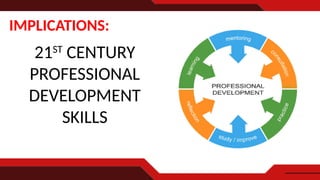
IMPLICATIONS:
21ST
CENTURY
PROFESSIONAL
DEVELOPMENT
SKILLS
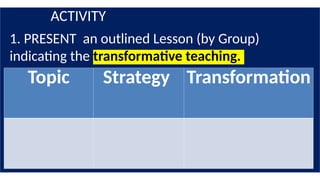
ACTIVITY
1. PRESENT an outlined Lesson (by Group)
indicating the transformative teaching.
Topic Strategy Transformation
REFERENCES:
1. PPST – Domains (DepEd Order 42, s 2017)
2. Eberly Center for Teaching Excellence, Carnegie Mellon University
(n.d.) Theory and Research-based Principles of Learning. Retrieved
from http://www.cmu.edu/teaching/principles/learning.html
3. Ambrose, S., Bridges, M., DiPietro, M., Lovett, M., Norman, M.
(2010) How learning works. San Francisco: Jossey Bass
4. Adapted with permission from Eberly Center for Teaching
Excellence, Carnegie Mellon University, Pittsburgh, Pennsylvania.
5. Vibal Studio: https://www.youtube.com/watch?
v=0B4zXQx62pQ&t=2552s
- required to be lifelong learners, constantly seeking out
new research, best practices, and innovative approaches
to enhance their teaching. By embracing the principles
and practices of transformative teaching, educators can
create a more engaging, effective, and transformative
learning experience for all students.
TRANSFORMATIVE TEACHERS
The purpose of education is
• to teach minds,
 to touch heart and
 to transform lives
(Dr. Capulso, 2020)
- So, at the end of the day, we do
what we are expected to do, to
bring the best from everyone,
from all students who are
entrusted for our care.
+639669975936
Debbie Florida
Debbie Bandahala
deborah.bandahala@deped.gov.ph
Debbie Engkoh
for listening.

Transformative Teaching: Applying Research-based Knowledge and Principles to enhance Learning

  • 1.
    Transformative Teaching: Applying Research-basedKnowledge and Principles to enhance Learning By : Deborah E. Bandahala Master Teacher 1 Talon-Talon National High School
  • 2.
    “The quality ofan education system cannot exceed the quality of its teachers.” (McKinsey, 2007)
  • 3.
    discuss the Research-basedKnowledge and its implication to the emerging educational paradigm; discuss the Transformative Teaching and its key Factors and Benefits for the Classroom Teaching explain the principles of teaching explain the principles of learning Session 2 - Objectives: At the end of the session, the participants will be able to:
  • 4.
  • 5.
  • 6.
    PPST WILL BEUSED AS: • Basis for all learning and development program for teachers to ensure that teachers are properly equipped to effectively implement K12 Program • For selection and promotion of teachers • Basis for all performance appraisal of teachers • DO 42, s. 2017
  • 7.
  • 8.
  • 9.
    1. Content Knowledgeand Pedagogy; 2. Learning Environment; 3. Diversity of Learners; 4. Curriculum and Planning; 5. Assessment and Reporting; 6. Community Linkages and Professional Engagement; and 7. Personal Growth and Professional Development. SEVEN DOMAINS OF PPST
  • 10.
    Recognizes the importanceof teachers’ mastery of content knowledge and its interconnectedness within and across curriculum areas, coupled with a sound and critical understanding of the application of theories and principles of teaching and learning. DOMAIN 1. CONTENT KNOWLEDGE AND PEDAGOGY
  • 11.
     This domainencompasses teachers’ ability to apply developmentally appropriate and meaningful pedagogy grounded on content knowledge and current research.  It takes into account teachers’ proficiency in Mother Tongue, Filipino and English in the teaching and learning process, as well as needed skills in the use of communication strategies, teaching strategies, and technologies to promote high-quality learning outcomes. DOMAIN 1. CONTENT KNOWLEDGE AND PEDAGOGY
  • 12.
    DOMAIN 1. STRAND2 STRAND 1.2 RESEARCH- BASED KNOWLEDGE AND PRINCIPLES OF TEACHING AND LEARNING BEGINNING 1.2.1 Beginning Demonstrate an understanding of research-based knowledge and principles of teaching and learning. PROFICIENT 1.2.2 Use research- based knowledge and principles of teaching and learning to enhance professional practice. HIGHLY PROFICIENT 1.2.3 Collaborate with colleagues in the conduct and application of research to enrich knowledge of content and pedagogy. DISTINGUISHED 1.2.4 Lead colleagues in the advancement of the art and science of teaching based on their comprehensive knowledge of research and pedagogy/
  • 13.
     Competencies thatteachers are expected to master for them to teach efficiently and effectively. CONTENT KNOWLEDGE
  • 14.
    1. Content knowledgeand its application within and across curriculum areas 2. Research-based knowledge and principles of teaching and learning 3. Positive use of ICT 4. Strategies for promoting literacy and numeracy 5. Strategies for developing critical and creative thinking, as well as other higher-order thinking skills 6. Mother Tongue, Filipino and English in teaching and learning 7. Classroom communication strategies DOMAIN 1. CONTENT KNOWLEDGE AND PEDAGOGY IS COMPOSED OF SEVEN STRANDS
  • 15.
    RESEARCH-BASED KNOWLEDGE • Information,knowledge or data acquired through systematic investigation and logical study
  • 16.
    RESEARCH • Scholarly activitythat consist of addressing a specific problem through collection, analysis and interpretation of data (or scientific information or facts) Wa-Mbaleka, 2019
  • 17.
    CHARACTERISTICS SPECIFIC PROBLEM EMPIRICAL SYSTEMATIC Because it isthere to help solve the problem Based on experience or observation Follow a specific process and a specific set of guidelines and principles
  • 18.
    CHARACTERISTICS CREDIBLE LOGICAL CRITICAL Based on realfacts that anyone who follows your method or steps can also find Based on evidence that is convincing to readers and listeners. Careful evaluation of the data we collect
  • 19.
    EDUCATIONAL REFORM SHOULD BEA BY- PRODUCT OF RESEARCH
  • 21.
  • 22.
  • 23.
  • 24.
  • 25.
  • 26.
  • 27.
  • 28.
  • 29.
  • 30.
  • 31.
    1. Mathematics Project: CommunityBudgeting Activity: Participants create a budget for a fictional community project (e.g., installing a playground). They must research costs, allocate a budget using mathematical operations (addition, subtraction, percentages), and present their financial plan. Transformation: This project makes math relevant by applying it to real-world situations, enhancing Participants’ understanding of budgeting and financial literacy. EXAMPLE
  • 32.
    2. English Project: Multi-genreResearch Paper Activity: Participants choose a significant social issue (e.g., climate change or human rights) and conduct research to write a multi-genre paper that includes various formats such as essays, poetry, articles, and art. Transformation: This approach encourages creativity and critical thinking, allowing Participants to explore different ways to express their understanding of a complex issue while improving their writing skills. EXAMPLE
  • 33.
    3. Science Project: EnvironmentalSustainability Activity: Participants investigate a local environmental issue (like water pollution) and develop a sustainability project. They collaborate with local organizations to create a plan that includes research, experimentation, and proposals for community workshops. Transformation: This hands-on project emphasizes scientific inquiry, data analysis, and community impact, empowering Participants to apply scientific concepts to real-world challenges. EXAMPLE
  • 34.
    4. Technology andLivelihood Education (TLE) Project: Entrepreneurial Business Plan Activity: Participants develop a business plan for a sustainable product or service, incorporating concepts from marketing, finance, and production. They create prototypes and pitch their business ideas to a panel of "investors" (peers or teachers). Transformation: This project enhances Participants’ understanding of entrepreneurship, critical thinking, and practical skills while connecting classroom learning to real-world applications. EXAMPLE
  • 35.
    5. Social Science Project:Cultural Heritage Fair Activity: Participants research and present on a culture or community within their country, creating exhibits, performances, or presentations that highlight traditions, values, and historical significance. Transformation: This project fosters appreciation for diversity and critical thinking as Participants engage with cultural studies, encouraging empathy and understanding of different perspectives. EXAMPLE
  • 36.
    6. Physical Education Project:Health and Fitness Campaign Activity: Participants design a health and fitness campaign for their school, focusing on issues like nutrition, exercise, and mental well-being. They create materials, host events, and measure the campaign’s impact on their peers’ health behaviors. Transformation: This initiative promotes leadership and advocacy skills, encouraging Participants to take responsibility for their health and that of their community. ACTIVITY
  • 37.
    7. Edukasyon saPagpapakatao (ESP) Project: Community Service Learning • Activity: Participants identify a social issue in their community (e.g., waste management) and develop a service project to address it. This might include organizing clean-up drives, awareness campaigns, or partnering with local NGOs. • Transformation: By participating in community service, Participants learn about social responsibility, ethics, and EXAMPLE
  • 38.
    8. Filipino Project: FilipinoCultural Heritage Documentary Activity: Participants create a documentary about a specific aspect of Filipino culture, such as traditional festivals, cuisine, or regional customs. They research, conduct interviews, and use multimedia tools to produce their documentary. Transformation: This project deepens Participants ' appreciation for their cultural heritage while developing EXAMPLE
  • 39.
    BACKGROUND Transformative teaching isa method of instruction that involves creating an environment where students are at the center of the learning process and are encouraged to question their assumptions, values, and beliefs. V O C A B U L A R
  • 40.
    https://blog.innerdrive.co.uk/20-principles-teaching-learning A Paradigm Shiftin Education Transformative teaching is a dynamic approach to education that goes beyond simply imparting knowledge.
  • 41.
    The Goal ofTransformative Teaching - is to enhance students' intellectual and personal growth by helping them develop a deeper understanding of the subject matter and their ability to apply it in real-world contexts
  • 42.
    https://blog.innerdrive.co.uk/20-principles-teaching-learning It aims tofundamentally change how students learn, think, and engage with the world around them.
  • 43.
    https://blog.innerdrive.co.uk/20-principles-teaching-learning This approach emphasizesthe application of research-based knowledge and principles to create a learning environment.
  • 44.
  • 45.
    https://blog.innerdrive.co.uk/20-principles-teaching-learning The Strategies forTransformative Teaching: Students are actively involved in the learning process through hands-on activities, discussions, problem-solving, and real- world applications. This encourages critical thinking and deeper understanding. 1. Active Learning
  • 46.
    https://blog.innerdrive.co.uk/20-principles-teaching-learning The Core Principlesof Transformative Teaching: The learning experience is tailored to the individual needs, interests, and learning styles of each student. This promotes autonomy, self-directed learning, and a sense of ownership over their education. 2. Student-Centered Learning

  • 47.
    https://blog.innerdrive.co.uk/20-principles-teaching-learning The Core Principlesof Transformative Teaching: Students work together in groups to solve problems, share ideas, and support each other's learning. This fosters teamwork, communication skills, and a sense of community 3. Collaborative Learning
  • 48.
    https://blog.innerdrive.co.uk/20-principles-teaching-learning The Core Principlesof Transformative Teaching: Students learn through direct experience, applying concepts to real-world situations. This promotes deeper understanding, practical skills, and a connection to the relevance of their learning. 4.Experiential Learning
  • 49.
    https://blog.innerdrive.co.uk/20-principles-teaching-learning The Core Principlesof Transformative Teaching: Students are presented with complex, real-world problems that they must solve through research, critical thinking, and collaboration. This encourages deeper learning, critical thinking, and problem-solving skills. 5. Problem-Based Learning
  • 50.
    https://blog.innerdrive.co.uk/20-principles-teaching-learning Theoretical Underpinnings ofTransformative Teaching : Transformative teaching is not a one-size- fits-all approach. It requires teachers to be flexible, adaptable, and responsive to the needs of their students.
  • 51.
    https://blog.innerdrive.co.uk/20-principles-teaching-learning Theoretical Underpinnings ofTransformative Teaching : 1. Constructivism - Learning is an active process where students construct their own understanding based on experiences and interactions with the world.
  • 52.
    https://blog.innerdrive.co.uk/20-principles-teaching-learning Theoretical Underpinnings ofTransformative Teaching : 2. Social Constructivism - Learning is shaped by social interactions, cultural contexts, and collaboration with others.
  • 53.
    https://blog.innerdrive.co.uk/20-principles-teaching-learning Theoretical Underpinnings ofTransformative Teaching : - Students' beliefs about their abilities (self-efficacy) play a crucial role in their motivation, effort, and achievement. 3. Social Cognitive Theory
  • 54.
    https://blog.innerdrive.co.uk/20-principles-teaching-learning Theoretical Underpinnings ofTransformative Teaching : - Learning involves a process of critical reflection and transformation of one's assumptions, beliefs, and perspectives. 4. Transformative Learning Theory
  • 55.
    https://blog.innerdrive.co.uk/20-principles-teaching-learning Theoretical Underpinnings ofTransformative Teaching : 5. Change Theory - Personal change involves a conscious process of self-reflection, goal setting, and deliberate action
  • 56.
    https://blog.innerdrive.co.uk/20-principles-teaching-learning Theoretical Underpinnings ofTransformative Teaching : 5. Change Theory - Personal change involves a conscious process of self-reflection, goal setting, and deliberate action
  • 57.
    https://blog.innerdrive.co.uk/20-principles-teaching-learning Transformative Teaching Practices Project Based Learning Inquiry-basedlearning Technology Integration Reflection and Assessment Differentiated Instructions Collaborative Group Work
  • 58.
    https://blog.innerdrive.co.uk/20-principles-teaching-learning Theoretical Underpinnings ofTransformative Teaching : The Benefits of Transformative Teaching 1.Increased student engagement and motivation 2.Improved academic performance 3.Development of higher-order thinking skills 4.Preparation for success in the 21st century 5.Increased teacher satisfaction
  • 59.
    Question: 1. As teacherin the modern era, what transformative teaching strategy/ies that you would incorporate in your teaching?
  • 60.
    Question: 1. How doyou assess the transformative teaching?
  • 61.
    Research-based Knowledge onthe Principles of Teaching to enhance Learning
  • 62.
    1. Effective teaching involvesacquiring relevant knowledge about students and using that knowledge to inform our course design and classroom teaching. ASSURE MODEL (Heinich, Molenda, Russell and Smaldino, 1999)
  • 63.
    2. Effective teaching involvesaligning the three major components of instruction: learning objectives, assessments, and instructional activities.
  • 64.
    3. Effective teaching involvesarticulating explicit expectations regarding learning objectives and policies.
  • 65.
    4. Effective teaching involves prioritizingthe knowledge and skills we choose to focus on.
  • 66.

    5. Effective teaching involvesrecognizing and overcoming our expert blind spots.
  • 67.
    6. Effective teaching involvesadopting appropriate teaching roles to support our learning goals.
  • 68.
    7. Effective teaching involvesprogressively refining our courses based on reflection and feedback.
  • 69.
    8. Effective teaching involvesprogressively refining our courses based on reflection and feedback.
  • 70.
    Research-based Knowledge on thePrinciples of Learning to enhance Learning Eberly Center for Teaching Excellence, Carnegie Mellon University
  • 71.
    1. Students’ prior knowledgecan help or hinder learning
  • 72.
    To apply thisprinciple, consider the following teaching techniques:  Administer a diagnostic assessment or have students assess their own prior knowledge  Use brainstorming to reveal prior knowledge.  Identify discipline-specific conventions explicitly.  Ask students to make and test predictions.
  • 73.
  • 74.
    To apply thisprinciple, consider the following teaching techniques:  Connect the material to students’ interests.  Provide authentic, real-world tasks  Show relevance to students’ current academic lives.  Provide rubrics
  • 75.
    3. How students organizeknowledge influences how they learn and apply what they know
  • 76.
    To apply thisprinciple, consider the following teaching techniques:  Provide students with the organizational structure of the course.  Share the organization of each lecture, lab, or discussion explicitly  Make connections among concepts explicit.  Ask students to draw a concept map to expose their understanding of how course material is organized.
  • 77.
    4. To developmastery, students must acquire component skills, practice integrating them, and know when to apply what they have learned.
  • 78.
    To apply thisprinciple, consider the following teachin techniques:  Provide isolated practice of weak or missing skills.  Give students opportunities to practice skills including low-stakes, ungraded assignments  Give students opportunities to apply skills or knowledge in diverse contexts.  Specify skills or knowledge and ask students to Identify contexts in which they apply.
  • 79.
    5. Goal-directed practice coupledwith targeted feedback enhances the quality of students’ learning
  • 80.
    To apply thisprinciple, consider the following teaching techniques:  Be explicit about your goals in your course materials Stage assignments by breaking tasks into smaller assignments.  Look for patterns of errors in student work.  Prioritize your feedback  Incorporate peer feedback.
  • 81.
    6. Students’ currentlevel of development interacts with the social, emotional, and intellectual climate of the course to impact learning.
  • 82.
    To apply thisprinciple, consider the following teaching techniques:  Make uncertainty safe.  Examine your assumptions about students.  Model inclusive language, behavior, and attitudes  Establish and reinforce ground rules for interaction  Use the syllabus and first day of class to establish the course climate
  • 83.
    7. To becomeself- directed learners, students must learn to monitor and adjust their approaches to learning.
  • 84.
    To apply thisprinciple, consider the following teaching techniques:  Check students’ understanding of the task.  Have students do guided self-assessments.  Require students to reflect on and annotate their own work.  Prompt students to analyze the effectiveness of their study skills.  Have students engage in peer feedback.
  • 85.
    Question 1. Which teachingprinciples that you would incorporate in your teaching as transformative teacher? Question 2. Which learning principles that you would incorporate for your students in your teaching as transformative teacher?
  • 86.
  • 87.
    ACTIVITY 1. PRESENT anoutlined Lesson (by Group) indicating the transformative teaching. Topic Strategy Transformation
  • 88.
    REFERENCES: 1. PPST –Domains (DepEd Order 42, s 2017) 2. Eberly Center for Teaching Excellence, Carnegie Mellon University (n.d.) Theory and Research-based Principles of Learning. Retrieved from http://www.cmu.edu/teaching/principles/learning.html 3. Ambrose, S., Bridges, M., DiPietro, M., Lovett, M., Norman, M. (2010) How learning works. San Francisco: Jossey Bass 4. Adapted with permission from Eberly Center for Teaching Excellence, Carnegie Mellon University, Pittsburgh, Pennsylvania. 5. Vibal Studio: https://www.youtube.com/watch? v=0B4zXQx62pQ&t=2552s
  • 89.
    - required tobe lifelong learners, constantly seeking out new research, best practices, and innovative approaches to enhance their teaching. By embracing the principles and practices of transformative teaching, educators can create a more engaging, effective, and transformative learning experience for all students. TRANSFORMATIVE TEACHERS
  • 90.
    The purpose ofeducation is • to teach minds,  to touch heart and  to transform lives (Dr. Capulso, 2020)
  • 91.
    - So, atthe end of the day, we do what we are expected to do, to bring the best from everyone, from all students who are entrusted for our care.
  • 92.
  • 93.