TRANSCRIPTION AND ITS
REGULATION
SUPERVISED BY
DR. SHAH HASSAN.
PRESENTED BY KEHKASHAN SABIR.
BS CHEMISTRY
ISLAMIA COLLEGE UNIVERSITY
Transcription
TRANSCRIPTION IS THE FIRST STEP OF GENE EXPRESSION, IN
WHICH A PARTICULAR SEGMENT OF DNA IS COPIED INTO RNA
(ESPECIALLY MRNA) BY THE ENZYME RNA POLYMERASE.
OR
DNA TRANSCRIPTION IS THE PROCESS IN WHICH DNA IS COPIED
INTO RNA; AS A RESULT THE PROCESS CAN ALSO BE CALLED RNA
SYNTHESIS.
1) CHAIN INITIATION
 During initiation, RNA Polymerase binds to the promotor region of the
gene.
 This is region where the majority of gene expression is controlled.
 Binding causes the DNA double helix to unwind and open.
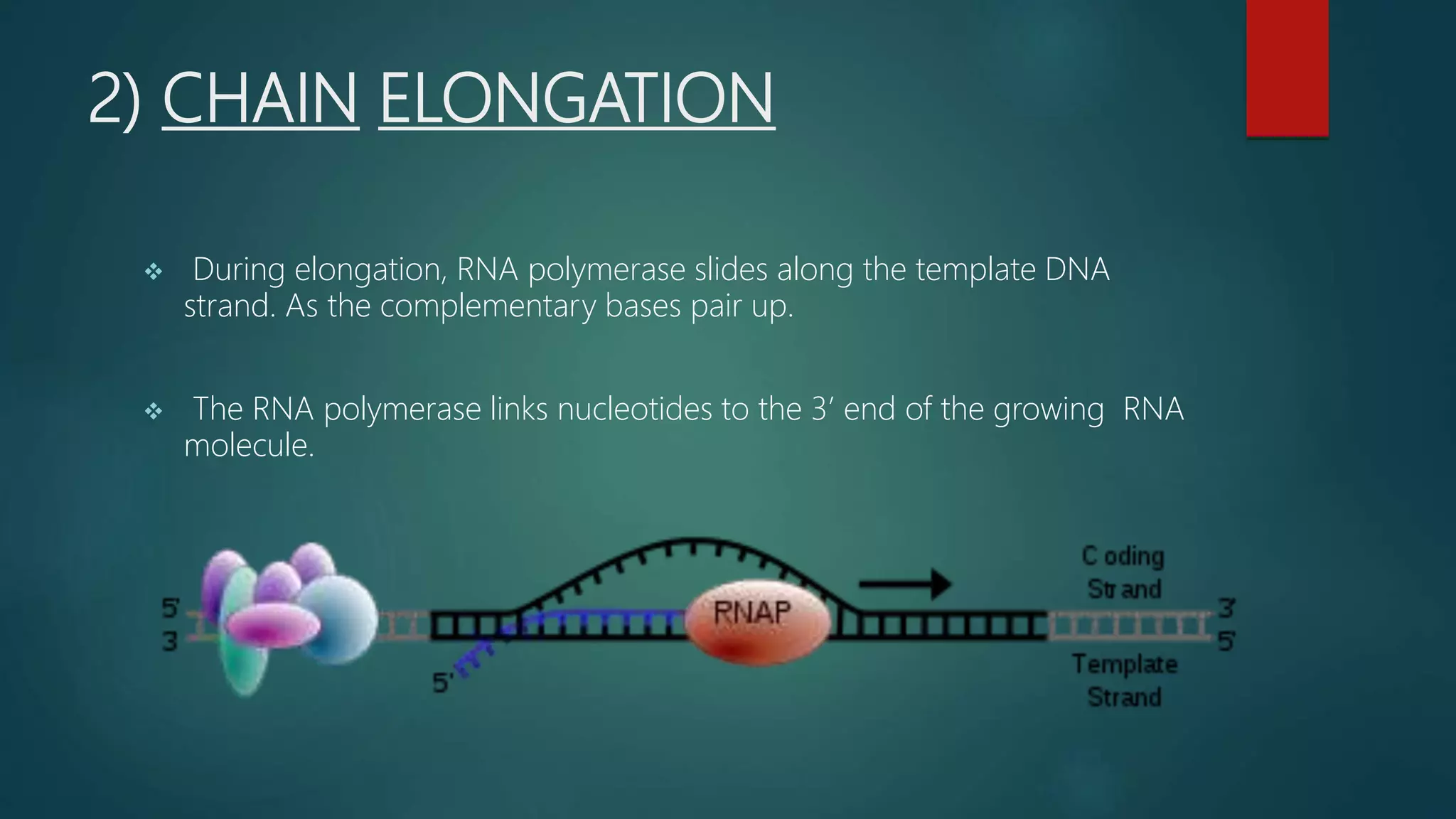
2) CHAIN ELONGATION
 During elongation, RNA polymerase slides along the template DNA
strand. As the complementary bases pair up.
 The RNA polymerase links nucleotides to the 3’ end of the growing RNA
molecule.
3) CHAIN Termination
 As the RNA polymerase reaches the terminator region of the gene, the
mRNA transcript is complete.
 Then the RNA polymerase, DNA stand and mRNA transcript dissociate
from each other.
DNA TRANSCRIPTION
TRANSCRIPTION
FACTORS
 TRANSCRIPTION IS REGULATED BY PROTEINS CALLED
TRANSCRIPTION FACTORS.
 TRANSCRIPTION FACTOR IS A PROTEIN THAT PRODUCE IN
CYTOPLASM AND EVENTUALLY MIGRATED IN TO THE NUCLEUS
,WHERE IT INTERACT WITH DNA AND STARTS TRANSCRIPTION.
 T.F THAT BINDS TO A DNA IN A SEQUENCE SPECIFIC MANNER
TO REGULATE TRANSCRIPTION.
Transcriptional Regulation
 Transcriptional regulation is about controlling how often a given gene is
transcribed.
 Once an RNA polymerase starts to transcribe, it continues to transcribe
until reaches the end of the gene.
 Transcription initiation is regulated by additional proteins, known
as activators and repressors.
Enhancer/Activator
 An Enhancer : is a DNA sequence located upstream or downstream of the promoter
region.
• An activator: is a regulatory protein that binds to enhancer sequence.
Enhancer/Activator
• Activators contain:
• A DNA binding domain: a location in the protein binds to DNA (enhancer
sequence).
• A protein binding domain: a location in the protein that binds to the
transcription initiation complex.
Enhancer/Activator
• When an activator binds to the enhancer sequence away from the promoter,
DNA loops so that the activator is in contact with the initiation complex.
• The activator interacts with the transcription initiation complex and give
signal to RNA polymerase to start transcription.
• Gene is turned ON and mRNA is made.
Enhancer/Activator regulates the
initiation of transcription by turning
ON
Regulation of transcription initiation
Silencer/Repressor
 A silencer: is a DNA sequence located upstream or downstream of the promoter
region.
 A Repressor is a regulatory protein that binds to silencer sequence.
Silencer/Repressor
 Repressors contain:
• A DNA binding domain: a location in the protein binds to DNA (silencer
sequence).
• A protein binding domain: a location in the protein that binds to the
transcription initiation complex.
Silencer/Repressor
• When an repressor binds to silencer sequence away from the promoter,
DNA loops so that the repressor is in contact with the initiation complex.
• The repressor interacts with the transcription initiation complex and
prevents the initiation of transcription.
• No mRNA is made.
Silencer/Repressor
Genetic
code
 The set of DNA and RNA sequences that
 determine the amino acid sequences used in th
e synthesis of an organism's proteins.
 It is the biochemical basis of heredity and
nearly universal in all organisms.
The genetic code is highly
similar among all organisms
and can be expressed in a
simple table with 64 entries.
Anti codon
The anticodon region is
a sequence of three
bases that are
complementary to a
codon in the messenger
RNA.
 The start codon is the first codon of a messenger RNA
(mRNA) transcript translated by a ribosome. The start codon
always codes for methionine in eukaryotes and a modified Met
(fMet) in prokaryotes. The most common start codon is AUG.
Start codon 28
STOP CODON
 In the genetic code, a stop codon (or termination
codon) is a nucleotide triplet within messenger RNA
that signals a termination of translation.
 Proteins are based on polypeptides, which are unique
sequences of amino acids.
• The reading of mRNA is always in the same
direction 5’ to 3’ (the same way as
transcription and replication).
• The code is universal for all organisms.
Transcription presentation

Transcription presentation

  • 2.
    TRANSCRIPTION AND ITS REGULATION SUPERVISEDBY DR. SHAH HASSAN. PRESENTED BY KEHKASHAN SABIR. BS CHEMISTRY ISLAMIA COLLEGE UNIVERSITY
  • 3.
    Transcription TRANSCRIPTION IS THEFIRST STEP OF GENE EXPRESSION, IN WHICH A PARTICULAR SEGMENT OF DNA IS COPIED INTO RNA (ESPECIALLY MRNA) BY THE ENZYME RNA POLYMERASE. OR DNA TRANSCRIPTION IS THE PROCESS IN WHICH DNA IS COPIED INTO RNA; AS A RESULT THE PROCESS CAN ALSO BE CALLED RNA SYNTHESIS.
  • 4.
    1) CHAIN INITIATION During initiation, RNA Polymerase binds to the promotor region of the gene.  This is region where the majority of gene expression is controlled.  Binding causes the DNA double helix to unwind and open.
  • 5.
    2) CHAIN ELONGATION During elongation, RNA polymerase slides along the template DNA strand. As the complementary bases pair up.  The RNA polymerase links nucleotides to the 3’ end of the growing RNA molecule.
  • 6.
    3) CHAIN Termination As the RNA polymerase reaches the terminator region of the gene, the mRNA transcript is complete.  Then the RNA polymerase, DNA stand and mRNA transcript dissociate from each other.
  • 7.
  • 8.
    TRANSCRIPTION FACTORS  TRANSCRIPTION ISREGULATED BY PROTEINS CALLED TRANSCRIPTION FACTORS.  TRANSCRIPTION FACTOR IS A PROTEIN THAT PRODUCE IN CYTOPLASM AND EVENTUALLY MIGRATED IN TO THE NUCLEUS ,WHERE IT INTERACT WITH DNA AND STARTS TRANSCRIPTION.  T.F THAT BINDS TO A DNA IN A SEQUENCE SPECIFIC MANNER TO REGULATE TRANSCRIPTION.
  • 9.
    Transcriptional Regulation  Transcriptionalregulation is about controlling how often a given gene is transcribed.  Once an RNA polymerase starts to transcribe, it continues to transcribe until reaches the end of the gene.  Transcription initiation is regulated by additional proteins, known as activators and repressors.
  • 10.
    Enhancer/Activator  An Enhancer: is a DNA sequence located upstream or downstream of the promoter region. • An activator: is a regulatory protein that binds to enhancer sequence.
  • 11.
    Enhancer/Activator • Activators contain: •A DNA binding domain: a location in the protein binds to DNA (enhancer sequence). • A protein binding domain: a location in the protein that binds to the transcription initiation complex.
  • 13.
    Enhancer/Activator • When anactivator binds to the enhancer sequence away from the promoter, DNA loops so that the activator is in contact with the initiation complex. • The activator interacts with the transcription initiation complex and give signal to RNA polymerase to start transcription. • Gene is turned ON and mRNA is made.
  • 14.
    Enhancer/Activator regulates the initiationof transcription by turning ON
  • 15.
    Regulation of transcriptioninitiation Silencer/Repressor  A silencer: is a DNA sequence located upstream or downstream of the promoter region.  A Repressor is a regulatory protein that binds to silencer sequence.
  • 16.
    Silencer/Repressor  Repressors contain: •A DNA binding domain: a location in the protein binds to DNA (silencer sequence). • A protein binding domain: a location in the protein that binds to the transcription initiation complex.
  • 17.
    Silencer/Repressor • When anrepressor binds to silencer sequence away from the promoter, DNA loops so that the repressor is in contact with the initiation complex. • The repressor interacts with the transcription initiation complex and prevents the initiation of transcription. • No mRNA is made.
  • 18.
  • 20.
    Genetic code  The setof DNA and RNA sequences that  determine the amino acid sequences used in th e synthesis of an organism's proteins.  It is the biochemical basis of heredity and nearly universal in all organisms.
  • 21.
    The genetic codeis highly similar among all organisms and can be expressed in a simple table with 64 entries.
  • 26.
    Anti codon The anticodonregion is a sequence of three bases that are complementary to a codon in the messenger RNA.
  • 28.
     The startcodon is the first codon of a messenger RNA (mRNA) transcript translated by a ribosome. The start codon always codes for methionine in eukaryotes and a modified Met (fMet) in prokaryotes. The most common start codon is AUG. Start codon 28
  • 29.
    STOP CODON  Inthe genetic code, a stop codon (or termination codon) is a nucleotide triplet within messenger RNA that signals a termination of translation.  Proteins are based on polypeptides, which are unique sequences of amino acids.
  • 30.
    • The readingof mRNA is always in the same direction 5’ to 3’ (the same way as transcription and replication). • The code is universal for all organisms.