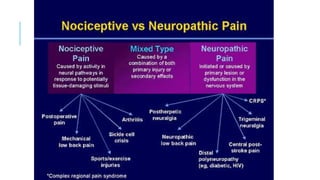
NEUROPATHIC PAIN AND
ITS MANAGEMENT
Presenter: Dr. Darendrajit
IASP DEFINITION (1994)
•Pain initiated or caused by a primary lesion or dysfunction of the
nervous system
NEW DEFINITION
•Pain arising as a direct consequence of a lesion or disease
affecting the somatosensory system
•CNS and/or PNS
Dysfunction
Nervous system
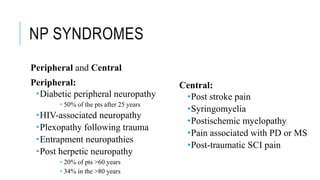
NP SYNDROMES
Peripheral and Central
Peripheral:
Diabetic peripheral neuropathy
 50% of the pts after 25 years
HIV-associated neuropathy
Plexopathy following trauma
Entrapment neuropathies
Post herpetic neuropathy
 20% of pts >60 years
 34% in the >80 years
Central:
•Post stroke pain
•Syringomyelia
•Postischemic myelopathy
•Pain associated with PD or MS
•Post-traumatic SCI pain
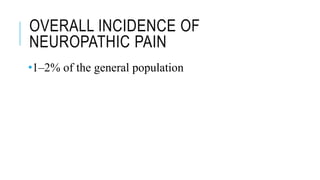
OVERALL INCIDENCE OF
NEUROPATHIC PAIN
•1–2% of the general population
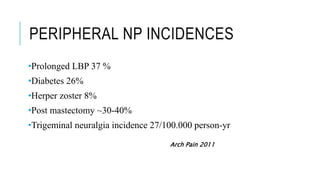
PERIPHERAL NP INCIDENCES
•Prolonged LBP 37 %
•Diabetes 26%
•Herper zoster 8%
•Post mastectomy ~30-40%
•Trigeminal neuralgia incidence 27/100.000 person-yr
Arch Pain 2011
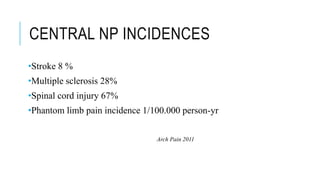
CENTRAL NP INCIDENCES
•Stroke 8 %
•Multiple sclerosis 28%
•Spinal cord injury 67%
•Phantom limb pain incidence 1/100.000 person-yr
Arch Pain 2011
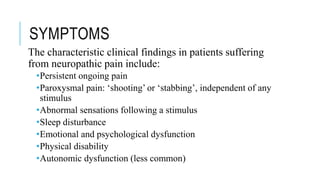
SYMPTOMS
The characteristic clinical findings in patients suffering
from neuropathic pain include:
•Persistent ongoing pain
•Paroxysmal pain: ‘shooting’ or ‘stabbing’, independent of any
stimulus
•Abnormal sensations following a stimulus
•Sleep disturbance
•Emotional and psychological dysfunction
•Physical disability
•Autonomic dysfunction (less common)
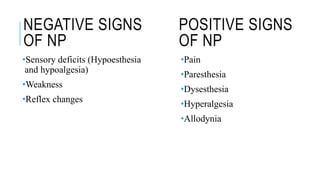
POSITIVE SIGNS
OF NP
•Pain
•Paresthesia
•Dysesthesia
•Hyperalgesia
•Allodynia
NEGATIVE SIGNS
OF NP
•Sensory deficits (Hypoesthesia
and hypoalgesia)
•Weakness
•Reflex changes
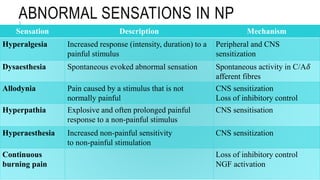
ABNORMAL SENSATIONS IN NP
Sensation Description Mechanism
Hyperalgesia Increased response (intensity, duration) to a
painful stimulus
Peripheral and CNS
sensitization
Dysaesthesia Spontaneous evoked abnormal sensation Spontaneous activity in C/A𝛿
afferent fibres
Allodynia Pain caused by a stimulus that is not
normally painful
CNS sensitization
Loss of inhibitory control
Hyperpathia Explosive and often prolonged painful
response to a non-painful stimulus
CNS sensitisation
Hyperaesthesia Increased non-painful sensitivity
to non-painful stimulation
CNS sensitization
Continuous
burning pain
Loss of inhibitory control
NGF activation
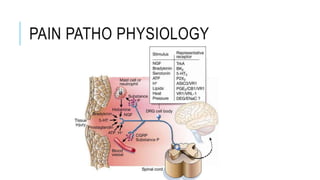
PAIN PATHO PHYSIOLOGY
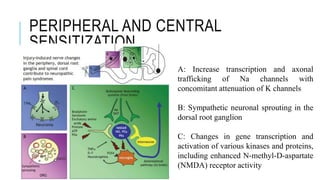
PERIPHERAL AND CENTRAL
SENSITIZATION
A: Increase transcription and axonal
trafficking of Na channels with
concomitant attenuation of K channels
B: Sympathetic neuronal sprouting in the
dorsal root ganglion
C: Changes in gene transcription and
activation of various kinases and proteins,
including enhanced N-methyl-D-aspartate
(NMDA) receptor activity
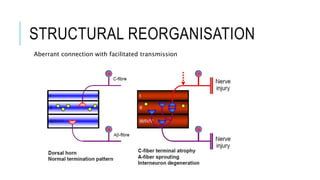
STRUCTURAL REORGANISATION
Aberrant connection with facilitated transmission
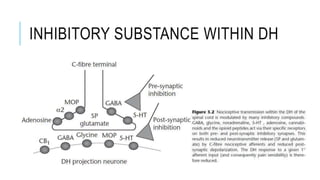
INHIBITORY SUBSTANCE WITHIN DH
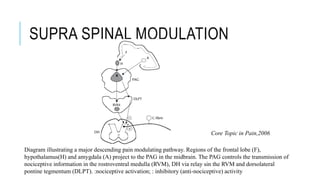
SUPRA SPINAL MODULATION
Diagram illustrating a major descending pain modulating pathway. Regions of the frontal lobe (F),
hypothalamus(H) and amygdala (A) project to the PAG in the midbrain. The PAG controls the transmission of
nociceptive information in the rostroventral medulla (RVM), DH via relay sin the RVM and dorsolateral
pontine tegmentum (DLPT). :nociceptive activation; : inhibitory (anti-nociceptive) activity
Core Topic in Pain,2006
ASSESSMENT: HISTORY
•Presence of abnormal sensations including site and area
•Evidence of any underlying pathology (infection, metabolic, autoimmune deficiency or
malignancy)
•Descriptors: McGill pain questionnaire (MPQ)
•Response to therapies (check if given in adequate doses – side effects may not permit)
•Quality of life (SF-36)
•Additional screening for emotional and psychological profiling
•Sleep disturbance
•Physical disability
PHYSICAL EXAMINATION
A bedside neurological examination that covers sensory testing
will:
•Provide valuable mapping of the affected areas
•Monitor future progress of the pain syndrome
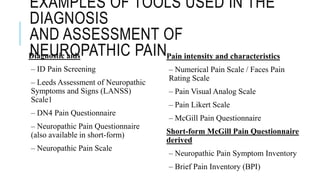
EXAMPLES OF TOOLS USED IN THE
DIAGNOSIS
AND ASSESSMENT OF
NEUROPATHIC PAINDiagnostic aids
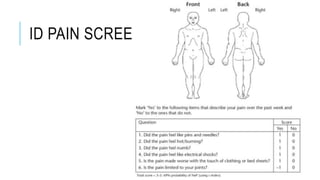
– ID Pain Screening
– Leeds Assessment of Neuropathic
Symptoms and Signs (LANSS)
Scale1
– DN4 Pain Questionnaire
– Neuropathic Pain Questionnaire
(also available in short-form)
– Neuropathic Pain Scale
Pain intensity and characteristics
– Numerical Pain Scale / Faces Pain
Rating Scale
– Pain Visual Analog Scale
– Pain Likert Scale
– McGill Pain Questionnaire
Short-form McGill Pain Questionnaire
derived
– Neuropathic Pain Symptom Inventory
– Brief Pain Inventory (BPI)
ID PAIN SCREENING
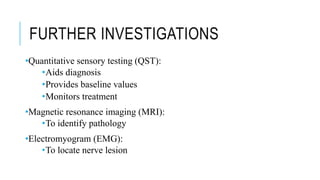
FURTHER INVESTIGATIONS
•Quantitative sensory testing (QST):
•Aids diagnosis
•Provides baseline values
•Monitors treatment
•Magnetic resonance imaging (MRI):
•To identify pathology
•Electromyogram (EMG):
•To locate nerve lesion
MANAGEMENT
NON-PHARMACOLOGIC OPTIONS
•Physical and Occupational Therapy
•Acupuncture
•Biofeedback
•Relaxation therapy
•Cognitive Behavioral strategies
•Meditation, guided imagery
•TENS
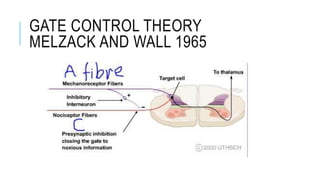
GATE CONTROL THEORY
MELZACK AND WALL 1965
TENS
•Frequency of 80 Hz, pulse width 350 µs, and currents up to 60 mA, 20
sessions, 30 minutes
•Significant improvements in pain intensities, pain characteristics, pain
qualities, and functional capacities
•The PNP patients presented more favourable results than the CNP patients
•TENS therapies can be used in clinical practice, either as an alternative
treatment or as a supportive method
Muhammed Kılınç et al. Effects of Transcutaneous Electrical Nerve Stimulation in
Patients with Peripheral and Central Neuropathic Pain. J Rehabil Med 2014; 46: 454–460
PHARMACOLOGIC MANAGEMENT
Local pharmacological therapy
•Neural blockade
•Repeated local anaesthesia of
the stellate ganglion
•Chemical neurolytic lumbar
sympathectomy
•IV guanethidine and
ketanserin
•Topical skin therapy
•Capsaicin
•Lidocaine
Systemic pharmacological therapy
•Antidepressants
•Anticonvulsants (including oral
local anaesthetics)
•NMDA antagonists compounds
•Opioids
•Cyclo-oxygenase (COX) inhibitors
•Tramadol
TOPICAL ANALGESICS
•Neuropathic pain syndromes are typically associated with touch-
evoked allodynia and hyperalgesia
•5% lidocaine patch
•Capsaicin
5% LIDOCAINE PATCH
• Post-herpetic neuralgia and a variety of other focal peripheral
neuropathies (first-line pharmacological treatment)
• Binds to voltage-gated Na channels reducing the frequency of
spontaneous Ectopic discharges
• Provides also a physical barrier to mechanical stimulation (for
example clothing)
• 5% lidocaine patch (up to three patches, once daily for 12
hours)
CAPSAICIN
•Binds to the vanilloid receptor subtype 1 (VR1) on C- or Aβ-fibers
•Capsaicin causes pain due to a release of substance P (initiating
nociceptive firing) from these nociceptive terminals
•Subsequently, an analgesic response follows because prolonged
exposure to capsaicin desensitizes the nociceptive terminals
(reversible depletion of Substance P) and elevates the pain
threshold
•Second-line pharmacological treatment in herpetic neuralgia,
diabetic neuropathy, painful polyneuropathy
•0.075% concentration
KETAMINE PATCH?
•Topical administration of ketamine, an NMDA-receptor
antagonist, resulted in pain relief in patients with neuropathic pain
•No analgesia observed following topical administration of 40 mg
ketamine
• Mary E. Lynch et al.. Topical 2% Amitriptyline and 1% Ketamine in Neuropathic Pain Syndromes.
Anesthesiology 2005; 103:140–6
•Higher concn ketamine (2%) resulted in adequate pain relief
• Lockhart E: Topical combination of amitriptyline and ketamine for post herpetic neuralgia
(abstract). J Pain 2004; 5 (suppl 1):82
TRICYCLIC ANTIDEPRESSANTS
•Often the 1st line drug
•Amitriptyline
•Nortriptyline (metabolite of Amitriptyline)
•Imipramine
•Desipramine (metabolite of Imipramine)
TRICYCLIC ANTIDEPRESSANTS
MECHANISM OF ACTION
•Blockade of the reuptake of norepinephrine and serotonin
(dual-acting)
•Blockade of neuronal membrane ion channels (reducing
neuronal influx of Ca2+ or Na+)
•Interaction with adenosine and NMDA receptors
TRICYCLIC ANTIDEPRESSANTS
Side-effects:
Anticholinergic effects (dry mouth, blurred vision, constipation,
urinary retention)
Sedation
Orthostatic hypotension
Wt gain (so use with topiramate)
QT prolongation
TRICYCLIC ANTIDEPRESSANTS
Caution: Cardiovascular disorders, glaucoma and urine retention
Serotonin syndrome: combination therapy with MAO inhibitors
Dworkin RH et al. Pharmacological management of
neuropathic pain: Evidence-based recommendations.
Pain, 2007, 132 (3), 237-51.
DOSAGE
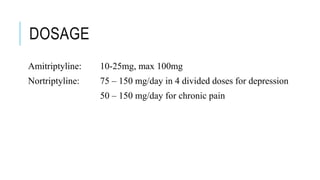
Amitriptyline: 10-25mg, max 100mg
Nortriptyline: 75 – 150 mg/day in 4 divided doses for depression
50 – 150 mg/day for chronic pain
OTHER ANTIDEPRESSANTS
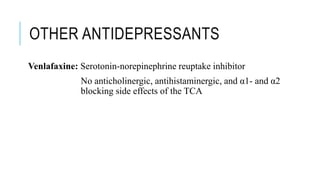
Venlafaxine: Serotonin-norepinephrine reuptake inhibitor
No anticholinergic, antihistaminergic, and α1- and α2
blocking side effects of the TCA
OTHER ANTIDEPRESSANTS
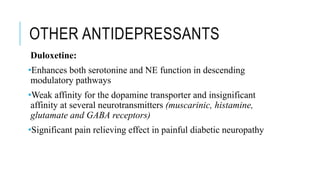
Duloxetine:
•Enhances both serotonine and NE function in descending
modulatory pathways
•Weak affinity for the dopamine transporter and insignificant
affinity at several neurotransmitters (muscarinic, histamine,
glutamate and GABA receptors)
•Significant pain relieving effect in painful diabetic neuropathy
ANTICONVULSANTS
Rationale:
•Reduction of neuronal hyperexcitability
•Blockade of neuronal membrane ion channels (reducing neuronal
influx of Ca2+ or Na+)
•Effects on neurotransmitters (enhancement of GABA, inhibition
of glutamate release) and/or neuromodulation systems (blocking
the NMDA receptor)
ANTICONVULSANTS
•Carbamazepine
•Phenytoin
•Clonazepam
•Gabapentin
•Pregabalin
•Topiramate
•Tiagabine
•Lamotrigine
Side effects and complicated pharmacokinetic
profile limit their use in treating neuropathic pain
Emerging as first-line treatment for neuropathic
pain (reducing elements of central sensitization),
esp. in post zoster neuralgia and diabetic
polyneuropathy
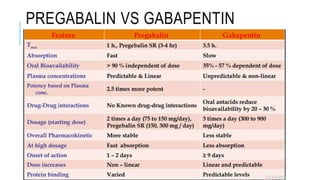
GABAPENTIN
DOSAGE: 300 mg OD ↑ in 300 mg increments every 3-7 days
Can go upto 600 mg -1200mg TDS
Drug's oral absorption is not dose dependent
For RLS – 600 mg once daily at 5 pm
SIDE EFFECTS:
Somnolence, Dizziness, Nausea, Ataxia, Peripheral edema, Fatigue
Subside within 1-2 week
Excreted unchanged in urine (Dose adjustments required in
patients with renal insufficiency)
GABAPENTIN IN ACUTE
LUMBOSACRAL RADICULAR PAIN
•Early initiation of Gabapentin prevents development of Neuropathic
Pain Syndrome
•Statistically significant pain relief when started from week 2
•Reduces the intensity and frequency of neuropathic pain
•Significantly better post discectomy results
PREGABALIN
•Half life is 5-7 hours
•Well absorbed orally, does not bind to plasma proteins
•Renal excretion without being metabolised
•Start Rx at a dose of 75-150 mg/day given in two or three divided
doses
•Titrated up to 300 mg/day over a 1 to 2 weeks as side effects and
pain relief dictate.
•Side effects are for the most part dose dependent
•50 mg of pregabalin is equivalent to 300 mg of gabapentin but
above that dose this ratio does not fit
PREGABALIN
Drug should be discontinued slowly to avoid any rebound effect
Side effects:
Dizziness, drowsiness, dry mouth, constipation
Blurred vision.
Weight gain
Difficulty in concentrating
↓Libido, erectile dysfuction
Euphoria, confusion.
Decreased Platelets
PREGABALIN VS GABAPENTIN
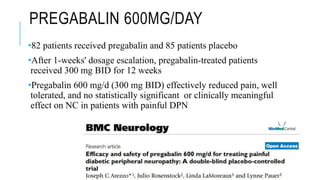
PREGABALIN 600MG/DAY
•82 patients received pregabalin and 85 patients placebo
•After 1-weeks' dosage escalation, pregabalin-treated patients
received 300 mg BID for 12 weeks
•Pregabalin 600 mg/d (300 mg BID) effectively reduced pain, well
tolerated, and no statistically significant or clinically meaningful
effect on NC in patients with painful DPN
CARBAMAZEPINE
•Trigeminal neuralgia
•Diabetic polyneuropathy
•Glossopharyngeal neuralgia
•Postherpetic neuralgia
•Central pain state
CARBAMAZEPINE
•Na Channel Blocker
•100mg OD/BD
•↑ every two days by 100mg
•Maximum dose 1200 mg / day for TN.
CARBAMAZEPINE
Side effects
Nausea, Drowsiness, category D drug
Dizziness(SETTLE IN FEW DAYS)
Tolerance, Ataxia
Bone Marrow Suppression
Thrombocytopenia
Regular Blood Counts on long term use
OXCARBAZEPINE
•300mg-1200mg /day
•An alternative drug with less S/E
NMDA –RECEPTOR ANTAGONISTS
Dextromethorphan
Amantadine
Memantine
Ketamine
OTHER DRUG TREATMENTS
Baclofen
Mexilitene
Clonidine
NEUROSURGICAL TREATMENT OF
NEUROPATHIC
PAIN
In patients with poor pain control despite pharmacotherapy
•Ablative surgery
•Nerve lesioning, cordotomy, myelotomy, mesencephalatomy, and
cingulotomy
•Stimulation techniques
•Spinal and brain stimulation
NEUROSURGICAL TREATMENT OF
NEUROPATHIC
PAIN
•Lesioning of the dorsal root entry zone of the spinal cord useful
for intractable pain following cervical or lumbar root avulsion
•Unfortunately, neuropathic pain reoccurs in 60-80% of patients
after two years
 Giller, C.A. The neurosurgical treatment of pain. Arch Neurol 2003, 60 (11), 1537-40.
NEUROSURGICAL TREATMENT OF
NEUROPATHIC
PAIN•Percutaneous cervical cordotomy: unilateral pain below the level C5
•Punctate midline myelotomy: relief of visceral cancer pain
•Mesencephalatomy (ablation of the spinothalamic tract, the quintothalamic
tract, and the periaqueductal gray): to manage malignant head and neck pain)
•Cingulotomy (lesions in both cingulated gyri modulate the emotional impact
of pain)
•May be performed in terminally ill cancer patients
Giller, C.A. The neurosurgical treatment of pain. Arch. Neurol 2003, 60 (11), 1537-40.
Sanders, M.; Zuurmond, W.W.A. Safety of unilateral and bilateral percutaneous cervical cordotomy in 80 terminally ill
cancer patients. J Clin Oncol 1995, 13 (6), 1509-12.
SPINAL CORD STIMULATION
Low-level electrical impulses, delivered directly into the spinal
cord through the SCS that is inserted in the epidural space, interfere
with the direct transmission of pain signals traveling along the
spinal cord to the brain
•CRPS type I and II
•Spinal cord injury
•Peripheral nerve injury
•Post-herpetic neuralgia
Cameron, T. Safety and efficacy of spinal cord stimulation for the treatment of pain: A 20-
year literature review. J. Neurosurg 2004, 100 (3 Suppl Spine), 254-67.
MOTOR CORTEX STIMULATION
An electrode is placed epidurally overlying the motor cortex
Relieve central pain such as anesthesia dolorosa and neuropathic
pain secondary to stroke, and spinal cord injury, phantom limb and
stump pain
Cortex stimulation increases cerebral blood flow to the cingulate
gyrus, which correlates with the degree of analgesia
Browna, J.A.; Barbaro, N.M. Motor cortex stimulation for centraland neuropathic pain:
Current status. Pain 2003, 104 (4), 431-5.
DEEP BRAIN STIMULATION
Shown to be effective in patients with thalamus stroke syndromes
Either the sensory thalamus or the periaqueductal gray is
stimulated
Giller, C.A. The neurosurgical treatment of pain. Arch Neurol 2003; 60 (11), 1537-40.
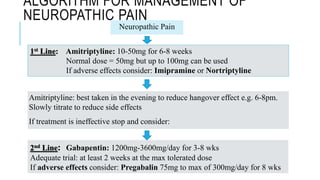
ALGORITHM FOR MANAGEMENT OF
NEUROPATHIC PAIN
Amitriptyline: best taken in the evening to reduce hangover effect e.g. 6-8pm.
Slowly titrate to reduce side effects
If treatment is ineffective stop and consider:
Neuropathic Pain
1st Line: Amitriptyline: 10-50mg for 6-8 weeks
Normal dose = 50mg but up to 100mg can be used
If adverse effects consider: Imipramine or Nortriptyline
2nd Line: Gabapentin: 1200mg-3600mg/day for 3-8 wks
Adequate trial: at least 2 weeks at the max tolerated dose
If adverse effects consider: Pregabalin 75mg to max of 300mg/day for 8 wks
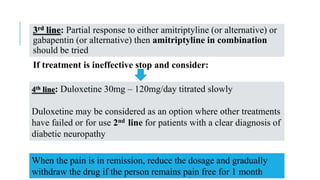
3rd line: Partial response to either amitriptyline (or alternative) or
gabapentin (or alternative) then amitriptyline in combination
should be tried
If treatment is ineffective stop and consider:
4th line: Duloxetine 30mg – 120mg/day titrated slowly
Duloxetine may be considered as an option where other treatments
have failed or for use 2nd line for patients with a clear diagnosis of
diabetic neuropathy
When the pain is in remission, reduce the dosage and gradually
withdraw the drug if the person remains pain free for 1 month
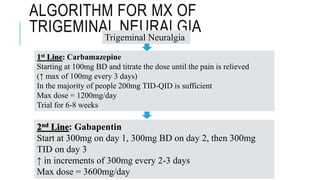
ALGORITHM FOR MX OF
TRIGEMINAL NEURALGIA
Trigeminal Neuralgia
1st Line: Carbamazepine
Starting at 100mg BD and titrate the dose until the pain is relieved
(↑ max of 100mg every 3 days)
In the majority of people 200mg TID-QID is sufficient
Max dose = 1200mg/day
Trial for 6-8 weeks
2nd Line: Gabapentin
Start at 300mg on day 1, 300mg BD on day 2, then 300mg
TID on day 3
↑ in increments of 300mg every 2-3 days
Max dose = 3600mg/day
THANK YOU

Neuropathic pain

  • 1.
    NEUROPATHIC PAIN AND ITSMANAGEMENT Presenter: Dr. Darendrajit
  • 3.
    IASP DEFINITION (1994) •Paininitiated or caused by a primary lesion or dysfunction of the nervous system
  • 4.
    NEW DEFINITION •Pain arisingas a direct consequence of a lesion or disease affecting the somatosensory system •CNS and/or PNS Dysfunction Nervous system
  • 6.
    NP SYNDROMES Peripheral andCentral Peripheral: Diabetic peripheral neuropathy  50% of the pts after 25 years HIV-associated neuropathy Plexopathy following trauma Entrapment neuropathies Post herpetic neuropathy  20% of pts >60 years  34% in the >80 years Central: •Post stroke pain •Syringomyelia •Postischemic myelopathy •Pain associated with PD or MS •Post-traumatic SCI pain
  • 7.
    OVERALL INCIDENCE OF NEUROPATHICPAIN •1–2% of the general population
  • 8.
    PERIPHERAL NP INCIDENCES •ProlongedLBP 37 % •Diabetes 26% •Herper zoster 8% •Post mastectomy ~30-40% •Trigeminal neuralgia incidence 27/100.000 person-yr Arch Pain 2011
  • 9.
    CENTRAL NP INCIDENCES •Stroke8 % •Multiple sclerosis 28% •Spinal cord injury 67% •Phantom limb pain incidence 1/100.000 person-yr Arch Pain 2011
  • 10.
    SYMPTOMS The characteristic clinicalfindings in patients suffering from neuropathic pain include: •Persistent ongoing pain •Paroxysmal pain: ‘shooting’ or ‘stabbing’, independent of any stimulus •Abnormal sensations following a stimulus •Sleep disturbance •Emotional and psychological dysfunction •Physical disability •Autonomic dysfunction (less common)
  • 11.
    POSITIVE SIGNS OF NP •Pain •Paresthesia •Dysesthesia •Hyperalgesia •Allodynia NEGATIVESIGNS OF NP •Sensory deficits (Hypoesthesia and hypoalgesia) •Weakness •Reflex changes
  • 12.
    ABNORMAL SENSATIONS INNP Sensation Description Mechanism Hyperalgesia Increased response (intensity, duration) to a painful stimulus Peripheral and CNS sensitization Dysaesthesia Spontaneous evoked abnormal sensation Spontaneous activity in C/A𝛿 afferent fibres Allodynia Pain caused by a stimulus that is not normally painful CNS sensitization Loss of inhibitory control Hyperpathia Explosive and often prolonged painful response to a non-painful stimulus CNS sensitisation Hyperaesthesia Increased non-painful sensitivity to non-painful stimulation CNS sensitization Continuous burning pain Loss of inhibitory control NGF activation
  • 13.
  • 14.
    PERIPHERAL AND CENTRAL SENSITIZATION A:Increase transcription and axonal trafficking of Na channels with concomitant attenuation of K channels B: Sympathetic neuronal sprouting in the dorsal root ganglion C: Changes in gene transcription and activation of various kinases and proteins, including enhanced N-methyl-D-aspartate (NMDA) receptor activity
  • 15.
    STRUCTURAL REORGANISATION Aberrant connectionwith facilitated transmission
  • 16.
  • 17.
    SUPRA SPINAL MODULATION Diagramillustrating a major descending pain modulating pathway. Regions of the frontal lobe (F), hypothalamus(H) and amygdala (A) project to the PAG in the midbrain. The PAG controls the transmission of nociceptive information in the rostroventral medulla (RVM), DH via relay sin the RVM and dorsolateral pontine tegmentum (DLPT). :nociceptive activation; : inhibitory (anti-nociceptive) activity Core Topic in Pain,2006
  • 18.
    ASSESSMENT: HISTORY •Presence ofabnormal sensations including site and area •Evidence of any underlying pathology (infection, metabolic, autoimmune deficiency or malignancy) •Descriptors: McGill pain questionnaire (MPQ) •Response to therapies (check if given in adequate doses – side effects may not permit) •Quality of life (SF-36) •Additional screening for emotional and psychological profiling •Sleep disturbance •Physical disability
  • 19.
    PHYSICAL EXAMINATION A bedsideneurological examination that covers sensory testing will: •Provide valuable mapping of the affected areas •Monitor future progress of the pain syndrome
  • 20.
    EXAMPLES OF TOOLSUSED IN THE DIAGNOSIS AND ASSESSMENT OF NEUROPATHIC PAINDiagnostic aids – ID Pain Screening – Leeds Assessment of Neuropathic Symptoms and Signs (LANSS) Scale1 – DN4 Pain Questionnaire – Neuropathic Pain Questionnaire (also available in short-form) – Neuropathic Pain Scale Pain intensity and characteristics – Numerical Pain Scale / Faces Pain Rating Scale – Pain Visual Analog Scale – Pain Likert Scale – McGill Pain Questionnaire Short-form McGill Pain Questionnaire derived – Neuropathic Pain Symptom Inventory – Brief Pain Inventory (BPI)
  • 21.
  • 22.
    FURTHER INVESTIGATIONS •Quantitative sensorytesting (QST): •Aids diagnosis •Provides baseline values •Monitors treatment •Magnetic resonance imaging (MRI): •To identify pathology •Electromyogram (EMG): •To locate nerve lesion
  • 23.
  • 24.
    NON-PHARMACOLOGIC OPTIONS •Physical andOccupational Therapy •Acupuncture •Biofeedback •Relaxation therapy •Cognitive Behavioral strategies •Meditation, guided imagery •TENS
  • 25.
  • 26.
    TENS •Frequency of 80Hz, pulse width 350 µs, and currents up to 60 mA, 20 sessions, 30 minutes •Significant improvements in pain intensities, pain characteristics, pain qualities, and functional capacities •The PNP patients presented more favourable results than the CNP patients •TENS therapies can be used in clinical practice, either as an alternative treatment or as a supportive method Muhammed Kılınç et al. Effects of Transcutaneous Electrical Nerve Stimulation in Patients with Peripheral and Central Neuropathic Pain. J Rehabil Med 2014; 46: 454–460
  • 27.
    PHARMACOLOGIC MANAGEMENT Local pharmacologicaltherapy •Neural blockade •Repeated local anaesthesia of the stellate ganglion •Chemical neurolytic lumbar sympathectomy •IV guanethidine and ketanserin •Topical skin therapy •Capsaicin •Lidocaine Systemic pharmacological therapy •Antidepressants •Anticonvulsants (including oral local anaesthetics) •NMDA antagonists compounds •Opioids •Cyclo-oxygenase (COX) inhibitors •Tramadol
  • 28.
    TOPICAL ANALGESICS •Neuropathic painsyndromes are typically associated with touch- evoked allodynia and hyperalgesia •5% lidocaine patch •Capsaicin
  • 29.
    5% LIDOCAINE PATCH •Post-herpetic neuralgia and a variety of other focal peripheral neuropathies (first-line pharmacological treatment) • Binds to voltage-gated Na channels reducing the frequency of spontaneous Ectopic discharges • Provides also a physical barrier to mechanical stimulation (for example clothing) • 5% lidocaine patch (up to three patches, once daily for 12 hours)
  • 30.
    CAPSAICIN •Binds to thevanilloid receptor subtype 1 (VR1) on C- or Aβ-fibers •Capsaicin causes pain due to a release of substance P (initiating nociceptive firing) from these nociceptive terminals •Subsequently, an analgesic response follows because prolonged exposure to capsaicin desensitizes the nociceptive terminals (reversible depletion of Substance P) and elevates the pain threshold •Second-line pharmacological treatment in herpetic neuralgia, diabetic neuropathy, painful polyneuropathy •0.075% concentration
  • 31.
    KETAMINE PATCH? •Topical administrationof ketamine, an NMDA-receptor antagonist, resulted in pain relief in patients with neuropathic pain •No analgesia observed following topical administration of 40 mg ketamine • Mary E. Lynch et al.. Topical 2% Amitriptyline and 1% Ketamine in Neuropathic Pain Syndromes. Anesthesiology 2005; 103:140–6 •Higher concn ketamine (2%) resulted in adequate pain relief • Lockhart E: Topical combination of amitriptyline and ketamine for post herpetic neuralgia (abstract). J Pain 2004; 5 (suppl 1):82
  • 32.
    TRICYCLIC ANTIDEPRESSANTS •Often the1st line drug •Amitriptyline •Nortriptyline (metabolite of Amitriptyline) •Imipramine •Desipramine (metabolite of Imipramine)
  • 33.
    TRICYCLIC ANTIDEPRESSANTS MECHANISM OFACTION •Blockade of the reuptake of norepinephrine and serotonin (dual-acting) •Blockade of neuronal membrane ion channels (reducing neuronal influx of Ca2+ or Na+) •Interaction with adenosine and NMDA receptors
  • 34.
    TRICYCLIC ANTIDEPRESSANTS Side-effects: Anticholinergic effects(dry mouth, blurred vision, constipation, urinary retention) Sedation Orthostatic hypotension Wt gain (so use with topiramate) QT prolongation
  • 35.
    TRICYCLIC ANTIDEPRESSANTS Caution: Cardiovasculardisorders, glaucoma and urine retention Serotonin syndrome: combination therapy with MAO inhibitors Dworkin RH et al. Pharmacological management of neuropathic pain: Evidence-based recommendations. Pain, 2007, 132 (3), 237-51.
  • 36.
    DOSAGE Amitriptyline: 10-25mg, max100mg Nortriptyline: 75 – 150 mg/day in 4 divided doses for depression 50 – 150 mg/day for chronic pain
  • 37.
    OTHER ANTIDEPRESSANTS Venlafaxine: Serotonin-norepinephrinereuptake inhibitor No anticholinergic, antihistaminergic, and α1- and α2 blocking side effects of the TCA
  • 38.
    OTHER ANTIDEPRESSANTS Duloxetine: •Enhances bothserotonine and NE function in descending modulatory pathways •Weak affinity for the dopamine transporter and insignificant affinity at several neurotransmitters (muscarinic, histamine, glutamate and GABA receptors) •Significant pain relieving effect in painful diabetic neuropathy
  • 39.
    ANTICONVULSANTS Rationale: •Reduction of neuronalhyperexcitability •Blockade of neuronal membrane ion channels (reducing neuronal influx of Ca2+ or Na+) •Effects on neurotransmitters (enhancement of GABA, inhibition of glutamate release) and/or neuromodulation systems (blocking the NMDA receptor)
  • 40.
    ANTICONVULSANTS •Carbamazepine •Phenytoin •Clonazepam •Gabapentin •Pregabalin •Topiramate •Tiagabine •Lamotrigine Side effects andcomplicated pharmacokinetic profile limit their use in treating neuropathic pain Emerging as first-line treatment for neuropathic pain (reducing elements of central sensitization), esp. in post zoster neuralgia and diabetic polyneuropathy
  • 41.
    GABAPENTIN DOSAGE: 300 mgOD ↑ in 300 mg increments every 3-7 days Can go upto 600 mg -1200mg TDS Drug's oral absorption is not dose dependent For RLS – 600 mg once daily at 5 pm SIDE EFFECTS: Somnolence, Dizziness, Nausea, Ataxia, Peripheral edema, Fatigue Subside within 1-2 week Excreted unchanged in urine (Dose adjustments required in patients with renal insufficiency)
  • 42.
    GABAPENTIN IN ACUTE LUMBOSACRALRADICULAR PAIN •Early initiation of Gabapentin prevents development of Neuropathic Pain Syndrome •Statistically significant pain relief when started from week 2 •Reduces the intensity and frequency of neuropathic pain •Significantly better post discectomy results
  • 43.
    PREGABALIN •Half life is5-7 hours •Well absorbed orally, does not bind to plasma proteins •Renal excretion without being metabolised •Start Rx at a dose of 75-150 mg/day given in two or three divided doses •Titrated up to 300 mg/day over a 1 to 2 weeks as side effects and pain relief dictate. •Side effects are for the most part dose dependent •50 mg of pregabalin is equivalent to 300 mg of gabapentin but above that dose this ratio does not fit
  • 44.
    PREGABALIN Drug should bediscontinued slowly to avoid any rebound effect Side effects: Dizziness, drowsiness, dry mouth, constipation Blurred vision. Weight gain Difficulty in concentrating ↓Libido, erectile dysfuction Euphoria, confusion. Decreased Platelets
  • 45.
  • 46.
    PREGABALIN 600MG/DAY •82 patientsreceived pregabalin and 85 patients placebo •After 1-weeks' dosage escalation, pregabalin-treated patients received 300 mg BID for 12 weeks •Pregabalin 600 mg/d (300 mg BID) effectively reduced pain, well tolerated, and no statistically significant or clinically meaningful effect on NC in patients with painful DPN
  • 47.
    CARBAMAZEPINE •Trigeminal neuralgia •Diabetic polyneuropathy •Glossopharyngealneuralgia •Postherpetic neuralgia •Central pain state
  • 48.
    CARBAMAZEPINE •Na Channel Blocker •100mgOD/BD •↑ every two days by 100mg •Maximum dose 1200 mg / day for TN.
  • 49.
    CARBAMAZEPINE Side effects Nausea, Drowsiness,category D drug Dizziness(SETTLE IN FEW DAYS) Tolerance, Ataxia Bone Marrow Suppression Thrombocytopenia Regular Blood Counts on long term use
  • 50.
  • 51.
  • 52.
  • 53.
    NEUROSURGICAL TREATMENT OF NEUROPATHIC PAIN Inpatients with poor pain control despite pharmacotherapy •Ablative surgery •Nerve lesioning, cordotomy, myelotomy, mesencephalatomy, and cingulotomy •Stimulation techniques •Spinal and brain stimulation
  • 54.
    NEUROSURGICAL TREATMENT OF NEUROPATHIC PAIN •Lesioningof the dorsal root entry zone of the spinal cord useful for intractable pain following cervical or lumbar root avulsion •Unfortunately, neuropathic pain reoccurs in 60-80% of patients after two years  Giller, C.A. The neurosurgical treatment of pain. Arch Neurol 2003, 60 (11), 1537-40.
  • 55.
    NEUROSURGICAL TREATMENT OF NEUROPATHIC PAIN•Percutaneouscervical cordotomy: unilateral pain below the level C5 •Punctate midline myelotomy: relief of visceral cancer pain •Mesencephalatomy (ablation of the spinothalamic tract, the quintothalamic tract, and the periaqueductal gray): to manage malignant head and neck pain) •Cingulotomy (lesions in both cingulated gyri modulate the emotional impact of pain) •May be performed in terminally ill cancer patients Giller, C.A. The neurosurgical treatment of pain. Arch. Neurol 2003, 60 (11), 1537-40. Sanders, M.; Zuurmond, W.W.A. Safety of unilateral and bilateral percutaneous cervical cordotomy in 80 terminally ill cancer patients. J Clin Oncol 1995, 13 (6), 1509-12.
  • 56.
    SPINAL CORD STIMULATION Low-levelelectrical impulses, delivered directly into the spinal cord through the SCS that is inserted in the epidural space, interfere with the direct transmission of pain signals traveling along the spinal cord to the brain •CRPS type I and II •Spinal cord injury •Peripheral nerve injury •Post-herpetic neuralgia Cameron, T. Safety and efficacy of spinal cord stimulation for the treatment of pain: A 20- year literature review. J. Neurosurg 2004, 100 (3 Suppl Spine), 254-67.
  • 57.
    MOTOR CORTEX STIMULATION Anelectrode is placed epidurally overlying the motor cortex Relieve central pain such as anesthesia dolorosa and neuropathic pain secondary to stroke, and spinal cord injury, phantom limb and stump pain Cortex stimulation increases cerebral blood flow to the cingulate gyrus, which correlates with the degree of analgesia Browna, J.A.; Barbaro, N.M. Motor cortex stimulation for centraland neuropathic pain: Current status. Pain 2003, 104 (4), 431-5.
  • 58.
    DEEP BRAIN STIMULATION Shownto be effective in patients with thalamus stroke syndromes Either the sensory thalamus or the periaqueductal gray is stimulated Giller, C.A. The neurosurgical treatment of pain. Arch Neurol 2003; 60 (11), 1537-40.
  • 59.
    ALGORITHM FOR MANAGEMENTOF NEUROPATHIC PAIN Amitriptyline: best taken in the evening to reduce hangover effect e.g. 6-8pm. Slowly titrate to reduce side effects If treatment is ineffective stop and consider: Neuropathic Pain 1st Line: Amitriptyline: 10-50mg for 6-8 weeks Normal dose = 50mg but up to 100mg can be used If adverse effects consider: Imipramine or Nortriptyline 2nd Line: Gabapentin: 1200mg-3600mg/day for 3-8 wks Adequate trial: at least 2 weeks at the max tolerated dose If adverse effects consider: Pregabalin 75mg to max of 300mg/day for 8 wks
  • 60.
    3rd line: Partialresponse to either amitriptyline (or alternative) or gabapentin (or alternative) then amitriptyline in combination should be tried If treatment is ineffective stop and consider: 4th line: Duloxetine 30mg – 120mg/day titrated slowly Duloxetine may be considered as an option where other treatments have failed or for use 2nd line for patients with a clear diagnosis of diabetic neuropathy When the pain is in remission, reduce the dosage and gradually withdraw the drug if the person remains pain free for 1 month
  • 61.
    ALGORITHM FOR MXOF TRIGEMINAL NEURALGIA Trigeminal Neuralgia 1st Line: Carbamazepine Starting at 100mg BD and titrate the dose until the pain is relieved (↑ max of 100mg every 3 days) In the majority of people 200mg TID-QID is sufficient Max dose = 1200mg/day Trial for 6-8 weeks 2nd Line: Gabapentin Start at 300mg on day 1, 300mg BD on day 2, then 300mg TID on day 3 ↑ in increments of 300mg every 2-3 days Max dose = 3600mg/day
  • 62.