Trait Approach
Leadership
Chapter 2
Description
In the early 20th century, leadership traits were studied to determine
what made certain people great leaders.
Example: Catherine the Great, Abraham Lincoln, Joan of Arc, and
Napoleon Bonaparte. It was believed that people were born with these
traits, and that only the “great” people possessed them.
In the mid-20th century, the trait approach was challenged by
research that questioned the universality of leadership traits.
In a major review, Stogdill (1948) suggested that no consistent set of
traits differentiated leaders from non-leaders across a variety of
situations.
The trait approach has generated much interest among researchers for
its explanation of how traits influence leadership.
An analysis of much of the previous trait research by Lord, DeVader,
and Alliger (1986) found that personality traits were strongly
associated with individuals’ perceptions of leadership.
Stogdill’s first survey identified a group of important leadership traits
that were related to how individuals in various groups became leaders.
He discovered that there were eight different traits among individuals
they were: intelligence, alertness, insight, responsibility, initiative,
persistence, self-confidence, and sociability.
Similar to the first survey, Stogdill’s second survey also identified
traits that were positively associated with leadership. The list
included the following 10 characteristics:
• 1. drive for responsibility and task completion;
• 2. vigor and persistence in pursuit of goals;
• 3. risk taking and originality in problem solving;
• 4. drive to exercise initiative in social situations;
• 5. self-confidence and sense of personal identity;
• 6. willingness to accept consequences of decision and action;
• 7. readiness to absorb interpersonal stress;
• 8. willingness to tolerate frustration and delay;
• 9. ability to influence other people’s behavior; and
• 10. capacity to structure social interaction systems to the purpose at
hand.
Rather than Stogdill, The following people talked about the leadership
traits and defined them as the following:
Mann: Intelligence Masculinity, adjustment, dominance, extraversion,
conservation.
Lord DeVader and Alleger: Intelligence, masculinity, dominance.
Kirkpatrick and locke: drive, motivation, integrity, confidence,
cognitive ability, task knowledge
Zaccaro, Kemp, Bader: cognitive abilities, extraversion,
conscientiousness, emotional stability, openness, agreeableness,
motivation, Social intelligence, Self-monitoring, emotional intelligence,
problem solving
Findings:
• At last researchers found nowadays that the most important
leadership traits are:
Intelligence
Self-Confidence
Determination
Integrity
Sociability
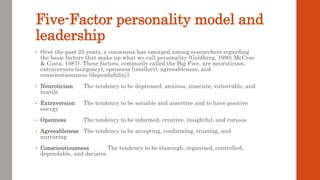
Five-Factor personality model and
leadership
• Over the past 25 years, a consensus has emerged among researchers regarding
the basic factors that make up what we call personality (Goldberg, 1990; McCrae
& Costa, 1987). These factors, commonly called the Big Five, are neuroticism,
extraversion (surgency), openness (intellect), agreeableness, and
conscientiousness (dependability).
• Neuroticism The tendency to be depressed, anxious, insecure, vulnerable, and
hostile
• Extraversion The tendency to be sociable and assertive and to have positive
energy
• Openness The tendency to be informed, creative, insightful, and curious
• Agreeableness The tendency to be accepting, conforming, trusting, and
nurturing
• Conscientiousness The tendency to be thorough, organized, controlled,
dependable, and decisive
HOW DOES THE TRAIT
APPROACH WORK?
Trait leadership focuses on the leader not necessarily the followers or
the situation. The leader exhibits a certain set of traits to be an
effective leader. Trait leadership works well for an organization with
managers in leadership positions have specific traits. Then the
company will go out and get the people with those traits. The persons
should fit the organization and then by time they will develop these
traits accordingly.

Trait approach

  • 1.
  • 2.
    Description In the early20th century, leadership traits were studied to determine what made certain people great leaders. Example: Catherine the Great, Abraham Lincoln, Joan of Arc, and Napoleon Bonaparte. It was believed that people were born with these traits, and that only the “great” people possessed them. In the mid-20th century, the trait approach was challenged by research that questioned the universality of leadership traits. In a major review, Stogdill (1948) suggested that no consistent set of traits differentiated leaders from non-leaders across a variety of situations. The trait approach has generated much interest among researchers for its explanation of how traits influence leadership.
  • 3.
    An analysis ofmuch of the previous trait research by Lord, DeVader, and Alliger (1986) found that personality traits were strongly associated with individuals’ perceptions of leadership. Stogdill’s first survey identified a group of important leadership traits that were related to how individuals in various groups became leaders. He discovered that there were eight different traits among individuals they were: intelligence, alertness, insight, responsibility, initiative, persistence, self-confidence, and sociability. Similar to the first survey, Stogdill’s second survey also identified traits that were positively associated with leadership. The list included the following 10 characteristics:
  • 4.
    • 1. drivefor responsibility and task completion; • 2. vigor and persistence in pursuit of goals; • 3. risk taking and originality in problem solving; • 4. drive to exercise initiative in social situations; • 5. self-confidence and sense of personal identity; • 6. willingness to accept consequences of decision and action; • 7. readiness to absorb interpersonal stress; • 8. willingness to tolerate frustration and delay; • 9. ability to influence other people’s behavior; and • 10. capacity to structure social interaction systems to the purpose at hand.
  • 5.
    Rather than Stogdill,The following people talked about the leadership traits and defined them as the following: Mann: Intelligence Masculinity, adjustment, dominance, extraversion, conservation. Lord DeVader and Alleger: Intelligence, masculinity, dominance. Kirkpatrick and locke: drive, motivation, integrity, confidence, cognitive ability, task knowledge Zaccaro, Kemp, Bader: cognitive abilities, extraversion, conscientiousness, emotional stability, openness, agreeableness, motivation, Social intelligence, Self-monitoring, emotional intelligence, problem solving
  • 6.
    Findings: • At lastresearchers found nowadays that the most important leadership traits are: Intelligence Self-Confidence Determination Integrity Sociability
  • 7.
    Five-Factor personality modeland leadership • Over the past 25 years, a consensus has emerged among researchers regarding the basic factors that make up what we call personality (Goldberg, 1990; McCrae & Costa, 1987). These factors, commonly called the Big Five, are neuroticism, extraversion (surgency), openness (intellect), agreeableness, and conscientiousness (dependability). • Neuroticism The tendency to be depressed, anxious, insecure, vulnerable, and hostile • Extraversion The tendency to be sociable and assertive and to have positive energy • Openness The tendency to be informed, creative, insightful, and curious • Agreeableness The tendency to be accepting, conforming, trusting, and nurturing • Conscientiousness The tendency to be thorough, organized, controlled, dependable, and decisive
  • 8.
    HOW DOES THETRAIT APPROACH WORK? Trait leadership focuses on the leader not necessarily the followers or the situation. The leader exhibits a certain set of traits to be an effective leader. Trait leadership works well for an organization with managers in leadership positions have specific traits. Then the company will go out and get the people with those traits. The persons should fit the organization and then by time they will develop these traits accordingly.