LECTURE 8
Mr. O.M. Nzimah
oswardnzimah@outlook.com
BA. EED University of Zambia
OCCUPATION HEALTH
AND
SAFTEY
PERSONAL PROTECTIVE
EQUIPMENT
THE REQUIREMENT FOR
PPE
1 2
SELECTING PPE
PERSONAL PROTECTIVE EQUIPMENT
1
Learning objectives
 Identify the requirements for PPE.
 Evaluate a variety of PPE devices and determine the
types of equipment necessary for your type of work.
 Understand the training requirements for your
workers on proper usage of PPE.
INTRODUCTION
Personal Protective Equipment (PPE)
is specialized clothing or equipment worn by staff
for protection against health and safety hazards.
Examples of PPE include such items as gloves, foot
and eye protection, protective hearing devices
(earplugs, muffs) hard hats, respirators and full
body suits.
THE REQUIREMENT FOR
PPE
To ensure the greatest possible protection for
employees in the workplace, the cooperative efforts
of both employers and employees will help in
establishing and maintaining a safe and healthful
work environment. In general, employers are
responsible for:
GENERAL EMPLOYERS RESPONSIBLE
 Performing a hazard assessment of the workplace to
identify and control physical and health hazards.
 Identifying and providing appropriate PPE for
employees.
 Training employees in the use and care of the PPE.
 Maintaining PPE, including replacing worn or damaged
PPE.
 Periodically reviewing, updating and evaluating the
effectiveness of the PPE program
GENERAL EMPLOYEES’ RESPONSIBLE
 Properly wear PPE,
 Attend training sessions on PPE,
 Care for, clean and maintain PPE, and
 Inform a supervisor of the need to repair or
replace PPE.
SELECTING PPE
All PPE clothing and equipment should be;
Safe design and construction.
Easy to clean and maintain.
Fit correctly.
Provide desired the level of protection.
TRAINING EMPLOYEES
IN THE PROPER USE
OF PPE
Employers are required to train each employee who must use
PPE. Employees must be trained to know at least the following:
 When PPE is necessary.
 What PPE is necessary.
 How to properly put on, take off, adjust and wear the
PPE.
 The limitations of the PPE.
 Proper care, maintenance, useful life and disposal of
PPE
Employers should make sure that each employee demonstrates;
Understanding of the PPE training
Ability to properly wear
Ability to properly use PPE before they are allowed to perform
work requiring the use of the PPE.
Note: situations that require additional or retraining of
employees include changes in the workplace or in the type of
required PPE that make prior training obsolete.
TYPES OF PPE
1. EYE AND FACE PROTECTION
Employees can be exposed to a large number of
hazards that pose danger to their eyes and face.
Employers should ensure that employees have appropriate eye
or face protection if they are exposed to eye or face hazards
such as;
 flying particles,
 molten metal,
 liquid chemicals,
 acids or caustic liquids,
 chemical gases or vapors,
 potentially infected material or potentially harmful light
radiation.
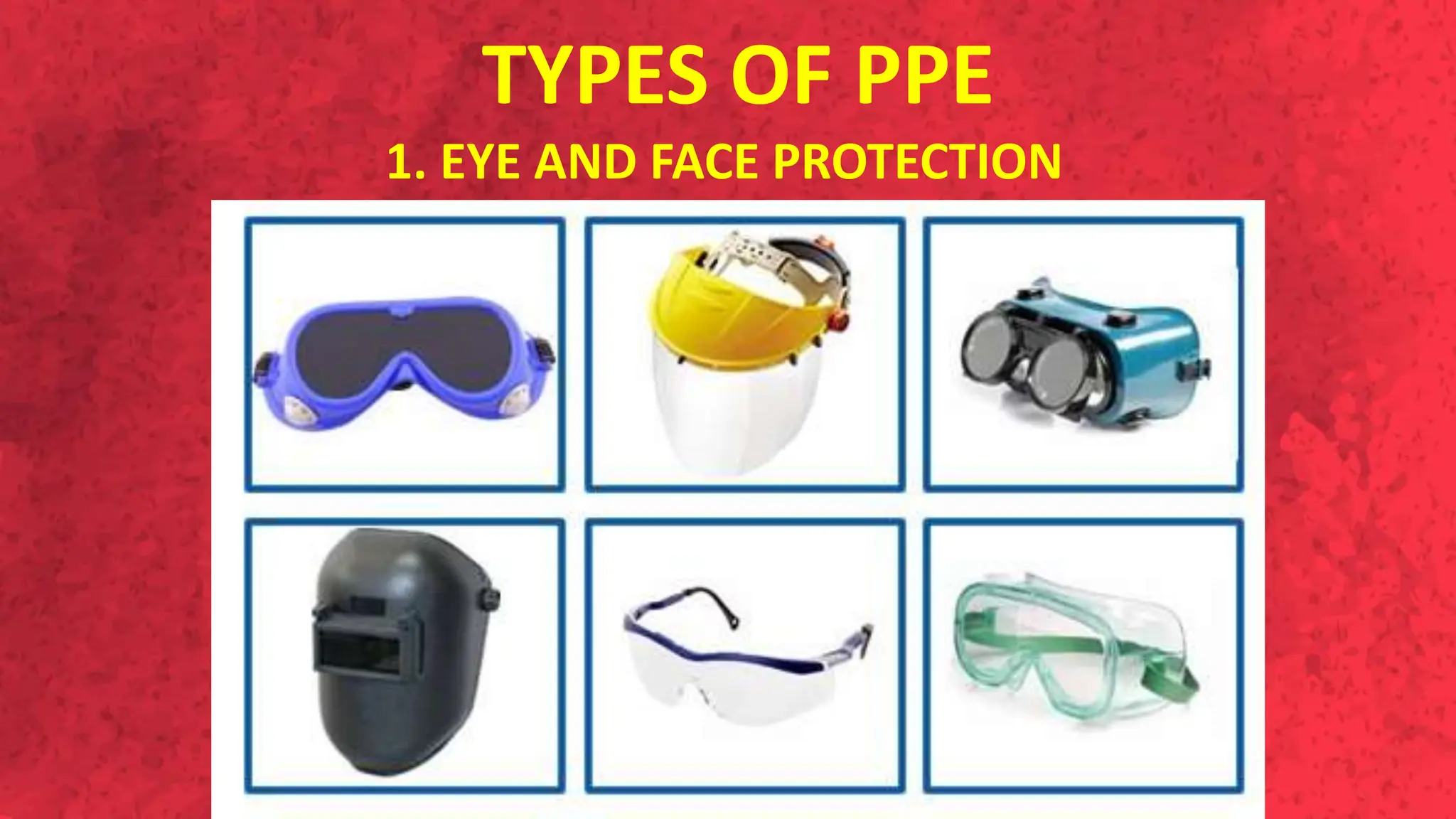
Safety spectacles- These protective eyeglasses have
safety frames constructed of metal or plastic and impact-
resistant lenses. Side shields are available on some
models.
Goggles- These are tight-fitting eye protection that
completely cover the eyes
Welding shields-protect eyes from burns caused by
infrared or intense radiant light; they also protect both
the eyes and face from flying sparks, metal spatter and
slag chips produced during welding, brazing, soldering
and cutting operations.
Laser safety goggles- These specialty goggles protect
against intense concentrations of light produced by lasers.
Face shields-These transparent sheets of plastic extend
from the eyebrows to below the chin and across the
entire width of the employee’s head. Some are polarized
for glare protection.
Types of Eye Protection
Selecting the most suitable eye and face
protection for employees should take into
consideration the following elements:
 Ability to protect against specific workplace
hazards.
 Should fit properly and be reasonably
comfortable to wear.
 Should provide unrestricted vision and
movement.
 Should be durable and cleanable.
 Should allow unrestricted functioning of any
other required PPE.
2. HEAD PROTECTION
Protecting employees from potential head
injuries is a key element of any safety
program.
A head injury can impair an employee for life or it
can be fatal.
Wearing a safety helmet or hard hat is one of the
easiest ways to protect an employee’s head from
injury.
Hard hats can protect employees from impact and
penetration hazards as well as from electrical shock
and burn hazards.
Employers must ensure that their employees wear
head protection if any of the following apply:
 Objects might fall from above and strike them on the head;
 They might bump their heads against fixed objects, such as exposed
pipes or beams; or
 There is a possibility of accidental head contact with electrical
hazards.
Some examples of occupations in which employees should be
required to wear head protection include;
 construction workers
 carpenters
 electricians
 linemen
 plumbers and pipefitters,
 timber and log cutters, welders,
Whenever there is a danger of objects falling from above, such as working below
others who are using tools or working under a conveyor belt, head protection must
be worn. Hard hats must be worn with the bill forward to protect employees
properly.
In general, protective helmets or hard hats should
do the following:
Resist penetration by objects.
Absorb the shock of a blow.
Be water-resistant and slow burning.
Have clear instructions explaining proper
adjustment and replacement of the suspension
and headband.
Hard hats are divided into three industrial classes:
Class A hard hats: provide impact and penetration resistance along
with limited voltage protection (up to 2,200 volts).
Class B hard hats: provide the highest level of protection against
electrical hazards, with high-voltage shock and burn protection (up to
20,000 volts). They also provide protection from impact and
penetration hazards by flying or falling objects.
Class C hard hats: provide lightweight comfort and impact protection
but offer no protection from electrical hazards.
3. Foot and Leg Protection
4. Hand and Arm Protection
5. Body Protection
6. Hearing Protection
END OF COURSE

8 Personal protective equipment.pptx & safety

  • 1.
    LECTURE 8 Mr. O.M.Nzimah oswardnzimah@outlook.com BA. EED University of Zambia OCCUPATION HEALTH AND SAFTEY
  • 2.
  • 3.
    PERSONAL PROTECTIVE EQUIPMENT 1 Learningobjectives  Identify the requirements for PPE.  Evaluate a variety of PPE devices and determine the types of equipment necessary for your type of work.  Understand the training requirements for your workers on proper usage of PPE.
  • 4.
    INTRODUCTION Personal Protective Equipment(PPE) is specialized clothing or equipment worn by staff for protection against health and safety hazards. Examples of PPE include such items as gloves, foot and eye protection, protective hearing devices (earplugs, muffs) hard hats, respirators and full body suits.
  • 5.
    THE REQUIREMENT FOR PPE Toensure the greatest possible protection for employees in the workplace, the cooperative efforts of both employers and employees will help in establishing and maintaining a safe and healthful work environment. In general, employers are responsible for:
  • 6.
    GENERAL EMPLOYERS RESPONSIBLE Performing a hazard assessment of the workplace to identify and control physical and health hazards.  Identifying and providing appropriate PPE for employees.  Training employees in the use and care of the PPE.  Maintaining PPE, including replacing worn or damaged PPE.  Periodically reviewing, updating and evaluating the effectiveness of the PPE program
  • 7.
    GENERAL EMPLOYEES’ RESPONSIBLE Properly wear PPE,  Attend training sessions on PPE,  Care for, clean and maintain PPE, and  Inform a supervisor of the need to repair or replace PPE.
  • 8.
    SELECTING PPE All PPEclothing and equipment should be; Safe design and construction. Easy to clean and maintain. Fit correctly. Provide desired the level of protection.
  • 9.
    TRAINING EMPLOYEES IN THEPROPER USE OF PPE
  • 10.
    Employers are requiredto train each employee who must use PPE. Employees must be trained to know at least the following:  When PPE is necessary.  What PPE is necessary.  How to properly put on, take off, adjust and wear the PPE.  The limitations of the PPE.  Proper care, maintenance, useful life and disposal of PPE
  • 11.
    Employers should makesure that each employee demonstrates; Understanding of the PPE training Ability to properly wear Ability to properly use PPE before they are allowed to perform work requiring the use of the PPE. Note: situations that require additional or retraining of employees include changes in the workplace or in the type of required PPE that make prior training obsolete.
  • 12.
    TYPES OF PPE 1.EYE AND FACE PROTECTION
  • 13.
    Employees can beexposed to a large number of hazards that pose danger to their eyes and face. Employers should ensure that employees have appropriate eye or face protection if they are exposed to eye or face hazards such as;  flying particles,  molten metal,  liquid chemicals,  acids or caustic liquids,  chemical gases or vapors,  potentially infected material or potentially harmful light radiation.
  • 14.
    Safety spectacles- Theseprotective eyeglasses have safety frames constructed of metal or plastic and impact- resistant lenses. Side shields are available on some models. Goggles- These are tight-fitting eye protection that completely cover the eyes Welding shields-protect eyes from burns caused by infrared or intense radiant light; they also protect both the eyes and face from flying sparks, metal spatter and slag chips produced during welding, brazing, soldering and cutting operations. Laser safety goggles- These specialty goggles protect against intense concentrations of light produced by lasers. Face shields-These transparent sheets of plastic extend from the eyebrows to below the chin and across the entire width of the employee’s head. Some are polarized for glare protection. Types of Eye Protection Selecting the most suitable eye and face protection for employees should take into consideration the following elements:  Ability to protect against specific workplace hazards.  Should fit properly and be reasonably comfortable to wear.  Should provide unrestricted vision and movement.  Should be durable and cleanable.  Should allow unrestricted functioning of any other required PPE.
  • 15.
  • 16.
    Protecting employees frompotential head injuries is a key element of any safety program. A head injury can impair an employee for life or it can be fatal. Wearing a safety helmet or hard hat is one of the easiest ways to protect an employee’s head from injury. Hard hats can protect employees from impact and penetration hazards as well as from electrical shock and burn hazards.
  • 17.
    Employers must ensurethat their employees wear head protection if any of the following apply:  Objects might fall from above and strike them on the head;  They might bump their heads against fixed objects, such as exposed pipes or beams; or  There is a possibility of accidental head contact with electrical hazards.
  • 18.
    Some examples ofoccupations in which employees should be required to wear head protection include;  construction workers  carpenters  electricians  linemen  plumbers and pipefitters,  timber and log cutters, welders, Whenever there is a danger of objects falling from above, such as working below others who are using tools or working under a conveyor belt, head protection must be worn. Hard hats must be worn with the bill forward to protect employees properly.
  • 19.
    In general, protectivehelmets or hard hats should do the following: Resist penetration by objects. Absorb the shock of a blow. Be water-resistant and slow burning. Have clear instructions explaining proper adjustment and replacement of the suspension and headband.
  • 20.
    Hard hats aredivided into three industrial classes: Class A hard hats: provide impact and penetration resistance along with limited voltage protection (up to 2,200 volts). Class B hard hats: provide the highest level of protection against electrical hazards, with high-voltage shock and burn protection (up to 20,000 volts). They also provide protection from impact and penetration hazards by flying or falling objects. Class C hard hats: provide lightweight comfort and impact protection but offer no protection from electrical hazards.
  • 21.
    3. Foot andLeg Protection 4. Hand and Arm Protection 5. Body Protection 6. Hearing Protection
  • 22.