Personal Protective
Equipment's (PPEs)
Definition
PPE means all equipments and clothing worn or held by a person at work,
which affords protection against one or more risks to health or safety.
The use of personal protective equipment is one of the control options
available for controlling hazards in the workplace and not substitutes for
effective engineering controls, safe work conditions or sound work
practices, but can play an essential part in the protection of the worker.
Its use does neither eliminate the hazard nor does it prevent incidents but
helps to reduce the impact or adverse health effects, if used correctly.
This is your last line of defense
Types of PPE
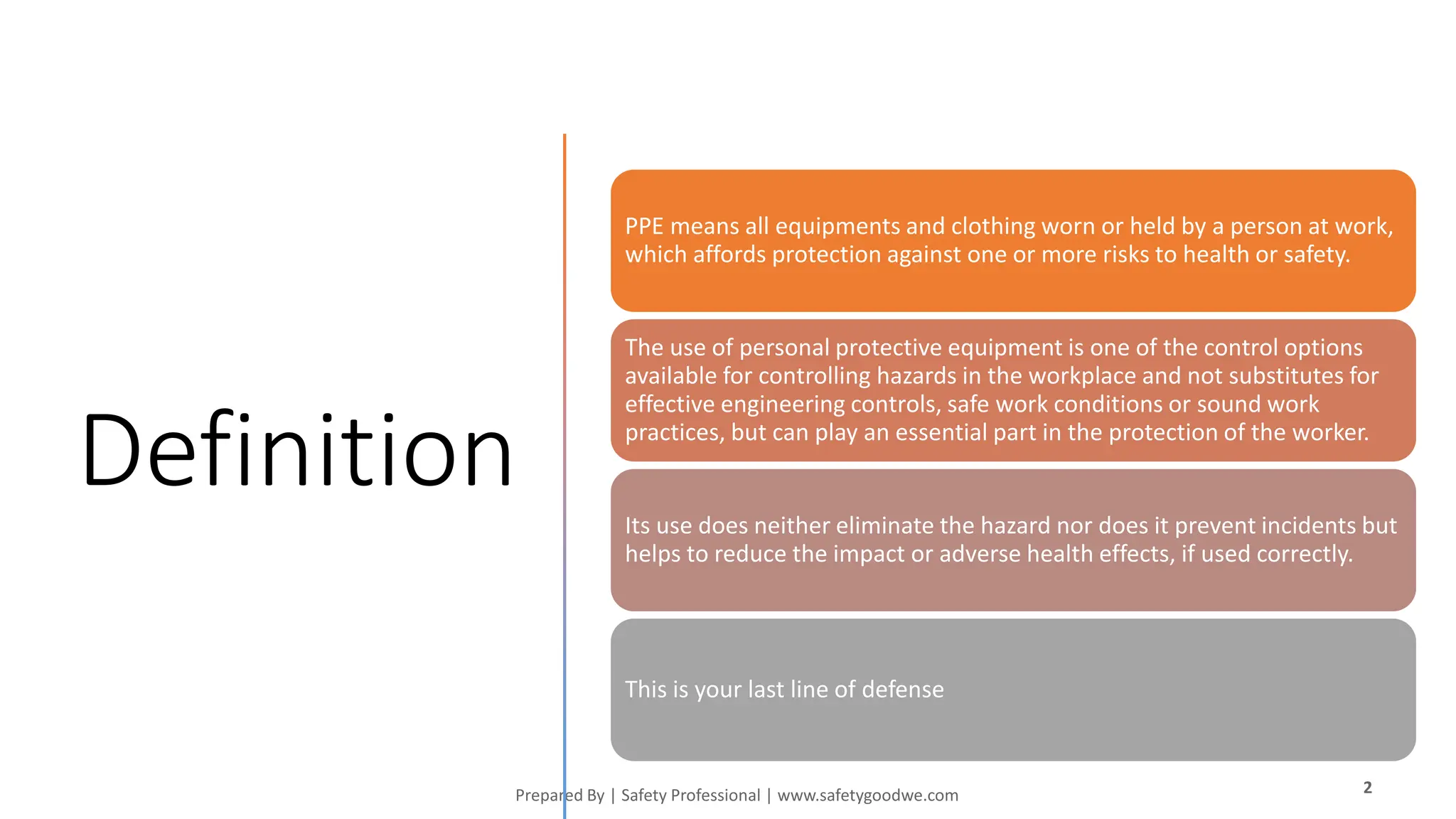
• Safety glass/goggles
• Safety shoes
• Ear plug/ Ear muff
• Respirator
• Coveralls
• Gloves
• Air supplied helmet
Prepared By | Safety Professional | www.safetygoodwe.com 3
Types of PPE
4
 Safety Harness with double
lanyard
 Life Jacket
 Face shield
 Helmets/Hardhat
 Welding Apron
 And others which is necessary
during execution of work
Prepared By | Safety Professional | www.safetygoodwe.com
Management Responsibility
• Is responsible for the provision of suitable types and quantity of PPE and ensures
proper use in line with the project PPE requirements.
• Additional PPE for more hazardous tasks shallalso be provided when required.
• Educate employees on the proper use of PPE and maintenance
• Is responsible and shall be held accountable for ineffective use
• of the PPE provided for workers under his control.
• He must set an example by using his PPE as appropriateand ensure its use by others
as required.
• Assessing the risks to employees in relation to the performance of particular items of
PPE
Prepared By | Safety Professional | www.safetygoodwe.com 5
Employees Responsibility
• Wear PPE at all times
• Inspect your PPE always to ensure they are
serviceable for job purpose required
• Ask question if you don’t know the specific PPE for
the job to be performed
• Request replacement for
• damaged PPE
• Maintaining the cleanliness
• and effectiveness of the PPE
Prepared By | Safety Professional | www.safetygoodwe.com 6
Training
• Employees must be given adequate,
comprehensive instructions, information and
training;
• The purpose for which PPE has been provided
• The risks that it will protect against
• The correct method of use
• The employee’s part in ensuring that PPE remains in
a properly working and in good condition
Prepared By | Safety Professional | www.safetygoodwe.com 7
Suitability
Prepared By | Safety Professional | www.safetygoodwe.com 8
To be suitable, PPE must be;
• Appropriate for the risk involved and the conditions at
• the place where exposure may arise
• Take ergonomic consideration into account, and be
• capable of being fitted and used by the worker
• Conform to KOSHA, BS, DIN, AS or ANSI standard or approved by the Client is fit for purpose
and comfortable
• So far as practicable, prevent or adequately control the risk of exposure without creating
another risk
• W here more than one PPE has to be used simultaneously, each must be compatible with
one another and full effectiveness must be maintained
Hazard Identification
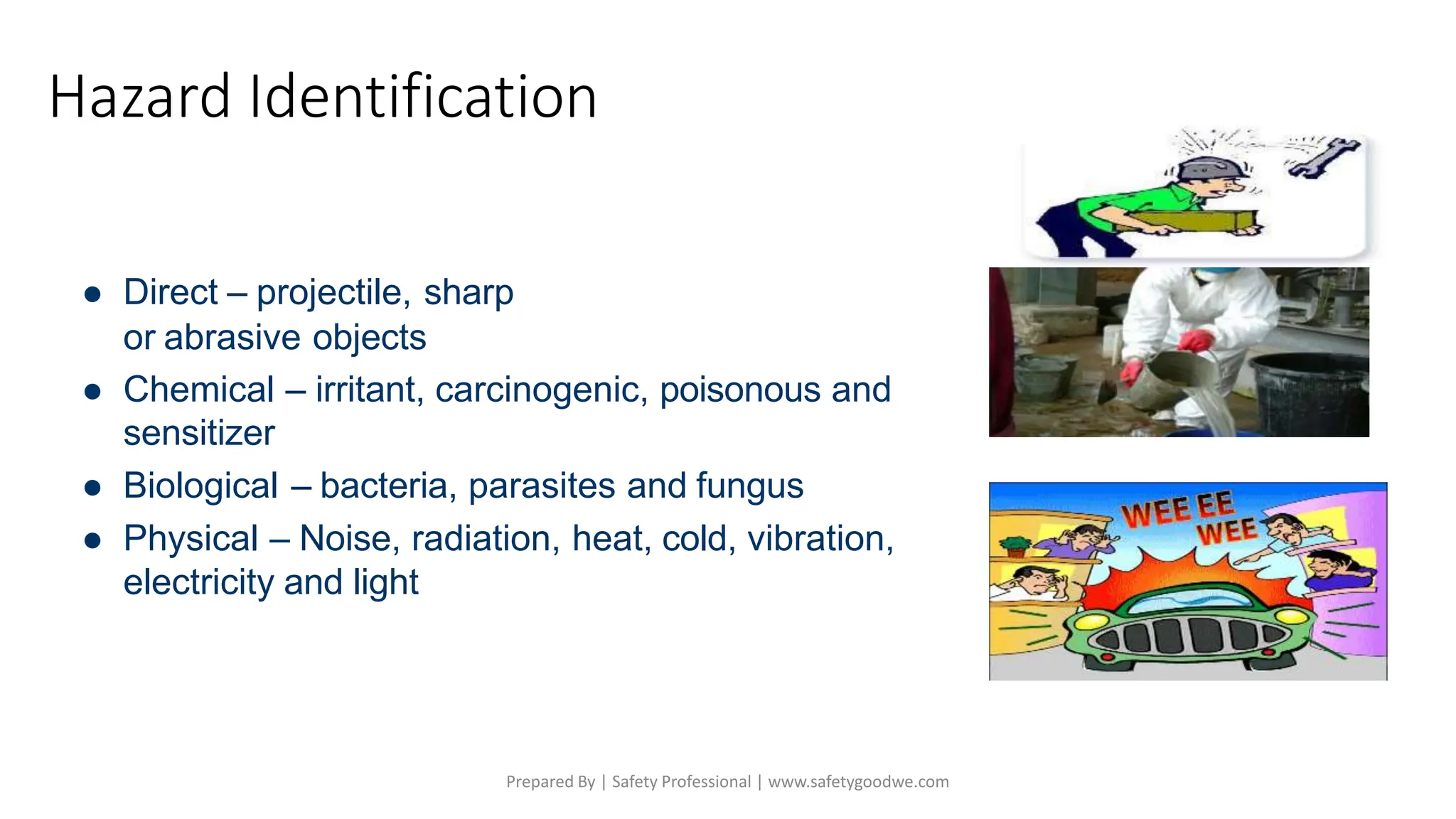
 Direct – projectile, sharp
or abrasive objects
 Chemical – irritant, carcinogenic, poisonous and
sensitizer
 Biological – bacteria, parasites and fungus
 Physical – Noise, radiation, heat, cold, vibration,
electricity and light
9 Prepared By | Safety Professional | www.safetygoodwe.com
Effect of Exposures
• Physical Injury
• Poisoning
• Asphyxiation
• Cancer
• Irritation
• Infection
• Loss of Hearing
• Dermatitis
• Burns
• Abrasion
Prepared By | Safety Professional | www.safetygoodwe.com 10
Hazard Assessment
Prepared By | Safety Professional | www.safetygoodwe.com 11
Hazard Type Hazard Type Common related tasks
Impact
Flying objects such as large chips,
fragments, particles, sand, and dirt.
Chipping, grinding, machining, masonry work, wood
working, sawing, drilling, riveting, sanding, etc.
Heat
Anything emitting extreme
heat.
Furnace operations, pouring, casting, hot dipping,
welding, etc.
Chemicals
Splash, fumes, vapors, and
irritating mists.
Acid and chemical handling, degreasing, plating, and
working with blood.
Dust Harmful dust. Woodworking, buffing, and general dusty conditions.
Optical Radiation
Radiant energy, glare, and
intense light
Welding, torch-cutting, -brazing, soldering, and
laser work.
Personal Protective Equipment
• Selection
• Fitting
• Health Aspect
• Compatibility
• Issue records
• Proper use
• Training in use
• Cleaning, service storage
• Supervision
• Disposal
Prepared By | Safety Professional | www.safetygoodwe.com 12
13
Head Protection
Prepared By | Safety Professional | www.safetygoodwe.com 13
To protect the wearer against head injuries caused by falling
objects, blows or other impacts. The helmet gives some
protection against splashing by liquids. It should be
manufactured from plastics.
Helmets are required to be replaced if subjected to severe
impact.
The use of paint (aerosol type) and certain adhesive stickers
may affect the integrity of the helmet and should not be
allowed.
Head Protection
 Metal safety helmets shall not
be worn.
 Air Supplied Helmets should be worn when
working with chemical sprays or grit blasting
 Welding Helmets/Caps, which give protection
against dangerous arc radiation and hot particles
of weld metal, shall be worn when engaged in
welding operations
14 Prepared By | Safety Professional | www.safetygoodwe.com
Eye and Face
Protection
• Eyes require to be protected against injuryfrom
wind blown debris, and from impact against
various fixtures, fittingsor loose items which the
wearer may inadvertently knock into by nature
of working in close confines of plant or
equipment.
• Eye protection shall beworn in specific areas, or
for specific activities, in all indoor and outdoor
operational sites.
• Weldingoperations require special eye, face and
neckprotection for the operator.
Prepared By | Safety Professional | www.safetygoodwe.com 15
Eye and Face Protection
• Certain operations are significantly more hazardous to the
eyes, and the eye protection selected must be suitable
against particular hazard in question. For operations including
grinding, scraping, chipping etc, the handling of chemicals
and solvents, sample taking, etc, advice should be sought
from the HSE section.
• Full-view goggles/face shields may be required, and they
should be suitable for dust or chemical protection.
16 Prepared By | Safety Professional | www.safetygoodwe.com
Eye and Face
Protection
• Check your Safety glass /
goggles
• Are the glasses/goggles
• offer protection against
• specific exposure?
• Do they distort vision?
• Do they limit peripheral (side)
vision?
• Are there gaps between side shields
and face which might allow
particles to enter eyes?
Prepared By | Safety Professional | www.safetygoodwe.com 17
Foot Protection
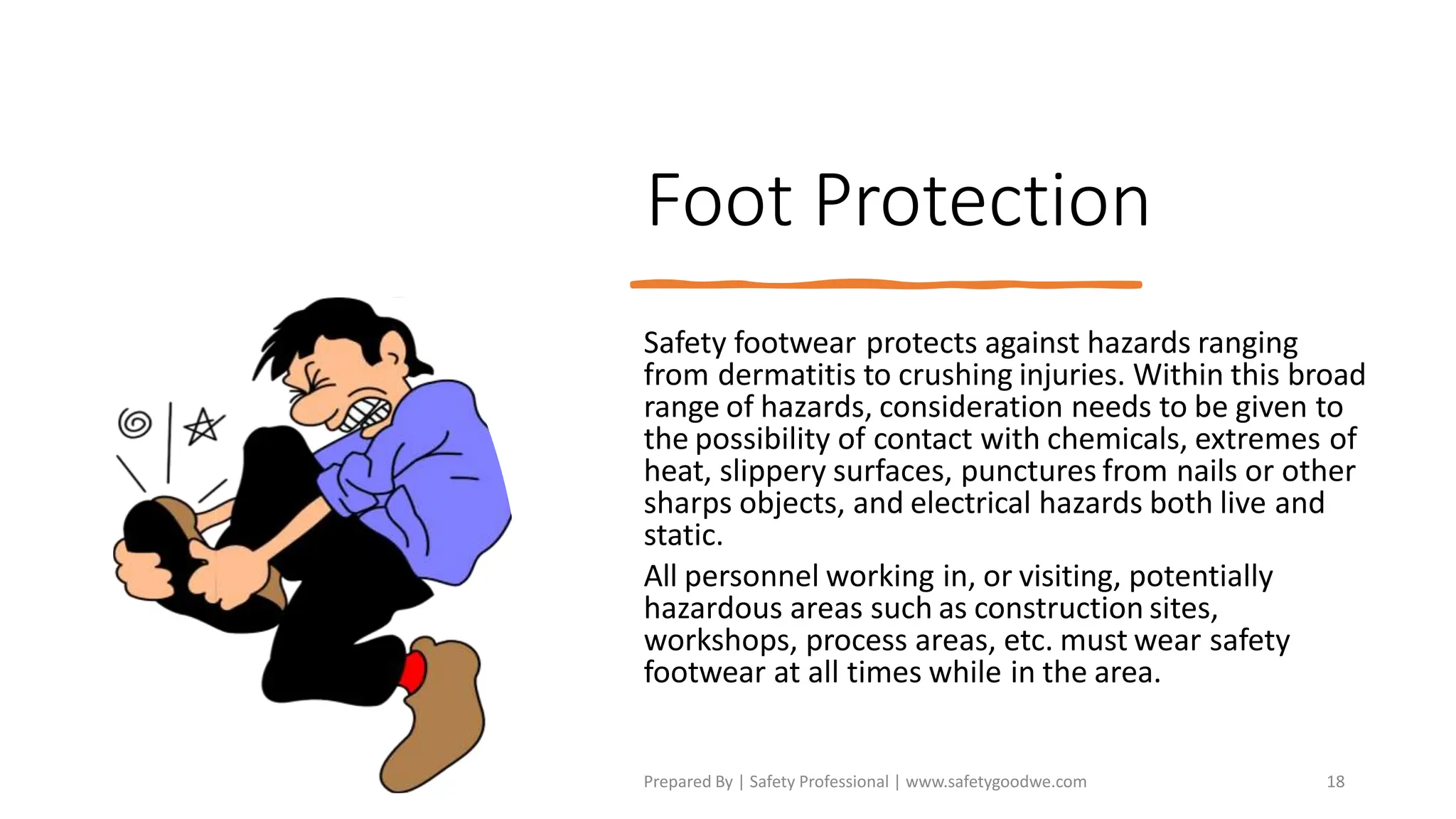
Safety footwear protects against hazards ranging
from dermatitis to crushing injuries. Within this broad
range of hazards, consideration needs to be given to
the possibility of contact with chemicals, extremes of
heat, slippery surfaces, punctures from nails or other
sharps objects, and electrical hazards both live and
static.
All personnel working in, or visiting, potentially
hazardous areas such as construction sites,
workshops, process areas, etc. must wear safety
footwear at all times while in the area.
Prepared By | Safety Professional | www.safetygoodwe.com 18
Foot Protection
• Check your Safety footwear does the footwear offer
protection against specific occupational exposure,
such as;
• Temperature variation
• Slippery surfaces
• Punctures
• Chemical exposure
• Direct impact on the toe?
Prepared By | Safety Professional | www.safetygoodwe.com 19
Hand Protection
20 Prepared By | Safety Professional | www.safetygoodwe.com
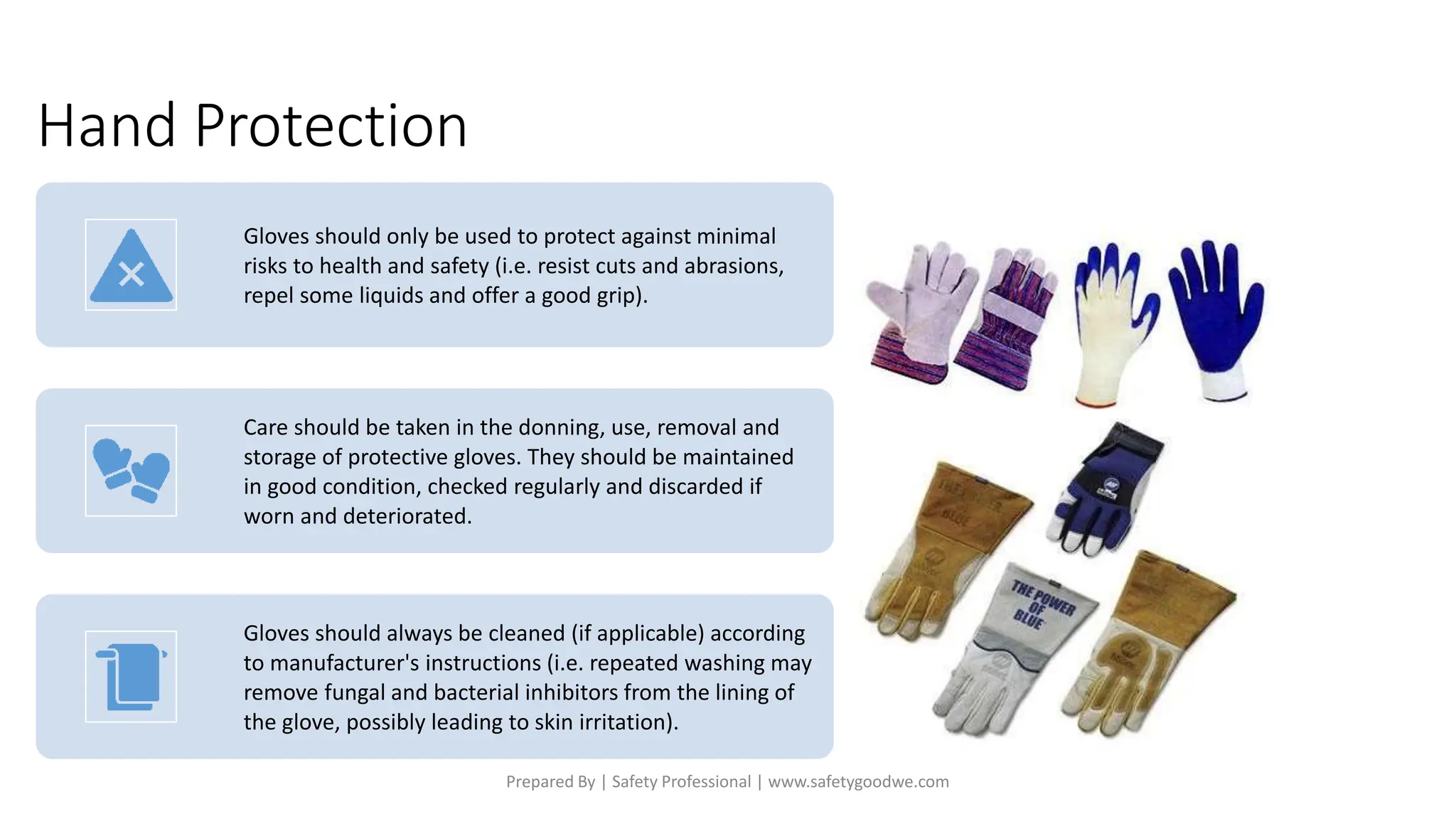
Gloves should only be used to protect against minimal
risks to health and safety (i.e. resist cuts and abrasions,
repel some liquids and offer a good grip).
Care should be taken in the donning, use, removal and
storage of protective gloves. They should be maintained
in good condition, checked regularly and discarded if
worn and deteriorated.
Gloves should always be cleaned (if applicable) according
to manufacturer's instructions (i.e. repeated washing may
remove fungal and bacterial inhibitors from the lining of
the glove, possibly leading to skin irritation).
Hearing Protection
• Hearing conversation programs should be established in all locations
where employees are exposed to noise levels above 85dBA for 8 hours.
• It is necessary to take special precautions to prevent damage to
hearing by exposure to excessive or prolonged noise.
• Wear hearing protection in all areas where noise levels exceed 85dBA
for an 8-hour shift shall be designated as Hearing Protection Areas.
• No exposure to continuous or intermittent noise levels in excess of
115dBA is allowed.
Prepared By | Safety Professional | www.safetygoodwe.com 21
Body Protection
22
Coveralls give protection to the
wearer against general dirt
• The garments shall be manufactured from
approved materials.
• The coveralls should be of color that is easily
seen, namely orange yellow or red (offshore).If
dark color material is used, a light- reflective
strip should be incorporated across the
shoulders of the garment.
• These garments give protection against wind,
and rain, and some protection against
splashing from liquids.
Prepared By | Safety Professional | www.safetygoodwe.com
Body Protection
• A coverall that offera degree of protection
infire shall be used if the wearer is
exposed to a welding or cutting activities.
• For Chemical Handling (Protective
Clothing) Personnel handling bulk
• chemicals may require
• whole body protection against splashes.
• If necessary, they shall wear impervious
suits or aprons.
Prepared By | Safety Professional | www.safetygoodwe.com 23
24
Fall protection
Prepared By | Safety Professional | www.safetygoodwe.com 24
Use equipment to reduce personal injury when crew may be exposed to:
A fall of 1.8 meters.
Work over the side.
Work on a vent stack.
Work in enclosed areas of oxygen deficiency/contamination.
The equipment is to consist of:
Full body harness.
Shock absorbing lanyard or approved equipment.
Connecting hook.
The label should indicate the year and standard of manufacturer.
Full Body Harness with Two lanyard
Used during works performed on an
unprotected work location at
elevations higher than 1.8 meters
above the ground
Lanyard must be secured to a
suitable anchorage point that is
capable of supporting an impact load of
2,500Kg
Prior to use, make sure that fall
protection equipment is in good
operating condition
Personal Fall Arrest System (PFAS)
25 Prepared By | Safety Professional | www.safetygoodwe.com
Summary
• “And the end is that the workman shall live to enjoy
• the fruit of his labor;
• That his wife shall not be untimelya widow;
• That his childrenshall have a father, and that cripplesand
hopeless workerswho were once strong men, shallno longer
be a by-product of industry .”
Prepared By | Safety Professional | www.safetygoodwe.com 26
Conclusion.. Its just beginning
QUESTIONS
Prepared By | Safety Professional | www.safetygoodwe.com 27

17._SGW-_Personal_Protective_Equipments_(PPEs).pptx

  • 1.
  • 2.
    Definition PPE means allequipments and clothing worn or held by a person at work, which affords protection against one or more risks to health or safety. The use of personal protective equipment is one of the control options available for controlling hazards in the workplace and not substitutes for effective engineering controls, safe work conditions or sound work practices, but can play an essential part in the protection of the worker. Its use does neither eliminate the hazard nor does it prevent incidents but helps to reduce the impact or adverse health effects, if used correctly. This is your last line of defense
  • 3.
    Types of PPE •Safety glass/goggles • Safety shoes • Ear plug/ Ear muff • Respirator • Coveralls • Gloves • Air supplied helmet Prepared By | Safety Professional | www.safetygoodwe.com 3
  • 4.
    Types of PPE 4 Safety Harness with double lanyard  Life Jacket  Face shield  Helmets/Hardhat  Welding Apron  And others which is necessary during execution of work Prepared By | Safety Professional | www.safetygoodwe.com
  • 5.
    Management Responsibility • Isresponsible for the provision of suitable types and quantity of PPE and ensures proper use in line with the project PPE requirements. • Additional PPE for more hazardous tasks shallalso be provided when required. • Educate employees on the proper use of PPE and maintenance • Is responsible and shall be held accountable for ineffective use • of the PPE provided for workers under his control. • He must set an example by using his PPE as appropriateand ensure its use by others as required. • Assessing the risks to employees in relation to the performance of particular items of PPE Prepared By | Safety Professional | www.safetygoodwe.com 5
  • 6.
    Employees Responsibility • WearPPE at all times • Inspect your PPE always to ensure they are serviceable for job purpose required • Ask question if you don’t know the specific PPE for the job to be performed • Request replacement for • damaged PPE • Maintaining the cleanliness • and effectiveness of the PPE Prepared By | Safety Professional | www.safetygoodwe.com 6
  • 7.
    Training • Employees mustbe given adequate, comprehensive instructions, information and training; • The purpose for which PPE has been provided • The risks that it will protect against • The correct method of use • The employee’s part in ensuring that PPE remains in a properly working and in good condition Prepared By | Safety Professional | www.safetygoodwe.com 7
  • 8.
    Suitability Prepared By |Safety Professional | www.safetygoodwe.com 8 To be suitable, PPE must be; • Appropriate for the risk involved and the conditions at • the place where exposure may arise • Take ergonomic consideration into account, and be • capable of being fitted and used by the worker • Conform to KOSHA, BS, DIN, AS or ANSI standard or approved by the Client is fit for purpose and comfortable • So far as practicable, prevent or adequately control the risk of exposure without creating another risk • W here more than one PPE has to be used simultaneously, each must be compatible with one another and full effectiveness must be maintained
  • 9.
    Hazard Identification  Direct– projectile, sharp or abrasive objects  Chemical – irritant, carcinogenic, poisonous and sensitizer  Biological – bacteria, parasites and fungus  Physical – Noise, radiation, heat, cold, vibration, electricity and light 9 Prepared By | Safety Professional | www.safetygoodwe.com
  • 10.
    Effect of Exposures •Physical Injury • Poisoning • Asphyxiation • Cancer • Irritation • Infection • Loss of Hearing • Dermatitis • Burns • Abrasion Prepared By | Safety Professional | www.safetygoodwe.com 10
  • 11.
    Hazard Assessment Prepared By| Safety Professional | www.safetygoodwe.com 11 Hazard Type Hazard Type Common related tasks Impact Flying objects such as large chips, fragments, particles, sand, and dirt. Chipping, grinding, machining, masonry work, wood working, sawing, drilling, riveting, sanding, etc. Heat Anything emitting extreme heat. Furnace operations, pouring, casting, hot dipping, welding, etc. Chemicals Splash, fumes, vapors, and irritating mists. Acid and chemical handling, degreasing, plating, and working with blood. Dust Harmful dust. Woodworking, buffing, and general dusty conditions. Optical Radiation Radiant energy, glare, and intense light Welding, torch-cutting, -brazing, soldering, and laser work.
  • 12.
    Personal Protective Equipment •Selection • Fitting • Health Aspect • Compatibility • Issue records • Proper use • Training in use • Cleaning, service storage • Supervision • Disposal Prepared By | Safety Professional | www.safetygoodwe.com 12
  • 13.
    13 Head Protection Prepared By| Safety Professional | www.safetygoodwe.com 13 To protect the wearer against head injuries caused by falling objects, blows or other impacts. The helmet gives some protection against splashing by liquids. It should be manufactured from plastics. Helmets are required to be replaced if subjected to severe impact. The use of paint (aerosol type) and certain adhesive stickers may affect the integrity of the helmet and should not be allowed.
  • 14.
    Head Protection  Metalsafety helmets shall not be worn.  Air Supplied Helmets should be worn when working with chemical sprays or grit blasting  Welding Helmets/Caps, which give protection against dangerous arc radiation and hot particles of weld metal, shall be worn when engaged in welding operations 14 Prepared By | Safety Professional | www.safetygoodwe.com
  • 15.
    Eye and Face Protection •Eyes require to be protected against injuryfrom wind blown debris, and from impact against various fixtures, fittingsor loose items which the wearer may inadvertently knock into by nature of working in close confines of plant or equipment. • Eye protection shall beworn in specific areas, or for specific activities, in all indoor and outdoor operational sites. • Weldingoperations require special eye, face and neckprotection for the operator. Prepared By | Safety Professional | www.safetygoodwe.com 15
  • 16.
    Eye and FaceProtection • Certain operations are significantly more hazardous to the eyes, and the eye protection selected must be suitable against particular hazard in question. For operations including grinding, scraping, chipping etc, the handling of chemicals and solvents, sample taking, etc, advice should be sought from the HSE section. • Full-view goggles/face shields may be required, and they should be suitable for dust or chemical protection. 16 Prepared By | Safety Professional | www.safetygoodwe.com
  • 17.
    Eye and Face Protection •Check your Safety glass / goggles • Are the glasses/goggles • offer protection against • specific exposure? • Do they distort vision? • Do they limit peripheral (side) vision? • Are there gaps between side shields and face which might allow particles to enter eyes? Prepared By | Safety Professional | www.safetygoodwe.com 17
  • 18.
    Foot Protection Safety footwearprotects against hazards ranging from dermatitis to crushing injuries. Within this broad range of hazards, consideration needs to be given to the possibility of contact with chemicals, extremes of heat, slippery surfaces, punctures from nails or other sharps objects, and electrical hazards both live and static. All personnel working in, or visiting, potentially hazardous areas such as construction sites, workshops, process areas, etc. must wear safety footwear at all times while in the area. Prepared By | Safety Professional | www.safetygoodwe.com 18
  • 19.
    Foot Protection • Checkyour Safety footwear does the footwear offer protection against specific occupational exposure, such as; • Temperature variation • Slippery surfaces • Punctures • Chemical exposure • Direct impact on the toe? Prepared By | Safety Professional | www.safetygoodwe.com 19
  • 20.
    Hand Protection 20 PreparedBy | Safety Professional | www.safetygoodwe.com Gloves should only be used to protect against minimal risks to health and safety (i.e. resist cuts and abrasions, repel some liquids and offer a good grip). Care should be taken in the donning, use, removal and storage of protective gloves. They should be maintained in good condition, checked regularly and discarded if worn and deteriorated. Gloves should always be cleaned (if applicable) according to manufacturer's instructions (i.e. repeated washing may remove fungal and bacterial inhibitors from the lining of the glove, possibly leading to skin irritation).
  • 21.
    Hearing Protection • Hearingconversation programs should be established in all locations where employees are exposed to noise levels above 85dBA for 8 hours. • It is necessary to take special precautions to prevent damage to hearing by exposure to excessive or prolonged noise. • Wear hearing protection in all areas where noise levels exceed 85dBA for an 8-hour shift shall be designated as Hearing Protection Areas. • No exposure to continuous or intermittent noise levels in excess of 115dBA is allowed. Prepared By | Safety Professional | www.safetygoodwe.com 21
  • 22.
    Body Protection 22 Coveralls giveprotection to the wearer against general dirt • The garments shall be manufactured from approved materials. • The coveralls should be of color that is easily seen, namely orange yellow or red (offshore).If dark color material is used, a light- reflective strip should be incorporated across the shoulders of the garment. • These garments give protection against wind, and rain, and some protection against splashing from liquids. Prepared By | Safety Professional | www.safetygoodwe.com
  • 23.
    Body Protection • Acoverall that offera degree of protection infire shall be used if the wearer is exposed to a welding or cutting activities. • For Chemical Handling (Protective Clothing) Personnel handling bulk • chemicals may require • whole body protection against splashes. • If necessary, they shall wear impervious suits or aprons. Prepared By | Safety Professional | www.safetygoodwe.com 23
  • 24.
    24 Fall protection Prepared By| Safety Professional | www.safetygoodwe.com 24 Use equipment to reduce personal injury when crew may be exposed to: A fall of 1.8 meters. Work over the side. Work on a vent stack. Work in enclosed areas of oxygen deficiency/contamination. The equipment is to consist of: Full body harness. Shock absorbing lanyard or approved equipment. Connecting hook. The label should indicate the year and standard of manufacturer.
  • 25.
    Full Body Harnesswith Two lanyard Used during works performed on an unprotected work location at elevations higher than 1.8 meters above the ground Lanyard must be secured to a suitable anchorage point that is capable of supporting an impact load of 2,500Kg Prior to use, make sure that fall protection equipment is in good operating condition Personal Fall Arrest System (PFAS) 25 Prepared By | Safety Professional | www.safetygoodwe.com
  • 26.
    Summary • “And theend is that the workman shall live to enjoy • the fruit of his labor; • That his wife shall not be untimelya widow; • That his childrenshall have a father, and that cripplesand hopeless workerswho were once strong men, shallno longer be a by-product of industry .” Prepared By | Safety Professional | www.safetygoodwe.com 26
  • 27.
    Conclusion.. Its justbeginning QUESTIONS Prepared By | Safety Professional | www.safetygoodwe.com 27