TRAFFIC & TRANSPORT
TRAFFIC CONTROL DEVICES
Submitted By -
Abhilasha Gaur (14001)
Amit jakhad (14010)
Mansi Pushpakar(14034)
Prerna Chouhan (14044)
Sahil (14048)
Sakshi Negi (14050)
Sanam Saini (14053)
Shagun (14055)
The various aids and devices used to control , regulate and guide traffic may
be called Traffic Control Devices.
The general requirement of Traffic Control Devices are : Attention , Time for
response and respect of road users.
INTRODUCTION
Types of traffic control devices :
• SIGNS
• SIGNALS
• MARKINGS
• ISLANDS
They are of great help in regulating traffic by imparting message to the
drivers about the need to stop , give way and limit their speeds.
They are of three types :
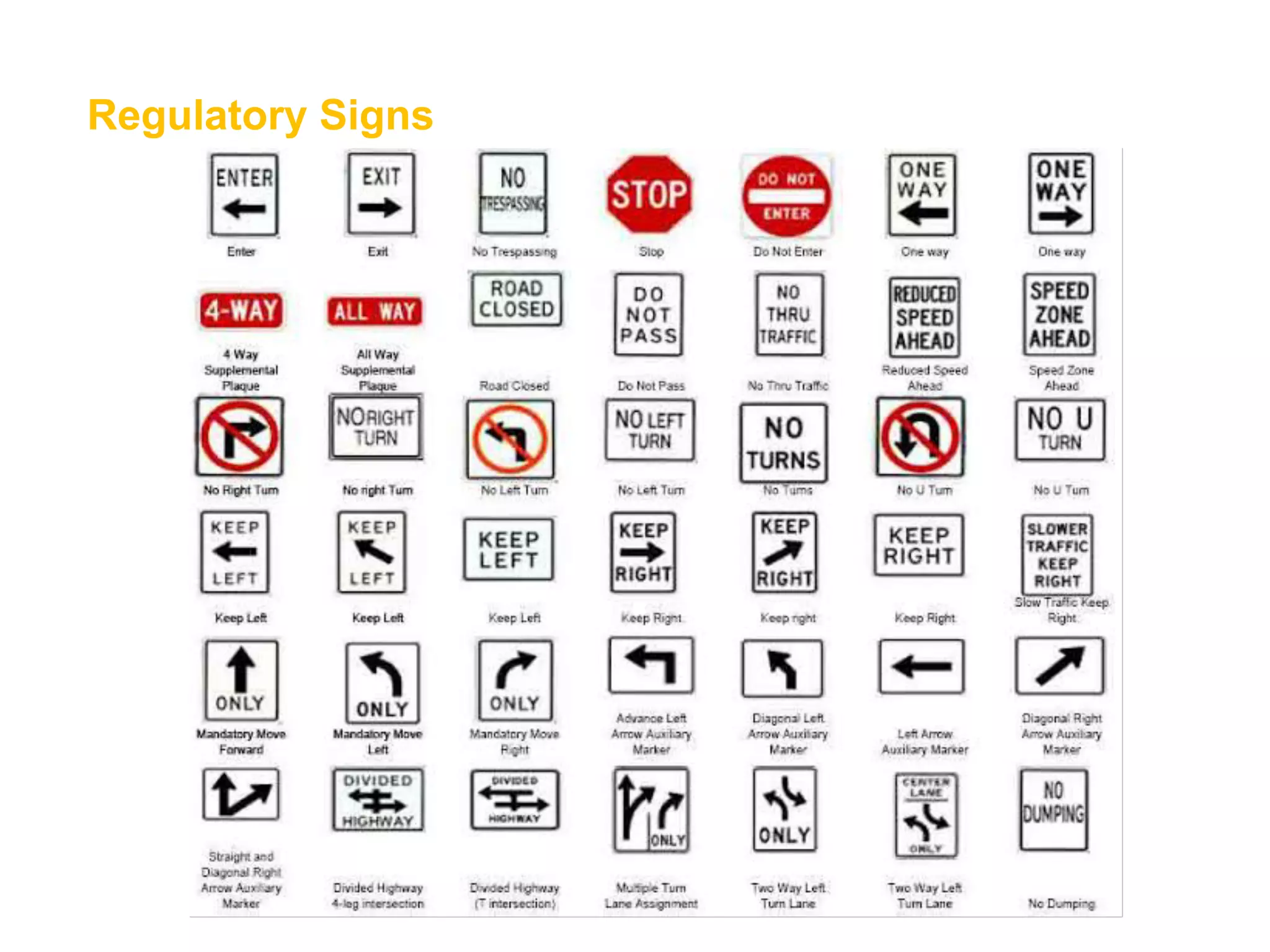
Regulatory signs-
They are meant to inform the road users of certain laws , regulations and
prohibitions ; the violation of these signs is a legal offense.
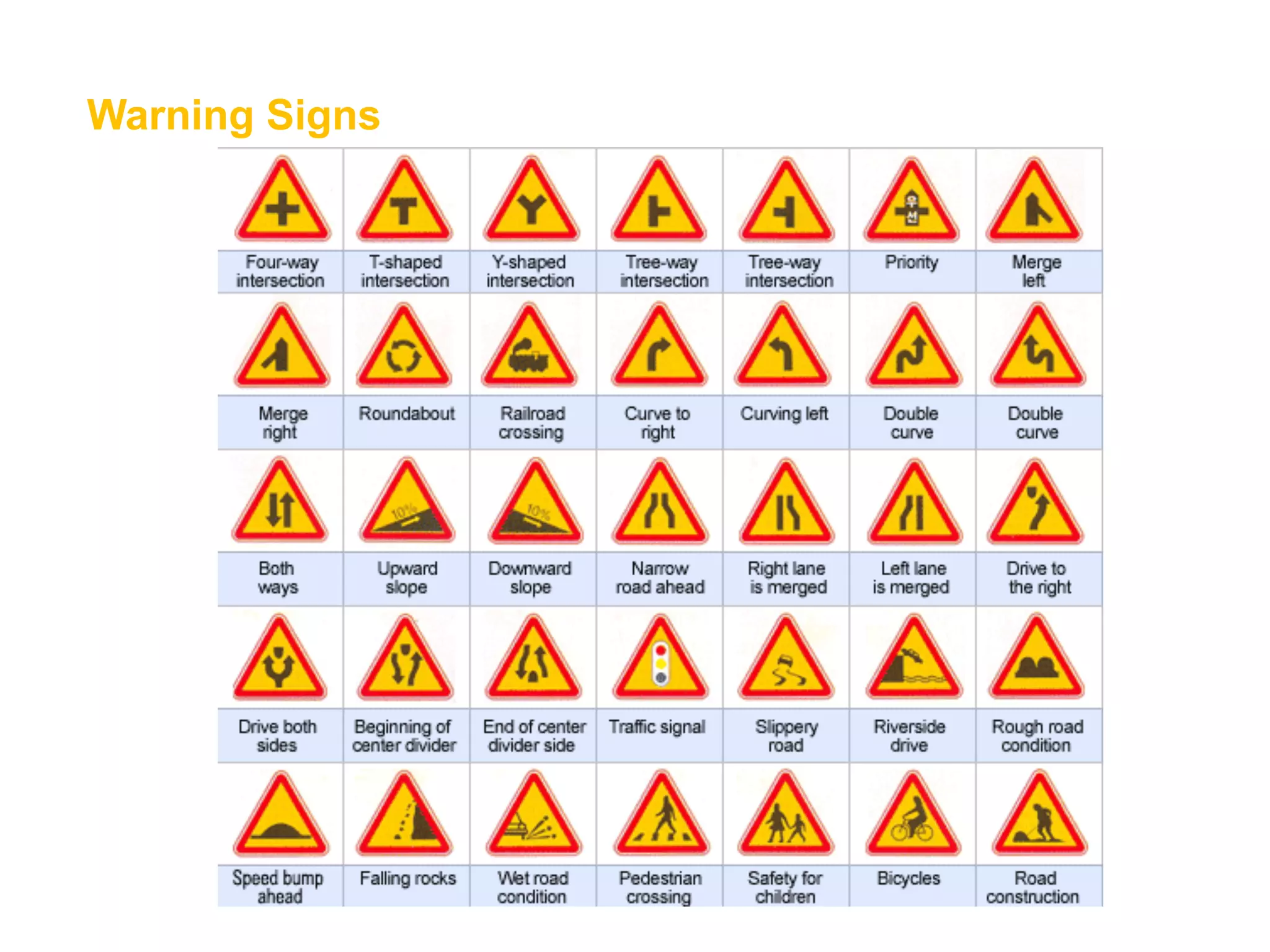
Warning Signs –
They are used to warn the hazardous conditions that exist or adjacent to
the Roadway. The warning signs in the shape of equilateral triangle with
one point upwards.
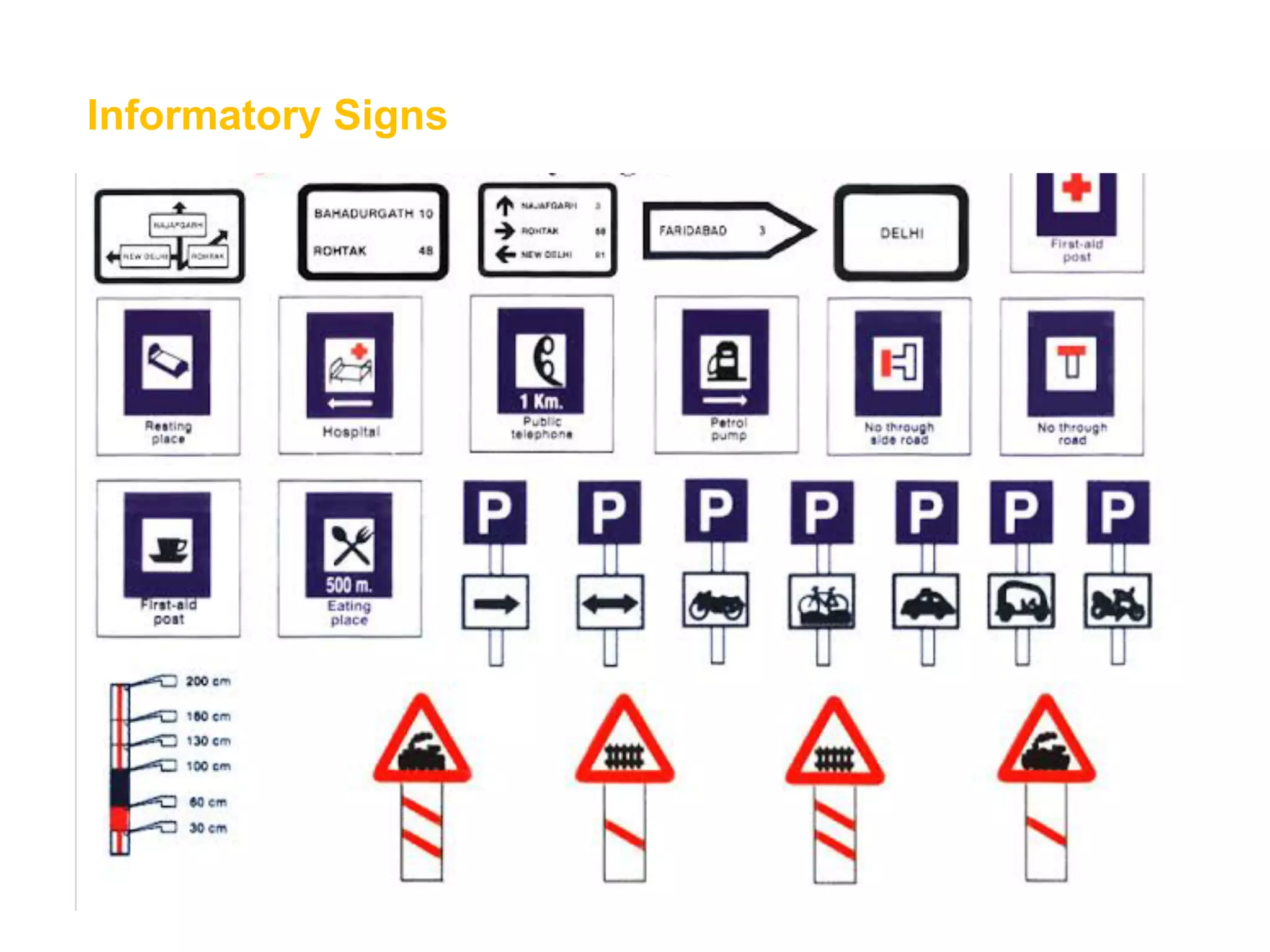
Informatory Signs-
These signs are used to guide the road users along routes , inform them of
destination and distance and provide with information to make travel easier ,
safe and pleasant.
TRAFFIC SIGNS
Regulatory Signs
Warning Signs
Informatory Signs
They are control devices which could alternately direct the traffic to stop
and proceed at intersections using red and green traffic light signals
automatically.
The main requirements of requirements of traffic signal are to draw
attention , provide meaning and time to respond and to have minimum
waste of time.
Types of Traffic Signal :
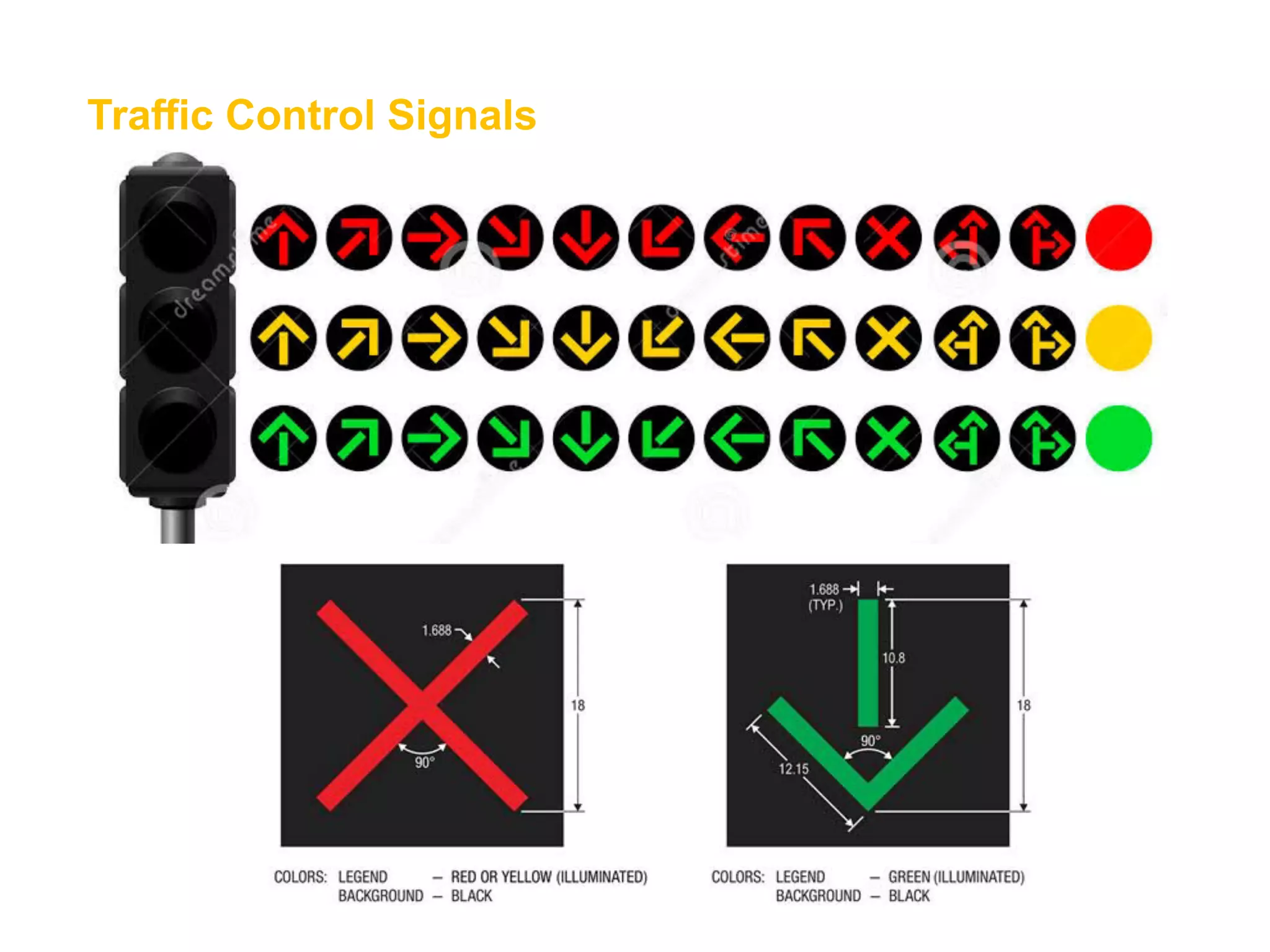
Traffic control signals-
They have three colored light glows facing each direction of traffic flow.
RED light means to STOP
GREEN means to GO
YELLOW or AMBER means allows the CLEARANCE TIME.
Pedestrian Signals-
They are meant to give the right way to pedestrian to cross a road during
the “walk period” when the vehicular traffic shall be stopped by red or stop
signal on the traffic signals of the road.
TRAFFIC SIGNALS
Traffic Control Signals
Pedestrian Signals
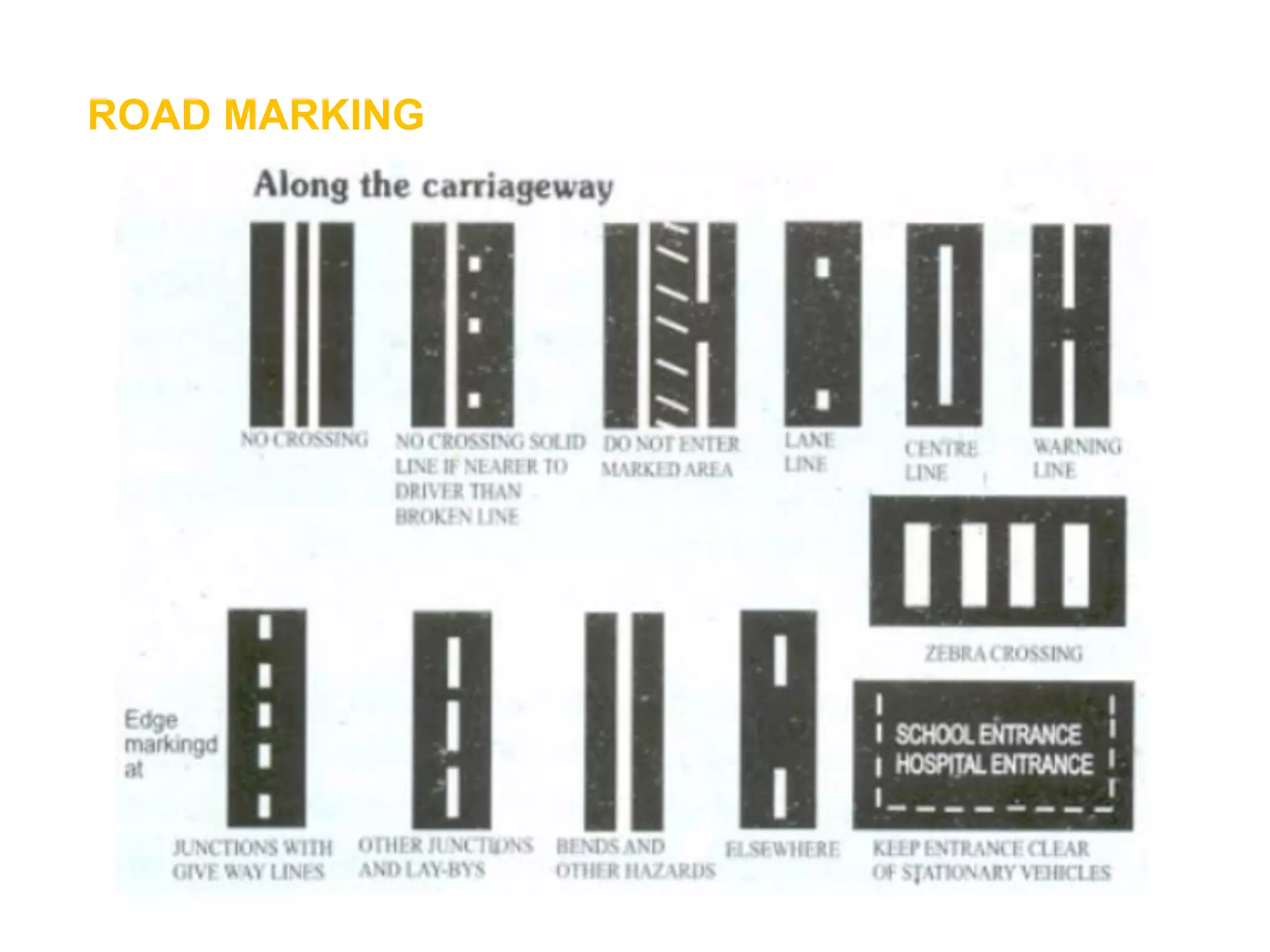
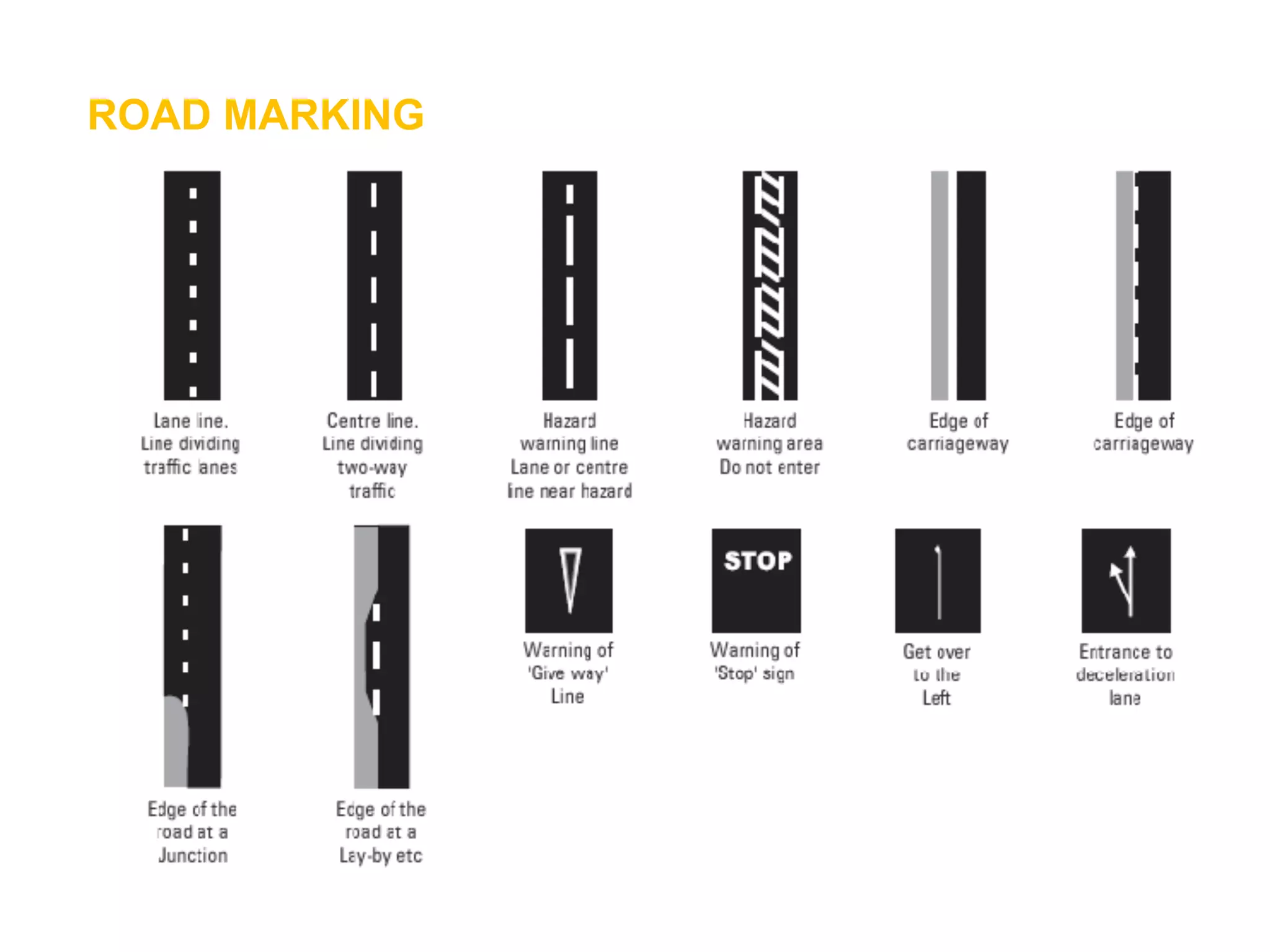
Road marking are made of lines , pattern , words , symbol or reflection on
the pavement , kerb , sides of islands or on the fixed objects within or near
the roadway.
The markings are made using paints in contrast with colourand brightness of
the pavements or other back ground.
Types of marking-
1. Pavement Marking-
They may generally be of white paint. Yellow marking are used to indicate
parking restrictions .
2. Kerb Marking-
These may indicate certain regulation like parking regulations. Also the
marking on the kerb and edges of islands with alternate black and white line
increases the visibility from the a long distance.
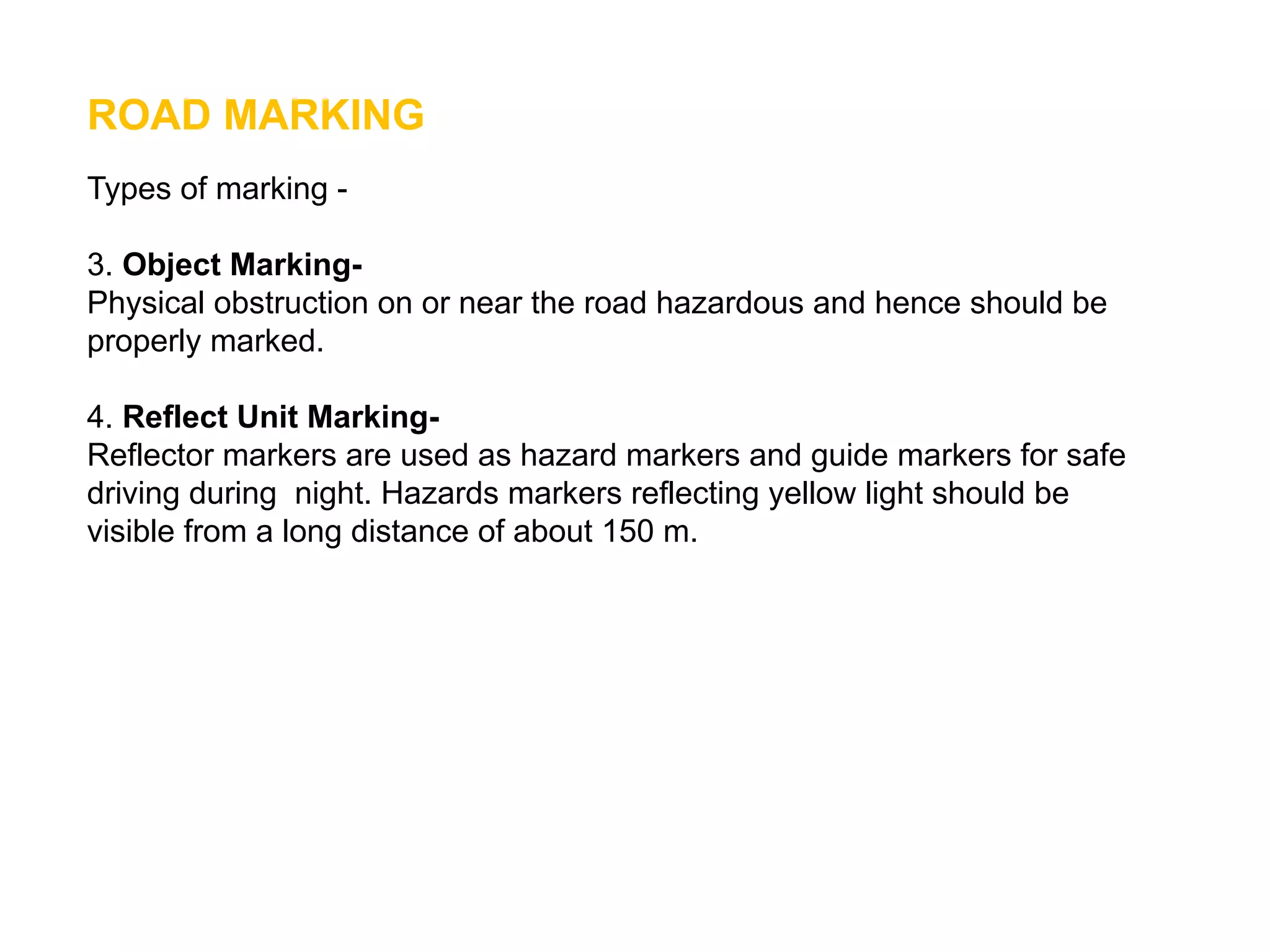
ROAD MARKING
Types of marking -
3. Object Marking-
Physical obstruction on or near the road hazardous and hence should be
properly marked.
4. Reflect Unit Marking-
Reflector markers are used as hazard markers and guide markers for safe
driving during night. Hazards markers reflecting yellow light should be
visible from a long distance of about 150 m.
ROAD MARKING
ROAD MARKING
ROAD MARKING
ROAD MARKING
ROAD MARKING
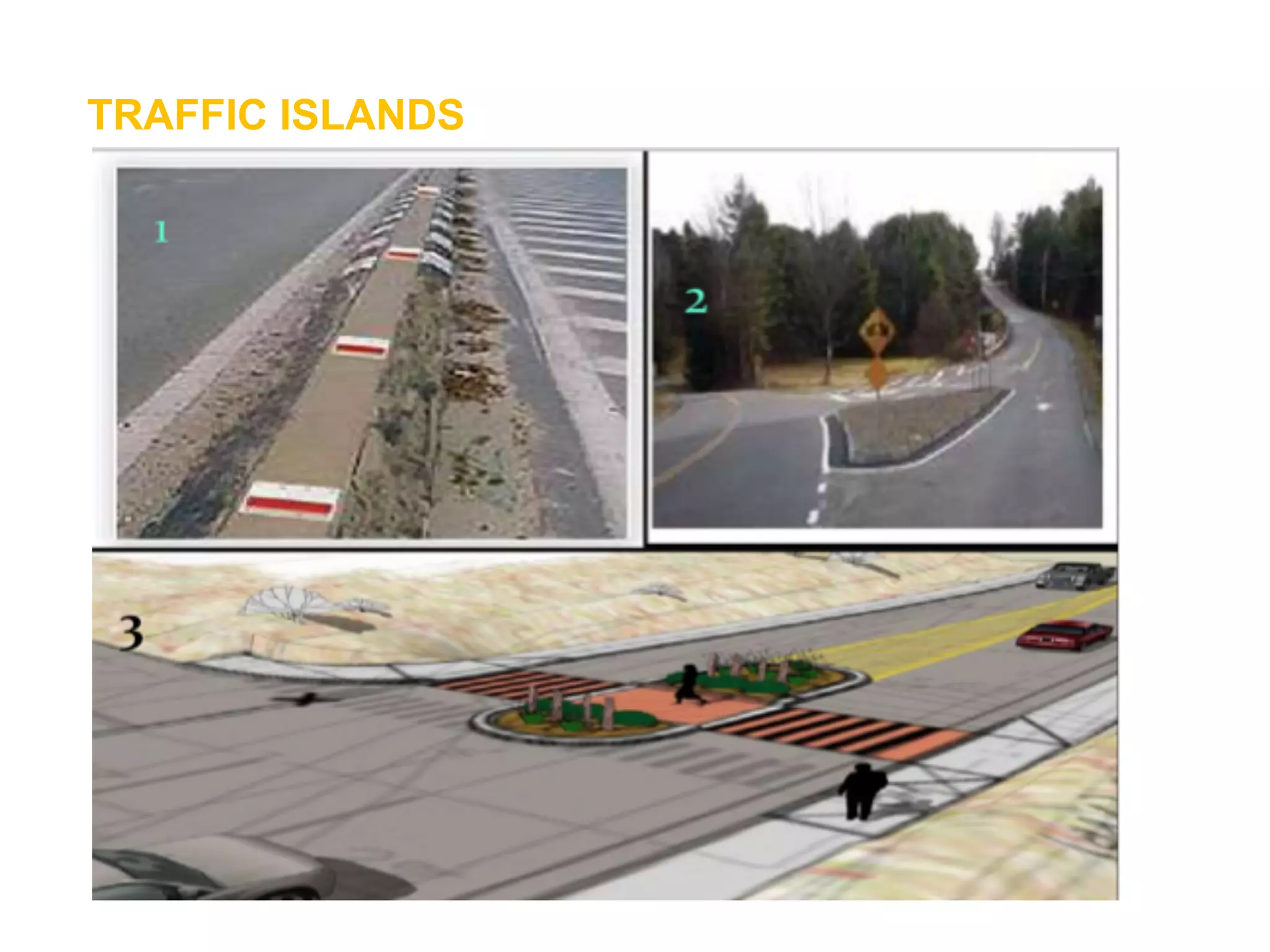
Traffic islands are raised areas constructed within the roadway to establish
physical channels through which the vehicular traffic may be guided.
They are mainly four types -
1. Divisional islands-
They are intended to separate opposing flow of traffic on a highway with four
or more lanes .
By thus dividing the highway into two one way roadways , the head-on
collisions are eliminated.
2. Channelizing islands-
They are used to guide the traffic into proper channel through the
intersection area.
They are very useful as traffic control devices for intersection at grades ,
when area is large.
TRAFFIC ISLANDS
They are mainly four types -
3. Pedestrian Loading Islands-
They are provided at regular bus stop and similar places for the protection
of passengers.
4. Rotary islands-
It is the large central island of rotary intersection ; this island is much larger
than the central island of channelized intersection.
TRAFFIC ISLANDS
TRAFFIC ISLANDS
TRAFFIC ISLANDS Roatry -
Thank you !

Traffic control devices

  • 1.
    TRAFFIC & TRANSPORT TRAFFICCONTROL DEVICES Submitted By - Abhilasha Gaur (14001) Amit jakhad (14010) Mansi Pushpakar(14034) Prerna Chouhan (14044) Sahil (14048) Sakshi Negi (14050) Sanam Saini (14053) Shagun (14055)
  • 2.
    The various aidsand devices used to control , regulate and guide traffic may be called Traffic Control Devices. The general requirement of Traffic Control Devices are : Attention , Time for response and respect of road users. INTRODUCTION Types of traffic control devices : • SIGNS • SIGNALS • MARKINGS • ISLANDS
  • 3.
    They are ofgreat help in regulating traffic by imparting message to the drivers about the need to stop , give way and limit their speeds. They are of three types : Regulatory signs- They are meant to inform the road users of certain laws , regulations and prohibitions ; the violation of these signs is a legal offense. Warning Signs – They are used to warn the hazardous conditions that exist or adjacent to the Roadway. The warning signs in the shape of equilateral triangle with one point upwards. Informatory Signs- These signs are used to guide the road users along routes , inform them of destination and distance and provide with information to make travel easier , safe and pleasant. TRAFFIC SIGNS
  • 4.
  • 5.
  • 6.
  • 7.
    They are controldevices which could alternately direct the traffic to stop and proceed at intersections using red and green traffic light signals automatically. The main requirements of requirements of traffic signal are to draw attention , provide meaning and time to respond and to have minimum waste of time. Types of Traffic Signal : Traffic control signals- They have three colored light glows facing each direction of traffic flow. RED light means to STOP GREEN means to GO YELLOW or AMBER means allows the CLEARANCE TIME. Pedestrian Signals- They are meant to give the right way to pedestrian to cross a road during the “walk period” when the vehicular traffic shall be stopped by red or stop signal on the traffic signals of the road. TRAFFIC SIGNALS
  • 8.
  • 9.
  • 10.
  • 11.
    Road marking aremade of lines , pattern , words , symbol or reflection on the pavement , kerb , sides of islands or on the fixed objects within or near the roadway. The markings are made using paints in contrast with colourand brightness of the pavements or other back ground. Types of marking- 1. Pavement Marking- They may generally be of white paint. Yellow marking are used to indicate parking restrictions . 2. Kerb Marking- These may indicate certain regulation like parking regulations. Also the marking on the kerb and edges of islands with alternate black and white line increases the visibility from the a long distance. ROAD MARKING
  • 12.
    Types of marking- 3. Object Marking- Physical obstruction on or near the road hazardous and hence should be properly marked. 4. Reflect Unit Marking- Reflector markers are used as hazard markers and guide markers for safe driving during night. Hazards markers reflecting yellow light should be visible from a long distance of about 150 m. ROAD MARKING
  • 13.
  • 14.
  • 15.
  • 16.
  • 17.
    Traffic islands areraised areas constructed within the roadway to establish physical channels through which the vehicular traffic may be guided. They are mainly four types - 1. Divisional islands- They are intended to separate opposing flow of traffic on a highway with four or more lanes . By thus dividing the highway into two one way roadways , the head-on collisions are eliminated. 2. Channelizing islands- They are used to guide the traffic into proper channel through the intersection area. They are very useful as traffic control devices for intersection at grades , when area is large. TRAFFIC ISLANDS
  • 18.
    They are mainlyfour types - 3. Pedestrian Loading Islands- They are provided at regular bus stop and similar places for the protection of passengers. 4. Rotary islands- It is the large central island of rotary intersection ; this island is much larger than the central island of channelized intersection. TRAFFIC ISLANDS
  • 19.
  • 20.
  • 21.