

PRESENTED IN
Class of :-
Dr. Shweta Mam
Presented by:
SUMANT KR.
SINGH
MBA/15017/15
Introduction….
 A trade union is such an organisation which is created
voluntarily on the basis of collective strength to secure
the interests of the workers.
• Development of modern industry, especially in
the Western countries, can be traced back to
the 18th century. Industrial development in India
on Western lines, however commenced from the
middle of the 19th century. The first organised
Trade Union in India named as the Madras
Labour Union was formed in the year 1918.
Since then a large number of unions sprang up
in almost all the industrial centres of the country.
Similarly, entrepreneurs also formed their
organisations to protect their interests.
Definition.
Section 2(h) of the Trade Union Act,1926 has define a trade union
as:-
“Any combination, whether temporary or permanent, former
primarily for the purpose of regulating the relation between
workman and workmen or between employers, or for imposing
restrictive conditions on the conduct of any trade or business, and
includes any federation of two or more trade unions.
The Trade Union Act was passed in 1926 under the
title of the Indian Trade Union Act and was brought
into effect from 1st June 1927 by a notification in the
Official Gazette by the Central Government. The
Act was amended in 1947, 1960 and 1962,
Subsequently the word ‘Indian’ was deleted from
the amended Act of 1964, which came into force
from 1st April 1965. A comprehensive trade unions
(Amendment) Act was passed in 1982.
 Greater Bargaining Power .
 Minimize Discrimination .
 Sense of Security .
 Sense of Participation .
 Sense of Belongingness.
 Platform for self expression .
 Betterment of relationships .
 Trade union certainly plays an important role
in industrial relations. The advantages of
trade union can be divided into the three:-
• Advantages To Workers.
• Advantages To Employer.
• Advantages To Society.
 Promote unity.
 Ensures improvement in working conditions
and provision of better welfare facilities.
 Spirit of self reliance and self respect.
 Change in employer’s attitude.
 Uniform Wages.
 Disputes can be avoided or may be solved
amicably (harmoniously, politely) (continuous workflow).
 Industrial peace (sense of resp. and loyalty).
 Framing healthy labor policies (reduces chance of
industrial disputes in future).
 Gain sympathy of general public (in crisis)
 Propose to the Government (to enact labor policies to
protect and develop labor force of the country in a better way)
 Development of industrial economy by
maintaining good industrial relations It will
result in higher and better production at
lower costs.
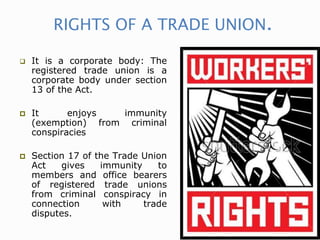
RIGHTS OF A TRADE UNION.
 It is a corporate body: The
registered trade union is a
corporate body under section
13 of the Act.
 It enjoys immunity
(exemption) from criminal
conspiracies
 Section 17 of the Trade Union
Act gives immunity to
members and office bearers
of registered trade unions
from criminal conspiracy in
connection with trade
disputes.
RIGHTS OF A TRADE UNION.
 The union can keep separate fund for political purposes.
 An agreement between the members of a registered trade
union not to accept employment is valid (not void being
agreement in restraint of trade).
 The union has a right to amalgamate to form a larger
union.
 Members of the union have a right to inspect books.
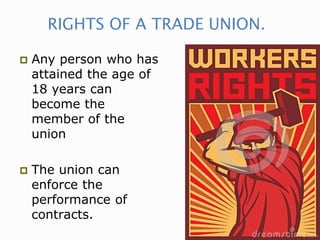
RIGHTS OF A TRADE UNION.
 Any person who has
attained the age of
18 years can
become the
member of the
union
 The union can
enforce the
performance of
contracts.
CASE STUDY OF HOTEL
OBEROI. The employees of the hotel used to get 65 days holiday per year, but
the management wanted to reduce it by 15 days due to some
managerial issues.
 The workers readily and strongly opposed this proposal and approached
Maharashtra Samarth Kamgar Sanghatna to solve this issue.
 MSKS understood the workers dilemma and went to the management
to reach an understanding via collective bargaining.
COLLECTIVE BARGAINING
PROCESS.
1. MSKS agreed to convince the workers but in return asked the management to pay
20 days extra salary in the month of December.
2. The management and workers debated over the issue.
The management found that they had the workers working for 15 extra days and
the workers found that they were being paid for 20 days just for 15 days of extra
work.
3. Both the parties reached an agreement.
Thus, MSKS was successful in creating a win-win situation via collective bargaining.
Present Central Trade Union
Organizations.
 INTUC (Indian National Trade Union
Congress)
 AITUC (All India Trade Union Congress)
 CITU (Centre of Indian Trade Unions)
 NLO (National Labour Organization)
 TUCC (Trade Union Congress Committee)
 Bharatiya Mazdoor Sangh (BMS)
 Hind Mazdoor Sabha (HMS)
Trade Union

Trade Union

  • 1.
    PRESENTED IN Class of:- Dr. Shweta Mam Presented by: SUMANT KR. SINGH MBA/15017/15
  • 2.
    Introduction….  A tradeunion is such an organisation which is created voluntarily on the basis of collective strength to secure the interests of the workers.
  • 3.
    • Development ofmodern industry, especially in the Western countries, can be traced back to the 18th century. Industrial development in India on Western lines, however commenced from the middle of the 19th century. The first organised Trade Union in India named as the Madras Labour Union was formed in the year 1918. Since then a large number of unions sprang up in almost all the industrial centres of the country. Similarly, entrepreneurs also formed their organisations to protect their interests.
  • 4.
    Definition. Section 2(h) ofthe Trade Union Act,1926 has define a trade union as:- “Any combination, whether temporary or permanent, former primarily for the purpose of regulating the relation between workman and workmen or between employers, or for imposing restrictive conditions on the conduct of any trade or business, and includes any federation of two or more trade unions.
  • 5.
    The Trade UnionAct was passed in 1926 under the title of the Indian Trade Union Act and was brought into effect from 1st June 1927 by a notification in the Official Gazette by the Central Government. The Act was amended in 1947, 1960 and 1962, Subsequently the word ‘Indian’ was deleted from the amended Act of 1964, which came into force from 1st April 1965. A comprehensive trade unions (Amendment) Act was passed in 1982.
  • 6.
     Greater BargainingPower .  Minimize Discrimination .  Sense of Security .  Sense of Participation .  Sense of Belongingness.  Platform for self expression .  Betterment of relationships .
  • 7.
     Trade unioncertainly plays an important role in industrial relations. The advantages of trade union can be divided into the three:- • Advantages To Workers. • Advantages To Employer. • Advantages To Society.
  • 8.
     Promote unity. Ensures improvement in working conditions and provision of better welfare facilities.  Spirit of self reliance and self respect.  Change in employer’s attitude.  Uniform Wages.
  • 9.
     Disputes canbe avoided or may be solved amicably (harmoniously, politely) (continuous workflow).  Industrial peace (sense of resp. and loyalty).  Framing healthy labor policies (reduces chance of industrial disputes in future).
  • 10.
     Gain sympathyof general public (in crisis)  Propose to the Government (to enact labor policies to protect and develop labor force of the country in a better way)  Development of industrial economy by maintaining good industrial relations It will result in higher and better production at lower costs.
  • 11.
    RIGHTS OF ATRADE UNION.  It is a corporate body: The registered trade union is a corporate body under section 13 of the Act.  It enjoys immunity (exemption) from criminal conspiracies  Section 17 of the Trade Union Act gives immunity to members and office bearers of registered trade unions from criminal conspiracy in connection with trade disputes.
  • 12.
    RIGHTS OF ATRADE UNION.  The union can keep separate fund for political purposes.  An agreement between the members of a registered trade union not to accept employment is valid (not void being agreement in restraint of trade).  The union has a right to amalgamate to form a larger union.  Members of the union have a right to inspect books.
  • 13.
    RIGHTS OF ATRADE UNION.  Any person who has attained the age of 18 years can become the member of the union  The union can enforce the performance of contracts.
  • 14.
    CASE STUDY OFHOTEL OBEROI. The employees of the hotel used to get 65 days holiday per year, but the management wanted to reduce it by 15 days due to some managerial issues.  The workers readily and strongly opposed this proposal and approached Maharashtra Samarth Kamgar Sanghatna to solve this issue.  MSKS understood the workers dilemma and went to the management to reach an understanding via collective bargaining.
  • 15.
    COLLECTIVE BARGAINING PROCESS. 1. MSKSagreed to convince the workers but in return asked the management to pay 20 days extra salary in the month of December. 2. The management and workers debated over the issue. The management found that they had the workers working for 15 extra days and the workers found that they were being paid for 20 days just for 15 days of extra work. 3. Both the parties reached an agreement. Thus, MSKS was successful in creating a win-win situation via collective bargaining.
  • 16.
    Present Central TradeUnion Organizations.  INTUC (Indian National Trade Union Congress)  AITUC (All India Trade Union Congress)  CITU (Centre of Indian Trade Unions)  NLO (National Labour Organization)  TUCC (Trade Union Congress Committee)  Bharatiya Mazdoor Sangh (BMS)  Hind Mazdoor Sabha (HMS)