PRESENTED IN
Class of :-
Shipli Samragy
Mam
Presented by:-
SUMANT KR.
SINGH
MBA/15017/15
 Originally, The Law Relating
To Sale Of Goods Was Contained
In The Indian Contract Act,
1872.
 The Same Was Repealed And
Re-enacted By The Sale Of Good
Act, 1930.
 The act came into force on
1st july, 1930.
 The Indian Sale Of Good Act
Closely Follows The English
Sale Of Good Act,1893.
 Caveat Emptor is a fundamental
principle of the law of sale of goods.
 It means "Caution Buyer", i.e. "Let the
buyer beware".
 Caveat means “beware”.
 Emptor means “buyer”.
 In other words, it is not the duty of
the seller's to point out defects of his
own goods.
 The buyer must inspect the goods to
find out if they will suit his purpose.
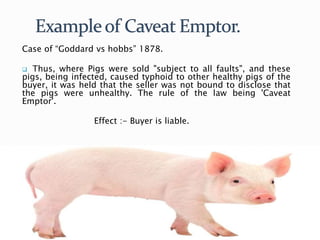
Case of “Goddard vs hobbs” 1878.
 Thus, where Pigs were sold "subject to all faults", and these
pigs, being infected, caused typhoid to other healthy pigs of the
buyer, it was held that the seller was not bound to disclose that
the pigs were unhealthy. The rule of the law being 'Caveat
Emptor'.
Effect :- Buyer is liable.
 Purchase By Description. [Section 15 ]
 Purchase by samples and Description. [Section 15 ]
 Fitness for purpose. [Section 16 (1) ]
 Merchantable Quality. [Section 16(2) ]
 Consent By Fraud. [Section ]
 Sale By Sample. [Section 17]
 Conditions as to title. [Section 14 (a) ]
Exception To Caveat Emptor.
 Purchase By Description: - The rule of caveat emptor does not
apply in a case where goods are brought by description from a
seller.
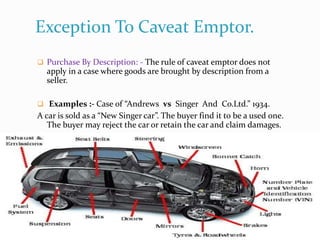
 Examples :- Case of “Andrews vs Singer And Co.Ltd.” 1934.
A car is sold as a “New Singer car”. The buyer find it to be a used one.
The buyer may reject the car or retain the car and claim damages.
 Purchase by samples and Description: - Where goods are
bought by samples as well as by description and the bulk of
goods do not correspond with the description, the buyer is
entitled to reject the goods.
 Examples :- Case of “Nichol vs Godts” 1854.
 “Foreign refined rape oil” was sold warranted to be equal to
sample. The sample was actually not “Foreign refined rape oil”
but a mixture of “Hemp oil”.
 HELD:- The buyer could reject the oil though the bulk
corresponded with the sample.
Exception To Caveat Emptor.
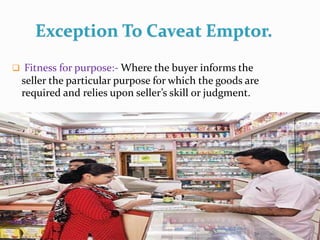
 Fitness for purpose:- Where the buyer informs the
seller the particular purpose for which the goods are
required and relies upon seller’s skill or judgment.
 Merchantable Quality:- Where the goods are brought by
description from a seller who deals in goods of that description.
Whether he is a manufacturer or producer or not, there is an
implied condition that the goods should be of merchantable
quality.
 Examples :- A bought black yarn from D and found it to be
damaged by white Ants.
 HELD:- The condition as to merchantability was broken.
Exception To Caveat Emptor.
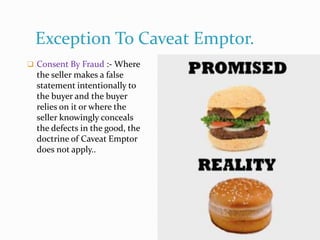
 Consent By Fraud :- Where
the seller makes a false
statement intentionally to
the buyer and the buyer
relies on it or where the
seller knowingly conceals
the defects in the good, the
doctrine of Caveat Emptor
does not apply..
 Sale By Sample:- In a sale of goods by sample. The rule
of caveat emptor does not apply if the bulk does not
correspond with the sample, or if the buyer is not
given an opportunity to compare bulk with the sample.
 Examples :- Certain shoes were sold by sample
for the French Army. The shoes were found to
contain paper not discoverable by ordinary
inspection.
 HELD:- The buyer was entitled to the refund of
price plus damages.
 Conditions as to title :- The general rule is that
only the owner of goods can transfer a good title.
No one can give a better title than he himself has.
 Examples :- A finds a ring of B and sells it to a third
person who purchases it for value and in good
faith. The true owner, i.e., B can recover from that
person, for A having no title could pass none the
better.
Caveat emptor ppt

Caveat emptor ppt

  • 1.
    PRESENTED IN Class of:- Shipli Samragy Mam Presented by:- SUMANT KR. SINGH MBA/15017/15
  • 2.
     Originally, TheLaw Relating To Sale Of Goods Was Contained In The Indian Contract Act, 1872.  The Same Was Repealed And Re-enacted By The Sale Of Good Act, 1930.  The act came into force on 1st july, 1930.  The Indian Sale Of Good Act Closely Follows The English Sale Of Good Act,1893.
  • 3.
     Caveat Emptoris a fundamental principle of the law of sale of goods.  It means "Caution Buyer", i.e. "Let the buyer beware".  Caveat means “beware”.  Emptor means “buyer”.  In other words, it is not the duty of the seller's to point out defects of his own goods.  The buyer must inspect the goods to find out if they will suit his purpose.
  • 4.
    Case of “Goddardvs hobbs” 1878.  Thus, where Pigs were sold "subject to all faults", and these pigs, being infected, caused typhoid to other healthy pigs of the buyer, it was held that the seller was not bound to disclose that the pigs were unhealthy. The rule of the law being 'Caveat Emptor'. Effect :- Buyer is liable.
  • 5.
     Purchase ByDescription. [Section 15 ]  Purchase by samples and Description. [Section 15 ]  Fitness for purpose. [Section 16 (1) ]  Merchantable Quality. [Section 16(2) ]  Consent By Fraud. [Section ]  Sale By Sample. [Section 17]  Conditions as to title. [Section 14 (a) ]
  • 6.
    Exception To CaveatEmptor.  Purchase By Description: - The rule of caveat emptor does not apply in a case where goods are brought by description from a seller.  Examples :- Case of “Andrews vs Singer And Co.Ltd.” 1934. A car is sold as a “New Singer car”. The buyer find it to be a used one. The buyer may reject the car or retain the car and claim damages.
  • 7.
     Purchase bysamples and Description: - Where goods are bought by samples as well as by description and the bulk of goods do not correspond with the description, the buyer is entitled to reject the goods.  Examples :- Case of “Nichol vs Godts” 1854.  “Foreign refined rape oil” was sold warranted to be equal to sample. The sample was actually not “Foreign refined rape oil” but a mixture of “Hemp oil”.  HELD:- The buyer could reject the oil though the bulk corresponded with the sample.
  • 8.
    Exception To CaveatEmptor.  Fitness for purpose:- Where the buyer informs the seller the particular purpose for which the goods are required and relies upon seller’s skill or judgment.
  • 9.
     Merchantable Quality:-Where the goods are brought by description from a seller who deals in goods of that description. Whether he is a manufacturer or producer or not, there is an implied condition that the goods should be of merchantable quality.  Examples :- A bought black yarn from D and found it to be damaged by white Ants.  HELD:- The condition as to merchantability was broken.
  • 10.
    Exception To CaveatEmptor.  Consent By Fraud :- Where the seller makes a false statement intentionally to the buyer and the buyer relies on it or where the seller knowingly conceals the defects in the good, the doctrine of Caveat Emptor does not apply..
  • 11.
     Sale BySample:- In a sale of goods by sample. The rule of caveat emptor does not apply if the bulk does not correspond with the sample, or if the buyer is not given an opportunity to compare bulk with the sample.  Examples :- Certain shoes were sold by sample for the French Army. The shoes were found to contain paper not discoverable by ordinary inspection.  HELD:- The buyer was entitled to the refund of price plus damages.
  • 12.
     Conditions asto title :- The general rule is that only the owner of goods can transfer a good title. No one can give a better title than he himself has.  Examples :- A finds a ring of B and sells it to a third person who purchases it for value and in good faith. The true owner, i.e., B can recover from that person, for A having no title could pass none the better.