Industrial Relations and
Trade unions
Industrial Relations
 It is the relationship between employer
and employee as a group.
 The role of different parties- employers,
employee and their unions, and state in
maintaining this relationship.
 It the mechanism of handling conflicts
between employer and employee.
Objectives
 To develop harmonious relationship
between operatives and management.
 Developing goodwill and understanding.
 Develop mutuality among the interests
of these parties.
 To raise productivity
 To curb employee turnover and
absenteeism
Objectives…..
 To avoid governments interference.
 To establish and nurse the growth of an
Industrial Democracy (sharing of profits,
managerial decisions)
 To avoid industrial conflict/ industrial
strife
Obj.
 To eliminate- strikes, lockouts and
gheraos.
 Development of healthy labor-
management relations
 Maintenance of industrial peace
Req. of a successful I.R. Prog.
 Creating trust between Employees and
Management
 Top Management support.
 Sound personnel policies
 Adequate practices should be
developed by professionals
 Detailed supervisory training
 Follow-up of Results
Definition of Trade Union
Trade unions are voluntary organizations of
workers or employers formed to promote and
protect their interests through collective action.
Trade Unions
 All organizations of employees
including those of salaried and
professional workers as well as those of
manual wage earners which are known
to include among their functions that the
negotiating with their employers with the
object of regulating conditions of
employment.
1926 TU Act Sec. 2
 Any body who has the willingness to
group together for the purpose of trade
employment or terms of employment or
can be united together shall be deemed
to be union and as considered in TU
Act 1926.
Nature of Trade Union
According to the Trade Union Act 1926 it is a
combination, whether temporary or permanent,
formed
(i) primarily for the purpose of regulating the relation
between
(a) workmen and employers or
(b) between workmen and workmen, or
(c) between employers and employers, or
(ii) for imposing restrictive conditions on the conduct of
any trade or business.
Nature of Trade Union
The analysis reveals that Trade Union is :-
1. A combination of workers or employers.
2. Such a combination could be permanent or
temporary.
3. Could include federation of two or more unions,
and
4. To regulate relations among workmen, between
workmen and employers or among employers
themselves.
Features of T.U
 T.U are voluntary associations formed by
employees to safeguard their interests
through collective actions.
 Such associations can work at the level on
individual organizations as well as apex
bodies (affiliated to trade unions)
 Since TU are voluntary- employee has choice
to join or not, TU has choice to affiliate or not
to affiliate itself with an apex body of TU.
Features of TU in India
 Various types of TU- primary unions,
regional unions, Central TU
 All major central TU are affiliated to
political parties
 Multiplicity of TU in single plant results
into inter-union rivalry
 Proliferation of TU results in Smaller
number of membership and financial
constraints
Features of TU in India
 Major decision making process is
controlled by the outsiders.
Principles of Trade Unionism
Trade unions function on the basis of three
fundamental principles.
 Unity is strength.
 Equal pay for equal work or for the same job.
 Security of service.
Objectives of Trade Unions
 Wages & salaries
 Working conditions
 Discipline
 Personal policies
 Welfare
 Employee-employer relations
 Negotiating machinery
 Safeguarding organizational health and interest of the
industry
Reasons for joining Union
 Dissatisfaction of employee
 Powerlessness
 Union Instrumentality
Why do Workers Join Trade Unions?
 To attain economic security- permanent employment with
higher salary and benefits.
 To improve their bargaining power
 To inform worker’s views, ideas aims and dissatisfaction
to the management.
 To satisfy social needs.
 To secure power.
 Betterment of Relationships.
TU movement in India
 TU activities started with the formation
of Bombay Mill Association in 1890.
 Followed by many other TU at Calcutta
and Madras .
 First World War- ILO International Labor
Organization (1919) and Swaraj
movement etc. facilitated the TU
movement
 All India Trade Union Congress
TU movement in India
 Formation of AITUC prompted the
formation of number of TU
 In 1926 Trade Union Act was enacted
to provide legal status to union activities
and registration of unions.
 1920s due to ideological differences
many left AITUC and formed National
Trade Union Federation.
TU movement in India
 During Second World War strikes and
lockouts were banned under the
Defence of Indian Rules.
 After the independence, the growth of
TU followed the pattern of development
of political parties.
 Congress Party formed- Indian National
Trade Union Congress (INTUC) 1947
TU movement in India
 Praja Socialist Party formed- Hind
Mazdoor Sabha 1948.
 Then Proliferation of political parties
 Presently more active TU are---
INTUC- Congress party
AITUC- Communist party
Center of Indian TU- Communist
(Marxists)
Bharatiya Mazdoor Sangh9 BJP etc.
Present Central Trade Union
Organizations
 All India Trade Union Congress (AITUC) 1920
 Bharatiya Mazdoor Sangh (BMS)
 Hind Mazdoor Sabha (HMS) 1948
 Indian Federation of Free Trade Unions (IFFTU)
 National Front of Indian Trade Unions (NFITU)
 National Labor Organization (NLO)
 Trade Unions Co-ordination Centre (TUCC)
Functions of TU
 Functions relating to members
 Functions relating to organization
 Functions relating to union activities
 Functions relating to society
Functions of Trade Union
The basic functions of trade unions is to protect and
promote the interest of the workers and conditions of
their employment.
1. Militant Functions
2. Fraternal Function
3. Political functions
4. social functions
Militant/Protective Functions
 Achieve higher wages and better working conditions.
 Raise the status of workers as a part of industry and
 Protect labour against victimization and injustice.
Fraternal Functions
 Providing financial and non-financial assistance to
workers
 Extension of medical facilities during sickness and
casualties.
 Provision of education, recreation, and housing
facilities.
 Provision of religious and social benefits.
 To provide opportunities for promotion and growth.
Political Functions
 Affiliating the union to a political party
 Helping to enroll the members, collecting
donations
 Seeking the help of political parties during
periods of strikes & lockouts
Social Functions
 Carrying out social service activities
 Discharging social responsibilities through
various sections of the society like educating
the customers
Problems for Trade Union GrowthProblems for Trade Union Growth
a) Off-Centering Labour
b) Segmentation of Workforce
c) Core / Periphery
d) Employment Instability
e) Investment Attraction
f) Individualization of Labour Relations
g) Labour Cost Cutting
h) Leadership Credibility/ Inside vs. Outside leadership
i) Failure of Institutions
Trade Union Act, 1926
Allows employees the right to form and organize
unions.
Min 7 persons is required to form their union and get
it registered under this act.
If union has been existing for more than 1 year the
statement of asset and liability must be shown.
The application must contain
1. Name, occupation and address of members.
2. Name of union, its head office details.
3. Details about office bearers
Grievance Management
Grievance
Grievance refers to any discontent or
dissatisfaction, whether expressed or
not and valid or not, arising out of
anything connected with the company
that an employee thinks, believes or
even feels, is unfair, unjust or
inequitable.
3 Cardinal principles of grievance
settlement
 Settlement at the lowest level
 Settlement as quickly as possible
 Settlement to the satisfaction of the
aggrieved
Steps in handling grievances
 Define the nature of the grievance
 Collect all the facts (how, where, when, why,
whom)
 Establish tentative solutions to the grievance
 Collect additional information to check the
validity
 Apply the solution
 Follow-up (casual observation, direct interaction
, general discussion, feedback from other
employees)
Principles of handling
grievance
 Fair demonstration of grievance
procedure
 Definite and clear
 Simple
 It should function promptly and speedily
 Right attitude of supervisor
 Confidence of supervisors
 Long run implications of the decision
Causes of grievances
 Wages and working conditions
 supervision
 Management policies and practices
 Maladjustment of employee
Identification of Grievances
 Exit interview
 Gripe box system
 opinion surveys
 open door policy
Grievance procedure
 The grievance procedure is a problem-
solving, dispute-settling machinery
which has been set up following an
agreement to that effect between labor
and management.
Steps in Grievance Procedure
 Step 1- Aggrieved employee explains
his grievance to his immediate
supervisor.
 Step 2- Here grievance handled by the
sectional/departmental head.Or
representative of industrial
relations/personal department.
Steps in Grievance Procedure
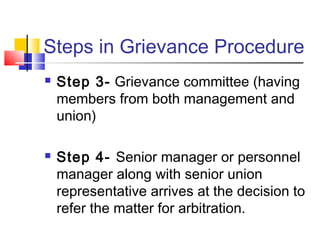
 Step 3- Grievance committee (having
members from both management and
union)
 Step 4- Senior manager or personnel
manager along with senior union
representative arrives at the decision to
refer the matter for arbitration.
Steps in Grievance Procedure
 Step 5- Arbitrator is appointed with the
mutual consultation of management
and union or the employee.
Model grievance procedure
1958
Step 1-
 An aggrieved employee shall first
present his grievance verbally in
person to the officer designated by the
management for this purpose.
An answer shall be given to him within
48 hours of the presentation of the
complaint.
Model grievance procedure
1958
Step 2-
 Aggrieved, in person and/or
accompanied by his departmental
representative present his grievance to
the HOD designated by the
management for the purpose of
handling grievances
 Decision should be given within 3
days
Model grievance procedure
1958
Step 3-
 Grievance committee
(recommendations within 7 days)
 In the case of difference of opinion
within the committee, matter is send to
the manager on which he has to give
recommendations within 3 days.
Model grievance procedure
1958
Step 4-
 Appeal to the management for revision.
 Worker has the right, if he desires , to
take a union official along with him.
 Decision should be made within a week
from the date of receipt.
Model grievance procedure
1958
Step 5-
 If no agreement is possible, the union
and management may refer the
grievance to voluntary arbitration within
a week from the date of receipt.
Important points
 No interference from the formal
conciliation machinery, till all the steps
in the grievance handling procedure
have been exhausted.
 If the grievance arise out of an order,
the said order shall be complied first.
Important points
 The workers representatives on the
grievance committee shall have the
right to assess any document
connected to the matter.
 Management has the right to refuse if
the document is confidential.
 But then that document shall not be
used against the worker in due course.
Important points
 72 hours time difference should be
there within one step and the other.
 In calculating time intervals, holidays
shall not be reckoned
 Management shall provide the
necessary clerical and other assistance
for a smooth functioning of the
grievance machinery.
Constitution of grievance
committee
 In case where the union is recognized
2 representatives of the management
a union representative
a union departmental representative
Constitution of grievance
committee
 Incase where the union is not
recognized or there is no union but a
workers committee
2 representatives of management
representative of the department
secretary or VP of the works committee
Max. no. of members of grievance
committee should not exceed 6

9 industrial relations gm & tu

  • 1.
  • 2.
    Industrial Relations  Itis the relationship between employer and employee as a group.  The role of different parties- employers, employee and their unions, and state in maintaining this relationship.  It the mechanism of handling conflicts between employer and employee.
  • 3.
    Objectives  To developharmonious relationship between operatives and management.  Developing goodwill and understanding.  Develop mutuality among the interests of these parties.  To raise productivity  To curb employee turnover and absenteeism
  • 4.
    Objectives…..  To avoidgovernments interference.  To establish and nurse the growth of an Industrial Democracy (sharing of profits, managerial decisions)  To avoid industrial conflict/ industrial strife
  • 5.
    Obj.  To eliminate-strikes, lockouts and gheraos.  Development of healthy labor- management relations  Maintenance of industrial peace
  • 6.
    Req. of asuccessful I.R. Prog.  Creating trust between Employees and Management  Top Management support.  Sound personnel policies  Adequate practices should be developed by professionals  Detailed supervisory training  Follow-up of Results
  • 7.
    Definition of TradeUnion Trade unions are voluntary organizations of workers or employers formed to promote and protect their interests through collective action.
  • 8.
    Trade Unions  Allorganizations of employees including those of salaried and professional workers as well as those of manual wage earners which are known to include among their functions that the negotiating with their employers with the object of regulating conditions of employment.
  • 9.
    1926 TU ActSec. 2  Any body who has the willingness to group together for the purpose of trade employment or terms of employment or can be united together shall be deemed to be union and as considered in TU Act 1926.
  • 10.
    Nature of TradeUnion According to the Trade Union Act 1926 it is a combination, whether temporary or permanent, formed (i) primarily for the purpose of regulating the relation between (a) workmen and employers or (b) between workmen and workmen, or (c) between employers and employers, or (ii) for imposing restrictive conditions on the conduct of any trade or business.
  • 11.
    Nature of TradeUnion The analysis reveals that Trade Union is :- 1. A combination of workers or employers. 2. Such a combination could be permanent or temporary. 3. Could include federation of two or more unions, and 4. To regulate relations among workmen, between workmen and employers or among employers themselves.
  • 12.
    Features of T.U T.U are voluntary associations formed by employees to safeguard their interests through collective actions.  Such associations can work at the level on individual organizations as well as apex bodies (affiliated to trade unions)  Since TU are voluntary- employee has choice to join or not, TU has choice to affiliate or not to affiliate itself with an apex body of TU.
  • 13.
    Features of TUin India  Various types of TU- primary unions, regional unions, Central TU  All major central TU are affiliated to political parties  Multiplicity of TU in single plant results into inter-union rivalry  Proliferation of TU results in Smaller number of membership and financial constraints
  • 14.
    Features of TUin India  Major decision making process is controlled by the outsiders.
  • 15.
    Principles of TradeUnionism Trade unions function on the basis of three fundamental principles.  Unity is strength.  Equal pay for equal work or for the same job.  Security of service.
  • 16.
    Objectives of TradeUnions  Wages & salaries  Working conditions  Discipline  Personal policies  Welfare  Employee-employer relations  Negotiating machinery  Safeguarding organizational health and interest of the industry
  • 17.
    Reasons for joiningUnion  Dissatisfaction of employee  Powerlessness  Union Instrumentality
  • 18.
    Why do WorkersJoin Trade Unions?  To attain economic security- permanent employment with higher salary and benefits.  To improve their bargaining power  To inform worker’s views, ideas aims and dissatisfaction to the management.  To satisfy social needs.  To secure power.  Betterment of Relationships.
  • 19.
    TU movement inIndia  TU activities started with the formation of Bombay Mill Association in 1890.  Followed by many other TU at Calcutta and Madras .  First World War- ILO International Labor Organization (1919) and Swaraj movement etc. facilitated the TU movement  All India Trade Union Congress
  • 20.
    TU movement inIndia  Formation of AITUC prompted the formation of number of TU  In 1926 Trade Union Act was enacted to provide legal status to union activities and registration of unions.  1920s due to ideological differences many left AITUC and formed National Trade Union Federation.
  • 21.
    TU movement inIndia  During Second World War strikes and lockouts were banned under the Defence of Indian Rules.  After the independence, the growth of TU followed the pattern of development of political parties.  Congress Party formed- Indian National Trade Union Congress (INTUC) 1947
  • 22.
    TU movement inIndia  Praja Socialist Party formed- Hind Mazdoor Sabha 1948.  Then Proliferation of political parties  Presently more active TU are--- INTUC- Congress party AITUC- Communist party Center of Indian TU- Communist (Marxists) Bharatiya Mazdoor Sangh9 BJP etc.
  • 23.
    Present Central TradeUnion Organizations  All India Trade Union Congress (AITUC) 1920  Bharatiya Mazdoor Sangh (BMS)  Hind Mazdoor Sabha (HMS) 1948  Indian Federation of Free Trade Unions (IFFTU)  National Front of Indian Trade Unions (NFITU)  National Labor Organization (NLO)  Trade Unions Co-ordination Centre (TUCC)
  • 24.
    Functions of TU Functions relating to members  Functions relating to organization  Functions relating to union activities  Functions relating to society
  • 25.
    Functions of TradeUnion The basic functions of trade unions is to protect and promote the interest of the workers and conditions of their employment. 1. Militant Functions 2. Fraternal Function 3. Political functions 4. social functions
  • 26.
    Militant/Protective Functions  Achievehigher wages and better working conditions.  Raise the status of workers as a part of industry and  Protect labour against victimization and injustice.
  • 27.
    Fraternal Functions  Providingfinancial and non-financial assistance to workers  Extension of medical facilities during sickness and casualties.  Provision of education, recreation, and housing facilities.  Provision of religious and social benefits.  To provide opportunities for promotion and growth.
  • 28.
    Political Functions  Affiliatingthe union to a political party  Helping to enroll the members, collecting donations  Seeking the help of political parties during periods of strikes & lockouts
  • 29.
    Social Functions  Carryingout social service activities  Discharging social responsibilities through various sections of the society like educating the customers
  • 30.
    Problems for TradeUnion GrowthProblems for Trade Union Growth a) Off-Centering Labour b) Segmentation of Workforce c) Core / Periphery d) Employment Instability e) Investment Attraction f) Individualization of Labour Relations g) Labour Cost Cutting h) Leadership Credibility/ Inside vs. Outside leadership i) Failure of Institutions
  • 31.
    Trade Union Act,1926 Allows employees the right to form and organize unions. Min 7 persons is required to form their union and get it registered under this act. If union has been existing for more than 1 year the statement of asset and liability must be shown. The application must contain 1. Name, occupation and address of members. 2. Name of union, its head office details. 3. Details about office bearers
  • 32.
  • 33.
    Grievance Grievance refers toany discontent or dissatisfaction, whether expressed or not and valid or not, arising out of anything connected with the company that an employee thinks, believes or even feels, is unfair, unjust or inequitable.
  • 34.
    3 Cardinal principlesof grievance settlement  Settlement at the lowest level  Settlement as quickly as possible  Settlement to the satisfaction of the aggrieved
  • 35.
    Steps in handlinggrievances  Define the nature of the grievance  Collect all the facts (how, where, when, why, whom)  Establish tentative solutions to the grievance  Collect additional information to check the validity  Apply the solution  Follow-up (casual observation, direct interaction , general discussion, feedback from other employees)
  • 36.
    Principles of handling grievance Fair demonstration of grievance procedure  Definite and clear  Simple  It should function promptly and speedily  Right attitude of supervisor  Confidence of supervisors  Long run implications of the decision
  • 37.
    Causes of grievances Wages and working conditions  supervision  Management policies and practices  Maladjustment of employee
  • 38.
    Identification of Grievances Exit interview  Gripe box system  opinion surveys  open door policy
  • 39.
    Grievance procedure  Thegrievance procedure is a problem- solving, dispute-settling machinery which has been set up following an agreement to that effect between labor and management.
  • 40.
    Steps in GrievanceProcedure  Step 1- Aggrieved employee explains his grievance to his immediate supervisor.  Step 2- Here grievance handled by the sectional/departmental head.Or representative of industrial relations/personal department.
  • 41.
    Steps in GrievanceProcedure  Step 3- Grievance committee (having members from both management and union)  Step 4- Senior manager or personnel manager along with senior union representative arrives at the decision to refer the matter for arbitration.
  • 42.
    Steps in GrievanceProcedure  Step 5- Arbitrator is appointed with the mutual consultation of management and union or the employee.
  • 43.
    Model grievance procedure 1958 Step1-  An aggrieved employee shall first present his grievance verbally in person to the officer designated by the management for this purpose. An answer shall be given to him within 48 hours of the presentation of the complaint.
  • 44.
    Model grievance procedure 1958 Step2-  Aggrieved, in person and/or accompanied by his departmental representative present his grievance to the HOD designated by the management for the purpose of handling grievances  Decision should be given within 3 days
  • 45.
    Model grievance procedure 1958 Step3-  Grievance committee (recommendations within 7 days)  In the case of difference of opinion within the committee, matter is send to the manager on which he has to give recommendations within 3 days.
  • 46.
    Model grievance procedure 1958 Step4-  Appeal to the management for revision.  Worker has the right, if he desires , to take a union official along with him.  Decision should be made within a week from the date of receipt.
  • 47.
    Model grievance procedure 1958 Step5-  If no agreement is possible, the union and management may refer the grievance to voluntary arbitration within a week from the date of receipt.
  • 48.
    Important points  Nointerference from the formal conciliation machinery, till all the steps in the grievance handling procedure have been exhausted.  If the grievance arise out of an order, the said order shall be complied first.
  • 49.
    Important points  Theworkers representatives on the grievance committee shall have the right to assess any document connected to the matter.  Management has the right to refuse if the document is confidential.  But then that document shall not be used against the worker in due course.
  • 50.
    Important points  72hours time difference should be there within one step and the other.  In calculating time intervals, holidays shall not be reckoned  Management shall provide the necessary clerical and other assistance for a smooth functioning of the grievance machinery.
  • 51.
    Constitution of grievance committee In case where the union is recognized 2 representatives of the management a union representative a union departmental representative
  • 52.
    Constitution of grievance committee Incase where the union is not recognized or there is no union but a workers committee 2 representatives of management representative of the department secretary or VP of the works committee Max. no. of members of grievance committee should not exceed 6