Tracking the tracker:
Time Series Analysis in Python From First
Principles
Kenneth Emeka Odoh
Data Science & Machine Learning Meetups
@Unbounce, Suite #400 - 401 W. Georgia Street
Vancouver, BC
March 20th, 2018
Talk Plan
● Bio
● Motivations & Goals
● Theory
● Application: Forecasting
● Application: Anomaly Detection
● Deployment
● Lessons
● ConclusionKenneth Emeka Odoh
2
Bio
Education
● Masters in Computer Science (University of Regina) 2013 - 2016
Work
● Research assistant in the field of Visual Analytics 2013 - 2016
○ ( https://scholar.google.com/citations?user=3G2ncgwAAAAJ&hl=en )
● Software engineer working in an IOT startup (Current position) 2017 -
Kenneth Emeka Odoh
3
This talk focuses on two applications in time series analysis:
● Forecasting
○ Can I use the past to predict the future?
● Anomaly Detection
○ Is a given point, normal or abnormal?
"Simplicity is the ultimate sophistication"--- Leonardo da Vinci
Kenneth Emeka Odoh
4
Motivation
Figure 1: Pole vault showing time series of position
[http://vaultermagazine.com/middle-school-womens-pole-vault-rankings-from-athletic-net-5/]
Kenneth Emeka Odoh
5
Figure 2: Missile Defence System
[http://www.bbc.com/news/world-asia-39214525]
Kenneth Emeka Odoh
6
Figure 3: Bitcoin time series [yahoo finance]Kenneth Emeka Odoh
7
Goals
● A real-time model for time series analysis.
● A less computational intensive model thereby resulting in scalability.
● A support for multivariate / univariate time series data.
introducing
pySmooth
( https://github.com/kenluck2001/pySmooth)
and
Anomaly
( https://github.com/kenluck2001/anomaly)
Kenneth Emeka Odoh
8
Application: Forecasting
Kenneth Emeka Odoh
9
Let’s dive into the maths
for some minutes
[http://www.boom-studios.com/2017/12/01/20th-century-fox-buys-girl-detective-adventure-movie-goldie-vance/]
Kenneth Emeka Odoh
10
Theory
● Time Series Data
○ Yt
where t=1,2,3, …, n where t is index and n is number of points.
● Time Series Decomposition
Sometimes the relation may be in multiplicative form
Where Yt
is predicted time series, Vt
is trend, St
is cyclic component, Ht
is holiday
component, and t
is residual.
Kenneth Emeka Odoh
11
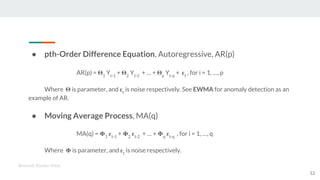
● pth-Order Difference Equation, Autoregressive, AR(p)
AR(p) = 1
Yt-1
+ 2
Yt-2
+ … + p
Yt-p
+ t
, for i = 1, …, p
Where is parameter, and t
is noise respectively. See EWMA for anomaly detection as an
example of AR.
● Moving Average Process, MA(q)
MA(q) = 1 t-1
+ 2 t-2
+ … + q t-q
, for i = 1, …, q
Where is parameter, and t
is noise respectively.
Kenneth Emeka Odoh
12
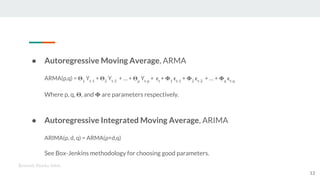
● Autoregressive Moving Average, ARMA
ARMA(p,q) = 1
Yt-1
+ 2
Yt-2
+ … + p
Yt-p
+ t
+ 1 t-1
+ 2 t-2
+ … + q t-q
Where p, q, , and are parameters respectively.
● Autoregressive Integrated Moving Average, ARIMA
ARIMA(p, d, q) = ARMA(p+d,q)
See Box-Jenkins methodology for choosing good parameters.
Kenneth Emeka Odoh
13
● ARCH
● GARCH ( related to exponential weighted moving average ). See section on anomaly detection.
● NGARCH
● IGARCH
● EGARCH
…
For more information,
see link ( https://en.wikipedia.org/wiki/Autoregressive_conditional_heteroskedasticity )
Kenneth Emeka Odoh
14
Why Kalman Filters?
● Allows for using measurement signals to augment the prediction of
your next states. State is the target variable.
● Allows for correction using the correct state from the recent past step.
● Allows for online prediction in real time.
It is good to note the following:
● How to identify the appropriate measurement signals?
● Measurement captures the trend of the state.
● Modeling can include domain knowledge e.g physics.Kenneth Emeka Odoh
15
Figure 4: How kalman filter worksKenneth Emeka Odoh
16
● Kalman filter
Where x, y, F,n, v are states, measurement, function, measurement noise, and
state noise respectively.
Kenneth Emeka Odoh
17
Kalman formulation allows for
● Handling missing data.
● Data fusion
It is a state space model.
Continuous form of the forward algorithm of an HMM [Andrew Fraser, 2008]. [Julier, 2002]
Discrete Kalman Filter (DKF)
● Capture linear relationship in the data.
● Fluctuates around the means and
covariance.
● Eventual convergence as the data increases,
thereby improving filter performance
( bayesian ).
In the presence of nonlinear relationship . The
increased error in the posterior estimates , thereby
leading to suboptimal filter performance
( underfitting ).
[Welch & Bishop, 2006]
Kenneth Emeka Odoh
18
Extended Kalman Filter (EKF)
● Makes use of Jacobians and hessians.
○ Increase computation cost.
○ Need for differentiable non-linear function
● Linearizing nonlinear equation using
taylor series to 1st order.
● Same computational complexity as
Unscented kalman filter.
● Captures nonlinear relationship in the
data.
The limited order of taylor series can lead to
error in the posterior estimates , thereby leading
to suboptimal filter performance.
[Welch & Bishop, 2006]
Kenneth Emeka Odoh
19
Unscented Kalman Filter (UKF)
● Better sampling to capture more representative characteristics of the
model.
○ By using sigma points.
○ Sigma point are extra data points that are chosen within the region surrounding the original data. This helps to
account for variability by capturing the likely position that data could be given some perturbation. Sampling
these points provides richer information of the distribution of the data. It is more ergodic.
● Avoid the use of jacobians and hessians.
○ Possible to use any form of nonlinear function ( not only differentiable function ).
● Linearizing nonlinear function using taylor series to 3rd order.
● Same computational efficiency as the EKF.
[Julier, 2002]Kenneth Emeka Odoh
20
Figure 5: Geometric interpretation of covariance matrix
For more info,
[http://www.visiondummy.co
m/2014/04/geometric-interpre
tation-covariance-matrix/]
21
Figure 6: Actual sampling vs extended kalman filter, and unscented kalman filters
Kenneth Emeka Odoh [Julier, 2002]
22
● RLS (Recursive Linear Regression)
Initial model at time, t with an update as new data arrives at time t+1.
y = (t)* xt
At time t+1, we have data, xt+1
and yt+1
and estimate (t+1) in incremental manner
Kenneth Emeka Odoh
23[Wellstead & Karl, 1991]
Online ARIMA
RLS
+
‘Vanilla’ ARIMAKenneth Emeka Odoh
24
[Kenneth Odoh]
Box-Jenkins Methodology
● Transform data so that a form of stationarity is attained.
○ E.g taking logarithm of the data, or other forms of scaling.
● Guess values p, d, and q respectively for ARIMA (p, d, q).
● Estimate the parameters needed for future prediction.
● Perform diagnostics using AIC, BIC, or REC (Regression Error Characteristic Curves) [Jinbo &
Kristin, 2003].
Probably, a generalization of Occam’s Razor
Kenneth Emeka Odoh
[https://www.tass.gov.uk/about/facts-figures/]
25
Stationarity
● Constant statistical properties over time
○ Joint probability distribution is shift-invariant
○ Can occur in different moments (mean, variance, skewness, and kurtosis)
● Why is it useful?
● Mean reverting.
● Markovian assumption
○ Future is independent of the past given the present
With states (A, B, C, D), then a sequence of states occurring in a sequence
P (A, B, C,D) = P (C | A, B) * P (B | A) * P (A)
= P(C | B) * P (B | A) * P (A)
26
Kenneth Emeka Odoh
● n: number of states, m: number of observations
● S: set of states, Y: set of measurements
■ S = {s1
, s2
, …, sn
}, Y = {y1
, y2
, …, ym
}
■ P S(1)
= [p1
, p2
, …, pn
] -- prior probability
■ T = P ( s(t+1) | s(t) ) --- transition probability
■ P S(t+1)
= P S(t)
* T --- stationarity
● Mapping states to measurement, P ( y|s )
● Makes it easy to compose more relationship using bayes theorem in Kalman filtering
formulation (continuous states and measurements).
Kenneth Emeka Odoh
27
● There are methods for converting data from non-stationary to
stationary
( implicit in algorithm formulation or explicit in data preprocessing )
● Detrending
● Differencing
● Avoid using algorithm based on stationarity assumption with
non-stationary data.
● Testing for stationarity
● Formally, use unit root test [https://faculty.washington.edu/ezivot/econ584/notes/unitroot.pdf]
● Informally, compare means or other statistic measures between different disjoint batches.
For a fuller treatment on stationarity, see [http://www.phdeconomics.sssup.it/documents/Lesson4.pdf]
Kenneth Emeka Odoh
28
Why stocks are hard to predict
● If efficient market hypothesis holds, then the stock times series, Xt
is i.i.d.
This means that the past cannot be used to predict the future.
P( Xt
| Xt-1
) = P(Xt
)
● Efficient market hypothesis
● Stocks are always at the right price or value
● Cannot profit by purchasing undervalued or overvalued asset.
● Stock selection is not guaranteed to increase returns.
● Profit can only be achieved by seeking out riskier investments.
In summary, it is “impossible to beat the market”. Very Controversial
● "Essentially, all models are wrong, but some are useful." --- George Box
○ As such, there is still hope with prediction, albeit a faint one.
○ Avoid transient spurious correlation. (Domain knowledge, causal inference, & statistical models ).
Kenneth Emeka Odoh
29
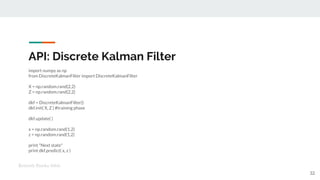
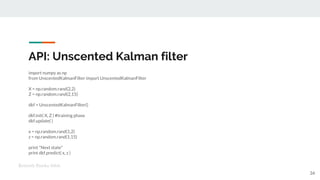
API
● Time difference model
● Online ARIMA
● Discrete kalman filter
● Extended kalman filter
● Unscented kalman filter
Kenneth Emeka Odoh
30
API: Online ARIMA
import numpy as np
from RecursiveARIMA import RecursiveARIMA
X = np.random.rand(10,5)
recArimaObj = RecursiveARIMA(p=6, d=0, q=6)
recArimaObj.init( X )
x = np.random.rand(1,5)
recArimaObj.update ( x )
print "Next state"
print recArimaObj.predict( )
Kenneth Emeka Odoh
31
API: Discrete Kalman Filter
import numpy as np
from DiscreteKalmanFilter import DiscreteKalmanFilter
X = np.random.rand(2,2)
Z = np.random.rand(2,2)
dkf = DiscreteKalmanFilter()
dkf.init( X, Z ) #training phase
dkf.update( )
x = np.random.rand(1,2)
z = np.random.rand(1,2)
print "Next state"
print dkf.predict( x, z )
Kenneth Emeka Odoh
32
API: Extended Kalman Filter
import numpy as np
from ExtendedKalmanFilter import ExtendedKalmanFilter
X = np.random.rand(2,2)
Z = np.random.rand(2,15)
dkf = ExtendedKalmanFilter()
dkf.init( X, Z ) #training phase
dkf.update( )
x = np.random.rand(1,2)
z = np.random.rand(1,15)
print "Next state"
print dkf.predict( x, z )
Kenneth Emeka Odoh
33
API: Unscented Kalman filter
import numpy as np
from UnscentedKalmanFilter import UnscentedKalmanFilter
X = np.random.rand(2,2)
Z = np.random.rand(2,15)
dkf = UnscentedKalmanFilter()
dkf.init( X, Z ) #training phase
dkf.update( )
x = np.random.rand(1,2)
z = np.random.rand(1,15)
print "Next state"
print dkf.predict( x, z )
Kenneth Emeka Odoh
34
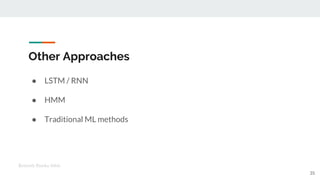
Other Approaches
● LSTM / RNN
● HMM
● Traditional ML methods
Kenneth Emeka Odoh
35
Application: Anomaly Detection
Kenneth Emeka Odoh
36
Anomaly Detection
It is ideal for unbalanced data set
● small number of negative samples and large number of positive samples or vice versa.
What is a normal data?
● This is the holy grail of a number of anomaly detection methods.
Figure 7: Types of signal changes: abrupt transient shift (A), abrupt distributional shift (B), and
gradual distributional shift (C) [kelvin & william, 2012].
Kenneth Emeka Odoh
37
Data Stream
● Time and space constraints.
● Online algorithms
○ Detecting concept drift.
○ Forgetting unnecessary history.
○ Revision of model after significant change in distribution.
● Time delay to prediction.
Kenneth Emeka Odoh
38
Handling Data Stream
There are a number of window techniques :
● Fixed window
● Adaptive window (ADWIN)
● Landmark window
● Damped window
[Zhu & Shasha, 2002]
Kenneth Emeka Odoh
39
Algorithm 1: Probabilistic Exponential Moving Average
[kelvin & william, 2012].
Kenneth Emeka Odoh
40
Probabilistic Exponentially Weighted
Moving Average (PEWMA)
● Retains the forgetting parameter of EWMA with an
added extra parameter to include probability of
data.
● Works with every kind of shift.
# Weighted Moving
average
# Weighted Moving
E(X2
)
# Moving standard
deviation
# weighing factor
# weighing factor
# normal distribution
pdf
# Z-score
Exponentially Weighted Moving Average
(EWMA)
● Add a forgetting parameter to weight recent items
more or less.
● Volatile to abrupt transient change and bad with
distributional shifts.
Figure 8: Normal Distribution Curve. 41
Kenneth Emeka Odoh
threshold
Exercise [ Group Activity ]
● Modify Algorithm 1 to work for the
multivariate case?
42
Deployment
This aims to show a streaming architecture for serving content.
The goal is that the deployment should not be AWS specific to prevent getting locked down in a
proprietary vendor.
● Flask
● Redis
● Gevent
● Scikit-learn / keras / numpy
● PostgreSQL
Kenneth Emeka Odoh
43
Machine learning as a service
● Web Server
○ Nginx (web server), Flask (lightweight web framework), and Gunicon (load balancer), Gevent (non-blocking
I/O)
● Caching Server
○ Redis (as a transportation medium and caching)
● ML Server
○ Custom algorithm and third party libraries
● Database
○ PostgreSQL
44
Kenneth Emeka Odoh
45
Kenneth Emeka Odoh
Figure 9: An example of a deployment architecture.
?
Database
● Authentication
● metadata
● User management
○ Subscription
○ Managing limiting rates
46
Kenneth Emeka Odoh
Other Considerations
● Rather than serve json in your rest API, think of using Google protobuf.
● Use the database as a service, rather than tight coupling in your
application.
● Flask is an easy to use web framework, think about using in MVP.
● Load balancer and replicated database.
● Make a Version control of your model to enhance reproducibility.
○ If necessary, map each prediction interval to a model.
Kenneth Emeka Odoh
47
Lessons
● "Prediction is very difficult, especially if it's about the future." -- Niels Bohr.
● "If you make a great number of predictions, the ones that were wrong
will soon be forgotten, and the ones that turn out to be true will make
you famous." -- Malcolm Gladwell.
● "I have seen the future and it is very much like the present, only
longer." -- Kehlog Albran.
Kenneth Emeka Odoh
48
Conclusion
● Recursive ARIMA
○ Not ideal for chaotic or irregularly spaced time series.
● Higher orders and moment are necessary in the model, making unscented Kalman filter
ideal for chaotic time series.
● Time difference model tends to overfit.
● MLE based method tend to under-estimates the variance.
● ARIMA requires domain knowledge to choose ideal parameters.
● Regularizers can be used in the RLS to reduce overfitting.
● Kalman gain ⇔ damped window
Kenneth Emeka Odoh 49
Thanks for listening
@kenluck2001
Kenneth Emeka Odoh
https://www.linkedin.com/in/kenluck2001/
kenneth.odoh@gmail.com
50
https://github.com/kenluck2001?tab=repositories
References1. Castanon, D., & Karl, C. W. SC505: Stochastic processes. Retrieved 06/15, 2017, from http://www.mit.edu/people/hmsallum/GradSchool/sc505notes.pdf
2. Wellstead, P. E. & Karl, C. W. (1991). Self-tuning Systems: Control and Signal Processing. Chichester, United Kingdom: John Wiley & Sons Ltd.
3. Hamilton, J. D. (1994). Time series analysis. Chichester, United Kingdom: Princeton University Press.
4. Julier, S. J. The scaled unscented transformation. Retrieved 06/15, 2017, from https://www.cs.unc.edu/~welch/kalman/media/pdf/ACC02-IEEE1357.PDF
5. Terejanu, G. A. Extended kalman filter tutorial. Retrieved 06/15, 2017, from https://www.cse.sc.edu/~terejanu/files/tutorialEKF.pdf
6. Wan , E. A., & Merwe, R. (2000). The unscented kalman filters for nonlinear estimation. IEEE Adaptive Systems for Signal Processing, Communications, and Control
Symposium, pp. 153-158.
7.Kevin M. Carter & William W. Streilein (2012). Probabilistic reasoning for streaming anomaly detection. In Proceedings of the Statistical Signal Processing Workshop, pp.
377–380.
8. Y.Zhu & D. Shasha (2002). Statstream: Statistical monitoring of thousands of data streams in real time. In Proceedings of the 28th international conference on Very Large
Data Bases, 358–369. VLDB Endowment.
9. Welch, G., & Bishop, G. An introduction to the kalman filter. Retrieved 06/15, 2017, from https://www.cs.unc.edu/~welch/media/pdf/kalman_intro.pdf
10. Andrew Fraser (2008). Hidden markov models and Dynamical System. Retrieved 06/15, 2017, fromhttp://www.siam.org/books/ot107/
11. Jinbo Bi & Kristin P. Bennett (2003). Regression Error Characteristic Curves. Retrieved 06/15, 2017, from
http://citeseerx.ist.psu.edu/viewdoc/download?doi=10.1.1.566.4289&rep=rep1&type=pdf
Kenneth Emeka Odoh
51
Upcoming Meetups
March 24th, 2018 | Sharing Memory
April 7th, 2018 | Consensus (paxo)
Venue: Vancouver public library, Downtown
Time: 2pm - 4pm
52

Tracking the tracker: Time Series Analysis in Python from First Principles

  • 1.
    Tracking the tracker: TimeSeries Analysis in Python From First Principles Kenneth Emeka Odoh Data Science & Machine Learning Meetups @Unbounce, Suite #400 - 401 W. Georgia Street Vancouver, BC March 20th, 2018
  • 2.
    Talk Plan ● Bio ●Motivations & Goals ● Theory ● Application: Forecasting ● Application: Anomaly Detection ● Deployment ● Lessons ● ConclusionKenneth Emeka Odoh 2
  • 3.
    Bio Education ● Masters inComputer Science (University of Regina) 2013 - 2016 Work ● Research assistant in the field of Visual Analytics 2013 - 2016 ○ ( https://scholar.google.com/citations?user=3G2ncgwAAAAJ&hl=en ) ● Software engineer working in an IOT startup (Current position) 2017 - Kenneth Emeka Odoh 3
  • 4.
    This talk focuseson two applications in time series analysis: ● Forecasting ○ Can I use the past to predict the future? ● Anomaly Detection ○ Is a given point, normal or abnormal? "Simplicity is the ultimate sophistication"--- Leonardo da Vinci Kenneth Emeka Odoh 4
  • 5.
    Motivation Figure 1: Polevault showing time series of position [http://vaultermagazine.com/middle-school-womens-pole-vault-rankings-from-athletic-net-5/] Kenneth Emeka Odoh 5
  • 6.
    Figure 2: MissileDefence System [http://www.bbc.com/news/world-asia-39214525] Kenneth Emeka Odoh 6
  • 7.
    Figure 3: Bitcointime series [yahoo finance]Kenneth Emeka Odoh 7
  • 8.
    Goals ● A real-timemodel for time series analysis. ● A less computational intensive model thereby resulting in scalability. ● A support for multivariate / univariate time series data. introducing pySmooth ( https://github.com/kenluck2001/pySmooth) and Anomaly ( https://github.com/kenluck2001/anomaly) Kenneth Emeka Odoh 8
  • 9.
  • 10.
    Let’s dive intothe maths for some minutes [http://www.boom-studios.com/2017/12/01/20th-century-fox-buys-girl-detective-adventure-movie-goldie-vance/] Kenneth Emeka Odoh 10
  • 11.
    Theory ● Time SeriesData ○ Yt where t=1,2,3, …, n where t is index and n is number of points. ● Time Series Decomposition Sometimes the relation may be in multiplicative form Where Yt is predicted time series, Vt is trend, St is cyclic component, Ht is holiday component, and t is residual. Kenneth Emeka Odoh 11
  • 12.
    ● pth-Order DifferenceEquation, Autoregressive, AR(p) AR(p) = 1 Yt-1 + 2 Yt-2 + … + p Yt-p + t , for i = 1, …, p Where is parameter, and t is noise respectively. See EWMA for anomaly detection as an example of AR. ● Moving Average Process, MA(q) MA(q) = 1 t-1 + 2 t-2 + … + q t-q , for i = 1, …, q Where is parameter, and t is noise respectively. Kenneth Emeka Odoh 12
  • 13.
    ● Autoregressive MovingAverage, ARMA ARMA(p,q) = 1 Yt-1 + 2 Yt-2 + … + p Yt-p + t + 1 t-1 + 2 t-2 + … + q t-q Where p, q, , and are parameters respectively. ● Autoregressive Integrated Moving Average, ARIMA ARIMA(p, d, q) = ARMA(p+d,q) See Box-Jenkins methodology for choosing good parameters. Kenneth Emeka Odoh 13
  • 14.
    ● ARCH ● GARCH( related to exponential weighted moving average ). See section on anomaly detection. ● NGARCH ● IGARCH ● EGARCH … For more information, see link ( https://en.wikipedia.org/wiki/Autoregressive_conditional_heteroskedasticity ) Kenneth Emeka Odoh 14
  • 15.
    Why Kalman Filters? ●Allows for using measurement signals to augment the prediction of your next states. State is the target variable. ● Allows for correction using the correct state from the recent past step. ● Allows for online prediction in real time. It is good to note the following: ● How to identify the appropriate measurement signals? ● Measurement captures the trend of the state. ● Modeling can include domain knowledge e.g physics.Kenneth Emeka Odoh 15
  • 16.
    Figure 4: Howkalman filter worksKenneth Emeka Odoh 16
  • 17.
    ● Kalman filter Wherex, y, F,n, v are states, measurement, function, measurement noise, and state noise respectively. Kenneth Emeka Odoh 17 Kalman formulation allows for ● Handling missing data. ● Data fusion It is a state space model. Continuous form of the forward algorithm of an HMM [Andrew Fraser, 2008]. [Julier, 2002]
  • 18.
    Discrete Kalman Filter(DKF) ● Capture linear relationship in the data. ● Fluctuates around the means and covariance. ● Eventual convergence as the data increases, thereby improving filter performance ( bayesian ). In the presence of nonlinear relationship . The increased error in the posterior estimates , thereby leading to suboptimal filter performance ( underfitting ). [Welch & Bishop, 2006] Kenneth Emeka Odoh 18
  • 19.
    Extended Kalman Filter(EKF) ● Makes use of Jacobians and hessians. ○ Increase computation cost. ○ Need for differentiable non-linear function ● Linearizing nonlinear equation using taylor series to 1st order. ● Same computational complexity as Unscented kalman filter. ● Captures nonlinear relationship in the data. The limited order of taylor series can lead to error in the posterior estimates , thereby leading to suboptimal filter performance. [Welch & Bishop, 2006] Kenneth Emeka Odoh 19
  • 20.
    Unscented Kalman Filter(UKF) ● Better sampling to capture more representative characteristics of the model. ○ By using sigma points. ○ Sigma point are extra data points that are chosen within the region surrounding the original data. This helps to account for variability by capturing the likely position that data could be given some perturbation. Sampling these points provides richer information of the distribution of the data. It is more ergodic. ● Avoid the use of jacobians and hessians. ○ Possible to use any form of nonlinear function ( not only differentiable function ). ● Linearizing nonlinear function using taylor series to 3rd order. ● Same computational efficiency as the EKF. [Julier, 2002]Kenneth Emeka Odoh 20
  • 21.
    Figure 5: Geometricinterpretation of covariance matrix For more info, [http://www.visiondummy.co m/2014/04/geometric-interpre tation-covariance-matrix/] 21
  • 22.
    Figure 6: Actualsampling vs extended kalman filter, and unscented kalman filters Kenneth Emeka Odoh [Julier, 2002] 22
  • 23.
    ● RLS (RecursiveLinear Regression) Initial model at time, t with an update as new data arrives at time t+1. y = (t)* xt At time t+1, we have data, xt+1 and yt+1 and estimate (t+1) in incremental manner Kenneth Emeka Odoh 23[Wellstead & Karl, 1991]
  • 24.
  • 25.
    Box-Jenkins Methodology ● Transformdata so that a form of stationarity is attained. ○ E.g taking logarithm of the data, or other forms of scaling. ● Guess values p, d, and q respectively for ARIMA (p, d, q). ● Estimate the parameters needed for future prediction. ● Perform diagnostics using AIC, BIC, or REC (Regression Error Characteristic Curves) [Jinbo & Kristin, 2003]. Probably, a generalization of Occam’s Razor Kenneth Emeka Odoh [https://www.tass.gov.uk/about/facts-figures/] 25
  • 26.
    Stationarity ● Constant statisticalproperties over time ○ Joint probability distribution is shift-invariant ○ Can occur in different moments (mean, variance, skewness, and kurtosis) ● Why is it useful? ● Mean reverting. ● Markovian assumption ○ Future is independent of the past given the present With states (A, B, C, D), then a sequence of states occurring in a sequence P (A, B, C,D) = P (C | A, B) * P (B | A) * P (A) = P(C | B) * P (B | A) * P (A) 26 Kenneth Emeka Odoh
  • 27.
    ● n: numberof states, m: number of observations ● S: set of states, Y: set of measurements ■ S = {s1 , s2 , …, sn }, Y = {y1 , y2 , …, ym } ■ P S(1) = [p1 , p2 , …, pn ] -- prior probability ■ T = P ( s(t+1) | s(t) ) --- transition probability ■ P S(t+1) = P S(t) * T --- stationarity ● Mapping states to measurement, P ( y|s ) ● Makes it easy to compose more relationship using bayes theorem in Kalman filtering formulation (continuous states and measurements). Kenneth Emeka Odoh 27
  • 28.
    ● There aremethods for converting data from non-stationary to stationary ( implicit in algorithm formulation or explicit in data preprocessing ) ● Detrending ● Differencing ● Avoid using algorithm based on stationarity assumption with non-stationary data. ● Testing for stationarity ● Formally, use unit root test [https://faculty.washington.edu/ezivot/econ584/notes/unitroot.pdf] ● Informally, compare means or other statistic measures between different disjoint batches. For a fuller treatment on stationarity, see [http://www.phdeconomics.sssup.it/documents/Lesson4.pdf] Kenneth Emeka Odoh 28
  • 29.
    Why stocks arehard to predict ● If efficient market hypothesis holds, then the stock times series, Xt is i.i.d. This means that the past cannot be used to predict the future. P( Xt | Xt-1 ) = P(Xt ) ● Efficient market hypothesis ● Stocks are always at the right price or value ● Cannot profit by purchasing undervalued or overvalued asset. ● Stock selection is not guaranteed to increase returns. ● Profit can only be achieved by seeking out riskier investments. In summary, it is “impossible to beat the market”. Very Controversial ● "Essentially, all models are wrong, but some are useful." --- George Box ○ As such, there is still hope with prediction, albeit a faint one. ○ Avoid transient spurious correlation. (Domain knowledge, causal inference, & statistical models ). Kenneth Emeka Odoh 29
  • 30.
    API ● Time differencemodel ● Online ARIMA ● Discrete kalman filter ● Extended kalman filter ● Unscented kalman filter Kenneth Emeka Odoh 30
  • 31.
    API: Online ARIMA importnumpy as np from RecursiveARIMA import RecursiveARIMA X = np.random.rand(10,5) recArimaObj = RecursiveARIMA(p=6, d=0, q=6) recArimaObj.init( X ) x = np.random.rand(1,5) recArimaObj.update ( x ) print "Next state" print recArimaObj.predict( ) Kenneth Emeka Odoh 31
  • 32.
    API: Discrete KalmanFilter import numpy as np from DiscreteKalmanFilter import DiscreteKalmanFilter X = np.random.rand(2,2) Z = np.random.rand(2,2) dkf = DiscreteKalmanFilter() dkf.init( X, Z ) #training phase dkf.update( ) x = np.random.rand(1,2) z = np.random.rand(1,2) print "Next state" print dkf.predict( x, z ) Kenneth Emeka Odoh 32
  • 33.
    API: Extended KalmanFilter import numpy as np from ExtendedKalmanFilter import ExtendedKalmanFilter X = np.random.rand(2,2) Z = np.random.rand(2,15) dkf = ExtendedKalmanFilter() dkf.init( X, Z ) #training phase dkf.update( ) x = np.random.rand(1,2) z = np.random.rand(1,15) print "Next state" print dkf.predict( x, z ) Kenneth Emeka Odoh 33
  • 34.
    API: Unscented Kalmanfilter import numpy as np from UnscentedKalmanFilter import UnscentedKalmanFilter X = np.random.rand(2,2) Z = np.random.rand(2,15) dkf = UnscentedKalmanFilter() dkf.init( X, Z ) #training phase dkf.update( ) x = np.random.rand(1,2) z = np.random.rand(1,15) print "Next state" print dkf.predict( x, z ) Kenneth Emeka Odoh 34
  • 35.
    Other Approaches ● LSTM/ RNN ● HMM ● Traditional ML methods Kenneth Emeka Odoh 35
  • 36.
  • 37.
    Anomaly Detection It isideal for unbalanced data set ● small number of negative samples and large number of positive samples or vice versa. What is a normal data? ● This is the holy grail of a number of anomaly detection methods. Figure 7: Types of signal changes: abrupt transient shift (A), abrupt distributional shift (B), and gradual distributional shift (C) [kelvin & william, 2012]. Kenneth Emeka Odoh 37
  • 38.
    Data Stream ● Timeand space constraints. ● Online algorithms ○ Detecting concept drift. ○ Forgetting unnecessary history. ○ Revision of model after significant change in distribution. ● Time delay to prediction. Kenneth Emeka Odoh 38
  • 39.
    Handling Data Stream Thereare a number of window techniques : ● Fixed window ● Adaptive window (ADWIN) ● Landmark window ● Damped window [Zhu & Shasha, 2002] Kenneth Emeka Odoh 39
  • 40.
    Algorithm 1: ProbabilisticExponential Moving Average [kelvin & william, 2012]. Kenneth Emeka Odoh 40 Probabilistic Exponentially Weighted Moving Average (PEWMA) ● Retains the forgetting parameter of EWMA with an added extra parameter to include probability of data. ● Works with every kind of shift. # Weighted Moving average # Weighted Moving E(X2 ) # Moving standard deviation # weighing factor # weighing factor # normal distribution pdf # Z-score Exponentially Weighted Moving Average (EWMA) ● Add a forgetting parameter to weight recent items more or less. ● Volatile to abrupt transient change and bad with distributional shifts.
  • 41.
    Figure 8: NormalDistribution Curve. 41 Kenneth Emeka Odoh threshold
  • 42.
    Exercise [ GroupActivity ] ● Modify Algorithm 1 to work for the multivariate case? 42
  • 43.
    Deployment This aims toshow a streaming architecture for serving content. The goal is that the deployment should not be AWS specific to prevent getting locked down in a proprietary vendor. ● Flask ● Redis ● Gevent ● Scikit-learn / keras / numpy ● PostgreSQL Kenneth Emeka Odoh 43
  • 44.
    Machine learning asa service ● Web Server ○ Nginx (web server), Flask (lightweight web framework), and Gunicon (load balancer), Gevent (non-blocking I/O) ● Caching Server ○ Redis (as a transportation medium and caching) ● ML Server ○ Custom algorithm and third party libraries ● Database ○ PostgreSQL 44 Kenneth Emeka Odoh
  • 45.
    45 Kenneth Emeka Odoh Figure9: An example of a deployment architecture. ?
  • 46.
    Database ● Authentication ● metadata ●User management ○ Subscription ○ Managing limiting rates 46 Kenneth Emeka Odoh
  • 47.
    Other Considerations ● Ratherthan serve json in your rest API, think of using Google protobuf. ● Use the database as a service, rather than tight coupling in your application. ● Flask is an easy to use web framework, think about using in MVP. ● Load balancer and replicated database. ● Make a Version control of your model to enhance reproducibility. ○ If necessary, map each prediction interval to a model. Kenneth Emeka Odoh 47
  • 48.
    Lessons ● "Prediction isvery difficult, especially if it's about the future." -- Niels Bohr. ● "If you make a great number of predictions, the ones that were wrong will soon be forgotten, and the ones that turn out to be true will make you famous." -- Malcolm Gladwell. ● "I have seen the future and it is very much like the present, only longer." -- Kehlog Albran. Kenneth Emeka Odoh 48
  • 49.
    Conclusion ● Recursive ARIMA ○Not ideal for chaotic or irregularly spaced time series. ● Higher orders and moment are necessary in the model, making unscented Kalman filter ideal for chaotic time series. ● Time difference model tends to overfit. ● MLE based method tend to under-estimates the variance. ● ARIMA requires domain knowledge to choose ideal parameters. ● Regularizers can be used in the RLS to reduce overfitting. ● Kalman gain ⇔ damped window Kenneth Emeka Odoh 49
  • 50.
    Thanks for listening @kenluck2001 KennethEmeka Odoh https://www.linkedin.com/in/kenluck2001/ kenneth.odoh@gmail.com 50 https://github.com/kenluck2001?tab=repositories
  • 51.
    References1. Castanon, D.,& Karl, C. W. SC505: Stochastic processes. Retrieved 06/15, 2017, from http://www.mit.edu/people/hmsallum/GradSchool/sc505notes.pdf 2. Wellstead, P. E. & Karl, C. W. (1991). Self-tuning Systems: Control and Signal Processing. Chichester, United Kingdom: John Wiley & Sons Ltd. 3. Hamilton, J. D. (1994). Time series analysis. Chichester, United Kingdom: Princeton University Press. 4. Julier, S. J. The scaled unscented transformation. Retrieved 06/15, 2017, from https://www.cs.unc.edu/~welch/kalman/media/pdf/ACC02-IEEE1357.PDF 5. Terejanu, G. A. Extended kalman filter tutorial. Retrieved 06/15, 2017, from https://www.cse.sc.edu/~terejanu/files/tutorialEKF.pdf 6. Wan , E. A., & Merwe, R. (2000). The unscented kalman filters for nonlinear estimation. IEEE Adaptive Systems for Signal Processing, Communications, and Control Symposium, pp. 153-158. 7.Kevin M. Carter & William W. Streilein (2012). Probabilistic reasoning for streaming anomaly detection. In Proceedings of the Statistical Signal Processing Workshop, pp. 377–380. 8. Y.Zhu & D. Shasha (2002). Statstream: Statistical monitoring of thousands of data streams in real time. In Proceedings of the 28th international conference on Very Large Data Bases, 358–369. VLDB Endowment. 9. Welch, G., & Bishop, G. An introduction to the kalman filter. Retrieved 06/15, 2017, from https://www.cs.unc.edu/~welch/media/pdf/kalman_intro.pdf 10. Andrew Fraser (2008). Hidden markov models and Dynamical System. Retrieved 06/15, 2017, fromhttp://www.siam.org/books/ot107/ 11. Jinbo Bi & Kristin P. Bennett (2003). Regression Error Characteristic Curves. Retrieved 06/15, 2017, from http://citeseerx.ist.psu.edu/viewdoc/download?doi=10.1.1.566.4289&rep=rep1&type=pdf Kenneth Emeka Odoh 51
  • 52.
    Upcoming Meetups March 24th,2018 | Sharing Memory April 7th, 2018 | Consensus (paxo) Venue: Vancouver public library, Downtown Time: 2pm - 4pm 52