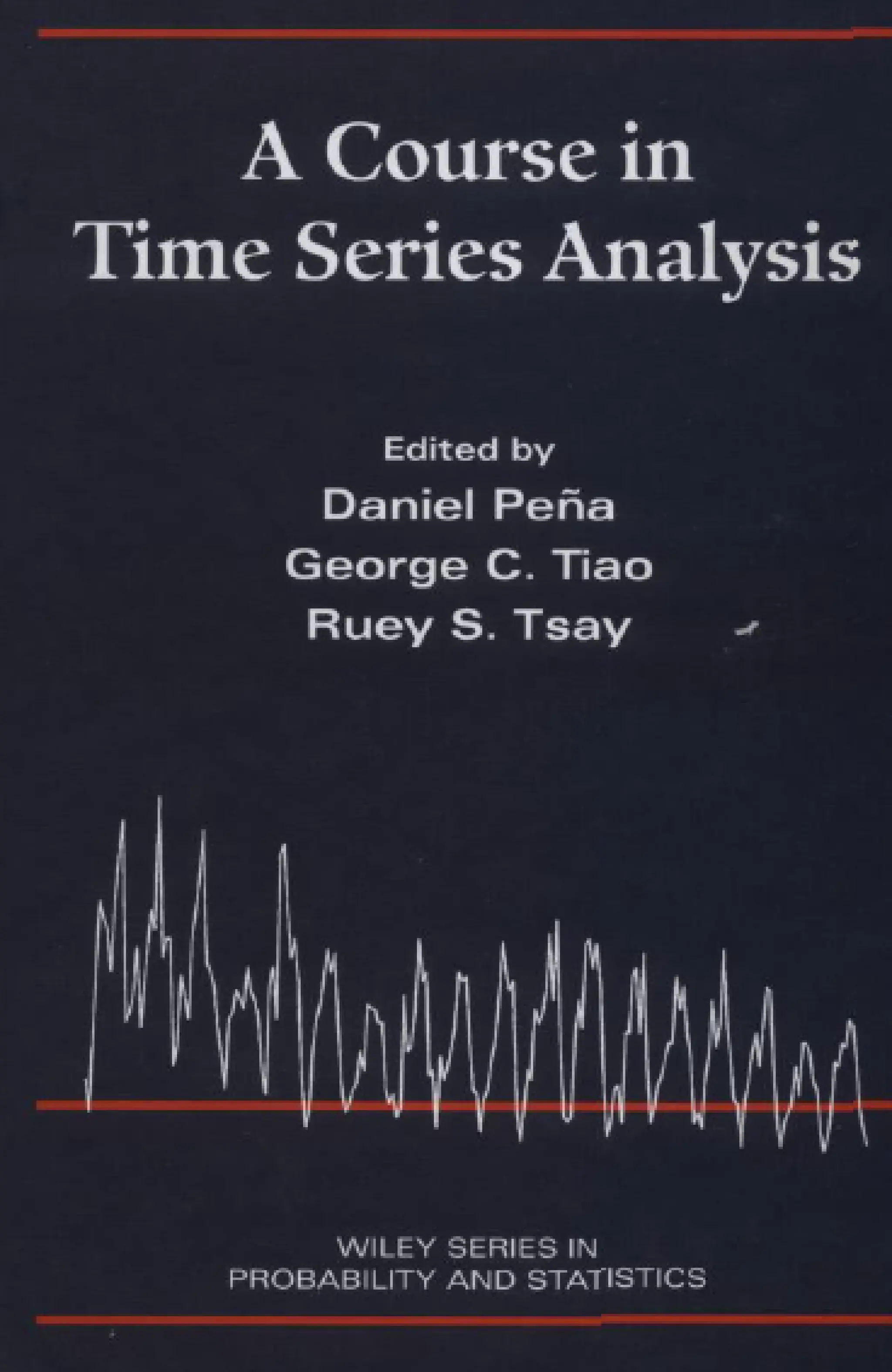
A Course in Time Series Analysis 1st Edition Pena D.
A Course in Time Series Analysis 1st Edition Pena D.
A Course in Time Series Analysis 1st Edition Pena D.
A Course in Time Series Analysis 1st Edition Pena D.
A Course in Time Series Analysis 1st Edition Pena D.
1.
Visit ebookfinal.com todownload the full version and
explore more ebooks or textbooks
A Course in Time Series Analysis 1st Edition Pena
D.
_____ Click the link below to download _____
https://ebookfinal.com/download/a-course-in-time-series-
analysis-1st-edition-pena-d/
Explore and download more ebooks or textbook at ebookfinal.com
2.
Here are somerecommended products that we believe you will be
interested in. You can click the link to download.
Nonlinear Time Series Analysis 2nd Edition Holger Kantz
https://ebookfinal.com/download/nonlinear-time-series-analysis-2nd-
edition-holger-kantz/
A First Course in Complex Analysis with Applications 1st
Edition Dennis G. Zill And Patrick D. Shanahan
https://ebookfinal.com/download/a-first-course-in-complex-analysis-
with-applications-1st-edition-dennis-g-zill-and-patrick-d-shanahan/
Time Series Analysis Fourth Edition George E. P. Box
https://ebookfinal.com/download/time-series-analysis-fourth-edition-
george-e-p-box/
Harmonic Analysis A Comprehensive Course in Analysis Part
3 1st Edition Barry Simon
https://ebookfinal.com/download/harmonic-analysis-a-comprehensive-
course-in-analysis-part-3-1st-edition-barry-simon/
3.
A Course inAbstract Analysis 1st Edition John B. Conway
https://ebookfinal.com/download/a-course-in-abstract-analysis-1st-
edition-john-b-conway/
Time Series Data Analysis Using EViews Statistics in
Practice I. Gusti Ngurah Agung
https://ebookfinal.com/download/time-series-data-analysis-using-
eviews-statistics-in-practice-i-gusti-ngurah-agung/
A Second Course in Mathematical Analysis J. C. Burkill
https://ebookfinal.com/download/a-second-course-in-mathematical-
analysis-j-c-burkill/
A First Course in Functional Analysis 1st Edition Orr
Moshe Shalit
https://ebookfinal.com/download/a-first-course-in-functional-
analysis-1st-edition-orr-moshe-shalit/
Analysis in Vector Spaces A Course in Advanced Calculus
1st Edition Mustafa A. Akcoglu
https://ebookfinal.com/download/analysis-in-vector-spaces-a-course-in-
advanced-calculus-1st-edition-mustafa-a-akcoglu/
5.
A Course inTime Series Analysis 1st Edition Pena D.
Digital Instant Download
Author(s): Pena D., Tiao G.C., Tsay R.S. (Eds.)
ISBN(s): 9780471361640, 047136164X
Edition: 1
File Details: PDF, 19.68 MB
Year: 2001
Language: english
WILEY SERIES INPROBABILITY A N D STATISTICS
PROBABILITY AND STATISTICS SECTION
Established by WALTER A. SHEWHART and SAMUEL S. WILKS
Editors: Noel A. C. Cressie, Nicholas I. Fisher, Iain M. Johnstone, J. B. Kadane,
David W. Scott, Bernard W. Silverman, Adrian F. M. Smith, JozefL. Teugels;
Vic Barnett, Emeritus, Ralph A. Bradley, Emeritus, J. Stuart Hunter, Emeritus,
David G. Kendall, Emeritus
A complete list of the titles in this series appears at the end of this volume.
9.
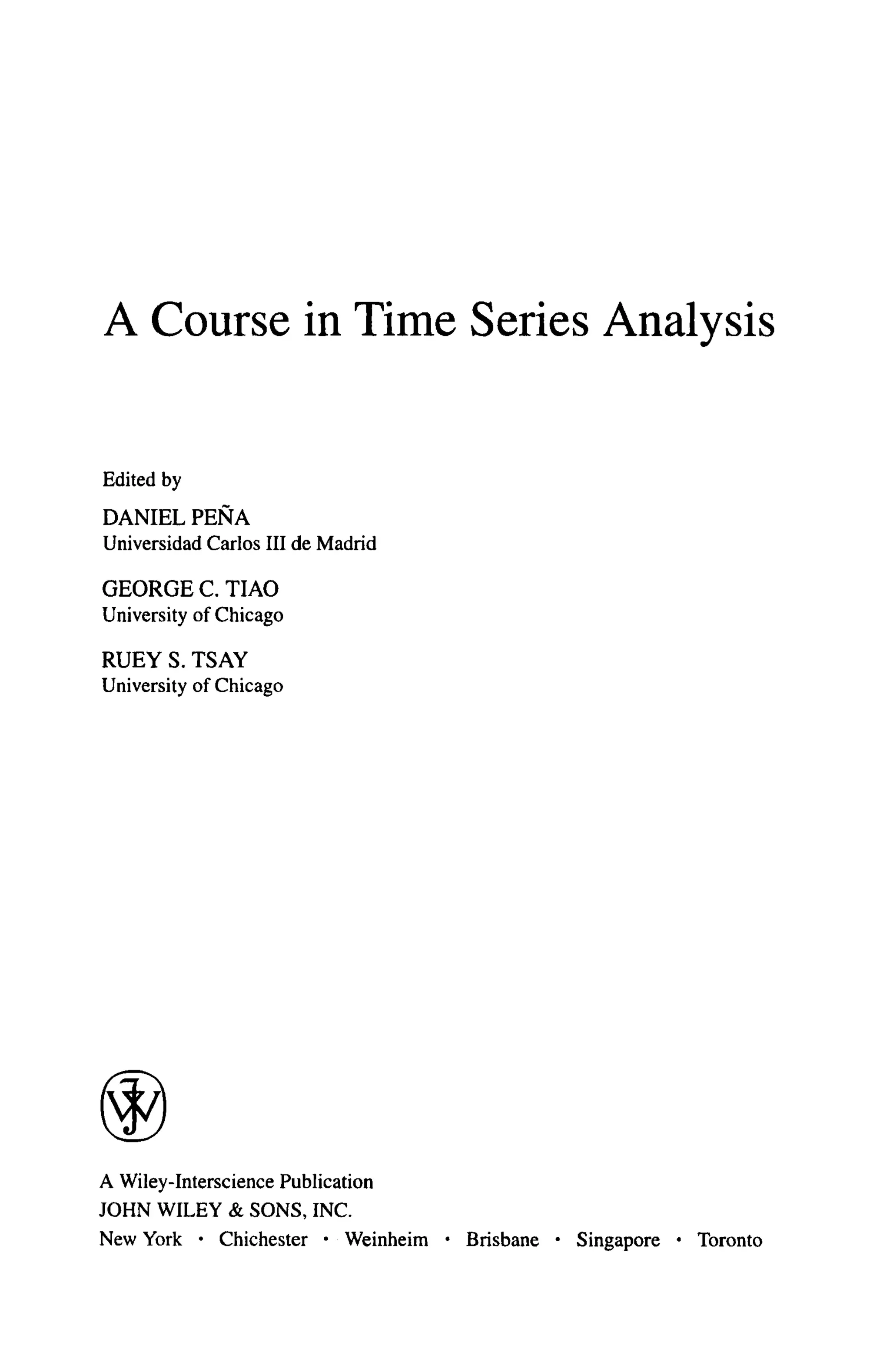
A Course inTime Series Analysis
Edited by
DANIEL ΡΕΝΑ
Universidad Carlos III de Madrid
GEORGE C. TIAO
University of Chicago
RUEY S. TSAY
University of Chicago
A Wiley-Interscience Publication
JOHN WILEY & SONS, INC.
New York · Chichester · Weinheim · Brisbane · Singapore · Toronto
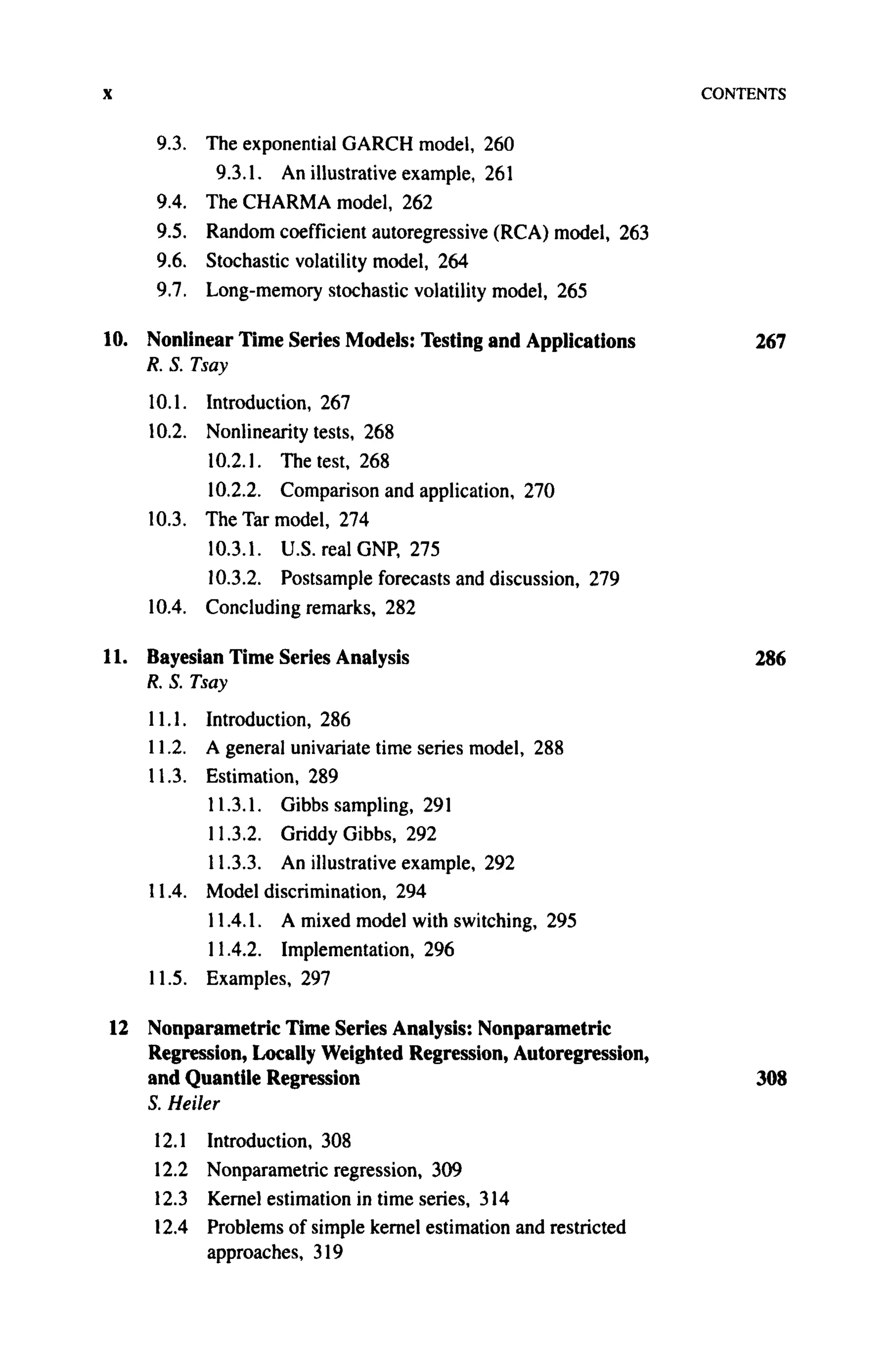
Contents
Preface xv
About ECASxvi
Contributors xvii
1. Introduction 1
D. Pena and G. C. Tiao
1.1. Examples of time series problems, 1
1.1.1. Stationary series, 2
1.1.2. Nonstationary series, 3
1.1.3. Seasonal series, 5
1.1.4. Level shifts and outliers in time series, 7
1.1.5. Variance changes, 7
1.1.6. Asymmetric time series, 7
1.1.7. Unidirectional-feedback relation between series, 9
1.1.8. Comovement and cointegration, 10
1.2. Overview of the book, 10
1.3. Further reading, 19
PART I BASIC CONCEPTS IN UNIVARIATE TIME SERIES
2. Univariate Time Series: Autocorrelation, Linear Prediction,
Spectrum, and State-Space Model 25
G. T. Wilson
2.1. Linear time series models, 25
2.2. The autocorrelation function, 28
2.3. Lagged prediction and the partial autocorrelation function, 33
ν
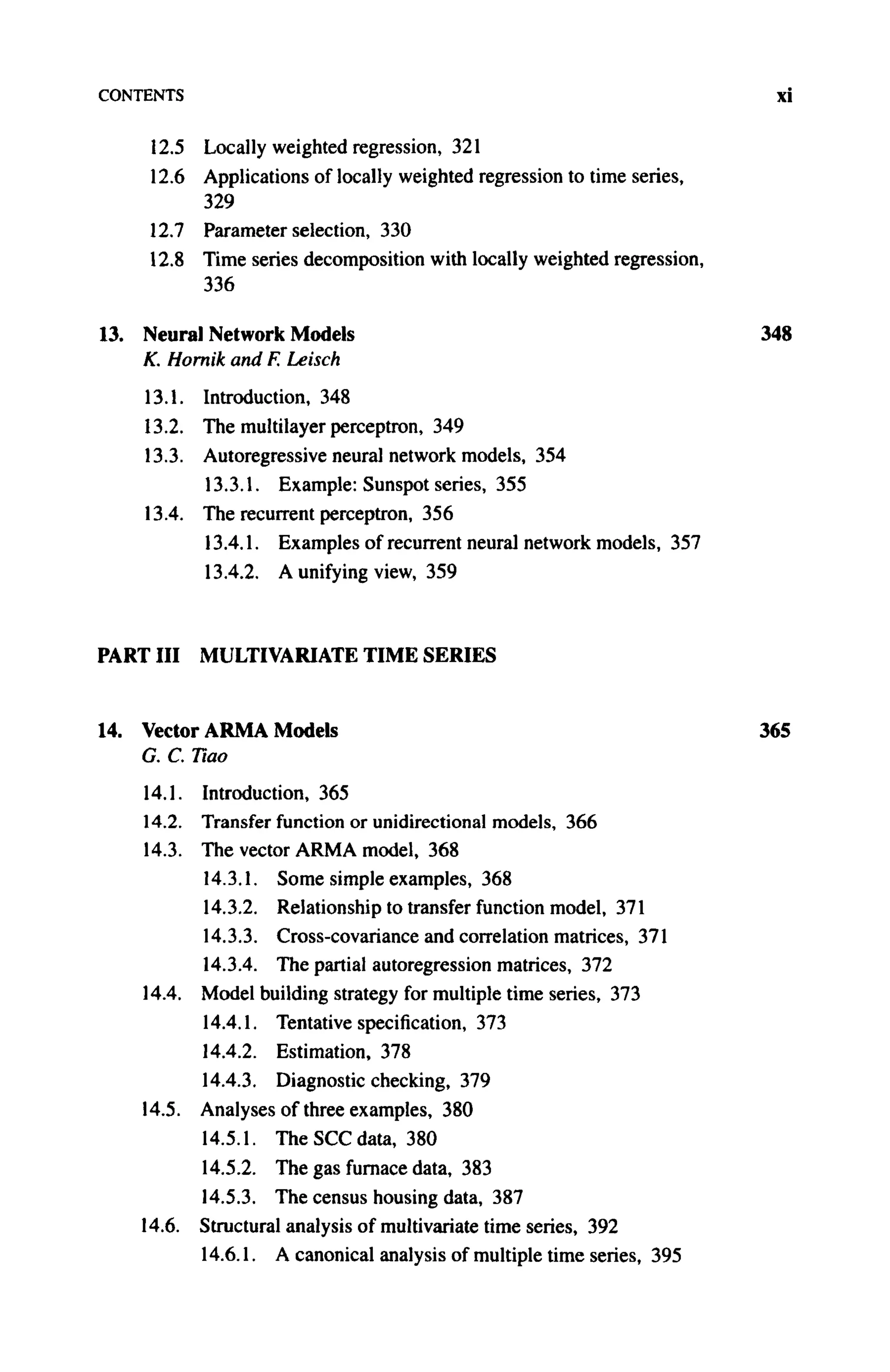
12.
vi CONTENTS
2.4. Transformationsto stationarity, 35
2.5. Cycles and the periodogram, 37
2.6. The spectrum, 42
2.7. Further interpretation of time series acf, pacf,
and spectrum, 46
2.8. State-space models and the Kalman Filter, 48
3. Univariate Autoregressive Moving-Average Models 53
G. C. Tiao
3.1. Introduction, 53
3.1.1. Univariate A R M A models, 54
3.1.2. Outline of the chapter, 55
3.2. Some basic properties of univariate ARMA models, 55
3.2.1. The ψ and TT weights, 56
3.2.2. Stationarity condition and autocovariance structure
o f z „ 58
3.2.3. The autocorrelation function, 59
3.2.4. The partial autocorrelation function, 60
3.2.5. The extended autocorrelaton function, 61
3.3. Model specification strategy, 63
3.3.1. Tentative specification, 63
3.3.2. Tentative model specification via SEACF, 67
3.4. Examples, 68
4. Model Fitting and Checking, and the Kalman Filter 86
G. T. Wilson
4.1. Prediction error and the estimation criterion, 86
4.2. The likelihood of A R M A models, 90
4.3. Likelihoods calculated using orthogonal errors, 94
4.4. Properties of estimates and problems in estimation, 98
4.5. Checking the fitted model, 101
4.6. Estimation by fitting to the sample spectrum, 104
4.7. Estimation of structural models by the Kalman filter, 105
5. Prediction and Model Selection 111
D. Pefia
5.1. Introduction, 111
5.2. Properties of minimum mean-square error prediction, 112
5.2.1. Prediction by the conditional expectation, 112
5.2.2. Linear predictions, 113
13.
CONTENTS vii
5.3. Thecomputation of ARIMA forecasts, 114
5.4. Interpreting the forecasts from A R I M A models, 116
5.4.1. Nonseasonal models, 116
5.4.2. Seasonal models, 120
5.5. Prediction confidence intervals, 123
5.5.1. Known parameter values, 123
5.5.2. Unknown parameter values, 124
5.6. Forecast updating, 125
5.6.1. Computing updated forecasts, 125
5.6.2. Testing model stability, 125
5.7. The combination of forecasts, 129
5.8. Model selection criteria, 131
5.8.1. The FPE and AIC criteria, 131
5.8.2. The Schwarz criterion, 133
5.9. Conclusions, 133
6. Outliers, Influential Observations, and Missing Data 136
D. Pena
6.1. Introduction, 136
6.2. Types of outliers in time series, 138
6.2.1. Additive outliers, 138
6.2.2. Innovative outliers, 141
6.2.3. Level shifts, 143
6.2.4. Outliers and intervention analysis, 146
6.3. Procedures for outlier identification and estimation, 147
6.3.1. Estimation of outlier effects, 148
6.3.2. Testing for outliers, 149
6.4. Influential observations, 152
6.4.1. Influence on time series, 152
6.4.2. Influential observations and outliers, 153
6.5. Multiple outliers, 154
6.5.1. Masking effects, 154
6.5.2. Procedures for multiple outlier identification, 156
6.6. Missing-value estimation, 160
6.6.1. Optimal interpolation and inverse autocorrelation
function, 160
6.6.2. Estimation of missing values, 162
6.7. Forecasting with outliers, 164
6.8. Other approaches, 166
6.9. Appendix, 166
14.
viii CONTENTS
7. AutomaticModeling Methods for Univariate Series 171
V. Gomez and A. Maravall
7.1. Classical model identification methods, 171
7.1.1. Subjectivity of the classical methods, 172
7.1.2. The difficulties with mixed ARMA models, 173
7.2. Automatic model identification methods, 173
7.2.1. Unit root testing, 174
7.2.2. Penalty function methods, 174
7.2.3. Pattern identification methods, 175
7.2.4. Uniqueness of the solution and the purpose of
modeling, 176
7.3. Tools for automatic model identification, 177
7.3.1. Test for the log-level specification, 177
7.3.2. Regression techniques for estimating unit roots, 178
7.3.3. The Hannan-Rissanen method, 181
7.3.4. Liu's filtering method, 185
7.4. Automatic modeling methods in the presence of outliers, 186
7.4.1. Algorithms for automatic outlier detection and
correction, 186
7.4.2. Estimation and filtering techniques to speed up the
algorithms, 190
7.4.3. The need to robustify automatic modeling methods,
191
7.4.4. An algorithm for automatic model identification in
the presence of outliers, 191
7.5. An automatic procedure for the general regression-ARIMA
model in the presence of outlierw, special effects, and,
possibly, missing observations, 192
7.5.1. Missing observations, 192
7.5.2. Trading day and Easter effects, 193
7.5.3. Intervention and regression effects, 194
7.6. Examples, 194
7.7. Tabular summary, 196
8. Seasonal Adjustment and Signal Extraction
Time Series 202
V. Gomez and A. Maravall
8.1. Introduction, 202
8.2. Some remarks on the evolution of seasonal adjustment
methods, 204
15.
CONTENTS
8.2.1. Evolution ofthe methodologic approach, 204
8.2.2. The situation at present, 207
8.3. The need for preadjustment, 209
8.4. Model specification, 210
8.5. Estimation of the components, 213
8.5.1. Stationary case, 215
8.5.2. Nonstationary series, 217
8.6 Historical or final estimator, 218
8.6.1. Properties of final estimator, 218
8.6.2. Component versus estimator, 219
8.6.3. Covariance between estimators, 221
8.7. Estimators for recent periods, 221
8.8. Revisions in the estimator, 223
8.8.1. Structure of the revision, 223
8.8.2. Optimality of the revisions, 224
8.9. Inference, 225
8.9.1. Optical Forecasts of the Components, 225
8.9.2. Estimation error, 225
8.9.3. Growth rate precision, 226
8.9.4. The gain from concurrent adjustment, 227
8.9.5. Innovations in the components (pseudoinnovations),
228
8.10. An example, 228
8.11. Relation with fixed filters, 235
8.12. Short-versus long-term trends; measuring economic cycles,
236
PART II ADVANCED TOPICS IN UNIVARIATE TIME SERIES
9. Heteroscedastic Models
R. S. Tsay
9.1. The ARCH model, 250
9.1.1. Some simple properties of ARCH models, 252
9.1.2. Weaknesses of ARCH models, 254
9.1.3. Building ARCH models, 254
9.1.4. An illustrative example, 255
9.2. The GARCH Model, 256
9.2.1. An illustrative example, 257
9.2.2. Remarks, 259
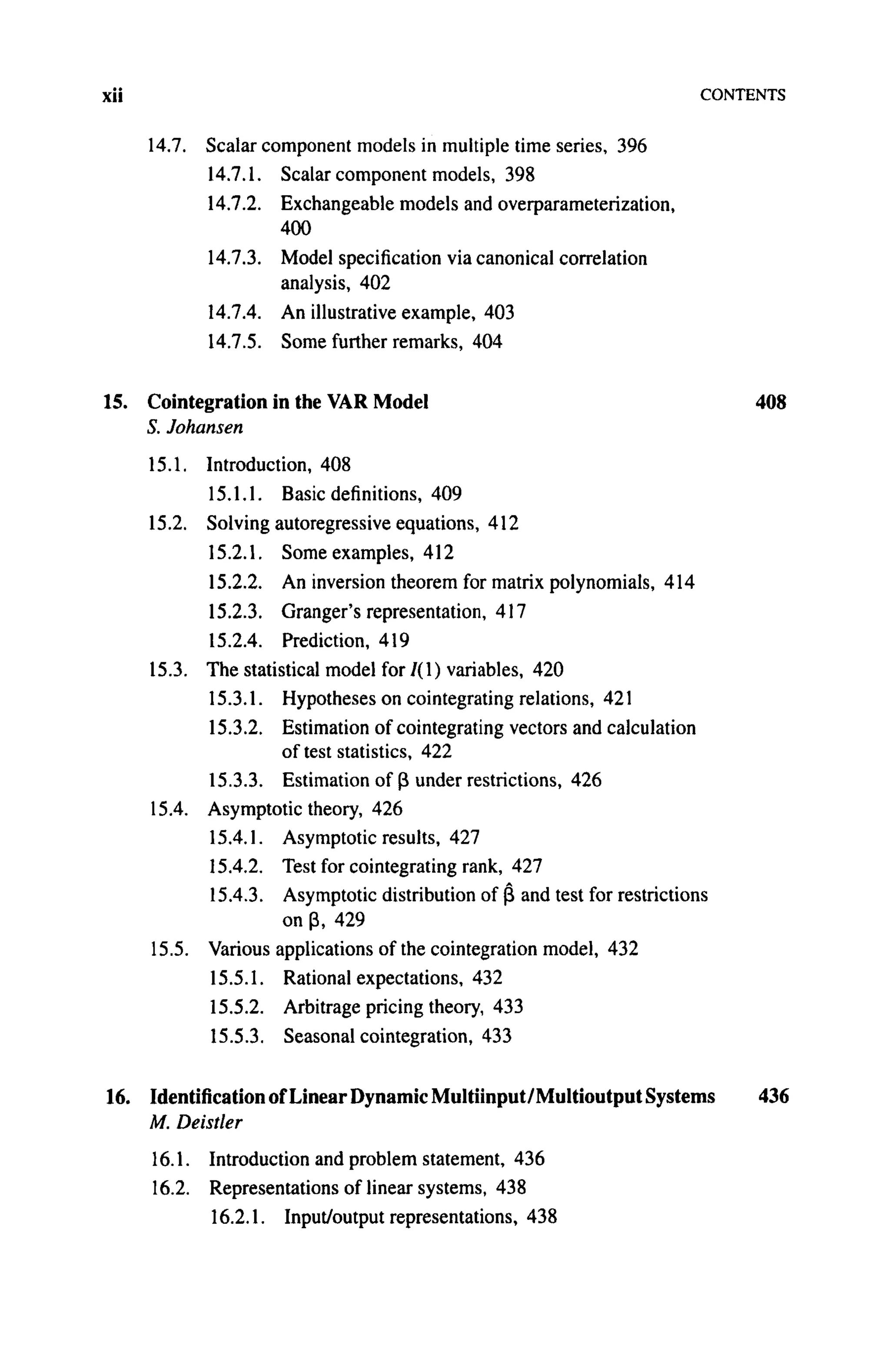
16.
χ CONTENTS
9.3. Theexponential GARCH model, 260
9.3.1. An illustrative example, 261
9.4. The CHARMA model, 262
9.5. Random coefficient autoregressive (RCA) model, 263
9.6. Stochastic volatility model, 264
9.7. Long-memory stochastic volatility model, 265
10. Nonlinear Time Series Models: Testing and Applications 267
R. S. Tsay
10.1. Introduction, 267
10.2. Nonlinearity tests, 268
10.2.1. The test, 268
10.2.2. Comparison and application, 270
10.3. The Tar model, 274
10.3.1. U.S. real GNP, 275
10.3.2. Postsample forecasts and discussion, 279
10.4. Concluding remarks, 282
11. Bayesian Time Series Analysis 286
R. S. Tsay
11.1. Introduction, 286
11.2. A general univariate time series model, 288
11.3. Estimation, 289
11.3.1. Gibbs sampling, 291
11.3.2. Griddy Gibbs, 292
11.3.3. An illustrative example, 292
11.4. Model discrimination, 294
11.4.1. A mixed model with switching, 295
11.4.2. Implementation, 296
11.5. Examples, 297
12 Nonparametric Time Series Analysis: Nonparametric
Regression, Locally Weighted Regression, Autoregression,
and Quantile Regression 308
S. Heiler
12.1 Introduction, 308
12.2 Nonparametric regression, 309
12.3 Kernel estimation in time series, 314
12.4 Problems of simple kernel estimation and restricted
approaches, 319
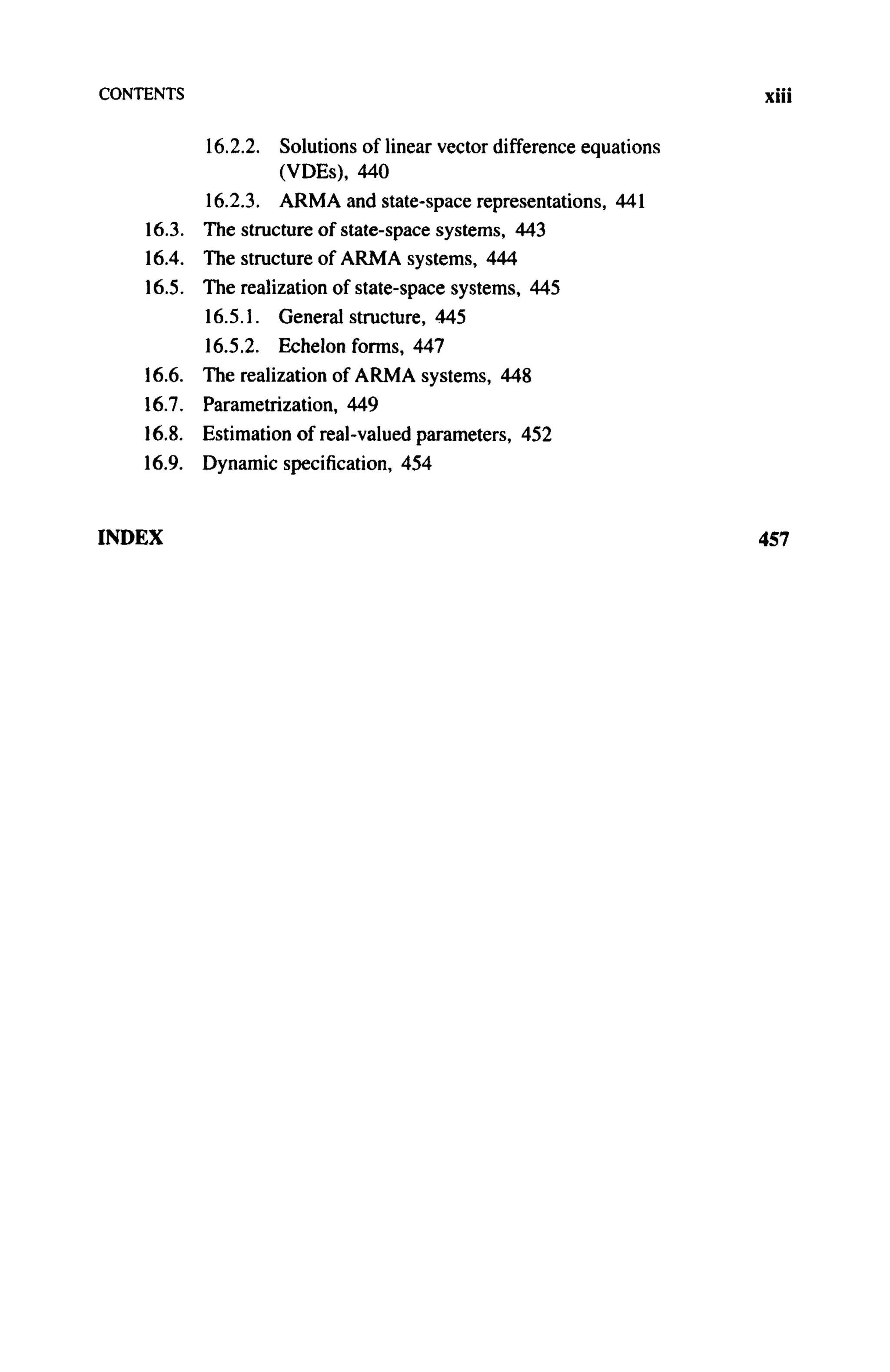
17.
CONTENTS xi
12.5 Locallyweighted regression, 321
12.6 Applications of locally weighted regression to time series,
329
12.7 Parameter selection, 330
12.8 Time series decomposition with locally weighted regression,
336
13. Neural Network Models 348
K. Hornik and F. Leisch
13.1. Introduction, 348
13.2. The multilayer perceptron, 349
13.3. Autoregressive neural network models, 354
13.3.1. Example: Sunspot series, 355
13.4. The recurrent perceptron, 356
13.4.1. Examples of recurrent neural network models, 357
13.4.2. A unifying view, 359
PART III MULTIVARIATE TIME SERIES
14. Vector A R M A Models 365
G. C. Tiao
14.1. Introduction, 365
14.2. Transfer function or unidirectional models, 366
14.3. The vector A R M A model, 368
14.3.1. Some simple examples, 368
14.3.2. Relationship to transfer function model, 371
14.3.3. Cross-covariance and correlation matrices, 371
14.3.4. The partial autoregression matrices, 372
14.4. Model building strategy for multiple time series, 373
14.4.1. Tentative specification, 373
14.4.2. Estimation, 378
14.4.3. Diagnostic checking, 379
14.5. Analyses of three examples, 380
14.5.1. The SCC data, 380
14.5.2. The gas furnace data, 383
14.5.3. The census housing data, 387
14.6. Structural analysis of multivariate time series, 392
14.6.1. A canonical analysis of multiple time series, 395
18.
xii CONTENTS
14.7. Scalarcomponent models in multiple time series, 396
14.7.1. Scalar component models, 398
14.7.2. Exchangeable models and overparameterization,
400
14.7.3. Model specification via canonical correlation
analysis, 402
14.7.4. An illustrative example, 403
14.7.5. Some further remarks, 404
15. Cointegration in the VAR Model 408
5. Johansen
15.1. Introduction, 408
15.1.1. Basic definitions, 409
15.2. Solving autoregressive equations, 412
15.2.1. Some examples, 412
15.2.2. An inversion theorem for matrix polynomials, 414
15.2.3. Granger's representation, 417
15.2.4. Prediction, 419
15.3. The statistical model for / ( l ) variables, 420
15.3.1. Hypotheses on cointegrating relations, 421
15.3.2. Estimation of cointegrating vectors and calculation
of test statistics, 422
15.3.3. Estimation of β under restrictions, 426
15.4. Asymptotic theory, 426
15.4.1. Asymptotic results, 427
15.4.2. Test for cointegrating rank, 427
15.4.3. Asymptotic distribution of β and test for restrictions
on β, 429
15.5. Various applications of the cointegration model, 432
15.5.1. Rational expectations, 432
15.5.2. Arbitrage pricing theory, 433
15.5.3. Seasonal cointegration, 433
16. Identification of Linear Dynamic Multiinput/Multioutput Systems 436
M. Deistler
16.1. Introduction and problem statement, 436
16.2. Representations of linear systems, 438
16.2.1. Input/output representations, 438
19.
CONTENTS xiii
16.2.2. Solutionsof linear vector difference equations
(VDEs), 440
16.2.3. A R M A and state-space representations, 441
16.3. The structure of state-space systems, 443
16.4. The structure of A R M A systems, 444
16.5. The realization of state-space systems, 445
16.5.1. General structure, 445
16.5.2. Echelon forms, 447
16.6. The realization of A R M A systems, 448
16.7. Parametrization, 449
16.8. Estimation of real-valued parameters, 452
16.9. Dynamic specification, 454
INDEX 457
20.
Preface
This book isbased on the lectures of the ECAS' 97 Course in Time Series Analysis
held at El Escorial, Madrid, Spain, from September 15 to September 19, 1997. The
course was sponsored by the European Courses in Advanced Statistics (ECAS). In
accordance with the objectives of ECAS, the lectures are directed to both researchers
and teachers of statistics in academic institutions and statistical professionals in in-
dustry and govermment, with the goal of presenting an overview of the current status
of the area. In particular, different approaches to time series analysis are discussed and
compared. In editing the book, we have worked hard to uphold ECAS' objectives. In
addition, special efforts have been made to unify the notation and to include as many
topics as possible, so that readers of the book can have an overview of the current
status of time series research and applications.
The book consists of three main components. The first component concern basic
materials of univariate time series analysis presented in the first eight chapters. It
includes recent developments in outlier detection, automatic model selection, and
seasonal adjustment. The second component addresses advanced topics in univariate
time series analysis such as conditional heteroscedastic models, nonlinear models,
Bayesian analysis, nonparametric methods, and neural networks. This component
represents current research activities in univariate time series analysis. The third and
final component of the book concerns with multivariate time series, including vector
A R M A models, cointegration, and linear systems.
The book can be used as a principal text or a complementary text for courses
in time series. A basic time series course can be taught from the first part of the
book that presents the basic material that can be found in the standard texts in time
series. This part also includes topics not normally covered in these texts, such as
the extended and inverse autocorrelation function, the decomposition of the forecast
function of ARIMA models, a detailed analysis of outliers and influential observations
and automatic methods for model building and model based seasonal adjustment. For
a basic course this book should be complemented with some of the excellent texts
available. The book would be very well suited for an advanced course in which
some of the basic material can be quickly reviewed using the first part, that skips
many details and concentrates in the main concepts of general applicability. Then the
xv
21.
xvi PREFACE
course canconcentrate in the topics in Parts 2 and 3. If the scope of the course is more
in methodological extensions of univariate linear models the material in Part 2 can
be useful, whereas if the objective is to introduce multivariate modeling Part 3 will
be appropriate. To facilitate the use of the book as a text, all the time series data used
in this book can be down loaded from the web address: http://gsbwww.
uchicago. edu/fac/ruey. tsay/teaching/ecas/
We are grateful to all people who have made this book possible: (1) to the 11 authors
of the chapters of the book who have been extremely helpful in the timely revisions
of the drafts of the chapters and have made a big effort to unify the presentation and
(2) to the organizers of the course and all the students from many different countries
in four continents that made this one week of lectures a very enjoyable experience for
all the participants. We are very grateful to our host in the Monastery of El Escorial,
father Agustin Alonso, who did his best to make our staying in the monastery an
unforgettable experience. The success of the course was in large part due to the
enthusiastic work in all the organization details of Ana Justel, Regina Kaiser, Juan
Romo, Esther Ruiz, and Maria Jesus Sanchez. In the preparation of the book we are
also grateful to Monica Benito for her help in organizing the index and the references
in the book.
The Editors
ABOUT ECAS
ECAS is a foundation of Statistical Societies within Europe that, according to its
constitution, was founded in order to foster links and to promote cooperation between
statisticians in Europe. In order to achieve these aims, courses on an advanced level
covering varying aspects of statistics are organized every 2 years in different countries
of Europe. In 1999 Statistical Societies members of ECAS belongs to the following
countries: Austria, Belgium, Denmark, France, Finland, Germany, Italy, Portugal,
Spain, Sweden, Switzerland, The Netherlands, and the United Kingdom.
The first ECAS course was held in Capri, Italy, on Multidimensional Data Analysis
in 1987. Subsequent courses were held on robustness in statistics in 1989 in the
castle Reisenburg, Germany; on experimental design in 1991 in Sete, France; on the
analysis of categorical data in 1995 in Leiden, The Netherlands; on longitudinal data
analysis and repeated measures in 1995 in Milton Keynes, United Kingdom; on time
series analysis in 1997 in San Lorenzo del Escorial, Spain; and on environmental
statistics in 1999 in Garpenberg, Sweden.
A Council has the overall responsibility for ECAS. Its members are nominated
by the statistical societies of participating countries. The Presidents of ECAS have
been Jean Jacques Debrosque (Belgium, 1987-1993) and Siegfried Heiler (Germany,
1994-1997). The current President is Daniel Pefia (Spain, 1998-2001).
22.
Contributors
Manfred Deistler
Institut fiirOkonometrie, Operations
Research und Systemtheorie
Technische Universitat Wien
Wien, Austria
Victor Gomez
Direccion General de Presupuestos
Ministerio de Hacienda
Madrid, Spain
Siegfried Heiler
Fakultaet fuer Mathematik und
Informatik
Universitat Konstanz
Konstanz, Germany
Kurt Hornik
Institut fiir Statistik
Technische Universitat Wien
Wien, Austria
S0ren Johansen
Economic Department
European University Institute
Florence, Italy
Friedrich Leisch
Institut fiir Statistik
Technische Universitat Wien
Wien, Austria
Agustin Maravall
Servicio de Estudios
Banco de Espana
Madrid, Spain
Daniel Pefia
Departamento de Estadistica y
Econometria
Universidad Carlos III de
Madrid
Madrid, Spain
George C. Tiao
Graduate School of
Business
University of Chicago
Chicago, IL, USA
Ruey S. Tsay
Graduate School of
Business
University of Chicago
Chicago, IL, USA
G. Tunnicliffe Wilson
Department of Mathematics and
Statistics
Lancaster University
Lancaster, UK
xvii
2 INTRODUCTION
• Outlier,level shift, structural change, and intervention
• Comovement and cointegration
These concepts motivate many of the topics discussed in this book.
1.1.1. Stationary series
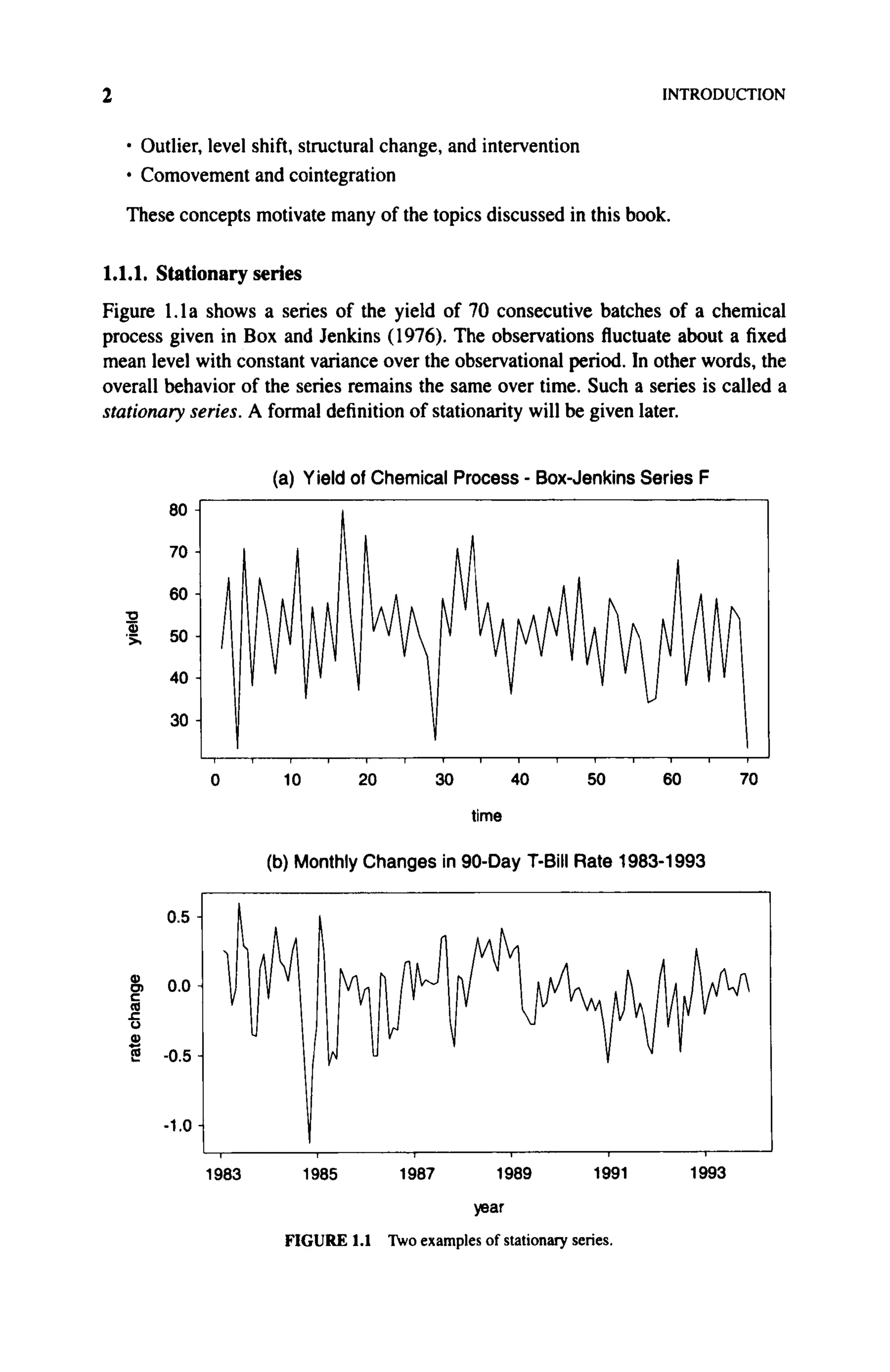
Figure 1.1a shows a series of the yield of 70 consecutive batches of a chemical
process given in Box and Jenkins (1976). The observations fluctuate about a fixed
mean level with constant variance over the observational period. In other words, the
overall behavior of the series remains the same over time. Such a series is called a
stationary series. A formal definition of stationarity will be given later.
(a) Yield of Chemical Process - Box-Jenkins Series F
0)
0 10 20 30 40 50 60 70
time
(b) Monthly Changes in 90-Day T-Bill Rate 1983-1993
1983 1985 1987 1989 1991 1993
year
FIGURE 1.1 Two examples of stationary series.
This ebook isfor the use of anyone anywhere in the United States
and most other parts of the world at no cost and with almost no
restrictions whatsoever. You may copy it, give it away or re-use it
under the terms of the Project Gutenberg License included with this
ebook or online at www.gutenberg.org. If you are not located in the
United States, you will have to check the laws of the country where
you are located before using this eBook.
Title: Australian fairy tales
Author: Atha Westbury
Illustrator: A. J. Johnson
Release date: June 4, 2022 [eBook #68225]
Language: English
Original publication: United Kingdom: Ward, Lock, & Co., Limited,
1897
Credits: Jeroen Hellingman and the Online Distributed Proofreading
Team at https://www.pgdp.net/ for Project Gutenberg (This
file was produced from images generously made available
by The Internet Archive/American Libraries.)
*** START OF THE PROJECT GUTENBERG EBOOK AUSTRALIAN
FAIRY TALES ***
AUSTRALIAN FAIRY TALES.
BY
ATHAWESTBURY.
ILLUSTRATED BY A. J. JOHNSON.
LONDON:
WARD, LOCK, & CO., LIMITED,
WARWICK HOUSE, SALISBURY
SQUARE, E.C.
36.
NEW YORK ANDMELBOURNE.
1897
All rights reserved.
[5]
[Contents]
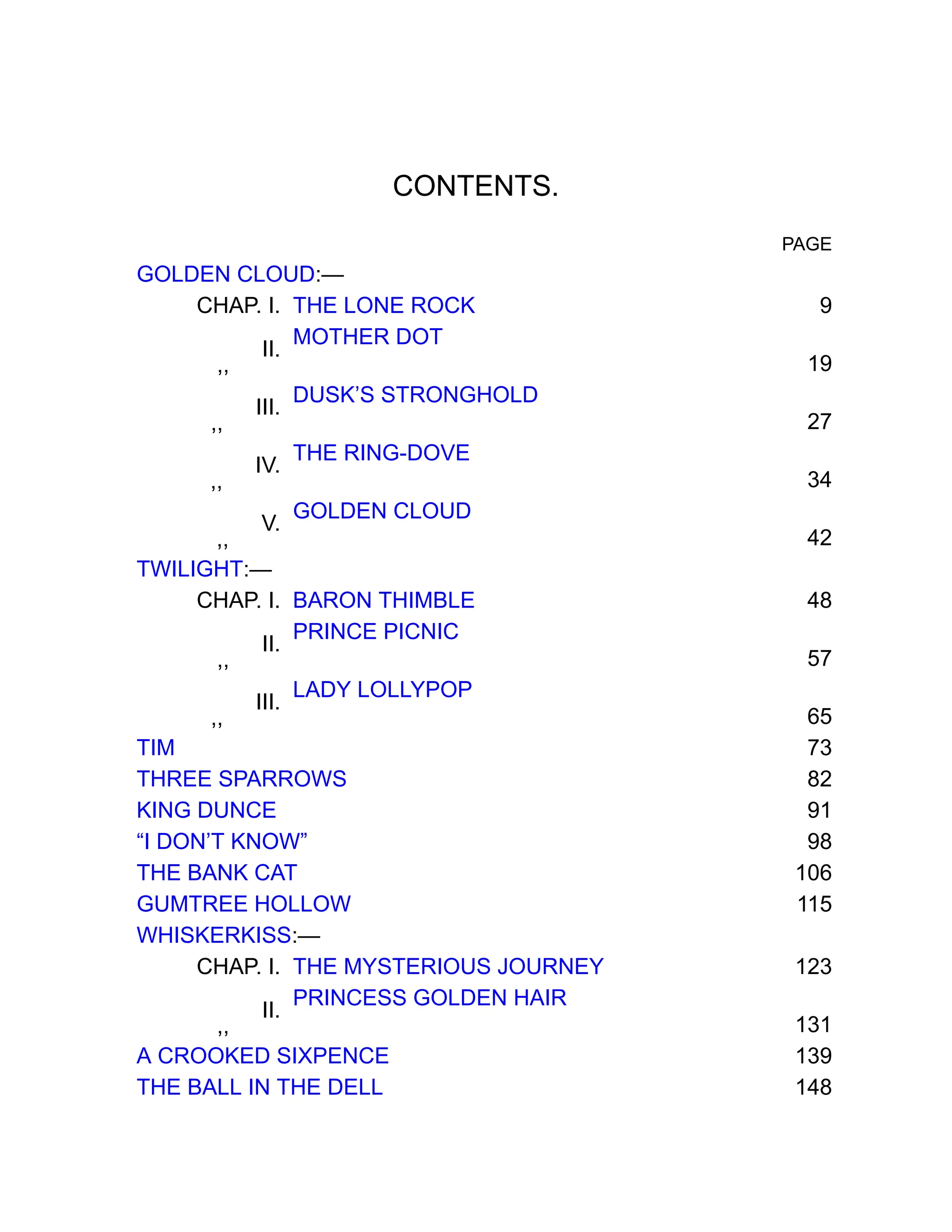
37.
CONTENTS.
PAGE
GOLDEN CLOUD:—
CHAP. I.THE LONE ROCK 9
,,
II.
MOTHER DOT
19
,,
III.
DUSK’S STRONGHOLD
27
,,
IV.
THE RING-DOVE
34
,,
V.
GOLDEN CLOUD
42
TWILIGHT:—
CHAP. I. BARON THIMBLE 48
,,
II.
PRINCE PICNIC
57
,,
III.
LADY LOLLYPOP
65
TIM 73
THREE SPARROWS 82
KING DUNCE 91
“I DON’T KNOW” 98
THE BANK CAT 106
GUMTREE HOLLOW 115
WHISKERKISS:—
CHAP. I. THE MYSTERIOUS JOURNEY 123
,,
II.
PRINCESS GOLDEN HAIR
131
A CROOKED SIXPENCE 139
THE BALL IN THE DELL 148
38.
ELSIE [6] 155
THEWISHING-CAP 162
TWO GIANTS 176
MOTHLAND 184
MOONLAND 197
“SAILOR” 221
NELLIE 228
IN THE CLOUDS 243
WONDERLAND 251
BABY’S VISITORS 259
RUBYWINGS:—
CHAP. I. THE JOURNEY 264
,,
II.
SHADOWS
271
LIFE AND DEATH 277
GIANTS 283
THE KANGAROO HUNTER:—
CHAP. I. THE LOST DRESS 291
,,
II.
QUIZ
298
,,
III.
A SLEEPING BEAUTY
304
THE LAUGHING JACKASS:—
CHAP. I. LOST IN THE BUSH 312
,,
II.
EMU ROYAL
319
HOP-O’-MY-THUMB 325
A MAGIC WHISTLE 334
“COCKY”:—
CHAP. I. THE MAGIC HUT 342
,,
II.
BROWN EYES
350
LIST OF FULL-PAGEAND OTHER ILLUSTRATIONS.
“THE GLOBE SLOWLY SPLIT IN TWAIN” Frontispiece
PAGE
“OUR HERO WENT SPRAWLING HEADLONG OVER
HIM” 20
“AT THE SIGHT OF HER THE ASS BEGAN TO BRAY
LOUDLY” 37
“‘SHAVE, OR HAIR CUT, SIR?’ ASKED THE BARBER” 51
“A TALL, HANDSOME YOUNG MAN, ROBED IN A
SUPERB HUNTING COSTUME” 71
“GET UP, TOBY THE GROWLER, AND FOLLOW ME” 83
“SPEEDING AWAY ACROSS THE COUNTRY AS
SWIFT AS THE WIND” 93
“A JACK-IN-THE-BOX … CAME AND REVILED HIM” 102
“‘HURRAH!’ HE CRIED, TOSSING UP HIS HAT” 119
“SEATED BENEATH A CANOPY OF ROSES” 134
“‘PRAY TAKE OUT THOSE HORRID LONG SPIKES’” 157
“THE FAIRIES FLED IN GREAT HASTE” 165
“BOTH HE AND THE DOG WERE ENVELOPED IN A
DEEP MIST” [8] 180
“HE WAS BORNE ALONG SO SWIFTLY THAT HE
NEARLY LOST HIS SENSES” 199
“HE WAS NOT CERTAIN WHETHER THE MONSTER
WAS LEAPING OR FLYING” 209
“‘WHY, SURELY, YOU’RE NOT THE MAN IN THE
MOON?’” 219
“THE LOVELY BEING TOOK NELLIE BY THE HAND” 233
“IT WAS A GRAND BALLOON” 245
“THE MONSTER … ADVANCED WITH A LARGE
STONE” 255
41.
“THE OLD MANBENT LOW BEFORE THE ICE
MONARCH”
266
“‘I AM QUEEN OF THE BUTTERFLIES,’ SHE REPLIED” 268
“‘WHAT KIND OF BIRD ARE YOU?’” 295
“‘YOU CAN’T BE OUR JACK?’” 315
“‘THOU ART VERY STRONG FOR SO SMALL A MAN’” 329
“ITS EYES WERE DREADFUL TOP BEHOLD, AS IT
CAME SLOWLY OUT OF THE WATER.” 352
[9]
A
A CHRISTMAS STORYFOR YOUNG PEOPLE.
[Contents]
CHAPTER I.
THE LONE ROCK.
ustralia! Hast thou no enchanted castles within thy vast domain? Is
there not one gallant youth, ready armed to do battle for the fair ones,
sleeping ’neath the spell of wicked genii?
Come, youngsters, draw up your chairs. Come, mothers, ye who live your
romantic girlhood o’er again in that of your children. Form up, gentlemen,
fathers, hard men of the world, whose brows are wrinkled with care and
worry, take rank in rear of your fair helpmates. Merchant, lock thy safe, close
thy ledgers; horny-handed sons of toil, [10]throw aside your implements of
trade; gather near. I am going to draw aside the magic curtain which hides
the great continent, marked on our map unknown. Turn down the lights—our
magic lantern is quite ready. Hey presto! Look!
Why, what is this? The heart of a deep mine! A gold mine, with all its dim and
rugged corridors, its tunnels and windings, lighted only by a dull taper here
and there. There is no one at work, for it is Christmas Eve. Yet the
underground region is not altogether untenanted. One man whose duty it is to
watch the place, until relieved on the morrow, lies coiled up asleep in one of
the long drives. He is a young man, not tall, but strongly made, and with limbs
like another Hercules. On account of his great strength and a certain good
temper combined, his mates call him, Samson the Nugget.
For what length of time the Nugget slumbered on this good Christmas Eve
will never be known. Certain it is that he suddenly opened his eyes and
beheld one of the biggest, and withal one of the ugliest, hulking fellows he
had ever seen standing over him. The Nugget was a brave youth, but fear
began to take possession of him as he looked at the intruder—a giant in
46.
stature, with ahuge, flat head upon his shoulder, and a mouth as large,
[11]and about the shape of the newspaper receiver at the General Post Office.
He carried a lamp in his hand, but there was a queer sheen from his eyes,
which illumined the cavern with a fiery glow. His dress was a brown russet,
his hat, sugar-loaf in shape, and he carried a sapling for a cudgel.
“Get up, Samson the Nugget, and follow me,” said he in a brief, gruff tone.
“Who are you?” cried our hero, rising to his feet, and seizing a heavy iron drill.
“I am the strongest man in Golden Cloud, and my name is Grapple,” rejoined
the other grimly. “Will you come?”
“Where?” said the Nugget. “There is no way out of this mine except by the
cage up the shaft.”
“That’s all you know about it,” returned Grapple, with a grim laugh. “If I find a
way, have you courage to follow?”
The Nugget felt inclined to refuse point blank, but curiosity being strong within
him, he bowed an assent.
Grapple, without a word, turned on his heel and led the way further down the
dark recesses of the tunnel. Our hero followed. Of one thing the miner felt
certain—that the end of the drive would [12]effectually bar the progress of his
unwelcome visitor. Strange to relate, such was not the case.
The narrow passage appeared to extend and widen out before their advance,
until it took the shape of a long railway tunnel, from which the pair emerged at
length into the bright beams of day. The transit from what seemed to be the
bowels of a high mountain range to a landscape fairer and more beautiful
than our hero had ever seen, filled his mind with wonder. His companion, now
that daylight was upon him, did not seem such an ugly customer after all. He
was certainly a huge, grotesque-looking personage, but there wasn’t a bit of
malice in anything he said or did.
Our hero’s amazement was so great, that it was some considerable time
before he found words wherewith to address his companion.
47.
Welcome to ourwebsite – the ideal destination for book lovers and
knowledge seekers. With a mission to inspire endlessly, we offer a
vast collection of books, ranging from classic literary works to
specialized publications, self-development books, and children's
literature. Each book is a new journey of discovery, expanding
knowledge and enriching the soul of the reade
Our website is not just a platform for buying books, but a bridge
connecting readers to the timeless values of culture and wisdom. With
an elegant, user-friendly interface and an intelligent search system,
we are committed to providing a quick and convenient shopping
experience. Additionally, our special promotions and home delivery
services ensure that you save time and fully enjoy the joy of reading.
Let us accompany you on the journey of exploring knowledge and
personal growth!
ebookfinal.com









![This ebook is for the use of anyone anywhere in the United States
and most other parts of the world at no cost and with almost no
restrictions whatsoever. You may copy it, give it away or re-use it
under the terms of the Project Gutenberg License included with this
ebook or online at www.gutenberg.org. If you are not located in the
United States, you will have to check the laws of the country where
you are located before using this eBook.
Title: Australian fairy tales
Author: Atha Westbury
Illustrator: A. J. Johnson
Release date: June 4, 2022 [eBook #68225]
Language: English
Original publication: United Kingdom: Ward, Lock, & Co., Limited,
1897
Credits: Jeroen Hellingman and the Online Distributed Proofreading
Team at https://www.pgdp.net/ for Project Gutenberg (This
file was produced from images generously made available
by The Internet Archive/American Libraries.)
*** START OF THE PROJECT GUTENBERG EBOOK AUSTRALIAN
FAIRY TALES ***](https://image.slidesharecdn.com/26088-250317155355-eb3ade90/75/A-Course-in-Time-Series-Analysis-1st-Edition-Pena-D-30-2048.jpg)
![[Contents]
[Contents]
AUSTRALIAN FAIRY TALES.
[Contents]](https://image.slidesharecdn.com/26088-250317155355-eb3ade90/75/A-Course-in-Time-Series-Analysis-1st-Edition-Pena-D-31-2048.jpg)
![Australian Fairy Tales.] [Frontispiece](https://image.slidesharecdn.com/26088-250317155355-eb3ade90/75/A-Course-in-Time-Series-Analysis-1st-Edition-Pena-D-32-2048.jpg)
![“The globe slowly split in twain.” (Page 32.)
[Contents]](https://image.slidesharecdn.com/26088-250317155355-eb3ade90/75/A-Course-in-Time-Series-Analysis-1st-Edition-Pena-D-33-2048.jpg)
![NEW YORK AND MELBOURNE.
1897
All rights reserved.
[5]
[Contents]](https://image.slidesharecdn.com/26088-250317155355-eb3ade90/75/A-Course-in-Time-Series-Analysis-1st-Edition-Pena-D-36-2048.jpg)
![ELSIE [6] 155
THE WISHING-CAP 162
TWO GIANTS 176
MOTHLAND 184
MOONLAND 197
“SAILOR” 221
NELLIE 228
IN THE CLOUDS 243
WONDERLAND 251
BABY’S VISITORS 259
RUBYWINGS:—
CHAP. I. THE JOURNEY 264
,,
II.
SHADOWS
271
LIFE AND DEATH 277
GIANTS 283
THE KANGAROO HUNTER:—
CHAP. I. THE LOST DRESS 291
,,
II.
QUIZ
298
,,
III.
A SLEEPING BEAUTY
304
THE LAUGHING JACKASS:—
CHAP. I. LOST IN THE BUSH 312
,,
II.
EMU ROYAL
319
HOP-O’-MY-THUMB 325
A MAGIC WHISTLE 334
“COCKY”:—
CHAP. I. THE MAGIC HUT 342
,,
II.
BROWN EYES
350](https://image.slidesharecdn.com/26088-250317155355-eb3ade90/75/A-Course-in-Time-Series-Analysis-1st-Edition-Pena-D-38-2048.jpg)
![[7]
[Contents]](https://image.slidesharecdn.com/26088-250317155355-eb3ade90/75/A-Course-in-Time-Series-Analysis-1st-Edition-Pena-D-39-2048.jpg)
![LIST OF FULL-PAGE AND OTHER ILLUSTRATIONS.
“THE GLOBE SLOWLY SPLIT IN TWAIN” Frontispiece
PAGE
“OUR HERO WENT SPRAWLING HEADLONG OVER
HIM” 20
“AT THE SIGHT OF HER THE ASS BEGAN TO BRAY
LOUDLY” 37
“‘SHAVE, OR HAIR CUT, SIR?’ ASKED THE BARBER” 51
“A TALL, HANDSOME YOUNG MAN, ROBED IN A
SUPERB HUNTING COSTUME” 71
“GET UP, TOBY THE GROWLER, AND FOLLOW ME” 83
“SPEEDING AWAY ACROSS THE COUNTRY AS
SWIFT AS THE WIND” 93
“A JACK-IN-THE-BOX … CAME AND REVILED HIM” 102
“‘HURRAH!’ HE CRIED, TOSSING UP HIS HAT” 119
“SEATED BENEATH A CANOPY OF ROSES” 134
“‘PRAY TAKE OUT THOSE HORRID LONG SPIKES’” 157
“THE FAIRIES FLED IN GREAT HASTE” 165
“BOTH HE AND THE DOG WERE ENVELOPED IN A
DEEP MIST” [8] 180
“HE WAS BORNE ALONG SO SWIFTLY THAT HE
NEARLY LOST HIS SENSES” 199
“HE WAS NOT CERTAIN WHETHER THE MONSTER
WAS LEAPING OR FLYING” 209
“‘WHY, SURELY, YOU’RE NOT THE MAN IN THE
MOON?’” 219
“THE LOVELY BEING TOOK NELLIE BY THE HAND” 233
“IT WAS A GRAND BALLOON” 245
“THE MONSTER … ADVANCED WITH A LARGE
STONE” 255](https://image.slidesharecdn.com/26088-250317155355-eb3ade90/75/A-Course-in-Time-Series-Analysis-1st-Edition-Pena-D-40-2048.jpg)
![“THE OLD MAN BENT LOW BEFORE THE ICE
MONARCH”
266
“‘I AM QUEEN OF THE BUTTERFLIES,’ SHE REPLIED” 268
“‘WHAT KIND OF BIRD ARE YOU?’” 295
“‘YOU CAN’T BE OUR JACK?’” 315
“‘THOU ART VERY STRONG FOR SO SMALL A MAN’” 329
“ITS EYES WERE DREADFUL TOP BEHOLD, AS IT
CAME SLOWLY OUT OF THE WATER.” 352
[9]](https://image.slidesharecdn.com/26088-250317155355-eb3ade90/75/A-Course-in-Time-Series-Analysis-1st-Edition-Pena-D-41-2048.jpg)
![[Contents]](https://image.slidesharecdn.com/26088-250317155355-eb3ade90/75/A-Course-in-Time-Series-Analysis-1st-Edition-Pena-D-42-2048.jpg)


![A
A CHRISTMAS STORY FOR YOUNG PEOPLE.
[Contents]
CHAPTER I.
THE LONE ROCK.
ustralia! Hast thou no enchanted castles within thy vast domain? Is
there not one gallant youth, ready armed to do battle for the fair ones,
sleeping ’neath the spell of wicked genii?
Come, youngsters, draw up your chairs. Come, mothers, ye who live your
romantic girlhood o’er again in that of your children. Form up, gentlemen,
fathers, hard men of the world, whose brows are wrinkled with care and
worry, take rank in rear of your fair helpmates. Merchant, lock thy safe, close
thy ledgers; horny-handed sons of toil, [10]throw aside your implements of
trade; gather near. I am going to draw aside the magic curtain which hides
the great continent, marked on our map unknown. Turn down the lights—our
magic lantern is quite ready. Hey presto! Look!
Why, what is this? The heart of a deep mine! A gold mine, with all its dim and
rugged corridors, its tunnels and windings, lighted only by a dull taper here
and there. There is no one at work, for it is Christmas Eve. Yet the
underground region is not altogether untenanted. One man whose duty it is to
watch the place, until relieved on the morrow, lies coiled up asleep in one of
the long drives. He is a young man, not tall, but strongly made, and with limbs
like another Hercules. On account of his great strength and a certain good
temper combined, his mates call him, Samson the Nugget.
For what length of time the Nugget slumbered on this good Christmas Eve
will never be known. Certain it is that he suddenly opened his eyes and
beheld one of the biggest, and withal one of the ugliest, hulking fellows he
had ever seen standing over him. The Nugget was a brave youth, but fear
began to take possession of him as he looked at the intruder—a giant in](https://image.slidesharecdn.com/26088-250317155355-eb3ade90/75/A-Course-in-Time-Series-Analysis-1st-Edition-Pena-D-45-2048.jpg)
![stature, with a huge, flat head upon his shoulder, and a mouth as large,
[11]and about the shape of the newspaper receiver at the General Post Office.
He carried a lamp in his hand, but there was a queer sheen from his eyes,
which illumined the cavern with a fiery glow. His dress was a brown russet,
his hat, sugar-loaf in shape, and he carried a sapling for a cudgel.
“Get up, Samson the Nugget, and follow me,” said he in a brief, gruff tone.
“Who are you?” cried our hero, rising to his feet, and seizing a heavy iron drill.
“I am the strongest man in Golden Cloud, and my name is Grapple,” rejoined
the other grimly. “Will you come?”
“Where?” said the Nugget. “There is no way out of this mine except by the
cage up the shaft.”
“That’s all you know about it,” returned Grapple, with a grim laugh. “If I find a
way, have you courage to follow?”
The Nugget felt inclined to refuse point blank, but curiosity being strong within
him, he bowed an assent.
Grapple, without a word, turned on his heel and led the way further down the
dark recesses of the tunnel. Our hero followed. Of one thing the miner felt
certain—that the end of the drive would [12]effectually bar the progress of his
unwelcome visitor. Strange to relate, such was not the case.
The narrow passage appeared to extend and widen out before their advance,
until it took the shape of a long railway tunnel, from which the pair emerged at
length into the bright beams of day. The transit from what seemed to be the
bowels of a high mountain range to a landscape fairer and more beautiful
than our hero had ever seen, filled his mind with wonder. His companion, now
that daylight was upon him, did not seem such an ugly customer after all. He
was certainly a huge, grotesque-looking personage, but there wasn’t a bit of
malice in anything he said or did.
Our hero’s amazement was so great, that it was some considerable time
before he found words wherewith to address his companion.](https://image.slidesharecdn.com/26088-250317155355-eb3ade90/75/A-Course-in-Time-Series-Analysis-1st-Edition-Pena-D-46-2048.jpg)